Cursor Secures $2.3B Series D at $29.3B Valuation as AI Coding Tools Market Heats Up


11 Sources
11 Sources
[1]
Coding assistant Cursor raises $2.3B 5 months after its previous round
Developer AI coding tool Cursor continues to gobble up venture capital as its valuation keeps climbing. On Thursday, Cursor announced a $2.3 billion funding round that valued the company at $29.3 billion, as originally reported by the Wall Street Journal. This round more than doubles the company's previous valuation of $9.9 billion, which it achieved in its $900 million Series C round in June. This most recent fundraise was led by co-led by Accel, an existing investor, and Coatue, which is new to the cap table. Strategic investors, including Nvidia (an enterprise customer) and Google (an AI model supplier), also joined the round. Joshua Kushner's Thrive Capital led the company's prior two rounds and participated in this round as well. Cursor's co-founder and CEO Michael Truell told the Wall Street Journal that the capital from the round will be put toward developing Composer, an AI model released by Cursor in October. Cursor still relies on outside AI models from companies, including Google, OpenAI, and Anthropic to power its platform, but the plan is for Composer to carry some of that load in the future. Next year could be a very interesting one for Cursor. While the company is still seeing strong growth, OpenAI and Anthropic are both sharpening their AI coding products as the market for AI development tools continues to get more competitive.
[2]
Coding assistant Cursor raises $2.3bn five months after its previous round | TechCrunch
Developer AI coding tool Cursor continues to gobble up venture capital as its valuation keeps climbing. On Thursday, Cursor announced a $2.3 billion funding round that valued the company at $29.3 billion, as originally reported by the Wall Street Journal. This round more than doubles the company's previous valuation of $9.9 billion, which it achieved in its $900 million Series C round in June. This most recent fundraise was led by co-led by Accel, an existing investor, and Coatue, which is new to the cap table. Strategic investors including Nvidia (an enterprise customer) and Google (an AI model supplier) also joined the round. Joshua Kushner's Thrive Capital led the company's prior two rounds and participated in this round as well. Cursor's co-founder and CEO Michael Truell told the Wall Street Journal that the capital from the round will be put toward developing Composer, an AI model released by Cursor in October. Cursor still relies on outside AI models from companies including Google, OpenAI and Anthropic to power its platform, but the plan is for Composer to carry some of that load in the future. Next year could be a very interesting one for Cursor. While the company is still seeing strong growth, OpenAI and Anthropic are both sharpening their AI coding products as the market for AI development tools continues to get more competitive.
[3]
AI startup Cursor raises $2.3 billion funding round at $29.3 billion valuation
Cursor built a popular AI coding tool that helps software developers generate, edit and review code. Its parent company, Anysphere, is an applied research lab that was founded in 2022. Cursor is one of just a handful of AI startups, including OpenAI, Anthropic, xAI, Safe Superintelligence and Thinking Machines, that are valued at over $10 billion. Investors including Accel, Thrive Capital, Andreessen Horowitz, DST Global, Coatue, Nvidia and Google participated in its latest funding round, according to a blog post. "This funding will allow us to invest deeply in our research and build Cursor's next magical moments," Cursor said.
[4]
Cursor's $2.3B Financing Reminds Us: Coding Automation Is Still Ultra-Hot
Coding automation platform Cursor announced today that it has raised $2.3 billion in Series D funding at a $29.3 billion post-money valuation. That valuation is more than 3x higher than what Cursor parent company Anysphere secured just six months ago, an indication that investors 1 see both lightning growth and enormous potential for more to come. Cursor has certainly signed on to that vision as well. The San Francisco-headquartered company, founded in 2022, now has a team of more than 300 and touts ambitious plans to extend its footprint. The company also said it now has over $1 billion in annualized revenue. Other investor favorites But Cursor is far from the only startup attracting considerable attention and big checks from venture investors lately. Using Crunchbase data, we put together a sample of a dozen companies working on AI-enabled coding and software development tools that raised sizable rounds in the past several quarters. AI coding startup Cognition is another investor favorite. The San Francisco company, known for its AI software development platform Devin, secured $400 million in a September round led by Founders Fund at a $10.2 billion valuation. Replit, an agentic platform for app development, also scored big, landing a $250 million Series C this summer. And Lovable, a Swedish startup offering AI-enabled app and website development, pulled in $200 million in a July financing. Exits too Coding automation is also an area where acquirers are active. This includes Cursor. OpenAI reportedly made overtures to acquire the company last year, but a deal did not come to fruition. Cursor parent Anysphere has also been an active buyer, acquiring fellow startups Koala and Supermaven in roughly the past year. Cognition is also an M&A player, having announced in July that it was acquiring definitive agreement code automation provider Windsurf. Just prior to that, Google hired away Windsurf's CEO Varun Mohan, co-founder Douglas Chen, and research leaders in a $2.4 billion tie-up. Given that the most heavily funded companies in the AI coding space are mostly relatively youthful startups, we've yet to see activity on the IPO front. But if things keep progressing at the current pace, that might not be far away.
[5]
Nvidia, Google back $2.3B round for AI code editor startup Cursor - SiliconANGLE
Cursor, the developer of a widely used artificial intelligence code editor, has closed a $2.3 billion investment at a $29.3 billion valuation. Accel and Coatue led the Series D round. They were joined by Google LLC, Nvidia Corp., Thrive, Andreessen Horowitz and DST. Cursor disclosed in its funding announcement today that its annualized revenue recently topped $1 billion. The company, which is incorporated as Anyscale Inc., has built a code editor that uses AI to help developers write software. It's a modified version of Microsoft Corp.'s open-source VS Code editor. Cursor has extended it with large language models that can generate code and fix bugs in existing software. One of the LLMs embedded in the editor is a custom model dubbed Composer. According to Cursor, it's a mixture-of-experts algorithm that runs four times faster than LLMs with comparable output quality. It can complete many coding tasks in under 30 seconds. An LLM is comprised of kernels, parallelized snippets of code that can run across a large number of graphics card cores at once. Developers usually write kernels with the help of CUDA libraries that abstract away some of the associated complexity. They contain pre-packaged code that removes the need to write everything from scratch. Cursor says that it didn't use any CUDA libraries while building Composer. The company implemented the model's kernels using PTX, the low-level machine language in which Nvidia chips express computations. That approach helped Cursor achieve a more than threefold performance increase across some Composer's components. The company trained the model using a custom AI cluster. The cluster is powered partly by Ray, an open-source tool for training and running Python-based AI workloads. The technology was co-developed by Cursor co-founder Philipp Moritz a few years before the company launched. One of the contributors to Composer's speed is that it stores information in a data format called MXFP8. The format takes up less space than many alternatives, which speeds up processing. Cursor customized its MXFP8 implementation for the Blackwell B200 chips it used to power Composer's training workflow. Cursor rolled out Composer to its code editor last month as part of a release called Cursor 2.0. The upgrade also introduced an embedded browser that the editor can use to test the web applications it generates. According to Cursor, users can run multiple AI agents in parallel to speed up code generation. The company disclosed today that its installed base includes several million developers. Cursor says that Composer and its other custom AI model, a code autocompletion algorithm called Cursor Tabs, generate more code than "almost any other" LLM. Its editor also uses models from external providers such as Google, one of the contributors to today's funding round. Cursor will use the new capital to finance AI research initiatives.
[6]

AI Coding Startup Cursor Raises $2.3 Bn, Reaches $29.3 Bn Valuation | AIM
The round includes participation from existing investors Accel, Thrive, Andreessen Horowitz, and DST, while Coatue, NVIDIA, and Google have joined as new backers. AI coding platform, Cursor, has raised $2.3 billion in a Series D funding round, taking the company to a $29.3 billion post-money valuation, the AI-powered code editor startup announced on Thursday. The round includes participation from existing investors Accel, Thrive, Andreessen Horowitz, and DST, while Coatue, NVIDIA, and Google have joined as new backers. The company said the fresh capital will support its ongoing research and product expansion. "This funding will allow us to invest deeply in our research and build Cursor's next magical moments," the company said. Cursor, which set out two years ago to build an AI-native development environment, said its long-term goal has been to create "a code editor that is more helpful, delightful, and fun than the world has ever seen," and an environment where "it's impossible to write bugs." The startup has scaled to over 300 engineers, researchers, designers, and operators, with plans to grow further. Cursor also reported crossing $1 billion in annualised revenue, claiming "millions of developers and many of the world's most accomplished engineering organisations" as customers. According to the company, its in-house models now generate more code than almost any other LLMs in the world. Cursor said the Series D marks the next phase in its effort to transform how software is written. "We're obsessed with the magical moments in the history of programming with AI," the team said, adding that "the ceiling is high for how great Cursor can become, and much work remains." The announcement comes as new academic research tracks Cursor's impact inside engineering teams. A study by Suproteem Sarkar, assistant professor of finance and applied AI at the University of Chicago, found that companies merged 39% more pull requests after Cursor's agent became the default mode. The study compared early Cursor users with organisations that had not adopted the tool. According to the research, senior developers are more likely to accept agent-written code changes. "For every standard deviation increase in experience, we see a corresponding increase in the rate of agent acceptances," Sarkar found. The study also noted that experienced developers are more likely to plan tasks before generating code. Cursor said the findings reflect how developers are learning to work with AI systems. The company noted that revert rates did not change significantly and bugfix rates slightly decreased, suggesting stable code quality.
[7]

This AI Coding Startup Just Minted 4 New Billionaires
Cursor is the sole product of parent company Anysphere, founded by MIT graduates Michael Truell, Sualeh Asif, Arvid Lunnemark, and Aman Sanger in 2022. Since launching Cursor, Anysphere has grown into a unicorn due to its popularity with professional software developers, who use its AI-assisted features to write and edit large quantities of code. Now, according to the company, Cursor has passed $1 billion in annualized revenue, making it one of the biggest winners of the AI coding explosion. In recent weeks, Cursor has launched a 2.0 redesign of its operating system, and introduced its own proprietary AI model, named Composer. The model has been positively received by software developers due to its high speed, and Cursor says that its "in-house models now generate more code than almost any other LLMs in the world." Cursor also revealed that it has acquired Growth by Design, a tech recruiting company that has worked with several AI companies, including OpenAI. In a joint statement, Cursor and Growth by Design said that two of the recruiting firm's founding partners "and a few other team members" are joining Cursor, but the rest of the team will be "exploring what's next," and linked to a Google Sheet containing the now-unemployed recruiters' contact information.
[8]

A.I. 'Vibe Coding' Startup Cursor Nearly Triples Valuation to $29B After New Funding
The fast-rising A.I. coding startup is redefining how engineers write and ship software across Silicon Valley. Cursor, an A.I. coding tool praised by tech leaders from Nvidia's Jensen Huang to Google's Sundar Pichai, has quickly become indispensable for engineers across Silicon Valley. Investors are taking notice, too: the startup announced today (Nov. 13) that it has raised a new Series D round valuing it at an astonishing $29.3 billion. Sign Up For Our Daily Newsletter Sign Up Thank you for signing up! By clicking submit, you agree to our <a href="http://observermedia.com/terms">terms of service</a> and acknowledge we may use your information to send you emails, product samples, and promotions on this website and other properties. You can opt out anytime. See all of our newsletters The figure represents a nearly threefold jump from Cursor's $9.9 billion valuation after raising $900 million in June, underscoring the meteoric rise of so-called "vibe coding," a term used to describe A.I.-assisted programming. The San Francisco-based startup's latest $2.3 billion round was co-led by Accel and Coatue, with participation from Andreessen Horowitz, Nvidia and Google. Founded in 2023 by MIT graduates Sualeh Asif, Arvid Lunnemark, Aman Sanger and Michael Truell (who serves as CEO), Cursor builds tools that help programmers write and edit code through autocomplete and intelligent assistance. Its clients include companies such as OpenAI, Uber, and even Major League Baseball (MLB). The rise of Cursor has helped popularize "vibe coding," a term coined earlier this year by OpenAI co-founder Andrej Karpathy to describe a state where programmers "fully give in to the vibes, embrace exponentials and forget that the code even exists." According to Karpathy, such a phenomenon is possible because coding models are "getting too good," as he said in a viral post on X. Cursor's capabilities have earned it high-profile endorsements. Nvidia's Jensen Huang called it his "favorite enterprise A.I. service" during an October appearance on CNBC's Squawk Box, revealing that nearly all of Nvidia's 40,000 engineers use Cursor's tools. Pichai has also praised the company, noting that he has personally experimented with vibe coding through its tools. Sebastian Siemiatkowski, CEO of Klarna, said on a recent episode of the Sourcery podcast that he has become so absorbed in using Cursor that he often codes late into the night -- much to his family's annoyance. The company's rapid adoption has fueled equally rapid internal growth. Cursor now employs more than 300 engineers, researchers, designers and operators. The company plans to expand further, according to a blog post today. The startup has surpassed $1 billion in annualized revenue and now generates more code than "almost any other LLMs in the world," it said. Competitors like Anthropic and OpenAI -- which reportedly considered acquiring Cursor earlier this year -- have also released coding tools to capitalize on the vibe coding boom. Cursor is pushing deeper into model development with Composer, its own coding model released in October. Much of the company's new funding will go toward improving Composer, CEO Michael Truell told the Wall Street Journal. "Internally, we often talk about how high the ceiling is for how great Cursor can become, and how much work still remains to get there," the company wrote in today's blog post. "This funding will allow us to invest deeply in our research and build Cursor's next magical moments."
[9]

Cursor raises $2.3 billion at $29.3 billion valuation, up 12x since January - WSJ By Investing.com
Investing.com -- AI coding tool maker Cursor has secured $2.3 billion in funding at a $29.3 billion valuation, representing nearly 12 times the company's value from January, according to a report from the Wall Street Journal. The funding round was co-led by existing investor Accel and new investor Coatue. Other previous backers including Thrive Capital and DST Global also participated in what marks Cursor's third funding round this year. The startup added strategic investors Google and Nvidia to "deepen the partnership," according to Cursor co-founder and CEO Michael Truell. Google provides AI services and cloud computing to Cursor, while Nvidia serves as an enterprise customer. Cursor has reportedly turned down acquisition offers from several major AI companies, according to sources familiar with the situation. This article was generated with the support of AI and reviewed by an editor. For more information see our T&C.
[10]

Code-gen startup Cursor nearly triples its valuation in Coatue-led funding round
(Reuters) -Code-generation startup Cursor nearly tripled its valuation to $29.3 billion in five months after raising $2.3 billion in its latest funding round, as artificial intelligence companies continue to attract investor attention. The Series D funding round was led by new investor Coatue, an investment management firm, and existing investor Accel, Cursor said in a blog post on Thursday. Fresh investors Nvidia and Alphabet's Google also participated in the round. AI firms have dominated private funding markets this year, with global venture funding in the third quarter increasing 38% year-over-year to $97 billion, about half of which went to AI companies, according to data from Crunchbase. "(The round) is a resounding current affirmation of AI prospects...but the commitments for this raise most likely accumulated over the last several weeks or months and are very specific to Cursor's prospects," said Michael Ashley Schulman, chief investment officer at Running Point Capital Advisors. A surge in investor appetite for AI-linked firms also helped drive Wall Street's benchmark indexes to record highs this year. The San Francisco-based company raised $900 million in June at a $9.9 billion valuation, attracting backing from investors, including Thrive Capital, Andreessen Horowitz and Accel. The company has crossed $1 billion in annualized revenue, with sales-led revenue increasing 100-fold since the beginning of 2025, Cursor said in a mailed statement to Reuters. Cursor, which develops tools to autonomously generate and complete code, said the latest funding round will be used to invest in its research efforts. Code-generation startups are attracting sky-high valuations as businesses explore artificial intelligence-based solutions to enhance or replace traditional software development roles. However, investor concerns that valuations of AI companies may have outpaced fundamentals intensified after SoftBank Group offloaded its $5.8 billion stake in Nvidia earlier in the week. (Reporting by Pritam Biswas in Bengaluru; Editing by Vijay Kishore)
[11]
Code-gen startup Cursor valuation nearly triples to $30 billion in latest funding round
(Reuters) -Code-generation startup Cursor nearly tripled its valuation to $29.3 billion in five months after raising $2.3 billion in its latest funding round, as artificial intelligence companies continue to attract investor attention. The Series D funding round was led by new investor Coatue, an investment management firm, and existing investor Accel, Cursor said in a blog post on Thursday. Fresh investors Nvidia and Alphabet's Google also participated in the round. AI firms have dominated private funding markets this year, with global venture funding in the third quarter increasing 38% year-over-year to $97 billion, about half of which went to AI companies, according to data from Crunchbase. A surge in investor appetite for AI-linked firms also helped drive Wall Street's benchmark indexes to record highs this year. The San Francisco-based company raised $900 million in June at a $9.9 billion valuation, attracting backing from investors, including Thrive Capital, Andreessen Horowitz and Accel. The company has crossed $1 billion in annualized revenue, with sales-led revenue increasing 100-fold since the beginning of 2025, Cursor said in a mailed statement to Reuters. Cursor, which develops tools to autonomously generate and complete code, said the latest funding round will be used to invest in its research efforts. Code-generation startups are attracting sky-high valuations as businesses explore artificial intelligence-based solutions to enhance or replace traditional software development roles. However, investor concerns that valuations of AI companies may have outpaced fundamentals intensified after SoftBank Group offloaded its $5.8 billion stake in Nvidia earlier in the week. (Reporting by Pritam Biswas in Bengaluru; Editing by Vijay Kishore)
Share
Share
Copy Link
AI coding assistant Cursor raises massive $2.3 billion funding round at $29.3 billion valuation, tripling its value in just five months. The company reports over $1 billion in annualized revenue as competition intensifies in the AI development tools market.
Record-Breaking Funding Round
AI coding assistant Cursor has secured a massive $2.3 billion Series D funding round, achieving a valuation of $29.3 billion and marking one of the largest venture capital raises in the AI sector this year
1
. The funding round was co-led by Accel, an existing investor, and Coatue, which joined the cap table for the first time2
.
Source: TechCrunch
The valuation represents a remarkable tripling of the company's worth in just five months, jumping from the $9.9 billion valuation achieved during its $900 million Series C round in June
1
. Strategic investors including Nvidia, an enterprise customer, and Google, an AI model supplier, also participated in the round alongside Thrive Capital, Andreessen Horowitz, and DST Global3
.Strong Financial Performance
Cursor, operated by parent company Anysphere, has demonstrated impressive financial metrics that justify investor confidence. The company disclosed that its annualized revenue has surpassed $1 billion, with an installed base of several million developers
5
. Founded in 2022 as an applied research lab, the San Francisco-based company has rapidly scaled to over 300 employees4
.This places Cursor among an elite group of AI startups valued at over $10 billion, joining the ranks of OpenAI, Anthropic, xAI, Safe Superintelligence, and Thinking Machines
3
. The company's meteoric rise reflects the intense investor interest in AI-powered development tools and coding automation platforms.Technology and Product Development
Cursor has built its platform around a modified version of Microsoft's open-source VS Code editor, enhanced with large language models that can generate code and fix bugs in existing software
5
. The company's flagship AI model, Composer, was released in October as part of Cursor 2.0 and represents a significant technical achievement.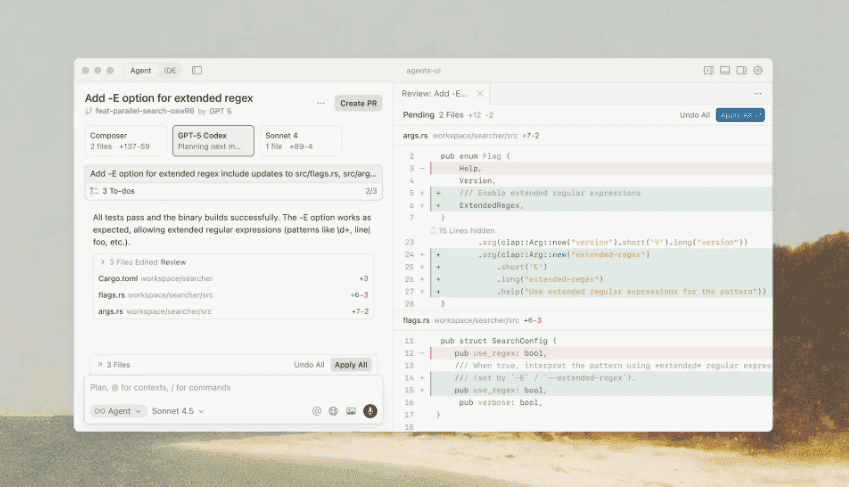
Source: SiliconANGLE
Composer is described as a mixture-of-experts algorithm that runs four times faster than comparable LLMs, capable of completing many coding tasks in under 30 seconds
5
. The model was built without using CUDA libraries, instead implementing kernels using PTX, Nvidia's low-level machine language, which helped achieve more than threefold performance improvements across some components.CEO Michael Truell indicated that the new capital will be primarily directed toward further developing Composer and reducing the company's reliance on external AI models from providers like Google, OpenAI, and Anthropic
1
.Related Stories

Competitive Landscape
The AI coding tools market has become increasingly competitive, with several well-funded players vying for market share. Cognition, known for its Devin AI software development platform, secured $400 million in September at a $10.2 billion valuation
4
. Other notable competitors include Replit, which raised $250 million, and Lovable, which secured $200 million in July4
.
Source: Observer
The competitive pressure is intensifying as established AI giants OpenAI and Anthropic continue to enhance their coding products
2
. This dynamic suggests that 2025 could be a pivotal year for Cursor as it seeks to maintain its market position while scaling its proprietary technology stack.References
Summarized by

Navi
[2]
Related Stories
Cursor pursues $50 billion valuation as AI coding tools reshape software development
12 Mar 2026•Startups

Cursor surpasses $2 billion in annualized revenue as corporate demand for AI coding tools surges
03 Mar 2026•Business and Economy

AI-Powered Coding Startup Anysphere Raises $900M, Triples Valuation to $9B
05 May 2025•Technology
Recent Highlights
1
Apple Plans Major Siri AI Overhaul in iOS 27 With Third-Party Chatbot Integration
Technology

2
OpenAI shuts down Sora after six months, ending Disney's $1 billion licensing partnership
Technology

3
AI chatbots validate you too much, making you less kind to others, Stanford study reveals
Science and Research

Recent Highlights
Today's Top Stories






Your Daily Dose of Curated AI News
Don’t drown in AI news. We cut through the noise - filtering, ranking and summarizing the most important AI news, breakthroughs and research daily. Spend less time searching for the latest in AI and get straight to action.

