India hosts massive AI Impact Summit drawing top tech CEOs and 20 world leaders to New Delhi


40 Sources
40 Sources
[1]
All the important news from the ongoing India AI Impact Summit | TechCrunch
With an eye towards luring more AI investment to the country, India is hosting a four-day AI Impact Summit this week that will be attended by executives from major AI labs and Big Tech, including OpenAI, Anthropic, Nvidia, Microsoft, Google, and Cloudflare, as well as heads of state. The event, which expects 250,000 visitors, will see Alphabet CEO Sundar Pichai, OpenAI CEO Sam Altman, Anthropic CEO Dario Amodei, Reliance Chairman Mukesh Ambani, and Google DeepMind CEO Demis Hassabis in attendance. India's prime minister, Narendra Modi, is scheduled to deliver a speech with French President Emmanuel Macron on Thursday.
[2]
India Seeks Role in Shaping AI Future With Summit of Tech Chiefs
India kicks off one of the world's largest artificial intelligence summits Monday, with Prime Minister Narendra Modi seeking to clear a path for India in a heated race to develop frontier models. World leaders, tech moguls, AI founders and investors are expected to arrive in New Delhi for the India AI Impact Summit, potentially the largest gathering of AI luminaries to date. Sundar Pichai of Alphabet Inc., Sam Altman of OpenAI Inc., Dario Amodei of Anthropic PBC and Meta Platforms Inc.'s Alexandr Wang are on the guest list, alongside researchers including Yann LeCun and Arthur Mensch. During the summit's final two days -- Feb. 19 and 20 -- French President Emmanuel Macron will deliver the keynote, followed by Modi's remarks. For Modi, the summit offers a chance to showcase India's vast tech-savvy population and engineering talent as forces that could tilt the next phase of the global AI race in its favor. The country has digital infrastructure powered by data from over a billion citizens, identifiable through Aadhaar, a biometric ID system. It has a proven track record of scaling technology quickly despite late starts -- missing the personal computer boom but becoming a software services powerhouse and leaping from limited landlines to nearly a billion smartphones in under two decades. "By overlaying AI over existing digital identity, payment rails as well as health care, education and governance stacks, India is attempting to compress decades of development into years," said Abhishek Singh, additional secretary at the Ministry of Electronics and IT. "And what gets built for India won't stay only in India." The country is already exporting its digital identity and payments blueprint. MOSIP, an open-source platform inspired by Aadhaar's architecture, is now helping countries including the Philippines, Morocco and Uganda build national ID systems. Some countries are creating digital payment platforms atop the same scaffolding. In AI competitiveness, India ranks third globally, trailing the US and China, according to Stanford University's Institute for Human-Centered AI. Global tech firms are taking notice. OpenAI and Anthropic are setting up operations in India, courting enterprise customers, developers and government agencies. Google and Meta are expanding data centers to serve one of the fastest-growing markets for models such as ChatGPT, Gemini and Claude. Nvidia Corp., squeezed by US export curbs on high-end chips in China, sees India as a counterweight, though its chief pulled out of the summit at the last hour citing "unforeseen circumstances." Still, industry analysts caution that years of underinvestment in technology research and development may hamper India's AI growth. Aakrit Vaish, founder of AI-focused fund Activate, said the country's real breakthrough will come from strengthening its research ecosystem so "we aren't just a testing lab for Silicon Valley's algorithms." Modi Powers Up India's Chip Dreams India Seeks Chipmaking Parity With Major Producers by 2032 The Hopes And Fears of Indian CEOs in 2026 With AI Looming India Unveils 20-Year Tax Break to Woo Global Data Centers Efforts to build locally attuned models are already underway. Systems reflecting India's linguistic diversity will be unveiled this week, with researchers developing voice-first systems for dozens of Indian languages. Get the Tech Newsletter bundle. Get the Tech Newsletter bundle. Get the Tech Newsletter bundle. Bloomberg's subscriber-only tech newsletters, and full access to all the articles they feature. Bloomberg's subscriber-only tech newsletters, and full access to all the articles they feature. Bloomberg's subscriber-only tech newsletters, and full access to all the articles they feature. Bloomberg may send me offers and promotions. Plus Signed UpPlus Sign UpPlus Sign Up By submitting my information, I agree to the Privacy Policy and Terms of Service. At the summit, government-backed BharatGen, formed by combining the research muscle of India's top engineering institutions, will debut Param2, a 17-billion parameter model supporting 22 Indian languages. Sarvam AI, backed by Lightspeed Venture Partners and Khosla Ventures, will unveil an even larger model with similar voice-first orientation. Both projects aim to introduce low-cost AI to a vast population and generate more data to help transform sectors from classrooms to clinics to crop fields. For US companies, burgeoning competition from such local models may further delay profitability from AI enterprises in India, a conundrum for the ecosystem in China. The focus on affordability is deliberate, and that could be game changing. "Our model is designed to accelerate adoption in critical areas across governance, education, health care and farming," said Rishi Bal, chief executive officer of BharatGen. "In India and much of the developing world, cost is not an afterthought." Himanshu Tyagi, co-founder of San Francisco-based and Peter Thiel-backed Sentient AI, said India could make up lost ground if it focuses on areas like advanced reasoning for science and robotics, since "the next wave of intelligence will use data not on the internet."
[3]
From OpenAI to Google, India hosts global AI summit
NEW DELHI, Feb 16 (Reuters) - Top executives from global AI giants will join several world leaders in New Delhi this week for a major artificial intelligence summit, at a time when India is trying to lure more investment in the industry. The country is emerging as a hotspot for AI firms, with Alphabet's Google (GOOGL.O), opens new tab, Microsoft MSFT.O and Amazon (AMZN.O), opens new tab already committing a combined $68 billion in AI and cloud infrastructure investment up to 2030. Indian officials are positioning the India AI Impact Summit, which started on Monday, as a platform to amplify the voices of developing nations in global AI governance. Delhi marks the first time the global event is being held in the developing world. "The theme of the summit is ... welfare for all, happiness for all, reflecting our shared commitment to harnessing Artificial Intelligence for human-centric progress," India's Prime Minister Narendra Modi posted on X. Key speakers at the summit include Alphabet CEO Sundar Pichai, OpenAI CEO Sam Altman, Anthropic CEO Dario Amodei, Reliance (RELI.NS), opens new tab Chairman Mukesh Ambani, and Google DeepMind CEO Demis Hassabis who will address the event on Thursday. Modi is also set to share the stage that day with French President Emmanuel Macron, who is visiting India as part of a broader bilateral trip. Large banners promoting the summit, featuring Modi's portrait, have been hung along Delhi's main roads in the kind of public relations blitz for which the prime minister has become known. India, which has yet to produce a globally dominant frontier AI model to rival those from the U.S. or China, is betting that its competitive edge lies in large-scale deployment rather than development of foundational models. India's Economic Survey, released last month, urged the government to focus on "application-led innovation" rather than chasing frontier-scale mega-models. The strategy is backed by significant domestic adoption: with more than 72 million daily ChatGPT users by late 2025, India has already become OpenAI's largest user market. But rapid AI adoption is also threatening jobs in India's $283 billion IT sector, with investment bank Jefferies predicting call centres could face a 50% revenue hit from AI adoption by 2030. AI CRICKET COACH, PRICEY HOTELS Previous global AI summits, at Bletchley Park in the UK in 2023, Seoul in 2024 and Paris in 2025, were dominated by safety commitments, voluntary corporate pledges and governance declarations, though critics said they produced few enforceable outcomes. More than 250,000 visitors are expected at the India summit, with more than 300 exhibitors across a 70,000-square-metre expo held at Bharat Mandapam, a $300 million mega convention complex. The influx of thousands of international delegates has sent Delhi's luxury hotel prices skyrocketing, stoking surprise on social media. A suite at the Taj Palace that normally costs about $2,200 per night was listed last week at more than $33,000. India's Supreme Court issued a circular on Saturday saying advocates could appear via video conferencing during the summit week, citing anticipated traffic congestion around the court in connection with the event. Reporting by Munsif Vengattil in New Delhi; Editing by Aditya Kalra and Kate Mayberry Our Standards: The Thomson Reuters Trust Principles., opens new tab * Suggested Topics: * Artificial Intelligence * Refining Munsif Vengattil Thomson Reuters Based in Bengaluru, Munsif Vengattil leads Reuters' technology news coverage in India. He tracks themes at the intersection of tech, business, and labor. A reporter for nine years, Munsif has written extensively on India's electronics manufacturing aspirations and its tech policy space, AI and election interference, satellite internet, streaming wars, and data breaches. His stories also focus on investigating corporate strategies and revealing India-specific initiatives and challenges of the biggest of tech firms - from Apple, Facebook, and Google, to Foxconn, Samsung, and Nvidia.
[4]
Huang and Pichai among tech CEOs heading to India for major AI summit in a key market
US President Joe Biden looks on as India's Prime Minister Narendra Modi speaks during a meeting with senior officials and CEOs of American and Indian companies, in the East Room the White House in Washington, DC, on June 23, 2023. Big technology executives descend on India this week for an AI summit in New Delhi as the world's largest companies aim to expand their presence in what is seen as a critical growth market. India this week will host the AI Impact Summit, the latest in a series of government-hosted events focused on artificial intelligence that have taken place in the U.K., South Korea and France. Among the key attendees are Nvidia CEO Jensen Huang, OpenAI CEO Sam Altman and Alphabet CEO Sundar Pichai. Anthropic boss Dario Amodei and Google DeepMind CEO Demis Hassabis are also slated to be there. Indian Prime Minister Narendra Modi will roll out of the red carpet which tech CEOs will happily walk down as the country presents a lucrative market of young, tech-forward consumers and a huge pool of talent which could be key to continued development of AI. "The summit ... is a huge validation of the potential of the market. Everyone's coming in because they realize that this is the place to be in and India just cannot be ignored," Lalit Ahuja, CEO of ANSR, a company that helps businesses run offshore teams in India.
[5]

India hosts a high-stakes AI summit in New Delhi, drawing 20 leaders and top tech CEOs
NEW DELHI (AP) -- India is hosting an artificial intelligence summit this week, bringing together heads of state, senior officials and tech executives to New Delhi for a five-day gathering highlighting the growing global importance of the technology. Organizers said the India AI Impact Summit is the first such summit being held in the Global South to discuss the technology developed and dominated by wealthy companies based in rich countries. It comes at a pivotal moment as AI rapidly transforms economies, reshapes labor markets and raises questions around regulations, security and ethics. From generative AI tools that can produce text and images to advanced systems used in defense, health care and climate modeling, AI has become a central focus for governments and corporations across the world. The summit, previously held in France, the U.K. and South Korea, has evolved far beyond its modest beginnings as a meeting tightly focused on the safety of cutting-edge AI systems into an all-purpose jamboree trade fair in which safety is just one aspect. India -- the world's most populous nation and one of the fastest-growing digital markets -- sees the summit as an opportunity to project itself as a bridge between advanced economies and the Global South. Officials said the country's experience in building large-scale digital public infrastructure, including digital identity and payment platforms, offer a model for deploying AI at scale while keeping costs low. "The goal is clear: AI should be used for shaping humanity, inclusive growth and a sustainable future," India's Minister for Electronics and Information Technology Ashwini Vaishnaw said. The summit begins Monday and will be attended by 20 heads of state and government, including French President Emmanuel Macron and Brazilian President Luiz Inácio Lula da Silva. India's Prime Minister Narendra Modi will address a session Thursday. Google's Chief Executive Sundar Pichai, Qualcomm's CEO Cristiano Amon, OpenAI's CEO Sam Altman, Microsoft's President Brad Smith and AMI Labs Executive Chairman Yann LeCun are also expected to attend. Indian executives are hoping the summit will reflect the country's recognition as an enabler of national capabilities, economic resilience and long-term capabilities. "As India continues on the journey to become a developed nation by 2047, AI has a critical role to play in strengthening large scale systems, from energy and manufacturing to public infrastructure," said Sumant Sinha, the CEO of the NASDAQ-listed ReNew, a clean energy company. Like previous editions, the India AI Impact Summit is not expected to result in a joint binding political agreement. It's more likely that the event could end with a non-binding pledge or declaration on goals for AI development. Last year's edition, the Paris AI Action Summit, was dominated by U.S. Vice President JD Vance's speech in which he rebuked European efforts to curb AI's risks by warning global leaders and tech industry executives against "excessive regulation" that could hobble the rapidly growing AI industry. AI summits have evolved since the first meeting in November 2023, barely a year after the launch of ChatGPT, which stoked both excitement and fear about the capabilities of generative artificial intelligence. That meeting at a former code breaking base north of London was attended only by official delegations from 28 countries and the European Union, along with a small number of AI execs and researchers, and was focused on keeping AI safe and reining in its potentially catastrophic risks. Ahead of the India meeting, a panel of experts released a second annual safety report on the risks posed by the most advanced AI systems, including through misuse, malfunctions and so-called systemic risks. AI governance efforts are also underway elsewhere, including at the United Nations, which last year adopted a resolution to set up two key bodies on AI -- a global forum and an independent scientific panel of experts. "The whole point of this report is to build an international consensus on the state of the science regarding the emerging risks of AI," said Yoshua Bengio, a prominent scientist known as one of the "Godfathers of AI" who led the study. "It's really important that the world will continue to have a strong independent scientific evaluation of the risks." Like elsewhere, there have been concerns in India about AI's adverse effect on jobs across technology and allied sectors, but experts point to reskilling to hedge risks. "There is a lot of genuine concern around this theme, and I don't want to underestimate this impact. But, from an Indian lens, emphasis is on re-skilling programs and as AI becomes much more mainstream, you will also see newer job roles coming up," said Sangeeta Gupta, senior vice president at Nasscom, a prominent body representing India's technology industry. For 22-year-old Anirudh Singh, pursuing a master's in social work from Delhi University, AI makes it easier to prepare internship projects. "I think AI is just reducing the tedious work that students generally had to do," said Singh. ___ Chan reported from London. Piyush Nagpal and Rishi Lekhi in New Delhi contributed to this report.
[6]

Everything to know about India's AI Impact Summit in New Delhi
Global leaders such as Emmanuel Macron are gathering in India for an AI Summit to try to agree on AI governance after the Paris AI pledge last year was deemed 'meaningless'. World and technology leaders are gathering in India this week for the annual global AI summit, which aims to establish a unified framework for artificial intelligence (AI) governance and international cooperation. The AI Impact Summit in New Delhi hopes for a "shared roadmap for global AI governance and collaboration" amid growing concerns from tech insiders about AI safety and increasing pressure from governments to loosen regulatory oversight of the technology. The summit being held in India marks an important occasion for putting the Global South on the AI map. But the initiative faces scepticism following last year's event. The AI Action Summit in Paris, which produced a declaration promoting safer and more responsible AI development, was slammed by tech leaders who dismissed it as "devoid of any meaning" and insufficient in addressing the potential risks and harms posed by the technology. The United Kingdom refused to sign the joint pledge, citing national security concerns. The US was also absent in signing; the country did not specify exactly why it did not sign the doctrine, but the country's vice president, JD Vance, warned delegates in Paris that too much regulation would stifle innovation. Here is everything to know about the India summit. Some 250,000 visitors are expected from researchers, AI companies and governments. Around 20 national leaders, such as French President Emmanuel Macron, Spain's Prime Minister Pedro Sanchez, and Brazil's President Lula da Silva, are expected to attend. The UK's Prime Minister and US President Donald Trump do not appear to be attending. There will also be 45 ministerial-level delegations present at the event. Google Chief Executive Sundar Pichai, Qualcomm CEO Cristiano Amon, OpenAI CEO Sam Altman, Microsoft President Brad Smith and the 'French godfather' of AI, Yann LeCun, are also expected to attend. The Summit has three themes: People, planet and progress, which define India's approach to cooperation on AI, the government says. It will be interesting to see how planet is addressed given the huge energy required to run large language models (LLMs) The summit may result in a pledge, and not a binding agreement like the previous summits. India, the world's most populous nation, which has a massive startup community and one of the fastest-growing digital markets, sees the summit as an opportunity for the Global South. "This occasion is further proof that our country is progressing rapidly in the field of science and technology," India's Prime Minister Narendra Modi wrote on the social media platform X on Monday. "It shows the capability of our country's youth," he added. The summit should not frame innovation and regulation as opposing forces, "the real task is to align them, ensuring ambition is met with accountability", said Gilroy Matthew, chief operating officer at US digital transformation company UST. "India's global position enables it to act as a bridge between developing and developed nations, championing a third way for AI - one that prioritises practical impact over existential risk, showing how AI can address challenges in healthcare, education and other public services," he told Euronews Next.
[7]

Leaders gather for New Delhi AI summit as warnings grow over societal risks
A global artificial intelligence summit opens in New Delhi on Monday, tackling issues from job disruption to child safety, though some participants warn its sweeping agenda may hinder firm commitments. Surging demand for generative AI has lifted tech profits and shares, even as concerns mount over social and environmental risks. A global artificial intelligence summit kicks off in New Delhi on Monday with big issues on the agenda, from job disruption to child safety, but some attendees warn the broad focus could diminish the chance of concrete commitments from world leaders. While frenzied demand for generative AI has turbocharged profits and share prices for many technology companies, anxiety is growing over the risks that it poses to society and the environment. Prime Minister Narendra Modi will on Monday afternoon inaugurate the five-day AI Impact Summit, which aims to declare a "shared roadmap for global AI governance and collaboration". It is the fourth annual gathering addressing the problems and opportunities posed by AI, after previous international meetings in Paris, Seoul and Britain's wartime code-breaking hub Bletchley. Touted as the biggest edition yet, the Indian government is expecting 250,000 visitors from across the sector, including 20 national leaders and 45 ministerial-level delegations. Also in attendance will be tech CEOs including Sam Altman of OpenAI and Google's Sundar Pichai, although unforeseen circumstances have reportedly led Jensen Huang, head of US chip titan Nvidia, to cancel his planned appearance. Modi will seek to "strengthen global partnerships and define India's leadership in the AI decade ahead" in talks with the likes of France's Emmanuel Macron and Brazil's Luiz Inacio Lula da Silva, organisers say. But whether they will take meaningful steps to hold AI giants accountable is in doubt, Amba Kak, co-executive director of the AI Now Institute, told AFP. Industry commitments made at previous events "have largely been narrow 'self regulatory' frameworks that position AI companies to continue to grade their own homework", said Kak, a former AI advisor to the US Federal Trade Commission who is taking part in the summit. AI safety The Bletchley gathering, held in 2023 -- a year after ChatGPT stunned the world -- was called the AI Safety Summit. The meetings' names have changed as they have grown in size and scope, and at last year's AI Action Summit in Paris, dozens of nations signed a statement calling for efforts to flank AI tech with regulation to make it "open" and "ethical". But the United States did not sign, with Vice President JD Vance warning that "excessive regulation... could kill a transformative sector just as it's taking off". The Delhi summit has the loose themes of "people, progress, planet" -- dubbed three "sutras". Even so, AI safety remains a priority, including the dangers of misinformation such as deepfakes. Last month saw a global backlash over Elon Musk's Grok AI tool because it allowed users to produce sexualised pictures of real people, including children, using simple text prompts. "Child safety and digital harms are also moving up the agenda, particularly as generative AI lowers the barrier to harmful content," AI Asia Pacific Institute director Kelly Forbes told AFP. "There is real scope for change" although it might not happen fast enough, said Forbes, whose organisation is researching how Australia and other countries are requiring platforms to confront the issue. Read moreAre we in an AI bubble? AI for 'the many' Organisers highlight this year's AI summit as the first to be hosted by a developing country. "The summit will shape a shared vision for AI that truly serves the many, not just the few," India's IT ministry has said. Last year India leapt to third place -- overtaking South Korea and Japan -- in an annual global ranking of AI competitiveness calculated by Stanford University researchers. But despite plans for large-scale infrastructure and grand ambitions for innovation, experts say the country still has a long way to go before it can rival the United States and China. Neither Donald Trump nor Xi Jinping will attend the summit, but both countries are sending high-level tech policy officials. Seth Hays, author of the Asia AI Policy Monitor newsletter, said talk at the summit would likely centre around "ensuring that governments put up some guardrails, but don't throttle AI development". "There may be some announcements for more state investment in AI, but it may not move the needle much -- as India needs partnerships to integrate on the international scene for AI," Hays told AFP.
[8]

AI Impact Summit: From Registration to Schedule, All You Need to Know
CEO of Google, OpenAI, Anthropic, and others are expected to attend AI Impact Summit 2026, India's inaugural global artificial intelligence (AI) conference, is all set to start. While sessions, exhibitions, and keynotes will occur between Monday, February 16, and Friday, February 20, the main AI summit will only take place on February 19 and 20\. The five-day event will see key attendees from major AI companies, participating nations, and industry stakeholders. Google CEO Sundar Pichai and OpenAI CEO Sam Altman are confirmed to be attending the event. Here, we have shared all the details about the summit, including how one can register to attend it in person._Developing. . ._
[9]

At India AI Impact Summit 2026, Akash Ambani showcases Jio's AI ecosystem to PM Modi
At the India AI Impact Summit 2026, Akash Ambani showcased Reliance Jio Infocomm Limited's AI ecosystem to Narendra Modi.The presentation highlighted Jio AI Stack as the backbone of scalable AI integration. Key platforms spanned healthcare, education, cultural preservation and smart homes. Initiatives like Jio Sanskriti AI and Jio Arogya AI underscored sector-focused innovation. The summit reinforced India's growing focus on indigenous AI development. At the India AI Impact Summit 2026, Akash M. Ambani, Chairman of Reliance Jio Infocomm Limited (RJIL), showcased the company's growing artificial intelligence (AI) ecosystem to Prime Minister Narendra Modi during a tour of the Jio Intelligence Pavilion. The showcase was part of the Prime Minister's broader engagement at the India AI Impact Expo, a major component of the summit that convened policymakers, technology firms, startups and industry leaders to discuss the trajectory of AI in India. The Jio pavilion at the expo featured Jio's AI-driven initiatives spanning digital infrastructure, healthcare, education, cultural preservation and smart living solutions. During the walkthrough, Akash Ambani detailed the vision underpinning Jio AI Stack, presenting it as a core technology framework built to support scalable AI integration across platforms and services. The company also showcased Jio Sanskriti AI, a platform designed to support the preservation and accessibility of India's linguistic and cultural heritage. The initiative focuses on enabling AI-driven tools for translation, digitisation and content discovery across multiple Indian languages. A post shared by The Economic Times (@economictimes) In the healthcare segment, Jio Arogya AI was presented as a solution intended to strengthen digital health ecosystems. The education-focused offering, Jio Shiksha, was demonstrated as part of Jio's broader AI strategy. The platform is designed to provide personalised learning pathways, adaptive content delivery and performance analytics to support both students and educators in digital learning environments. A post shared by The Economic Times (@economictimes) Another key highlight of the pavilion was Jio AI Home, positioned as a smart living solution that integrates AI capabilities within residential settings. Jio AI Home aims to enhance automation, connectivity and user interaction across devices within the home ecosystem. The India AI Impact Summit 2026 aims to serve as a forum for discussions around AI adoption, indigenous innovation and digital inclusion. Sessions at the summit examined how artificial intelligence can contribute to governance, economic development and public service delivery, aligning with India's broader digital transformation agenda. The summit will bring together government representatives, industry experts and academic institutions to deliberate on policy frameworks, infrastructure readiness and collaborative opportunities in artificial intelligence. As AI continues to play a significant role in shaping global economies, events such as the India AI Impact Summit provide a platform for stakeholders to present innovations and engage in dialogue on future growth. (You can now subscribe to our Economic Times WhatsApp channel)
[10]

Airtel Showcases AI Powered Solutions to Prime Minister Modi
Airtel Arena was visited by the Prime Minister Narendra Modi after the summit was inagurated by him. Bharti Airtel, the second-largest telecom operator in India, has participated in the India AI Impact Summit 2026. The telco has built the Airtel Arena showcasing AI (artificial intelligence) powered solutions to the visitors and the government officials. Airtel Arena was visited by the Prime Minister Narendra Modi after the summit was inagurated by him. Read More - Apple Could Launch Multiple New Products in the Coming Weeks Sunil Bharti Mittal, Chairman and Founder, Bharti Enterprises showcased the strengths of AI and its use cases to the Prime Minister Modi. Here are some of the key use cases showcased by the telco at the summit: Read More - Realme P4 Lite 4G India Launch Date The India AI Impact Summit 2026 has put the country in a global spotlight with companies from many countries participating and showcasing their solutions and products.
[11]

India hosts AI summit as safety concerns grow
A global artificial intelligence summit kicks off in New Delhi on Monday with big issues on the agenda, from job disruption to child safety, but some attendees warn the broad focus could diminish the chance of concrete commitments from world leaders. While frenzied demand for generative AI has turbocharged profits for many tech companies, anxiety is growing over the risks that it poses to society and the environment. Prime Minister Narendra Modi will on Monday afternoon inaugurate the five-day AI Impact Summit, which aims to declare a "shared roadmap for global AI governance and collaboration."
[12]
AI Impact Summit: Where AI Grows Up
From CES and Mobile World Congress to IFA Berlin, global tech events focus on commercial innovation. But the AI Impact Summit at Bharat Mandapam in New Delhi operates at a different layer - governance. With leaders like Sam Altman, Sundar Pichai, Satya Nadella, Jensen Huang and global policymakers in attendance, the focus is on safety norms, funding commitments, bilateral agreements and defining AI guardrails - not product launches. Tech360's Ishaan Singh explains why this summit could reshape the global AI power map - and why India is positioning itself at the center of that conversation.
[13]
Indian AI, gaming startups take centre stage at AI Impact Summit 2026, showcasing cutting-edge innovations
Among the standout participants are five Indian ventures -- Yesgnome, Metasports (Hitwicket), Koyozo, Youth Buzz (Ourcadium) and Evivve -- each presenting unique AI-driven solutions that are reshaping gaming, creative production, and enterprise transformation. With the AI Impact Summit 2026 kicking off on Monday, Indian AI and gaming startups take centre stage, showcasing cutting-edge innovations that place the country at the forefront of AI-powered gaming and immersive technologies. The summit, positioned as a premier global platform on Artificial Intelligence, brings together policymakers, investors, technology leaders and startups to highlight real-world AI applications across sectors. Among the standout participants are five Indian ventures -- Yesgnome, Metasports (Hitwicket), Koyozo, Youth Buzz (Ourcadium) and Evivve -- each presenting unique AI-driven solutions that are reshaping gaming, creative production, and enterprise transformation. According to a press release, Yesgnome unveils Sketly AI, an advanced art-generation platform designed for game studios and design teams. The tool enables rapid creation of production-ready assets, including characters, environments and animation components, while its proprietary style-training system allows studios to maintain visual consistency across large-scale projects. The platform aims to significantly reduce production timelines and creative bottlenecks for both independent developers and global studios. Metasports showcases its popular multiplayer cricket game, Hitwicket, which has crossed 18 million users worldwide. At the summit, the company demonstrates a Generative AI-powered real-time commentary engine that analyses live gameplay, produces contextual text narration and converts it into expressive voice output. The system personalises match commentary, blending AI storytelling with competitive sports gaming to create a broadcast-like interactive experience. Koyozo introduces its integrated mobile handheld gaming ecosystem designed to transform smartphones into console-grade gaming devices. Its flagship hardware, Koyozo One, features hall-effect joysticks, dual connectivity, and haptic feedback, complemented by Koyozo Club -- a smart platform layer that offers auto button mapping, remote play integration, and personalised control profiles. The ecosystem seeks to streamline India's fragmented mobile gaming landscape and elevate competitive mobile play. In an immersive showcase, Youth Buzz presents "Man vs. GPT" on its platform, Ourcadium--a live, interactive format in which human participants compete against adaptive AI opponents. The AI system learns behavioural patterns and adjusts strategies in real time, offering audiences a simplified yet engaging window into complex AI adaptation models. Positioned as homegrown intellectual property, the experience reflects India's push toward original, AI-native entertainment formats. Meanwhile, Evivve, a behavioural intelligence and organisational transformation lab, debuts its Enterprise Cognitive AI Readiness Tool. Built on a neuroscience-based framework, the tool assesses leadership and organisational preparedness for AI adoption beyond technical metrics. At the summit, Evivve conducts live executive simulations and unveils its "State of Cognition: India AI Snapshot 2026," highlighting gaps and opportunities in AI leadership readiness. A special panel discussion titled "The New Gold Rush: Investing in India's AI-Powered Gaming Future," curated with the Game Developers Association of India, brings together global investors and industry leaders, focusing on evolving funding trends, AI-enabled production pipelines, skill development and policy frameworks necessary to accelerate India's rise as a global hub for AI-driven game development, the release stated. The strong presence of these startups underscores India's expanding capabilities at the intersection of artificial intelligence, gaming and immersive media. Their participation at the India AI Impact Summit 2026 reflects a broader national ambition--to build globally competitive AI-native platforms and position India as a powerhouse in next-generation digital innovation. Prime Minister Narendra Modi will inaugurate the India AI Impact Expo 2026 at the Bharat Mandapam in the national capital today. An unprecedented roster of Presidents, Prime Ministers, Crown Princes, and the brightest minds from Silicon Valley and beyond will convene here as India hosts the first global AI summit to be in the Global South. It will bring together global leaders, policymakers, technology companies, innovators, and experts to showcase and deliberate on the transformative potential of AI across governance, innovation, and sustainable development. The summit, which kicked off on Monday in New Delhi, will welcome world leaders from across 20 countries, including French President Emmanuel Macron, Brazilian President Lula da Silva, Sri Lankan President Anura Kumara Dissanayake and others. UN Secretary-General Antonio Guterres will also attend the event. From February 16 to 20, the Impact Summit will showcase New Delhi's ambition: to shape an AI future that is inclusive, responsible, and impactful. At the core is India's audacious vision for sovereign AI.
[14]
PM Modi's Visit to Jio's AI Pavilion Explained
At the summit, Reliance Jio has built the Jio Intelligence Pavilion. India's at the global spotlight by hosting the India AI Impact Summit 2026. One of the key highlights of the event was PM Modi inaugurating it. At the summit, Reliance Jio has built the Jio Intelligence Pavilion. The telco showcased several AI (artificial intelligence) powered use cases at the summit, and the same was explained to PM Modi by Akash Ambani, chairman of Jio Platforms Limited. Read More - Apple Could Launch Multiple New Products in the Coming Weeks Jio showcased things such as Jio AI Stack, Jio Sanskriti AI, Jio Arogya AI, Jio Shiksha, and Jio AI Home. These are AI powered solutions meant to help with education, preserving cultural identity, healthcare, and smart living solutions. Jio's vision of 'AI for All' was announced by Mukesh Ambani, Chairman of Reliance Industries Limited. The telco wants that AI should be accessible for everyone. The prime minister's presence at the Jio Intelligence Pavilion, as well as summit highlights the importance of AI for the future of India and the global economy. Read More - Realme P4 Lite 4G India Launch Date The PM's focus on AI will also ensure that the future policy will mostly align between the private sector and the public sector.
[15]

Airtel showcases AI-Powered Infrastructure and Security Solutions at India AI Impact Summit 2026
At the ongoing India AI Impact Summit 2026, telecommunications major Airtel unveiled its comprehensive strategy for integrating Artificial Intelligence (AI) across its digital ecosystem. Under the theme "Powering AI for India," the company showcased advancements in network security, consumer applications, and sovereign digital infrastructure. The presentation included a briefing for Prime Minister Narendra Modi, led by Sunil Bharti Mittal, Chairman & Founder of Bharti Enterprises. The showcase highlighted Airtel's focus on building a secure, AI-first infrastructure designed to support India's "Digital Bharat" initiative. A significant portion of the showcase was dedicated to "The Safe Network," Airtel's AI-powered solution designed to combat telecommunications fraud. The company presented data regarding the efficacy of its real-time spam detection system, which analyzes traffic patterns and behavioral signals at the network level. According to the data released at the summit, the AI filter has achieved the following since its launch in September 2024: On the enterprise side, Airtel introduced solutions aimed at B2B spam prevention. This includes a "Business Name Display" feature that presents verified brand names on call screens to reduce impersonation, as well as network APIs designed to allow businesses to integrate these security features into their own operations. Airtel also demonstrated how AI is being deployed to enhance consumer experiences in home entertainment and digital creativity. The company outlined its structural investments designed to support the growing demand for AI workloads in India, focusing on sovereignty and sustainability. The company showcased its "Sovereign Cloud," emphasizing that it is built in India with full data residency and operational control remaining within the country. The presentation concluded with an overview of Airtel's enterprise-grade security platform. The system employs a Zero Trust architecture and an AI-driven Security Operations Center (iSOC) to provide 24/7 monitoring. The platform focuses on the rapid detection and automated remediation of threats, including dark-web monitoring and endpoint protection. The Airtel showcase is located at Hall 4, Arena 4.9 at the India AI Impact Summit 2026. The exhibit covers the integration of AI across networks, cloud, and cybersecurity platforms.
[16]

Global South's first AI Summit begins in New Delhi today, heads of 20 nations to attend
The five-day India AI Impact Summit begins in New Delhi today. The summit will be attended by technology leaders including Google CEO Sundar Pichai, OpenAI CEO Sam Altman, Anthropic CEO Dario Amodei, and Google DeepMind CEO and Nobel Prize winner Demis Hassabis. Policymakers from 20 countries including French president Emmanuel Macron, Brazil's president Luiz Inacio Lula da Silva, and United Nations Secretary-General Antonio Guterres are also expected to attend and participate in the Global Partnership on Artificial Intelligence (GPAI) Council meeting, which is on February 20. More than 600 startups and over 3,000 speakers from several countries are expected to attend the summit. Prior to India, similar global AI summits were held in the UK (2023), South Korea (2024) and France (2025). However, this is the first such summit to be held in the Global South, which broadly means developing, less developed and underdeveloped countries in Asia, South America and Africa. Despite trailing the US and China in AI investments, India is building several sovereign AI models and is expanding its datacentre capacity rapidly. The summit provides a platform to the AI startups to showcase the sovereign AI models and secure more investments. For policymakers, the AI Summit is an opportunity to strengthen global collaboration, promote responsible and ethical use of AI, and accelerate AI adoption in critical sectors. For global tech companies India presents a massive growth opportunity. According to BCG, India as an AI market is expected to grow three times to $17 billion by 2027. Ahead of the AI Summit, union IT Minister Ashwini Vaishnaw announced that several sovereign AI models built by Indian tech firms and startups on Indian language datasets will be unveiled during the week. He also added that India's AI infrastructure build out could attract more than $200 billion in investments. Early this month, the government of India also announced a tax holiday until 2047 for foreign companies providing global cloud services using datacentres based in India, along with a 15% safe harbour on cost for related entities delivering datacentre services. According to a government of India report, India's datacentre capacity is expected to reach 9.2GW by 2030 from the current capacity of 960MW. Gartner also expects IT spending in India to grow by 10.6% YoY to reach $176 billion in 2026, while datacentre spending is expected to grow at 20.5% YoY, surpassing all other segments. The AI Summit is also hosting a program called AI by HER where women technologists can showcase AI solutions aimed at solving real-world public challenges. Sovereign AI models, AI skilling India has allocated ₹ 10,000 crore under the national AI mission to build sovereign AI models that can enhance public service delivery and governance. So far, 12 Indian firms have been selected under the mission to build India-centric large language models (LLMs) and voice AI systems. The central government has acquired 38,000 GPUs and is making them available to Indian AI firms at subsidized rates along with access to AI Kosha, a local language dataset. Sarvam AI is building a suite of sovereign LLMs aimed at improving governance and public service delivery. IIT Bombay-led BharatGen project is building LLMs with up to 1 trillion parameters, along with SLMs for sector-specific applications. Gnani.ai is developing a 14-billion parameter voice AI model for reasoning and real-time multilingual speech processing in Indian languages. Soket AI is building a 120-billion parameter multilingual model for specific sectors including defence, healthcare, and education. According to a new benchmark created specifically for testing the performance of AI models on Indian languages, OpenAI's transcription models showed a 55% word error rate on Indian speech, while Microsoft's AI solution does not support 6 out of 15 tested Indian languages. Also, Meta's error rates with Tamil and Malayalam were found to be two to three times higher than those of Indian AI models. The benchmark was developed by Josh Talks and AI4Bharat at Indian Institute of Technology (IIT) Madras. Among sovereign AI models, Sarvam Audio consistently secured rank 1 or 2 across Indian languages and dialects, including Hindi, Bengali, Odia and Assamese. Google's Gemini was the only global model that was on par with Sarvam on Indian languages. In addition to building AI models, several AI skill development projects are also underway across India. For instance, the central government is setting up data and AI labs in tier-2 and tier-3 cities. Several states and union territories (UT) have nominated 174 ITIs and polytechnics to be turned into AI labs. The National Institute of Electronics and Information Technology (NIELIT) has already identified 27 such labs. According to BCG, India accounts for 16% of the global AI talent pool after the US. While India is believed to have close to 2,000 AI startups, its share of global AI patents is nowhere near the US and China and is believed to be less than 1%. This means that India also needs to step up investment in AI R&D and not just AI infrastructure. AI Governance, global collaboration A day before the Summit, MeitY also released India AI governance guidelines to ensure AI is built and deployed in a safe, trusted, and inclusive manner. The guidelines recommend creation of several national institutions such as AI Governance Group, AI Safety Institute, and Technology and Policy Expert Committee. The guidelines are based on seven principles called sutras by the MeitY, which aims to balance innovation with safeguard. Unlike the EU which has adopted a risk based AI governance that bans AI models that are deemed risky, India has adopted a "light-touch" approach to regulation and plans to introduce additional safeguards only if necessary. Last month, MeitY had issued a notice to xAI for the misuse of its GenAI bot Grok to generate explicit deepfakes of women and children. The seven principles of these AI guidelines establish trust as the foundation, embedding it across the AI value chain. It also focuses on keeping humans at the centre of AI development to ensure it benefits humanity while remaining under human control and oversight. The guidelines also prioritize innovation over restraint, ensuring that AI innovation is fair and free from bias. To ensure, AI is used responsibly, the guidelines emphasize on assigning accountability based on specific function and risk of harm, while having understandability by design so AI's decision-making process can be celery explained. Finally, it weighs in on the importance of safety, resilience and sustainability, requiring that AI is designed to minimize risks of harm while remaining environmentally responsible. During the 2025 AI Summit in France, a resolution on inclusive and sustainable AI was adopted and supported by heads of 58 countries. The resolution declared goals to reduce the digital divide, ensure ethical and safe AI development and encourage AI investment for public good. UK's Deputy PM David Lammy said in a statement that the India AI Summit is an opportunity to find a way to work together with international partners to unlock the full potential of AI, while ensuring robust and fair safety standards.
[17]
Diagnosis time reduced by 50%: Qure.ai founding member Ankit Modi on AI's healthcare impact in India
At the India AI Impact Summit 2026, Ankit Modi of Qure.ai highlighted AI's impact in medical imaging and early disease detection, citing deployments at Mahakumbh and Goa screenings. Abilash Soundararajan of PrivaSapien stressed responsible AI frameworks and new skills. PM Narendra Modi welcomed delegates and will inaugurate the India AI Impact Expo 2026. Highlighting India's leadership in medical innovation and technological governance, industry experts at the India AI Impact Summit 2026 underscored the transformative role of Artificial Intelligence (AI) in public health and responsible data frameworks. Speaking to on the sidelines of the summit on Monday, Ankit Modi, Founding Member and Chief Product Officer of Qure.ai, shared the global impact of AI in medical imaging across 100 countries. "We build AI solutions for medical imaging, impacting oncology, cardiology, tuberculosis and multiple disease areas. We are at this summit to showcase our impact that we have created for 40 million people across 100 plus countries," Modi stated. Detailing the practical application of these technologies in India, Modi cited successful interventions at large-scale gatherings and state-level screenings. "We use AI to read chest X-rays and make an AI intervention at the right time. For example, we deployed AI at Mahakumbh last year; we saw that in a very small area, a lot of people have been crowded up, X-rays were being taken, but 3 per cent of those X-rays also had signs of tuberculosis," he noted. He further added, "Similarly, in Goa, we did a population-level health screening with AI for lung cancer. Having an AI that can look for early signs of lung cancer in them, we showed that diagnosis time can be reduced by 50 per cent in Goa and it can be scaled across public health systems across the country." Expressing pride in India's role as a global host, Modi emphasised the long-term inspiration for the youth. "Personally, it fills me with immense pride that India is hosting delegates and leaders of AI from around the world today. I definitely see them getting inspired and creating more such companies, more impact for India using AI over the next 5 to 10 years," he said. Alongside healthcare innovation, the summit also addressed the critical need for ethical guardrails and responsible AI adoption. Speaking on the sidelines, Abilash Soundararajan, Founder and CEO of PrivaSapien, highlighted India's proactive stance on building frameworks for responsible AI. "Given that India is taking a lead in responsible AI, there needs to be a technological framework which has to be in place. PM Modi's Office, the PSA, Principal Scientific Adviser's Office has come up with a framework called technological framework for India to make use of responsible AI," Soundararajan explained. He noted that India is helping set a global benchmark. "While Europe and US is not focussing on responsible AI critically, India is giving a path for the world to define how should organisations use AI responsibly. How it boils down from regulation to technology which can be implemented by enterprises is what government is looking at," he added. Addressing the shift in the job market, Soundararajan compared the AI transition to the advent of the internet. "After this Gen AI launch, the skills needed for people to be employable is going to be very different. How can you govern a model? How can you approve a model? How can you use data in a model? All these are going to be verticals of critical importance for employability; if you build your skills in this direction, I think opportunities are a lot," he said. With India hosting the summit at Bharat Mandapam, PM Narendra Modi on Monday welcomed world leaders, industry experts, and dignitaries. In a post on X, the Prime Minister highlighted the summit's theme, "Sarvajana Hitaya, Sarvajana Sukhaya," meaning welfare for all and happiness for all, reflecting India's commitment to harnessing AI for human-centric progress. PM Modi is set to inaugurate the India AI Impact Expo 2026 at the venue this evening. An unprecedented roster of Presidents, Prime Ministers, Crown Princes, and leading global technology voices are participating in the event, which marks the first global AI gathering to be hosted in the Global South. The summit will see participation from leaders across 20 countries, including French President Emmanuel Macron, Brazilian President Lula da Silva, and Sri Lankan President Anura Kumara Dissanayake. UN Secretary-General Antonio Guterres will also attend. Running till February 20, the Impact Summit showcases New Delhi's ambition to shape an AI future that is inclusive, responsible, and impactful, anchored in PM Narendra Modi's broader vision for sovereign AI.
[18]

AI Impact Summit 2026: PM Modi Hails India's Rising AI Ambitions
The Summit Aims to Influence How AI is Developed, Regulated, and Deployed Worldwide, Both in Emerging and Developing Economies Prime Minister Narendra Modi has described the AI Impact Summit 2026 in Delhi as proof of India's technological progress. It highlights the country's expanding AI ecosystem and commitment to innovation and collaborations across the world. The brings together firms, startups, state governments, and research institutions. This diverse gathering also helps foster business opportunities with an overview of the global AI ecosystem.
[19]
India AI Impact Summit 2026 opens in New Delhi: Key conversations shaping India's AI future
The India AI Impact Summit 2026 opens today in New Delhi with a packed agenda focused on public systems, sovereign infrastructure, responsible AI governance and workforce transformation. As conversations unfold across multiple tracks, Day 1 offers early signals on how India intends to scale artificial intelligence across sectors. The Economic Times is providing on-ground coverage of the five-day summit. If the opening day of the India AI Impact Summit 2026 reveals anything, it is that India's artificial intelligence push is entering a more operational phase. From the moment sessions begin this morning at Bharat Mandapam, the emphasis is less on futuristic rhetoric and more on systems that already affect daily life. The conversation has shifted from "what AI can do" to "where AI must work." A strong current running through Day 1 discussions is the integration of AI into public infrastructure. Whether in road safety systems, judicial processes, audit mechanisms or welfare delivery, the underlying message is consistent: AI is being positioned as an enabler of institutional efficiency and transparency. The focus is not experimentation in isolation, but embedding intelligence within existing governance structures. This signals a notable evolution. For years, AI debates were dominated by startup ecosystems and consumer applications. Today's agenda reflects a broader institutional embrace, where ministries, regulators and public agencies are actively exploring scalable deployment. The implications are significant: once AI becomes part of civic systems, the standards for reliability and accountability rise dramatically. Trust and governance form another defining axis of the day. Across multiple conversations, the emphasis is on building frameworks that allow innovation without trembling public confidence. The discussion is not framed as a binary between regulation and growth. Instead, it is about operationalising responsible AI, through evaluation protocols, quality infrastructure, risk management and institutional safeguards. The message emerging is that trust must be engineered into AI systems from the outset, rather than retrofitted later. Parallel to governance is the question of sovereignty. Infrastructure conversations on Day 1 underscore a growing awareness that AI leadership is inseparable from compute capacity, hardware ecosystems and data architecture. Discussions around indigenous capabilities, secure infrastructure and open technology pathways reflect a strategic shift. AI is increasingly viewed as a core national capability, not merely a layer of software. Equally prominent is the human capital dimension. Multiple panels today examine workforce transformation, higher education reform and AI literacy. The framing is pragmatic: as automation accelerates, labour markets will adjust unevenly. Preparing for that shift requires not only reskilling initiatives but institutional redesign. The idea of AI literacy as a foundational skill, akin to digital literacy a decade ago, appears central to the day's dialogue. Inclusion also emerges as a structural theme rather than a side conversation. From multilingual AI systems to gender representation and equitable access to technology, Day 1 reflects an awareness that scale without inclusion deepens divides. India's linguistic and demographic diversity makes culturally grounded design essential. Conversations around community-led data, participatory development and context-aware systems suggest that the country is grappling seriously with how AI performs across varied realities. Climate resilience, agriculture and disaster management add yet another layer. The use of AI in anticipatory systems, predicting risk, optimising resources, supporting small-scale producers, indicates that the summit is positioning artificial intelligence as part of a broader developmental strategy. Taken together, the first day does not revolve around spectacle. It revolves around architecture. Infrastructure, governance, literacy, sovereignty and inclusion, these are not headline-grabbing themes, but they are foundational. If Day 1 is any indication, the India AI Impact Summit is less about announcing isolated breakthroughs and more about aligning long-term systems. As the week unfolds, the real test will be whether these conversations translate into durable frameworks and collaborative commitments. But the early signals are clear: India's AI roadmap is being shaped not only by innovation, but by institutional design. Follow https://ai.economictimes.com/ai-summit for comprehensive coverage.
[20]
Sam Altman Bets Big On India As Next Full-Stack AI Powerhouse
India Set to Shape AI's Future, Says Sam Altman Ahead of Global AI Impact Summit Visit OpenAI CEO Sam Altman has said India is uniquely positioned to emerge as a 'full-stack AI leader', citing its deep technology talent, national strategy, and strong public optimism toward artificial intelligence. Writing ahead of his visit to the Global AI Impact Summit, Altman noted that the world's largest democracy combines homegrown expertise with a policy framework aimed at deploying AI at scale. He pointed to the government's IndiaAI Mission as a key driver, designed to expand compute capacity, support startups, and accelerate multilingual applications across healthcare, agriculture, and public services. The goal, he said, is to make an 'essential tool for hundreds of millions of people'.
[21]
India's AI Impact Summit 2026: Global AI leadership & economic growth
The Summit brings together heads of state, policymakers, CEOs, researchers, and civil society leaders to address critical questions about the role of AI in economic transformation, governance, infrastructure, inclusion, and ethical deployment. With participation from over 45 countries, more than 600 startups, 3,000 speakers, and 250,000+ visitors expected across plenaries and exhibitions, the scale of the Summit underscores its ambition as a platform for both debate and action. Prime Minister Narendra Modi inaugurated the Summit, emphasizing India's readiness to lead an "AI transformation" that prioritizes public welfare, innovation, and shared prosperity. He articulated the Summit's overarching theme, "Sarvajana Hitaya, Sarvajana Sukhaya" (welfare and happiness for all), stressing the need for AI deployment that benefits people, planet, and progress rather than narrow commercial interests. Prime Minister Narendra Modi underscored India's progress in digital infrastructure, startup ecosystems, and regulatory frameworks, and invited global partners to store and process data within India's evolving digital economy. Analysts note that by hosting the Summit, India asserts itself as a bridge between advanced economies and emerging markets, advocating for inclusive frameworks that avoid the concentration of AI benefits within a few nations. This aligns with broader geopolitical trends where technology leadership and policy norms are increasingly contested and where developing economies seek a louder voice. The Summit's guest list spans global political and technology leadership. Notable attendees include French President Emmanuel Macron, Brazilian President Luiz Inácio Lula da Silva, and senior representatives from leading AI firms such as Google, Microsoft, OpenAI, Meta, Anthropic, and Qualcomm, reflecting a blend of policy and private-sector perspectives. Despite these high-level engagements, not all expected voices are present; Nvidia CEO Jensen Huang announced he would not attend due to unforeseen circumstances, though the company will send a senior delegation. Leadership in AI isn't just about representation but also agenda-setting. OpenAI CEO Sam Altman, speaking ahead of the summit, framed his vision around three pillars: access, adoption, and agency, urging that AI must be affordable, embedded into societal systems like education and healthcare, and paired with literacy so people can use AI as builders, not just consumers. Altman praised India's AI policies, particularly the IndiaAI Mission aimed at expanding infrastructure, supporting AI startups, and advancing multilingual AI suited to local needs. Economists view the summit as timely against the backdrop of unprecedented global investments in AI infrastructure. Recent analyses show the five largest AI platform providers, including Amazon, Alphabet, Microsoft, and Meta, are collectively investing nearly $700 billion in 2026, roughly double their 2025 commitments. Such a scale of capital deployment is reshaping labor markets, investment patterns, and competitive dynamics across industries. At the summit, major discussions focus on how governments and markets can cooperate to ensure AI becomes a growth engine rather than a source of widening inequality. Topics range from economic policy coordination and access to foundational compute infrastructure to deploying "small AI," lightweight, affordable AI solutions tailored for regions with limited connectivity and technological capacity, particularly in sectors like agriculture, public health, and governance. The World Bank, a strategic partner in Summit sessions, highlighted the need for linking innovation with measurable development outcomes, especially in low-income regions where digital divides remain stark. The Summit agenda also tackles socio-economic and ethical implications of AI, including labor displacement, educational reform, and child safety in digital environments. Global leaders and civil society voices underscored the need for responsible AI frameworks that safeguard rights while promoting innovation, a sentiment echoed by United Nations representatives attending the summit. Security logistics in New Delhi reflect the high stakes: the city has deployed advanced surveillance mechanisms and coordinated traffic control to secure the Summit's proceedings. The India AI Impact Summit 2026 represents a critical juncture in how the world thinks about artificial intelligence, not merely as a technological frontier but as an economic and social force that must be governed collaboratively. By hosting this summit, India has signaled its intent to pivot global AI policy toward inclusivity, sustainability, and shared economic opportunity. As dialogues unfold over the week, businesses, policymakers, and civil society will be watching closely for concrete frameworks and partnerships that can bridge economic divides and ensure that the AI revolution benefits all. Follow https://ai.economictimes.com/ai-summit for comprehensive coverage.
[22]

From OpenAI to Google, India hosts global AI summit
NEW DELHI, Feb 16 (Reuters) - Top executives from global AI giants will join several world leaders in New Delhi this week for a major artificial intelligence summit, at a time when India is trying to lure more investment in the industry. The country is emerging as a hotspot for AI firms, with Alphabet's Google, Microsoft and Amazon already committing a combined $68 billion in AI and cloud infrastructure investment up to 2030. Indian officials are positioning the India AI Impact Summit, which started on Monday, as a platform to amplify the voices of developing nations in global AI governance. Delhi marks the first time the global event is being held in the developing world. "The theme of the summit is ... welfare for all, happiness for all, reflecting our shared commitment to harnessing Artificial Intelligence for human-centric progress," India's Prime Minister Narendra Modi posted on X. Key speakers at the summit include Alphabet CEO Sundar Pichai, OpenAI CEO Sam Altman, Anthropic CEO Dario Amodei, Reliance Chairman Mukesh Ambani, and Google DeepMind CEO Demis Hassabis who will address the event on Thursday. Modi is also set to share the stage that day with French President Emmanuel Macron, who is visiting India as part of a broader bilateral trip. Large banners promoting the summit, featuring Modi's portrait, have been hung along Delhi's main roads in the kind of public relations blitz for which the prime minister has become known. India, which has yet to produce a globally dominant frontier AI model to rival those from the U.S. or China, is betting that its competitive edge lies in large-scale deployment rather than development of foundational models. India's Economic Survey, released last month, urged the government to focus on "application-led innovation" rather than chasing frontier-scale mega-models. The strategy is backed by significant domestic adoption: with more than 72 million daily ChatGPT users by late 2025, India has already become OpenAI's largest user market. But rapid AI adoption is also threatening jobs in India's $283 billion IT sector, with investment bank Jefferies predicting call centres could face a 50% revenue hit from AI adoption by 2030. AI CRICKET COACH, PRICEY HOTELS Previous global AI summits, at Bletchley Park in the UK in 2023, Seoul in 2024 and Paris in 2025, were dominated by safety commitments, voluntary corporate pledges and governance declarations, though critics said they produced few enforceable outcomes. More than 250,000 visitors are expected at the India summit, with more than 300 exhibitors across a 70,000-square-metre expo held at Bharat Mandapam, a $300 million mega convention complex. The influx of thousands of international delegates has sent Delhi's luxury hotel prices skyrocketing, stoking surprise on social media. A suite at the Taj Palace that normally costs about $2,200 per night was listed last week at more than $33,000. India's Supreme Court issued a circular on Saturday saying advocates could appear via video conferencing during the summit week, citing anticipated traffic congestion around the court in connection with the event. (Reporting by Munsif Vengattil in New Delhi; Editing by Aditya Kalra and Kate Mayberry)
[23]
India hosts AI summit as safety concerns grow
"Child safety and digital harms are also moving up the agenda, particularly as generative AI lowers the barrier to harmful content," AI Asia Pacific Institute director Kelly Forbes told AFP. "There is real scope for change" although it might not happen fast enough, said Forbes, whose organisation is researching how Australia and other countries are requiring platforms to confront the issue. A global artificial intelligence summit kicks off in New Delhi on Monday with big issues on the agenda, from job disruption to child safety, but some attendees warn the broad focus could diminish the chance of concrete commitments from world leaders. While frenzied demand for generative AI has turbocharged profits for many tech companies, anxiety is growing over the risks that it poses to society and the environment. Prime Minister Narendra Modi will on Monday afternoon inaugurate the five-day AI Impact Summit, which aims to declare a "shared roadmap for global AI governance and collaboration". "This occasion is further proof that our country is progressing rapidly in the field of science and technology," and it "shows the capability of our country's youth", he said in an X post on Monday. It is the fourth annual gathering addressing the problems and opportunities posed by AI, after previous international meetings in Paris, Seoul and Britain's wartime code-breaking hub Bletchley. Touted as the biggest edition yet, the Indian government is expecting 250,000 visitors from across the sector, including 20 national leaders and 45 ministerial-level delegations. Also in attendance will be tech CEOs including Sam Altman of OpenAI and Google's Sundar Pichai, although unforeseen circumstances have reportedly led Jensen Huang, head of US chip titan Nvidia, to cancel his planned appearance. Modi will seek to "strengthen global partnerships and define India's leadership in the AI decade ahead" in talks with the likes of France's Emmanuel Macron and Brazil's Luiz Inacio Lula da Silva, organisers say. But whether they will take meaningful steps to hold AI giants accountable is in doubt, Amba Kak, co-executive director of the AI Now Institute, told AFP. Industry commitments made at previous events "have largely been narrow 'self regulatory' frameworks that position AI companies to continue to grade their own homework", said Kak, a former AI advisor to the US Federal Trade Commission who is taking part in the summit. AI safety The Bletchley gathering, held in 2023 -- a year after ChatGPT stunned the world -- was called the AI Safety Summit. The meetings' names have changed as they have grown in size and scope, and at last year's AI Action Summit in Paris, dozens of nations signed a statement calling for efforts to flank AI tech with regulation to make it "open" and "ethical". But the United States did not sign, with Vice President JD Vance warning that "excessive regulation... could kill a transformative sector just as it's taking off". The Delhi summit has the loose themes of "people, progress, planet" -- dubbed three "sutras". AI safety remains a priority, including the dangers of misinformation such as deepfakes. Last month saw a global backlash over Elon Musk's Grok AI tool because it allowed users to produce sexualised pictures of real people, including children, using simple text prompts. "Child safety and digital harms are also moving up the agenda, particularly as generative AI lowers the barrier to harmful content," AI Asia Pacific Institute director Kelly Forbes told AFP. "There is real scope for change" although it might not happen fast enough, said Forbes, whose organisation is researching how Australia and other countries are requiring platforms to confront the issue. AI for 'the many' Organisers highlight this year's AI summit as the first to be hosted by a developing country. "The summit will shape a shared vision for AI that truly serves the many, not just the few," India's IT ministry has said. Last year India leapt to third place -- overtaking South Korea and Japan -- in an annual global ranking of AI competitiveness calculated by Stanford University researchers. But despite plans for large-scale infrastructure and grand ambitions for innovation, experts say the country still has a long way to go before it can rival the United States and China. Seth Hays, author of the Asia AI Policy Monitor newsletter, said talk at the summit would likely centre around "ensuring that governments put up some guardrails, but don't throttle AI development". "There may be some announcements for more state investment in AI, but it may not move the needle much -- as India needs partnerships to integrate on the international scene for AI," Hays told AFP.
[24]
India AI Impact Summit 2026 starts tomorrow in New Delhi: What it means for India
The India AI Impact Summit 2026 kicks off tomorrow, February 16, in New Delhi, bringing together global technology architects, policymakers and industry leaders under the Government of India's IndiaAI Mission. Among the many distinguished international participants are Erik Ekudden, Chief Technology Officer, Ericsson; Tony Blair, Executive Chairman, Tony Blair Institute for Global Change; Shobana Kamineni, Executive Chairperson, Apollo HealthCo; Roshni Nadar Malhotra, Chairperson, HCLTech; Prof. Alison Noble, Professor of Engineering, University of Oxford; and Natalie Black, Group Director (Infrastructure and Connectivity) and Executive Board Member, Ofcom. The Economic Times will provide comprehensive on-ground coverage of the summit. The wait is almost over. From February 16 to February 20, New Delhi will host the India AI Impact Summit 2026, a five-day global gathering that brings artificial intelligence to the forefront of policy, innovation and enterprise transformation. At a time when AI is reshaping industries and governance frameworks worldwide, the summit arrives at a pivotal moment. Organised under the Government of India's IndiaAI Mission, the summit is structured as more than a conventional technology conference. It is a curated platform where infrastructure leaders, policymakers, researchers and industry decision-makers converge to examine how AI systems can be responsibly scaled across sectors. The conversations will span public digital infrastructure, connectivity, healthcare, sustainability, research ecosystems and regulatory alignment. The Economic Times will be on the ground in New Delhi, delivering full coverage across the five days, tracking key announcements, capturing insights from global participants and unpacking what the discussions mean for India's AI trajectory and the broader international landscape. This year's summit features a diverse international presence. Among the many prominent attendees are Erik Ekudden, Chief Technology Officer (CTO), Ericsson; Tony Blair, Executive Chairman, Tony Blair Institute for Global Change; Shobana Kamineni, Executive Chairperson, Apollo HealthCo; Roshni Nadar Malhotra, Chairperson, HCLTech; Alison Noble, Professor of Engineering, University of Oxford; and Natalie Black, Group Director (Infrastructure and Connectivity) and Executive Board Member, Ofcom, among many others from global technology, academia, enterprise and regulatory bodies. Their participation reflects the breadth of the summit's scope. Artificial intelligence today influences telecom networks, healthcare systems, digital infrastructure, public policy and enterprise strategy. Bringing together voices from each of these domains ensures that the dialogue remains grounded in real-world complexity rather than abstract potential. A central thematic focus of the summit is "People, Planet and Progress," highlighting the role AI can play in sustainable growth and long-term societal resilience. The framing signals that conversations will extend beyond productivity gains toward broader developmental and environmental considerations. As AI capabilities accelerate, questions of responsible deployment and inclusive access are increasingly shaping global discourse. Over five days, the summit will host plenary discussions, curated exchanges and ecosystem showcases designed to foster collaboration rather than isolated commentary. The aim is to connect global expertise with India's scale and digital infrastructure strengths, creating pathways for shared learning and practical implementation. For India, the summit reinforces its emerging role as a convener in the global AI conversation. With one of the world's largest digital user bases and expanding investments in AI capability, the country represents both a significant market and a testing ground for large-scale innovation. Hosting international leaders in New Delhi underscores India's intent to actively shape the direction of AI governance and adoption. As the India AI Impact Summit 2026 begins tomorrow, attention turns to the conversations that will unfold over the next five days. The Economic Times will bring readers comprehensive coverage, offering insight into the ideas, collaborations and perspectives that could define the next phase of AI impact. Follow https://ai.economictimes.com/ai-summit for comprehensive coverage.
[25]
AI Summit 2026: Open AI CEO Sam Altman says India has all ingredients to be a full-stack AI leader
Sam Altman sees India as a future AI leader. He highlights India's tech talent, national strategy, and optimism about AI. OpenAI is committed to building AI in India. The company plans to expand AI literacy, infrastructure, and integration into workflows. India's democracy will shape AI's future. New Delhi, India has "all the ingredients to be a full-stack AI leader", Sam Altman said ahead of his visit to the country for the Global AI Impact Summit, citing its tech talent, national strategy and optimism about the technology's potential. Calling India the world's largest democracy, OpenAI CEO wrote in TOI that the country combines homegrown expertise with a policy push to deploy AI at scale. Also read: India plans AI 'data city' on staggering scale Referring to the government's IndiaAI Mission, he said it is designed to expand compute capacity, support startups and accelerate multilingual applications in healthcare, agriculture and public services to ensure AI becomes "an essential tool for hundreds of millions of people across India". Altman noted India's rapid adoption of AI tools, saying the country now has "100 million weekly active users", the second-largest base after the US. India also has "the largest number of students on ChatGPT worldwide" and ranks fourth globally in the use of Prism, OpenAI's free research and collaboration tool. "India, the world's largest democracy, has all the ingredients to be a full-stack AI leader: optimism about what AI can do for the country, homegrown tech talent, and a national strategy for how to incorporate the technology more widely," he wrote. He stressed that widening AI's benefits requires progress on "access, adoption, and agency". "Access is the admission ticket; without it, people and institutions cannot participate fully in the AI era. Adoption is putting AI to work in classrooms, workplaces, and public services. Agency is what turns access and adoption into impact by giving people the ability and confidence to use AI to learn faster, build more, and make better decisions," he said. "When the three align, more people can participate not just as users of AI, but as builders and beneficiaries of the growth it enables." Warning against uneven gains, Altman said, "If AI access and adoption are uneven, AI's upside will be uneven, too", and added that a "capability overhang" risks concentrating productivity and economic gains if left unaddressed. Also read: India AI Summit: Nvidia CEO Jensen Huang cancels trip to New Delhi "OpenAI is committed to doing its part to help build AI in India, with India, and for India," he said, adding that the company has made its tools available for free to widen access. He outlined three priorities: scaling AI literacy, building computing and energy infrastructure, and integrating AI into real workflows. "Infrastructure is destiny," he said. Stressing safeguards, Altman added, "None of this works without trust," and said, "If we want AI to expand opportunity, safety and reliability have to keep pace with capability". Altman said OpenAI recently brought together more than 200 nonprofit leaders across four Indian cities to help them use ChatGPT, opened its first office in Delhi last August and plans to expand further this year. "We will soon be announcing new ways of partnering with the Indian government to put access to AI and its benefits within reach for more people across the country," he said. "AI will help define India's future, and India will help define AI's future. And it will do so in a way only a democracy can," Altman added.
[26]
AI Impact Summit: India gears up for global dialogue on Artificial Intelligence
New Delhi: India is set to host the AI Impact Summit, a high-profile gathering of global leaders and industry heavyweights in Artificial Intelligence - a technology widely seen as one of the biggest disruptors since the advent of electricity. The summit, at the grand 'Bharat Mandapam' from February 16-20, will bring together policymakers, industry leaders and technology innovators at a time when nations are racing to define their AI agenda. Also read: French president Emmanuel Macron, Bazil's Lula to attend AI Impact Summit in Delhi For India, the event is as much about signalling capability as it is about intent - showcasing its deep talent pool, expanding digital public infrastructure and growing startup ecosystem, while positioning itself as a key architect of responsible, scalable and inclusive AI solutions for the world. Artificial intelligence or AI has moved well beyond research labs and boardroom buzzwords -- it is reshaping healthcare delivery, transforming agriculture, recalibrating financial markets, redefining education systems and rewriting corporate strategy, even as it alters the very nature of work and, increasingly, everyday life. For India, the global summit underlines the nation's intent to not merely be a participant, but a key architect in shaping the rules, standards and opportunities of the AI age. At its core lies the ambition to secure a seat at the global high table of technology leadership and help shape the next phase of Artificial Intelligence development. Also read: Hotel rates swing as Delhi plays the grand host "The key message we want to send is that whatever happens with AI needs to be human-centric and inclusive. There needs to be democratic access to AI resources, and it needs to be done in a way where people are at the centre of this process," IT Secretary S Krishnan told PTI. At the invitation of Prime Minister Narendra Modi, many global leaders are scheduled to attend the AI Impact Summit, including French President Emmanuel Macron and Brazilian President Lula da Silva - the presence of these heads of state underscores the high-level international engagement and interest around the AI agenda. Ministerial delegations from over 45 countries would be participating in the summit. The UN Secretary General and senior officials from several international organisations will also join the deliberations. Prime Minister Modi will address the Summit, visit the Expo, and engage closely with the CEOs. The event will be closely watched globally as it unfolds, given that some of the biggest names shaping the tech narrative are slated to be part of it. Also read: India plans AI 'data city' on staggering scale While earlier global gatherings - including the UK's AI Safety Summit at Bletchley Park (2023), the Seoul Summit (2024), and the Paris meet (2025) - placed significant emphasis on frontier risks, safety guardrails and voluntary commitments, India is widening the lens to foreground AI's developmental impact and real-world applications that can drive economic growth, social inclusion and sustainability. In essence, People, Planet and Progress. India is the architect of one of the world's largest digital public infrastructures, which has drawn global recognition, and is home to a fast-growing startup ecosystem. Backed by the IndiaAI Mission's push for compute capacity, datasets and skilling, the summit will signal New Delhi's strategy for harnessing Artificial Intelligence while balancing rapid innovation with appropriate safeguards. Governments, captains of the global tech industry, researchers, startups, students and citizens from across the world will tune in to high-voltage deliberations for a peek into the future and what it would look like in the AI era. Seven thematic working groups, co-chaired by representatives from the Global North and Global South, will present concrete deliverables, including proposals for AI Commons, trusted AI tools, shared compute infrastructure, and sector-specific compendiums of AI use cases. Power-packed sessions, over 700 planned over five days, will address AI safety, governance, ethical use, data protection and India's approach to sovereign AI, including the development of indigenous foundation models for strategic sectors. The summit will have deep dives into how AI is impacting professions and industries, the new skill requirements for the evolving job market, and the role of AI in supporting farmers, small businesses and individuals. Also read: Top leaders of at least 20 countries set to attend AI Impact summit As automation reshapes industries, workforce readiness will come under the spotlight. India has one of the youngest workforces in the world, with over 65 per cent of the population under 35, giving the nation a substantial edge in the new era. Given the favourable demographic profile, the tech-savvy talent base can be trained and adapted for AI-driven industries, creating a foundation for innovation, digital services, and future-ready jobs. Technology stocks have, in recent months, turned volatile, even nervous, amid concerns that advances in Artificial Intelligence tools could disrupt traditional outsourcing and software services models. Reskilling initiatives, AI-focused training programmes and the broader implications for India's vast IT services sector are likely to feature prominently in the discussions in the coming days. Recent amendment to IT rules and FAQs around AI-generated content and labelling is the huge talking point in the industry at the moment, as is increased accountability of social media platforms and AI tool providers. The summit will offer insights into India's approach to tackling deepfakes and AI misinformation. Unlike the EU's regulation-heavy AI Act or the US' market-driven approach, India has opted, and indeed advocated, for an innovation-first approach. A development-first model focused on scaling benefits across emerging economies. "Concerns of each society and each country are different in where the negative impact could lie, and so we need to understand that our approach to regulate AI will depend on the objective situations we find ourselves in. "If we need to legislate and regulate, we can do it quickly and do it in a way that does not impact innovation. Which is why we say innovation-first is the approach, we stand ready to regulate when the need arises, and to the extent possible, we will use existing legislation and regulations," Krishnan said. Also read: NVIDIA, Google, OpenAI among 400 exhibitors at India AI Expo The India AI Impact Summit 2026 will be the first global AI summit to be hosted in the Global South. India has consistently championed the voice of developing economies in digital policy forums. The summit will push for equitable access to AI resources and fair rule-making. Having cemented its reputation with digital public infrastructure like UPI and Aadhaar, the attention now shifts to the summit to see how the country can extend that storied legacy to the realm of Artificial Intelligence and set the global benchmarks for responsible AI at scale. Host India expects that the event will build consensus on key issues around Artificial Intelligence (AI), particularly spotlighting the inclusion agenda and democratisation of AI resources. A joint declaration, a framework for responsible AI deployment in developing economies, or a roadmap for shared research and compute infrastructure would be keenly watched. The summit has a blockbuster lineup of CEOs headlined by Sundar Pichai (CEO of Google), Sam Altman (CEO of OpenAI), Demis Hassabis (CEO of DeepMind Technologies), Dario Amodei (Anthropic CEO), Brad Smith (Microsoft president) and many others. The collective presence of these influential tech voices under one roof elevates the summit proceedings to a centre of gravity for global tech deliberations. Audiences will keep a close eye on frontier AI labs (OpenAI, Anthropic) and leading players (Microsoft, Google) for cues and company-related updates and announcements. Indian startup founders building indigenous models will share the summit stage, highlighting the country's growing role in the AI stack. Also read: AI will usher a golden age of Dum Pukht In preparation for the India AI Impact Summit 2026, 12 Indian AI start-ups selected under the Foundation Model Pillar recently engaged in a roundtable chaired by Prime Minister Narendra Modi and presented their ideas and work. These startups are working in a diverse set of areas, including Indian language foundation models, multilingual LLMs, speech-to-text, text-to-audio and text-to-video; 3D content using generative AI for e-commerce, marketing, and personalised content creation; engineering simulations, material research and advanced analytics for data-driven decision-making across industries; healthcare diagnostics and medical research, among others. As the world navigates twin realities of AI's transformative promise and fears around disruptive potential, the India AI Impact Summit 2026 arrives as more than a global-scale event. The deliberations from Bharat Mandapam will influence how AI is built, governed and deployed across the world in the years ahead.
[27]
India's AI Moment: From promise to public impact
India is set to host the India-AI Impact Summit 2026, aiming to redefine AI leadership by focusing on development impact and human well-being. The summit, anchored in People, Planet, and Progress, will explore AI's role in achieving Viksit Bharat 2047, emphasizing inclusive growth and responsible deployment across sectors like education and governance. As India prepares to host the India-AI Impact Summit 2026 from February 16-20 in New Delhi, the moment invites both reflection and resolve. This Summit is not merely another global convening on artificial intelligence; it has the potential to become a turning point in India's transformative path to 2047. Significantly, it will also be the first global AI summit hosted in the Global South, symbolically and substantively repositioning the locus of AI discourse from technology dominance to development impact. Anchored in three foundational sutras -- People, Planet, and Progress -- the India-AI Impact Summit reflects an unmistakably Indian framing of AI: one that foregrounds human well-being, environmental sustainability, and inclusive economic advancement. At a time when global debates around AI are often polarized between unchecked techno-optimism and deep ethical anxiety, India's approach offers a pragmatic middle path -- ambitious yet grounded, innovative yet responsible. AI as an Enabler of Viksit Bharat Artificial Intelligence is rapidly emerging as a key enabler of India's development journey. From strengthening governance systems to improving public service delivery, AI holds the promise of inclusive growth at population scale. Under the vision of Viksit Bharat 2047, AI is positioned not as a luxury technology, but as a decisive lever to bridge growth gaps across sectors and regions. India's unique linguistic, cultural, and socio-economic diversity gives it a distinctive advantage in advancing multilingual and multimodal AI systems. Solutions developed for India's complexity are, by definition, solutions for the world. The Summit's focus on translating global conversations into development outcomes aligned with national priorities, particularly through the IndiaAI Mission and the Digital India initiative, underscores this intent. From Global Dialogue to Ground-Level Impact The India-AI Impact Summit 2026 seeks to strengthen multilateral cooperation while advancing people-centric AI frameworks relevant to governance, the economy, and society. This orientation is critical. AI's real test is not its technical sophistication but its ability to improve lives -- whether by enhancing agricultural productivity, improving healthcare access, enabling financial inclusion, or strengthening state capacity. Estimates suggest that AI adoption could add $500-600 billion to India's GDP by 2035, contributing nearly 30-35% of the required growth acceleration envisaged by NITI Aayog. With its vast STEM workforce and robust digital public infrastructure, India could potentially capture 10-15% of the global AI value opportunity. Yet, realizing this promise requires sustained investments in skills, infrastructure, and institutional capacity. Education, Skills, and the AI-Ready Citizen One of the most consequential arenas of AI deployment is education. India's integration of AI tools and curricula across school and higher education systems -- aligned with NEP 2020 -- signals a strategic recognition that AI literacy is foundational to future readiness. Platforms such as DIKSHA 2.0 and AI-driven applications like TARA aim to enable personalized learning, adaptive assessment, and enhanced teacher support. However, a rights-based approach to AI in education is essential. Without addressing infrastructure gaps -- particularly reliable internet connectivity and digital access in rural and underserved areas -- AI risks widening, rather than narrowing, the digital divide. Equitable AI deployment must therefore go hand in hand with investments in last-mile connectivity and digital inclusion. AI literacy, moreover, is not merely about learning tools. It is about preparing students for evolving job markets where digital fluency and AI-related skills will increasingly define employability. Governance, Ethics, and Trust As AI systems increasingly shape public decision-making, AI governance has become indispensable. Transparent rules and ethical frameworks are essential to ensure responsible and trustworthy use of AI in the public sector. The Economic Survey's proposal of a public "AI OS" platform, analogous to UPI or Aadhaar, is particularly compelling. By democratizing access to AI capabilities through open and interoperable public infrastructure, India can lower entry barriers for startups, researchers, and state agencies alike -- fostering innovation while safeguarding public interest. The Role of Academia and the Road Ahead For academia, the India-AI Impact Summit is a call to action. Universities, Institutes of eminence, and research institutions must play a central role in shaping trustworthy AI ecosystems -- through interdisciplinary research, ethical leadership, and talent development. Collaboration between academia, industry, startups, and global partners will be critical to overcoming constraints in high-end R&D investment and workforce skilling. Ultimately, the significance of the India-AI Impact Summit 2026 lies in its aspiration to redefine AI leadership -- not in terms of who builds the most powerful models, but who deploys AI most responsibly, inclusively, and impactfully. If India succeeds in this endeavour, the Summit will be remembered as the moment when AI moved from promise to public purpose -- and when India decisively shaped the global AI narrative on its own terms. The author is Author and Director IIM Kozhikode
[28]
AI must be human-centric; democratic in tech access: IT Secy ahead of mega summit
India is preparing to host the AI Impact Summit 2026. The nation's key message is that artificial intelligence must be human-centric and inclusive. IT Secretary S Krishnan stated that AI should drive global economic growth, benefiting all regions. The summit will foster discussions on AI governance, safety, and economic progress. New Delhi: Ahead of the AI Impact Summit, IT Secretary S Krishnan has said the key message India wants to send to the world is that artificial intelligence must remain human-centric and inclusive, with democratic access to AI resources. In an interview with PTI, Krishnan said AI should be a positive force for the global economy, with the potential to drive growth across all parts of the world, including India and the Global South. "The key message that we want to send is that whatever happens with AI needs to be human-centric and inclusive. There needs to be a democratic access to AI resources, and it needs to be done in a way that people and humans are at the centre of this process," Krishnan said. As countries prepare for deeper AI-adoption across sectors, India is positioning itself as a voice for equitable growth in the emerging technology landscape. According to Krishnan, the broader goals are to ensure that AI becomes a truly inclusive technology, with the benefits of prosperity reaching all. India is all set to host the India AI Impact Summit 2026, positioning the country at the centre for critical global conversations on AI governance, safety and economic growth. The summit will bring together policymakers, industry leaders and technology innovators at a time when nations are racing to define the AI agenda. Krishnan underlined that AI must be leveraged as a "positive impetus" for the global economy, capable of putting the world on a higher growth trajectory. The summit, he said, is aimed at fostering a meeting of minds among nations on how to approach a technology likely to shape global progress over the coming years. "We need to look at it as a huge positive impetus to the overall economy, and the possibility of using AI, of leveraging this technology, to see growth across the world, including India, including the rest of the Global South, so that it becomes truly an inclusive technology, which puts the world on a higher growth trajectory, with benefits of prosperity reaching everybody," Krishnan said. He noted that while investment announcements and partnerships could emerge from the mega gathering, the summit is a platform to deepen global understanding of AI, assess its impact on humanity, and deliberate on the steps needed to maximise its positive and beneficial effects for all. "It is a summit to expand our understanding of AI. It's a summit to expand how we believe AI will impact humankind, and what is it that we need to do to make sure that the beneficial and positive impact of AI is expanded to the extent possible," Krishnan said. He noted that the India AI mission supports indigenous foundational models. "...foundational models include some large language models, some small language models, multimodal models, Vision models, quantitative models, and a range of models. And as you're aware, the Prime Minister interacted with 12 startups and research institutions which were working on their models...in the coming week, we should see unveiling of some of the models, some of the work that has been done under the India mission," the IT Ministry's top bureaucrat said. Krishnan noted that India has adopted an "innovation-first" approach in AI, while remaining prepared to regulate swiftly, if needed. Wherever possible, existing laws and regulatory frameworks would be leveraged, an approach also recommended by the Principal Scientific Adviser-led AI governance group. "Each society, each country, does it in a way that suits its objective situation. And I think India's approach is what is best suited for our own needs," Krishnan said, adding that "we will legislate when the need arises, and we stand ready to put together a law, if need be, at short notice". The summit presents a strong opportunity to highlight the work being undertaken by Indian companies and startups, as well as the depth of research and policy thinking that has emerged in the AI space in recent years, he pointed out. "It's a wonderful occasion for people to converge on one platform and one forum to talk about issues which concern them...that should result in valuable outcomes," he said.
[29]
India can play a key role in shaping global AI rulebook: Wipro's Bartoletti - The Economic Times
India's leadership matters in this sphere as the country is home to over 1.4 billion people, generates roughly 20% of the world's data, has the second-largest AI talent base globally and more than 700 million digitally connected citizens, she said at the summit.India's combination of scale, digital public infrastructure and AI talent gives it an outsized role in shaping global norms for responsible AI, said Ivana Bartoletti, vice-president, global chief privacy and AI governance officer, Wipro. India's leadership matters in this sphere as the country is home to over 1.4 billion people, generates roughly 20% of the world's data, has the second-largest AI talent base globally and more than 700 million digitally connected citizens, she said at the summit. "India's experience with digital infrastructure shows something critical to the world, and that is that large-scale technology adoption is possible when two conditions align: first, when society is open to transformation, and second, when institutional capacity supports and regulates the transformation," Bartoletti said. "This alignment is rare and is very powerful. India's technological approach reflects an ambition to move from risk categorisation towards life-cycle accountability." She demystified the notion that governance is a constraint on growth. "It is the architecture that allows growth to be sustainable and provide long-term value. The countries that succeed will not be the ones that move fastest alone. They will be the ones that move fastest with trust," Bartoletti said. She said AI will reward countries and companies that can build strong institutions around it, not just cutting-edge models. "The question is not whether AI will transform our society - it will. The question is whether governance systems can evolve from compliance structures into strategic capabilities," Bartoletti said. Further, she said that the global AI debate has moved beyond hypothetical threats to the reality of "super intelligent" systems increasingly embedded in economic and public infrastructure. "When we speak about super-intelligent AI, we should not imagine science fiction. We should observe acceleration," she said, pointing to foundation models that can design molecules, accelerate drug discovery and power autonomous agents executing "countless workloads." Bartoletti also highlighted the "systemic stress" caused by widespread misinformation and synthetic media that "disproportionately affects women," in addition to this innovation. Concerns about labour displacement "across multiple sectors" and the impact of AI companions on vulnerable groups have workers wondering about their future and job security. "AI is not just software. It is the semiconductor supply chain, rare earth materials, hyperscalers, data centres, energy grid, infrastructure, geopolitics," she said, adding that competition is now "about compute capacity, sovereign infrastructure and strategic autonomy," not only better models. She said this ecosystem demands governance that anticipates interdependencies, saying that "nations must go beyond being consumers of AI to co-architects of its evolution." Risk management to AI-readiness The governance expert noted that in the age of accelerated technological advancements, risk management alone won't suffice. Outlining a four-part approach, Bartoletti said the first step is setting a clear direction before building capacity, with governments defining what transformations they seek from AI, what risks are "totally unacceptable" and which sectors should be prioritised . "The shift we need is very clear: from abstract risk management to accountable deployment, from principle statement to institutional readiness, from regulation as reaction to governance as capability," she said. Second, she called for "designing for trust" through transparent data flows, documented model development, human oversight mechanisms, and assigned responsibility for AI-driven outcomes, instead of trying to retrofit protections after systems go live. "Capability without direction creates volatility," she said, adding that retrofitting is costly and destabilising. Third, she framed inclusion as a performance issue rather than only a moral imperative, arguing that diverse datasets, design teams and regulatory inputs help reduce systemic bias and make AI systems more resilient and effective over time. Fourth, democratisation of AI, must go "beyond access," she cautioned. "It does not just mean giving everybody access to powerful tools. It is participation in design, governance and standard setting," Bartoletti said, as AI becomes an embedded layer of economic and institutional life. True democratisation of AI requires countries to move from being mere consumers of imported technologies to "co-architects of its evolution," investing in open ecosystems, interoperability and capacity-building programmes for regulators and enterprises alike.
[30]
'India important to AI': Tech leaders express confidence ahead of AI-India Impact Summit 2026
Ahead of the anticipated Global AI Impact Summit in New Delhi next week, industry leaders have praised India's AI policy ecosystem and described the country as integral to AI. Vishal Sikka expressed optimism about breakthroughs, infrastructure, talent and safety discussions. Rorry Daniels highlighted trust, safety and emerging AI guidelines. Ahead of the anticipated Global AI Impact Summit which New Delhi is set to host next week, industry leaders have praised India's AI policy ecosystem and described the country as integral to AI. In a video posted by the Indian Embassy in the US, Vishal Sikka, Founder and CEO of Vianai Systems, expressed his optimism ahead of the Global AI Impact Summit. "I'm really excited about India AI Impact Summit happening in Delhi next week. You know, there is so much development in AI every day. There is some or the other breakthrough happening somewhere and it has so many implications, so many consequences. And it is so important to India and India is so important to AI that this is really going to be, I think, the best AI conference that has ever happened in the last several years, all the way from the, you know, impact of AI on all the different industries, the, creating AI, the talent that we have in India and how we can build applications of AI, how we can build AI itself in the infrastructure for AI, to all the serious issues around AI from energy to availability of talent to the safety of AI," Sikka said. "Imagine having billions of, swarms of billions of AI agents doing their thing and ensuring the safety of these things, the security of these things, the ethics of AI. There are so many fundamental societal issues to be discussed. And so many different people from all walks of life are converging in Delhi next week. I'm really excited about it and looking forward to it," he added. Rorry Daniels, Managing Director of Asia Society Policy Institute (ASPI) shared her excitement ahead of the AI Impact Summit and said,"I'm so excited to travel to Delhi next week for the Global AI Impact Summit where the Policy Institute will be partnering with the United Nations to hold an event on trust and safety in the AI ecosystems. We're particularly excited to learn how India's emerging AI guidelines and policy ecosystems could provide a model for the rest of emerging economies in Asia. I look forward to the summit and to seeing the great results." The upcoming India-AI Impact Summit, the first-ever global AI Summit to be hosted in the Global South, from Feb 16-20 will be anchored in three guiding "sutras" of People, Planet and Progress and structured around seven key "chakras," Ministry of External Affairs (MEA) spokesperson Randhir Jaiswal said on Thursday. 20 leaders from around the globe will participate in the India-AI Impact Summit 2026 to be held in the national capital from February 16 to 20. Ministerial delegations from over 45 countries will participate in the Summit, with the UN Secretary-General Antonio Guterres and Senior Officials from several international organisations joining the deliberations. At the invitation of Prime Minister Narendra Modi, several Heads of State and Government are scheduled to attend the Summit. The India-AI Impact Summit will be held from February 16 to 20 at Bharat Mandapam, New Delhi, marking the first global AI summit to be hosted in the Global South. Designed as a five-day programme covering policy, research, industry, and public engagement, the Summit is expected to bring together global leaders, policymakers, technology companies, innovators, and experts to deliberate on AI's role in governance, innovation, and sustainable development. The Summit builds on India's development-focused approach to AI, aligns with the India AI Mission and Digital India Initiative, and emphasises translating global AI discussions into practical, people-centric outcomes. The India-AI Impact Summit 2026 aims to foster dialogue on responsible AI governance, innovation ecosystems, digital public infrastructure, climate-conscious technology and equitable access to emerging technologies. The Summit is envisioned as a pivotal global platform to shape a future-oriented agenda for inclusive, responsible, and impactful AI, and it aims to move beyond high-level discussions to deliver tangible outcomes that support economic growth, social development, and the sustainable use of AI.
[31]
NVIDIA, Google, OpenAI among 400 exhibitors at India AI Expo
The India AI Impact Summit will be structured around three core pillars -- People, Planet and Progress and discussions will focus on employment and skilling, sustainable and energy-efficient AI, and economic as well as social development. New Delhi: Dominant AI ecosystem players Nvidia, Google and OpenAI are among 400 exhibitors who will participate at the five-day-long India AI Impact Expo 2026, a senior government official said on Thursday. Software Technology Parks of India (STPI), Director General, Arvind Kumar, told PTI that the expo will serve as a matchmaking for AI ecosystem players, where Indian innovators will also showcase their potential. "Leading AI ecosystem players, including NVIDIA, Google, and OpenAI, will be among 400 exhibitors at the India AI Impact Expo. Their top executives have also confirmed their participation. They will also hold meetings with Indian companies," he said. Kumar said over 100 countries have confirmed participation in the summit, which includes 50 ministerial-level delegations. He said that the preparation for the India AI Impact Summit and Expo started immediately after Prime Minister Narendra Modi announced the hosting of the next AI summit in India. "We have started work on the expo. The entire summit, comprising the expo, will be held between February 16th and 20th. Almost all the technology companies in the country are participating in this. Many government departments and ministries will also participate in it," he said. The expo will be held in an area of about 75,000 square metres in Pragati Maidan. Kumar said the expo will also host sessions to connect start-ups with investors. Around 700 sessions are planned during five days for discussion on AI and its impact. The India AI Impact Summit will be structured around three core pillars -- People, Planet and Progress and discussions will focus on employment and skilling, sustainable and energy-efficient AI, and economic as well as social development. It has seven thematic working groups, co-chaired by representatives from the Global North and Global South, that will present concrete deliverables, including proposals for AI Commons, trusted AI tools, shared compute infrastructure and sector-specific compendiums of AI use cases.
[32]
Why global AI leaders are flocking to the India AI Impact Summit in New Delhi
The India AI Impact Summit 2026 in New Delhi has emerged as a focal point for the world's leading artificial intelligence innovators and technology CEOs. With Sundar Pichai, Sam Altman and Dario Amodei among those attending, the event reflects how India's market dynamics are attracting global investment interest and signals the country's growing influence in shaping the future of AI. Next week, New Delhi will host one of the most consequential gatherings of technology leaders the world has seen. The India AI Impact Summit 2026, scheduled from February 16 to February 20 at Bharat Mandapam, has attracted a constellation of global figures from the artificial intelligence ecosystem. From the chief executives of global tech giants to founders of cutting-edge AI firms, the guest list reads like a who's who of the industry. Among those confirmed to attend are Google's Sundar Pichai, OpenAI's Sam Altman and Nvidia's Jensen Huang. Also expected are Anthropic's Dario Amodei, Google DeepMind's Demis Hassabis, Microsoft President Brad Smith, Meta's Chief AI Scientist Alexandr Wang and the CEO of Qualcomm Cristiano Amon. The scale of participation from key players in Silicon Valley and beyond is unprecedented for an AI event in the Global South. A central question arises when one surveys this lineup: why are so many global AI leaders converging on Delhi at this moment? The short answer lies in business strategy. As large technology companies pour hundreds of billions of dollars into building AI systems and platforms, the pressure to convert research and innovation into revenue has intensified. AI models are expensive to develop and train. To justify those investments, firms must secure customers and revenue streams that match the scale of their ambitions. In that context, India looks like a very attractive market. With a massive service economy and one of the world's largest populations of internet users, the country represents a vast potential base of customers for AI tools and enterprise solutions. India is often described as the back-office of the world, given its established position in global IT and business process services. In the age of AI, the familiar narrative is shifting rapidly. Global AI companies are now positioning themselves to serve Indian businesses, government agencies and developers rather than simply maintaining ceremonial ties. Their leaders are flying to New Delhi because their presence at a summit of this magnitude signals serious intent to engage with Indian policymakers and commercial partners. Their attendance is both a gesture of commitment and an investment in building trust with Indian stakeholders ahead of future deals and collaborations. Unlike markets such as the United States and China, India combines scale with openness to global technology platforms. The US remains a core revenue engine for most of these firms, while China's regulatory barriers limit access for many Western AI companies. India, therefore, stands out as a market where deep engagement could translate into significant enterprise adoption and commercial growth. But it is not only the demand from business users that is drawing interest. India's government is actively promoting AI deployment across sectors as part of broader development initiatives. The summit is being positioned not merely as a showcase but as a platform to align global innovation with India's strategic priorities in governance, economic growth and public service delivery. Sessions will span policy discussions, research panels and industry roundtables designed to accelerate AI adoption at scale. AI companies also see the opportunity to tap into India's rich data environment. With over 700 million internet users and a workforce increasingly versed in digital technologies, India generates a diversity of real-world data that is valuable for training and refining AI systems. This combination of data scale and human capital gives India a competitive advantage as a testbed for deploying AI solutions in complex multilingual and multimodal contexts. For firms like Anthropic and OpenAI, the focus is on establishing footholds in India's enterprise sector for tools such as AI code assistants and productivity platforms. For others like Google and Microsoft, the opportunity extends to education, cloud services and partnerships that embed AI into government-sector and commercial workflows. The summit, therefore, represents a pivot point where India's role in the global AI economy is being redefined. No longer confined to being a back-office destination for outsourcing and support services, the country is increasingly seen as a strategic arena where AI technology can be both deployed and shaped. The presence of global tech leaders underscores their belief that to succeed in the next phase of AI, they must have a strong presence in India and work with its ecosystem of businesses, researchers and regulators. Follow https://ai.economictimes.com/ai-summit for comprehensive coverage.
[33]
Ashwini Vaishnaw discusses India-US strategic ties with Gor; looks forward to strong US participation in AI Summit
India and the US are boosting strategic ties, emphasising semiconductors and electronics manufacturing. This collaboration follows a recent trade agreement. India is set to host the AI Impact Summit 2026, a major global event. The summit will gather leaders from governments, industry, and research to shape the future of artificial intelligence. New Delhi, Union Minister Ashwini Vaishnaw on Monday met US Ambassador to India Sergio Gor and discussed strengthening of strategic ties between the two nations, with a focus on semiconductors and electronics manufacturing. In a post on X, Vaishnaw - Minister for Electronics and IT, Railways and Information and Broadcasting - said he looks forward to strong participation from the US in the AI Impact Summit 2026. "Good meeting with Mr. Sergio Gor, US Ambassador to India. Discussed strengthening our strategic ties, with a focus on semiconductors, electronics manufacturing and supply chain resilience," Vaishnaw said in the post as he shared photos from the meeting. The development comes within days of India-US reaching an agreement on tariffs, and ahead of the crucial India AI Impact Summit that New Delhi is hosting during February 16-20, 2026. India and the US on Saturday announced they have reached a framework for an interim trade agreement under which both sides will reduce import duties on a number of goods to boost two-way trade. According to a joint statement issued by both sides on February 7, 2026, on the framework for the first phase of the bilateral trade agreement, India has expressed its intention to purchase USD 500 billion of US energy products, aircraft and aircraft parts, precious metals, technology products and coking coal over the next five years. As the two nations made the big announcement, Vaishnaw said on Saturday that the Indian government is closely engaged with the US for electronics and IP-related matters. India is also set to take centre stage in global AI conversations next week as it hosts AI Impact Summit 2026 - the largest of the four global AI summits hosted so far (AI Safety Summit hosted by the UK, the AI Seoul Summit, and the AI Action Summit hosted by France). The much-awaited event - that has created quite a buzz - will reflect growing international focus on responsible, inclusive and impact-driven AI, as well as India's expanding role in shaping the global AI narrative. According to an official release earlier last week, the Summit has garnered strong interest from the global community, with over 35,000 registrations received ahead of the event, at the last count. Governments, industry leaders, researchers, civil society organisations and international institutions are set to actively participate in shaping the Summit's agenda. It is expected to see participation from over 100 countries, including 15 to 20 heads of government, 50-plus ministers from various countries, and 40-plus prominent global and Indian companies. Around 500 leading names from the global AI ecosystem, including innovators, researchers and chief technology officers, are expected to attend the mega event, which will feature a showcase of over 500 AI startups and host around 500 sessions alongside the main programme. The event will be closely followed globally, given that several influential figures shaping the global tech discourse are slated to participate in it. That list includes Jensen Huang, Founder and CEO, NVIDIA; Dario Amodei, Chief Executive Officer (CEO), Anthropic; Brad Smith, President and Vice Chair, Microsoft; Demis Hassabis, Co-founder and Chief Executive Officer (CEO), Google DeepMind; and Julie Sweet, Chair & CEO, Accenture, among others.
[34]

PM Modi inaugurates India AI Impact Summit 2026, meets Jio's Akash Ambani and other startup founders
India positioned itself as a global AI leader, backed by strong digital public infrastructure and a vibrant startup ecosystem. Prime Minister Narendra Modi has formally inaugurated the India AI Impact Summit 2026 at Bharat Mandapam on Monday. This marks the start of a five-day event focused on artificial intelligence and its growing role in almost every sector of the country including agriculture, healthcare and more. The summit, along with the India AI Impact Expo, will run until February 20 and is set to open to the general public from February 17, according to official advisories. During his visit to the exhibition floor, PM Modi stopped by the Jio Intelligence Pavilion and was briefed by Akash Ambani, Chairman of Reliance Jio. The Prime Minister saw demonstrations of various AI-powered initiatives, including enterprise solutions, Indian language preservation, healthcare, education, and smart home technologies. Jio executives demonstrated platforms aimed at increasing digital access and incorporating AI into everyday services. Ahead of the India AI Impact Summit 2026 start, PM Modi in his post on X welcomed global tech leaders, innovators and policymakers, highlighting the summit's theme, "Sarvajana Hitaya, Sarvajana Sukhaya". Modi said artificial intelligence is transforming sectors such as healthcare, education, agriculture and governance. He expressed confidence that the summit would shape a progressive, innovation-driven future and reaffirmed India's leadership in digital infrastructure, startups and responsible AI development. Many global leaders Sundar Pichai (Google/Alphabet), Sam Altman (OpenAI), Brad Smith (Microsoft), Sir Demis Hassabis (Google DeepMind), Dario Amodei (Anthropic), Alexandr Wang (Meta), Arthur Mensch (Mistral AI), Julie Sweet (Accenture), Shantanu Narayen (Adobe), and Cristiano Amon (Qualcomm) will be present at the event. If you want to visit, you can go to the official registration page and click on Register Now and choose Register as Delegate. After that, fill in the details and upload the photo and then verify the email address. Once approved, you will get a QR pass. Do note that you will need a valid ID to enter the event.
[35]
India AI Impact Summit: Reliance Jio fast-tracks AI hiring, Chief AI Scientist invites direct pitches at the mega event
Reliance is working with global tech companies like Google Cloud, Meta, and NVIDIA to build AI platforms and supercomputers. The India AI Impact Summit 2026, currently underway at Bharat Mandapam in New Delhi, has seen a massive crowd today along with global technology leaders, policymakers and industry executives. Among the big tech giants at the mega AI event, Reliance Jio has managed to stand out, not for its AI showcase, but for turning the summit floor into an open hiring pitch. Gaurav Aggarwal, Chief AI Scientist at Reliance Jio, took to X to announce that he and his team would be stationed at the venue throughout the event, encouraging engineers working on cutting-edge AI systems to meet them directly. In his post, Aggarwal invited developers building frontier AI models, optimisation systems and large-scale platforms to reach out, adding that promising candidates could be fast-tracked to the company's recruitment team. Also read: Google Pixel 10 available with over Rs 12,600 discount on this platform The hiring announcement is in line with Reliance Industries' overall artificial intelligence strategy, which is being developed under Mukesh Ambani's leadership. Over the last year, the group has announced plans to develop AI services tailored to India's scale and linguistic diversity. Also read: India AI Summit 2026: Foreign delegates can now access UPI One World wallet, here's how it works In 2025, the group launched Reliance Intelligence, a platform for developing AI tools in multiple Indian languages for both businesses and consumers. The initiative is being developed in collaboration with global technology players such as Google Cloud, Meta, and NVIDIA. Also read: Vivo V70 Elite and V70 India launch this week: Check expected specs and price As part of its partnership with NVIDIA, Reliance is developing AI supercomputing infrastructure using Blackwell processors and GH200 Grace Hopper Superchips. The company has positioned these investments as part of a larger effort to make AI more accessible and affordable in industries such as education, healthcare, and agriculture.
[36]
Global AI commons: India's most ambitious tech diplomacy pitch yet
Shift focus from AI safety talk to inclusive deployment at scale Every AI summit promises safety, guardrails, and responsible innovation. But, according to reports, the upcoming India AI Impact Summit in New Delhi is promising something that hasn't been proposed earlier - shared ownership in the era of AI. At the centre of that pitch is a proposal now being described as a "global AI commons" - an international framework where datasets, models, tools and compute infrastructure are treated less like corporate assets and more like shared public goods. According to a recent Financial Times report, India will push for global consensus around this idea at the summit, positioning it as a way to democratise access to AI for the Global South. If it sounds idealistic, it is. If it sounds necessary, it may be even more so. If you think about it and look around, the global AI economy today resembles a bit of an exclusive club. Where foundation models are largely built by a handful of companies in the US and China, trained on English-heavy datasets, and optimised for markets that can afford expensive compute infrastructure and subscriptions. Also read: 40000 GPUs not enough for India's AI ambitions, says IndiaAI chief This is where India's proposed global AI commons attempts to invert that hierarchy. Instead of each country building isolated sovereign AI stacks, the commons envisions a shared repository of resources. This will include multilingual datasets, open models, use-case libraries, and compute pools designed specifically for emerging economies. Various reports describe the concept as a way to create interoperable AI tools across sectors like education, agriculture and healthcare, ensuring that applications can be reused and adapted globally rather than reinvented locally. Think of it as open-source software - but for national-scale AI infrastructure. India's pitch for a global AI commons is not accidental. It is an extension of its digital public infrastructure push of the last decade or so. Examples like Aadhaar, UPI, and India Stack have proven that open, interoperable platforms can scale across populations and even borders. Also read: India AI Impact Summit: 5 major announcements you shouldn't miss Now New Delhi wants to replicate that model for AI-led infrastructure. By pooling datasets - especially multilingual and voice-first data from countries like India - participating nations could build AI systems that work for billions who don't interact primarily in English or text. India is also expected to propose a funding facility to support these shared resources, allowing countries to contribute data, compute or use-case development rather than building everything independently. The aim is simply to allow countries to build affordable, locally relevant AI that can be deployed in public services, education and rural economies across the Global South. This proposed global AI commons concept doesn't reject regulation or responsible AI - which has been the focus of recent global AI summits from Bletchley Park to Paris. Instead, it emphasises implementation: how AI can be deployed at scale for social and developmental outcomes. It also acknowledges a simple reality - most developing nations cannot afford to build frontier AI models or massive compute clusters on their own. A shared global infrastructure may be the only viable path. If this proposal gains traction, the upcoming India AI Impact Summit in New Delhi could mark a subtle shift in the global AI conversation. From the ones who lead the AI race to who gets to use AI at all.
[37]
India AI Impact Summit 2026: Why India's global south AI Summit changes everything
Global leaders, big tech chiefs and policy architects are en route to Delhi and the national capital is ready to host them from February 16th to 20th. This is not a diplomatic delegation nor a tycoon's wedding. This is a platform to define the coming decade, courtesy of AI. For the past few years, the global conversation on Artificial Intelligence has unfolded in polished halls across London, Washington and Brussels. The debates have largely centred on safety. Tech CEOs talk about guardrails for systems that do not yet exist. Policymakers ask what happens if machines outthink us. It is a valid concern. But it is also a debate shaped by countries where the basics already work. By hosting the India AI Impact Summit in the Global South, India is forcing a pivot. The focus shifts from what AI might do to us in the future to what AI must do for us right now. It is about whether AI can help a farmer in Vidarbha decide when to sow. Whether a diagnostic tool can run on a low-end smartphone in a clinic that loses power three times a day. Whether governance can become more transparent for 1.4 billion people. That is why the world is not just visiting Delhi this week. The world is paying attention. Also Read: India AI Impact Summit: 5 major announcements you shouldn't miss This is not a summit about who builds the biggest model. It is about who deploys AI at a population scale. Prabhu Ram, VP at CyberMedia Research, puts it bluntly: "While the Global North remains focused on AI safety and regulation, India is reframing the global conversation around utility." "The 'People, Planet, Progress' framing positions AI as Digital Public Infrastructure, shifting the debate from frontier risk to real-world outcomes in multilingual, resource-constrained environments," he adds. The framing matters. It positions AI not as a premium product to be sold, but as infrastructure. India has already proven this approach with Aadhaar for identity and UPI for payments. Now, the ambition is to extend that model toward "AI as a Public Good." Yogesh Brar, independent tech analyst and market insights expert, calls the summit a pragmatic pivot. "By hosting the first summit of this scale in the Global South, India is attempting to re-center the narrative on AI utility and deployment-led outcomes, rather than the North's focus on existential risk." This does not mean India dismisses safety. It means the risks being discussed are different. Not just hypothetical superintelligence, but deepfakes, misinformation, bias in local language systems, uneven access and energy consumption. Leaders from across Europe, Latin America, Africa and Asia are attending. Sam Altman, Satya Nadella, and a delegation of over 100 US companies are here because the user base is here. In his recent column, Sam Altman wrote: "AI will help define India's future and India will help define AI's future." He pointed out that India has the second-largest user base for ChatGPT globally. He also wrote that "access is the admission ticket." But access without agency is meaningless. The US delegation, led by USISPF, recognises that India is moving from experimentation to execution. The conversation is no longer about testing AI in isolated pilots. It is about embedding it into workflows, public systems and businesses. Tarun Pathak of Counterpoint Research argues that India has the ingredients to lead AI application at scale: "a young, connected and ambitious population" combined with a digital-first mindset. For him, the focus is not on model supremacy but on enabling a startup ecosystem that solves local needs, particularly through multilingual and multimodal systems. Most Large Language Models are fluent in English and confident in everything else. They are trained on Western data, which carries Western biases and context. The summit showcases models such as BharatGen and Sarvam-1, which are not simply translated versions of Western systems. They are built from the ground up on Indian languages. Rishi Bal, CEO of BharatGen, makes it clear: "India's AI progress must be built on language access and contextual understanding." These systems are designed for deployment across citizen services, finance, healthcare and education. In that sense, multilingual AI is not a feature. It is the foundation. Tarun Pathak calls India the ultimate testing ground. If you can build an AI that navigates linguistic diversity where dialects shift every 100 kilometres, you build something robust enough for the rest of the world. India's sovereign AI push includes subsidised GPUs at roughly one dollar per hour. Tens of thousands are available. But as Abhishek Singh, CEO of the IndiaAI Mission, acknowledges, 40,000 GPUs are not enough when global companies operate clusters with more than half a million GPUs. The halving of compute subsidies in the 2026 Budget has raised questions about the gap between policy intent and hardware autonomy. Yogesh Brar notes a "persistent gap between policy intent and hardware autonomy." India still relies heavily on imported GPUs and global chip ecosystems. Tarun Pathak frames it differently. He sees a systematic plan toward ICT self-sufficiency. Domestic chip design initiatives under the semiconductor mission, projected expansion of data centre capacity from 960 MW to 9.2 GW by 2030 and the development of an India AI Stack signal long-term intent. You will hear a lot about the Stack. It consists of five layers: If one layer weakens, the system stalls. As Arun Jain, Chairman of Intellect Design Arena, puts it: "AI capability is no longer the constraint; reliability is. Enterprises do not hesitate because AI is weak; they hesitate because AI must earn the right to act." That may define the next phase of global AI more than any benchmark score. Also Read: India AI Impact Summit 2026: Date, location, list of attendees, where to buy tickets and more details The summit has also drawn strong advocacy for open source AI. Mark Surman, President of Mozilla, said: "Open source AI is your path to both economic and digital sovereignty." Raffi Krikorian, Mozilla's CTO, emphasised decentralisation and plurality across languages and cultures. If AI is to operate within democratic safeguards at the population scale, centralisation carries risks. Openness becomes not an ideological stance, but a structural safeguard. Nabiha Syed of the Mozilla Foundation added that imagination and creativity are not luxuries. They are safeguards. As AI reshapes culture, efficiency cannot be the only metric. Human stakes must remain central. This summit is an assertion of status. India is no longer just the back office of the world, nor simply a market to be harvested. It is attempting to influence how AI is defined for the billions who live outside the West. The challenges are massive: energy, chips and the sheer chaos of implementation. But as Yogesh Brar cautions, success will not be measured by investment announcements or footfall. It will be measured by whether AI deployments translate into measurable gains for underserved populations. If the India AI Impact Summit succeeds, that future will not be defined solely by the biggest models or the fastest chips. It will be defined by whether AI can function as public infrastructure, inclusive, multilingual, energy-aware and deployable at a population scale.
[38]
AI Impact Summit 2026: OpenAI CEO Sam Altman says India will help define AI's future
'AI will help define India's future, and India will help define AI's future,' Altman stated. India is preparing to host the AI Impact Summit 2026 next week in New Delhi at Bharat Mandapam. Ahead of the event, OpenAI CEO Sam Altman has highlighted India's growing importance in the global AI race. Writing in The Times of India before his visit, Altman described India as a possible 'full-stack AI leader.' He said the country has quickly become OpenAI's second-largest user base in the world, behind only the US. Altman also shared his idea of 'Democratic AI.' He believes India has the right mix of talent, large-scale data, and 'infectious optimism.' OpenAI opened its first office in Delhi last August. Altman said the company plans to expand its team and operations in India over the coming year. The expansion follows India reaching 100 million weekly active users on OpenAI platforms, driven primarily by a student population that has become ChatGPT's largest user group globally. Also read: OpenAI calls out DeepSeek for copying its model for self training: Here's what's happening 'AI will help define India's future, and India will help define AI's future,' Altman stated. 'And it will do so in a way only a democracy can.' To address what he calls a 'capability overhang,' where tools are available but people may lack the skills to use them fully, Altman suggested a three-part plan for India. First is Access, making sure that AI tools are available to everyone, no matter their income or education. Second is Adoption, bringing AI into everyday sectors such as schools, clinics, and small businesses. Third is Agency, helping people build AI skills so they can create solutions, not just consume them. Also read: Elon Musk criticises Anthropic, calls it misanthropic and evil: Here's why Altman's visit next week is expected to include talks with government leaders. These discussions may align with the IndiaAI Mission, a Rs 10,371 crore government initiative aimed at building local computing power and multilingual AI applications for healthcare and agriculture.
[39]
India AI Impact Summit 2026: Date, location, list of attendees, where to buy tickets and more details
The event will focus on AI policy, innovation and social impact, and visitor registration is free through the official website. India is set to host one of the world's largest technology gatherings this year as the AI Impact Summit 2026 gets underway in the national capital. The high-profile event will take place in New Delhi from February 16 to February 20. This summit will place India at the heart of global discussions on innovation, growth, and the responsible use of AI. According to the Indian government, this is the first major global AI event to be held in the Global South. World leaders, top technology CEOs, researchers, and leaders from Indian industries are expected to attend. Prime Minister Narendra Modi and French President Emmanuel Macron will speak at the event on February 19. The AI Impact Summit is a global conference bringing together speakers from various countries, companies, startups, and research institutions. Some of the prominent topics of discussion include AI policy, research, and business innovation, with a heavy emphasis on societal impact. The summit shall go beyond mere discussion to actionable outcomes, especially in alignment with initiatives such as IndiaAI and Digital India. Also read: Lava Yuva Star 3 launched in India: Check price and specifications The summit is built around three foundational pillars called Sutras notably People, Planet, and Progress. These principles are operationalised through seven areas of cooperation called Chakras, which include: The AI Impact Summit 2026 will take place in Bharat Mandapam, New Delhi, from February 16 to February 20, 2026. Also read: Samsung One UI 8.5 may release with Galaxy S26 series: Check features, eligible devices and everything else we know The India AI Impact Expo is spread across more than 70,000 square metres, where over 300 exhibitors from around 30 countries are expected to showcase their work. Furthermore, the summit will also feature competitions such as AI for ALL and AI by HER, which will highlight women-led innovation, while YUVAi will encourage young innovators between 13 and 21 years of age. With the upcoming AI Impact Summit, the government is aiming to translate AI discussions into practical results that align with national priorities. The conversations in the summit will cover how AI can be used in healthcare, agriculture, rural development, education, finance, governance, and public services. The government is also said to discuss its recent project 'AIKosh', which is a public AI platform similar to UPI to make AI resources more accessible. The idea is to provide shared computing power, data access, and tools to startups, researchers, and entrepreneurs. The government believes this approach will promote collaboration and reduce monopoly control in AI services. Tax incentives for data centres and partnerships between global companies and Indian institutions are also expected to be discussed. Also read: Samsung Galaxy Z Flip 6 available with Rs 44,500 discount on this platform If you want to visit the AI Impact Summit 2026, then you can register yourself as a visitor on the AI Impact Summit website. The process is simple: Open your browser. Do note that the registration for the visitors is free. Here is a list of the global and Indian leaders attending the AI Impact Summit 2026:
[40]
USISPF expands US-India AI Ties at India AI Impact Summit 2026
The India AI Impact Summit 2026 is shaping up to be a major moment in the evolving technology partnership between India and the United States. One clear signal of that shift is the scale of US industry participation being lined up for the event. The US-India Strategic Partnership Forum (USISPF) has confirmed that it will bring the largest US business delegation ever for an AI-focused summit in India. The move reflects growing alignment between American companies and Indian policymakers on how artificial intelligence should be built, governed and deployed at scale. The summit is being organised by the Ministry of Electronics and Information Technology (MeitY) and will be held at Bharat Mandapam in New Delhi from February 16 to 20, 2026. With its focus on people, planet, and progress, the event is expected to host discussions on AI systems that move beyond experimentation and into real-world use. According to government officials, this will be the first global AI summit of this scale to be hosted in the Global South. More than 35,000 participants from multiple countries have already registered for the event. As part of its engagement with the summit, USISPF has announced the formation of an AI Board Task Force. The task force is chaired by John Chambers, who currently serves as Chairman of USISPF. The initiative aims to strengthen AI ecosystems in both India and the United States, support large-scale deployment of AI systems, and encourage the adoption of governance frameworks centred on safety and accountability. Speaking in a USISPF press release, Chambers said the US-India partnership in artificial intelligence reflects a long-term strategic alignment between the two countries. He noted that the task force would draw on USISPF's experience in public-private collaboration to support responsible AI development across large populations. The task force's first major step will be leading a delegation of more than 100 US companies to the India AI Impact Summit. These companies are expected to engage with Indian policymakers, industry leaders and institutions on AI deployment, infrastructure and skills development. Also Read: Motorola Signature vs Oppo Find X9: Which flagship makes more sense in 2026?? USISPF has also confirmed its role as an official partner of the summit. As part of this partnership, the organisation will lead a delegation of over 120 senior executives from sectors including technology, manufacturing, logistics, and advanced services. The delegation will be co-chaired by Shantanu Narayen, Vice Chair of USISPF and Chair and CEO of Adobe, and Raj Subramaniam, Vice Chair of USISPF and President and CEO of FedEx. Executives expected to be part of the delegation include Borje Ekholm of Ericsson, Umesh Sachdev of Uniphore, Bipul Sinha of Rubrik, Raj Koneru of Kore.ai, Denis Dignam of Chemours, Brad Smith of Microsoft, and Hemant Taneja of General Catalyst, among others. USISPF will host a headline session on 'Scaling Trusted AI for 8 Billion+' during the summit. The session will focus on how governments and industry can work together to deploy AI systems that are aligned with safety, compatibility, and public needs. In addition, USISPF will organise a public-facing event at The Leela Palace, New Delhi on February 18. Discussions at the event will centre on AI infrastructure, workforce readiness, and deployment models tied to welfare and service delivery. The India AI Impact Summit 2026 is expected to see participation from more than 50 international ministers, 15 to 20 heads of state, and senior executives from global technology firms. Among the global leaders expected to attend are Sam Altman of OpenAI, Bill Gates, Sundar Pichai of Google and Alphabet, Jensen Huang of NVIDIA, Cristiano Amon of Qualcomm, Denim Hassabis of Google DeepMind and Cristiano Amon of Qualcomm. Indian participation is expected from leaders at Razorpay, Intel India, HCLTech, Infosys, along with Mukesh Ambani of Reliance Industries, Sunil Bharti of Bharti Enterprises and Nandan Nilekani of Infosys.
Share
Share
Copy Link
India is hosting one of the world's largest AI gatherings this week, bringing together tech giants like OpenAI, Google, and Anthropic with global leaders. The AI Impact Summit marks the first time such an event is held in the Global South, with 250,000 expected visitors and $68 billion in commitments already on the table. Prime Minister Narendra Modi aims to position India as a critical player in shaping AI's future.
India Positions Itself as AI Powerhouse With Massive Global Summit
India kicked off the AI Impact Summit this week in New Delhi, marking the first time this global AI summit has been held in the developing world
2
. The four-day event expects 250,000 visitors and brings together an unprecedented gathering of top tech CEOs, AI researchers, and 20 heads of state to discuss the technology's future1
5
. Prime Minister Narendra Modi is using the summit to showcase India's vast tech talent pool and digital public infrastructure as forces that could tilt the global AI race in the country's favor2
.Among the key attendees are Alphabet CEO Sundar Pichai, OpenAI CEO Sam Altman, Anthropic CEO Dario Amodei, Google DeepMind CEO Demis Hassabis, and Nvidia CEO Jensen Huang
1
4
. French President Emmanuel Macron will deliver a keynote address alongside Modi on Thursday, while Brazilian President Luiz Inácio Lula da Silva is also expected to attend2
5
.
Source: ET
Tech Giants Commit $68 Billion to Attract AI Investment
The summit comes as India emerges as a hotspot for AI firms seeking to expand operations. Google, Microsoft, and Amazon have already committed a combined $68 billion in AI and cloud infrastructure investment through 2030
3
. OpenAI and Anthropic are setting up operations in India, courting enterprise customers, developers, and government agencies, while Google and Meta are expanding data centers to serve one of the fastest-growing markets for models like ChatGPT, Gemini, and Claude2
.Nvidia sees India as a counterweight to US export curbs on high-end chips in China, though its chief pulled out of the summit at the last hour citing unforeseen circumstances
2
. The event features more than 300 exhibitors across a 70,000-square-meter expo at Bharat Mandapam, a $300 million mega convention complex3
.
Source: ET
Focus on Large-Scale AI Deployment Over Frontier AI Model Development
India's strategy differs from the US and China approach. Rather than chasing frontier AI model development, the country is betting its competitive edge lies in large-scale AI deployment and application-led innovation
3
. India's Economic Survey, released last month, urged the government to focus on practical applications rather than mega-models. This approach is backed by significant adoption: with more than 72 million daily ChatGPT users by late 2025, India has become OpenAI's largest user market3
.At the summit, government-backed BharatGen will debut Param2, a 17-billion parameter model supporting 22 Indian languages
2
. Sarvam AI, backed by Lightspeed Venture Partners and Khosla Ventures, will unveil an even larger model with voice-first orientation. Both projects aim to introduce low-cost AI designed to accelerate adoption across governance, education, health care, and farming2
.Related Stories
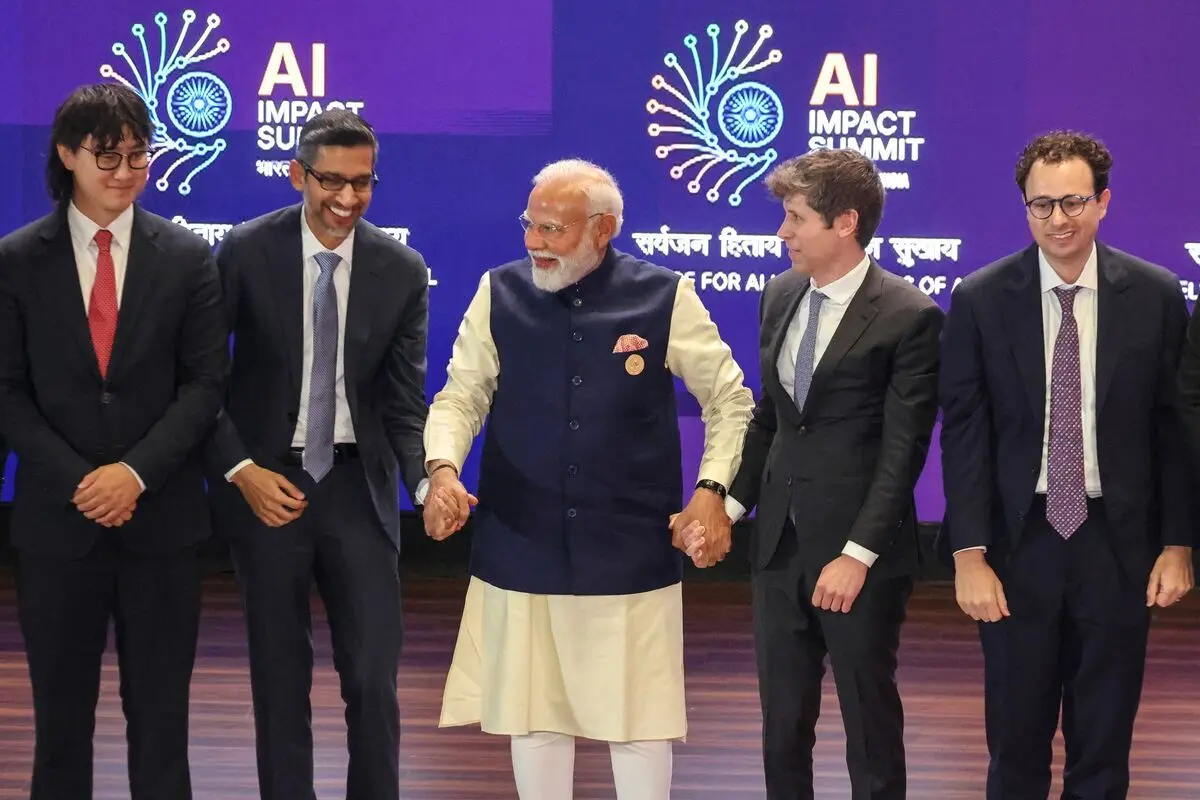
Global AI Governance Takes Center Stage in Global South
Indian officials are positioning the summit as a platform to amplify voices from developing nations in global AI governance discussions
3
. The theme reflects a commitment to harnessing AI for human-centric progress, with Modi emphasizing "welfare for all, happiness for all"3
. The summit marks an evolution from previous editions held in Bletchley Park, Seoul, and Paris, which focused primarily on safety commitments and voluntary corporate pledges3
5
.
Source: ET
Ahead of the meeting, a panel of experts released a second annual safety report examining risks posed by advanced AI systems, including misuse, malfunctions, and systemic risks
5
. Questions around regulations, ethics, and security remain central as AI rapidly transforms economies and reshapes labor markets5
.Job Displacement Concerns and Digital Infrastructure Advantages
Rapid AI adoption is threatening jobs in India's $283 billion IT sector, with investment bank Jefferies predicting call centers could face a 50% revenue hit from AI adoption by 2030
3
. Industry experts emphasize reskilling programs to hedge these risks as newer job roles emerge5
.Yet India holds distinct advantages. The country has digital infrastructure powered by data from over a billion citizens identifiable through Aadhaar, a biometric ID system
2
. By overlaying AI over existing digital identity, payment rails, and governance stacks, India aims to compress decades of development into years2
. The country is already exporting its digital blueprint through MOSIP, an open-source platform helping countries including the Philippines, Morocco, and Uganda build national ID systems2
.In AI competitiveness, India ranks third globally, trailing only the US and China, according to Stanford University's Institute for Human-Centered AI
2
. However, industry analysts caution that years of underinvestment in technology research and development may hamper growth, with India's real breakthrough dependent on strengthening its research ecosystem beyond serving as a testing lab for Silicon Valley's algorithms2
.References
Summarized by

Navi
Related Stories
India positions itself as global AI development hub with Impact Summit 2026 and startup push
02 Jan 2026•Policy and Regulation

PM Modi Advocates for India's AI Future at Paris Summit, Meets Tech Leaders
12 Feb 2025•Policy and Regulation

Akash Ambani Urges Indian Government to Accelerate AI Adoption and Data Center Policy Reform
15 Oct 2024•Business and Economy

Recent Highlights
1
Apple Plans Major Siri AI Overhaul in iOS 27 With Third-Party Chatbot Integration
Technology

2
OpenAI shuts down Sora after six months, ending Disney's $1 billion licensing partnership
Technology

3
AI chatbots validate you too much, making you less kind to others, Stanford study reveals
Science and Research

Recent Highlights
Today's Top Stories







Your Daily Dose of Curated AI News
Don’t drown in AI news. We cut through the noise - filtering, ranking and summarizing the most important AI news, breakthroughs and research daily. Spend less time searching for the latest in AI and get straight to action.

