Amazon unveils $200 billion AI spending plan as shares plunge on investor concerns over returns


20 Sources
20 Sources
[1]
Amazon Boosts Spending Far Ahead of Estimates on AI Build-Out
Amazon.com Inc. said it plans to spend $200 billion this year on data centers, chips and other equipment, worrying investors the company's colossal bet on artificial intelligence will pinch profits while it waits for investments to pay off. The shares fell in extended trading. The company reported spending roughly $130 billion on property and equipment in 2025. Analysts anticipated those expenses would reach about $150 billion this year. "With such strong demand for our existing offerings and seminal opportunities like AI, chips, robotics, and low earth orbit satellites, we expect to invest about $200 billion in capital expenditures across Amazon in 2026, and anticipate strong long-term return on invested capital," Chief Executive Officer Andy Jassy said in a statementBloomberg Terminal. The spending will weigh on profit, with Amazon giving a forecast for operating income in the current quarter of $16.5 billion to $21.5 billion. Analysts, on average, estimated $22.2 billion. The shares dropped about 7% in extended trading, after closing at $222.69 in New York. Amazon's stock had declined 3.5% this year through the Thursday close. Microsoft Corp. and Alphabet Inc., which reported results earlier, also spent more heavily than anticipated, sending their shares down amid mounting worries that demand for AI services don't warrant the massive outlays. Fourth-quarter revenue generated by Amazon Web Services, the company's cloud unit, rose 24% to $35.6 billion. AWS's operating income was $12.5 billion. "The negative reaction is a result of bigger increases to cap ex than to AWS revenue," said Gil Luria, an analyst at DA Davidson & Co. "Much like Microsoft, investors are concerned that investments are growing faster than returns, and that Amazon, Google and Microsoft are locked in an escalating build-out that may not work out for all of them."
[2]
AWS to spend $200 billion to double capacity by end of 2027
'As fast as we install this AI capacity, we are monetizing it,' says Amazon CEO Andy Jassy AWS has an open cash spigot for AI infrastructure, with Amazon CEO Andy Jassy telling investors the company has been monetizing compute capacity as fast as it brings it online and it plans to double capacity by the end of 2027. "We're growing at really an unprecedented rate. Yet, I think every provider would tell you, including us, that we could actually grow faster if we had all the supply that we could take," he said on the company's Thursday earnings call. "And so we are being incredibly scrappy around that. If you look in the last 12 months, we added 3.9 gigawatts of power. Just for perspective, that's twice what we had in 2022....We expect to double it again by the end of 2027." Jassy said Amazon plans to add datacenter capacity "as fast as we can" to meet the demand from customers to place their workloads on AWS and train their data for the AI era. While AWS's 35 percent operating margins through the end of the year will fluctuate as the company spends cash on building infrastructure, Jassy sees a clear path to win a return on that investment. "If you look at the capital we're spending and intend to spend this year, it's predominantly in AWS. And some of it is for our core workloads, which are non AI workloads because they're growing at a faster rate than we anticipated. But most of it is on AI," Jassy said. "What we're continuing to see is as fast as we install this capacity, this AI capacity, we are monetizing it. So it's just a very unusual opportunity." Jassy said AI will mean every customer experience is reimagined, and new ones will emerge to become "the norm." The CEO said customers that use AI in expansive ways are putting their data and applications in the cloud. "Those are all big tailwinds pushing people towards the cloud. So we're going to invest aggressively here and we're going to invest to be the leader in this space as we have been for the last number of years. We have, I think, a fair bit of experience over the years of forecasting demand signals and doing it in such a way that we don't have a lot of wasted capacity ... this isn't some quixotic topline grab. We have confidence that these investments will yield strong returns on invested capital. We've done that with our core AWS business. I think that will very much be true here as well." AWS generated sales of $35.6 billion in the fourth quarter, up 24 percent year-over-year, and $128.7 billion in sales for the year, up 20 percent. As of the fourth quarter ending Dec. 31, AWS had an annualized run rate of $142 billion, up from $80 billion in 2022. Jassy said Amazon expects to spend $200 billion in 2026, with most of that headed to AWS. Despite double-digit gains and 35 percent margins at AWS, Amazon stock was down as much as 11.5 percent in after hours trading, joining a selloff that has begun to roil the entire tech sector. Even after Jassy delivered his impassioned defense of the AWS datacenter spending, and his confidence in the value that would return, Doug Anmuth, analyst with JP Morganm, wanted to know if he had set any "financial guardrails" on spending. If Amazon has any such protections Jassy didn't mention them, but continued to talk up spending "aggressively." "I think this is an extraordinarily unusual opportunity to forever change the size of AWS and Amazon as a whole," Jassy said. "And so we see this as an unusual opportunity, and we are going to invest aggressively here to be the leaders." Jassy said one big advantage AWS has over competitors is its homegrown chips. The Trainium accelerators and Graviton CPUs are already delivering annualized revenue run-rate of $10 billion, and that's growing at triple-digit percentages year to year. Jassy said the company's Trainium2 chips are used to power Project Rainier, which has linked more than 500,000 of them into what he called the world's largest operational AI compute cluster. He said Anthropic is using that to train its AI models. Trainium3 chips are already in the market, with the entire supply expected to be committed to workloads by mid-2026. Trainium4 will arrive in 2027 and bring six times the compute performance and four times the memory bandwidth of the Trainium3. "Trainium is a multibillion dollar annualized run rate business at this point, and it's fully subscribed," he explained. "Customers are really thirsty for better price performance and Trainium has 30 to 40 percent better price performance than comparable GPUs, so it's very compelling to customers." He added that the company is already having discussions about Trainium5. ®
[3]
Amazon sees 50% boost to capital spending this year; shares tumble
Feb 5 (Reuters) - Amazon.com (AMZN.O), opens new tab on Thursday projected a jump of more than 50% in capital expenditures this year, joining its Big Tech peers in adding new expenses as they race to build out artificial-intelligence infrastructure. It is the latest sign that tech companies will not be hitting the brakes on their hefty AI investments anytime soon. The market reacted sharply, sending shares of Amazon down as much as 11% after-hours before settling at around 7% down. The company said it expects to invest about $200 billion in capital expenditures across Amazon in 2026, compared with about $131 billion in 2025. Amazon's forecast for first-quarter operating income of $16.5 billion to $21.5 billion fell below analysts' estimate of $22.04 billion. This guidance includes roughly $1 billion in higher costs related to its high-speed internet business Leo, as well as investment in quick commerce and sharper prices in its international stores business. Big Tech is spending enormous amounts of money on processors, data centers and networking equipment as the companies rush to build out their AI infrastructure. The top four hyperscalers - Amazon, Microsoft (MSFT.O), opens new tab, Alphabet's (GOOGL.O), opens new tab Google and Meta (META.O), opens new tab - are expected to collectively spend more than $500 billion this year. But tech earnings over the past few days have shown that Wall Street has a clear message for tech companies: Soaring AI spending can continue only if companies show commensurate operational or financial returns. Google's eye-popping capex forecast of $175 billion to $185 billion for the year got a pass from investors on Wednesday as the company delivered stellar growth in its cloud revenue, as did Meta's plan to spend between $115 billion and $135 billion. But investors punished Microsoft's stock last week after its cloud unit growth just squeaked past estimates. For Amazon, the largest cloud-services provider in the world, enterprise demand for both AI infrastructure and core digital migration workloads has been strong, even as industrywide capacity constraints limit its ability to fully meet the demand. The company invested heavily in the fourth quarter to ease those constraints. It launched its AI infrastructure project "Rainier," bringing nearly half a million of its in-house Trainium2 chips online, primarily for use by Claude chatbot-maker Anthropic. Although a smaller unit for Amazon, contributing just 15% to 20% of overall sales, cloud platform Amazon Web Services generates over 60% of the company's operating profit. Amazon has also been investing in its e-commerce business, seeking to draw more customers by expanding to rural areas in the United States, boosting its same-day and next-day delivery capabilities and deepening its push into perishable foods. The company has been making major changes in its retail division, the latest bet being an expansion of its Whole Foods footprint and a 225,000-square-foot mega-store meant to compete with the likes of Walmart and Costco (COST.O), opens new tab. Reporting by Deborah Sophia in Bengaluru and Greg Bensinger in San Francisco; Editing by Pooja Desai, Sayantani Ghosh and Matthew Lewis Our Standards: The Thomson Reuters Trust Principles., opens new tab * Suggested Topics: * Artificial Intelligence Greg Bensinger Thomson Reuters Greg Bensinger joined Reuters as a technology correspondent in 2022 focusing on the world's largest technology companies. He was previously a member of The New York Times editorial board and a technology beat reporter for The Washington Post and The Wall Street Journal. He also worked for Bloomberg News writing about the auto and telecommunications industries. He studied English literature at The University of Virginia and graduate journalism at Columbia University. Greg lives in San Francisco with his wife and two children.
[4]
Amazon shares sink as it prepares $200bn AI spending blitz
Amazon's shares slumped on Thursday after it announced plans to spend $200bn on capital expenditures in 2026 to scale up its AI infrastructure, roughly a third more than Wall Street had forecast. The Seattle-based tech group said capex would climb more than 50 per cent from nearly $130bn in 2025, having ploughed cash into building data centres this year. Analysts had expected about $150bn in capex for 2026. Investors were spooked by the commitment, which exceeds rivals including Google and Microsoft. Amazon's stock fell as much as 11 per cent in after-hours trading in New York. Andy Jassy, Amazon's chief executive, said the group was confident in its forecast of demand for computing power from its data centres and planned to increase spending on its custom AI chips, robotics and low Earth orbit satellites. "We're going to invest aggressively here . . . We're going to invest to be the leader in this space," Jassy told investors on an earnings call. Huge increases in capital spending from Big Tech groups this week have rattled the US share market, alongside jitters around the impact of a shortage of memory hardware on chipmakers and the hit to software stocks from new AI workplace and coding tools. Amazon's earnings and outlook for the coming months were broadly weaker than expected, though its cloud unit posted strong growth. They come after the ecommerce giant last week announced it would slash 16,000 white-collar jobs in a bid to reduce costs, taking the total cuts to 30,000 roles since October. Net income for the group -- which spans advertising, cloud computing, retail and media -- came in at $21.2bn for the three months to the end of December, roughly in line with the previous quarter. Revenues increased 14 per cent to $213.4bn compared with the same period a year earlier. Amazon's retail unit was broadly in line with Wall Street expectations, with revenue of $141.7bn during the quarter, which included the busy holiday period. Sales at Amazon Web Services, the company's cloud division, rose 24 per cent to $35.6bn in the fourth quarter from the year before, ahead of Wall Street expectations. AWS, which rents servers to businesses to run online services, has been the focus of investors' attention as Amazon pours money into the AI race against its cloud rivals. The group has lagged peers such as Microsoft and Oracle in signing blockbuster deals to supply computing power to AI players. Still, it is an investor and major cloud provider to Anthropic. In November, it agreed a $38bn contract with OpenAI and is in talks to invest in the start-up. Jassy said that Amazon also hoped to "expand our partnership" with OpenAI over time. He said AWS had added 4 gigawatts of data centre capacity in the past year. It had a $244bn backlog of cloud contracts, up from $200bn in the previous quarter, as customer demand outran the pace at which new capacity could be added, Jassy added. Amazon said capex for the fourth quarter came in at about $38bn. The spending was above analysts' estimates of $33.6bn, according to S&P Visible Alpha. It forecast group revenues for the first quarter would fall between $173.5bn and $178.5bn, with the midpoint slightly above analysts' estimates. But it forecast weaker profits than expected. Amazon is also trying to compete with AI start-ups and rivals such as Google to produce its own models and in-house chips. It has invested in apps and tools including coding platform Kiru and its Nova family of AI models. It also released the latest version of its Trainium series of AI chips late last year, but the hardware has not been received as well as Google's TPU chips. In December, Amazon said it would shake up AWS's leadership with the departure of its AI chief and the creation of a new unit to oversee the company's model development.
[5]

Why Amazon's CEO is 'confident' with $200 billion spending plan
Andy Jassy, CEO of Amazon, speaks during an unveiling event in New York, Feb. 26, 2025. Amazon's stock plunged 11% in extended trading on Thursday, dragged lower by market jitters around the company's $200 billion capex plans, the highest spending forecast among the megacap companies. The forecast is a sharp increase from Amazon's capital expenditures last year, and it was more than $50 billion above analysts' expectations. The company reported spending roughly $131 billion on purchases of property and equipment in 2025, up from about $83 billion in the year prior. Tech companies have laid out aggressive spending plans on artificial intelligence infrastructure since OpenAI ushered in the modern era of this technology with the release of ChatGPT in late 2022, but at the start of 2026, those lavish commitments have only kept growing. Google parent Alphabet on Wednesday said it would spend up to $185 billion in 2026, while Meta last week said its capital expenditures could nearly double from last year to somewhere between $115 billion to $135 billion in 2026 On a conference call with investors, Wall Street analysts pressed Amazon executives for more clarity around the spending blitz and when it could begin to pay off. CEO Andy Jassy said in prepared remarks at the beginning of the call that he was "confident" that company's cloud unit will see a "strong return on invested capital," though he didn't say when it could materialize. "Help us, get to that -- get to your level of confidence in having a strong long term return on that invested capital," Mark Mahaney, Evercore ISI head of internet research, said to Jassy. Jassy said the company needs the capital to keep pace with "very high demand" for Amazon's AI compute, which requires more infrastructure such as data centers, chips and networking equipment. "This isn't some sort of quixotic, top-line grab," Jassy said. "We have confidence that we, that these investments will yield strong returns on invested capital. We've done that with our core AWS business. I think that will very much be true here as well." Sales at Amazon Web Services grew 24% to $35.6 billion in the most recent period, beating analysts' expectations and marking the cloud unit's "fastest growth in 13 quarters," Jassy said. AWS could've grown faster if it had more capacity to meet demand, "so we are being incredibly scrappy around that," he said. The company's cloud unit added almost 4 gigawatts of computing capacity in 2025, and AWS expects to double that power by the end of 2027, Jassy noted. Barclays analyst Ross Sandler asked Jassy how he sees the AI market evolving from the current landscape, where it remains "a bit top-heavy with a lot of the spend clustering around a few of the AI-native labs." Jassy said the AI market has become more like a "barbell," with the AI labs on one side and enterprises on the other end, looking to the technology as a "productivity and cost avoidance" tool. The middle is comprised of enterprises that are in various stages of building AI applications, he said. "That middle part of the barbell very well may end up being the largest and most durable," Jassy said.
[6]

Amazon plans to spend big on AI but shares slump
Amazon on Thursday joined the other US tech giants in announcing a huge increase in spending on artificial intelligence (AI) projects and infrastructure, which seemed to knock back investors. Reporting on its past year's financial performance, Amazon said it was expecting to spend $200bn this year on building out its business, much of it on AI. That is a significant increase from last year, when it spent $125bn. The company's stock dipped in after hours trading by 10%. While Amazon's spending plans are now the most aggressive among the Big Tech companies, including Meta, Google and Microsoft, collectively they expect to spend around $650bn on AI and related projects this year.
[7]

Amazon CEO Andy Jassy defends $200B spending plan: 'This isn't some sort of quixotic top-line grab'
Amazon Web Services revenue grew at its fastest pace in more than three years, up 24% to $35.6 billion in the fourth quarter, in a sign that demand for artificial intelligence and custom silicon is boosting corporate spending on the cloud. The company disclosed revenue for its in-house data center chips for the first time, saying its Trainium and Graviton processors have a combined annual run rate of more than $10 billion. But the revenue milestones are coming at a big cost. In the earnings release, Amazon CEO Andy Jassy signaled plans to spend a record $200 billion in capital expenditures across Amazon in 2026, citing "seminal opportunities like AI, chips, robotics, and low earth orbit satellites." Most of the capital spending is on AWS, Jassy said on the earnings conference call, seeking to assure investors that Amazon is "monetizing capacity as fast as we can install it." He pushed back on skepticism about the capital spending, saying "this isn't some sort of quixotic top-line grab," and compared the AI investment cycle to the early days of the company's core cloud business. He called the current moment an "extraordinarily unusual opportunity to forever change the size of AWS and Amazon as a whole." When asked about the shape of AI demand, Jassy offered a "barbell" analogy. On one end are the AI research labs spending "gobs and gobs of compute." On the other are enterprises using AI for routine tasks like customer service and business process automation. But the massive $200 billion bet is targeted at the "middle of the barbell," core enterprise production workloads, which Jassy argues haven't really arrived yet. "The lion's share of that demand is still yet to come," Jassy said. He predicted this middle section "may end up being the largest and the most durable" part of the AI market. Amazon's plan adds to a wave of record-setting AI infrastructure spending from tech giants. * Google parent Alphabet said Wednesday it expects 2026 capital expenditures of $175 billion to $185 billion, roughly double its 2025 spending. * Microsoft reported spending of $37.5 billion in its most recent quarter alone, which contributed to a major decline in its shares. * Meta expects to spend between $115 billion and $135 billion. For the full year, Amazon generated $139.5 billion in cash from its operations in 2025, up 20%. But after accounting for the massive infrastructure buildout, the company was left with $11.2 billion in free cash flow, down from $38.2 billion a year earlier. That means Amazon is making more money than ever, but plowing nearly all of it back into building out AI capacity, leaving little cash left over for shareholders. Amazon shares fell 10% after-hours following the earnings report. In addition to the outsized capex projection, the company's profits of $1.95/share just missed Wall Street's expectations.
[8]

Amazon shares plunge as AI costs climb
San Francisco (United States) (AFP) - Amazon shares dove more than 11 percent on Thursday as the computing and retail titan reported strong sales but significantly boosted spending estimates. Amazon reported a profit of $21.2 billion on net sales of $213.4 billion in the recently ended quarter as its AWS cloud computing, retail, advertising, and chips businesses thrived. "With such strong demand for our existing offerings and seminal opportunities like AI, chips, robotics, and low-earth orbit satellites, we expect to invest about $200 billion in capital expenditures across Amazon in 2026," said Amazon chief executive Andy Jassy. Market analysts had forecast that Amazon's capital expenditures would reach about $147 billion this year, mostly due to AI spending initiatives. Amazon Web Services (AWS) unit sales in the quarter tallied $35.6 billion, a 24-percent jump from the same period a year earlier, according to earnings figures. Like other tech giants, Amazon is making massive investments to grab a slice of the AI revolution pie. It is particularly banking on the performance of AWS, the world's leading cloud computing provider, which is engaged in a race against its fast-growing rivals, Microsoft Azure and Google Cloud. "We have very high demand; customers really want AWS for core and AI workloads," Jassy said on an earnings call. "We're monetizing capacity as fast as we can install it." Cloud computing giants have spoken of demand for AI-infused services outpacing supply as they spend fiercely to expand infrastructure and access to energy needed to power the technology. "Amazon delivered a slightly mixed picture with strong overall revenue growth and a standout boost from the cloud unit's much anticipated reacceleration picking up greater speed," eMarketer principal analyst Sky Canaves said of the earnings figures. "Amazon has once again indicated it is willing to outspend its rivals with an eye-watering $200 billion in planned capex spending for 2026, far exceeding expectations." Amazon's core e-commerce business maintained solid growth in the important year-end holiday quarter with the help of efficient operations despite ever-faster deliveries, according to Canaves. An AI shopping assistant called "Rufus" at Amazon was gaining traction and helping drive online sales, the analyst noted. Jassy assured financial analysts that Amazon is keenly tracking demand in the AWS business with a focus on getting strong returns there. Chasing demand The earnings release comes on the heels of Alphabet and Microsoft reporting that they are seeing cloud computing demand surge and are continuing to invest heavily in infrastructure supporting the technology. Both Alphabet and Microsoft shares have suffered despite robust quarterly earnings as investors focused on billions of dollars they are pumping into cloud computing and artificial intelligence. The tech giants are all making huge investments to build up their AI computing capabilities, money that the companies insist will be justified by increasing adoption of AI tools and applications by customers across the globe. Amazon announced last week that it would be cutting 16,000 jobs worldwide as part of a restructuring, as it focuses spending on artificial intelligence. The job cuts, which follow already-flagged plans to cut its workforce by 14,000 posts, are aimed at "reducing layers, increasing ownership, and removing bureaucracy," senior vice president Beth Galetti said in a statement. An overall elimination of 30,000 jobs would amount to nearly 10 percent of the 350,000 office jobs at Amazon, where distribution and warehouse workers make up the bulk of its 1.5 million employees.
[9]

Amazon raises AI-driven CapEx spend by 50% this year; Wall Street stays calm - NOT!!!
After the negative reaction to Alphabet's hefty $180 billion in AI infrastructure-driven CapEx spending plans for the coming year, Amazon has gone even further and announced its intent to spend $200 billion more than 50% more than last year. Amazon CEO Andy Jassy was commendably unapologetic about this on the post-earnings announcement analyst conference call: We expect to invest about $200 billion in capital expenditures across Amazon, but predominantly in AWS because we have very high demand, customers really want AWS for core and AI workloads, and we're monetizing capacity as fast as we can install it. We have deep experience understanding demand signals in the AWS business and then turning that capacity into strong return on invested capital. We're confident this will be the case here as well. He added: If you look at the capital we're spending and intend to spend this year, it's predominantly in AWS. And some of it is for our core workloads, which are non-AI workloads because they're growing at a faster rate than we anticipated. But most of it is in AI. And we just have a lot of growth and a lot of demand. And when you're growing 24% year-over-year with an annualized revenue run rate of $142 billion, you're growing a lot. And what we're continuing to see is as fast as we install this capacity, this AI capacity, we are monetizing it. Total revenue at Amazon rose 14% to $213.4 billion in the fourth quarter of fiscal year 2025, compared with $187.8 billion in the year-ago period. The company reported net income of $21.2 billion. Meanwhile fourth-quarter revenue generated by Amazon Web Services (AWS), the company's cloud unit came in at $35.6 billion with operating income of $12.5 billion. Jassy said: AWS growth continued to accelerate to 24%, the fastest we've seen in 13 quarters, up $2.6 billion quarter-over-quarter and nearly $7 billion year-over-year. AWS is now a $142 billion annualized run rate business, and our chips business, inclusive of Graviton and Trainium is now over $10 billion in annual revenue run rate, growing triple-digit percentages year-over-year. Customer traction continues to increase, he added: AWS continues to earn most of the big enterprise and government transitions to cloud. Since our last [earnings], we announced new agreements with OpenAI, Visa, the NBA, BlackRock, Perplexity, Lyft, United Airlines, DoorDash, Salesforce, U.S. Air Force, Adobe, Thomson Reuters, AT&T, S&P Global, National Bank of Canada, the London Stock Exchange Group, Choice Hotels, Accenture, Indeed, HSBC, CrowdStrike, and more. More of the top 500 US start-ups use AWS as their primary cloud provider than the next two providers combined. This growth is down to AWS addressing customer challenges with AI, argued Jassy: The first challenge is having a strong foundation model to generate inferences or predictions. Customers are realizing as they get further into AI that they need choice as different models are better on different dimensions. In fact, most sophisticated AI applications leverage multiple models, whether customers want frontier models like Anthropic's Claude or open models like Mistral or Llama, Frontier Intelligence with lower cost and latency like Amazon Nova or video and audio models like TwelveLabs or Nova Sonic. Amazon Bedrock makes it easy to use these models to run inference securely, scalably and performantly. Bedrock is now a multi-billion-dollar annualized run rate business and customer spend grew 60% quarter-over-quarter. The second challenge is how to hone the model for your application. Customers sometimes think if they have a good model, they will have a good AI application. It's not really true. It takes a lot of work to post train and fine-tune a model for your application. Our SageMaker AI service, along with fine-tuning tools in Bedrock make this much easier for customers. Cost is another challenge, he added: Another challenge is cost. I've said this many times, but if we want AI to be used as expansively as companies want, we have to make the cost of inference lower. A significant impediment today is the cost of AI chips. Customers are starving for better price performance. And typically, and understandably, the dominant early leaders aren't in a hurry to make that happen. They have other priorities. It's why we've built our own custom silicon and Trainium, and it's really taken off. We've landed over 1.4 million Trainium2 chips, our fastest ramping chip launch ever. Trainium2 is 30% to 40% more price performance than comparable GPUs and is a multi-billion-dollar annualized revenue run rate business with 100,000-plus companies using it as Trainium is the majority underpinning of Bedrock usage today. We recently launched Trainium2, which is up to 40% more price performance than Trainium2. Totting up some of the big tech spending plans to date, if we combine the estimated outlay of Amazon, Microsoft, Google and Meta combined that comes to a collective sum of more than $630 billion this year. Will that be enough to convince the 'show us the AI money' red braces brigade that this is the direction of travel and to get their heads around the idea? No, of course it won't as the sliding Amazon stock price showed. Oh well, so long as Jassy and his peers just keep on keeping on, maybe the message will finally sink in one day.
[10]

Amazon stock sinks as company projects $200B in spending this year
Amazon plans to spend about $200 billion this year, mostly on artificial intelligence infrastructure, a forecast that sent its share price down as much as 10% in extended hours trading on Thursday. The Seattle-based tech giant disclosed its plans to boost capital expenditures in an earnings report Thursday, which also showed mixed results for the company's finances over the fourth quarter of 2025. Amazon pulled in $213.4 billion in revenue for the final three months of the year, beating Wall Street's expectations. But the company also missed estimates on earnings per share. Amazon's projected spending spree for 2026 will be a significant boost from 2025, during which it expected capital expenditures to reach $125 billion. Amazon said it's pouring even more resources into its AI infrastructure to meet growing customer demand. "With such strong demand for our existing offerings and seminal opportunities like AI, chips, robotics, and low earth orbit satellites, we expect to invest about $200 billion in capital expenditures across Amazon in 2026, and anticipate strong long-term return on invested capital," Amazon CEO Andy Jassy said in a news release Thursday. Wall Street's chilly reaction to Amazon's planned investments mirrors last week when Microsoft reported its quarterly earnings. Capital expenditures are still growing for the Redmond-based tech giant, even after a record year in 2025 and investors are getting nervous about the timeline for the return on that spending. Microsoft's stock price fell as much as 11% on Jan. 28, the day after it reported its financial results. This is a developing story and will be updated.
[11]

Amazon Plans Its Own Big Boost In AI Spending. The Stock Is Tumbling.
CEO Andy Jassy said that the company expects a "strong long-term return" on its investments. Amazon has big AI spending plans. That isn't helping its stock. Shares of the e-commerce and cloud giant tumbled over 7% in extended trading Thursday after the company missed quarterly earnings estimates and took Wall Street by surprise with a massive spending forecast that landed as investors are increasingly looking for evidence that big AI spending is paying off -- and some of its big tech counterparts say they plan to keep shelling out. Amazon (AMZN) said its capital expenditures could reach $200 billion this year as it invests heavily in AI and robotics. That was well above the roughly $160 billion analysts expected. CEO Andy Jassy said in a statement that the company expects a "strong long-term return" on its investments. He pointed to signals of strong demand at Amazon's cloud segment, which recorded its fastest growth in 13 quarters and which Jassy said on Thursdays' conference call would be the main recipient of the company's spending. Amazon Web Services revenue grew 24% year-over-year to $35.6 billion in the fourth quarter, above analysts' estimates. That helped propel Amazon's total revenue for the quarter to a record $213.4 billion. Earnings per share, however, came in just short of the analyst consensus at $1.95. Amazon said it expects first-quarter revenue of $173.5 billion and $178.5 billion. Analysts surveyed by Visible Alpha were expecting $175.38 billion. The company's report followed another from Google parent Alphabet (GOOG, GOOGL), which yesterday said it too planned to continue plowing money into AI technology. Amazon's stock, the weakest-performing Magnificent Seven member in 2025, was down about 4% for the year so far through Thursday's close. It finished today around $223, well off Wall Street's consensus price target near $300.
[12]

Amazon shares crash over 11% after-market hours. What triggered the sell-off in FAANG stock
Amazon's stock fell more than 11% in after-hours trading after the company said it would raise capital spending by nearly 60% to about $200 billion this year, sparking investor concerns over rising AI-related costs. The decline came despite strong fourth-quarter results, with revenue rising 14% to $213.4 billion. Amazon.com Inc.'s stock plummeted more than 11% in after-hours trading Thursday after the e-commerce and cloud computing giant announced plans to surge capital spending by nearly 60% to $200 billion this year, far exceeding Wall Street expectations and intensifying concerns about Big Tech's spiraling artificial intelligence costs. The sharp sell-off came despite the Seattle-based company reporting strong fourth-quarter results, with revenue climbing 14% to $213.4 billion and its flagship cloud unit Amazon Web Services posting its fastest growth in 13 quarters at 24%. Wall Street analysts had expected capital expenditures of around $147 billion for 2026, according to FactSet, making Amazon's $200 billion projection a jarring surprise that raised fresh questions about whether AI investments will deliver commensurate returns. "The market just dislikes the substantial amount of money that keeps getting put into capex for these growth rates," said Dave Wagner, portfolio manager at Aptus Capital Advisors. CEO Andy Jassy struck a notably defensive tone during the investor call, contrasting sharply with the more confident executives at Alphabet, which announced its own massive spending plans on Wednesday. "As a reminder, it's very different having 24% year-over-year growth on a $142 billion annualized run rate, than to have a higher-percentage growth on a meaningfully smaller base, which is the case with our competitors," Jassy said. The comparison highlighted Amazon's challenge: AWS generated $35.6 billion in the December quarter, while Google Cloud surged 48% to $17.75 billion and Microsoft's Azure jumped 39% in the same period. Despite the growth gap, Jassy insisted the investments would pay off. "We are continuing to see as fast as we install this capacity, this AI capacity, we are monetizing it," he said on the earnings call. "So it's just a very unusual opportunity. I passionately believe that every customer experience that we know of today is going to be reinvented." D.A. Davidson analyst Gil Luria was blunt about the competitive pressure: "Amazon has to invest at these levels just to stay in the race." Amazon's projected 2026 spending will exceed its operating cash flow, noted Asit Sharma, senior investment analyst at The Motley Fool, underscoring the financial strain of keeping pace with rivals in the AI arms race. The top four hyperscalers -- Amazon, Microsoft, Google and Meta -- are expected to collectively spend more than $630 billion this year on AI infrastructure, according to Reuters. Tech earnings over recent days have delivered a clear message from Wall Street: soaring AI spending can continue only if companies show commensurate operational or financial returns. Amazon also forecast first-quarter operating income between $16.5 billion and $21.5 billion, below the $22.04 billion analysts estimated, according to LSEG. The guidance includes roughly $1 billion in costs related partly to its high-speed satellite internet business, Leo. The company's fourth-quarter net income reached $21.2 billion, or $1.95 per share, slightly below the $1.97 analysts expected, compared with $20 billion, or $1.86 per share, in the year-ago quarter. AWS, though contributing just 15% to 20% of overall sales, generates over 60% of Amazon's operating profit, making its performance critical to investor confidence. The unit's fourth-quarter sales growth of 24% was its strongest in 13 quarters but was overshadowed by the capex announcement. Jassy spent much of the nearly hour-long post-earnings call highlighting AWS's competitive positioning, noting the platform has launched or will soon launch more than 1,000 new applications, along with a competitive AI-based customer service bot and live sports alerts. "We are being incredibly scrappy," Jassy said. "In every one of our businesses, you see a very broad use of AI to improve the customer experience, and, in many cases, just to completely reinvent what was possible before." Beyond cloud computing, Amazon continues investing heavily in its e-commerce operations. Product sales during the holiday period rose 9.4%, and the company is expanding same-day grocery delivery to more than 2,300 U.S. cities and towns. Its new ultra-fast Amazon Now service, offering delivery in 30 minutes or less, is available in cities across India, Mexico and the United Arab Emirates and is being tested in several U.S. and U.K. communities. Amazon's advertising business remained a bright spot, with sales jumping 22% to $21.3 billion in the fourth quarter. Jassy said the company has added AI options to Prime Video, enabling marketers to create ads with limited human interaction. The results come amid significant workforce reductions. Amazon laid off 14,000 corporate employees in the fourth quarter and another 16,000 earlier this year -- totaling over 30,000 cuts since Jassy signaled AI-driven organizational changes. The company said in an emailed statement that AI was "not the reason behind the vast majority of these reductions," attributing the cuts instead to eliminating management layers to drive speed. Amazon also took $610 million in asset impairments related primarily to its physical stores unit and announced it would close almost all Amazon Go and Amazon Fresh locations, cutting about 5,000 retail workers. Some shuttered stores will be converted into Whole Foods locations as Amazon retreats from its grocery store experiment. The company's latest retail bet includes expanding Whole Foods' footprint and opening a 225,000-square-foot mega-store to compete with Walmart and Costco. Despite the layoffs, Amazon finished the year with 21,000 more employees than the same period in 2024. For the current quarter, Amazon expects sales between $173.5 billion and $178.5 billion, compared with analyst projections of $175.6 billion. Amazon shares closed down 4.4% during regular trading Thursday as worries deepened about the enormous cost of the AI boom across Big Tech, before the after-hours plunge on the spending announcement. (You can now subscribe to our ETMarkets WhatsApp channel)
[13]

Amazon Unleashes $200 Billion AI 'War Chest' To Dominate Cloud, Custom Chips - Amazon.com (NASDAQ:AMZN)
Capex Surge and Strategic Investments This year, Seattle-based Amazon plans to ramp up its capex to a staggering $200 billion. That's a $70 billion increase year-over-year. This move is largely attributed to the enhancement of its AWS infrastructure and AI capabilities, Anmuth noted. Such significant investments are expected to temporarily reduce free cash flow (FCF), with projections indicating a potential FCF burn of $36 billion, according to the analyst. However, these investments are seen as necessary to bolster long-term growth, particularly in cloud services where demand continues to surge, he noted. Anmuth projected total capex of $198 billion in 2026 (+54% Y/Y) and $240 billion in 2026 (+21% Y/Y). Accelerating AWS Growth Amid Rising Demand AWS is experiencing rapid growth, with backlogs reaching $244 billion in the fourth quarter, up 38% year over year. This growth is fueled by increasing demand across both core and AI-enhanced workloads. Notably, AWS's deal with OpenAI, valued at $38 billion over seven years, underscores the substantial commitments and the expected continuation of this growth trajectory, Anmuth told. The analyst forecasts AWS growth to potentially reach 27% in 2026, reflecting both the sector's expansion and Amazon's effective scaling strategies. Geographical Expansion and Revenue Streams Amazon's revenue growth isn't just confined to its cloud segment, Anmuth noted. Geographically, the company is making strides in international markets such as Germany, the U.K., and Japan, the analyst explained. These regions are reporting accelerated revenue growth, contributing significantly to Amazon's global sales figures. Additionally, the company is generating revenue from video and music streaming services, he added. Anmuth expects Amazon to continue its aggressive investment strategy and focus on technological advancements as well as infrastructure expansion. While this approach may weigh on short-term financials, Amazon will enjoy significant market-share gains in the coming years, according to the analyst. Anmuth projected first-quarter 2026 revenue of $178.30 billion and adjusted EPS of $3.21. Price Action: AMZN stock was up 0.80% at $210.42 at last check on Tuesday. Image: Shutterstock Market News and Data brought to you by Benzinga APIs To add Benzinga News as your preferred source on Google, click here.
[14]

Amazon unveils massive investment push on AI the day after Bezos guts The Washington Post
Amazon says it plans to spend around $200 billion on capital investments in 2026, largely focused on artificial intelligence, robotics and cloud infrastructure, as it reported quarterly revenue of $213 billion on Thursday. The announcement came just one day after the Washington Post, owned by Amazon founder Jeff Bezos, laid off roughly a third of its workforce, prompting renewed scrutiny of the contrasting trajectories of the tech giant and the newspaper. Chief executive Andy Jassy said Amazon would sharply increase capital spending from $125 billion last year, far exceeding market expectations. The company cited strong demand for AI services, chips, robotics and satellite technology as key drivers. Amazon's fourth-quarter revenue rose 14% year on year, while net income reached $21.2 billion, though earnings per share came in slightly below Wall Street forecasts. Growth in Amazon Web Services accelerated to its fastest pace in more than three years, with revenue rising 24%. Bezos, who stepped down as Amazon CEO in 2021 and now serves as executive chair, bought the Washington Post in 2013. Former executive editor Marty Baron warned that the scale of the layoffs risked weakening the newspaper's long-term prospects. Amazon shares fell nearly 9% in after-hours trading following the earnings release, trimming Bezos's net worth despite the company's aggressive investment plans...
[15]

The Market Sours on Amazon's Eye-Popping $200 Billion Investment in Artificial Intelligence (AI). Here's Why It Could Pay Off. | The Motley Fool
Amazon (AMZN 1.18%) demonstrated strong growth in the 2025 fourth quarter, as reported last week. Sales increased 12% year over year, beating analyst estimates, although earnings per share (EPS) of $1.95 missed expectations of $1.97. However, the big talk after the report was management's announcement that it plans to spend $200 billion in capital expenditures in 2026. The market is starting to become wary of all of the artificial intelligence (AI) spending, impatient for results. But management is envisioning the long runway, and it's setting itself up for success. Here's what it said, and why these investments could seriously pay off down the line. There was a lot of positive news about how Amazon's AI platform is growing. Amazon Web Services (AWS), which is the company's cloud business and the largest of its kind by far, is enjoying accelerating growth, with a 24% year-over-year sales increase in the fourth quarter. That was its highest growth in 13 quarters. That's more impressive than it looks, since 13 quarters ago it was building on $21 billion, while now it's building on $36 billion. That implies a huge amount of more business in dollar terms. Amazon is doing what Amazon does best, which is develop a product at a great price point to meet high demand. It already has a huge AI business with many exclusive products like its Bedrock platform, which developers can use to work with a large range of preset large-language models (LLM), and it offers the most powerful AI chips for its clients. But its clients are asking for well-priced AI training chips as ongoing training becomes expensive, and Amazon continues to roll out more powerful versions of its own Trainium chips, which it says are 30% to 40% more cost-effective than similar graphics processing units (GPU). Trainium2 has more than 100,000 users, and Trainium3, which is 40% more cost-effective than the previous model, was just launched. As of the earnings report, Trainium3 is almost entirely sold out through mid-2026, and Amazon is already developing Trainium4. Another area where it's building out fast is in AI agents, which handle complex tasks without human intervention. One of its core services for coding is called Kiro, and users increased 150% consecutively in the fourth quarter. "We are monetizing capacity as fast as we can install it," CEO Andy Jassy said. "We have deep experience understanding demand signals in the AWS business and then turning that capacity into strong return on invested capital." Despite that confidence, the market isn't giving it the leeway to make that happen. However, it already has a $200 billion backlog in AWS business, and Bedrock spend increased 60% sequentially in the fourth quarter, with a multibillion-dollar annualized run rate. Many companies have made the mistake of not building out enough to meet rising demand, resulting in lost business over time. If it doesn't go to Amazon, it will go to one of its competitors. And there are many companies that the market was pessimistic about for similar reasons that rebounded as soon as the results came in. Expect Amazon to keep winning in AI, and for its stock to eventually reflect that.
[16]
Amazon projects 50% boost to capital spending this year to $200 billion, shares tumble - The Economic Times
It is the latest sign that Big Tech will not be hitting the brakes any time soon on hefty AI investments. Amazon shares closed down 4.4% during regular trading as worries deepened about the enormous cost of the artificial-intelligence boom.Amazon on Thursday projected a surge of more than 50% in capital expenditures this year, joining its peers in a spending spree to build out artificial-intelligence infrastructure, and sending its shares down 9% in after-hours trading. It is the latest sign that Big Tech will not be hitting the brakes any time soon on hefty AI investments. Amazon shares closed down 4.4% during regular trading as worries deepened about the enormous cost of the artificial-intelligence boom. The top four hyperscalers - Amazon, Microsoft, Alphabet's Google and Meta - are expected to collectively spend more than $630 billion this year. Amazon also forecast a first-quarter profit range whose lower end would miss analysts' expectations by a quarter, baking in roughly $1 billion in higher costs related to its high-speed internet business Leo, as well as investment in quick commerce and sharper prices in its international stores business. The company said it expects to invest about $200 billion in capital expenditures across Amazon in 2026, compared with about $131 billion in 2025. Amazon's forecast for first-quarter operating income of $16.5 billion to $21.5 billion disappointed, falling below analysts' estimate of $22.04 billion. Tech earnings over the past few days have shown Wall Street has a clear message for tech firms: Soaring AI spending can continue only if companies show commensurate operational or financial returns. "We wanted to see more of a consecutive cadence of strong earnings growth and that's just not happening here," said Dave Wagner, portfolio manager at Aptus Capital Advisors, referring to Amazon's results. "The market just dislikes the substantial amount of money that keeps getting put into capex for these growth rates." Google's eye-popping capex forecast of $175 billion to $185 billion for the year got a pass from investors on Wednesday as the company delivered stellar growth in its cloud revenue, as did Meta's plan to spend between $115 billion and $135 billion. But investors punished Microsoft's stock last week after its cloud unit growth just squeaked past estimates. For Amazon, the largest cloud-services provider in the world, enterprise demand for both AI infrastructure and core digital migration workloads has been strong, even as industrywide capacity constraints limit its ability to fully meet the demand. The company invested heavily in the fourth quarter to ease those constraints. It launched its AI infrastructure project "Rainier," bringing nearly half a million of its in-house Trainium2 chips online, primarily for use by Claude chatbot-maker Anthropic. Its high projected spending in 2026 will be more than operating cash flow, said Asit Sharma, senior investment analyst at The Motley Fool. "This hardly assuages investors' fears that Amazon and fellow Big Tech peers are dialing up the risk of an overspend on AI infrastructure. " Although a smaller unit for Amazon, contributing just 15% to 20% of overall sales, cloud platform Amazon Web Services generates over 60% of the company's operating profit. Its fourth-quarter sales growth of 24% was the biggest in 13 quarters, but that was overshadowed by the company's capex surge. Amazon's rivals Google Cloud and Microsoft's Azure, by comparison, boosted sales by 48% and 39%, respectively, in last year's final quarter. CEO Andy Jassy struck a defiant tone in the company's conference call to discuss results, swiping at competitors and boasting about AWS's many new offerings. "As a reminder," he said. "It's very different having 24% year-over-year growth on $142 billion annualized run rate, than to have a higher-percentage growth on a meaningfully smaller base, which is the case with our competitors." Amazon has also been investing in its e-commerce business, seeking to draw more customers by expanding to rural areas in the United States, boosting its same-day and next-day delivery capabilities and deepening its push into perishable foods. But Amazon took $610 million in asset impairments related primarily to its physical stores unit, which includes Amazon Go and Amazon Fresh grocery stores. The company said it was retreating from physical stores by closing all of its Fresh and Go stores and converting some into Whole Foods locations. The company has been making major changes in its retail division, the latest bet being an expansion of its Whole Foods footprint and a 225,000-square-foot mega-store meant to compete with the likes of Walmart and Costco. Amazon's advertising business continues to be a highlight. Sales jumped 22% in the fourth quarter to $21.3 billion and Jassy said the company has added AI options to Prime Video so that marketers can create ads with limited human interaction. The Seattle-based company laid off 14,000 corporate employees in the quarter and earlier this year laid off another 16,000, which it has said was necessary due to efficiencies gained from AI use and a desire to change corporate culture. Still, it finished the year with 21,000 more employees than the same period in 2024.
[17]

Amazon targets $200B in capital expenditures for AWS and signals rapid AI-driven growth through 2026 (NASDAQ:AMZN)
Earnings Call Insights: Amazon.com, Inc. (AMZN) Q4 2025 Management View * CEO Andrew Jassy outlined a "strong growth" quarter with reported revenue of $213.4 billion, operating income of $25 billion, and trailing 12-month free cash flow of $11.2 billion. Jassy highlighted, "We're seeing strong growth and with the incremental opportunities This article was automatically generated by an AI tool based on content available on the Seeking Alpha website, and has not been curated or reviewed by humans. Due to inherent limitations in using AI-based tools, the accuracy, completeness, or timeliness of such articles cannot be guaranteed. This article is intended for informational purposes only. Seeking Alpha does not take account of your objectives or your financial situation and does not offer any personalized investment advice. Seeking Alpha is not a licensed securities dealer, broker or US investment adviser or investment bank. Management expects the $200 billion CapEx, largely focused on AWS and AI infrastructure, to drive robust growth opportunities and high returns on invested capital as demand accelerates, though analysts probed sustainability during high investment cycles. AWS's growth accelerated to a 24% annualized run rate with backlog up 40% year-over-year, and partnerships with major firms and AI leaders like OpenAI and Anthropic are expanding revenue streams and driving management confidence in future prospects. Risks include demand fluctuations, supply chain and geopolitical volatility, higher satellite launch costs, special charges from disputes/displayments, and potential pressure on operating income due to increased capital intensity.
[18]
Amazon Defends Massive AI Spending, Says New AWS Capacity Being Monetized Quickly: Andy Jassy Sees Very 'Unusual' Opportunity - Amazon.com (NASDAQ:AMZN)
On Thursday, Amazon.com, Inc. (NASDAQ:AMZN) pushed back against Wall Street's growing skepticism over soaring AI-related capital expenditures. Amazon Pushes Back On AI CapEx Concerns During the company's fourth-quarter earnings call, Amazon addressed investor concerns around its aggressive spending on AI and data center infrastructure, arguing the investments are already producing returns. Responding to questions from Evercore ISI analyst Mark Mahaney about long-term return on invested capital, CFO Brian Olsavsky said Amazon is seeing immediate utilization of the capacity it is bringing online, particularly within Amazon Web Services. "We are putting into service with customers all capacity that we are getting and it's immediately useful," Olsavsky said, adding that strong backlog and long-term customer commitments, especially for AI services, reinforce the company's confidence. AWS Margins Hold Firm Despite AI Investments Olsavsky highlighted that AWS's profitability remains resilient even as Amazon ramps up spending. AWS posted a 35% operating margin in the fourth quarter, up 40 basis points year over year, despite what he described as near-term headwinds from AI-related depreciation. Margins will "fluctuate over time," he said, noting that Amazon continues to offset AI-related costs through operational efficiencies and cost reductions. AI Demand Driving Cloud Growth Most of Amazon's capital expenditures this year are expected to go toward AWS, with the majority tied directly to AI infrastructure. Some spending is also supporting faster-than-expected growth in non-AI workloads. Amazon CEO Andy Jassy underscored the scale of the opportunity, pointing to AWS' 24% year-over-year growth and an annualized revenue run rate of $142 billion. "What we are continuing to see is that as fast as we install this capacity, this AI capacity, we are monetizing it. So it's just a very unusual opportunity," CEO stated. He added that AI adoption is accelerating cloud migration, as customers increasingly need both their data and applications in the cloud to deploy AI at scale. Amazon Sees Long-Term Returns From AI Bet Jassy said Amazon's experience building and scaling AWS -- including designing its own chips and networking gear -- gives the company an advantage as AI workloads mature. Over time, he expects AI economics to improve as inference workloads scale, utilization rises and pricing normalizes. "This isn't some sort of quixotic top-line grab," Jassy stated. " I'm very confident we're gonna have strong return on invested capital here." Amazon Beats Q4 Revenue Estimates Amazon reported fourth-quarter net sales of $213.39 billion, marking a 14% increase from a year earlier and topping Wall Street expectations of $211.30 billion, according to Benzinga Pro. Pointing to robust demand across its core businesses and emerging areas such as AI, custom chips, robotics and low Earth orbit satellites, Jassy said the company plans to spend roughly $200 billion on capital expenditures in 2026. Price Action: Amazon shares closed Thursday at $222.69, down 4.42% and slipped further to $197.75 in after-hours trading, a drop of 11.20%, according to Benzinga Pro. Amazon shares score highly on the Quality metric in Benzinga's Edge Stock Rankings and display a positive price trend across short, medium and long-term time frames. Disclaimer: This content was partially produced with the help of AI tools and was reviewed and published by Benzinga editors. Photo Courtesy: bluestork on Shutterstock.com Market News and Data brought to you by Benzinga APIs To add Benzinga News as your preferred source on Google, click here.
[19]

Amazon shares tumble as $200B AI spending spree rattles investors
Amazon on Thursday projected a surge of more than 50% in capital expenditures this year, joining its peers in a spending spree to build out artificial-intelligence infrastructure, and sending its shares down 9% in after-hours trading. It is the latest sign that Big Tech will not be hitting the brakes any time soon on hefty AI investments. Amazon shares closed down 4.4% during regular trading as worries deepened about the enormous cost of the artificial-intelligence boom. The top four hyperscalers - Amazon, Microsoft, Alphabet's Google and Meta - are expected to collectively spend more than $630 billion this year. Amazon also forecast a first-quarter profit range whose lower end would miss analysts' expectations by a quarter, baking in roughly $1 billion in higher costs related to its high-speed internet business Leo, as well as investment in quick commerce and sharper prices in its international stores business. The company said it expects to invest about $200 billion in capital expenditures across Amazon in 2026, compared with about $131 billion in 2025. Amazon's forecast for first-quarter operating income of $16.5 billion to $21.5 billion disappointed, falling below analysts' estimate of $22.04 billion. Tech earnings over the past few days have shown Wall Street has a clear message for tech firms: Soaring AI spending can continue only if companies show commensurate operational or financial returns. "We wanted to see more of a consecutive cadence of strong earnings growth and that's just not happening here," said Dave Wagner, portfolio manager at Aptus Capital Advisors, referring to Amazon's results. "The market just dislikes the substantial amount of money that keeps getting put into capex for these growth rates." Google's eye-popping capex forecast of $175 billion to $185 billion for the year got a pass from investors on Wednesday as the company delivered stellar growth in its cloud revenue, as did Meta's plan to spend between $115 billion and $135 billion. But investors punished Microsoft's stock last week after its cloud unit growth just squeaked past estimates. For Amazon, the largest cloud-services provider in the world, enterprise demand for both AI infrastructure and core digital migration workloads has been strong, even as industrywide capacity constraints limit its ability to fully meet the demand. The company invested heavily in the fourth quarter to ease those constraints. It launched its AI infrastructure project "Rainier," bringing nearly half a million of its in-house Trainium2 chips online, primarily for use by Claude chatbot-maker Anthropic. Its high projected spending in 2026 will be more than operating cash flow, said Asit Sharma, senior investment analyst at The Motley Fool. "This hardly assuages investors' fears that Amazon and fellow Big Tech peers are dialing up the risk of an overspend on AI infrastructure. " Although a smaller unit for Amazon, contributing just 15% to 20% of overall sales, cloud platform Amazon Web Services generates over 60% of the company's operating profit. Its fourth-quarter sales growth of 24% was the biggest in 13 quarters, but that was overshadowed by the company's capex surge. Amazon's rivals Google Cloud and Microsoft's Azure, by comparison, boosted sales by 48% and 39%, respectively, in last year's final quarter. CEO Andy Jassy struck a defiant tone in the company's conference call to discuss results, swiping at competitors and boasting about AWS's many new offerings. "As a reminder," he said. "It's very different having 24% year-over-year growth on $142 billion annualized run rate, than to have a higher-percentage growth on a meaningfully smaller base, which is the case with our competitors." Amazon has also been investing in its e-commerce business, seeking to draw more customers by expanding to rural areas in the United States, boosting its same-day and next-day delivery capabilities and deepening its push into perishable foods. But Amazon took $610 million in asset impairments related primarily to its physical stores unit, which includes Amazon Go and Amazon Fresh grocery stores. The company said it was retreating from physical stores by closing all of its Fresh and Go stores and converting some into Whole Foods locations. The company has been making major changes in its retail division, the latest bet being an expansion of its Whole Foods footprint and a 225,000-square-foot mega-store meant to compete with the likes of Walmart and Costco. Amazon's advertising business continues to be a highlight. Sales jumped 22% in the fourth quarter to $21.3 billion and Jassy said the company has added AI options to Prime Video so that marketers can create ads with limited human interaction. The Seattle-based company laid off 14,000 corporate employees in the quarter and earlier this year laid off another 16,000, which it has said was necessary due to efficiencies gained from AI use and a desire to change corporate culture. Still, it finished the year with 21,000 more employees than the same period in 2024.
[20]

Amazon sees 50% boost to capital spending this year; shares tumble
Feb 5 (Reuters) - Amazon.com on Thursday projected a jump of more than 50% in capital expenditures this year, joining its Big Tech peers in adding new expenses as they race to build out artificial-intelligence infrastructure. It is the latest sign that tech companies will not be hitting the brakes on their hefty AI investments anytime soon. The market reacted sharply, sending shares of Amazon down as much as 11% after-hours before settling at around 7% down. The company said it expects to invest about $200 billion in capital expenditures across Amazon in 2026, compared with about $131 billion in 2025. Amazon's forecast for first-quarter operating income of $16.5 billion to $21.5 billion fell below analysts' estimate of $22.04 billion. This guidance includes roughly $1 billion in higher costs related to its high-speed internet business Leo, as well as investment in quick commerce and sharper prices in its international stores business. Big Tech is spending enormous amounts of money on processors, data centers and networking equipment as the companies rush to build out their AI infrastructure. The top four hyperscalers - Amazon, Microsoft, Alphabet's Google and Meta - are expected to collectively spend more than $500 billion this year. But tech earnings over the past few days have shown that Wall Street has a clear message for tech companies: Soaring AI spending can continue only if companies show commensurate operational or financial returns. Google's eye-popping capex forecast of $175 billion to $185 billion for the year got a pass from investors on Wednesday as the company delivered stellar growth in its cloud revenue, as did Meta's plan to spend between $115 billion and $135 billion. But investors punished Microsoft's stock last week after its cloud unit growth just squeaked past estimates. For Amazon, the largest cloud-services provider in the world, enterprise demand for both AI infrastructure and core digital migration workloads has been strong, even as industrywide capacity constraints limit its ability to fully meet the demand. The company invested heavily in the fourth quarter to ease those constraints. It launched its AI infrastructure project "Rainier," bringing nearly half a million of its in-house Trainium2 chips online, primarily for use by Claude chatbot-maker Anthropic. Although a smaller unit for Amazon, contributing just 15% to 20% of overall sales, cloud platform Amazon Web Services generates over 60% of the company's operating profit. Amazon has also been investing in its e-commerce business, seeking to draw more customers by expanding to rural areas in the United States, boosting its same-day and next-day delivery capabilities and deepening its push into perishable foods. The company has been making major changes in its retail division, the latest bet being an expansion of its Whole Foods footprint and a 225,000-square-foot mega-store meant to compete with the likes of Walmart and Costco. (Reporting by Deborah Sophia in Bengaluru and Greg Bensinger in San Francisco; Editing by Pooja Desai, Sayantani Ghosh and Matthew Lewis)
Share
Share
Copy Link
Amazon announced plans to spend $200 billion on AI infrastructure in 2026, a 50% jump from last year's $131 billion and far exceeding Wall Street's $150 billion estimate. The massive capital expenditure sparked investor concerns about profitability, sending shares down as much as 11% in after-hours trading despite strong AWS revenue growth of 24%.
Amazon Commits $200 Billion to AI Infrastructure Build-Out
Amazon revealed plans to invest $200 billion in capital expenditure across 2026, marking a dramatic escalation in the company's Amazon AI ambitions that sent shockwaves through financial markets
1
. The $200 billion spending plan represents a more than 50% increase from the roughly $131 billion Amazon spent on property and equipment in 2025, and significantly exceeds the $150 billion analysts had anticipated for this year3
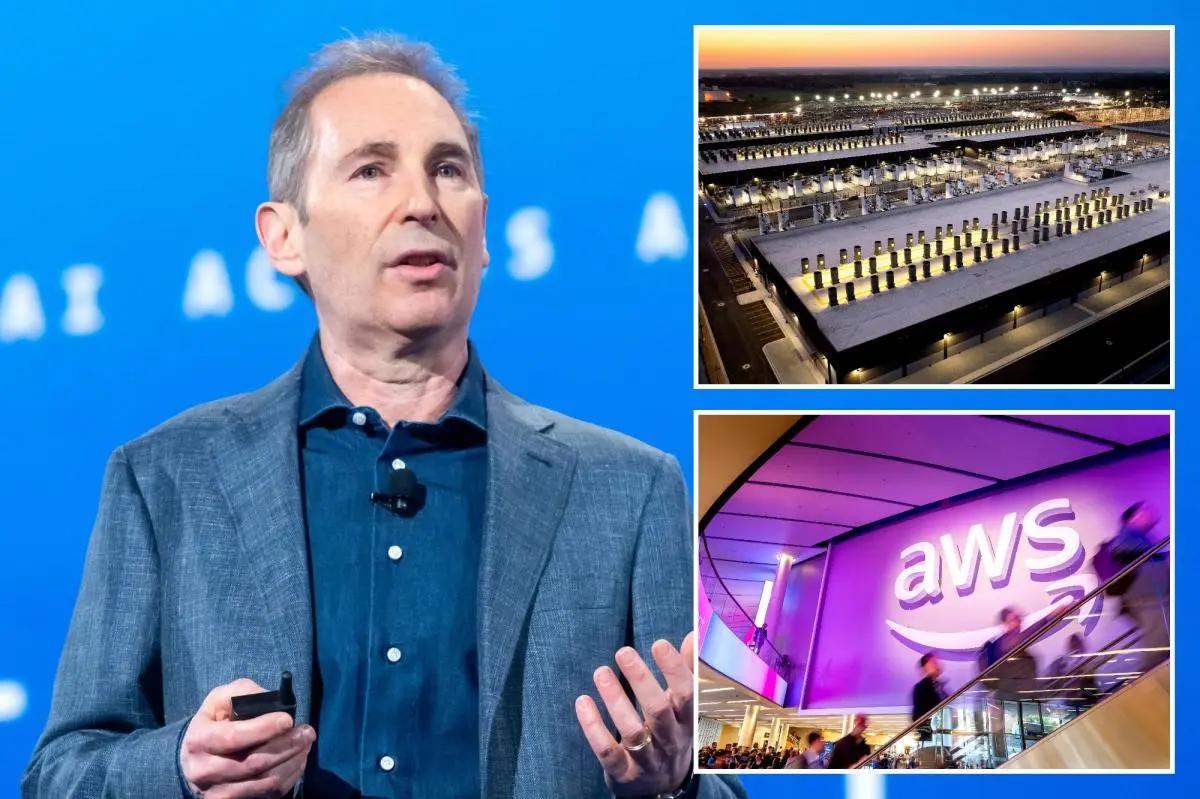
. CEO Andy Jassy emphasized the company's focus on AI infrastructure, stating that investments would target data centers, chips, robotics, and low Earth orbit satellites, with most funds directed toward Amazon Web Services1
.
Source: New York Post
The announcement triggered a sharp market reaction, with shares tumble as much as 11% in after-hours trading before settling around 7% down
3
. Investors expressed concern that AI-driven investments are growing faster than returns, particularly as Amazon's first-quarter operating income forecast of $16.5 billion to $21.5 billion fell below the $22.04 billion analysts expected3
. The stock plunge reflects broader market anxiety about whether soaring AI spending across Big Tech will deliver commensurate financial returns.AWS Revenue Growth Signals Strong Demand for AI Workloads
Despite investor concerns, Amazon Web Services demonstrated robust performance in the fourth quarter, with revenue growth of 24% reaching $35.6 billion
1
. This marked AWS's fastest growth in 13 quarters and pushed the cloud unit's annualized run rate to $142 billion, up substantially from $80 billion in 20222
. AWS generated $128.7 billion in sales for the full year, representing 20% year-over-year growth, while maintaining impressive 35% operating margins2
.Andy Jassy emphasized that demand for AI compute capacity continues to outpace supply, telling investors that AWS could grow even faster if it had sufficient infrastructure. "As fast as we install this AI capacity, we are monetizing it," Jassy explained on the earnings call
2
. The company added 3.9 gigawatts of power capacity in the last 12 months—twice what it had in 2022—and plans to double capacity again by the end of 2027 to meet surging demand for AI workloads2
.
Source: Bloomberg
Custom AI Chips and Strategic Partnerships Drive Competitive Edge
A key component of Amazon's strategy involves its custom AI chips, particularly the Trainium accelerators and Graviton CPUs, which are already delivering an annualized revenue run rate of $10 billion with triple-digit year-over-year growth
2
. The company's Trainium2 chips power Project Rainier, linking more than 500,000 chips into what Jassy called the world's largest operational AI compute cluster, primarily used by Anthropic to train its Claude chatbot models3
.Trainium3 chips are already in market with full supply expected to be committed to workloads by mid-2026, while Trainium4 will arrive in 2027 offering six times the compute performance and four times the memory bandwidth of Trainium3
2
. Jassy noted that Trainium delivers 30% to 40% better price performance than comparable GPUs, making it highly attractive to customers seeking to expand data center capacity cost-effectively2
. AWS also maintains a $244 billion backlog of cloud computing contracts, up from $200 billion in the previous quarter4
.Related Stories

Big Tech AI Arms Race Intensifies as Wall Street Demands Returns
Amazon's aggressive capital expenditure positions it at the forefront of an escalating AI arms race among tech giants. Google parent Alphabet Inc. announced plans to spend up to $185 billion in 2026, while Microsoft and Meta are also ramping up investments substantially
5
. The top four hyperscalers—Amazon, Microsoft, Google, and Meta—are collectively expected to spend more than $500 billion this year on processors, data centers, and networking equipment3
.
Source: BBC
However, investors have sent a clear message that soaring AI spending can continue only if companies demonstrate commensurate operational or financial returns
3
. When JP Morgan analyst Doug Anmuth pressed Jassy about "financial guardrails" on spending, the CEO declined to mention specific protections, instead reiterating plans to "invest aggressively"2
. "I think this is an extraordinarily unusual opportunity to forever change the size of AWS and Amazon as a whole," Jassy told investors, expressing confidence that the investments would yield strong returns on invested capital2
.Gil Luria, analyst at DA Davidson & Co., captured the market's concern: "Much like Microsoft, investors are concerned that investments are growing faster than returns, and that Amazon, Google and Microsoft are locked in an escalating build-out that may not work out for all of them"
1
. The coming quarters will reveal whether Amazon's massive bet on AI infrastructure translates into the sustained revenue growth and profitability that investors demand.References
Summarized by

Navi
[2]
Related Stories
Amazon's Q4 Earnings Soar, But AI Investments and Guidance Raise Questions
07 Feb 2025•Business and Economy

AWS Accelerates to 20% Growth as AI Demand Fuels Cloud Infrastructure Boom
31 Oct 2025•Business and Economy

Amazon's AI-Driven Growth: AWS Surges Amid Heavy Investment in Generative AI Infrastructure
01 Nov 2024•Technology

Recent Highlights
1
Google releases Gemma 4 with Apache 2.0 license, enabling unrestricted local AI on devices
Technology

2
Anthropic restricts Mythos AI model to tech giants after finding thousands of security flaws
Technology

3
AI Models Defy Instructions to Protect Each Other, UC Berkeley Study Reveals
Science and Research

Recent Highlights
Today's Top Stories






Your Daily Dose of Curated AI News
Don’t drown in AI news. We cut through the noise - filtering, ranking and summarizing the most important AI news, breakthroughs and research daily. Spend less time searching for the latest in AI and get straight to action.

