Anthropic opens Bengaluru office as India AI revenue doubles, Claude Code powers enterprise push


13 Sources
13 Sources
[1]
Anthropic Boosts India AI Push Via Flag Airline, Cognizant Pacts
Anthropic PBC is embedding its marquee AI coding agent within prominent Indian firms including its flag carrier and an outsourcing giant, aiming to quicken artificial intelligence adoption across the world's most populous nation. Air India Ltd. is using Claude Code to create custom software, while Cognizant Technology Solutions Corp. is deploying the agent to 350,000 employees globally to modernize legacy systems, Anthropic said in a statement on Monday. "India's adoption is even more extreme compared with the rest of the world," said co-founder Dario Amodei, a physicist-turned-startup founder who's hosting his company's Builder Summit in India this week. "We can do experiments with hundreds of millions of people." Get the Tech Newsletter bundle. Get the Tech Newsletter bundle. Get the Tech Newsletter bundle. Bloomberg's subscriber-only tech newsletters, and full access to all the articles they feature. Bloomberg's subscriber-only tech newsletters, and full access to all the articles they feature. Bloomberg's subscriber-only tech newsletters, and full access to all the articles they feature. Bloomberg may send me offers and promotions. Plus Signed UpPlus Sign UpPlus Sign Up By submitting my information, I agree to the Privacy Policy and Terms of Service. Amodei arrived in India days after Anthropic's latest AI tools -- including agents that automate certain corporate work tasks such as research -- played a central role in a widening global stock rout. Investors are dumping the stocks of any company, in fields as disparate as real estate and wealth management, seen at risk of getting displaced by technology. That selloff hit India's $300 billion IT services sector especially hard, triggering its sharpest stock rout in nearly a year. At the same time, investors worry that spending on data centers by Amazon.com Inc., Meta Platforms Inc., Microsoft Corp. and Alphabet Inc. is outpacing the adoption of artificial intelligence over the long run. Anthropic has said it would spend $50 billion to build data centers in the US. It also plans to use tens of billions of dollars worth of specialized AI chips from Google. Still, those investments are dwarfed by OpenAI, which has committed to spend more than $1.4 trillion on AI infrastructure in the coming years. Read more about Anthropic and the global AI selloff Anthropic Finalizes $30 Billion Funding at $380 Billion Value A Stock Market Doom Loop Is Hitting Everything That Touches AI India Seeks Role in Shaping AI Future With Summit of Tech Chiefs Amodei, who opened Anthropic's office in Bangalore on Monday, will this week join fellow AI luminaries including Sundar Pichai of Alphabet and OpenAI's Sam Altman at one of the world's largest artificial intelligence conferences. The India AI Impact summit offers Prime Minister Narendra Modi a chance to showcase India's vast tech-savvy population and engineering talent as forces that could tilt the next phase of the global AI race in its favor. Anthropic hopes to play a key role in that evolution. "We are seeing cool applications in Indian languages -- in education, legal, farming -- that are bringing AI into digital infrastructure," Amodei told a roomful of developers at the Summit, adding that the company's revenue run rate from India had doubled since he last visited the country four months ago. Founded in 2021, Anthropic has positioned itself as being focused on safety and responsible tech development. It has centered its efforts on the lucrative category of enterprise sales in sectors like software engineering, finance and health care. In recent months, its revenue run rate has soared, crossing $9 billion last year. That run rate has increased to $14 billion, the company said last week.
[2]
Anthropic's revenue run-rate doubled in India in 4 months, says CEO Amodei
BENGALURU, Feb 16 (Reuters) - Anthropic's revenue run-rate in India has doubled in four months, chief executive officer Dario Amodei said on Monday, underscoring the rapid adoption of the AI startup's Claude coding product in the country. Anthropic, which announced its India expansion in October 2025 and opened its Bengaluru office on Monday, said the world's most populous country is the largest market for its Claude AI model after the United States. "Anthropic's business run-rate revenue within India has doubled over the last four months, and Claude Code may have even grown faster," said Amodei at the firm's Builder Summit in Bengaluru, without disclosing specifics. The Amazon (AMZN.O), opens new tab and Alphabet (GOOGL.O), opens new tab-backed startup raised $30 billion in a funding round last week that valued the AI firm at $380 billion. Anthropic has leaned heavily into the enterprise AI market, after Claude Code received strong reception from developers since it was made generally available last May. The company launched Claude Cowork, an AI agent that helps execute computer tasks for white-collar workers, last month. A plug-in for Claude Cowork released in January to automate tasks triggered a global selloff in software stocks, intensifying concerns that rapid adoption of generative AI could upend India's $283 billion IT services industry. So far in February, the country's software exporter stocks have shed more than $47 billion in market cap. Amodei said the "technical intensity" of Claude usage in India is high. "Claude has always skewed a little bit more towards the kind of productivity and professional (workloads), and that's even more so here in India," he said. Anthropic also touted several partnerships with companies in India. Air India is leaning on Claude Code to push custom software faster and integrate agentic AI across the carrier's operations, while IT major Cognizant (CTSH.O), opens new tab is deploying Claude to modernize legacy tech systems. The company also announced several tie-ups with Indian startups across the legal, education, healthcare and agriculture sectors. The announcements come ahead of Amodei's appearance at the India AI Impact Summit this week. Reporting by Haripriya Suresh and Deborah Sophia in Bengaluru, additional reporting by Nandan Mandayam; Editing by Ronojoy Mazumdar Our Standards: The Thomson Reuters Trust Principles., opens new tab * Suggested Topics: * Artificial Intelligence Haripriya Suresh Thomson Reuters Haripriya reports on India's $254-billion Indian information technology (IT) industry, the country's burgeoning GCCs, as well as new-age startups. With seven years of experience, she has previously reported on politics, civic issues, crime, and breaking news in south India, and tracked the country's gig economy. She has a degree in Media Studies with a specialisation in journalism from the Symbiosis Centre for Media and Communication.
[3]
Anthropic's First Indian Office in Bengaluru Is Now Open
* Anthropic also has an office in Tokyo * The AI firm said India is Claude's second largest market * Indians majorly use Claude for mathematics and coding Anthropic inaugurated its first Indian office in Bengaluru on Monday. The artificial intelligence (AI) startup's announcement came on the first day of the AI Impact Summit 2026, highlighting the company's interest in the high potential of the country's market. The Claude maker also highlighted that India is its second largest user base. Interestingly, this is only the second base of the company in the Asia-Pacific region, with the first one located in Japan's Tokyo. Anthropic has also announced that it is now hiring local talent for its India office. Anthropic Opens Office in Bengaluru In a post on X (formerly known as Twitter), the official handle of Anthropic announced the inauguration of its Bengaluru office. Elaborating in a blog post, the AI firm said, "Today, as we officially open our Bengaluru office, we're announcing partnerships across enterprise, education, and agriculture that deepen our commitment to India across a range of sectors." The new office, located at the Embassy Golf Links Business Park, will also oversee several partnerships the company has forged in India. For instance, Anthropic is working with karya and the Collective Intelligence Project to build evaluations testing performance on locally relevant tasks across agriculture and law. The project will also see participation of domain experts from Digital Green and Adalat AI. The company says this work will enable it to improve future models for Indic language speakers. Anthropic also revealed that its run-rate revenue in India has doubled since October 2025, when it announced its expansion into the country. To serve its customer base better, the company is offering applied AI expertise to enterprises and startups, enabling them to design, build, and scale personalised Claude-powered solutions. Some of the company's notable Indian customers include Air India, Cognizant, Razorpay, Enterpret, and Emergent AI. "India represents one of the world's most promising opportunities to bring the benefits of responsible AI to vastly more people and enterprises. Already, it's home to extraordinary technical talent, digital infrastructure at scale, and a proven track record of using technology to improve people's lives. That's exactly the foundation you need to make sure this technology reaches the people who can benefit from it most," said Irina Ghose, Managing Director of India, Anthropic. The AI firm has also started hiring local talent across a wide range of roles.
[4]
India revenues have doubled over the last four months: Anthropic CEO Dario Amodei
In a conversation with Anthropic India managing director, Amodei discussed the India opportunity, the growth of enterprise AI globally and coexisting with AI systems. On what stands out in India, Amodei said it's the "ability to build software with AI and to build on top of AI-developing new applications and systems." Anthropic India's revenues have doubled over the last four months, said CEO Dario Amodei, adding that adoption of its Claude Code may have grown even faster among developers. "We can run experiments here involving hundreds of millions of people. That scale allows entrepreneurs and builders to learn incredibly fast and fail fast. This is something that's much harder to do in smaller markets. "It's incredible to see the pace at which things are happening. It mirrors the broader explosion in Claude models and coding models globally, but the intensity in India feels even more extreme than what we're seeing elsewhere," he said while speaking at the company's Builder Summit in Bengaluru. In a conversation with Irina Ghose, managing director, Anthropic India, Amodei discussed the India opportunity, the growth of enterprise AI globally, and coexisting with AI systems. On what stands out in India, Amodei said it's the "ability to build software with AI and to build on top of AI, developing new applications and systems." Citing an example, he said, "I heard recently that the ministry of statistics is building a server to query economic data. Government bodies elsewhere typically don't move this fast or engage this deeply with emerging technology." When Ghose asked about how Indian developers should use Anthropic's tools, Amodei said he's already seeing a number of exciting and unique applications coming out of India. "One major area is around building systems that interoperate across (Indian) languages and make translation and multilingual access easier." He added that Claude is working hard to support the long tail of languages, where India's linguistic diversity opens up opportunities. AI for the future Using an ice hockey metaphor, Amodei said developers or startups should "skate to where the puck is going," and added that, "You shouldn't build for where AI models are today, you should build for where they'll be in a year or two." Amodei explained that since large enterprises take time to deploy and test systems, they need to imagine where the technology is headed: ''Don't just automate step four of a 10-step workflow. Try to automate the whole workflow, even if the model isn't fully capable yet,'' Amodei said, addressing about 250 developers on Monday. For the Anthropic CEO, the most exciting area is the usage of AI models in medicine and health. "I strongly encourage builders to explore where AI intersects with these fields. Pure software apps are easy to replicate, but applications tied to the physical world -- biology, medicine, etc., -- end up creating real moats." He explained that these fields require deep domain knowledge, regulatory navigation, and long-term effort. "That's hard, but it leads to durable businesses and meaningful impact." Amodei said the ecosystem is moving towards true end-to-end workflows, where humans act as supervisors and can accelerate productivity by 10 or even 100X.
[5]

Anthropic CEO Dario Amodei Bets Big On India's AI Future, Opens Bengaluru Office As Claude Faces US Military Scrutiny At Home - Amazon.com (NASDAQ:AMZN)
On Thursday, Amazon.com, Inc. (NASDAQ:AMZN)-backed Anthropic's CEO Dario Amodei struck an optimistic tone in India. Anthropic Expands In India With New Bengaluru Office Speaking at AI Impact Summit 2026, Amodei said that AI progress over the past two-and-a-half years has been "absolutely staggering." Anthropic this week opened a new office in Bengaluru, marking its second location in the Asia-Pacific region. The company has underscored India's importance as its second-largest market for Claude. Anthropic also named Irina Ghose as managing director for India and announced partnerships with companies including Infosys. At the summit, Amodei said Anthropic is evaluating Claude's performance across India's regional languages and local use cases. He also reiterated his belief that AI is advancing exponentially and could soon surpass most human cognitive abilities in many domains. The CEO described the coming era as akin to "a country of geniuses in a data center," while acknowledging risks tied to misuse, economic disruption and autonomous behavior. Pentagon Scrutiny Over Claude's Military Use The India push comes as Anthropic faces reported friction with the U.S. Department of Defense over how its AI tools can be deployed. According to reports, Defense Secretary Pete Hegseth is weighing whether to end certain ties with the company. As per the report, Anthropic may soon be formally designated as a "supply chain risk." Anthropic Raises $30 Billion In Funding Earlier this month, Anthropic announced a $30 billion funding round, boosting its valuation to $380 billion. In December 2025, venture capital firm Menlo Ventures said Anthropic had surpassed ChatGPT-maker OpenAI as the leader in enterprise AI, accounting for about 40% of enterprise large language model spending, up from 24% in 2024. Disclaimer: This content was partially produced with the help of AI tools and was reviewed and published by Benzinga editors. Photo Courtesy: miss.cabul on Shutterstock.com Market News and Data brought to you by Benzinga APIs To add Benzinga News as your preferred source on Google, click here.
[6]

Anthropic Expands in India with New Bengaluru Office
India is home to a highly skilled developer community conducting some of the most technically advanced AI work in the world, with nearly half of Claude.ai usage in the country focused on complex computing and mathematical tasks, including building applications, modernizing systems, and shipping production software. Anthropic announced the official opening of its Bengaluru office, marking a significant expansion in India, the company's second-largest market globally. India is home to a highly skilled developer community conducting some of the most technically advanced AI work in the world, with nearly half of Claude.ai usage in the country focused on complex computing and mathematical tasks, including building applications, modernizing systems, and shipping production software.
[7]
Anthropic opens Bengaluru office, announces new partnerships across India - The Economic Times
India drives nearly half of Claude's usage for computer and mathematical tasks, like building applications and modernising systems, with run-rate revenue doubling since the October 2025 expansion announcement.Anthropic officially opened its new office in Bengaluru on Monday, pushing a significant expansion in India, the second-largest market for Claude, its AI assistant. The AI company also announced partnerships across enterprise, education, and agriculture sectors to bolster responsible AI adoption in the country. India drives nearly half of Claude's usage for computer and mathematical tasks, like building applications and modernising systems, with run-rate revenue doubling since the October 2025 expansion announcement. The Bengaluru office will be Anthropic's second in Asia after Tokyo, and will be led by tech veteran managing director Irina Ghose. The AI giant will hire local talent and offer applied AI expertise to help enterprises, digital natives, and startups scale Claude-powered solutions tailored to Indian needs, it said in a statement. Key enterprise wins include Air India using Claude Code for faster custom software development and agentic AI to cut costs, Cred achieving two times faster feature delivery and 10% better test coverage; and Cognizant rolling it out to 350,000 global employees for legacy upgrades. Indian startups like Razorpay integrate it into risk systems, while Enterpret and Emergent rely on it for AI assistants and rapid growth to $25 million annual recurring revenue (ARR).
[8]

Anthropic Pushes Into India With Airline and Startup Pacts | PYMNTS.com
With the company's new office in Bengaluru, announced Monday (Feb. 16) and partnerships with the likes of Air India, the maker of the Claude chatbot is hoping to boost AI usage in the world's most populous country. "India is the second-largest market for Claude, home to a developer community doing some of the most technically intense AI work we see anywhere," Anthropic said in a news release. "Nearly half of Claude usage in India comprises computer and mathematical tasks: building applications, modernizing systems and shipping production software." Among the company's new partnerships is a collaboration with Air India, which is employing Claude Code to help developers ship custom software faster and at reduced cost as it tries to increase agentic AI usage. Meanwhile, online payments platform Razorpay has integrated AI into risk systems, decision-making processes, and operations throughout the company. Emergent, an AI-powered platform built solely using Claude that allows users to build software by describing what they want in plain language, achieved $25 million in annual recurring revenue and two million users in under five months, Anthropic said in the release. "India represents one of the world's most promising opportunities to bring the benefits of responsible AI to vastly more people and enterprises," said Irina Ghose, managing director of India for Anthropic, said in a statement. "Already, it's home to extraordinary technical talent, digital infrastructure at scale, and a proven track record of using technology to improve people's lives. That's exactly the foundation you need to make sure this technology reaches the people who can benefit from it most." At the same time, India presented a challenge to Anthropic: while more than a billion people there speak upwards of a dozen officially recognized languages, AI models to perform better in English than in other languages. To that end, Anthropic has launched an effort to close this gap by cultivating training data using 10 of the most widely spoken languages in India, leading to improvements in its models. As covered here last month, India has emerged as the most aggressive adopter of agentic AI, with nearly half of organizations pointing to it as a chief strategic focus and roughly half of all executives expecting AI to generate over 15% revenue uplift in the next five years. "India's adoption is even more extreme compared with the rest of the world," said Anthropic Co-founder and CEO Dario Amodei, per a report Monday by Bloomberg news. "We can do experiments with hundreds of millions of people."
[9]

Anthropic opens office in India, inks new partnerships across sectors
Anthropic (ANTHRO) said it has opened an office in Bengaluru, Karnataka, and announced partnerships across enterprise, education, and agriculture in India. The Bengaluru office is Anthropic's second in Asia after Tokyo. India is the second-largest market for Claude.ai. Nearly half of Anthropic is opening a Bengaluru office, forming partnerships in multiple sectors, and doubling its India revenue run-rate. Claude.ai is popular in computer, mathematical, education, agriculture, and legal sectors, with enterprises and startups using it for modernizing systems and app development. Air India uses Claude Code for custom software, while Cognizant is deploying Claude to 350,000 employees to modernize systems and boost AI adoption.
[10]

Anthropic opens Bengaluru office, citing India as 2nd-largest market for Claude
Anthropic, the AI safety and research company behind Claude, has officially opened a new office in Bengaluru, marking its second major expansion in Asia following Tokyo. The move comes as the company identifies India as the second-largest market for its consumer-facing AI assistant, Claude.ai. The expansion is accompanied by a series of partnerships across enterprise, education, and public sectors, aimed at deepening the company's integration into India's digital ecosystem. Irina Ghose, recently appointed as the Managing Director of India for Anthropic, will lead the new office, which plans to hire local talent across various roles to support regional operations. According to Anthropic, nearly half of the usage of Claude in India is centered on computer and mathematical tasks, such as application building, system modernization, and shipping production software. The company reports that its run-rate revenue in India has doubled since it first announced its expansion plans in October 2025. Addressing a common disparity in AI model performance, Anthropic has launched initiatives to improve Claude's fluency in non-English languages. Six months ago, the company began a focused effort to curate high-quality training data for ten widely spoken Indian languages: Hindi, Bengali, Marathi, Telugu, Tamil, Punjabi, Gujarati, Kannada, Malayalam, and Urdu. To further this goal, Anthropic is collaborating with Karya and the Collective Intelligence Project to create evaluations for locally relevant tasks in sectors like law and agriculture. These evaluations, developed with inputs from nonprofits such as Digital Green and Adalat AI, are intended to measure model performance in specific Indian contexts. Anthropic has stated it intends to make these evaluations publicly available. The company highlighted several commercial partnerships and use cases among Indian businesses: Anthropic reported that educational tasks comprise 12% of Claude.ai usage in India. In response, the company has partnered with the non-profit Pratham to pilot the "Anytime Testing Machine." This tool, currently used by 1,500 students across 20 schools, helps students practice for exams and is expected to expand to 100 schools by late 2026. Additionally, a collaboration with the Central Square Foundation will provide technical expertise and API credits to developers building AI-enabled educational tools. In the public sector, partnerships include: The new Bengaluru office will focus on supporting these diverse customer bases, with specific teams dedicated to offering applied AI expertise to enterprises and startups. Regarding this, Irina Ghose, Managing Director of India, Anthropic, said:
[11]

Anthropic opens Bengaluru office and announces new partnerships across India
India is the second-largest market for Claude.ai, home to a developer community doing some of the most technically intense AI work we see anywhere. Nearly half of Claude usage in India comprises computer and mathematical tasks: building applications, modernizing systems, and shipping production software. Today, as we officially open our Bengaluru office, we're announcing partnerships across enterprise, education, and agriculture that deepen our commitment to India across a range of sectors. "India represents one of the world's most promising opportunities to bring the benefits of responsible AI to vastly more people and enterprises," said Irina Ghose, Managing Director of India, Anthropic. "Already, it's home to extraordinary technical talent, digital infrastructure at scale, and a proven track record of using technology to improve people's lives. That's exactly the foundation you need to make sure this technology reaches the people who can benefit from it most." Building language capabilities for a billion speakers More than a billion people in India speak one of over a dozen officially recognized languages, but AI models continue to perform better in English than they do in other languages. Six months ago, we launched a company-wide effort to narrow this gap by curating higher-quality, more representative training data in 10 of the most widely spoken languages throughout India: Hindi, Bengali, Marathi, Telugu, Tamil, Punjabi, Gujarati, Kannada, Malayalam, and Urdu. This resulted in improvements to our models, and we continue to work on enhancing their fluency. Now, Anthropic is working with Karya and the Collective Intelligence Project to build evaluations testing performance on locally relevant tasks across domains like agriculture and law, in partnership with domain experts from leading Indian nonprofits including Digital Green and Adalat AI. This work will inform how we improve future models for speakers of Indic languages and for use cases important to India and the businesses that use Claude. We intend to make the evaluations publicly available for others to use. Partnering with enterprises, digital natives, and startups Our run-rate revenue in India has doubled since we announced our expansion in October 2025, and the range of organizations building on Claude reflects how broadly that growth is distributed -- from large enterprises to digital-native companies to startups shipping their first products. To support this growing customer base, our India team will offer applied AI expertise to enterprise customers, digital natives and startups, helping them design, build, and scale Claude-powered solutions tailored to their business needs. Air India is using Claude Code to help developers ship custom software faster and at lower cost, as part of a broader push to use agentic AI across its operations. CRED achieved 2x faster feature delivery and 10% better test coverage with Claude Code. And Cognizant is deploying Claude to 350,000 employees globally to modernize legacy systems, accelerate software development, and support AI adoption among its enterprise clients. Dr. Satya Ramaswamy, Chief Digital and Technology Officer, Air India said: "Our partnership with Anthropic is pivotal in our quest to become a leading Agentic Airline. Claude Code from Anthropic has become a revolutionary tool for our developers that empowers them to complete more software development tasks much faster. This has the important benefit for Air India in reducing software operating costs by helping us develop custom software systems tailored to our business needs at much lower expenses than before. We are also in the process of adopting other agentic AI capabilities from Anthropic to increase customer delight, reduce customer pain, increase revenues, reduce costs and, very importantly, do things that were never possible before." Among India's startups, the story is similar. At Razorpay, AI is integrated into risk systems, decision-making processes, and operations across the company. At Enterpret, Claude powers its AI assistant, the engineering team builds with Claude Code daily, and the startup has shipped an MCP integration that brings customer insights directly into Claude. And Emergent, an AI-powered platform that lets anyone build software by describing what they want in plain language, reached $25 million in annual recurring revenue and two million users in under five months, built entirely with Claude. Arnav Sharma, CTO & Co-founder, Enterpret said: "We use Claude across every layer of Enterpret -- our AI assistant Wisdom runs on Claude via Bedrock, our engineering team builds with Claude Code daily, and we've shipped an MCP integration that brings Enterpret's customer insights directly into Claude for our users. Claude has become core infrastructure for us, not just a tool." Reaching students in low-income communities Educational and instructional tasks make up 12% of Claude.ai use in India. Pratham, one of India's largest education nonprofits, chose Anthropic as its first strategic AI lab partner because of our shared focus on safety and educational rigor. Their Anytime Testing Machine, powered by Claude, is currently being piloted with 1,500 students across 20 schools, with plans to expand to 100 schools by the end of 2026. Adapted earlier this year for over 5,000 learners in Pratham's Second Chance program, which supports women who have dropped out of formal schooling, the Anytime Testing Machine aims to create flexible, credible pathways for learning and certification by helping students practice for exams. Madhav Chavan, Co-Founder and CEO, Pratham said: "AI tools like Claude give us new ways to reach students who do not have access to advanced educational resources. In addition to providing personalized support to understand the textbook, the ATM innovation will help children verify and authenticate their knowledge beyond the textbooks." Anthropic is collaborating with Central Square Foundation to use EdTech and AI more effectively to educate children from underserved communities. As part of this collaboration, Anthropic will provide technical expertise, mentorship, and API credits to organizations developing AI-enabled tools -- including personalized tutors, teacher coaching solutions, and assessment-driven instruction -- with the goal of reaching more primary school students across India. AI diffusion for impact at scale India has a track record of building interoperable digital public infrastructure that improves people's lives. Anthropic is partnering with the EkStep Foundation to explore how AI can build on these efforts and deliver population-scale impact in the domains that matter most to India. Agriculture is one example. It makes up nearly a sixth of the Indian economy and employs nearly half of the labor force. Using the OpenAgriNet effort, we are working towards deployments of Claude that expand access to expert knowledge in this critical sector. An EkStep spokesperson said: "AI has the potential to be transformative in India if we are able to harness it for India-centric use cases in a cost effective, user agency enhancing, and non-extractive manner. If AI solutions have to move from pilots to scale there is a need for capabilities such as models, compute, safe AI mechanisms, and know-how from experts and operators that can be viewed as infrastructure that can enable AI diffusion in high-need populations. Anthropic is making available tools, research and know-how as components of AI diffusion infrastructure, because they recognize both the enormous opportunities for AI to be transformative in people's lives, and the importance of doing this in a manner where safety and trust are paramount." We're also demonstrating how Claude Code and Cowork can have an impact within nonprofits themselves -- including Noora Health, which delivers accessible health coaching to millions of families, and Intelehealth, which connects patients in remote communities to quality medical care. India has 50 million pending court cases, and routine updates often take months to reach litigants. Accessing case information typically requires repeated court visits or intermediaries to navigate paper files and legal jargon. Anthropic is supporting Adalat AI to improve access to judicial services with a national WhatsApp helpline launching today. Using Claude, it provides instant case updates, plus translation, document summarization, and interactive querying of legal documents in native Indian languages. Open-source standards that drive adoption Anthropic created the Model Context Protocol (MCP) as a universal open-source standard for connecting AI applications to external systems, and recently donated it to the Linux Foundation. The Indian Ministry of Statistics and Programme Implementation (MoSPI), with the support of nonprofit Bharat Digital, recently launched the first official Indian government MCP server, enabling users of AI systems to access and query authoritative national statistics in an open and interoperable manner. In the private sector, Swiggy uses the Model Context Protocol to allow people to order groceries and make dining reservations directly through Claude. Growing Anthropic's presence in India These partnerships will grow in the coming months and years through our expanded presence in India. Our new Bengaluru office -- Anthropic's second in Asia after Tokyo -- has officially opened. Led by Managing Director of India Irina Ghose, an enterprise and startup technology leader, the office will focus on hiring local talent across a wide array of roles.
[12]

Anthropic Opens Bengaluru Office, India is Now the Second Largest Market for Claude AI
India is now the second-largest market for . Many users in India use Claude for coding and math-related work. Developers rely on it to build apps and launch software. The company said its revenue in India has doubled since October 2025. Irina Ghose leads the new Bengaluru office as Managing Director. She said India offers strong tech talent and large-scale digital systems. The company plans to hire people in engineering, research, sales, and operations. The focus remains on building safe and responsible AI.
[13]

Ahead of India AI Impact Summit 2026, Anthropic launches Bengaluru office, expands India push
The company is improving Indian language support and partnering with local organisations. Anthropic, a US based AI company has announced the launch of its first office in Bengaluru, along with a string of partnerships all across business, agriculture and public services sectors. The company said India has become Claude's second-largest market globally. A big share of usage in the country comes from developers and engineers relying on the tool for coding, mathematical problem-solving, system upgrades and building production-ready software. Irina Ghose, Anthropic's Managing Director for India, characterised the country as a high-potential market for responsible AI. She added that strong digital public infrastructure, deep talent pool and track record of tech driven transformation in India are among major reasons for company's this aggressive expansion. Also read: Oppo Find X8 Pro price drops by over Rs 15,000 on this platform: How to get this deal The newly opened Bengaluru office, Anthropic's second Asian base after Tokyo, will hire for engineering, go-to-market, and policy positions. The company also stated that its India run-rate revenue has doubled since it announced expansion plans in October 2025. Language development is a top priority. While AI systems typically perform best in English, Anthropic is working to close performance gaps in widely spoken Indian languages. Over the last six months, it has improved model capabilities in Hindi, Bengali, Marathi, Tamil, and Telugu by improving datasets and evaluation criteria. Also read: India AI Impact Summit: Reliance Jio fast-tracks AI hiring, Chief AI Scientist invites direct pitches at the mega event To ensure local relevance, Anthropic is working with Karya and the Collective Intelligence Project to evaluate AI performance in fields such as agriculture and law. Nonprofits such as Digital Green and Adalat AI are providing domain expertise, and the company intends to make evaluation benchmarks public. Corporate adoption is also accelerating. Air India is using Claude Code to accelerate software development, while CRED and Cognisant are implementing Claude tools to improve engineering productivity and modernise legacy systems. Also read: Google Pixel 10 available with over Rs 12,600 discount on this platform In education, Anthropic has partnered with Pratham to power its AI-based assessment platform, which is currently being tested in schools and aims to increase access to exam preparation and certification pathways. The company is also working with the EkStep Foundation to investigate population-scale AI applications in fields like agriculture.
Share
Share
Copy Link
Anthropic inaugurated its first Indian office in Bengaluru, revealing that its revenue run-rate in the country has doubled in just four months. CEO Dario Amodei announced strategic partnerships with Air India and Cognizant to deploy Claude Code across operations. India now stands as Claude AI's second-largest market globally, with the company betting heavily on the nation's tech talent and vast population to accelerate enterprise AI adoption.
Anthropic Opens Bengaluru Office as India AI Revenue Surges
Anthropic officially opened its first Indian office in Bengaluru on Monday, marking a significant milestone in the company's Anthropic India expansion strategy
1
3
. Located at the Embassy Golf Links Business Park, this represents only the second Asia-Pacific office for the AI startup, following its Tokyo location. CEO Dario Amodei revealed that the company's revenue run-rate in India has doubled over the last four months since announcing its expansion in October 20252
4
. Speaking at the company's Builder Summit, Amodei noted that Claude Code may have grown even faster among developers, underscoring the rapid enterprise AI adoption taking place across the world's most populous nation.
Source: PYMNTS
Strategic Partnerships Drive Claude AI Enterprise Adoption
The company announced major strategic partnerships in India to embed its AI coding agent within prominent organizations. Air India is using Claude Code to create custom software and integrate agentic AI across the carrier's operations
1
. Meanwhile, Cognizant Technology Solutions is deploying Claude AI to 350,000 employees globally to modernize legacy systems1
2
. Additional partnerships span sectors including legal, education, healthcare, and agriculture, with notable customers including Razorpay, Enterpret, and Emergent AI3
. Anthropic is also collaborating with karya and the Collective Intelligence Project to build evaluations testing performance on locally relevant tasks, with domain experts from Digital Green and Adalat AI participating to improve future models for Indic language speakers.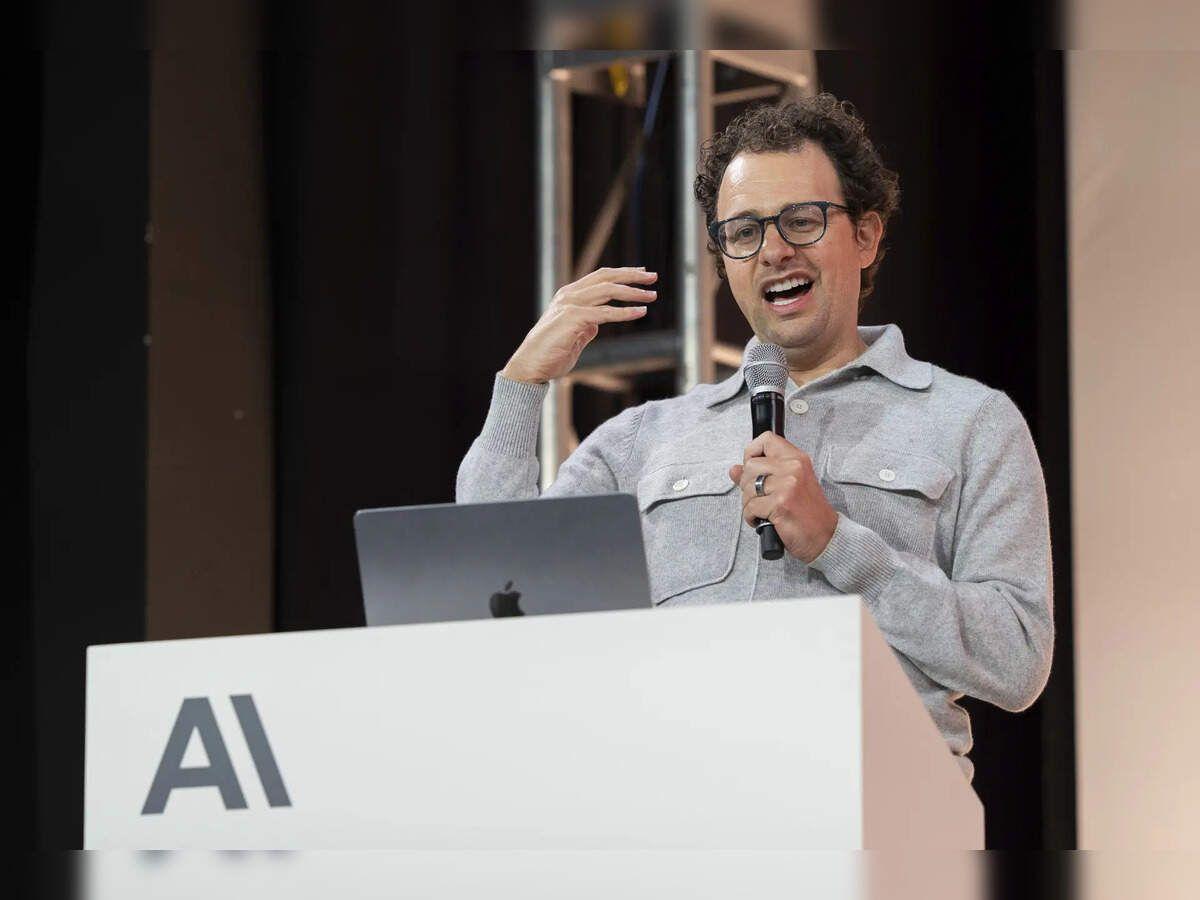
Source: ET
India Emerges as Second-Largest Market for Claude AI
India now represents Claude AI's second-largest market after the United States, driven by what Amodei describes as the country's "technical intensity" in AI usage
1
2
. "India's adoption is even more extreme compared with the rest of the world," Amodei stated, adding that the company can "do experiments with hundreds of millions of people"1
. He highlighted seeing "cool applications in Indian languages -- in education, legal, farming -- that are bringing AI into digital infrastructure"1
. What stands out about India's AI future, according to Amodei, is "the ability to build software with AI and to build on top of AI-developing new applications and systems"4
. The company is now hiring local talent across a wide range of roles to support this growth.Related Stories
Anthropic's Broader AI Strategy and Market Position
Founded in 2021, Anthropic has positioned itself around safety and responsible tech development, focusing heavily on enterprise sales in sectors like AI for software engineering, finance, and healthcare
1
. The company's global revenue run-rate crossed $9 billion last year and has since increased to $14 billion1
. Earlier this month, the Amazon and Alphabet-backed startup raised $30 billion in a funding round that valued the company at $380 billion2
5
. Amodei's visit to India coincides with the AI Impact Summit 2026, where he joins AI luminaries including Sundar Pichai of Alphabet and OpenAI's Sam Altman, offering Prime Minister Narendra Modi a platform to showcase India's tech-savvy population and engineering talent1
5
. Irina Ghose, appointed as managing director for Anthropic India, emphasized that "India represents one of the world's most promising opportunities to bring the benefits of responsible AI to vastly more people and enterprises"3
. The Bengaluru office will provide applied AI expertise to enterprises and startups, enabling them to design, build, and scale personalized Claude-powered solutions tailored to local needs.
Source: Bloomberg
References
Summarized by

Navi
[3]
Related Stories
Anthropic Expands to India: Plans Bengaluru Office, Eyes Partnership with Reliance Industries
08 Oct 2025•Business and Economy

Anthropic Appoints Microsoft Veteran Irina Ghose to Lead India Expansion With Bengaluru Office
16 Jan 2026•Business and Economy
Anthropic's Global Expansion: Tripling International Workforce Amid Surging AI Demand
26 Sept 2025•Business and Economy
Recent Highlights
1
AI Models Lie and Deceive to Protect Other AI Models From Deletion, Study Reveals
Science and Research

2
AI chatbots validate you too much, making you less kind to others, Stanford study reveals
Science and Research

3
Judge blocks Pentagon from blacklisting Anthropic over AI safety guardrails dispute
Policy and Regulation

Recent Highlights
Today's Top Stories









Your Daily Dose of Curated AI News
Don’t drown in AI news. We cut through the noise - filtering, ranking and summarizing the most important AI news, breakthroughs and research daily. Spend less time searching for the latest in AI and get straight to action.

