Applied Materials projects 20% semiconductor equipment growth as AI demand fuels record results


3 Sources
3 Sources
[1]
Applied Materials forecasts upbeat results on AI demand, memory shortage
Feb 12 (Reuters) - Applied Materials (AMAT.O), opens new tab forecast second-quarter revenue and profit above market estimates on Thursday, betting on a boom in demand for AI processors and a worldwide memory shortage to help drive sales of its chipmaking equipment. The rapid build-out of artificial intelligence infrastructure -- a major driver for Applied -- has absorbed much of the world's memory chip supply, boosting production capacity, and further helping the company's sales. The company's shares rose over 12% in extended trading. Shares of peers Lam Research (LRCX.O), opens new tab and KLA (KLAC.O), opens new tab rose nearly 3% each after the bell, as Applied's upbeat outlook lifted sentiment. Applied Materials expects second-quarter sales of about $7.65 billion, plus or minus $500 million, compared with estimates of $7.01 billion, according to data compiled by LSEG. The results were "fueled by the acceleration of industry investments in AI computing," CEO Gary Dickerson said in a statement. "The need for higher performance and more energy-efficient chips is driving high growth rates for leading-edge logic, high-bandwidth memory and advanced packaging." The largest U.S. semiconductor equipment maker forecast second-quarter adjusted profit of about $2.64 per share, plus or minus 20 cents, compared with estimates of $2.28. "Memory and logic-foundry capex growth are two sides of the same coin. They are both growing significantly - with memory a greater growth driver near-term," said Timm Schulze-Melander, a Rothschild & Co. Redburn analyst. Logic generally refers to a type of chip that is capable of serving as the brains of a system, such as graphics processors and central processing units. MEMORY IN FOCUS High-bandwidth memory (HBM), made by stacking layers of dynamic random access memory (DRAM) on top of each other, refers to a type of advanced memory chip used alongside pricey AI processors such as those sold by Nvidia. Applied expects DRAM to be its fastest growing segment in 2026, coupled with 3D chiplet stacking -- a technique used extensively in producing AI processors -- Dickerson said during a post-earnings call. The company reported first-quarter revenue of $7.01 billion, beating estimates of $6.87 billion. Revenue for the quarter ended January 25 included record DRAM sales on a year-on-year basis, finance chief Brice Hill said during the call. The company reported first-quarter profit of $2.38 per share, excluding items. Analysts had expected $2.20 per share. Reporting by Arsheeya Bajwa in Bengaluru; Editing by Alan Barona and Sriraj Kalluvila Our Standards: The Thomson Reuters Trust Principles., opens new tab
[2]
Applied Materials jumps on earnings strength and bullish forecast tied to AI chip boom - SiliconANGLE
Applied Materials jumps on earnings strength and bullish forecast tied to AI chip boom Shares in Applied Materials Inc. were up more than 12% in after-hours trading today after the semiconductor maker reported earnings and revenue beats in its fiscal 2026 first quarter and gave an outlook ahead of expectations amid increased demand for its chips driven by the ongoing artificial intelligence boom. For the quarter that ended on Jan. 25, Applied Materials reported adjusted earnings per share of $2.38, no change from the first quarter of the previous fiscal year, on revenue of $7.012 billion, down 2% year-over-year. Both figures were ahead of the $2.21 per share and revenue of $6.87 billion expected by analysts. Applied Materials generated $1.69 billion in cash from operations in the quarter and distributed $702 million to shareholders through $337 million in share repurchases and $365 million in dividends. Business highlights in the quarter included the announcement that Samsung Electronics Co. Ltd. will join Applied Materials's new EPIC Center in Silicon Valley, a facility intended to accelerate the transition of semiconductor technologies from early-stage research into high-volume manufacturing. The EPIC Center is designed to shorten development cycles by enabling closer collaboration between chipmakers, materials suppliers and equipment engineers working on next-generation process technologies. The company also introduced new deposition, etch and materials modification systems that are aimed at improving the energy efficiency and performance of Gate-All-Around transistors and advanced interconnects at the 2-nanometer node and beyond. New offerings included Viva, a pure radical treatment system designed to smooth GAA silicon nanosheets at atomic-scale precision; Sym3 Z Magnum, a conductor etch platform engineered to provide angstrom-level three-dimensional trench profile control for improved nanosheet uniformity; and Spectral, an atomic layer deposition system that enables the replacement of tungsten transistor contacts with molybdenum to support continued scaling of advanced logic devices. "Applied Materials delivered strong results in our fiscal first quarter, fueled by the acceleration of industry investments in AI computing," said Gary Dickerson, president and chief executive officer of Applied Materials, in the company's earnings release. "The need for higher performance and more energy-efficient chips is driving high-growth rates for leading-edge logic, high-bandwidth memory and advanced packaging. These are areas where Applied is the process equipment leader, and we expect to grow our semiconductor equipment business over 20% this calendar year." The last line - Dickerson saying that the company expects to grow its semiconductor equipment business by more than 20% - fortold an outlook that also impressed. For its fiscal 2026 second quarter, Applied Materials expects adjusted earnings per share of $2.24 to $2.84 on revenue of $7.165 billion to $8.150 billion, the latter being well ahead at the midpoint of the $7 billion expected by analysts.
[3]
Applied Materials Profit Rises On Soaring AI Computing Demand
Applied Materials logged higher profit in the fiscal first quarter as artificial intelligence computing demand soars. The semiconductor-equipment maker on Thursday posted a profit of $2.03 billion, or $2.54 a share, in the quarter ended in January, compared with $1.19 billion, or $1.45 a share, a year earlier. Stripping out certain one-time items, adjusted per-share earnings were $2.38, ahead of the $2.21 anticipated by analysts, according to FactSet. Revenue fell 2% to $7.01 billion. Analysts surveyed by FactSet forecast revenue of $6.87 billion. Applied Materials expects revenue in the current quarter to be $7.15 billion to $8.15 billion. It anticipates adjusted earnings per share in a range from $2.44 to $2.84. Wall Street was projecting $7.01 billion in second-quarter revenue and $2.28 in adjusted earnings per share. The company's results were boosted by the acceleration of industry investments in AI computing, Chief Executive Gary Dickerson said. The need for higher performing and more energy-efficient chips is driving growth rates for memory and packaging, he said. Dickerson said Applied Materials' semiconductor equipment business will grow more than 20% this calendar year. The company has nearly doubled its system manufacturing capability and increased inventories to keep up with demand, Chief Financial Officer Brice Hill added. Write to Katherine Hamilton at [email protected]
Share
Share
Copy Link
Applied Materials reported first-quarter earnings that beat analyst expectations, with adjusted EPS of $2.38 on revenue of $7.01 billion. The semiconductor equipment manufacturer projects over 20% growth in 2026, driven by surging demand for AI chips and a worldwide memory shortage. Shares jumped over 12% in extended trading as the company's bullish forecast lifted sentiment across the chip equipment sector.
Applied Materials beats estimates as AI chip boom accelerates
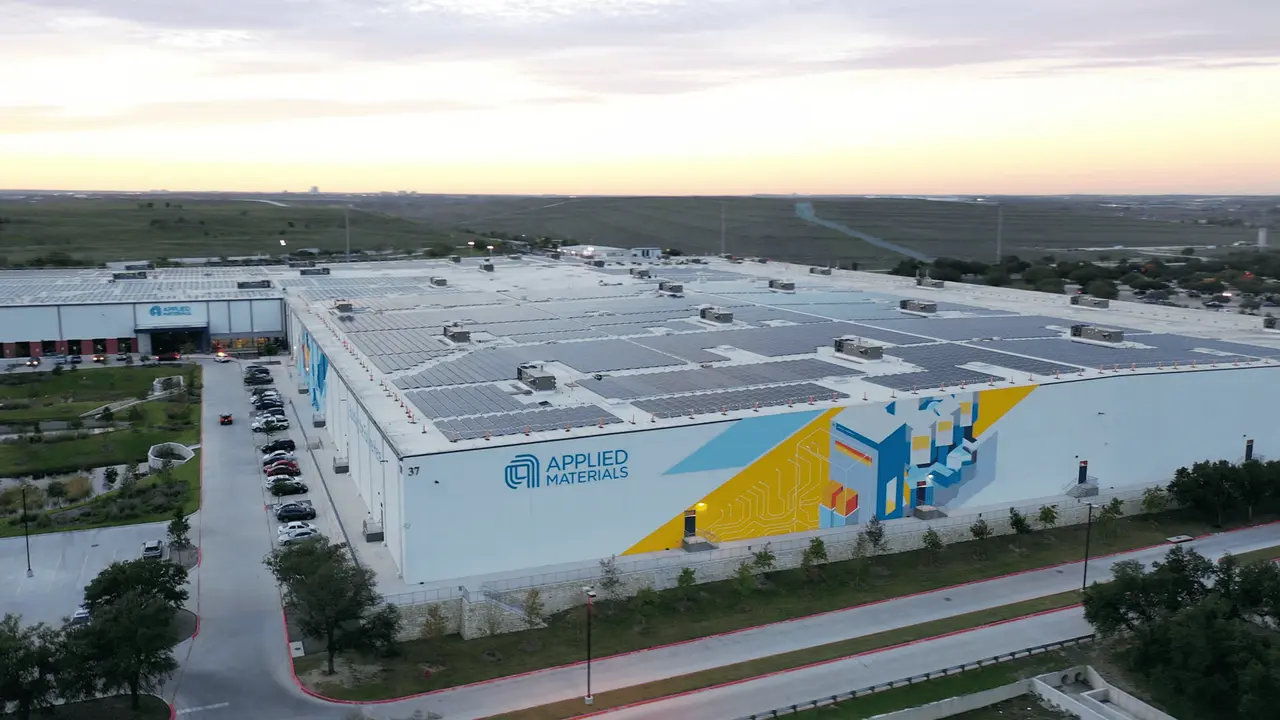
Applied Materials reported first-quarter fiscal 2026 results that exceeded Wall Street expectations, signaling robust momentum in the semiconductor equipment sector. The company posted adjusted earnings of $2.38 per share on revenue of $7.01 billion for the quarter ended January 25, surpassing analyst estimates of $2.21 per share and $6.87 billion in revenue
1
2
. While revenue declined 2% year-over-year, the results demonstrated the company's ability to capitalize on AI demand despite broader market headwinds. Shares surged over 12% in extended trading, with peers Lam Research and KLA rising nearly 3% each as the upbeat outlook lifted sentiment across the industry1
.
Source: SiliconANGLE
Semiconductor equipment manufacturer projects aggressive growth trajectory
CEO Gary Dickerson announced that Applied Materials expects to grow its semiconductor equipment business by more than 20% in calendar year 2026, a projection that underscores the intensity of AI computing demand
2
. The company's second-quarter revenue forecast of $7.65 billion, plus or minus $500 million, came in well above the $7.01 billion analysts anticipated1
. Applied Materials also expects adjusted profit of about $2.64 per share, plus or minus 20 cents, compared with estimates of $2.281
. Chief Financial Officer Brice Hill noted that the company has nearly doubled its system manufacturing capability and increased inventories to keep pace with surging demand for AI chips .Memory chip shortage and high-bandwidth memory drive record DRAM sales
The rapid build-out of artificial intelligence infrastructure has absorbed much of the world's memory chip supply, creating a memory chip shortage that has boosted production capacity and helped drive Applied Materials' sales
1
. The company reported record DRAM sales on a year-on-year basis during the first quarter, with Gary Dickerson stating that DRAM is expected to be the fastest growing segment in 20261
. High-bandwidth memory (HBM), which involves stacking layers of DRAM on top of each other, has become critical for AI processors such as those sold by Nvidia1
. Rothschild & Co. Redburn analyst Timm Schulze-Melander observed that memory and logic-foundry capital expenditure growth are interconnected, with memory serving as the greater growth driver in the near term1
.Related Stories
Advanced packaging techniques and energy-efficient chips expand market opportunities
Applied Materials is capitalizing on the need for higher performance and more energy-efficient chips, which is driving high growth rates for leading-edge logic, high-bandwidth memory and advanced packaging techniques
1
. The company expects 3D chiplet stacking—a technique used extensively in producing AI processors—to contribute significantly to growth alongside DRAM1
. During the quarter, Applied Materials introduced new deposition, etch and materials modification systems aimed at improving the energy efficiency and performance of Gate-All-Around transistors and advanced interconnects at the 2-nanometer node and beyond2
. New offerings included Viva, a pure radical treatment system for smoothing silicon nanosheets at atomic-scale precision, and Spectral, an atomic layer deposition system that enables the replacement of tungsten transistor contacts with molybdenum2
.
Source: Reuters
Strategic investments position company for long-term AI infrastructure expansion
Applied Materials announced that Samsung Electronics will join its new EPIC Center in Silicon Valley, a facility designed to accelerate the transition of semiconductor technologies from early-stage research into high-volume manufacturing
2
. The EPIC Center aims to shorten development cycles by enabling closer collaboration between chipmakers, materials suppliers and equipment engineers working on next-generation process technologies2
. The company generated $1.69 billion in cash from operations during the quarter and distributed $702 million to shareholders through $337 million in share repurchases and $365 million in dividends2
. As AI infrastructure continues to expand globally, Applied Materials' leadership position in process equipment for leading-edge logic, memory and packaging technologies positions it to capture sustained growth in an industry experiencing fundamental transformation driven by artificial intelligence applications.References
Summarized by

Navi
[2]
[3]
Related Stories
Applied Materials Reports Record-Breaking Q3 Revenue Amid AI-Driven Chip Demand Surge
16 Aug 2024

Applied Materials Reports Strong Q4 Earnings, but Faces Challenges in China and Non-AI Chip Demand
16 Nov 2024•Business and Economy

Applied Materials: Strong Q3 Results Spark Mixed Analyst Reactions
16 Aug 2024

Recent Highlights
1
Apple Plans Major Siri AI Overhaul in iOS 27 With Third-Party Chatbot Integration
Technology

2
OpenAI shuts down Sora after six months, ending Disney's $1 billion licensing partnership
Technology

3
AI chatbots validate you too much, making you less kind to others, Stanford study reveals
Science and Research

Recent Highlights
Today's Top Stories



Your Daily Dose of Curated AI News
Don’t drown in AI news. We cut through the noise - filtering, ranking and summarizing the most important AI news, breakthroughs and research daily. Spend less time searching for the latest in AI and get straight to action.

