Apptronik Raises $520 Million to Scale Apollo Humanoid Robots for Industrial Deployment


6 Sources
6 Sources
[1]
Apptronik Raises $520 Million in New Funding to Build More Humanoids
Apptronik, a fast-growing startup that makes artificial intelligence-powered humanoid robots, has secured about $520 million in a new funding round that values the company at more than $5.5 billion, around three times its valuation from its initial Series A raise last year. The funding round was led by existing investors including Google, Mercedes-Benz Group AG and B Capital, along with new investors AT&T Ventures, John Deere & Co. and the Qatar Investment Authority. This investment is an extension of a $415 million fundraise in February 2025. The company said it received substantial inbound investor interest after the first round, leading it to open the new extension at three times the valuation. The funding comes at a time when investors have been committing billions of dollars to humanoid robotics startups, including Figure AI and Dexterity, betting that advances in AI will speed up commercial adoption. Founded in 2016, Apptronik has partnerships with Mercedes-Benz, GXO Logistics and Jabil, as well as a strategic tie-up with Google DeepMind to develop humanoid robots powered by Gemini Robotics, a series of AI models from Google optimized for robots. The new round of capital will be used to bring Apptronik's humanoid robot, Apollo, to market, expand ongoing pilot programs and support the initial scaling and production of the system, the company said. Apollo is the company's flagship humanoid robot, the latest in a series of 10 humanoid systems developed by the company over the past decade. It is designed as a general-purpose platform and can operate using either legs or wheels. The robot can also be deployed in a stationary configuration or mounted, an approach the company said is critical to moving robotics beyond single-purpose use cases. However, Apptronik argues that legged mobility is essential for whole body control and operating effectively in environments designed for humans. "Apollo will evolve over time," said Jeff Cardenas, Apptronik's co-founder and chief executive officer. "We'll likely introduce other characters to the mix over time as well. But you can think of Apollo as the moonshot. Apollo is sort of the hero in our story." The Austin-based company employs about 300 people, with origins extending back to the University of Texas' Human Centered Robotics Lab, where the three co-founders -- Cardenas, adviser Dr. Luis Sentis and Chief Technology Officer Dr. Nicholas Payne -- worked together on NASA's Valkyrie humanoid robotics project. Apptronik's strategy involves three stages of market expansion, Cardenas said. It is currently focused on manufacturing and logistics, with an emphasis on repeatable tasks like handling material and sorting. It's also running pilot programs with partners including Mercedes-Benz and GXO. Over time, it plans to move into broader commercial settings, including healthcare, retail and hospitality, before aiming to deploy consumer-focused robots in the home. These systems could perform personal care and assistive functions, including elder care, cleaning and cooking, Cardenas said. "That's the hardest market of all. It's also the biggest market," Cardenas said, adding that he's especially interested in personal care or assistive robots that assist in elder care. It will "take longer until the robots are good enough" to be used in people's homes, he said, adding he expects that to happen within the next decade. "The stakes are really high, and it's early in the humanoid development cycle," he said. "I always say we're in the early '80s," he added, likening it to the beginning of the personal computer era. "We're in the spreadsheet word processing stage, where we're beginning to show commercial viability. I think we're at the front end of what I would call the next big cycle."
[2]
Humanoid startup Apptronik raises $520 million with backing from Google and Mercedes-Benz
Feb 11 (Reuters) - Humanoid robotics startup Apptronik raised $520 million in a funding round backed by investors including Google and Mercedes-Benz, the company said on Wednesday, as it seeks to commercialize its robots for industrial use. The round valued the Austin, Texas-based company at about $5 billion, a source familiar with the matter said. B Capital and the Qatar Investment Authority also participated in the so-called Series A extension, roughly a year after Apptronik raised $415 million. Apptronik plans to use the fresh capital to develop new versions of its Apollo robot, ramp up production and expand its workforce beyond its current headcount of more than 300 employees. It is also planning a robot training and data collection facility in Austin and an office in California. Chief Executive Jeff Horden said the company expects more deployments of humanoid robots in factories and warehouses this year and next. The funding comes as companies race to develop human-like robots for industrial work; Tesla and Nvidia-backed Figure AI are trying to build and deploy humanoids at scale. Figure AI was recently valued at $39 billion. Apptronik is initially targeting manufacturing and logistics customers and has commercial agreements with Mercedes-Benz and GXO Logistics. Over the longer term, it is seeking to expand into assisted care and home-use applications. Its humanoid Apollo has both legs and wheels to navigate industrial environments. Apptronik says human-scale robots can access existing workstations and shelving, potentially replacing some task-specific industrial machines over time. The company is also deepening its partnership with Google DeepMind, which co-develops the Gemini-based artificial intelligence models for the Apollo platform. Apptronik provides the hardware and real-world training data from its deployments, Horden said. Founded in 2016 as a spinout from the University of Texas, Apptronik traces its origins to early work on NASA's Valkyrie humanoid robot program. Howard Morgan, a general partner at B Capital, said the company has a competitive advantage in its robotic hand design and has built a sizable commercial order pipeline. "The valuation relative to its potential is more attractive than some of its peers," Morgan said in an interview. Reporting by Krystal Hu in San Francisco; Editing by Thomas Derpinghaus Our Standards: The Thomson Reuters Trust Principles., opens new tab * Suggested Topics: * Technology * ADAS, AV & Safety * Products Krystal Hu Thomson Reuters Krystal reports on venture capital and startups for Reuters. She covers Silicon Valley and beyond through the lens of money and characters, with a focus on growth-stage startups, tech investments and AI. She has previously covered M&A for Reuters, breaking stories on Trump's SPAC and Elon Musk's Twitter financing. Previously, she reported on Amazon for Yahoo Finance, and her investigation of the company's retail practice was cited by lawmakers in Congress. Krystal started a career in journalism by writing about tech and politics in China. She has a master's degree from New York University, and enjoys a scoop of Matcha ice cream as much as getting a scoop at work.
[3]
Apptronik raises $520 million to beat Chinese humanoids, Tesla Optimus to market
Apptronik co-founders (L-R): CTO Nicholas Paine and CEO Jeff Cardenas Apptronik has raised $520 million in funding at a $5 billion valuation as the startup aims to commercialize its humanoid Apollo robots, potentially beating Chinese competitors and Tesla's Optimus to the market. The new funding, announced on Wednesday, brings Apptronik's series A funding round to $935 million. B Capital, chaired by Howard Morgan, co-led the deal with Google. Located in Austin, Texas, where Tesla is also headquartered, Apptronik is reeling in cash to refine and start producing more of its Apollo humanoids, CEO Jeff Cardenas told CNBC. Early versions of the company's Apollo robots are currently working within designated areas in factories and warehouses run by Apptronik strategic partners, including Mercedes-Benz, GXO Logistics and Jabil. The designated areas are defined by external sensors and so-called light curtains, Cardenas said, meaning an Apollo in the area will pause if a human steps across a boundary. Cardenas said that in the future, the Apollo will be engineered for "collaborative safety," so the humanoids can slow down, stop, or maneuver alongside other people, just as a human would, while performing tasks like transporting components, sorting and lifting. Apptronik's competitors include a wide array of humanoid developers, such as China-based Unitree, Figure, Agility Robotics and 1X. Tesla has grand ambitions with Optimus, one of the reasons it's planning to shell out $20 billion on capex in 2026. Tesla said it has to ramp up spending to start manufacturing its robots and self-driving cars. But in a recent earnings call, CEO Elon Musk said the Optimus humanoids remain in an early, research and development stage. Cardenas said that within the field of automation, the allure of humanoids is their versatility, which allows "one robot to do thousands of tasks, versus a thousand robots doing a single task." From pilot deployments, Apptronik is able to observe its Apollo in action, gather data from its fleet and use that to refine its systems and the way they work. The new funding comes after Apptronik locked in a partnership with Google DeepMind and began working with its Gemini Robotics AI models, which underpin Apollo's capabilities. Apptronik ranked 33rd on the 2025 CNBC Disruptor 50 list. The company began in the Human Centered Robotics Lab at the University of Texas in 2016, well before Tesla began talking up humanoid robotics. Apptronik now has 300 employees. Cardenas said the company will use some of the fresh capital to expand its footprint in Austin, and open a new office in California later this year, while working to get its robots and facilities ready for mass production. Unlike Musk, who's known for making lofty promises, Cardenas prefers not to make many public predictions about Apollo. He declined to say when the robots will be widely produced and what capabilities they will have when they first ship. Apptronik will reveal more later this year about what its robots will and won't be able to do, Cardenas said. Morgan was more forthcoming about his expectations for the company, and said demand for the Apollo is already apparent. He said he expects orders for $1 billion worth of robots starting in 2027, when he hopes the company will be delivering Apollo in high volumes for roughly $80,000 a year, about the price of a luxury car. "Think about a factory worker doing three or four shifts, and on any weekend," Morgan said. "Eighty-thousand is cheap!" Morgan also said he expects Apptronik to hire at least another 200 people in the next year, and that the company needed to lock in the new funds now given the excitement around humanoid robotics. "You do need to have enough so you can be taken seriously by everybody," Morgan said. "Google is spending a lot and we're partnering with them, so we'll get the benefit of that."
[4]
Amid Record Robotics Funding, Apptronik Raises $520M Series A Extension To Boost Production Of Humanoid Robot Apollo
AI-powered robotics company Apptronik announced Wednesday that it has raised $520 million in an extension of its $415 million Series A raise in February 2025, bringing the total round to over $935 million. Existing backers B Capital, Google, Mercedes-Benz and Peak6 joined new investors including AT&T Ventures and manufacturing giant John Deere participating in the extension. The Austin-based company says that after its initial Series A announcement, it received "substantial inbound investor interest," which led it to open the new extension of the round "at a 3x multiple of the Series A valuation." It did not reveal its new valuation. However, the Austin-American Statesman reported in November that Apptronik had reached a valuation of $5 billion after raising $331 million earlier that month, according to a filing with the U.S. Securities and Exchange Commission. The company confirmed that the $331 million raised is a part of this Series A extension round. With the latest funding, Apptronik has now raised nearly $1 billion since its 2016 inception. Robotics startup funding hit a record high last year, per Crunchbase data. Startups in the sector raised nearly $14 billion in funding in 2025, up from $8.2 billion in 2024, even topping the $13.1 billion raised in the peak venture funding year of 2021. So far, that momentum appears to be continuing in 2026. Besides this raise, Skild AI, a robotics company building an "omni-bodied" brain to operate any robot for any task, announced in January that it had raised $1.4 billion, tripling its valuation to more than $14 billion. Human connections Apptronik was founded on the belief that for humanoid robots to reach mass adoption, the industry had to solve for intuitive, safe human-robot interaction, and improve the cost and ease of manufacturing these robots. The company claims its flagship robot, Apollo, is designed with "approachability at its forefront." "Its friendly head and face, eye-level cameras, and natural color palette are engineered to make human interactions feel engaging and more natural," a spokesperson told Crunchbase News. Apollo is designed to "revolutionize" human-robot interaction, initially in industries such as logistics and manufacturing, with future planned expansion into retail, healthcare, and eventually, the home, according to the company. It's designed to take on physically demanding work and labor-intensive operational processes in manufacturing and logistics and to work alongside human counterparts to transport components, sort and kit, among other tasks. Apptronik has commercial agreements with companies across several industries such as automotive manufacturing, logistics and consumer packaged goods, including Mercedes-Benz, GXO Logistics and Jabil. It also has a strategic partnership with Google DeepMind "to build the next generation of humanoid robots, powered by Gemini Robotics." The company says it will use the capital to ramp up production of Apollo and expand its global network of commercial and pilot deployments. Apptronik has worked on developing 15 robotic systems, including NASA's humanoid robot Valkyrie. Apptronik's business is built on a Robotics as a Service model, which includes the robot hardware, software updates, service and support. The company started out of the Human Centered Robotics Lab at the The University of Texas at Austin and has nearly 300 employees, double its size a year ago.
[5]

Humanoid startup Apptronik raises $520 million with backing from Google and Mercedes-Benz
Apptronik raised $520 million in a funding round backed by investors including Google and Mercedes-Benz, the company said on Wednesday, as it seeks to commercialise its robots for industrial use. Humanoid robotics startup Apptronik raised $520 million in a funding round backed by investors including Google and Mercedes-Benz, the company said on Wednesday, as it seeks to commercialise its robots for industrial use. The round valued the Austin, Texas-based company at about $5 billion, a source familiar with the matter said. B Capital and the Qatar Investment Authority also participated in the so-called Series A extension, roughly a year after Apptronik raised $415 million. Apptronik plans to use the fresh capital to develop new versions of its Apollo robot, ramp up production and expand its workforce beyond its current headcount of more than 300 employees. It is also planning a robot training and data collection facility in Austin and an office in California. Chief executive Jeff Cardenas said the company expects more deployments of humanoid robots in factories and warehouses this year and next. The funding comes as companies race to develop human-like robots for industrial work; Tesla and Nvidia-backed Figure AI are trying to build and deploy humanoids at scale. Figure AI was recently valued at $39 billion. Apptronik is initially targeting manufacturing and logistics customers and has commercial agreements with Mercedes-Benz and GXO Logistics. Over the longer term, it is seeking to expand into assisted care and home-use applications. Its humanoid Apollo has both legs and wheels to navigate industrial environments. Apptronik says human-scale robots can access existing workstations and shelving, potentially replacing some task-specific industrial machines over time. The company is also deepening its partnership with Google DeepMind, which co-develops the Gemini-based artificial intelligence models for the Apollo platform. Apptronik provides the hardware and real-world training data from its deployments, Horden said. Founded in 2016 as a spinout from the University of Texas, Apptronik traces its origins to early work on NASA's Valkyrie humanoid robot program. Howard Morgan, a general partner at B Capital, said the company has a competitive advantage in its robotic hand design and has built a sizable commercial order pipeline. "The valuation relative to its potential is more attractive than some of its peers," Morgan said in an interview.
[6]

Humanoid startup Apptronik raises $520 million with backing from Google and Mercedes-Benz
Feb 11 (Reuters) - Humanoid robotics startup Apptronik raised $520 million in a funding round backed by investors including Google and Mercedes-Benz, the company said on Wednesday, as it seeks to commercialize its robots for industrial use. The round valued the Austin, Texas-based company at about $5 billion, a source familiar with the matter said. B Capital and the Qatar Investment Authority also participated in the so-called Series A extension, roughly a year after Apptronik raised $415 million. Apptronik plans to use the fresh capital to develop new versions of its Apollo robot, ramp up production and expand its workforce beyond its current headcount of more than 300 employees. It is also planning a robot training and data collection facility in Austin and an office in California. Chief Executive Jeff Horden said the company expects more deployments of humanoid robots in factories and warehouses this year and next. The funding comes as companies race to develop human-like robots for industrial work; Tesla and Nvidia-backed Figure AI are trying to build and deploy humanoids at scale. Figure AI was recently valued at $39 billion. Apptronik is initially targeting manufacturing and logistics customers and has commercial agreements with Mercedes-Benz and GXO Logistics. Over the longer term, it is seeking to expand into assisted care and home-use applications. Its humanoid Apollo has both legs and wheels to navigate industrial environments. Apptronik says human-scale robots can access existing workstations and shelving, potentially replacing some task-specific industrial machines over time. The company is also deepening its partnership with Google DeepMind, which co-develops the Gemini-based artificial intelligence models for the Apollo platform. Apptronik provides the hardware and real-world training data from its deployments, Horden said. Founded in 2016 as a spinout from the University of Texas, Apptronik traces its origins to early work on NASA's Valkyrie humanoid robot program. Howard Morgan, a general partner at B Capital, said the company has a competitive advantage in its robotic hand design and has built a sizable commercial order pipeline. "The valuation relative to its potential is more attractive than some of its peers," Morgan said in an interview. (Reporting by Krystal Hu in San Francisco; Editing by Thomas Derpinghaus)
Share
Share
Copy Link
Apptronik secured $520 million in new funding led by Google and Mercedes-Benz, tripling its valuation to over $5.5 billion. The Austin-based startup plans to accelerate production of its Apollo humanoid robot for manufacturing and logistics customers, with pilot programs already underway at Mercedes-Benz and GXO Logistics facilities.
Apptronik Funding Reaches $520 Million With Major Tech and Automotive Backers
Apptronik has secured approximately $520 million in a Series A extension that values the company at more than $5.5 billion, roughly three times its valuation from its initial raise last year
1
. The funding round was led by existing investors including Google and Mercedes-Benz Group AG, along with B Capital, and welcomed new participants AT&T Ventures, John Deere & Co., and the Qatar Investment Authority1
. This extension follows a $415 million fundraise in February 2025, bringing the total Series A round to over $935 million4
. The company said it received substantial inbound investor interest after the first round, prompting it to open the new extension at three times the previous valuation1
.AI-Powered Humanoid Robots Target Manufacturing and Logistics Markets
The Austin-based startup plans to deploy the fresh capital to bring its flagship Apollo robot to market, expand ongoing pilot programs, and support initial scaling and production
1
. Apollo is designed as a general-purpose platform that can operate using either legs or wheels, and can be deployed in stationary or mounted configurations1
. Early versions of the Apollo robot are currently working within designated areas in factories and warehouses run by strategic partners, including Mercedes-Benz, GXO Logistics, and Jabil .
Source: Bloomberg
The designated areas are defined by external sensors and light curtains, meaning an Apollo in the area will pause if a human steps across a boundary . CEO Jeff Cardenas explained that Apptronik is currently focused on manufacturing and logistics, with an emphasis on repeatable tasks like handling material and sorting
1
.Google DeepMind Partnership Powers Gemini Robotics AI Models
Apptronik has established a strategic partnership with Google DeepMind to develop humanoid robots powered by Gemini Robotics, a series of artificial intelligence models from Google optimized for robots
1
. The company is deepening this collaboration, with Google DeepMind co-developing the Gemini-based AI models for the Apollo platform while Apptronik provides the hardware and real-world training data from its deployments2
. This partnership positions Apptronik to benefit from Google's substantial AI investments without bearing the full cost of development .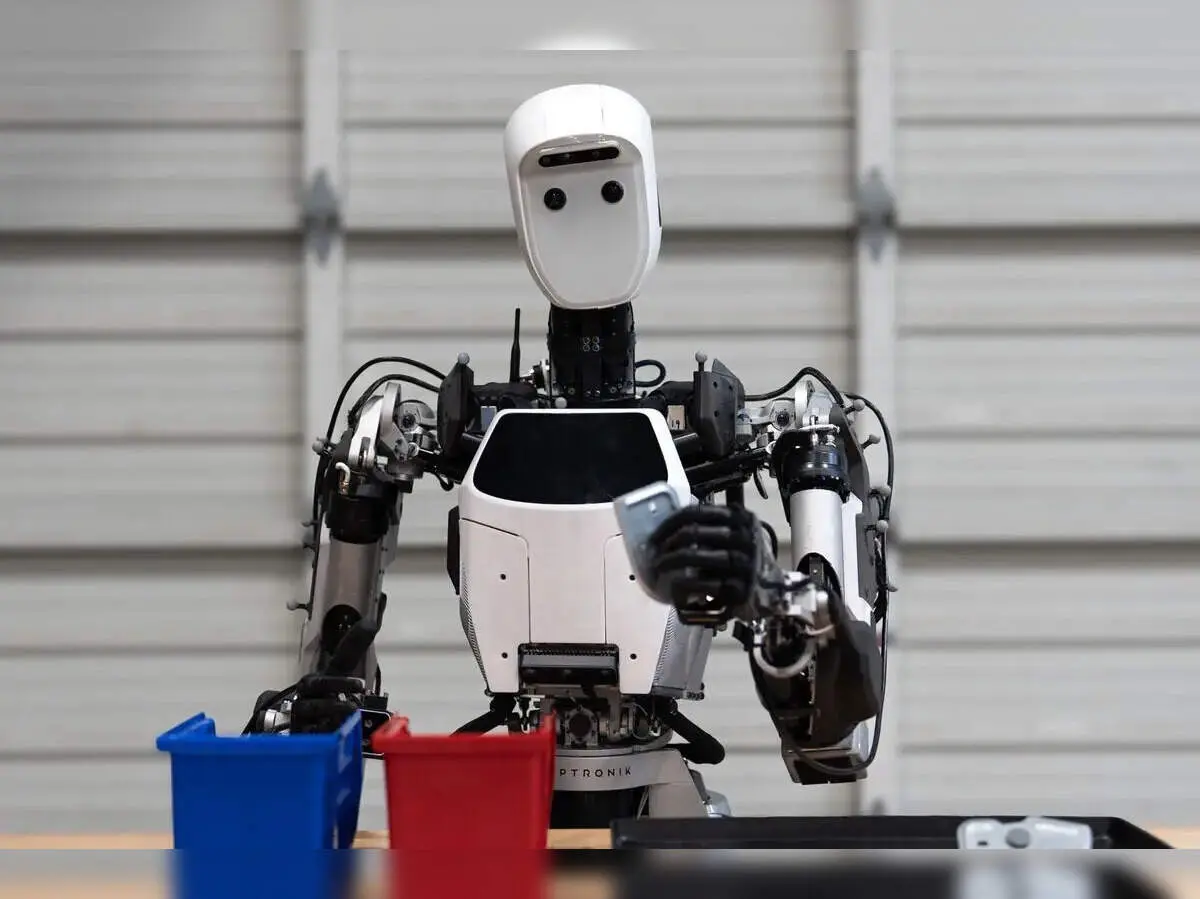
Source: ET
Scaling Humanoid Production Against Tesla Optimus and Chinese Competitors
The robotics startup funding landscape has reached record levels, with startups in the sector raising nearly $14 billion in 2025, up from $8.2 billion in 2024
4
. Apptronik faces competition from Tesla Optimus, Figure AI, Unitree, Agility Robotics, and 1X . While Tesla CEO Elon Musk said the Optimus humanoids remain in an early research and development stage, Apptronik is positioning itself to potentially beat Chinese competitors and Tesla to market with commercial deployments .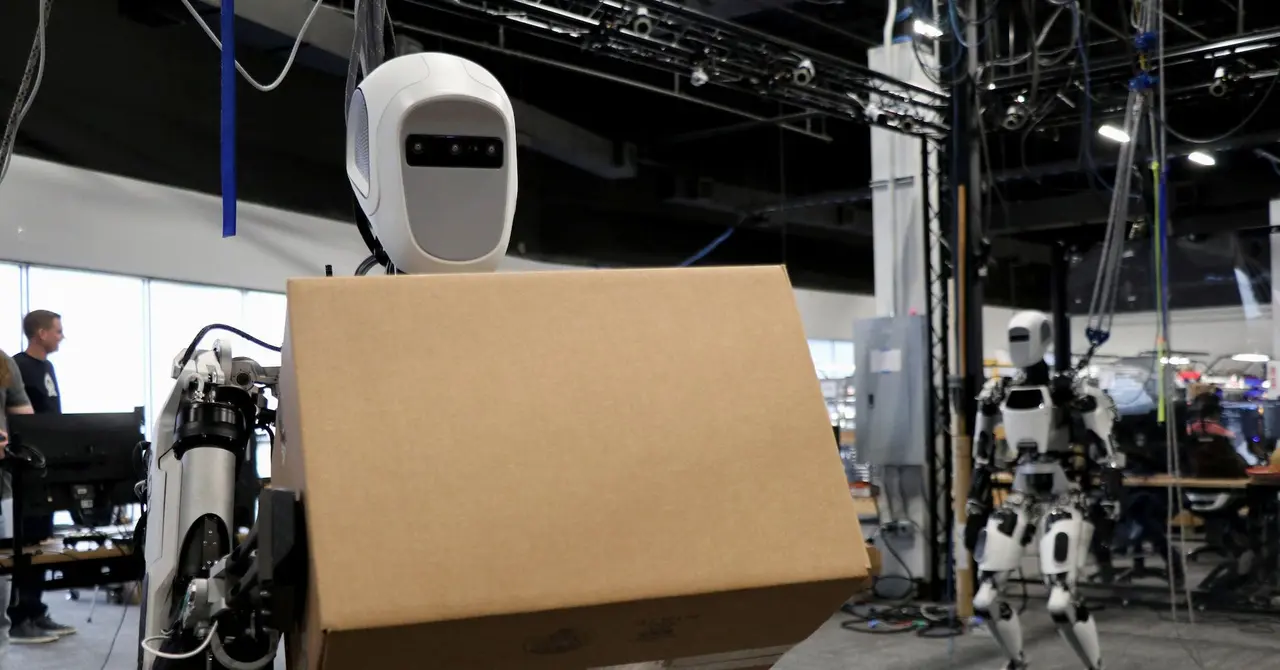
Source: Reuters
Howard Morgan, a general partner at B Capital, expects orders for $1 billion worth of robots starting in 2027, when he hopes the company will be delivering Apollo in high volumes for roughly $80,000 a year .
Related Stories

Industrial Applications for Robots Expanding to Healthcare and Home Use
Apptronik's strategy involves three stages of market expansion. Beyond its current focus on industrial applications for robots in manufacturing and logistics, the company plans to move into broader commercial settings including healthcare, retail, and hospitality
1
. The ultimate goal is deploying consumer-focused robots in the home for assisted care, personal care functions including elder care, cleaning, and cooking1
. Cardenas acknowledged that home use represents "the hardest market of all" but also "the biggest market," expecting it will "take longer until the robots are good enough" to be used in people's homes, projecting that to happen within the next decade1
.From NASA Valkyrie to Commercial Viability
Founded in 2016 as a spinout from the University of Texas Human Centered Robotics Lab, Apptronik traces its origins to early work on NASA's Valkyrie humanoid robot program
5
. The three co-founders—Jeff Cardenas, adviser Dr. Luis Sentis, and Chief Technology Officer Dr. Nicholas Payne—worked together on the NASA project1
. Apollo is the latest in a series of 10 humanoid systems developed by the company over the past decade1
. The company now employs about 300 people, double its size a year ago, and plans to expand its workforce by at least another 200 people in the next year . Apptronik is also planning a robot training and data collection facility in Austin and an office in California2
. Cardenas compared the current state of humanoid development to the early 1980s personal computer era, saying "we're in the spreadsheet word processing stage, where we're beginning to show commercial viability"1
.References
Summarized by

Navi
[2]
[4]
Related Stories
Apptronik Secures $350 Million in Series A Funding to Accelerate Humanoid Robot Development
13 Feb 2025•Technology

Apptronik Secures $403M in Series A Funding for AI-Powered Humanoid Robotics
19 Mar 2025•Technology

Apptronik and Google DeepMind Join Forces to Advance AI-Powered Humanoid Robots
21 Dec 2024•Technology

Recent Highlights
1
AI Models Lie and Deceive to Protect Other AI Models From Deletion, Study Reveals
Science and Research

2
AI chatbots validate you too much, making you less kind to others, Stanford study reveals
Science and Research

3
Judge blocks Pentagon from blacklisting Anthropic over AI safety guardrails dispute
Policy and Regulation

Recent Highlights
Today's Top Stories




Your Daily Dose of Curated AI News
Don’t drown in AI news. We cut through the noise - filtering, ranking and summarizing the most important AI news, breakthroughs and research daily. Spend less time searching for the latest in AI and get straight to action.

