Bank of America CEO says AI economic impact is accelerating as US growth forecast rises to 2.4%


3 Sources
3 Sources
[1]
Bank of America's Moynihan says AI's economic benefit is 'kicking in more' | Fortune
Bank of America Corp. Chief Executive Officer Brian Moynihan said that artificial intelligence is starting to have a bigger impact on the US economy. "The AI investment's been building during the year and is probably a bigger contributor next year and the years beyond," Moynihan said Monday in a Bloomberg Television interview. "AI is kicking in more and more, and so it's not all attributable to AI, but that's having a marginal impact that's pretty strong." Moynihan, who has led the bank for nearly 15 years, said the firm is predicting a strong economy for the US next year, with expected growth of 2.4%, up from about 2% in 2025. While the labor market has started to get softer, it appears that it's more of a normalization for jobs, Moynihan said. AI companies including OpenAI have been pulling in billions of dollars of funds in recent months as investors are eager to bet on the industry. But executives such as Amazon.com Inc. founder Jeff Bezos have warned that AI spending is an "industrial bubble" that could lead to lost investment, but will ultimately help society. Moynihan said his bank sees relatively limited risk to the economy -- including the impact on consumers and job losses -- if the AI industry became too overheated and had to pull back, given that the sector is composed of a narrow group of companies. "As a lender we look at the leverage on these projects and make sure we're comfortable with that and the duration of the contract by the person who's going to commit to use the data center," Moynihan said. The bank itself is also using artificial intelligence, he said in the interview. The company launched Erica, its agent bot, in 2018. Now, Erica can answer 700 questions, up from 200, Moynihan said. Read More: Nvidia Looks Past DeepSeek and Tariffs for AI's Next Chapter "We'll be applying more and more of automated intelligence -- or augmented intelligence, as we call it, with a person using AI, using that to be more effective -- and that'll affect all the businesses," Moynihan said.
[2]
Bank of America Says AI Increasingly Contributes to US Economic Growth | PYMNTS.com
By completing this form, you agree to receive marketing communications from PYMNTS and to the sharing of your information with our sponsor, if applicable, in accordance with our Privacy Policy and Terms and Conditions. Speaking Monday (Dec. 22) with Bloomberg Television, Bank of America CEO Brian Moynihan said that AI had an increasing impact this year and that it will accelerate in the coming years. Moynihan said this while sharing that Bank of America expects the U.S. economy to grow 2.4% in 2026, up from 2% this year, Bloomberg reported Monday. "AI is kicking in more and more, and so it's not all attributable to AI, but that's having a marginal impact that's pretty strong," Moynihan said, per the report. The Bank of America Institute said in October that AI was fueling American economic growth, though its effect on employment was limited. AI-related capital expenditures, especially in software and computing, were key drivers of GDP growth, the institute said in a report. "After a slight decline in Q1, GDP growth rebounded in Q2 with 3.8% for an annualized rate of 1.6% in 1H," the report said. "One major reason for the resiliency in growth to date is the investment being poured into technology- and AI-related categories." The report added that there was little sign that AI was causing steep job losses, contrary to the fears of some observers that such losses could occur. Moynihan said in November that Bank of America has embedded AI in its day-to-day operations and that the technology is helping the bank personalize client experiences, streamline capabilities, identify new opportunities and make efficiency gains across underwriting, audit, legal and finance functions. Speaking during the bank's Nov. 5 investor day, Moynihan added that the bank's virtual assistant Erica had handled 3 billion customer interactions since its launch and was allowing customers to manage their finances around the clock. During his Monday interview with Bloomberg Television, Moynihan said that the number of questions that Erica can answer has increased from 200 to 800. "We'll be applying more and more of automated intelligence -- or augmented intelligence, as we call it, with a person using AI, using that to be more effective -- and that'll affect all the businesses," Moynihan said, per the report.
[3]
Bank of America CEO sees AI's growing economic impact - Bloomberg Interview By Investing.com
Investing.com -- Bank of America Corp. Chief Executive Officer Brian Moynihan said artificial intelligence is beginning to have a larger impact on the U.S. economy. "The AI investment's been building during the year and is probably a bigger contributor next year and the years beyond," Moynihan said Monday in a Bloomberg Television interview. "AI is kicking in more and more, and so it's not all attributable to AI, but that's having a marginal impact that's pretty strong." Moynihan, who has led the bank for nearly 15 years, said his firm forecasts a robust U.S. economy for next year, projecting 2.4% growth, up from about 2% in 2025. He noted that while the labor market has softened somewhat, this appears to be more of a normalization in employment. "It's strong on an absolute basis relative to the United States' history and strong on a relative basis to the other economies. And that's because frankly the great American engine of capitalism [that] consumers are driving. And the markets are valuing that future growth rate and that's why they've been very constructive this year," he explained. The CEO said Bank of America sees minimal risk to the economy if the AI sector became overheated and needed to pull back, as the industry consists of a narrow group of companies. This limited exposure would minimize impacts on consumers and job losses. "As a lender we look at the leverage on these projects and make sure we're comfortable with that and the duration of the contract by the person who's going to commit to use the data center," Moynihan said. He also mentioned that Bank of America itself is implementing AI technology. "We'll be applying more and more of automated intelligence -- or augmented intelligence, as we call it, with a person using AI, using that to be more effective -- and that'll affect all the businesses," Moynihan added. This article was generated with the support of AI and reviewed by an editor. For more information see our T&C.
Share
Share
Copy Link
Bank of America CEO Brian Moynihan told Bloomberg Television that AI is having an increasingly strong marginal impact on the US economy. The bank forecasts 2.4% GDP growth for 2026, up from 2% in 2025, with AI investments playing a bigger role. Despite concerns about an AI bubble, Moynihan sees limited economic risk due to the sector's narrow composition.
Bank of America Forecasts AI's Growing Economic Impact
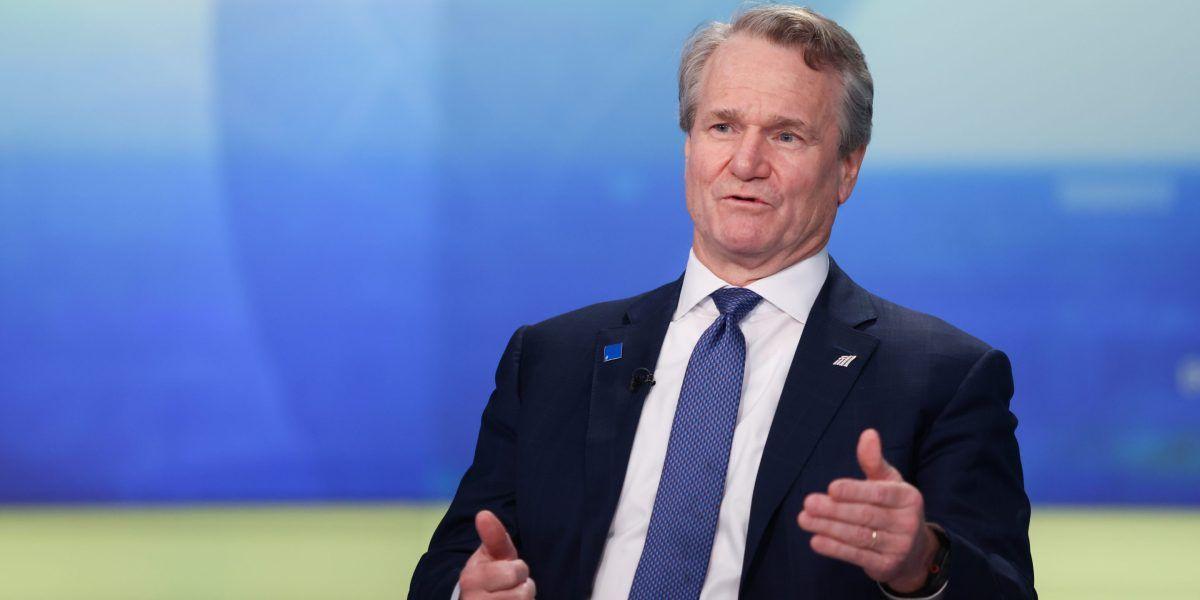
Bank of America CEO Brian Moynihan said in a Bloomberg Television interview on Monday that AI is starting to deliver measurable economic benefits across the United States
1
. "AI is kicking in more and more, and so it's not all attributable to AI, but that's having a marginal impact that's pretty strong," Moynihan explained2
. The bank projects US GDP growth of 2.4% for 2026, up from approximately 2% in 2025, with AI investments expected to become a bigger contributor next year and beyond1
.
Source: Fortune
AI Investments Drive Capital Expenditures and Growth
AI's economic benefit has been building throughout the year, according to Moynihan, who has led Bank of America for nearly 15 years
3
. The Bank of America Institute reported in October that AI-related capital expenditures, particularly in software and computing, were key drivers of GDP growth2
. After a slight decline in Q1, GDP growth rebounded in Q2 with 3.8% for an annualized rate of 1.6% in the first half of the year, with technology and AI-related categories showing resilience2
. Companies like OpenAI have pulled in billions of dollars in recent months as investors bet heavily on the industry1
.Limited Risk Despite Bubble Concerns
While executives such as Amazon founder Jeff Bezos have warned that AI spending represents an "industrial bubble" that could lead to lost investment, Moynihan sees relatively limited risk to the economy
1
. The Bank of America CEO noted that potential impacts on consumers and job losses would be minimal if the AI industry became overheated and had to pull back, given that the sector consists of a narrow group of companies3
. "As a lender we look at the leverage on these projects and make sure we're comfortable with that and the duration of the contract by the person who's going to commit to use the data center," Moynihan explained1
.Related Stories

Bank of America's Integration of AI Shows Practical Benefits
Bank of America itself demonstrates how AI increasingly contributes to US economic growth through its own operations. The bank launched Erica, its virtual assistant, in 2018, and the platform has now handled 3 billion customer interactions since launch
2
. The number of questions Erica can answer has expanded dramatically from 200 to 700 questions, according to Moynihan's interview, though one source reported the figure as 8001
2
. In November, Moynihan said the bank has embedded AI in day-to-day operations, helping personalize client experiences, streamline capabilities, identify new opportunities, and make efficiency gains across underwriting, audit, legal, and finance functions2
.
Source: PYMNTS
Employment Outlook Remains Stable
Contrary to fears about widespread displacement, the Bank of America Institute found little sign that AI was causing steep job losses
2
. While the labor market has softened somewhat, Moynihan characterized this as more of a normalization in employment rather than AI-induced disruption3
. The CEO emphasized that Bank of America will apply more "automated intelligence -- or augmented intelligence, as we call it, with a person using AI, using that to be more effective" across all businesses1
. This approach suggests AI's growing economic impact will manifest through enhanced productivity rather than wholesale replacement of workers, positioning the technology as a tool that amplifies human capabilities in the financial sector and beyond.References
Summarized by

Navi
Related Stories
Bank of America's $4 Billion AI Investment: Transforming Banking with Technology
17 Jul 2024

Bank of America's AI Patent Portfolio Surges 94% in Two Years, Highlighting Financial Sector's Tech Race
24 Oct 2024•Business and Economy

BNY Mellon Leads Wall Street in AI Adoption with Over 100 'Digital Employees'
17 Oct 2025•Technology

Recent Highlights
1
Google releases Gemma 4 with Apache 2.0 license, enabling unrestricted local AI on devices
Technology

2
AI Models Lie and Deceive to Protect Other AI Models From Deletion, Study Reveals
Science and Research

3
OpenAI closes $122 billion funding round amid fierce AI competition and profitability questions
Startups

Recent Highlights
Today's Top Stories







Your Daily Dose of Curated AI News
Don’t drown in AI news. We cut through the noise - filtering, ranking and summarizing the most important AI news, breakthroughs and research daily. Spend less time searching for the latest in AI and get straight to action.

