Ben Affleck calls AI writing 'shitty' and warns valuations are inflated by job displacement fears


3 Sources
3 Sources
[1]
'I can't stand what it writes': Ben Affleck and Matt Damon share their views on using AI to write movies, but admit it could become a new editing tool
Ben Affleck and Matt Damon are busy with promoting their new Netflix movie The Rip, and their recent appearance on The Joe Rogan Podcast has everyone talking about AI's place in film production. As well as their discussion about the best streaming services allegedly 'dumbing down' movies to cater to doomscrollers and background viewers, the long-time collaborators had a few things to say about the direction of AI and whether or not it's a valuable means of enhancing human creativity for movie making. Affleck didn't hold back, claiming that generative AI platforms such as ChatGPT will never be able to replicate the nuance of art produced by humans: "If you try to get ChatGPT, Claude, or Gemini to write you something, it's really sh***y, because by its nature it goes to the mean, to the average", he starts, implying that the standard of writing is no match to a full-fledged story written by a screenwriter. But his rant doesn't end there: "I just can't stand to see what it even writes" he added, doubling down on his views. This is when Matt Damon stepped in. Screenwriting aside, generative AI tools are also used for facial modification when creating certain expressions, or even adding actors to a scene without having to have them on set. Much like Affleck's statements on AI-generated writing, Damon slammed it for similar reasons. Following an anecdote about a scene from Benny Safdie's latest movie The Smashing Machine, Damon recalls being moved by Dwayne Johnson's performance in a particular scene due to his raw display of emotion which he drew from a traumatic experience. "You can have AI understand Dwayne's face and move it in to different (expressions), no f*****g AI can do that", says Damon. From a creative perspective, these views are reasonable - nothing that AI produces can compare to a script that's rich in depth or an acting performance that comes from the heart - but Affleck doesn't rule generative AI out altogether. Though Affleck acknowledged AI's incapacities, sharing "I think it's very unlikely that (AI) is going to be able to write anything meaningful, or that it's going to be making movies from whole cloth", that's not to say he doesn't believe it will be a useful movie making tool. In a similar light to enhancement technology like CGI and other visual effects tools, Affleck believes AI will play a similar role in future movie production: "The guilds are going to manage this where it's like 'if this is a tool that can actually help us'" he starts. From a union and business point of view, he puts it this way: "For example, we don't have to go to the North Pole, we can shoot the scene here in our parkas and whatever but make it appear very realistically as if we're in the North Pole, it'll save us a lot of money and time". It could be that the same applies for the written aspect of movies he says. Not in the sense that AI will be writing full scripts, but it may well become part of generating ideas during the creative process, even if it's simply asking for help when you're struggling to build context, which Affleck also highlighted. As a writer but also a fan of movies, what draws me in the most is the idea that there's a whole army of creatives behind every aspect of a movie, and one of the most valued parts is knowing that a strong script and compelling acting performances are all coming from talented and intelligent humans. AI in movie production was inevitable, but I fear that Affleck is really downplaying the influence it could have in years to come.
[2]
'It is shitty': Hollywood star Ben Affleck on AI vs human creativity and valuation of AI companies
Ben Affleck expressed skepticism about current AI writing tools, calling them "shitty" and emphasizing that human artistry is irreplaceable in filmmaking. He argued that fears of AI-driven job displacement are often exaggerated to inflate company valuations, stating that AI adoption is typically slow and incremental. Affleck views AI as a tool, not a replacement for human creativity. Hollywood star Ben Affleck recently opened up about the impact of artificial intelligence on creativity and the entertainment industry during a lively appearance on The Joe Rogan Experience podcast, alongside Matt Damon. Affleck didn't hold back, describing current AI writing tools as "shitty" and emphasising that human artistry remains irreplaceable. He highlighted the hype around AI valuations, comparing early adoption fears to the exaggerated promises often used to justify investment in tech companies. On the podcast, Affleck reflected on how AI is being touted as a potential game-changer for film production, from recreating actors' likenesses to writing entire scripts. He likened the technology to electricity, acknowledging its usefulness while warning that it often produces generic, unreliable results. While AI could streamline certain aspects of filmmaking -- like visual effects or expensive location shoots -- he stressed that it cannot replicate the nuance, creativity, and emotional depth of human artists. Affleck also addressed the business side of AI, noting that the fear around job displacement is often exaggerated to support company valuations. He said that the fear around AI is because people feel an existential dread, imagining it could wipe out entire industries. But he claims that history shows adoption is usually slow and incremental. Much of the dramatic rhetoric comes from those trying to justify high company valuations, claiming AI will transform everything in just a couple of years. In reality, he challenged that newer models like ChatGPT-5 are only about 25% better than their predecessors and require significantly more energy and resources. He further pointed out that most users engage with AI casually, often as chat companions, rather than for complex creative tasks. Ultimately, he sees AI as a tool, not a replacement, for the human creativity that drives the film industry. Ben Affleck is an acclaimed actor and filmmaker who has received two Academy Awards, three Golden Globes, and two BAFTAs over a career spanning more than four decades. Affleck got his start as a kid on the PBS series The Voyage of the Mimi. The real breakthrough came when he and longtime friend Matt Damon co-wrote and starred in Good Will Hunting, earning an Oscar for Best Original Screenplay. Affleck soon became a go-to leading man in Hollywood blockbusters like Armageddon, Pearl Harbor, and The Sum of All Fears. A As a director, Affleck has earned praise for gripping films like Gone Baby Gone, The Town, and Argo, the latter winning him BAFTA and Academy Award glory for Best Picture and Best Director accolades. He's also taken on diverse roles, from the psychological thriller Gone Girl to playing Batman in the DC Extended Universe, and sports dramas like The Way Back. His recent projects include The Accountant 2 and The Rip, a star-studded 2026 action thriller from Netflix alongside Matt Damon, Steven Yeun, and Sasha Calle.
[3]
Ben Affleck says AI is overhyped, overvalued, and creatively hollow
Calling Ben Affleck anti-AI would be wrong. He's just profoundly unimpressed by it, as per latest evidence. In a recent, refreshingly unfiltered appearance on The Joe Rogan Experience podcast (along with good friend and fellow actor Matt Damon), Ben Affleck did something rare - at least as far as tech commentary goes. The Hollywood actor-director stripped AI of its mystical robes and pointed at what's underneath. Mostly, it's a very expensive autocomplete machine, argued Affleck. Ben Affleck's first and most brutal observation is also the one Silicon Valley least wants to hear. That LLMs are fundamentally incapable of writing anything meaningful. Not "useful," not "technically competent," but meaningful in the way movies, stories, and human expression are meant to be. Ask ChatGPT, Claude, or Gemini to write something, Affleck says, and what you get is something "really shitty." That's because these systems regress to the mean. They average out taste, smooth out risk, so that nothing original remains - only generalised offerings. Meh! And if you've ever read an AI-generated screenplay synopsis that feels like it was assembled by a committee of LinkedIn posts, you know exactly what Ben Affleck means. Also read: Anthropic's data shows AI will be a teammate, not replace humans at work Affleck is especially dismissive of the idea that AI will one day "prompt-generate" movies from thin air. The fantasy of typing a carefully crafted prompted and watching cinema emerge is, in his words, bullshit. Not because machines won't improve, but because the core of storytelling isn't pattern replication - it's intention, taste, flair, meaningful but also contradictory to the lived human context. AI can suggest how a delayed letter might work in a scene. It can't decide why that letter matters is Ben Affleck's bone of contention. And this is where Ben Affleck drives his point home, where the real problem seems to be that AI isn't unfolding along the magical curve it was sold on. The exponential rocket ship narrative has quietly turned into something flatter, slower, and much more expensive. Affleck casually called out ChatGPT-5 as an example, arguing newer models are only incrementally better than their predecessors while costing multiples more to run. That's not disruption, but diminishing returns wrapped in PR spin. Ben Affleck's most sobering point about AI is that the hype exists because it has to. AI isn't being framed as "a useful tool" because that doesn't justify trillion-dollar valuations or continent-sized capex spends. So instead, we're told it will replace everything. All jobs. All art. All meaning, just replaced. In reality, Affleck argues, AI will end up where most technologies do - as infrastructure. Like visual effects, for example. A tool that fills in the expensive, boring gaps - but still depends entirely on human judgement to decide what matters. His parting shot in this AI debate is the most unsettling. If the dominant use case for AI turns out to be companionship - chatbots that flatter you, listen endlessly, and never push back - then we should question its social value altogether, argues Ben Affleck. A sycophantic digital friend might feel good at night, but it doesn't build anything. It doesn't challenge you. And it certainly doesn't make better movies. For a man whose career depends on creative risk, Affleck's verdict is loud and clear. While AI can definitely help around the edges, but the soul of all creative endeavour is still stubbornly human.
Share
Share
Copy Link
Ben Affleck didn't mince words on The Joe Rogan Experience podcast, calling AI writing tools like ChatGPT 'shitty' and arguing they produce generic content. Alongside Matt Damon, he warned that fears of AI-driven job displacement are exaggerated to justify trillion-dollar valuations, while emphasizing that human creativity in filmmaking remains irreplaceable.
Ben Affleck Slams AI Writing Tools as Generic and Unreliable
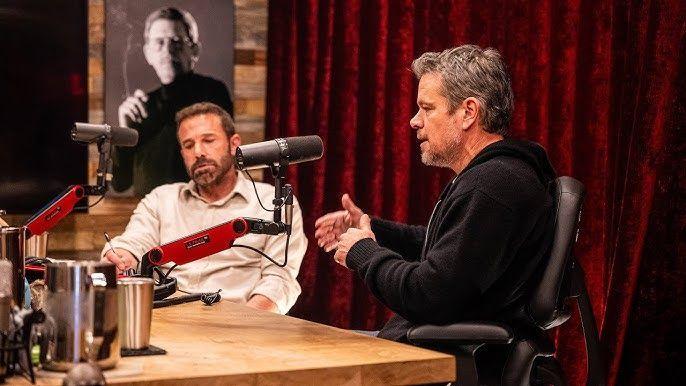
Ben Affleck delivered a blunt assessment of AI during a recent appearance on The Joe Rogan Experience podcast alongside Matt Damon, where the duo promoted their upcoming Netflix film The Rip. The Oscar-winning actor-director didn't hold back, describing AI writing tools like ChatGPT, Claude, and Gemini as producing content that is "really shitty" because "by its nature it goes to the mean, to the average."
1
Affleck's skepticism regarding artificial intelligence centers on its fundamental inability to replicate the nuance and emotional depth that human creativity brings to storytelling. "I just can't stand to see what it even writes," he added, emphasizing that AI-generated scripts lack the richness and intention that define meaningful art.1
Source: TechRadar
The conversation highlighted how Large Language Models (LLMs) operate by averaging patterns rather than creating original work. Affleck described these systems as essentially "a very expensive autocomplete machine" that smooths out risk and eliminates anything truly original.
3
This regression to the mean produces content that feels assembled rather than crafted, lacking the flair and contradictions inherent in lived human experience.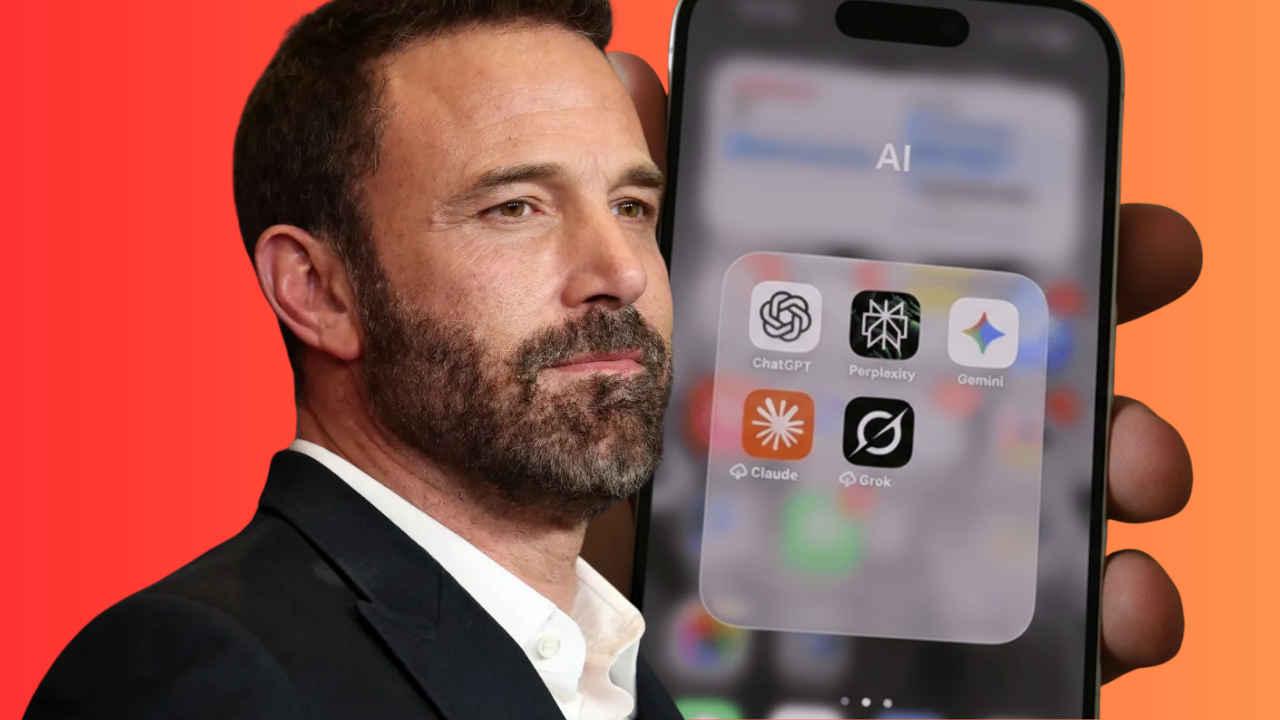
Source: Digit
Matt Damon Reinforces Concerns About AI in Movie Production
Matt Damon joined the discussion by addressing AI's role in facial modification and performance capture technology used in Hollywood. Following an anecdote about Dwayne Johnson's raw emotional performance in Benny Safdie's The Smashing Machine, Damon emphasized that no algorithm can replicate authentic human expression drawn from real trauma and experience. "You can have AI understand Dwayne's face and move it into different (expressions), no f*****g AI can do that," Damon stated.
1
His comments underscore the irreplaceable value of human artistry in screenwriting and performance, where emotional authenticity cannot be synthesized through pattern recognition.AI Company Valuations Inflated by Job Displacement Fears
Ben Affleck took aim at the business narrative surrounding AI, arguing that fears of widespread job displacement are deliberately exaggerated to support inflated AI company valuations. "The fear around AI is because people feel an existential dread, imagining it could wipe out entire industries," he explained, adding that "much of the dramatic rhetoric comes from those trying to justify high company valuations, claiming AI will transform everything in just a couple of years."
2
This framing serves corporate interests rather than reflecting technological reality, Affleck suggested.He pointed to the diminishing returns in AI development, noting that newer models like ChatGPT-5 are only approximately 25% better than predecessors while requiring significantly more energy and resources.
2
The promised exponential growth curve has flattened into something "slower, and much more expensive," representing "diminishing returns wrapped in PR spin" rather than genuine disruption.3
History shows that adoption is typically slow and incremental, contradicting the revolutionary narratives used to justify trillion-dollar investments.Related Stories

AI is Overhyped But Could Serve as Infrastructure
Despite his harsh criticism, Affleck acknowledged that AI as a filmmaking tool could provide practical value in specific applications. He compared it to existing technologies like CGI and visual effects, suggesting it might help reduce production costs. "For example, we don't have to go to the North Pole, we can shoot the scene here in our parkas and whatever but make it appear very realistically as if we're in the North Pole, it'll save us a lot of money and time," he explained.
1
Affleck believes AI will ultimately function as infrastructure rather than a creative replacement, filling "the expensive, boring gaps" while depending entirely on human judgment to determine what matters.
3
From a union perspective, he suggested guilds will manage AI adoption as a tool that assists rather than replaces workers. AI might help generate ideas during creative blocks or provide context when writers struggle, but it cannot write meaningful stories "from whole cloth."1
The Troubling Reality of AI Companionship
Affleck raised concerns about AI's dominant use case emerging as companionship through chatbots that flatter users endlessly without challenging them. "If the dominant use case for AI turns out to be companionship - chatbots that flatter you, listen endlessly, and never push back - then we should question its social value altogether," he argued.
3
Most users engage with AI casually as chat companions rather than for complex creative tasks, he noted.2
A sycophanic digital friend might provide comfort but doesn't build anything meaningful or contribute to artistic expression. For someone whose career depends on creative risk, Affleck's verdict remains clear: while AI can assist around the edges, the soul of creative endeavor stays stubbornly human, making it creatively hollow as a replacement for genuine artistry.References
Summarized by

Navi
[2]
Related Stories
Ben Affleck's Nuanced Take on AI in Filmmaking: Potential Benefits and Creative Limitations
19 Nov 2024•Entertainment and Society

Hollywood reframes AI as infrastructure while studios navigate creative boundaries and job concerns
17 Mar 2026•Technology

AMC Theatres blocks AI-generated film after social media outcry over creative rights
20 Feb 2026•Entertainment and Society
Recent Highlights
1
Apple Plans Major Siri AI Overhaul in iOS 27 With Third-Party Chatbot Integration
Technology

2
OpenAI shuts down Sora after six months, ending Disney's $1 billion licensing partnership
Technology

3
AI chatbots validate you too much, making you less kind to others, Stanford study reveals
Science and Research
Recent Highlights
Today's Top Stories




Your Daily Dose of Curated AI News
Don’t drown in AI news. We cut through the noise - filtering, ranking and summarizing the most important AI news, breakthroughs and research daily. Spend less time searching for the latest in AI and get straight to action.

