Boston Dynamics unveils production-ready Atlas robot with superhuman abilities at CES 2026


5 Sources
5 Sources
[1]
Boston Dynamics' New Atlas Robot Makes Public Debut With Jaunty Human Walk
Katie is a UK-based news reporter and features writer. Officially, she is CNET's European correspondent, covering tech policy and Big Tech in the EU and UK. Unofficially, she serves as CNET's Taylor Swift correspondent. You can also find her writing about tech for good, ethics and human rights, the climate crisis, robots, travel and digital culture. She was once described a "living synth" by London's Evening Standard for having a microchip injected into her hand. If there's one name you've heard of in the world of robotics, it's likely to be Boston Dynamics. For years, videos of the company's inventions have inspired intrigue, excitement and sometimes fear in viewers around the world. At CES 2026, the company unveiled the latest version of Atlas, its general-purpose humanoid robot. The new Atlas prototype strolled onto the stage at Hyundai's CES media event, with a jaunty and remarkably human-like walk. It twirled around, before performing a dramatic reveal of a static version of the final Atlas product, which will soon go into production and take on manufacturing jobs of its own. Over the past decade, we've watched as Atlas has evolved from a goofy metal robot into the sleek humanoid we see today. This marks an exciting, if unnerving moment in its journey. New and improved Atlas is designed to be an industrious and powerful worker bee, capable of navigating complex environments, performing repetitive tasks and constantly learning through AI so as to be able to adapt to new roles. Physically, it has 56 degrees of freedom with fully rotational joints, along with human-scale hands capable of tactile sensing for material sequencing, assembly and machine tending. One of the first places it will be working is a manufacturing plant in Savannah, Georgia owned by Boston Dynamics' parent company Hyundai Motor Group. It's among a range of facilities in Hyundai's global portfolio where Atlas will be able to perform real-world tasks on site. "I've been designing, building and programming robots for my entire career, and I've never been more excited about what's next than I am right now, we're on the cusp of a transformational shift that will be as impactful as the smartphone," said Zachary Jackowski, VP and General Manager of Atlas at Boston Dynamic on stage at Hyundai's press event. At the core of Hyundai's robot strategy, which the company unveiled at the show, is what it sees as a future partnership between humans and co-working robots. Even though many people have expressed wariness at the idea of Atlas, this refreshed robot is a key part of that strategy. In a press release, the company said it expects humanoids to become the largest segment of the physical AI segment in the future. Another key element of Hyundai's robot strategy is partnering with other leaders in AI. On Monday at CES, the company said it would be working closely with Google DeepMind. It's something of a full-circle moment for the company, as Google previously owned Boston Dynamics between 2013 and 2017. This partnership will see Google's AI models -- including Gemini Robotics -- integrated with Boston Dynamics. The rapid advancements in AI over the past few years is starting to accelerate robot development, and the Google Deepmind and Boston Dynamics partnership speaks to the growth of what some in the industry refer to as physical AI. "We are excited to begin working with the Boston Dynamics team to explore what's possible with their new Atlas robot as we develop new models to expand the impact of robotics, and to scale robots safely and efficiently," said Carolina Parada, senior director of robotics at DeepMind.
[2]
Boston Dynamics' Unnatural New Robot Demo Will Give You Goose Bumps
Not everybody agrees that replicating the four-limbed, bipedal shape of a human should be replicated in robot form. For one, walking with two feet is inherently less stable than four, nevermind a set of wheels. Replicating the dexterity and fine motor skills of human hands also remains a major challenge. In a modified approach, Boston Dynamics has clearly decided to loosen up some of the restrictions of the human form. During an on-stage demonstration at this year's CES convention in Las Vegas, Boston Dynamics showed off the agility of its humanoid Atlas robot -- albeit with an unnerving degree of freedom of movement that dispels the illusion of a human entity. Key to the demo is that the robot features clever joints that allow for "continuous rotation." In effect, its hips, wrists, and neck can swivel a full 360 degrees unimpeded. After confidently strutting to the front of the stage, Atlas starts twisting its hands like a drill, rotating its head like the girl in "The Exorcist," and even turning its entire torso around in a dizzying maneuver -- a clear indication that Boston Dynamics isn't planning to be boxed in by the limitations of human anatomy. "There's more to it than just copying nature," Boston Dynamics CEO Robert Playter said during the announcement. "We can pick the best parts of what nature has to offer and do better in others." The demo was part of Boston Dynamics' announcement of a production-ready version of its Atlas robot. The Hyundai-owned firm also announced a partnership with Google's DeepMind to bring AI smarts to its bots as well. The firm claimed that it's already working on a robot that can be deployed in a car factory. The plan is to deploy it at Hyundai's EV manufacturing facility by 2028. However, pricing and an availability date for the six-foot-two, 200-pound robot have yet to be revealed. Beyond spinning its head and hands around freely, Boston Dynamics has shown how Atlas can manipulate car parts and even perform slick breakdancing moves. "Atlas is going to revolutionize the way industry works, and it marks the first step toward a long-term goal we have dreamed about since we were children," Playter boasted on stage. Yet many questions remain about the tech's long-term viability. For one, not everybody agrees that they make the most sense when it comes to actually replacing human labor. Experts have also warned that humanoid robots could be the next financial bubble. When or if bipedal robots will be the form factor of choice, particularly when it comes to industrial settings, remains a subject of debate. "I think the question comes back to what are the use cases and where is the applicability of the technology," McKinsey partner Alex Panas told NBC News. "In some cases, it may look more humanoid. In some cases, it may not." Judging by its latest demo, Boston Dynamics is playing it safe by taking some liberties.
[3]
How Boston Dynamics upgraded the Atlas robot -- and what's next
In 2021, 60 Minutes visited the offices of robotics company Boston Dynamics and met an early model of its humanoid robot, Atlas. It could run, jump and maintain its balance when pushed. But it was bulky, with stiff, mechanical movements. Now, Atlas can cartwheel, dance, run with human-like fluidity, twist its arms, head and torso 360 degrees, and pick itself up off of the floor using only its feet. "They call it a humanoid, but he stands up in a way no human could possibly stand up," correspondent Bill Whitaker told Overtime. "His limbs can bend in ways ours can't." Boston Dynamics CEO Robert Playter told Whitaker that Atlas' "superhuman" range of motion is keeping with the company's vision for humanoid robots. "We think that's the way you should build robots. Don't limit yourself to what people can do, but actually go beyond," Playter said. Whitaker watched demonstrations of the latest Atlas model at Boston Dynamics' headquarters in Waltham, Massachusetts. Rather than turning around to walk in the other direction, Atlas can simply rotate its upper torso 180 degrees. "For us to turn around, we have to physically turn around," he told Overtime. "Atlas just pivots on his core." Boston Dynamics' head of robotics research, Scott Kuindersma, told Whitaker that Atlas doesn't have wires that cross its the joints of the limbs, torso and head, allowing continuous rotation for tasks and easier maintenance of the robot. "The robot's not really limited in its range of motion," Kuindersma told Whitaker. "One of the reliability issues that you often find in robots is that their wires start to break over time... we don't have any wires that go across those rotating parts anymore." Another upgrade to the Atlas humanoid robot is its AI brain, powered by Nvidia chips. Atlas' AI can be trained to do tasks. One way is through teleoperation, in which a human controls the robot. Using virtual reality gear, the teleoperator trains Atlas to do a specific task, repeating it multiple times until the robot succeeds. Whitaker watched a teleoperation training session. A Boston Dynamics' machine learning scientist showed Atlas how to stack cups and tie a knot. Kuindersma told Whitaker robot hands pose a complex engineering problem. "Human hands are incredible machines that are very versatile. We can do many, many different manipulation tasks with the same hand," Kuindersma said. Boston Dynamics' new Atlas has only three digits on each hand, which can swing into different positions or modes. "They can act as if they were a hand with these three digits, or this digit can swing around and act more like a thumb," Kuindersma said. "It allows the robot to have different shaped grasps, to have two-finger opposing grasp to pick up small objects. And then also make its hands very wide, in order to pick up large objects." Kuindersma said the robot has tactile sensors on its fingers, which provide information to Atlas' neural network so the robot can learn how to manipulate objects with the right amount of pressure. But Kuindersma said there is still room to improve teleoperation systems. "Being able to precisely control not only the shape and the motion, but the force of the grippers, is actually an interesting challenge," Kuindersma told Whitaker. "I think there's still a lot of opportunity to improve teleoperation systems, so that we can do even more dexterous manipulation tasks with robots." Whitaker told Overtime, "There is quite a bit of hype around these humanoids right now. Financial institutions predict that we will be living with millions, if not billions, of robots in our future. We're not there yet." Whitaker asked Boston Dynamics CEO Robert Playter if the humanoid hype was getting ahead of reality. "There is definitely a hype cycle right now. Part of that is created by the optimism and enthusiasm we see for the potential," Playter said. "But while AI, while software, can sort of move ahead at super speeds... these are machines and building reliable machines takes time... These robots have to be reliable. They have to be affordable. That will take time to deploy."
[4]
Boston Dynamics is training an AI-powered humanoid robot to do factory work
Marc Lieberman joined 60 Minutes in 2014. Working with correspondent Bill Whitaker, he has produced more than 40 stories, including breaking news, newsmaker interviews, profiles, and in-depth investigations. He started his career at CBS News in 1992. With rapid advances in artificial intelligence, computer scientists and engineers are making progress in developing robots that look and act like humans. A global race is underway to develop humanoid robots for widespread use. Boston Dynamics has established itself as a frontrunner in the field. With support from South Korean carmaker Hyundai, which owns an 88% stake in Boston Dynamics, the Massachusetts company is testing a new generation of its humanoid robot, Atlas. This past October, a 5-foot-9-inch, 200-pound Atlas was put to the test at Hyundai's new Georgia factory, where it practiced autonomously sorting roof racks for the assembly line. Today's AI-powered humanoids are learning movements that, until recently, were considered a step too far for a machine, according to Scott Kuindersma, who is the head of robotics research at Boston Dynamics. "A lot of this has to do with how we're going about programming these robots now, where it's more about teaching, and demonstrations, and machine learning than manual programming." Kuindersma said. When 60 Minutes visited Boston Dynamics' headquarters in 2021, Atlas was a bulky, hydraulic robot that could run and jump. Back then, Atlas relied on algorithms written by engineers. The Atlas of today is sleeker, with an all-electric body and an AI brain powered by Nvidia's advanced microchips, making it smart enough to master hard-to-believe feats. Atlas learns in several ways. At Boston Dynamics, machine learning scientist Kevin Bergamin demonstrated an example of supervised learning. Wearing a virtual reality headset, Bergamin took direct control of the humanoid and guided its hands and arms through each task until Atlas succeeded. "That generates data that we can use to train the robot's AI models to then later do that task autonomously," Kuindersma said. Another teaching technique involves a motion capture body suit. 60 Minutes correspondent Bill Whitaker wore the suit while performing jumping jacks. Since Atlas' body is different from Whitaker's, the robot was trained to match his motions. Data collected by the motion capture suit was fed into Boston Dynamics' machine learning process. More than 4,000 digital Atlases trained for six hours in simulation. The simulation added challenges for the avatars -- like slippery floors, inclines or stiff joints - and homed in on the best way for Atlas to perform the jumping jacks. The Boston Dynamics team then uploaded the new skill into the AI system that controls every Atlas robot. Once one was trained, they were all trained. At the end of the process, Atlas performed jumping jacks that looked just like Whitaker's. Having learned from the same technique, Atlas demonstrated the ability to run, crawl, skip, and dance. There are limitations, Kuindersma said. Atlas isn't proficient at performing most of the routine tasks that people do in their daily lives, like putting on clothes or pouring a cup of coffee. "There are no humanoids that do that nearly as well as a person," Kuindersma said. "But I think the thing that's really exciting now is we see a pathway to get there." Boston Dynamics CEO Robert Playter spearheaded the company's humanoid development. "There's a lot of excitement in the industry right now about the potential of building robots that are smart enough to really become general purpose," he said. Goldman Sachs predicts the market for humanoids will reach $38 billion within the decade. Boston Dynamics and other U.S. robot makers are fighting to come out on top. State-supported Chinese companies are also in the race. "The Chinese government has a mission to win the robotics race.," Playter said. "Technically I believe we remain in the lead. But there's a real threat there that, simply through the scale of investment, we could fall behind." As fears grow that AI will displace workers, humanoid robots are learning to perform human tasks. Boston Dynamics is training Atlas to do a job that human workers currently handle at Hyundai's Georgia plant. Playter said it could be several years before Atlas becomes a full-time worker at Hyundai, but he predicted that humanoids will change the nature of work. "The really repetitive, really backbreaking labor is really, is going to end up being done by robots. But these robots are not so autonomous that they don't need to be managed. They need to be built. They need to be trained. They need to be serviced." Playter said there are benefits to creating robots like Atlas, which can move in ways that humans can't. "We would like [robots] that could be stronger than us or tolerate more heat than us or definitely go into a dangerous place where we shouldn't be going," he said. "So you really want superhuman capabilities." Still, Playter said there's no reason to worry about a future like the one depicted in "The Terminator." "[If you] saw how hard we have to work to get the robots to just do some of the straightforward tasks we want them to do, that would dispel that worry about sentience and rogue robots," he said.
[5]
Boston Dynamics CEO Says Robots Will Replace Workers for One Particular Type of Labor
Boston Dynamics is an undisputed frontrunner in the race to develop humanoid robots -- and now, its Atlas robot is getting to work at Hyundai. A corner of the parts warehouse at Hyundai's Georgia factory is home to on-the-job training for Atlas. Following Hyundai's 2021 investment in Boston Dynamics, the 5'9" and 200-lb humanoid is being trained to perform tasks like sorting roof racks for the Korean automaker's assembly line. Thanks to advancements in AI, the robot, which once ran on algorithms, can now learn and perform tasks, courtesy of an "AI brain" powered by Nvidia chips, CBS News reported. The robot, however, is still several years from joining the Hyundai workforce full time. Asked whether building a robot that functions similarly to a human -- only stronger, more heat resistant and less prone to fatigue -- could put human jobs at risk, Boston Dynamics CEO Robert Playter said it likely will. "Work does change so the really repetitive, really back-breaking labor is going to end up being done by robots. But these robots are not so autonomous that they don't need to be managed," Playter told 60 Minutes.
Share
Share
Copy Link
Boston Dynamics showcased its latest Atlas robot at CES 2026, demonstrating a remarkably human-like walk alongside superhuman capabilities including 360-degree joint rotation. The AI-powered humanoid robot, standing 5'9" and weighing 200 pounds, is set to begin work at Hyundai's Georgia manufacturing facility by 2028, marking a significant step toward widespread deployment of humanoid robots in industrial settings.
Boston Dynamics Showcases Production-Ready Atlas Robot at CES 2026
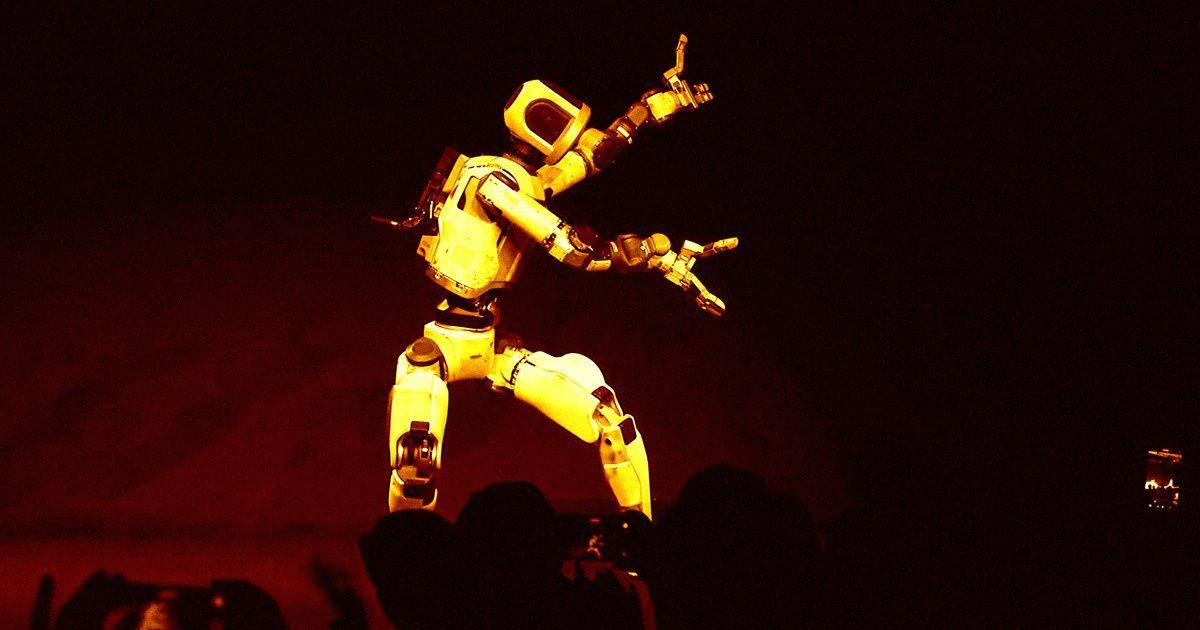
Boston Dynamics made a striking entrance at CES 2026, unveiling the production-ready version of its Atlas robot during Hyundai's media event in Las Vegas. The AI-powered humanoid robot walked onto the stage with what observers described as a "jaunty and remarkably human-like walk," twirling before dramatically revealing a static version of the final product destined for manufacturing facilities
1
. Standing at 5'9" and weighing 200 pounds, the new Atlas represents years of evolution from its bulky, hydraulic predecessor into a sleek, all-electric humanoid powered by an AI brain using Nvidia chips3
.
Source: Futurism
Advanced Physical Agility Beyond Human Limitations
What sets this Atlas robot apart is its deliberate departure from human anatomical constraints. The robot features 56 degrees of freedom with fully rotational joints, enabling continuous 360-degree rotation of its hips, wrists, neck, and entire torso
1
2
. During the demonstration, Atlas twisted its hands like a drill and rotated its head in movements reminiscent of "The Exorcist," showcasing capabilities that dispel any illusion of merely replicating human form2
. Boston Dynamics CEO Robert Playter emphasized this design philosophy: "There's more to it than just copying nature. We can pick the best parts of what nature has to offer and do better in others"2
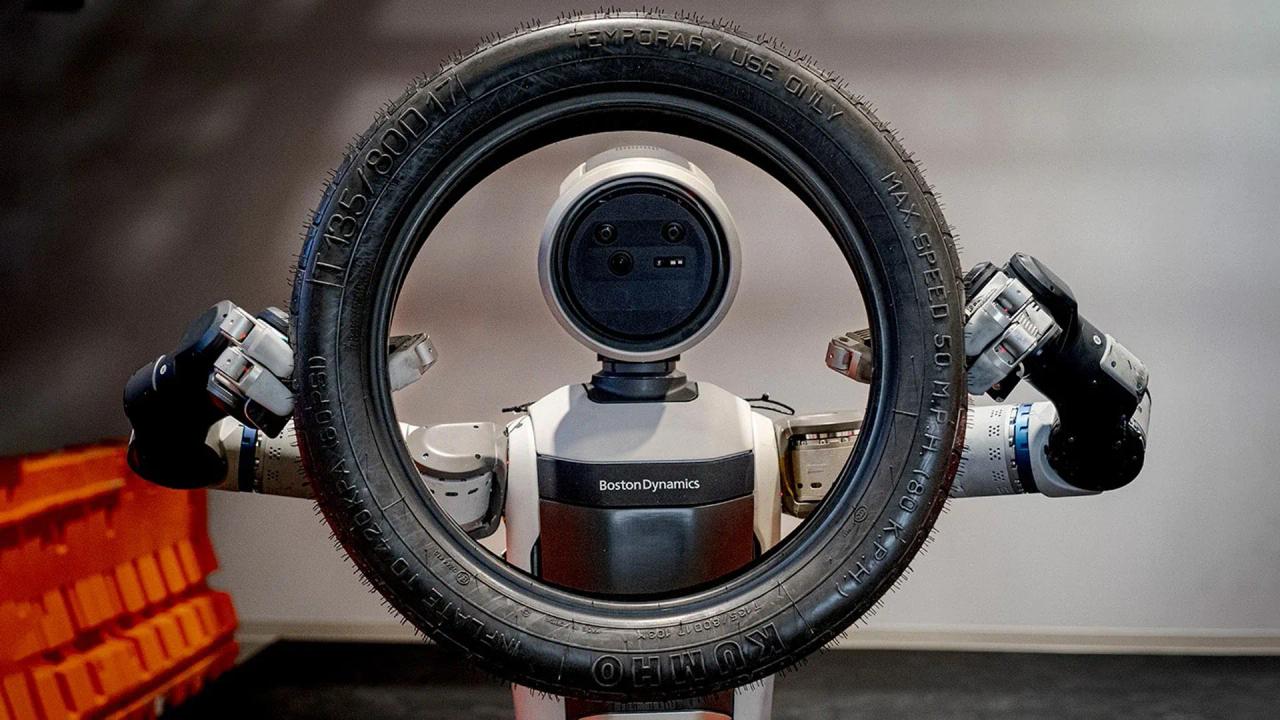
.The robot's hands feature only three digits but can swing into different positions, allowing for both two-finger opposing grasps for small objects and wide grips for larger items. Equipped with tactile sensors on its fingers, Atlas can learn to manipulate objects with appropriate pressure through its neural network
3
. Scott Kuindersma, head of robotics research at Boston Dynamics, explained that eliminating wires crossing the joints not only enables unlimited range of motion but also improves reliability by preventing wire breakage over time3
.
Source: Inc.
Training for Factory Work Through Machine Learning and Teleoperation
The Atlas robot learns through multiple sophisticated techniques powered by artificial intelligence. Using teleoperation, human operators wearing virtual reality headsets control the robot, guiding it through specific tasks repeatedly until Atlas masters them autonomously
4
. Machine learning scientist Kevin Bergamin demonstrated this supervised learning approach, showing how data generated from human control trains the robot's AI models4
.Another training method employs motion capture technology. When a person wearing a motion capture suit performs movements like jumping jacks, over 4,000 digital Atlases train for six hours in simulation, encountering challenges like slippery floors and inclines. Once one Atlas learns a skill, all Atlas robots gain that capability through uploaded data
4
. This approach has enabled Atlas to run, crawl, skip, dance, perform breakdancing moves, and even pick itself up using only its feet2
3
.Hyundai Manufacturing Plants Set for 2028 Deployment
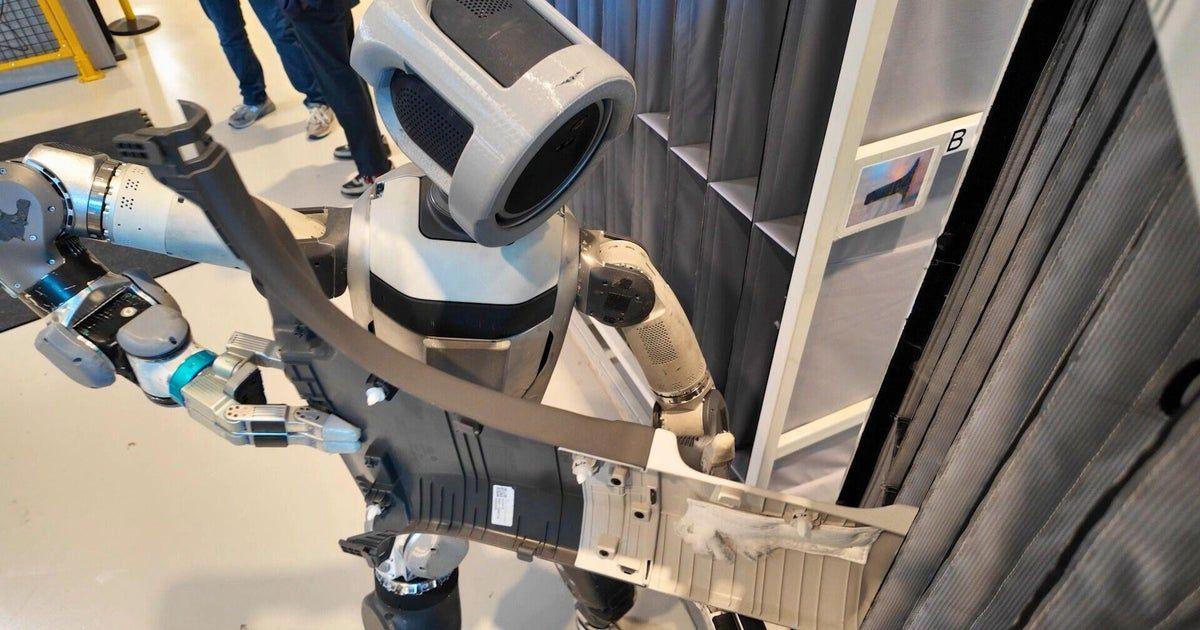
The first workplace for Atlas will be Hyundai's manufacturing facility in Savannah, Georgia, where the robot has already begun training for factory work. In October, Atlas practiced autonomously sorting roof racks for the assembly line at Hyundai's new Georgia factory
4
. Boston Dynamics plans full deployment at Hyundai's EV manufacturing facility by 20282
. The robot will perform real-world tasks across Hyundai's global portfolio of facilities, handling material sequencing, assembly, and machine tending1
.
Source: CBS
Zachary Jackowski, VP and General Manager of Atlas at Boston Dynamics, declared: "I've been designing, building and programming robots for my entire career, and I've never been more excited about what's next than I am right now, we're on the cusp of a transformational shift that will be as impactful as the smartphone"
1
.Related Stories

Google DeepMind Partnership Accelerates Robotics Development
Boston Dynamics announced a partnership with Google DeepMind to integrate advanced AI models, including Gemini Robotics, into its robotic systems. This collaboration marks a full-circle moment, as Google previously owned Boston Dynamics between 2013 and 2017
1
. Carolina Parada, senior director of robotics at DeepMind, stated: "We are excited to begin working with the Boston Dynamics team to explore what's possible with their new Atlas robot as we develop new models to expand the impact of robotics, and to scale robots safely and efficiently"1
.This partnership exemplifies the growth of physical AI, where rapid advancements in artificial intelligence accelerate robotics development. Hyundai's robot strategy centers on future partnerships between humans and co-working robots, with humanoids expected to become the largest segment of the physical AI market
1
.Impact on Repetitive Labor and Workforce Transformation
When asked whether Atlas could replace human workers, Robert Playter acknowledged the reality: "Work does change so the really repetitive, really back-breaking labor is going to end up being done by robots. But these robots are not so autonomous that they don't need to be managed" . He emphasized that humanoids will require human oversight, noting they "need to be built. They need to be trained. They need to be serviced"
4
.Goldman Sachs predicts the market for humanoids will reach $38 billion within the decade, with Boston Dynamics competing against both U.S. rivals and state-supported Chinese companies
4
. Playter warned: "The Chinese government has a mission to win the robotics race. Technically I believe we remain in the lead. But there's a real threat there that, simply through the scale of investment, we could fall behind"4
.Despite the excitement, questions persist about long-term viability. Experts have warned that humanoid robots could represent the next financial bubble, with debate continuing over whether bipedal robots make the most sense for industrial settings
2
. McKinsey partner Alex Panas noted: "I think the question comes back to what are the use cases and where is the applicability of the technology"2
. While Atlas demonstrates impressive human-like movements, Kuindersma acknowledged it isn't yet proficient at routine daily tasks like putting on clothes or pouring coffee, though he sees "a pathway to get there"4
.Playter addressed concerns about the current hype cycle: "There is definitely a hype cycle right now. Part of that is created by the optimism and enthusiasm we see for the potential. But while AI, while software, can sort of move ahead at super speeds... these are machines and building reliable machines takes time... These robots have to be reliable. They have to be affordable. That will take time to deploy"
3
. Pricing and broader availability dates for Atlas remain undisclosed2
.References
Summarized by

Navi
Related Stories
Boston Dynamics' Atlas Robot Demonstrates Autonomous Workplace Capabilities
01 Nov 2024•Technology

Boston Dynamics' Atlas robot enters production to build Hyundai cars starting in 2028
05 Jan 2026•Technology

Boston Dynamics' Atlas Robot Showcases Advanced Mobility and AI-Driven Movements
20 Mar 2025•Technology

Recent Highlights
1
AI chatbots validate you too much, making you less kind to others, Stanford study reveals
Science and Research
2
Anthropic's Claude Code Source Leak Reveals Hidden AI Agent Plans and Extensive System Access
Technology

3
Judge blocks Pentagon from branding Anthropic a security risk over AI safety guardrails dispute
Policy and Regulation

Recent Highlights
Today's Top Stories




Your Daily Dose of Curated AI News
Don’t drown in AI news. We cut through the noise - filtering, ranking and summarizing the most important AI news, breakthroughs and research daily. Spend less time searching for the latest in AI and get straight to action.

