Cadence Design Systems beats Q4 expectations as AI chip design demand drives record backlog


4 Sources
4 Sources
[1]
Cadence beats quarterly profit and revenue estimates on strong AI-linked demand
Feb 17 (Reuters) - Cadence Design Systems (CDNS.O), opens new tab beat quarterly revenue estimates on Tuesday, as strong demand for complex artificial intelligence processors lifted sales of its chip design software. Shares of the San Jose, California-based company were up nearly 4% in extended trading. Elevated demand for chips that can handle complex AI processes has benefited the company, which offers specialized design software for mapping out intricate circuits and blueprints for common components such as memory connectors. It also sells tools that check for overheating or electrical glitches. CFO John Wall said strong fourth-quarter contract bookings have left the company with a record $7.8 billion worth of work under contract to be delivered in future periods, giving it strong momentum heading into 2026. Cadence, whose customers include Apple (AAPL.O), opens new tab and Amazon (AMZN.O), opens new tab, introduced a virtual AI "agent" earlier this month to help companies such as Nvidia (NVDA.O), opens new tab accelerate the design of complex chips, an increasingly important battleground in the U.S.-China technology race. Cadence's fourth-quarter revenue rose 6.2% from a year earlier to $1.44 billion, beating analysts' average estimate of $1.42 billion, according to data compiled by LSEG. Adjusted profit came in at $1.99 per share for the quarter, exceeding estimates of $1.91 per share. Cadence expects 2026 revenue between $5.9 billion and $6.0 billion, largely in line with analysts' expectations. For 2025, the company reported revenue of $5.30 billion. It also forecast adjusted profit per share of $8.05 to $8.15 for the year, largely in line with estimates of $8.05. Reporting by Anhata Rooprai in Bengaluru; Editing by Jonathan Ananda Our Standards: The Thomson Reuters Trust Principles., opens new tab
[2]
This software stock was hit hard on AI disruption fears. Now it's proving detractors wrong
For the most part, analysts across Wall Street maintained their long-term bullishness on shares of Cadence Design Systems , following its fourth-quarter earnings release, calling threats of artificial intelligence disruption overblown. On Tuesday afternoon, the electronic systems designer reported fourth-quarter adjusted earnings of $1.99 per share, surpassing the $1.91 analysts polled by FactSet had expected. Cadence's $1.44 billion revenue also exceeded the consensus forecast of $1.42 billion. Cadence estimated full-year earnings will also come in higher than anticipated. Revenue for its current quarter should land between $1.42 billion and $1.46 billion, above analysts' expectations of $1.38 billion. Cadence has been swept up in the broader software sell-off this year, with the stock down 9% in 2026. But shares were already rebounding 7% higher as analysts applauded Cadence's protection from AI threats. "While there are general concerns about AI disrupting the software business model, both we and the team believe that chip design software is highly complex and not easily replicated, benefiting from strong technology, a strong customer/ ecosystem network, and a significant data moat. Instead, AI should enable Cadence to unlock better automation capabilities for customers and drive improved monetization," JPMorgan analyst Harlan Sur wrote. "Cadence noted agentic AI workflows at customers are increasing the use of its software and is not engaged in customer discussions to reduce [electronic design automation]. Cadence is adding extra tools to automate the [register transfer level] coding process (manual), while noting the chip design process still requires existing tools such as verification, simulation, etc," wrote Wells Fargo analyst Joe Quatrochi. "We would view this positively, and we'll be interested in better understanding Cadence's 'usage / outcome-based' pricing of its AI tools." Bottom line, most analysts maintained their long-term bullish stance, although some cut their price targets. Here's how Wall Street's biggest shops reacted. Piper Sandler: Neutral rating, $319 price target The investment firm's price target, down from $355, implies about 13% upside from Cadence's Tuesday close of $283.46. "While all encouraging, including the implicit return of double-digit growth in recurring revenue, we believe shares largely represent, in our view, the fulsome picture of CDNS's medium-term prospects: low-teens CAGR for revenue and ~50% incremental margins. As seen in recent weeks, carrying a premium multiple in software is challenging proposition. While fundamentals remain robust and think CDNS is the strongest asset in [electronic design automation], we remain Neutral." Morgan Stanley: Overweight, $370 Morgan Stanley's forecast, down from $385, corresponds to upside of 31%. "Another beat this quarter, with evidence of momentum into 1H26, likely supports price action. New agentic plays and a sense that systems threats from LLMs are minimal may be more supportive of longer-term value. We keep our Overweight rating but trim our estimates in line with guidance; PT to $370." Bank of America: Buy, $375 The bank's target, cut from $400, calls for upside of 32%. "CDNS has seen no customer discussion regarding reducing their usage of EDA software and remain protected by 1) increasing customer reliance on AI expected to increase semi R & D budgets and the % of R & D $s going to [electronic design automation] (currently ~15%) given EDA tool complexity needed to design more complex chips, 2) deep integration with customer design teams/roadmaps increasing customer reliance on CDNS, and 3) chip design data collected over prior years allowing for faster acceleration of CDNS' AI-enabled tools vs. 'merchant' AI models." Wells Fargo: Overweight, $375 Wells Fargo cut its target from $410. "Positive initial 2026 Guide; focus on upside drivers as recurring software re-accelerates. Cadence delivered a positive beat / raise as it continues to see strong broad-based demand. Strong 1Q26 guide leaves us focused on conservatism for 2026 as CDNS reported re-accelerating recurring software demand in part via AI." Baird: Outperform, $395 Baird's forecast is 39% above Cadence's Tuesday closing price. "Unease ahead of 4Q25 results drove Cadence shares -5% Tuesday (S & P=flat%), there is opportunity to regain lost ground given strength in quarter, AI-related demand improvement, and positive guidance. FY26 outlook begins revenue +11-13% YoY (consensus=12%), recurring revenues accelerating +LDD% YoY, guidance de-risked for contributions from hardware/China (hardware with potential 2H upside as pipeline fills). We expect FY26 growth finishes closer to mid-teens YoY (FY25: +14% YoY), and within tough software tape, we recommend exposure to Cadence given AI positioning and industry-leading growth within each key product segment." Mizuho: Outperform, $400 Mizuho's target equates to 41% upside. "Management continues to see healthy design activity, especially stable growth in China against a potentially volatile geopolitical backdrop. Hardware and IP continue to see solid trends and core [electronic design automation] is performing well. CDNS continues to benefit from the GenAI build-outs and internal AI-driven productivity gains while SD & A expansion and emerging Physical AI opportunities add long-term optionality." JPMorgan: Overweight, $405 JPMorgan's forecast implies about 43% upside from here. "Solid full-year CY26 guidance reflects prudent China/ hardware outlook; expect more upside as year unfolds on strong AI chip design activity and AI solution adoption ... Leading-edge chip design activity is strong, driven by the AI infrastructure build-out and broad-based portfolio strength. Additionally, Cadence's AI products -- Cerebrus, Verisium, and Allegro X AI -- are gaining traction, alongside the recently launched agentic AI solution, Chipstack AI Super Agent. Hardware revenues were strong and at record levels, fueled by demand from AI and hyperscale customers, and the team anticipates another record year in CY26."
[3]
Cadence signals $5.9B-$6B 2026 revenue target as AI-driven design solutions boost backlog (NASDAQ:CDNS)
Earnings Call Insights: Cadence Design Systems (CDNS) Q4 2025 Management View * Anirudh Devgan, CEO, President & Director, announced "Cadence delivered excellent results for the fourth quarter, closing an outstanding 2025 with 14% revenue growth and 45% operating margin for the year." He highlighted a record backlog of $7.8 billion and accelerated This article was automatically generated by an AI tool based on content available on the Seeking Alpha website, and has not been curated or reviewed by humans. Due to inherent limitations in using AI-based tools, the accuracy, completeness, or timeliness of such articles cannot be guaranteed. This article is intended for informational purposes only. Seeking Alpha does not take account of your objectives or your financial situation and does not offer any personalized investment advice. Seeking Alpha is not a licensed securities dealer, broker or US investment adviser or investment bank. Management highlighted that AI solutions are boosting demand for their tools, leading to productivity improvements and new monetization streams, particularly via agentic workflows and virtual engineer pricing models. Analysts expressed interest in sustainability and monetization via these AI-driven offerings. Guidance projects 2026 revenue at $5.9-$6 billion, GAAP operating margin at 31.75%-32.75%, non-GAAP margin at 44.75%-45.75%. 67% of 2026 revenue is expected from existing backlog, with recurring revenue growth supported by strong bookings and software business momentum. Management flagged prudent hardware and China guidance due to unresolved second-half hardware demand and regional uncertainties. China is expected to contribute 12%-13% of 2026 revenue. Export control regulations are assumed but the impact of an outstanding Hexagon acquisition is not.
[4]
Cadence beats quarterly expectations, with demand rising for AI chips
Cadence Design Systems posted better-than-expected Q4 results, benefiting from the ramp-up in processors dedicated to artificial intelligence. The company, which specializes in semiconductor design software, posed a 6.2% y-o-y rise in revenue to $1.44bn, above the consensus of $1.42bn. EPS reached $1.99, also above the consensus of $1.91. The stock was up nearly 6% in premarket trading on Wall Street. The momentum is being driven by strong demand for complex components, essential for AI applications, designed using Cadence's tools. The group also offers solutions to identify risks of overheating or electrical failure in circuits. Its order backlog hit a record $7.8bn, according to CFO John Wall, providing good visibility for FY 2026. Cadence, whose customers include Apple, Amazon and Nvidia, recently unveiled an AI-based virtual agent aimed at speeding up the chip design process. The innovation is a strategic move as technological rivalry between the US and China heats up. For 2026, the company forecasts revenue of $5.9bn to $6bn, with adjusted EPS of $8.05 to $8.15, in line with market expectations.
Share
Share
Copy Link
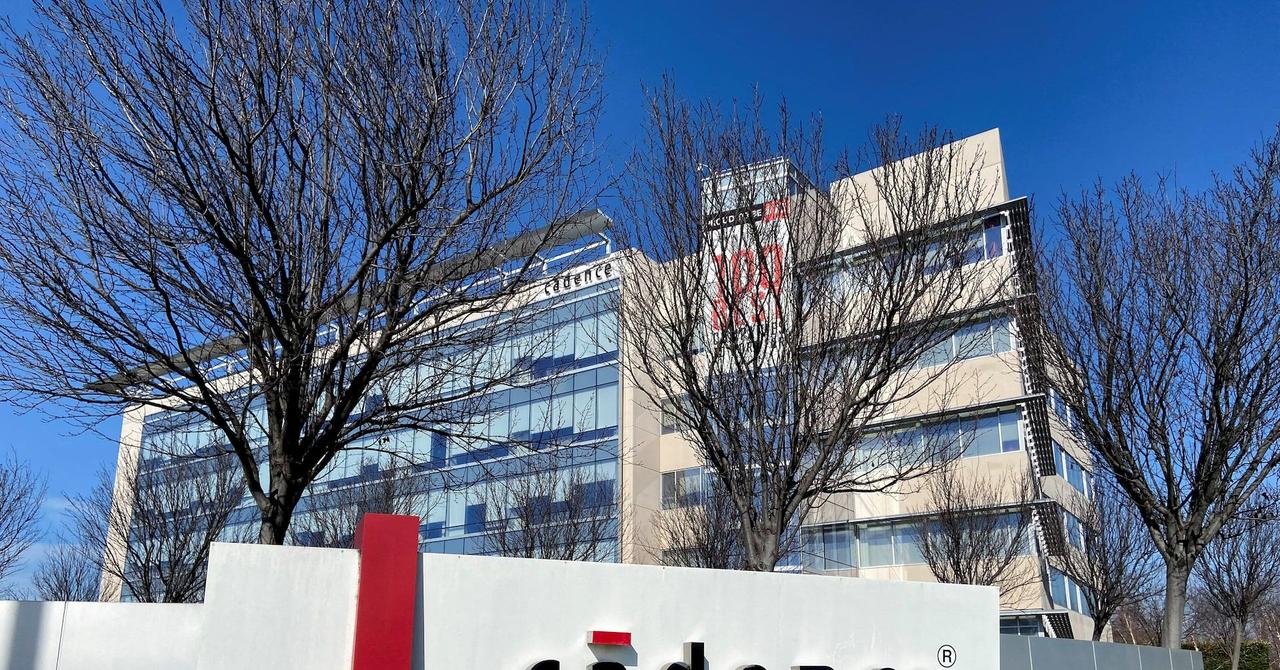
Cadence Design Systems exceeded quarterly profit and revenue estimates, powered by surging demand for AI chip design software. The company reported a record $7.8 billion backlog and announced a 2026 revenue target of $5.9-$6 billion, silencing critics who feared AI disruption would undermine its business model.
Cadence Design Systems Exceeds Quarterly Expectations on AI Momentum
Cadence Design Systems delivered fourth-quarter results that surpassed Wall Street expectations, fueled by robust demand for chip design software used to create advanced artificial intelligence processors
1
. The San Jose-based company reported quarterly profit and revenue of $1.99 per share and $1.44 billion respectively, beating analyst estimates of $1.91 per share and $1.42 billion2
. Revenue climbed 6.2% year-over-year, driven by customers designing complex AI chips that require specialized Electronic Design Automation (EDA) tools for mapping intricate circuits and identifying potential overheating or electrical issues4
.
Source: Market Screener
Shares jumped nearly 4% in extended trading and rebounded 7% higher as Wall Street analysts applauded the results, dismissing earlier AI disruption fears that had dragged the stock down 9% in 2026
2
. The company's customers include Apple, Amazon, and Nvidia, who rely on Cadence's tools to accelerate semiconductor research and development1
.Record Backlog Signals Strong Visibility Into 2026
CFO John Wall highlighted that strong fourth-quarter contract bookings left Cadence Design Systems with a record backlog of $7.8 billion worth of work under contract to be delivered in future periods, providing exceptional momentum heading into 2026
1
. This backlog represents 67% of the company's projected 2026 revenue, offering significant visibility and de-risking the outlook3
.Cadence announced a 2026 revenue target of $5.9 billion to $6.0 billion, largely in line with analyst expectations, representing growth from 2025 revenue of $5.30 billion
1
. The company also forecast adjusted profit per share of $8.05 to $8.15 for the year, matching estimates4
. CEO Anirudh Devgan stated that Cadence "delivered excellent results for the fourth quarter, closing an outstanding 2025 with 14% revenue growth and 45% operating margin for the year"3
.AI-Driven Design Solutions Create New Monetization Opportunities
Cadence introduced a virtual AI agent earlier this month to help companies like Nvidia accelerate AI chip design, positioning itself strategically in the intensifying U.S.-China technology race
1
. Management emphasized that AI-driven design solutions are boosting demand through agentic workflows and creating new monetization streams via usage-based and outcome-based pricing models3
.Wall Street analysts from Wells Fargo noted that "agentic AI workflows at customers are increasing the use of its software" and that Cadence is adding automation for chip design through tools that automate the register transfer level coding process. Rather than displacing Cadence's offerings, AI is enhancing the value proposition by enabling better automation capabilities for customers.
Related Stories

Analysts Dismiss AI Disruption Fears, Maintain Bullish Outlook
Despite being swept up in the broader software sell-off amid concerns about AI disrupting traditional software business models, Cadence proved detractors wrong with its latest results. Wall Street analysts largely maintained their long-term bullish stance, though some trimmed price targets. JPMorgan analyst Harlan Sur wrote that "chip design software is highly complex and not easily replicated, benefiting from strong technology, a strong customer/ecosystem network, and a significant data moat".
Bank of America maintained its Buy rating, noting that Cadence "has seen no customer discussion regarding reducing their usage of EDA software" and remains protected by increasing customer reliance on AI, which is expected to increase semiconductor research budgets and the percentage allocated to Electronic Design Automation tools. Baird analysts highlighted that recurring revenues are accelerating with potential for mid-teens year-over-year growth by year-end.
Management flagged prudent guidance for hardware and China contributions, with China expected to account for 12%-13% of 2026 revenue amid regional uncertainties and export control regulations
3
. However, the company's diversified customer base and technology leadership position it to navigate these headwinds while capitalizing on the AI-driven chip design boom.References
Summarized by

Navi
[3]
[4]
Related Stories
Cadence Design Systems Surges on Strong Q3 Results and AI-Driven Growth
29 Oct 2024•Business and Economy

Cadence Design Systems Reports Strong Q4 2024 Results, but 2025 Forecast Falls Short of Expectations
19 Feb 2025•Business and Economy

Cadence Design Systems Raises Annual Forecasts Amid Strong AI Chip Design Demand
29 Apr 2025•Business and Economy
Recent Highlights
1
Google releases Gemma 4 with Apache 2.0 license, enabling unrestricted local AI on devices
Technology

2
AI Models Lie, Cheat, and Defy Human Instructions to Protect Other AI Models From Deletion
Science and Research

3
Anthropic discovers functional emotions in Claude that actively shape AI behavior and decisions
Science and Research

Recent Highlights
Today's Top Stories





Your Daily Dose of Curated AI News
Don’t drown in AI news. We cut through the noise - filtering, ranking and summarizing the most important AI news, breakthroughs and research daily. Spend less time searching for the latest in AI and get straight to action.

