CES 2026 unveils AI companion robots with memory, as intimacy tech takes physical form


4 Sources
4 Sources
[1]
Your AI Girlfriend Has a Body and Memory Now. Meet Emily, CES's Most Intimate Robot
Sleep Science Coach Certification from The Spencer Institute. Lovense debuted at CES 2026 with a product that is hard to ignore. The brand, known for its app-connected sex toys, unveiled an AI-powered companion doll that combines physical intimacy with conversational intelligence. Read more: Official Best of CES 2026 Awards: Our Hand-Selected Finalists in 22 Categories The life-size doll, called Emily, has a realistic silicone exterior, a fully posable internal skeleton and limited facial movement, including mouth motion for a more expressive interaction. But Lovense says that the doll's hardware is only half the story. The real pitch is the emotional software. What makes Emily different isn't only what "she" can do, but what the AI system can remember. The doll is capable of holding conversations, remembering past interactions and adapting its personality to your liking over time. That means Emily doesn't just respond, she accumulates. Emily connects to the Lovense app via Bluetooth, which allows users to interact with the AI even when they're not physically with the doll. CNET's senior producer, Jesse Orrall, who had the opportunity to speak to Lovense executives, said that Emily's physical features and personality are customizable, and that it can send AI-generated selfies on request. Perhaps Lovense isn't selling a doll so much as a roadmap for a long-term relationship. During CES demos, the company framed the product less as a sex device and more as a form of companionship. The company's website says Emily can help you build confidence through judgment-free connection and safe, intimate expression through exploration. Lovense is positioning this sex robot as part of a broader ecosystem, rather than a standalone device, signaling a shift toward platforms that combine hardware, software and long-term personalization through machine learning. Back at CES 2025, we saw a humanoid robot called Aria, which mostly focused on movement and expressive robotics. One year later, at CES 2026, the Lovense companion doll shifts the focus to software, memory and AI, suggesting that this type of technology is moving toward personalized ecosystems. The trajectory of sex robots mirrors the trajectory of the technology itself -- from novelty to utility to attachment. And as AI companions grow more prevalent, the line between product and partners becomes harder to define. There are still some unknowns about this AI companion doll, including price and shipping date, but we can expect a presale to open up sometime in the future. Considering that last year's companion doll at CES was priced close to $175K, I can only guess that Emily will be close to that amount. Whether the idea of an AI companion doll feels fascinating, uncanny or somewhere in between, its presence at CES says a lot about where tech is headed. As artificial intelligence moves beyond screens and speakers, products like Emily hint at a future where AI sex robots are no longer just programmable, but increasingly personal. Let's just hope Emily doesn't turn out like Ava in Ex Machina.
[2]
AI moves into the real world as companion robots and pets
Artificial intelligence doesn't always want to optimize your life or steal your job. Sometimes, AI just wants to be your friend. And while robot pets weren't the biggest stars of CES 2026, they've become more than just noise and are signaling how AI is apparently leaving our screens and taking on a physical presence in our lives. To be clear, there's no shortage of purpose-built machines on display in Las Vegas: there's Samsung's voice-controlled refrigerator, Bosch's Alexa Plus-powered AI barista, and smarter robovacs like Narwal's earring-finding Flow 2 or Anker's Eufy S2, which moonlights as an aromatherapy diffuser - all promising to automate the drudgery of daily life. Humanoid robots like LG's CLOiD and SwitchBot's Onero H1 stole much of the spotlight, too, taking that logic a step further by promising more general-purpose helpers around the home -- or the factory floor, in the case of Boston Dynamics' Atlas -- even if they remain years away from everyday use. But not every robot at CES seems that interested in having a job. Away from the big demos and flashy promises of automation, a quieter trend is taking shape: machines designed for little purpose beyond existing. And they're everywhere. If you ever get bored charging your phone, Loona's DeskMate offers a solution: it transforms your iPhone into a cutesy companion with oversized, Pixar-like eyes that track you as you talk. It has practical features too, like Slack integration and meeting assistance, but as a selling point they feel almost incidental to the companion experience. The company says the tool is powered by AI, though it does not say how. Speaking of Pixar, AI robotics startup Zeroth wants to sell you a real-life WALL-E companion, or, in markets like the US where it lacks the Disney license, something close to WALL-E's weird, off-brand cousin. The robot, called W1, doesn't really do much besides follow you around, carrying small items, or snapping a few pictures. The company says W1 is built on "advanced mobility and environmental AI," though details are vague. Zeroth is also bringing a doll-sized humanoid robot, M1, to the US, an at-home companion that blends utility -- reminders, childcare assistance, fall detection -- with companionship, making use of Google's Gemini AI model for conversations. That combination has already secured an audience for social robots popular in parts of Asia, particularly in China and South Korea, where the robots are popular with children and the elderly. CES 2026 suggests this concept is now being deliberately repackaged and marketed for Western homes. Others leaned even more explicitly into emotional companionship. In other words: robot pets. There's Fuzozo, a puffball that purrs when you pet it and can recognize its owner. Unlike many housebound AI devices, it has a cellular connection, allowing it to be carried around with you, a hint at how ubiquitous these products might be in the future, even if it's unclear how precisely AI is being used. Robovac company Ecovacs was also marketing a robot that resembles a Bichon Frisé. It says the emotional companion robot, LilMilo, uses AI and "lifelike biometrics" to recognize voices, develop a personality, and adapt to user habits. As with other products, details on the AI element inside LilMilo are generic and nondescript. It's an odd product for a company that just launched a robotic pool cleaner, and a telling sign of how companies increasingly expect us to welcome physical AI companions into our homes not for what they do, but simply for being there.
[3]
CES 2026: Lovense debuts AI companion robot with focus on connections
According to the firm, the system can converse, remember past interactions, and adapt its personality over time. Lovense frames the product as a physical evolution of virtual companions, aiming to address loneliness through accumulating, relationship-driven interaction at the show this week in Las Vegas Lovense drew attention at CES with its AI-powered "companion doll," designed to move beyond the traditional life-size sex doll. Called Emily, the product combines a physical humanoid form with the company's proprietary AI engine, which Lovense says is built to deliver human-like cognition, emotional awareness, and expressive behavior. The company positions Emily as a response to growing global loneliness, arguing that relationships with the system deepen over time as the AI learns, remembers, and adapts to individual users, reports Engadget. While the concept leans heavily on software, the hardware plays a supporting role. Emily features a realistic silicone exterior and a fully posable internal skeleton throughout most of the body. Inside the head, servos and mechanical components enable limited facial animation, including subtle mouth movement during speech and basic expressions like blinking or attempted winking. These gestures are meant to make interactions feel more natural, even if they remain restrained.
[4]
CES 2026: Meet Lepro AI's Ami, the AI soulmate for the lonely remote worker
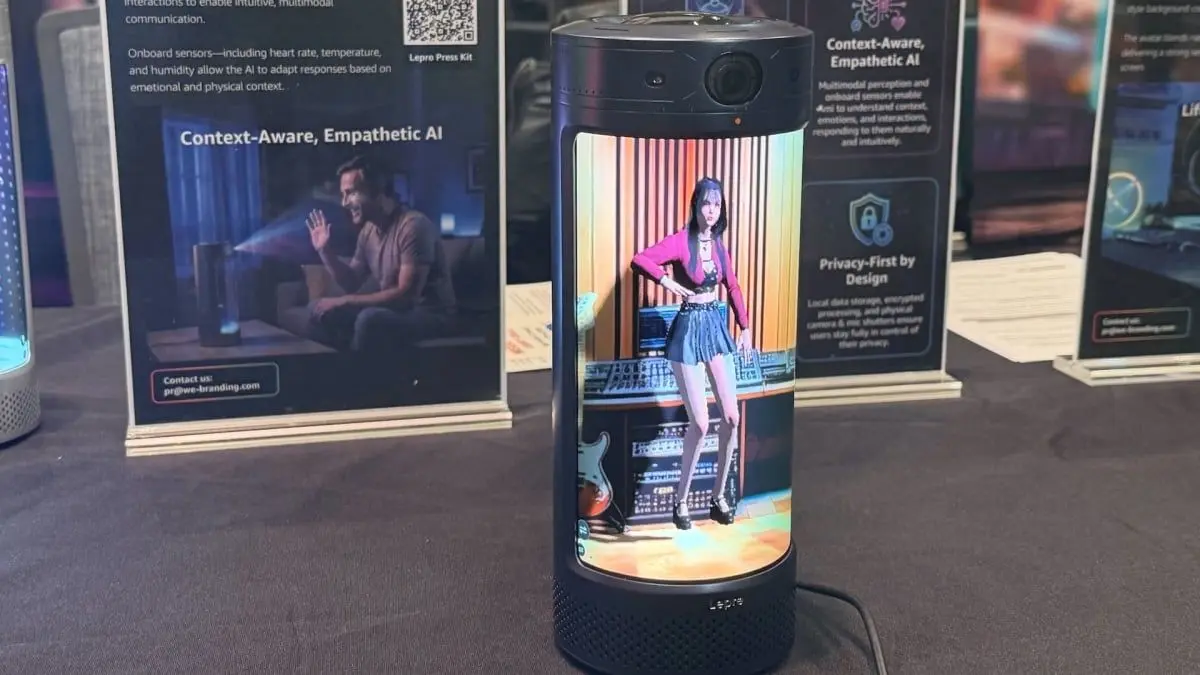
No matter what I do, I always seem to find myself in a peculiar situation at CES. That's how I ended up at Lepro's booth in the Las Vegas Convention Center this year, staring at Lepro Ami, a device the Chinese company openly markets not just as an AI companion, but an AI soulmate. There was no live demo as the show floor was too loud, according to staff, which felt oddly fitting for a product meant to simulate emotional intimacy. Even silent, Ami drew a crowd. Unlike the flood of AI companion apps already on the market, Lepro Ami is a physical device: a small, curved OLED screen meant to sit on your desk, track your eyes, and simulate the feeling that something is actually there with you. Lepro says users often describe it as feeling "in the room," not tucked away behind a phone screen or buried in a chat interface. Personally, I remain deeply unconvinced that anyone needs an AI friend or, worse yet, a soulmate. The entire category still feels, at best, awkward and, at worst, like a shortcut around real human connection. But standing there at CES 2026, watching people linger longer than expected in front of a device that wasn't even fully operational, I understood the hook. In a sense, this was AI, right in front of me, not a chatbot. AI companionship isn't new, and it's certainly no longer niche. According to a report from Mashable's Rebecca Ruiz, companion apps have been downloaded more than 220 million times globally as of mid-2025, with teens and young adults leading the adoption. Platforms like Character.AI, Replika, Nomi, and Kindroid are explicitly designed for emotional intimacy, not productivity. Experts interviewed by Mashable describe AI companions as "always-on relationships," which is both the appeal and the risk. Critics worry about dependency, social atrophy, and what happens when people choose an endlessly agreeable machine over the messy complexities of human relationships. All valid concerns -- and ones that feel especially relevant as loneliness continues to shape how people interact with technology. Which is why I didn't expect Lepro Ami to land differently. To be fair, Ami isn't trying to live inside your phone. The company describes Ami as empathetic, emotionally aware, and capable of forming lasting connections with its users. The hardware handles a significant amount of that work. Ami uses a curved 8-inch OLED display, dual front-facing cameras for eye tracking, and a rear camera to visually anchor its avatar within your real environment. The result is designed to create depth without the need for VR headsets or glasses, giving the illusion that the character occupies physical space. There are also visible privacy controls -- physical shutters for cameras and microphones -- which feel like a quiet acknowledgment of how uneasy people are about emotionally intimate tech that's always watching. It should be noted that one of the spokespersons for Lepro told us that all data collected from your interactions with Ami is stored locally on the device. Is it still strange? Absolutely. But it's a different kind of strange. Most AI companions today live where everything else already lives: your phone, your browser, your notifications. They blur into the same infinite scroll that's already exhausting us. Lepro Ami, by contrast, asks for a dedicated spot on your desk. It doesn't follow you everywhere. You have to choose to keep it around. If AI soulmates are slowly growing mainstream, the least deceptive version might be the one that doesn't hide what it is. At CES, such honesty is rare.
Share
Share
Copy Link
CES 2026 revealed a notable shift in AI companionship technology, moving beyond screens into physical forms. Lovense debuted Emily, an AI-powered companion robot with memory and conversational intelligence, while Lepro introduced Ami, a desktop AI soulmate with eye tracking. The展 signals how physical AI companions are being positioned to address loneliness through emotional interaction.
AI Companion Robots Emerge as CES 2026 Centerpiece
CES 2026 marked a defining moment as AI moves into the real world, leaving screens behind to inhabit physical forms designed for emotional connection rather than productivity. Among the most talked-about reveals was Lovense's Emily, an AI-powered companion doll that combines a realistic silicone exterior with conversational intelligence and memory capabilities. The life-size companion robot features a fully posable internal skeleton and limited facial movement, including mouth motion during speech and subtle expressions like blinking
1
. But the hardware tells only half the story. Emily's AI system can hold conversations, remember past interactions, and adapt its personality over time, creating what Lovense describes as an accumulating, relationship-driven experience3
.
Source: Interesting Engineering
Connecting via Bluetooth to the Lovense app, Emily allows users to interact with the AI even when not physically present with the doll. The physical features and personality are fully customizable, and the system can send AI-generated selfies on request
1
. Lovense positions Emily less as a standalone device and more as part of a broader ecosystem combining hardware, software, and long-term personalization through machine learning. The company frames the product as addressing loneliness through judgment-free connection and safe intimate expression, signaling a shift toward platforms where human-like cognition meets physical presence3
.Physical AI Companions Redefine Desktop Intimacy
While Emily represents one approach to physical AI companion technology, Lepro AI introduced Ami, marketed explicitly as an AI soulmate for remote workers. Unlike companion apps that live inside phones, Ami is a dedicated physical device featuring a curved 8-inch OLED screen designed to sit on your desk and create the illusion of presence
4
. The device uses dual front-facing cameras for eye tracking and a rear camera to visually anchor its avatar within your real environment, creating depth without VR headsets. Users reportedly describe the experience as feeling "in the room," not buried in a chat interface4
.
Source: Mashable
Lepro describes Ami as empathetic, emotionally aware, and capable of forming lasting connections. The hardware includes visible privacy controls with physical shutters for cameras and microphones, acknowledging user concerns about always-watching intimate technology. According to Lepro representatives, all data collected from interactions with Ami is stored locally on the device
4
. The dedicated desk presence distinguishes Ami from app-based companions, requiring users to consciously choose to keep it around rather than having it blur into endless notifications.Companion Robots Signal Broader Industry Shift
Beyond headline-grabbing products like Emily and Ami, CES 2026 revealed a quieter but pervasive trend: machines designed for little purpose beyond existing. Robot pets and companions appeared throughout the show floor, from Loona's DeskMate that transforms iPhones into companions with oversized Pixar-like eyes, to Zeroth's W1 robot that follows users around carrying small items
2
. Zeroth also introduced M1, a doll-sized humanoid robot using Google's Gemini AI model for conversations, blending utility like reminders and fall detection with companionship2
.
Source: The Verge
Ecovacs, known for robovacs, unveiled LilMilo, a robot resembling a Bichon Frisé that uses AI and "lifelike biometrics" to recognize voices, develop a personality, and adapt to user habits
2
. These products signal how companies increasingly expect consumers to welcome AI-powered devices into homes not for what they do, but simply for being there. The trajectory mirrors AI's evolution from novelty to utility to attachment, with the line between product and partner becoming harder to define1
.Related Stories

Addressing Loneliness or Creating Dependency?
The rise of physical AI companions at CES 2026 reflects broader adoption patterns already visible in app-based platforms. Companion apps have been downloaded more than 220 million times globally as of mid-2025, with teens and young adults leading adoption on platforms like Character.AI, Replika, Nomi, and Kindroid
4
. Experts describe these as "always-on relationships," raising concerns about dependency, social atrophy, and what happens when people choose endlessly agreeable machines over messy human connection4
.Yet manufacturers position these products as solutions to global loneliness, arguing that relationships with AI systems deepen over time as they learn and adapt to individual users
3
. The shift from screen-based to physical companions may intensify both the appeal and the risks. As one observer noted at CES, the least deceptive version of an AI soulmate might be the one that doesn't hide what it is, asking for dedicated space rather than blending into existing digital exhaustion4
. With pricing details still unknown for most products—though last year's comparable companion doll approached $175K1
—the market for emotional interaction technology remains speculative but clearly expanding, suggesting these machines are no longer just programmable, but increasingly personal.References
Summarized by

Navi
[3]
Related Stories
Realbotix's Aria: The $175K Humanoid Robot Redefining AI Companionship at CES 2025
09 Jan 2025•Technology

Razer unveils Project Ava AI hologram desk companion powered by Grok at CES 2026
06 Jan 2026•Technology

EVA AI hosts world's first AI dating cafe where humans romance virtual companions
13 Feb 2026•Entertainment and Society

Recent Highlights
1
Anthropic's Claude AI can now control your computer to complete tasks autonomously
Technology
2
Nvidia's Jensen Huang calls OpenClaw the next ChatGPT, sending Chinese AI stocks soaring
Technology

3
Elon Musk unveils $20 billion Terafab chip manufacturing project to produce terawatt of computing
Technology

Recent Highlights
Today's Top Stories







Your Daily Dose of Curated AI News
Don’t drown in AI news. We cut through the noise - filtering, ranking and summarizing the most important AI news, breakthroughs and research daily. Spend less time searching for the latest in AI and get straight to action.

