Claude App Integrations Bring Slack, Figma, and Canva Inside Chat with MCP Extension


14 Sources
14 Sources
[1]
Claude gets interactive with MCP extension
Anthropic's Claude got a bit livelier today thanks to a new extension to MCP, the open-source protocol that allows AI agents to easily access tools and data across the internet. Users will now be able to interact with apps directly inside the Claude chatbot, letting you draft and format Slack messages to colleagues and create presentations for clients in Canva without having to switch tabs. As of today, Anthropic said tools like Asana, Figma, Slack, and Canva will "open as interactive apps right inside of chat." While users could previously connect tools like Slack and Asana to the AI assistant, doing so meant getting text back. The company says the new in-app integration means users can actually engage with the tool and "see, explore, and refine results visually, not just read about them." A number of popular tools are already available to use directly in Claude. Anthropic says users can customize Canva decks in real time, format and preview Slack messages, build interactive charts with Hex or Amplitude, and manage projects with Asana or monday.com. There are also integrations for Figma, Clay, and Box, Anthropic said, with Salesforce tools like Data 360, Agentforce, and Customer 360 apps "coming soon." The interactivity -- something of apps-within-an-app -- sounds similar to the "mini" apps embedded inside messaging platforms like Telegram and Discord. The integration signals a shift in how AI platforms like ChatGPT and Claude are likely to operate in the future, becoming more like operating systems than individual tools, an "everything app" in the vein of Tencent's WeChat in China. ChatGPT has already made a step in that direction with the launch of its own app ecosystem last year. Anthropic credited the Model Context Protocol, or MCP, for the ability to integrate apps into Claude. The extension, called MCP Apps, "lets any MCP server deliver an interactive interface within any supporting AI product -- not just Claude," meaning other interactive app interfaces could soon be on the way to other AI tools. Operating standards like MCP are crucial for building usable ecosystems of products as they avoid the need for companies to develop and maintain numerous different interfaces. MCP began life at Anthropic in 2024 but has been widely adopted by companies including OpenAI, Google, and Microsoft. Anthropic donated it to the Linux foundation late last year and established a new fund -- the Agentic AI Foundation -- with other tech giants like OpenAI, Google, Microsoft, AWS, Block, Bloomberg, and Cloudflare, to "advance open-source agentic AI."
[2]
You can use Slack, Asana, and Figma directly inside Claude now - here's how
Follow ZDNET: Add us as a preferred source on Google. ZDNET's key takeaways * Claude can now interface with workplace apps within a chat. * The chatbot could become the main digital interface for business. * Other AI developers are also trying to expand their reach. AI startup Anthropic announced Monday that Claude can now interface directly with popular workplace productivity apps like Figma, Asana, and Slack within a chat, negating the need for users to work between separate tabs. Also: I let Anthropic's Claude Cowork loose on my files, and it was both brilliant and scary Arriving two weeks after the research preview launch of Claude Cowork -- a feature designed to deliver the agentic capabilities of Claude Code to non-coding tasks -- the news underscores what's become an increasingly clear objective from Anthropic: make Claude the primary interface of users' working lives. A closer look Anthropic has long been investing in Claude's technological reach, so to speak. In July, the company debuted a directory of connectors to third-party apps, including Stripe and Canva, with the goal of transforming Claude "from a helpful assistant into an informed AI collaborator that gives you more relevant responses and can work with you directly in your tools," Anthropic wrote in a press release. Rather than having to copy and paste information from an external app into Claude and vice versa, connectors enable the chatbot to pull data from those apps directly if prompted to do so. Also: I used Claude Code to vibe code a Mac app in 8 hours, but it was more work than magic Monday's news takes that underlying idea one step further by giving Claude the power to essentially interact with workplace productivity apps exactly as it would within those apps themselves, but inside a Claude chat. For example, you could ask Claude to draft a board in Asana for a particular project, and it would be able to pull data from your team's account to know which data it should include, as well as relevant timelines. Crucially, it would then present you with a preview of what the finished product would look like within Asana, which you could then manually edit or launch. Also: Anthropic to Claude: Make good choices! Claude can now directly interface with Amplitude, Asana, Box, Canva, Clay, Figma, Hex, monday.com, and Slack, according to the blog post. Salesforce will also soon be added to that list. Big ambitions Built upon Anthropic's open-sourced Model Context Protocol, the new capability could push Claude closer to becoming the digital cornerstone for many enterprises. Also: Claude's Skills just got easier to manage and share - here's how Meanwhile, Anthropic's competitors are also aspiring to become for the AI era what Google has been for the traditional online search era: not just one product among many, but the primary portal through which the majority of people engage with the internet. Both OpenAI and Perplexity, for example, have recently launched their own AI-powered web browsers. How to access The new feature is available now on web and desktop for Pro, Max, Team, and Enterprise subscribers. Just visit claude.ai/directory and select apps labeled "interactive." Also: How to install and configure Claude Code, step by step Anthropic added in its Monday announcement that the Claude Cowork research preview can now be accessed on web and desktop for Team and Enterprise subscribers (it was originally only available through Pro and Max plans).
[3]
Claude supports MCP Apps, presents UI within chat window
Anthropic's Claude can now present the interfaces of other applications within its chat window, thanks to an extension of the Model Context Protocol (MCP). Claude has long been able to fetch data from third-party applications through an MCP server connection. That capability has been expanded to present user interface elements like charts, forms, and dashboards, allowing third-party apps to be operated from within the chat window. "Claude already connects to your tools and takes actions on your behalf," the company said in a blog post. "Now those tools show up right in the conversation, so you can see what's happening and collaborate in real time." The change makes Claude's chat environment more like a cross-application interface layer - users no longer have to switch application focus to access app-specific tools. It could pose a challenge to operating system makers like Apple, Google, and Microsoft, similar to the one presented by web browsers - it reduces the need to interact with the operating system. And it's not just Claude that stands to benefit. The extension, called MCP Apps, should be available in other vendors' AI applications, including Goose, Visual Studio Code, and ChatGPT, either today or soon. The MCP Apps Extension (SEP-1865) was first proposed back in November 2025 and is based on MCP-UI and the OpenAI Apps SDK. It allows MCP servers to deliver interactive user interface elements that hosts can render in-conversation, rather than returning data alone. "MCP Apps address a real gap between what agentic tools can provide and how users naturally want to interact with them," said Clare Liguori, senior principal engineer at AWS, in remarks accompanying the MCP blog post. "The ability to render dynamic interfaces directly in conversation makes it easier to leverage MCP server capabilities in practical ways." Initially, this ability to be proxied within Claude is limited to Anthropic's launch partners: Amplitude, Asana, Box, Canva, Clay, Figma, Hex, monday.com, Slack, and (soon) Salesforce. But expect that to expand over time as other software makers adapt their apps. MCP Apps surface third-party interface elements in iframes, but with additional capabilities like logging events for debugging, opening links in the user's browser, sending follow-up messages, and updating the underlying model's context. "Running UI from MCP servers means running code you didn't write within your MCP host," the MCP post explains, citing various security layers like iframe sandboxing, pre-declared templates for prevailing HTML content prior to rendering, auditable messages, and host-managed approvals for UI-initiated tool calls. Whether those defenses prove sufficient to avoid creating novel risks will be tested in time. ®
[4]
Claude now offers deeper integrations with apps like Canva and Slack
Anthropic has been building out support for third-party apps inside of Claude. As of today, the chatbot can now connect to platforms like Slack and Canva, fetching up files from inside those apps or performing tasks within them on a user's behalf. For instance, when connected to Box, Claude can now search for files, preview documents inline and answer questions about the content in front of you. Meanwhile, with a connection to Asana, it can now turn chats into projects, tasks and timelines your co-workers can then find and interact with on the project management app. Box and Asana are just two of the platforms adding deeper integrations with Claude today. In total, there are nine launch partners, with some of the more notable ones including Canva, Figma and Slack. As with Anthropic's past integrations, the new functionality is powered by Model Context Protocol (MCP) servers. MCP is a technology Anthropic released in fall 2024 to make it easier for third-party platforms to connect their systems to Claude. Since then, the protocol has become an industry standard. OpenAI, for instance, adopted MCP last year, and has been building additional support since then. At the end of last year, Anthropic donated the protocol to the Linux Foundation. The company says AI platforms will be able to bring similar integrations to their own products since they're built on a new open extension designed by Anthropic.
[5]

You can now use apps like Slack, Figma, and Canva from Claude
From drafting Slack messages to updating project timelines on Asana, Claude now lets you work inside connected apps without ever leaving the chatbot. Here's how it works. The protocol that keeps on giving In late 2024, Anthropic introduced the Model Context Protocol (MCP), its open-source project to bridge AI models, external tools, and data sources. In a nutshell, this gave AI chatbots and agents the tools required to interact with third-party platforms as if they were humans. Since then, MCP has become the industry's standard for agentic-powered, AI-based productivity, with countless companies, platforms, and developers building and deploying MCP servers to connect tools and data sources. That includes Apple, which began working on MCP support across its operating systems last year, although there has been little movement on that front as of late. Be it as it may, late last year, Anthopic donated MCP to the Linux Foundation's Agentic AI Foundation, and its market-wide adoption is only expected to grow. Today, Anthropic announced that nine productivity tools and platforms are now available as interactive apps inside Claude thanks to MCP, including Asana, Canva, Figma, and Slack. Here's Anthropic's demo of the new features: And here's Anthropic on what Claude users can do with each one: * Amplitude - Build analytics charts, then explore trends and adjust parameters interactively to uncover hidden insights. * Asana - Turn chats into projects, tasks, and timelines your team can see and execute in Asana. * Box - Search for files, preview documents inline, then extract insights and ask questions about your content. * Canva - Create presentation outlines, then customize branding and design in real-time to produce client-ready decks. * Clay - Research companies, find contacts with email and phone info, pull data like company size and funding, then draft personalized outreach directly in your conversation. * Figma - Prompt to turn text and images into flow charts, Gantt charts, or other visual diagrams in FigJam. * Hex - Ask data questions and get answers complete with interactive charts, tables, and citations. * monday.com - Manage your work, run projects, update boards, smartly assign tasks, and visualize progress with insights. * Slack (from Salesforce) - Search and retrieve Slack conversations for context, generate message drafts, format them your way, and review before you post. Anthropic also says that Salesforce will be coming soon, to "bring enterprise context to Claude with Agentforce 360, enabling teams to reason, collaborate, and act from a single, connected interface." To learn more about these integrations, as well as many other connectors that extend Claude's capabilities, head over to claude.ai/directory.
[6]

I used Claude for work and it completely changed my workflow -- here's what you need to do
Using Claude's new in-chat apps makes work so fast it almost feels illegal Claude has gotten one step closer to becoming a true all-round AI personal assistant thanks to a new feature that lets you interact with tools like Asana, Slack and Canva directly in your chat.This newly announced feature is available to everyone on web and desktop with Pro, Max, Team, or Enterprise plans. Whether you're managing projects in Asana, sending team updates through Slack, or prototyping app interfaces, you can prompt these tools directly in Claude. They appear inside the chat, letting you view, edit, and iterate in real time. For ChatGPT users, this works like using tools from ChatGPT's app store. If you're ready to start interacting with tools using prompts in Claude, this is exactly what you need to do.
[7]

Claude AI Now Lets You Use Slack, Figma, and Canva Within the Chat
Anthropic has announced new interactive tools in Claude that let users open and interact with other services and apps directly within the AI chat interface via the web and Mac app. The update offers real-time collaboration with third-party apps like Asana, Slack, Figma, Canva, and more without requiring users to switch between tabs or apps. The feature is powered by MCP Apps, a new extension to the Model Context Protocol that lets any MCP server deliver an interactive interface within supporting AI products. Anthropic open-sourced MCP last year as a universal standard for connecting tools to AI applications. Per Anthropic's announcement, here's what you can now do directly in Claude: Amplitude - Build analytics charts, then explore trends and adjust parameters interactively to uncover hidden insights. Asana - Turn chats into projects, tasks, and timelines your team can see and execute in Asana. Box - Search for files, preview documents inline, then extract insights and ask questions about your content. Canva - Create presentation outlines, then customize branding and design in real-time to produce client-ready decks. Clay - Research companies, find contacts with email and phone info, pull data like company size and funding, then draft personalized outreach directly in your conversation. Figma - Prompt to turn text and images into flow charts, Gantt charts, or other visual diagrams in FigJam. Hex - Ask data questions and get answers complete with interactive charts, tables, and citations. monday.com - Manage your work, run projects, update boards, smartly assign tasks, and visualize progress with insights. Slack (from Salesforce) - Search and retrieve Slack conversations for context, generate message drafts, format them your way, and review before you post. Interactive tools are available on web and desktop for Pro, Max, Team, and Enterprise plans, with support said to be coming to Claude Cowork down the line.
[8]

Claude apps: How Anthropic will integrate Slack, Canva, and more
Claude now has some more parity with ChatGPT. Credit: Anthropic/YouTube Last year, ChatGPT got the ability to perform tasks in connected third-party apps. Not to be outdone, Anthropic's Claude chatbot just got a similar feature this week. Announced in a blog post on Monday, Claude now has the capability to interface directly with a handful of connected enterprise-focused apps. These include Slack, Canva, Box, Asana, and more. The blog post and accompanying video demonstrations do a good enough job of showing off how it all works, but since the feature is out now for paid Claude users, you can also get in there and start testing it out yourself. For instance, with Slack, you can have Claude draft messages using context derived from previous messages in your inbox, and review and re-format them to your liking before hitting send. Canva allows for the creation of presentation outlines and real-time design work, while Asana will turn your chats with Claude into projects that the rest of your team can see and execute on. As stated previously, this is similar to something OpenAI embraced last year. However, many of the apps ChatGPT started with were not necessarily focused on professional work. They included things like Spotify and Instacart, not Slack and Asana. This gives Claude a more distinct flavor in the war between AI chatbots, if nothing else.
[9]

Claude turns your AI chats into a control room for real work - run Slack, Figma, and more without needing to switch apps
* Anthropic is pushing Claude as an AI-powered workspace with new integrations using MCP Apps * Claude now lets users interact with tools like Slack, Asana, and Figma directly inside chats * The update reduces tab-switching by embedding live interfaces into conversations Anthropic has given Claude an upgrade to incorporate many of the most common productivity and collaboration workplace apps around today directly into its AI assistant. Claude Pro, Max, Team, and Enterprise subscribers can now draft and preview Slack messages, edit Figma diagrams, update Asana timelines, and manipulate analytics dashboards with Claude acting as the glue between them all. Anthropic is setting Claude up to now lean into the messier, click-by-click reality of modern digital work. The tools appear in the chat with Claude. So, a Slack message draft looks like a Slack message, and an Asana timeline can be adjusted with live visuals. The whole thing runs on an extension of the open source Model Context Protocol, called MCP Apps, which lets any participating tool show up inside the Claude chat. The idea is to reduce all of the flipping back and forth among multiple apps and browser tabs, cutting down on time spent hunting for the right file or view. Anthropic's aim would have users asking Claude operate on behalf of those many other tabs. If you ask it for a follow-up on a marketing timeline in Asana and assign a couple of items to the design lead, Claude could open up the live board and update it. It could then write a Slack message for your approval summarizing the changes and send it with your approval. That's more efficient than just providing a to-do list or a link, as would usually be the case. That fluidity is part of the point. Anthropic's pitch is about reducing friction. Until now, AI productivity workflows still depended on a kind of mental multitasking. With MCP Apps, Anthropic is clearly betting that a future where everything is handled within its AI conversations can emerge for professionals as well as consumers. All in Claude OpenAI, Google, and others are racing in the same direction, each with slightly different takes. OpenAI's GPT-based apps can run within ChatGPT, but still run semi-independently of the chatbot, while Google's Gemini is becoming ubiquitous within its Workspace. But Claude's new tools stand out for being built into the chat itself. Naturally, giving any AI assistant direct access to platforms like Slack or Asana means your conversations, projects, and decisions are now part of its working memory. Anthropic promises tight sandboxing and clear permissions, but as with any workplace tech, the devil will be in the defaults. It's also not yet a revolution for everyone. The current rollout supports web and desktop versions of Claude, not mobile or the Claude Cowork experience just yet. And if your day doesn't involve charts, decks, timelines, or boards, you may not notice much of a change in how Claude works. For those who do, this could be the beginning of a real consolidation moment. Instead of drowning in tabs, inboxes, and dashboards, the AI brings everything together. A creative team can draft a concept, assign tasks, build the deck, and send updates from a single Claude chat. The big idea of the assistant becoming the platform has legs. It shifts how we think about generative AI from sidekick to central operations. Even if the AI isn't always perfect, the shift in where and how the work happens feels like a deeper evolution. It's too soon to call Claude's plans a blueprint for the next standard work interface, but if the conversational completion of work pans out, this might set Anthropic up for a lot more business to come. Follow TechRadar on Google News and add us as a preferred source to get our expert news, reviews, and opinion in your feeds. Make sure to click the Follow button! And of course you can also follow TechRadar on TikTok for news, reviews, unboxings in video form, and get regular updates from us on WhatsApp too.
[10]

Anthropic embeds Slack, Figma and Asana inside Claude, turning AI chat into a workplace command center
Anthropic announced Monday that users can now open and interact with popular business applications directly inside Claude, the company's AI assistant -- a significant expansion that transforms the chatbot from a conversational tool into an integrated workspace where employees can build project timelines, draft Slack messages, create presentations, and visualize data without switching browser tabs. The rollout, which goes live today, includes integrations with Amplitude, Asana, Box, Canva, Clay, Figma, Hex, Monday.com, and Slack. Salesforce integration is coming soon. The feature marks a new chapter in Anthropic's aggressive push to dominate enterprise AI, arriving just days after the company's CEO made headlines at Davos with bold predictions about AI replacing white-collar workers. "MCP Apps are an extension to the core MCP protocol and are part of the open source MCP ecosystem," Sean Strong, Anthropic's product manager for MCP Apps, told VentureBeat in an exclusive interview. "Within Claude.ai, connectors require a paid Claude plan -- Pro, Max, Team, or Enterprise -- but there is no additional charge associated with using connectors." That pricing decision is notable. Rather than monetizing integrations separately or charging partners for distribution, Anthropic is bundling interactive tools into existing subscription tiers -- a strategy designed to accelerate adoption and deepen Claude's foothold in corporate environments where the company reportedly already leads OpenAI. Inside MCP Apps, the open-source technology that lets Claude control your favorite work tools The technical foundation is what Anthropic calls "MCP Apps," a new extension to the Model Context Protocol, the open standard for connecting external tools to AI applications that Anthropic open-sourced last year. MCP Apps allow any MCP server to deliver an interactive user interface within any supporting AI product -- meaning the technology isn't limited to Claude. In practice, the integrations allow for surprisingly granular control. Users can build analytics charts in Amplitude and adjust parameters interactively to explore trends. They can turn conversations into Asana projects with tasks and timelines that sync automatically. They can prompt Claude to generate flowcharts or Gantt charts in Figma's collaborative whiteboard tool, FigJam. They can draft Slack messages, preview formatting, and review before posting. The Hex integration may prove particularly valuable for data teams: users can ask data questions in natural language and receive answers complete with interactive charts, tables, and citations -- effectively turning Claude into a business intelligence interface. "We open sourced MCP to give the ecosystem a universal way to connect tools to AI," the company said in its announcement blog. "Now we're extending MCP further so developers can build interactive UI on top of it, wherever their users are." What happens when AI can send messages and create projects on your behalf With AI systems increasingly capable of taking real-world actions -- sending messages, creating projects, publishing content -- the question of guardrails becomes critical. Can an employee accidentally send an unreviewed Slack message or publish an incomplete Canva presentation? Strong addressed this directly. "Most major MCP clients, including Claude, provide consent prompts that help users determine if they want to take an action via a MCP server," he said. For enterprise deployments, IT administrators retain control. "Team and Enterprise admins have the ability to control which MCP servers users in their organizations have the ability to use," Strong explained. The consent-prompt approach is a middle ground between full autonomy and cumbersome approval workflows. But it also places significant responsibility on individual users to review actions before confirming them -- a design choice that may draw scrutiny as AI agents become capable of more consequential decisions. The security concerns are not hypothetical. As Fortune reported last week, Anthropic's Claude Code product faces vulnerabilities including "prompt injections," where attackers hide malicious instructions in web content to manipulate AI behavior. The company has implemented multiple security layers, including running some features in virtual machines and adding deletion protection after users accidentally removed files. "Agent safety -- that is, the task of securing Claude's real-world actions -- is still an active area of development in the industry," Anthropic has acknowledged. Claude Code's viral success set the stage for Anthropic's enterprise ambitions The interactive tools announcement arrives at a moment of unusual momentum for Anthropic. Claude Code, the company's coding assistant released in February 2024, has become a viral hit that has captured attention far beyond its intended developer audience. Originally built for software developers, Claude Code has captured attention far beyond its intended audience. Non-programmers have deployed it to book theater tickets, file taxes, and monitor tomato plants. Nvidia CEO Jensen Huang called it "incredible." Even Microsoft, which sells the competing GitHub Copilot, has widely adopted Claude Code internally, with non-developers reportedly encouraged to use it. Boris Cherny, Anthropic's head of Claude Code, told Fortune that his team built Cowork -- a user-friendly version of the coding product for non-programmers -- in approximately a week and a half, largely using Claude Code itself. "Engineers just feel unshackled, that they don't have to work on all the tedious stuff anymore," Cherny said. Claude Code is now used by Uber, Netflix, Spotify, Salesforce, Accenture, and Snowflake, according to Anthropic. Claude's total web audience has more than doubled since December 2024, and daily unique visitors on desktop are up 12% globally year-to-date, according to data from Similarweb and Sensor Tower published by The Wall Street Journal. The company is also reportedly planning a $10 billion fundraising round that would value Anthropic at $350 billion -- a staggering figure that reflects investor confidence in the company's enterprise traction. Anthropic's CEO stirred controversy at Davos with predictions about AI replacing workers The interactive tools launch also arrives against a backdrop of intense debate about AI's impact on employment -- a debate that Anthropic's own CEO helped intensify at the World Economic Forum in Davos last week. Dario Amodei told a Davos audience that AI models would replace the work of all software developers within a year and would reach "Nobel-level" scientific research in multiple fields within two years. He predicted that 50% of white-collar jobs would disappear within five years. "I have engineers within Anthropic who say 'I don't write any code anymore. I just let the model write the code, I edit it,'" Amodei said. "We might be six to 12 months away from when the model is doing most, maybe all of what software engineers do end-to-end." Not everyone agrees with that timeline. Demis Hassabis, the Nobel Prize-winning CEO of Google DeepMind, said at the same conference that today's AI systems are "nowhere near" human-level artificial general intelligence. Yann LeCun, the Turing Award-winning AI pioneer who recently left Meta to found Advanced Machine Intelligence Labs, went further, arguing that large language models "will never be able to achieve humanlike intelligence" and that a completely different approach is needed. Why embedding AI into daily workflows could create powerful lock-in for enterprises Anthropic's integration strategy reflects a broader shift in enterprise AI competition. The battleground is moving from model benchmarks and capability demonstrations toward workflow integration -- the degree to which AI systems become embedded in how companies actually operate. By making Claude the interface through which employees interact with Asana, Slack, Figma, and other daily tools, Anthropic is positioning itself not merely as an AI provider but as a workflow orchestration layer. The more actions that flow through Claude, the harder it becomes for enterprises to switch to a competitor. This approach mirrors strategies that proved successful for earlier generations of enterprise software. Salesforce built its dominance partly by becoming the system of record for customer data. Slack grew by centralizing workplace communication. Anthropic appears to be betting that AI assistants can occupy a similar position -- the default starting point for work itself. The open-source foundation of MCP may accelerate this strategy. By making the protocol available to any developer, Anthropic encourages a broad ecosystem of integrations that all funnel through MCP-compatible clients -- of which Claude is the most prominent. The company benefits from network effects even as it maintains the standard is open. The race to become the operating system for AI-powered work is just getting started The launch notably excludes some major enterprise platforms. Salesforce integration is listed as "coming soon," and there's no mention of Microsoft 365, Google Workspace, or other productivity suites that dominate corporate environments. Those gaps may limit initial adoption in organizations heavily invested in those ecosystems. The feature is available on web and desktop for paid Claude plans, with support for Claude Cowork -- the file management agent launched last week -- coming later. Mobile support was not mentioned in the announcement. For enterprises evaluating Claude against OpenAI's offerings and other competitors, the interactive integrations represent a tangible differentiator. The ability to take action within business tools -- rather than simply generating text that users must copy elsewhere -- addresses a persistent friction point in AI adoption. Whether that advantage proves durable depends on how quickly competitors respond. OpenAI has its own enterprise ambitions and partnerships. Google is integrating Gemini across its productivity suite. Microsoft continues to deepen Copilot's presence in Office applications. But the larger significance may be what today's announcement signals about where enterprise software is headed. For decades, the default unit of work has been the application -- the spreadsheet, the project tracker, the messaging platform. Anthropic is wagering that the future belongs to the AI layer that sits above them all. If the company is right, the question for every enterprise software vendor becomes uncomfortably simple: Do you want to be the tool, or the thing that controls the tools?
[11]

Your Claude chats just got more powerful with interactive app support
You can now use Slack, Canva, Figma, and more without leaving the chat interface. Anthropic just turned its AI chatbot Claude into a real productivity hub by bringing interactive apps right into the chat. Users can now perform actions within apps like Slack, Figma, Asana, Canva, Box, Clay, and more without needing to switch windows. Instead of offering text-only responses, Claude can now act as a full-on workspace, letting you draft Slack messages, build project boards, design mockups, and more. Built on top of the Model Context Protocol (MCP), which Anthropic introduced in 2024 as a standard for how AI and apps talk to each other, the feature is designed to scale over time, with support for additional tools and platforms expected soon. For now, supported apps include Amplitude, Asana, Box, Canva, Clay, Figma, Hex, monday.com, and Slack. Anthropic says the feature is currently rolling out to paid subscribers on the Pro, Team, Max, and Enterprise plans, and is not available on the free tier. Users can enable it by navigating to claude.ai/directory and connecting their accounts to get a live, logged-in window into the apps within Claude. Recommended Videos The feature will also tie into the recently released Claude Cowork, which lets users perform multi-step tasks without entering a single line of code. With app integration in place, users could, for example, update a Canva design using files stored in Box. Following OpenAI's lead Claude isn't the only chatbot to add app integrations directly within the chat interface. OpenAI debuted a similar feature in ChatGPT back in October with support for a handful of popular apps. Since then, it has expanded support to include more tools and, as of last month, opened a new publishing pipeline for developers to submit apps that run inside ChatGPT. By letting users access apps within the chat interface, Anthropic and OpenAI are evolving their chatbots from AI assistants that simply answer queries into full-fledged workspaces where users can get things done without constantly switching between apps.
[12]
Asana launches Claude integration, says AI models are 'context-starved' without enterprise data
When Anthropic announced Monday that it was embedding nine workplace applications directly inside Claude, transforming its AI chatbot into what I earlier described as a "workplace command center," Asana was among the headliners. But while the broader launch signals a new era of AI-native productivity tools, Asana's participation reflects a deeper strategic bet -- one that positions the project management company not as an AI competitor, but as the essential context layer that makes any AI model more useful. In an exclusive interview with VentureBeat, Arnab Bose, Asana's Chief Product Officer, explained the thinking behind the partnership and why the company chose to embrace external AI providers rather than build proprietary models. "The AI landscape is advancing at a breakneck pace," Bose said. "We believe our customers are best served when they have access to the latest, most powerful reasoning capabilities from best-in-class providers like Anthropic, rather than being locked into a single, proprietary model that may fall behind quickly." The integration arrives at a pivotal moment for Asana: the company is navigating a leadership transition after co-founder Dustin Moskovitz's retirement, competing against rivals racing to embed AI into productivity software, and betting that its proprietary "Work Graph" -- the company's mapping of how tasks, people, and goals connect inside organizations -- can differentiate it in an increasingly crowded market. Asana's chief product officer argues that raw AI power matters less than business context The strategic logic Bose outlined goes beyond simply offering Claude users another tool to connect. At its core, Asana is making a bet about where value will accrue in the AI era -- and the company believes context will matter more than raw model capability. "An LLM in isolation is context-starved," Bose told VentureBeat. "It knows how to write, but it doesn't know your business -- your goals, your knowledge, your specific approvals, or your historical relationships. Asana provides the scaffolding -- the Work Graph data model -- that grounds those external models in the reality of how your company actually operates." It's a framing that positions Asana as essential infrastructure rather than a replaceable application. If Bose is right, then even as AI models from Anthropic, OpenAI, and Google grow more powerful, they will remain fundamentally limited without deep integration into how organizations actually function. "Most errors happen because models are context-starved," Bose said. "Asana solves this with context that is unique to each business." The argument has implications beyond Asana. It suggests a future where AI capability becomes increasingly commoditized, while the companies that control rich organizational data -- project histories, approval workflows, team relationships -- become the essential partners that make AI useful in enterprise settings. The integration transforms natural language conversations into structured project plans In practice, the Claude integration allows users to create and manage Asana projects entirely through natural conversation. When a user connects their Asana account via OAuth authentication, Claude gains the ability to read project data, create new tasks, and build entire project structures based on natural language instructions. A marketing team discussing a product launch in Claude can simply say: "Create a Q2 product launch project with phases for creative development, partner outreach, press kit, and launch day." Claude then generates the project structure, complete with sections and tasks, which the user can review before pushing it live to Asana. "When you use Claude to explore a new initiative, like brainstorming a campaign structure, outlining a project plan, or mapping out a cross-functional launch, you can turn that thinking into real, structured work in Asana without breaking your flow," the company said in its press release announcing the integration. The synchronization runs in real time. Changes made through Claude appear immediately in Asana, and status updates from Asana can be pulled into Claude conversations for on-the-fly reporting. Users can ask questions like "What's behind schedule in our marketing campaigns right now?" and receive answers grounded in their actual project data. Human approval remains mandatory before Claude can create or modify any work in Asana One of the key design decisions in the integration is a strict requirement for human oversight. Bose emphasized that Claude cannot act autonomously within Asana -- every consequential action requires explicit user approval. "Our architecture follows a strict human-in-the-loop philosophy where AI actions -- from drafting project plans to summarizing risks -- has a human in the loop to course correct, check quality, and ultimately give final sign-off when working with AI," Bose told VentureBeat. "Users review and approve before tasks are created and projects are built." When asked whether Claude could potentially access projects or tasks that a user wouldn't normally have permission to see, Bose was direct: "No. Users need to authenticate via OAuth with their Asana credentials to use this integration, and Claude respects their permissions and access." The approach is an increasingly common pattern in enterprise AI -- giving artificial intelligence significant capabilities while maintaining human control over final decisions. It addresses one of the core anxieties around AI in workplace settings: the fear that automated systems will make mistakes that propagate through organizations before anyone notices. When asked about audit capabilities for enterprise administrators, Bose said admins can monitor usage information about Claude in Asana's Admin App Management portal, with deeper audit log visibility potentially coming based on customer feedback. Asana is building integrations with ChatGPT and Google Gemini to avoid platform lock-in Notably, Asana is not betting exclusively on Claude. Bose emphasized the company's commitment to working with multiple AI providers, positioning Asana as a neutral platform that works with whichever AI systems its customers prefer. "Our philosophy is to meet users where they want to work," Bose said. "We are building the work platform for today and the future which means being the best front-end for any vendor's agents." He confirmed that Asana offers "foundational connectors" with both ChatGPT and Google Gemini and is working to deepen those integrations. The company is also committed to emerging industry standards for AI agent interoperability, including the Agent-to-Agent protocol and MCP. "We want to be the best front-end for agents from any vendor," Bose said, describing a vision where Asana becomes the coordination layer through which various AI systems -- whether from Anthropic, OpenAI, Google, or others -- can operate within enterprise workflows. This multi-provider approach differs from companies that have tied themselves exclusively to a single AI partner. It reflects both a pragmatic recognition that the AI landscape remains volatile and a strategic bet that Asana's value lies in its data and workflow capabilities rather than any particular AI model. The announcement comes as Asana navigates a major leadership transition The Claude integration arrives as Asana navigates significant organizational change. Dustin Moskovitz, the company's co-founder and longtime CEO, retired earlier this year after announcing his departure during Asana's fourth-quarter earnings report in March. Moskovitz's departure triggered immediate market reaction, with Asana's stock dropping more than 25 percent in after-hours trading following the announcement. The company subsequently hired Dan Rogers -- formerly CEO of software startup LaunchDarkly and previously president of Rubrik and marketing chief at ServiceNow -- to take over as chief executive. Rogers started in July, with Moskovitz transitioning to the role of board chairman. In a recent appearance on the Stratechery podcast, Moskovitz reflected candidly on his tenure. "I don't like to manage teams, and it wasn't my intention when we started Asana," he said. "I'd intended to be more of a independent or head of engineering or something again. Then one thing led to another and I was CEO for 13 years and I just found it quite exhausting." Moskovitz -- who co-founded Facebook alongside Mark Zuckerberg before leaving to start Asana in 2008 -- retains approximately 39 percent of outstanding Asana shares. He said he plans to focus more on his philanthropic endeavors, including Good Ventures and Open Philanthropy, which lists "potential risks from advanced AI" among its focus areas. Bose envisions AI handling orchestration while humans retain control over strategic decisions When asked about the long-term trajectory of AI in Asana, Bose outlined a vision that balances automation with human judgment -- what he described as a "self-driving" organization where humans nonetheless remain at the wheel. "Our vision is for customers to work however suits them best, alongside AI agents that actually have the context to be helpful and productive," he said. "But the goal is not for agents to make important decisions on their own. That is where humans provide value: having the judgment, relationships, and nuance to make complex decisions." He described a future in which AI handles "orchestration" -- spotting patterns, flagging risks, managing follow-ups -- while humans retain authority over strategy and trade-offs. As an example, Bose pointed to Asana's AI Teammates feature, which the company introduced in beta last year. "Asana AI Teammates -- built on the Work Graph, so they understand who is doing what, by when, and why -- can flag that three teams are behind on dependencies for a launch and draft a mitigation plan," Bose said. "But a human reviews it, adjusts based on business priorities, and makes the call on what happens next." The question is whether that boundary will hold as AI capabilities advance. Anthropic and OpenAI are both racing to build more capable "agentic" systems that can execute multi-step tasks with less human oversight. If those systems become reliable enough, the human-in-the-loop requirement may shift from necessity to preference -- a transition Asana appears to be preparing for, even as it emphasizes human control today. How to access the Asana integration in Claude The Asana integration in Claude is available immediately to all Asana customers who have a paid Claude subscription. Users can connect Asana through Claude's app directory or request that their administrator enable the integration for their workspace. The interactive app feature is available on Claude's web and desktop applications for Pro, Max, Team, and Enterprise subscribers. Once connected, users can mention Asana in any Claude conversation to start creating projects, assigning tasks, or pulling status updates from their existing work.
[13]

Anthropic Brings Slack and Other Workplace Tools into Its Claude Interface
Anthropic's efforts indicate the growing competition for enterprise customers between AI and agentic AI service providers Anthropic users will now get to use tools such as Slack, Asana and Figma as interactive applications right within the chat window while working on the Claude AI chatbot. Users would be able to see, explore and tweak results without having to switch tabs or opening new windows. The latest expansion built on the open Model Context Protocol (MCP) allows nine integrations that includes Asana for project management, Figma for visual diagrams, Canva for presentation design and Slack for messages. Others to be integrated include Amplitude for analytics charts, Box for file search and previews, Clay for company research, Hex for data analysis and charts, and Monday.com for project management. Playing a catch-up game with OpenAI? The upgrade was announced yesterday and is seen as a late response to a similar step taken by OpenAI back in October last year. The company had unveiled a new Apps SDK that opened ChatGPT to third-party developers and allowed applications to run directly inside the chat interface. OpenAI had allowed Canva, Coursera, Expedia, Figma, Spotify, and Zillow at the launch of their MCP based technical backbone. Looks like both companies are making a concerted effort to add more enterprise clients, though it is a known fact that Anthropic has a sizeable chunk of this segment while OpenAI is stacked with individual users. Which is probably the reason why Anthropic's focus with this release has again been on workplace tools. Reports suggested that a Salesforce implementation might also be on the way. Users will now be able to access a logged-in instance of the tools within the Claude window, making collaboration easier and smoother. Getting to collaborate faster and better is the focus In a blog post, Anthropic noted that "analyzing data, designing content, and managing projects all work better with a dedicated visual interface." Combined with Claude's intelligence, you can work and iterate faster than either could offer alone, they said noting that the feature will be available for Pro, Max, Team, and Enterprise subscribers. Those eligble can activate the tools at claude.ai/directory, the post said. Analysts feel that the app suite would become more powerful when integrated with Claude Cowork, the all-purpose agent tool launched by Anthropic last week. It allows users to assign multistage tasks requiring large and open-ended datasets. Once the new feature gets integrated with Cowork, enterprise-level collaborative actions may become even more simpler and encourage division-wide data sharing as access to cloud files, ongoing work on projects and collaborations might become easier. For example, imagine Cowork updating a graphic using Figma or call for new data from the company's Box. However, Anthropic does share a caveat over the unpredictability of systems on its safety documentation for Cowork. It urges users to monitor the agent closely and not grant any unnecessary permissions. "Be cautious about granting access to sensitive information like financial documents, credentials, or personal records," it warns.
[14]

Claude gets new superpowers: You can access multiple apps directly inside chatbot
For most users, AI chatbots have lived in a familiar lane. You ask a question, get an answer, maybe copy it, and then move to another app to actually do the work. Claude's latest update aims to collapse that entire process into a single interface. Anthropic has rolled out interactive tools inside Claude that let users connect and work with third party apps directly within the chatbot. Instead of acting as a sidekick that only suggests next steps, Claude is now positioned as a place where real work can happen. The update pushes the chatbot closer to becoming a full-fledged productivity hub rather than just a conversational assistant. At a time when AI tools are flooding the market with similar writing and reasoning capabilities, this move signals where the next competitive frontier lies. It is not just about smarter outputs, but about deeper integration into everyday workflows. Also read: Dario Amodei: Superintelligent AGI can cause civilization level damage From conversations to actions The most visible change is how Claude now handles popular work tools. Apps like Asana, Slack, Figma, Canva, Box, monday.com, Amplitude, Hex, and Clay can be accessed directly inside the chat interface. These are not simple links or previews. They appear as interactive elements that users can actively work with. A project manager can update tasks in Asana while discussing priorities with Claude. A team lead can draft and send a Slack message without switching tabs. Designers can visualize ideas in Figma or adjust layouts in Canva as part of the same conversation. Data teams can pull charts from Amplitude or Hex and discuss insights in real time. This fundamentally changes the rhythm of work. Instead of bouncing between tools, users can stay focused on a single thread. Claude becomes the layer that connects thinking, planning, and execution. The chatbot is no longer just explaining what to do. It is helping users do it. Also read: "Maybe they need the revenue": Google AI chief swipes at OpenAI's ad push For professionals juggling multiple platforms, this reduces friction in small but meaningful ways. Less context switching means fewer interruptions, faster decisions, and workflows that feel more fluid. The technology and the bigger picture Behind the scenes, this feature is powered by Anthropic's Model Context Protocol, or MCP. MCP allows external applications to securely share context with Claude and embed interactive interfaces directly inside the chat. This enables Claude to operate within connected tools rather than simply generating instructions about them. The rollout also reflects a broader shift across the AI industry. As large language models reach similar levels of performance, differentiation is increasingly about ecosystem and integration. The AI that fits most seamlessly into existing work habits has a clear advantage. Claude's approach suggests a future where chatbots function as an operating layer across software stacks. Instead of opening tools one by one, users may start with a conversation and let the tools come to them as needed. Access to interactive tools is currently limited to Claude's paid plans, including Pro, Max, Team, and Enterprise, through web and desktop versions. While this is not yet a full replacement for native apps, the direction is clear. Claude's new superpowers are not flashy features or dramatic breakthroughs. They are practical. By turning conversations into actions, the chatbot takes a step closer to becoming something users rely on throughout the workday, not just when they need an answer.
Share
Share
Copy Link
Anthropic's Claude chatbot now supports interactive app integrations, allowing users to work with Slack, Asana, Figma, Canva, and other workplace productivity applications directly within the chat interface. Powered by the Model Context Protocol (MCP) extension, this capability transforms Claude from a simple AI assistant into a cross-application interface layer.
Claude Transforms Into Interactive Workspace Hub
Anthropic has launched a significant expansion of Claude chatbot integrations, enabling users to interact with apps in Claude without switching tabs or windows. The new capability allows workplace productivity applications like Slack, Asana, Figma, and Canva to open as interactive interfaces directly inside the chat window
1
. While users could previously connect tools to the AI assistant, those connections only returned text responses. Now, Claude presents actual user interface elements like charts, forms, and dashboards, letting users see, explore, and refine results visually2
.
Source: CXOToday
This shift matters because it positions Claude as more than just a conversational AI tool. The chatbot is evolving into what some observers describe as an operating system-like platform, similar to how ChatGPT launched its own app ecosystem last year
1
. For businesses, this means fewer context switches and a more streamlined workflow where AI agents can both fetch data and execute tasks within familiar third-party application support environments.Model Context Protocol (MCP) Powers New Interactive UI in Chat
The technical foundation enabling these app integrations comes from an extension to the Model Context Protocol called MCP Apps
3
. This open-source protocol was first introduced by Anthropic in 2024 and has since been widely adopted by companies including OpenAI, Google, and Microsoft. Late last year, Anthropic donated it to the Linux Foundation and established the Agentic AI Foundation alongside tech giants like OpenAI, Google, Microsoft, AWS, Block, Bloomberg, and Cloudflare to advance open-source agentic AI .The MCP Apps extension, first proposed in November 2025 as SEP-1865, allows MCP servers to deliver interactive user interface elements that hosts can render in-conversation rather than returning data alone
3
. Crucially, this technology isn't exclusive to Claude. According to Anthropic, any MCP server can deliver an interactive interface within any supporting AI product, meaning similar capabilities could soon appear in other AI-driven productivity tools like Goose, Visual Studio Code, and ChatGPT3
.Clare Liguori, senior principal engineer at AWS, noted that "MCP Apps address a real gap between what agentic tools can provide and how users naturally want to interact with them. The ability to render dynamic interfaces directly in conversation makes it easier to leverage MCP server capabilities in practical ways"
3
.Nine Launch Partners Enable Real-Time Collaboration
The initial rollout includes nine workplace productivity applications available as interactive apps inside Claude: Amplitude, Asana, Box, Canva, Clay, Figma, Hex, monday.com, and Slack
5
. Salesforce tools including Data 360, Agentforce, and Customer 360 apps are coming soon1
.
Source: 9to5Mac
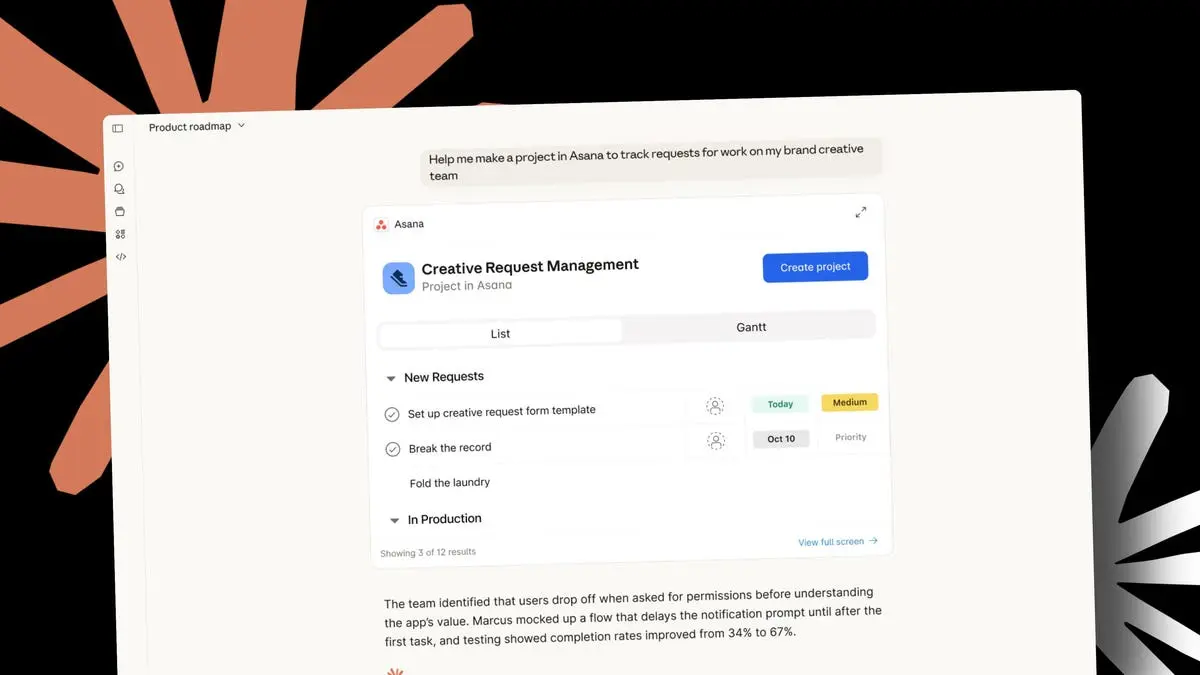
With these integrations, users can customize Canva decks in real time, format and preview Slack messages before posting, build interactive charts with Hex or Amplitude, and manage projects with Asana or monday.com
1
. When connected to Box, Claude can search for files, preview documents inline, and answer questions about content4
. With Asana, it can turn chats into projects, tasks, and timelines that co-workers can find and interact with on the project management app4
.
Source: ZDNet
The interactivity resembles "mini" apps embedded inside messaging platforms like Telegram and Discord, creating an apps-within-an-app experience
1
. This chatbot UI approach reduces the need to interact with traditional operating systems, potentially posing a challenge to platform makers like Apple, Google, and Microsoft3
.Related Stories

Security and Access Considerations
MCP Apps surface third-party interface elements in iframes with multiple security layers including iframe sandboxing, pre-declared templates for previewing HTML content prior to rendering, auditable messages, and host-managed approvals for UI-initiated tool calls
3
. However, as The Register notes, "running UI from MCP servers means running code you didn't write within your MCP host," and whether these defenses prove sufficient to avoid creating novel risks will be tested over time3
.The new feature is available now on web and desktop for Pro, Max, Team, and Enterprise subscribers
2
. Users can access interactive apps by visiting claude.ai/directory and selecting apps labeled "interactive" .Implications for AI Platform Competition
This development arrives two weeks after Anthropic launched Claude Cowork, a research preview feature designed to deliver agentic capabilities to non-coding tasks . Together, these releases underscore Anthropic's objective to make Claude the primary interface of users' working lives. The company's competitors are pursuing similar ambitions—both OpenAI and Perplexity have recently launched their own AI-powered web browsers .
Operating standards like the Model Context Protocol are crucial for building usable ecosystems of products as they avoid the need for companies to develop and maintain numerous different interfaces . The protocol's interoperability means that as more platforms adopt MCP, the ecosystem of AI agents capable of seamlessly working across tools will expand significantly. Watch for how OpenAI, Google, and Microsoft implement similar capabilities in their own AI products, and whether Salesforce's promised integration brings enterprise-scale data context into the conversation.
References
Summarized by

Navi
[1]
[3]
Related Stories
Anthropic's Claude AI Expands Integration Capabilities for Education and Design
10 Jul 2025•Technology

Anthropic's New Claude Feature: Powerful File Creation with Security Concerns
09 Sept 2025•Technology

Anthropic Moves Premium Features to Claude's Free Plan as AI Competition Intensifies
12 Feb 2026•Technology

Recent Highlights
1
OpenAI Releases GPT-5.4, New AI Model Built for Agents and Professional Work
Technology
2
Anthropic sues Pentagon over supply chain risk label after refusing autonomous weapons use
Policy and Regulation

3
OpenAI secures $110 billion funding round as questions swirl around AI bubble and profitability
Business and Economy

Recent Highlights
Today's Top Stories





Your Daily Dose of Curated AI News
Don’t drown in AI news. We cut through the noise - filtering, ranking and summarizing the most important AI news, breakthroughs and research daily. Spend less time searching for the latest in AI and get straight to action.

