Elon Musk Claims AI and Robotics Are Only Solution to America's $38 Trillion Debt Crisis


2 Sources
2 Sources
[1]
Elon Musk says the only thing that can solve 'insanely high' $38 trillion national debt crisis is AI and robotics -- but it would cause 'significant deflation' | Fortune
Tesla CEO Elon Musk describes his foray into the world of politics as a "very interesting side quest." The world's richest man ploughed hundreds of millions into President Trump's election campaign, barrelled into the capital and set off administrative hand grenades with the Department of Government Efficiency (DOGE). He then promptly fell out of favor with the White House and was dismissed back to Texas. The separation between Trump and Musk was a break up pretty much everyone saw coming. It came in part due to the Oval Office's "One Big, Beautiful Bill Act," which the tech titan said undermined the cost-cutting work of DOGE. Musk is one of many business leaders concerned by America's spending habits, with national debt now totalling more than $38 trillion. Economists aren't necessarily worried by the level of national debt -- nations actually need it to underpin the bond market and keep the global economy moving -- but they are worried about the interest payments on the debt, and how this impacts the all-important debt-to-GDP ratio. This ratio indicates how fast a country's economy is growing and as a result, its ability to be able to repay the debt or keep up with interest payments on the borrowing. And those payments are rocketing: As of October 2025, it costs $104 billion to maintain the debt, which is 15% of total federal spending in fiscal year 2026. Total interest paid on the debt for FY 2025 was $1.22 trillion. To rebalance the debt-to-GDP ratio and avoid even higher borrowing rates, a nation can either reduce its spending or stimulate its economy to rebalance the books. Musk seems to think that the latter is the best option, via a new age of growth unlocked by AI. "As long as civilization keeps advancing, we will have AI and robotics at very large scale," Musk told Nikhil Kamath's podcast in an episode aired yesterday. "I think that's pretty much the only thing that's going to solve the U.S. debt crisis." He added: "Currently the U.S. debt is insanely high and the interest payments on the debt exceed the entire military budget of the United States, just the interest payments, and that's -- at least in the short term -- going to continue to increase." Musk may be referring to the fact that in 2024, the Committee for a Responsible Budget reported that borrowing costs exceeded defense and medicaid payments for the first time. "I think actually the only thing that can solve the debt situation is AI and robotics," Musk continued, before making a caveat that the increased output in goods and services as a result of the transformative technology would likely lead to "significant deflation." He explained: "If you have AI and robotics, and a dramatic increase in the output of goods and services, probably you will have deflation. That seems likely because you simply won't be able to increase the money supply as fast as you increase the output of goods and services." Some economists agree with Musk, though perhaps to a less extreme degree. Ron Insana, a senior advisor at Schroders, wrote in a column way back in 2023 that "with every technological advancement, workers are displaced and costs for specific goods and services decline as a consequence." Likewise, in August this year BlackRock's senior managing director, Rick Rieder wrote AI may prove to be a "force that pushes unit costs down and output up. In economic terms: disinflationary growth. In investment terms: higher returns on equity, expanding margins, and a re-rating of productivity leaders." That said, the takes are generally of the opinion that AI may be disinflationary (a slowing of price rises) as opposed to deflationary (an outright decrease in the price levels). Musk added the productivity gains needed to offset the current inflation rate of 3% are not there yet, but they're not far off either. He added: "If you say 'How long would it take us to get there?' I think it's three years. In three years or less, my guess is goods and services output will exceed the rate of inflation ... like money supply growth. Maybe after those three years, you have deflation and then interest rates go to zero, and then the debt is a smaller problem than it is."
[2]
Elon Musk claims America's 'insanely high' $38T debt crisis can only...
Elon Musk said in a new interview that he thinks robotics powered by artificial intelligence driving productivity gains and output are the only way to address the more than $38 trillion national debt. Musk said in a podcast interview on "A Different Conversation with Nikhil Kamath" released Sunday that the widespread deployment of AI and robotics are the only ways to address the large and growing national debt. "I think that's pretty much the only thing that's going to solve for the US debt crisis, because currently the US debt is insanely high," Musk said. "The interest payments on the debt exceed the entire military budget of the United States - just the interest payments, and that's at least in the short-term going to continue to increase." "So I think actually the only thing that can solve for the debt situation is AI and robotics," he added. "It probably would cause significant deflation because deflation or inflation is really the ratio of goods and services produced to the change in the money supply." Musk said that because AI and robotics could lead to a significant increase in output, it would likely lead to deflation - which is the opposite of inflation and results in a decrease in the price level. "If you have AI and robotics, and a dramatic increase in the output of goods and services, probably you will have deflation. That seems likely. Because you simply won't be able to increase the money supply as fast as you can increase the output of goods and services," he said. The Tesla CEO was asked about the current level of inflation, which remains elevated relative to the Federal Reserve's 2% target, and said that AI hasn't boosted productivity enough yet to cause deflation. "AI has not yet made enough of an impact on productivity to increase the goods and services faster than the money supply. The US is increasing the money supply quite substantially with deficits that are on the order of $2 trillion, so you have to have goods and services output more than that in order to not have inflation," he said. "We're not there yet, but if you say 'how long would it take us to get there,' I think it's three years. Probably three years - in three years or less, my guess is goods and services growth will exceed money supply growth in about three years," Musk added. The tech billionaire also said he thinks the proliferation of AI and robotics will remake the economy and the monetary system overall. "I think at a certain point you decouple from the sort of conventional economy if you have AI and robots producing chips and solar panels and mining resources in order to make chips and robots... You sort of complete that cycle, once that cycle is complete, I think that's the point at which you decouple from the monetary system," Musk said. Musk was asked if that's the way forward for the US addressing its national debt, and the Tesla CEO noted, "In this future that I'm talking about, the notion of countries becomes sort of anachronistic." "These are just what I think will happen based on what I see, as opposed to these are fundamentally good things, and I'm trying to make them happen," he said. "I think this would happen without me, whether I like it or not. As long as civilization keeps advancing, we will have AI and robotics at very large scale."
Share
Share
Copy Link
Tesla CEO Elon Musk argues that widespread deployment of AI and robotics is the only viable solution to America's mounting $38 trillion national debt, predicting these technologies will drive productivity gains and cause significant deflation within three years.
Musk's Bold Economic Prediction
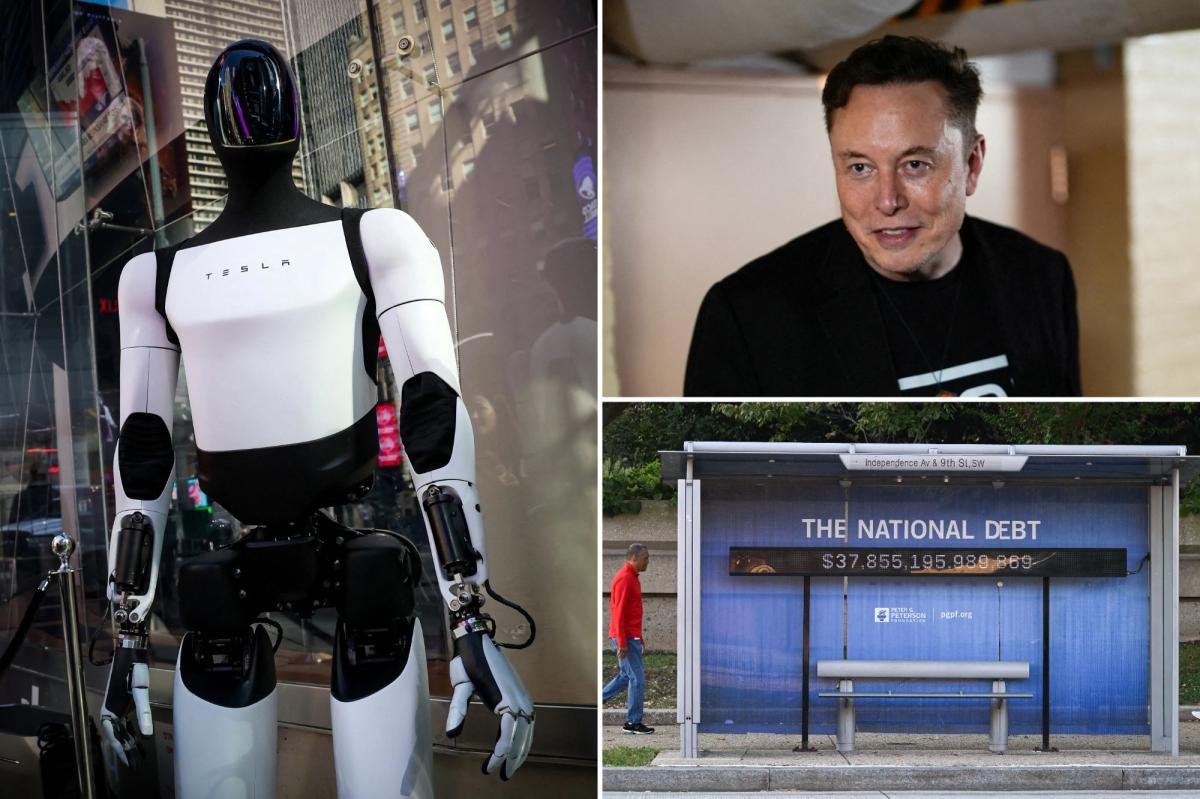
Tesla CEO Elon Musk has made a striking claim about America's mounting debt crisis, arguing that artificial intelligence and robotics represent the only viable solution to the nation's $38 trillion national debt burden. Speaking on "A Different Conversation with Nikhil Kamath" podcast, Musk outlined his vision for how transformative technologies could fundamentally reshape the U.S. economy and address what he describes as an "insanely high" debt problem
1
.
Source: New York Post
The world's richest man emphasized the severity of the current situation, noting that interest payments on the national debt now exceed the entire U.S. military budget. "The interest payments on the debt exceed the entire military budget of the United States - just the interest payments, and that's at least in the short-term going to continue to increase," Musk explained during the interview
2
.The Deflation Solution
Musk's economic theory centers on the concept that widespread AI and robotics deployment would create such dramatic increases in productivity and output that it would trigger significant deflation. "If you have AI and robotics, and a dramatic increase in the output of goods and services, probably you will have deflation," he stated, explaining that the technology would increase production faster than the money supply could expand
1
.This deflationary scenario, according to Musk, would fundamentally alter the debt dynamics. He predicts that within three years, goods and services output will exceed the rate of money supply growth, potentially leading to zero interest rates and making the debt "a smaller problem than it is." The Tesla CEO acknowledged that current AI hasn't yet achieved the productivity gains necessary to outpace inflation, but believes this threshold is rapidly approaching
2
.Economic Expert Perspectives
Some economists share elements of Musk's vision, though typically in more measured terms. Ron Insana, a senior advisor at Schroders, has noted that technological advancements historically displace workers while reducing costs for goods and services. Similarly, BlackRock's Rick Rieder has written about AI's potential as a "force that pushes unit costs down and output up," describing it as "disinflationary growth" rather than outright deflation
1
.However, most economic experts view AI as potentially disinflationary - slowing price increases - rather than deflationary, which involves actual price decreases. This distinction is crucial, as deflation can create its own economic challenges, including reduced consumer spending and increased real debt burdens.
Related Stories

Beyond Traditional Economics
Musk's vision extends beyond conventional economic frameworks. He envisions a future where AI and robotics create self-sustaining production cycles, potentially decoupling from traditional monetary systems entirely. "I think at a certain point you decouple from the sort of conventional economy if you have AI and robots producing chips and solar panels and mining resources in order to make chips and robots," he explained
2
.This transformation could be so profound that Musk believes it might make the concept of countries "anachronistic." He emphasized that these predictions represent his assessment of inevitable technological progress rather than advocacy for specific outcomes, stating that such developments would occur "whether I like it or not" as long as civilization continues advancing.
References
Summarized by

Navi
Related Stories
Elon Musk says AI will make retirement savings irrelevant as robots reshape the future of work
13 Jan 2026•Technology
Elon Musk predicts robots will outnumber humans as AI drives unprecedented economic growth
22 Jan 2026•Technology

Sam Altman predicts AI will cause massive deflation, making goods and services radically cheaper
30 Jan 2026•Business and Economy

Recent Highlights
1
Google releases Gemma 4 with Apache 2.0 license, enabling unrestricted local AI on devices
Technology

2
AI Models Lie and Deceive to Protect Other AI Models From Deletion, Study Reveals
Science and Research

3
OpenAI closes $122 billion funding round amid fierce AI competition and profitability questions
Startups

Recent Highlights
Today's Top Stories






Your Daily Dose of Curated AI News
Don’t drown in AI news. We cut through the noise - filtering, ranking and summarizing the most important AI news, breakthroughs and research daily. Spend less time searching for the latest in AI and get straight to action.

