German Start-Up Sitegeist Raises €4M to Deploy AI Robots for Concrete Renovation


2 Sources
2 Sources
[1]
German start-up raises €4m for construction site robots
From left: Sitegeist co-founders Julian Hoffmann, Nicola Kolb, Dr Lena-Marie Pätzmann and Claus Carste. Image: Sitegeist Munich-based Sitegeist wants to address Europe's backlog of broken concrete architecture. German construction automation start-up Sitegeist has raised €4m for team expansion and scaled deployment of its AI-enabled robots that specialise in concrete renovation. The pre-seed funding round was co-led by B2Venture and OpenOcean, with participation from angel investors including Verena Pausder, Lea-Sophie Cramer and Alexander Schwörer. Sitegeist said that Europe is full of dated architecture and broken infrastructure, and that its robots can help with capacity constraints and backlogs around concrete renovation and repair of public buildings, bridges, tunnels and car parks. "Infrastructure renovation is hitting a critical bottleneck, especially in concrete repair," said Dr Lena-Marie Pätzmann, co-founder and CEO of Sitegeist. "Today, deteriorated concrete is still removed using manually-intensive processes that are hard to scale. We're tackling this challenge with the first ever specialized automated and modular robots that can perform concrete renovation directly on existing structures." According to the Munich-based company, concrete renovation is a complex, specialised, and time consuming sector of infrastructure maintenance, with a shortage of qualified labour compounded by strict safety requirements and specific requirements for individual sites leading to waiting lists of months or years. Sitegeist said that while conventional automation approaches rely on pre-existing 3D models or standardised site conditions, its modular robots operate directly on existing structures and that by using advanced perception, AI-based decision support and adaptive control, they can handle complex geometries and varying material conditions without prior digitisation. "The way concrete is removed today by workers is devastating and extremely arduous. This is the perfect case for augmenting humans with robots," said Florian Schweitzer, a partner at B2Venture, which has previously invested in irish semiconductor start-up Equal1. Sam Hields, a partner at OpenOcean, added: "Sitegeist's non-humanoid robots are purpose-built to solve real-world problems, and their ability to operate in harsh environments with superhuman strength and autonomy is genuinely game-changing. This is exactly the kind of task we want AI to automate: a manual, expensive process with low talent availability." Sitegeist was co-founded by Pätzmann, Claus Carste, Julian Hoffmann and Nicola Kolb and comes from the same research environment as RobCo. Don't miss out on the knowledge you need to succeed. Sign up for the Daily Brief, Silicon Republic's digest of need-to-know sci-tech news.
[2]
Construction robotics startup Sitegeist raises €4M to automate arduous concrete repair jobs - SiliconANGLE
Construction robotics startup Sitegeist raises €4M to automate arduous concrete repair jobs German startup Sitegeist GmbH said today it has raised €4 million (around $4.75 million) in pre-seed funding to help accelerate the renovation of Europe's infrastructure with robotic automation. Today's round was led by b2venture and OpenOcean and saw participation from UnternehmerTUM Funding for Innovators and several angel investors, plus strategic partners in the construction and robotics industries. Sitegeist's non-humanoid robots are focused on one of the more dramatic yet necessary challenges of renovation projects - demolition. To be more specific, they're designed to remove deteriorated concrete from existing structures up to ten-times faster than humans can do, helping to accelerate renovation projects and overcome a growing labor shortage in the construction industry. The startup's co-founder and chief executive officer Dr Lena-Marie Pätzmann (pictured below, second from right) says there's an urgent need for robotic assistance in the construction industry. Across Europe, there are hundreds, if not thousands of ageing bridges, tunnels, parking facilities and public buildings in need of urgent renovation. In Germany, the repair backlog amounts to hundreds of billions of euros, and there are similar challenges in other European countries and in the U.S. and other parts of the world. Most countries cannot keep up, due to a shortage of skilled laborers and the physically demanding nature of the work. The task of concrete renovation is especially complex. Crumbling concrete is normally removed using high-pressure water or abrasive blasting machines, which are operated by humans and require extreme precision to avoid damaging the steel reinforcement used within it. The process is slow and complicated by the fact that it's often site-specific, which means there's a huge backlog of work that needs to be done. "Infrastructure renovation is hitting a critical bottleneck, especially in concrete repair," Pätzmann said. "Today, deteriorated concrete is still removed using manually-intensive processes that are hard to scale. Pätzmann believes the solution is robotic automation. Her company has created a modular robot that's designed to operate in unstructured construction environments. Unlike existing robots that are programmed to operate in standardized environments, its robots can operate in any construction site. They navigate their environment through a combination of advanced sensors, artificial intelligence-based decision support and adaptive control systems, allowing them to handle complex geometries without site-specific training, meaning they can be deployed quickly to almost any site. They're also extremely durable, which is necessary to handle the worst of Europe's winter weather conditions. "We're tackling this challenge with the first ever specialized automated and modular robots that can perform concrete renovation directly on existing structures," Pätzmann said. "This backing enables us to move faster in bringing automated renovation to critical infrastructure worldwide." Sitegeist isn't alone in trying to speed up construction timelines with robotic automation. In Europe alone, there are many rival robotics firms, including RobCo., Brokk AB, Epiroc AB and Husqvarna AB. But Pätzmann said Sitegeist's robots are the only ones capable of performing large-scale concrete renovation with full autonomy. "For our first use case - concrete removal - we differentiate ourselves through two core features: automated, sensor-based concrete removal, and the ability to work not only on large, straight surfaces but also in open areas, corners, columns, and similar spaces, where much of the work occurs," she explained. The startup is already working alongside a number of German concrete renovation firms, and the funding will allow it to expand its collaborations and deploy its robots on additional test sites and hire new talent to further enhance their design. OpenOcean Partner Sam Hields said the most impactful AI-powered robots in use today are not humanoids with fingers and thumbs, but rather, those that are purpose-built to solve real-world problems. "Sitegeist's non-humanoid robots and their ability to operate in harsh environments with superhuman strength and autonomy is genuinely game-changing," he insisted. "This is exactly the kind of task we want AI to automate: a manual, expensive process with low talent availability. With an aging population and a skills shortage in physical industries like construction, robotics will help us refit our infrastructure for the future." Sitegeist is focused on concrete renovation for now, but ultimately it believes robots will be able to assume dozens of different tasks in the construction industry, including sandblasting and drilling.
Share
Share
Copy Link
Munich-based Sitegeist has secured €4m in pre-seed funding to deploy AI-enabled robots that automate concrete renovation. The German start-up's modular robots can remove deteriorated concrete up to ten times faster than manual labor, addressing Europe's infrastructure backlog and labor shortages across bridges, tunnels and public buildings.
Sitegeist Secures €4M to Tackle Europe's Infrastructure Crisis
Munich-based Sitegeist has raised €4m in pre-seed funding to accelerate deployment of its AI-enabled robots designed specifically for concrete renovation
1
. The German start-up's funding round was co-led by B2Venture and OpenOcean, with participation from UnternehmerTUM Funding for Innovators and angel investors including Verena Pausder, Lea-Sophie Cramer and Alexander Schwörer2
. The investment will enable team expansion and scaled deployment of construction site robots that can remove deteriorated concrete up to ten times faster than humans2
.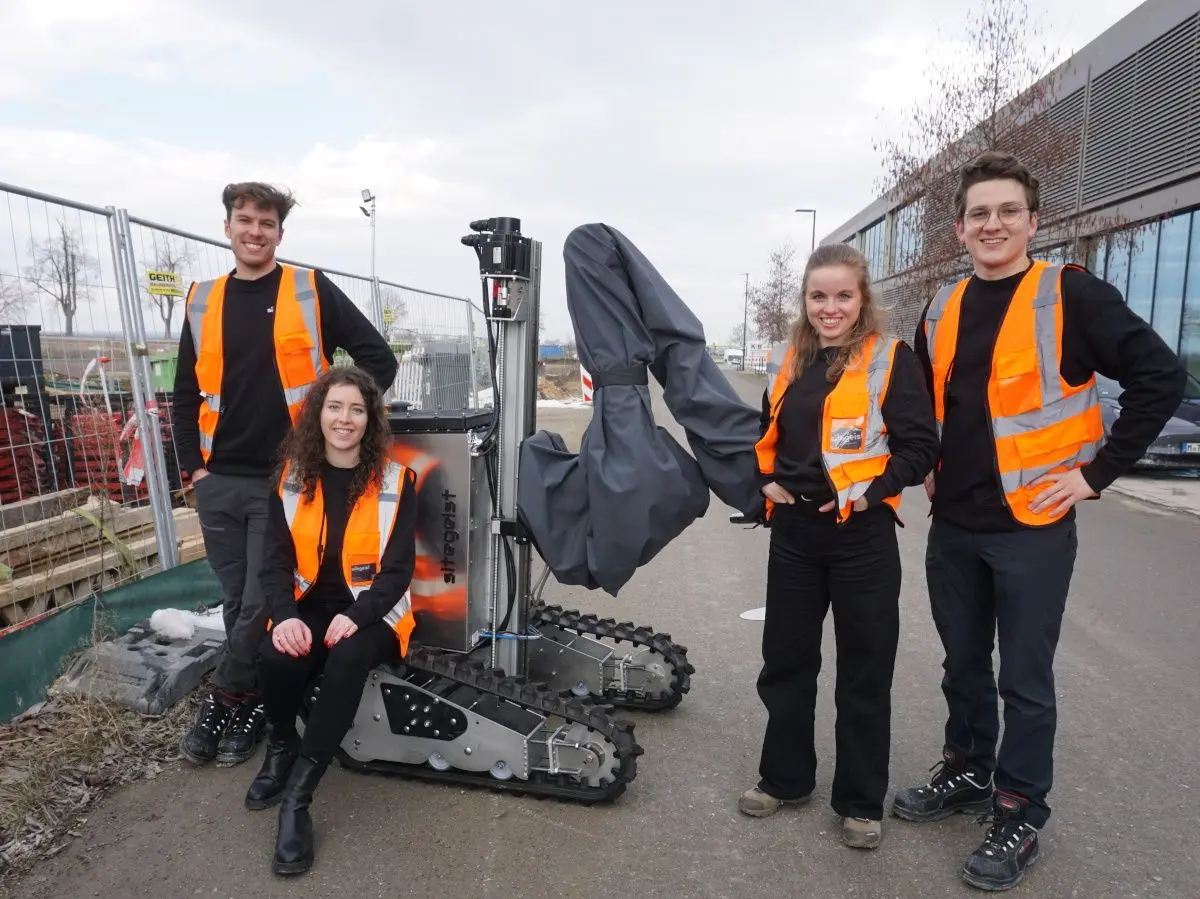
Source: Silicon Republic
Automating Concrete Repair at Critical Scale
Europe faces a mounting infrastructure backlog, with hundreds of ageing bridges, tunnels, car parks and public buildings requiring urgent attention. In Germany alone, the repair backlog amounts to hundreds of billions of euros
2
. Dr Lena-Marie Pätzmann, co-founder and CEO of Sitegeist, explained that infrastructure renovation is hitting a critical bottleneck, particularly in concrete repair where deteriorated concrete is still removed using manually-intensive processes that are hard to scale1
. The company's modular construction robotics systems are the first specialized automated robots capable of performing concrete renovation directly on existing structures1
.Advanced Sensors and AI-Based Decision Support Drive Autonomy
Unlike conventional automation approaches that rely on pre-existing 3D models or standardized site conditions, Sitegeist's robots operate directly on existing structures using advanced perception, AI-based decision support and adaptive control
1
. The robots navigate unstructured construction environments through advanced sensors, allowing them to handle complex geometries and varying material conditions without prior digitisation1
. This autonomy enables rapid deployment to almost any site without site-specific training2
. The robots perform automated, sensor-based concrete removal and can work not only on large, straight surfaces but also in open areas, corners and columns where much of the renovation work occurs2
.
Source: SiliconANGLE
Related Stories


Addressing Labor Shortages in Physically Demanding Work
Concrete renovation is a complex, specialized and time-consuming sector of infrastructure maintenance, with capacity constraints compounded by strict safety requirements and specific site requirements leading to waiting lists of months or years
1
. Labor shortages across Europe make it impossible for most countries to keep up with the physically demanding nature of manual labor required for automating concrete repair2
. Florian Schweitzer, partner at B2Venture, noted that the way concrete is removed today by workers is devastating and extremely arduous, making it the perfect case for augmenting humans with robots1
. Sam Hields, partner at OpenOcean, emphasized that Sitegeist's non-humanoid robots are purpose-built to solve real-world problems, with their ability to operate in harsh environments with superhuman strength representing exactly the kind of task AI should automate1
.Sitegeist was co-founded by Pätzmann, Claus Carste, Julian Hoffmann and Nicola Kolb, emerging from the same research environment as RobCo
1
. The company is already collaborating with German concrete renovation firms, and the funding will allow expanded partnerships and additional test site deployments2
. While focused on autonomous concrete renovation for now, Sitegeist believes robots will eventually assume dozens of different construction tasks, including sandblasting and drilling2
.References
Summarized by

Navi
[1]
Related Stories
Recent Highlights
1
AI Models Lie and Deceive to Protect Other AI Models From Deletion, Study Reveals
Science and Research

2
AI chatbots validate you too much, making you less kind to others, Stanford study reveals
Science and Research

3
Judge blocks Pentagon from blacklisting Anthropic over AI safety guardrails dispute
Policy and Regulation

Recent Highlights
Today's Top Stories












Your Daily Dose of Curated AI News
Don’t drown in AI news. We cut through the noise - filtering, ranking and summarizing the most important AI news, breakthroughs and research daily. Spend less time searching for the latest in AI and get straight to action.

