Google AI virtual try-on feature now lets you try on clothes using just a selfie


10 Sources
10 Sources
[1]
Google's AI try-on feature for clothes now works with just a selfie | TechCrunch
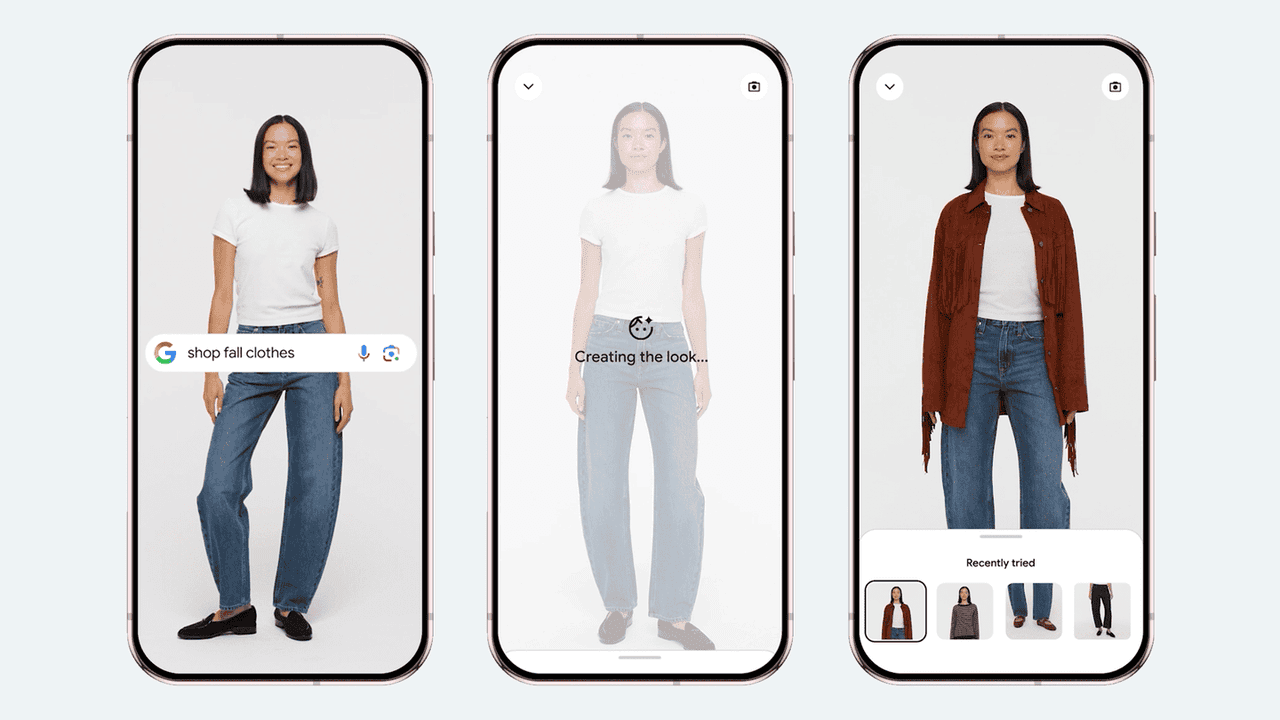
Google is updating its AI try-on feature to let you virtually try on clothes using just a selfie, the company announced on Thursday. In the past, users had to upload a full-body picture of themselves to virtually try on a piece of clothing. Now, they can use a selfie and Nano Banana, Google's Gemini 2.5 Flash Image model, to generate a full-body digital version of themselves for virtual try-ons. Users can select their usual clothing size, and the feature will then generate several images. From there, users can choose one to make it their default try-on photo. If desired, users still have the option to use a full-body photo or select from a range of models with diverse body types. The new capability is launching in the United States today. Google first launched the try-on feature in July, allowing users to try on apparel items from its Shopping Graph across Search, Google Shopping, and Google Images. To use the feature, users need to tap on a product listing or apparel product result and select the "try it on" icon. The move comes as Google has been investing in the virtual AI try-on space, as the company has a separate app dedicated specifically to that purpose. The app, called Doppl, is designed to help visualize how different outfits might look on you using AI. Earlier this week, the tech giant updated it with a shoppable discovery feed that displays recommendations so users can discover and virtually try on new items. Nearly everything in the feed is shoppable, with direct links to merchants. The discovery feed features AI-generated videos of real products and suggests outfits based on your personalized style. While some may not be fond of an AI-generated feed, Google likely views it as a way to showcase products in a format that people are already familiar with, thanks to platforms like TikTok and Instagram.
[2]
Google's AI try-on app Doppl adds a shoppable discovery feed | TechCrunch
Google announced on Monday that it's introducing a shoppable discovery feed in Doppl, its experimental app that uses AI to visualize how different outfits might look on you. The tech giant says the idea behind the new feed is to display recommendations so users can discover and virtually try on new items. Nearly everything in the feed is shoppable, with direct links to merchants. The discovery feed features AI-generated videos of real products and suggests outfits based on your personalized style. Google determines your style by analyzing the preferences you share with Doppl and the items you interact with. The move comes as short-form video feeds, particularly on TikTok and Instagram, have conditioned users to scroll visual feeds and buy what they see. However, unlike on TikTok and Instagram, where real influencers showcase products, Google's new feed only consists of AI-generated content. While some may not be fond of an AI-generated feed, Google likely sees it as a way to surface products in a way that people are already used to. Plus, it makes sense for the company to try a new e-commerce strategy, especially as it continues to lose ground to companies like Amazon and social media platforms. It's worth noting that AI-generated videos aren't new to Doppl. While the app creates images of a virtual version of yourself wearing different outfits, it can turn these static images and convert them into AI-generated videos. The purpose of this is to give you a better sense of how the outfit would look on you in real life. The new discovery feed is rolling out to Doppl on iOS and Android in the U.S. for users 18 and above. Although a feed consisting solely of AI-generated content would have seemed strange a year ago, the idea is now gaining traction. For example, OpenAI in September launched Sora, a social media platform of just AI videos. Meta also has a short-form video feed of AI-generated videos called "Vibes" in the Meta AI app.
[3]
Strike a Pose: Here's How to Use Google's Upgraded Virtual Try-On Feature
Meara covers streaming service news for CNET. She graduated from the University of Texas at Austin with a degree in journalism. When she's not writing, she likes to dote over her cat, sip black coffee and try out new horror movies. Say goodbye to awkward dressing-room selfies. Google is upgrading its existing AI-powered try-on tool, which allows you to skip an in-person shopping trip and view yourself in clothes virtually with the help of AI. The update, announced on Thursday, adds the option to generate a complete digital version of yourself, rather than providing a full-body photo. So, if you have a great selfie but happen to be sitting down in the image, or it's a head-and-shoulders-only photo, you can now use it. The tool will ask what size body you want it to create, from XS to 4XL+, and create a full-body avatar with your image. So, even if you don't have a need to wear a full-length, formal satin gown or black leather pants, you can see how you might look if you did. You must be in the US, but if you are, upload a selfie to the website, select a size, and Nano Banana -- Google's Gemini 2.5 Flash Image model -- will generate a full-length image, allowing you to click around and try out outfits. Don't miss any of our unbiased tech content and lab-based reviews. Add CNET as a preferred Google source. Google initially introduced its AI try-on feature in May at its I/O developers conference. You'll still be able to virtually try on clothes using a full-body photo if you prefer.
[4]
Google introduces app that lets you try before you buy
Try-before-you-buy AI assistants are becoming increasingly popular with retailers, letting shoppers see how clothing and accessories look without having to leave home. However, Google has one-upped them with a fashion discovery and styling app called Doppl. This experimental AI app from Google Labs doesn't limit users to just one shop's offerings. Doppl instead curates entire looks and lets users upload items they've picked out and would like to see on themselves. It's available in the US on both iOS and Android. To get started, a user answers a few questions about their style, chooses from a few suggested outfits, and then uploads a full body photo of themselves. Those who don't feel comfortable uploading a photo can choose an AI-generated model instead. They'll then be presented with looks in a Discovery feed. Within it, Doppl will provide recommendations, so users can discover new clothing they might not have seen before, and virtually try on items. The feed includes AI-generated videos of actual products and, according to Google, nearly everything in it is shoppable, with direct links to merchants. Users aren't limited to the suggestions Doppl presents. They can upload images of clothing to try on. There are some exceptions, like bathing suits, lingerie, shoes, and accessories. Sheer clothing that violates Google's generative AI policies is not allowed, and users must be 18 or older. Doppl goes a big step beyond Google Chrome's Shopping tab, but it's not alone in AI-powered virtual try-on. A trend that's taking off Luxury brands have begun adding it to elevate the shopping experience. According to Fytted, Gucci has partnered with Wanna Kicks to introduce an AR sneaker try-on that lets customers see what the latest releases will look like on them. Dior is offering something similar, using virtual try-on for both sunglasses and makeup to create what is described as a "seamless beauty-to-fashion experience." Fytted also noted that Louis Vuitton and Prada are experimenting with AR try-on features for accessories. Mass-market retailers and department store chains have similar features. Recently, Walmart acquired ZeeKit, which enabled the grocery chain to implement a wide-scale virtual try-on across apparel categories. ASOS recently launched a Virtual Catwalk feature to show clothes on different model types. Retailers H&M and Target have also started implementing virtual try-ons across each brand's online presence, with Target using the technology for beauty products and home goods, while H&M is piloting virtual try-ons in select markets. Athletic brands are in on it, too, with Nike's Fit app offering AR shoe sizing and try-on with advanced foot measurement. Adidas has integrated a similar feature into its mobile app for popular sneaker models. While Google is more of a follower than a leader with this trend, it could have the clout needed for Doppl to become a fashion star.
[5]
Google's Virtual Try On Tool Lets You Visualize Yourself in Any Outfit From Just a Selfie
Google has updated its AI try-on feature, an app that allows people to virtually try on clothes by uploading a photo of themselves. Previously, users had to upload a full-length photo to see themselves in a particular outfit or garment, but a new update rolled out last week allows them to do so with just a selfie. By harnessing Google's Nano Banana AI image model found on Google Gemini 2.5, the powerful AI can generate a digital full-length version of the user from just a headshot. "Say goodbye to bad dressing room lighting and awkward outfit selfies. Today U.S. shoppers have a new way to use our virtual try on tool," Google writes on The Keyword blog. "Now if you don't have a full body photo of yourself you can use a selfie and Nano Banana, our Gemini 2.5 Flash Image model, will generate a full body digital version of you for virtual try on." Google explains that users select their usual clothing size and "we'll generate several studio-like images." Users can choose one of those images to be their default try-on photo for subsequent clothing. Users still have the option to virtually try on clothes via full-length photos or select from a range of models with different body types. The new feature was launched in the United States last week and is available now. TechCrunch reports that the try-on feature for users was launched in July, but a similar feature allowing users to try clothes on the bodies of models has been around since 2023. The clever technology that melds photographs and AI is a way of driving more commerce. Google has an app called Doppl which also visualizes how outfits will look on different people. TechCrunch notes it was recently updated with a discovery feed of clothes, and all the items can be purchased via direct links to merchants.
[6]

Google's virtual try-on app now helps you discover and shop outfits tailored to you
Doppl just made it easier to discover, try, and buy your next favorite look. Google introduced a virtual try-on app called Doppl earlier this year that uses AI to help users visualize how different outfits look on them. The company has now added a shoppable discovery feed to the app that offers outfit recommendations with direct links to merchants. In a recent blog post, Google said that the idea behind this new feed is to help users "discover new favorites," try them on a virtual avatar of themselves, and purchase them right within Doppl. This discovery feed works like a personalized style stream, surfacing outfit recommendations based on user-specified preferences and past interactions. Recommended Videos Google says nearly all items highlighted in the discovery feed are shoppable and feature direct links to merchants, making it simple for users to move from browsing outfits to completing a purchase. The discovery feed also features AI-generated videos of items, which should give users a clear idea of how an outfit may fit and move in real life. Doppl's discovery feed seems inspired by the shopping features on short-form video apps like TikTok and Instagram, which allow creators to add quick buy links to items showcased in their videos. However, by utilizing AI to tailor outfit recommendations, Doppl offers users a more personal shopping experience than these platforms. Additionally, by combining outfit discovery, virtual try-on, and shoppable links in one feed, Google's app streamlines the entire shopping experience, eliminating the need to visit multiple websites or apps. The shoppable discovery feed is rolling out in the US to users aged 18 or older. You can take it for a spin by downloading the Doppl app for Android or iOS. The app is free to use and has the potential to change the way people shop for clothes online. However, early reviews suggest it still has a long way to go before it can be considered a market disruptor.
[7]

Discover new outfits, try them on and shop from Doppl's new discovery feed.
We're introducing a new, shoppable fashion discovery feed in Doppl, an experimental AI app from Google Labs that helps you explore your style and see how new outfits might look on you. In this new feed, Doppl will provide recommendations so you can discover new favorites and virtually try on items -- and nearly everything you see is shoppable, with direct links to merchants. The discovery feed includes AI-generated videos of real products and recommends outfits based on your personalized style profile, informed by the style preferences you share with Doppl and the items you interact with.
[8]

Google Will Now Let You Virtually Try on Clothes With Just a Selfie
There are guardrails in place to stop people from using selfies of celebrities or children, but not of selfies of other people. The pace of AI technology is so rapid, it's tough to keep up with everything. At Google I/O back in May, Google rolled out an AI-powered shopping feature that let you virtually try on clothes you find online. All you needed to do was upload a full-length photo of yourself, and Google's AI would be to dress you up in whatever article of clothing you liked. I still can't decide whether the feature sounds useful, creepy, or a little bit of both. What I can say, however, is that the feature is getting a little creepier. On Thursday, Google announced an update to its virtual try on feature, that takes advantage of the company's new AI image model, Nano Banana. Now, you don't need a full-length photo of yourself: just a selfie. With solely a photo of your face, Nano Banana will generate a full-length avatar in your likeness, which you can use to virtually try on your clothes. I'm not exactly sure who this particular update is for: Maybe there are some of us out there who want to use this virtual try-on feature, but don't have a full-length photo of ourselves to share. Personally, I wouldn't really want to send Google my photo -- selfie or otherwise -- but I don't think I'd prefer to have Google infer what I look like from a photo of my face alone. I'd rather just send it the full photo, and give it something to actually work off of. Here's the other issue: While Google asks you to only upload images of yourself, it doesn't stop you if you upload an image of someone else. Talk about creepy: You can upload someone else's selfie and see how they look in various clothes. There is a system in place to stop you from uploading certain selfies, like celebrities, children, or otherwise "unsafe" items, but if the system fails, this feature could be used maliciously. I feel like Google could get around this by verifying the selfie against your Google Account, since you need to be signed in to use the feature anyway. If you are interested in trying the feature out -- and, subsequently, trying on virtual clothes with your AI-generated avatar -- you can head over to Google's try on feature, sign into your Google Account, and upload your selfie. When it processes, you choose one of four avatars, each dressed in a different fit, to proceed. Once through, you can virtually try on any clothes you see in the feed. Again, I see the potential usefulness of a feature that lets you see what you might look like in a certain piece of clothing before buying it. But, at the same time, I think I'd rather just order the item and try it on in the comfort (and privacy) of my own home.
[9]

Google now lets you try on clothes virtually with just a selfie
Google announced an update to its AI try-on feature on Thursday, enabling users to virtually try on clothes using only a selfie. The company previously required a full-body photo for this function. The enhancement uses Nano Banana, Google's Gemini 2.5 Flash Image model, to create a full-body digital version from the selfie. This capability launches in the United States today. The updated feature allows users to select their usual clothing size after uploading a selfie. The system then generates several try-on images based on that size input. Users can review these images and choose one to designate as their default try-on photo. This process simplifies access to virtual fitting without needing extensive photography setup. For those preferring alternatives, the option remains to upload a full-body photo or select from a range of models representing diverse body types. These models provide variety in physique to match different user preferences. Google initially introduced the AI try-on feature in July. It integrates with the company's Shopping Graph, which catalogs apparel items available across multiple platforms. Users access the feature by tapping on a product listing or apparel result within Google Search, Google Shopping, or Google Images. Once engaged, selecting the "try it on" icon initiates the virtual fitting experience. This integration spans these core services, making the tool readily available during everyday browsing and shopping activities. The development reflects Google's broader investment in virtual AI try-on technologies. The company maintains a dedicated application named Doppl, focused on visualizing outfit appearances through artificial intelligence. Doppl assists users in previewing how various clothing combinations might suit them. Earlier this week, Google enhanced Doppl with a shoppable discovery feed. This feed presents AI-generated videos featuring actual products from merchants. It also includes outfit recommendations tailored to the user's personalized style profile. Within the Doppl app's discovery feed, nearly all content connects directly to purchasing options. Users encounter links to merchants for immediate transactions. The format draws from familiar social media styles, incorporating short videos to display items dynamically. These elements combine to facilitate product discovery alongside virtual try-ons in a seamless interface.
[10]
Google adds shoppable AI video feed to Doppl try-on app
Google introduced a shoppable discovery feed in Doppl, its experimental artificial intelligence (AI) powered try-on application, on Monday. The new feed gives users merchandise recommendations and allows them to virtually try on clothing items. Most items within the feed are shoppable and include direct links to merchants. The discovery feed presents AI-generated videos of actual products and suggests outfits based on a user's personalized style. Google determines user style by analyzing preferences shared within Doppl and interacted items. The launch comes as short-form video feeds, prevalent on platforms like TikTok and Instagram, have accustomed users to visual scrolling and impulse purchases. However, unlike these platforms where human influencers display products, Google's new feed exclusively features AI-generated content. The company likely views this AI-generated format as a method to present products in a familiar user experience. This e-commerce strategy also aligns with Google's efforts to compete with companies like Amazon and various social media platforms in the retail sector. AI-generated videos are not a new feature for Doppl. The application generates images of a virtual user wearing different outfits and can convert these static images into AI-generated videos. This functionality aims to provide a more realistic visualization of how an outfit would appear in person. The new discovery feed is rolling out to Doppl users aged 18 and above on both iOS and Android platforms in the United States. While an exclusively AI-generated content feed would have seemed unusual previously, the concept has gained momentum. OpenAI, for example, launched Sora in September, a social media platform featuring only AI videos. Meta also includes a short-form video feed of AI-generated videos, named "Vibes," within its Meta AI application.
Share
Share
Copy Link
Google updated its AI try-on feature to work with selfies instead of full-body photos, using its Gemini 2.5 Flash Image model called Nano Banana. The company also enhanced its Doppl app with a shoppable discovery feed featuring AI-generated videos. These moves signal Google's push to compete in e-commerce as it loses ground to Amazon and social platforms.

Google AI Transforms Virtual Try-On With Selfie Technology
Google has updated its AI try-on feature to let users try on clothes with a selfie, eliminating the need for full-body photographs. The enhancement, announced last week and now available in the United States, uses Nano Banana, the Gemini 2.5 Flash Image model, to generate a full-body digital representation from just a headshot
1
. Users select their usual clothing size, from XS to 4XL+, and the system generates several studio-like images3
. From there, shoppers can choose one image to serve as their default try-on photo for subsequent clothing trials. The AI-powered virtual try-on tool still offers the option to upload full-body photos or select from a range of models with diverse body types1
.Doppl App Adds Shoppable Discovery Feed
Google's experimental AI try-on app Doppl received a significant update earlier this month with the introduction of a shoppable discovery feed
2
. The feed displays personalized recommendations, allowing users to discover and virtually try on new items. Nearly everything in the feed is shoppable, with direct links to merchants4
. The discovery feed features AI-generated videos of real products and suggests personalized outfits based on user preferences and interaction patterns. Google determines style preferences by analyzing what users share with Doppl and the items they engage with2
. Available on iOS and Android for users 18 and above in the United States, Doppl allows shoppers to upload images of clothing they want to try on, though exceptions include bathing suits, lingerie, shoes, and accessories4
.Strategic Push Into E-Commerce Competition
The updates reflect Google's strategic effort to strengthen its position in e-commerce as it continues to lose ground to Amazon and social media platforms like TikTok and Instagram
2
. Short-form visual feeds on these platforms have conditioned users to scroll and buy what they see, prompting Google to adopt a similar approach with AI-generated content2
. Google first launched the virtual try-on feature in July for users, allowing them to try on apparel items from its Shopping Graph across Search, Google Shopping, and Google Images5
. A similar feature for models has been available since 20235
.Related Stories

What This Means For Online Shopping Experience
The technology addresses a persistent friction point in online shopping: the inability to visualize how clothes will look on your actual body before purchasing. By converting a simple selfie into an avatar that can model different outfits, Google lowers the barrier to entry for users who may not have suitable full-body photos readily available
3
. This matters because it could reduce return rates for merchants while increasing consumer confidence in online apparel purchases. The integration of Flash Image technology with Google's existing Shopping infrastructure creates a seamless path from discovery to purchase. Watch for how conversion rates and return rates shift as more retailers adopt this technology, and whether Google can leverage its AI capabilities to reclaim e-commerce market share from competitors who have established dominance in visual shopping experiences.References
Summarized by

Navi
[4]
Related Stories
Google Launches AI-Powered Virtual Try-On and Enhanced Shopping Features
24 Jul 2025•Technology
Google's Virtual Apparel Try On expands to UK and India with AI-powered fitting room experience
03 Dec 2025•Technology
Google Expands AI-Powered Virtual Try-On to Shoes, Reaches New Markets
08 Oct 2025•Technology
Recent Highlights
1
Apple Plans Major Siri AI Overhaul in iOS 27 With Third-Party Chatbot Integration
Technology

2
OpenAI shuts down Sora after six months, ending Disney's $1 billion licensing partnership
Technology

3
AI chatbots validate you too much, making you less kind to others, Stanford study reveals
Science and Research
Recent Highlights
Today's Top Stories







Your Daily Dose of Curated AI News
Don’t drown in AI news. We cut through the noise - filtering, ranking and summarizing the most important AI news, breakthroughs and research daily. Spend less time searching for the latest in AI and get straight to action.

