Google Translate brings real-time translation to any headphones with Gemini AI across 70+ languages


12 Sources
12 Sources
[1]
Google Turns Ordinary Headphones into Instant Language Interpreters
Google is taking on Apple's Live Translation feature with its own live speech-to-speech translations, and Google's version doesn't require users to use a specific set of headphones. The new Translate app, currently rolling out in beta, provides users with real-time translation in their preferred language when they tap "Live Translate." The function, now usable on any headset, was only previously available on Pixel Buds. Don't miss any of our unbiased tech content and lab-based reviews. Add CNET as a preferred Google source. The Translate Android app update is rolling out in the US, Mexico, and India, and it supports more than 70 languages. The company says it will bring the feature to iOS, and more countries, in 2026. In addition, the company announced it was improving translation quality using Gemini, Google's AI model, and said that idioms, in particular, were no longer literal translations, but more contextual. Google said that it was also expanding the language learning tools with more feedback and daily challenges. Meanwhile, as part of iOS 26, Apple recently introduced Live Translation, but in comparison, the live audio version is currently limited to use with the AirPods Pro or AirPods 4.
[2]
Google Translate brings real-time speech translations to any headphones
Google Translate's latest update brings live speech translations, originally available only on the Pixel Buds, to any headphones you want, with support for over 70 languages. It's rolling out today in beta and just requires a compatible Android phone with the Translate app (unlike Apple's similar feature, which requires AirPods). It's one of a few new features coming to Google Translate, along with improved text translations. Using Gemini, Translate will now offer more accurate translations of phrases like idioms and slang, which have a different meaning than what they literally sound like word for word, such as the expression "stealing my thunder." Today's update also includes an expansion of the Practice feature in Translate, bringing it to 20 new countries and adding more supported languages. The Practice feature, which launched in beta in August, is a bit like Duolingo, but baked into Google Translate. It uses AI to make customized language learning sessions based on your skill level, including vocabulary practice and listening comprehension. Live speech-to-speech translation is rolling out today in the US, Mexico, and India on Android and will make its way over to the iOS Translate app next year. Improved text translations are rolling out today in the US and Mexico on both the Android and iOS Translate apps, as well as on the web version of Translate. Practice is still a beta feature in Translate, so it may not be available to everyone yet.
[3]
Your earbuds can translate 70 languages in real-time now, thanks to Gemini
Android users can try it now, with iOS support coming next year. If you find yourself in a situation where you need conversations around you translated to your language but don't want to purchase dedicated AI translation earbuds (which our own Jack Wallen recently tested and called "seriously impressive"), the Google Translate app has a new feature you'll want to check out. Starting today for Android phones, Google says you can now hear real-time foreign language translation from the Translate app right in your headphones, thanks to Gemini's new live speech-to-speech translation capabilities. Also: Are voice translation earbuds actually viable in public? I tested some, here's my advice The feature works with any headphones and supports more than 70 languages. Google will add support for iOS and more countries next year. While the Translate app does have an existing feature that translates a conversation live, this new option preserves the tone, emphasis, and cadence of each speaker. This means it's much more natural-sounding, Google explained, and makes it easier to follow a conversation. Also: You can send live video to 911 from your Android phone in seconds now - here's how Google added that Translate will use Gemini's capabilities to better handle phrases with nuanced meanings, idioms, local expressions, or slang. For example, if someone says a phrase like "stealing my thunder," you'll get a helpful translation that says what the phrase really means instead of a literal word-for-word translation. To use this option, open the Translate app and tap "Live translate" while you're connected to your earbuds or headphones. In addition, Google revealed that it's expanding its language learning tools in Translate. Feedback is improved, so you can get helpful tips based on your speaking practice, and you can track how many days in a row you've been learning so you can see your progress. Also: Gemini vs. Copilot: I tested the AI tools on 7 everyday tasks, and it wasn't even close The app also has expanded language training, including English to German and Portuguese, and Bengali, Mandarin Chinese (Simplified), Dutch, German, Hindi, Italian, Romanian, and Swedish to English.
[4]
Google Translate is now better at translating slang terms and idioms using AI
Google is rolling out new Gemini-assisted functionality to Search and its Translate app. It says its AI can now provide more natural and accurate text translations for phrases that have more "nuanced meanings." Translate will now take slang terms and colloquial expressions into consideration rather than provide sometimes unhelpful direct translations. The latest update to its text translation feature is rolling out first in the US and India, translating between English and just under 20 other languages, including German, Spanish, Chinese and Arabic. It works in the Translate app for iOS and Android and on the web. Gemini's speech-to-speech translation feature has also been updated, so you can now hear real-time translations in your headphones, like with Apple's . Google says the new functionality, which is now in beta in the Translate app for Android (iOS is coming next year) in the US, tries to "preserve the tone, emphasis and cadence of each speaker" so you better understand the direction of the conversation and who said what. It works with any headphones and supports more than 70 languages. Finally, Google is adding more tools to its potentially Duolingo-rivaling AI-powered language learning tools, which it to the Translate app in August. Like Duolingo, Translate can now track how many days in a row you've been attempting to learn a new language, so you can check your progress over time. Whether it will nag you as persistently as the Duolingo owl famously does for slacking off is not clear. The feedback feature has also been improved, so you should receive more useful tips on how you're pronouncing words or phrases. Germany, India and Sweden are among the 20 new countries that can now use these educational tools. After not showing it much love for a while, Google has been busy adding new features to Translate recently. As well as the new language practice feature, an update last month added the to select between "Fast" and "Advanced" translations that allow you to prioritize speed when you're in a rush (ordering a drink at the bar, for example) or receiving more accurate translations using Gemini.
[5]

Google Translate gets a major upgrade from Gemini
Google is rolling out a major update to its Gemini audio models, bringing powerful live speech-to-speech translation capabilities to the Google Translate app. This upgrade uses the improved Gemini 2.5 Flash Native Audio model, which is designed to handle complex voice interactions. This new live speech translation feature is designed specifically for headphones, essentially letting you hear the world around you translated in real time. This beta experience is rolling out right now within the Google Translate app. If you're traveling or just need to communicate across a language barrier, this is a feature that could really change how you interact with people who don't speak your native language. The functionality is split into two modes. First, there is continuous listening. This is perfect for situations like listening to a lecture or following a group conversation. The AI listens to several different languages at once and converts them all into the one language you understand. You just put your headphones in and hear the world translated directly. Second, there is a two-way conversation. This handles real-time translation between two specific languages, and it automatically swaps languages on the fly depending on who is talking. For instance, if you speak English and the person across from you speaks Hindi, you hear English translations instantly in your headphones, and when you speak back, your phone broadcasts the Hindi translation. The detail that really makes this feature stand out is called "style transfer." This lets users hear the nuance of human speech. It mimics the speaker's actual voice, matching their speed and tone so the translation doesn't sound robotic. Beyond that, the system offers robust noise filtering, meaning you can still hold a comfortable conversation even if you are in a loud, outdoor environment. The translation coverage is extensive, supporting over 70 languages and 2,000 language pairs. This wide support is thanks to blending Gemini's audio processing power with its vast language database Another key component is multilingual input and auto-detection. This lets the system understand multiple languages simultaneously in a single session. You do not need to mess with the settings, and you do not even need to know what language is being spoken to start translating. The app figures out the language on its own and starts translating. Behind all this is the updated Gemini 2.5 Flash Native Audio model itself, which is also powering Google's live voice agents across various products. Google has improved the model in three key technical areas that should result in snappier performance for those using the tools. The model now has sharper function calling. This means the system is more reliable when it needs to connect to outside tools. For example, it can grab live data while you are talking without pausing or breaking the flow. Google reports a 90% adherence rate to developer instructions, which is up from 84% in previous versions. Finally, the conversations themselves should be smoother. The model is remembering what you said earlier in the chat. This helps it stay on topic and feels less like a disjointed exchange. I would say this improvement in multi-turn conversation quality is what's truly needed for stability in any voice assistant. These improvements are not just for the Translate app. The new Gemini 2.5 Flash Native Audio is rolling out across Google products, including Google AI Studio, Vertex AI, Gemini Live, and Search Live. You can also expect more effective brainstorming sessions with Gemini Live or better real-time help in Search Live. If you'd like to try out the live translation feature, the beta experience is rolling out starting today in the Google Translate app. You can connect your headphones to your device and tap "Live translate." For now, this experience is available on Android devices in the US, Mexico, and India, with support for iOS and more regions coming soon. Source: Google
[6]

Google's real-time AI translation looks like it could change the world
If Google can pull this off, traveling overseas to a foreign country won't be that foreign any more. Google Gemini has launched real-time, continuous translation using your phone and a pair of connected earbuds, in what looks like a powerful transformative change to the way in which we interact with speakers from other countries. Google buried its announcement in an update to Gemini voice model updates on Friday, but the additional translation features look like they could change the way in which people interact with foreign speakers. Google is launching a beta of Google Translate to accommodate both real-time translation and two-way conversations, powered by Gemini. Wander through the markets in Bangkok, and the update promises that you'll hear the ambient conversations of vendors around you translated into English, via a pair of connected earbuds. In a two-way conversation, you'll have the same experience, but you'll have a chance to speak, and then your phone will play back what you've said via your phone's speaker. Google is promising that Translate will auto-detect over 70 languages and 2,000 language pairs, or a direct back-and-forth translation between English, for example, and Italian. The company is also promising that the phone will filter out extraneous noise as well as preserve the nuance of the conversation using AI. Translate will even accommodate multiple languages in a single session. Those are all issues that I've wrestled with while traveling overseas, using various translation devices. In Taiwan, for example, I naively thought that Mandarin would be the primary spoken language, and it seems to be. But locals use others, including Hakka or Hokkien, and switched back and forth at will. I also can speak some French, but like others who lack immersion training I can speak French far better than I understand it -- and probably not all that well at that. Put simply, in my experience translation apps have almost reached a level of utility where I could depend upon them. If Google's services works as advertised, however, this could really put translation services over that critical threshold. Google published a video showing off what the new service could do, and it's amazing in its simplicity. One of the things that I personally have loved about technology is watching its impact on culture. ReplayTV and TiVo introduced the ability to pause live TV, which was revolutionary to a generation of consumers, even those who owned VCRs. Remember GPS devices? When Google released its free Google Maps app for Android phones with GPS and directions, companies like Magellan faded from public view almost overnight. Many, many people own smartphones and headphones or earbuds, and travel overseas without fluency in the local language. A few years ago, you'd be at the mercy of a local who understood English. Google's updated Translator app really looks like we've moved past that, where translators will always be available in our ear.
[7]

Google Translate finally understands what you meant, not just what you typed
Google Translate adds live headphone translation and improved language learning Google is rolling out a major upgrade to Translate, using its Gemini AI models to deliver more natural text translations, real-time speech translation through headphones, and expanded language-learning tools. The changes aim to help users understand not just words, but intent, tone, and cultural nuance. What Happened: Google Translate Gets Gemini-Powered Text and Live Speech Translation Recommended Videos Google has begun deploying state-of-the-art translation improvements across Google Search and the Translate app, powered by Gemini. The most immediate change is smarter text translation that better understands context, idioms, slang, and local expressions. Instead of literal word-for-word translations, Gemini analyzes meaning and intent to produce results that sound more natural and accurate. These improvements are rolling out starting today in the U.S. and India, covering translations between English and nearly 20 languages, including Hindi, Spanish, Chinese, Japanese, and German. The update is available on Android, iOS, and the web. Alongside text improvements, Google is introducing a beta version of live speech-to-speech translation. Using Gemini's native audio capabilities, the feature allows users to hear real-time translations through any pair of headphones. The system is designed to preserve cadence, tone, and emphasis, making conversations, lectures, or media in another language easier to follow. The live translation beta is now available on Android in the U.S., Mexico, and India, supports more than 70 languages, and works directly within the Translate app. Google says iOS support and wider country availability are planned for 2026. Why This Matters, Why You Should Care, and What's Next Translation tools are increasingly central to how people travel, work, study, and communicate globally. While traditional machine translation handled basic vocabulary well, it often struggled with idioms or emotionally nuanced phrases. By applying Gemini's contextual reasoning, Google is addressing one of the biggest gaps in automated translation: meaning beyond the literal words. For users, this means fewer awkward or misleading translations, more confidence in real-world conversations, and less friction when navigating foreign languages. The live translation feature is particularly relevant for travelers, international students, and multilingual households, offering a more seamless alternative to reading on-screen subtitles or switching between apps. Google is also expanding language-learning features inside Translate. Users now receive improved feedback during speaking practice, along with streak tracking to monitor consistency and progress. These tools are expanding to nearly 20 additional countries, including Germany, India, Sweden, and Taiwan, and add support for new language pairs such as English to German and Portuguese, and multiple languages to English. Looking ahead, Google plans to refine the live translation beta based on user feedback and expand it across platforms. As Gemini continues to power more of Google's language tools, Translate is shifting from a utility app into a real-time communication and learning companion - focused not just on translating words, but on helping people truly understand one another.
[8]

I Tested Google's New Live Translation With AirPods, and It Actually Works Well
Android users can use any headphones they want to hear another person's words translated live in their ears. I can be pretty tough on AI, especially when it's used to make misinformation slop. But as cynical as I may seem, I do acknowledge that there are plenty of useful and beneficial features that AI powers. Take live translation, for instance: Not long ago, the concept of a device that could translate someone else's words directly in your ear as they spoke would seem like some far future technology. But not only is it not a futuristic technology, both Google and Apple have their own takes on the feature that users can take advantage of. That said, not all iPhone and Android users alike have been able to use live translate. Both companies have limited the feature to work with their respective earbuds: For Apple, that's the AirPods Pro 2 and AirPods Pro 3; for Google, that's the Pixel Buds. Without your platform's flagship earbuds, you haven't been able to use live translation, and instead need to stick with the rest of your translation app's experience, whether that be Apple Translate or Google Translate. Lucky for Android users, that's no longer the case for the latter. On Friday, Google announced new Gemini translation capabilities for its proprietary translation app. The company says these new updates introduce "state-of-the-art text translation quality," with more nuanced, natural, and accurate translations. Importantly, however, as part of those upgrades, the company is launching a beta where all Google Translate users can access live translation through any headphones -- not just Pixel Buds. This initial rollout is only available on the Android version of Google Translate in the U.S., Mexico, and India, though Google says the company will bring the feature to iOS and more regions in the next year. This is kind of huge: Companies typically like to keep features like this locked behind their own platform as a marketing tactic. You're more likely to buy Pixel Buds over other earbuds or headphones if you really want to try live translation. However, you don't even need to buy a new pair of headphones to use this feature at all: As long as you have some type of headphones or earbuds connected to your Android device, you can translate conversations on the fly. I gave this a shot on my Pixel 8 Pro with my AirPods Max, by playing a video of people speaking Portuguese. Set up wasn't the simplest: First, it took forever for the Pixel to recognize my AirPods, despite the headphones being in pairing mode for some time, but that's beside the point. The key issue was getting Google Translate to present the new beta for live translation. When I first opened it, it was using the older live translate feature, which didn't work with my AirPods. I had the latest version running, so I uninstalled and reinstalled the app. When it launched, I didn't have live translate at all. Finally, after force quitting and reopening the app, I got a pop-up for the new live translation beta experience. The next part was user error: I had my language set to the target language (Portuguese), and vice versa. As such, Google assumed I would be the one speaking Portuguese, and didn't vocalize the English translation. Once I flipped the languages, and confirmed that English would be spoken through my headphones, the feature started working -- and well, for that matter. The video I choose was taken from a news broadcast, with two anchors, and various speakers during news segments. Once the video started, I could see Google Translation translating the words on my screen, and, after about four seconds, I heard the audio translated in my hear. Google Translate even tries to match the speaker's voice, and though it certainly isn't a deepfake, it does well enough to distinguish different speakers from one another. It even tried to take on more a serious tone to match the anchor's, versus the more casual tone of one of the people interviewed in a news segment. I tried a couple of other videos in different languages, but this time, using the "Detect language" feature rather than a preset target language. The app was able to recognize this video was spoken in Thai, and this one was spoken in Urdu, and translated both accordingly. And while I can't verify the quality of the translation (I am sadly not fluent in any other language), the experience was overall easy enough to follow. The speed of speech can get a bit slow at times, perhaps because the AI has a lot to process at once, but as long as you turn up the volume on your headphones, it's easy enough to follow. All that to say, I'm very interested to give this a try in a real world scenario. Even though my daily driver is an iPhone, I might need to start carrying around my Pixel 8 Pro just in case.
[9]

Google Translate Gets Fresh AI Model, Headphones Live Translation...
We may earn a commission when you click links to retailers and purchase goods. More info. Google announced upgrades for Google Translate this morning, bringing in a new AI model for, "smarter and more natural text translations," plus a new beta for any set of headphones to support live one-way translation, and new language support for the language learning tool. The new AI model will offer state-of-the-art translation quality, with more natural and accurate text translations. This will help when attempting to pick up on nuanced meanings like idioms and slang. Google says this update will be available starting tomorrow in the US and will support nearly 20 languages at launch. This same model is also rolling out to Google Search, so that's neat. Google also announced a new beta experience that enables the ability to hear real-time translations in your headphones, turning any pair into a one-way translation device. "Building on Gemini's new live speech-to-speech translation capabilities, this new experience works to preserve the tone, emphasis, and cadence of each speaker to create more natural translations and make it easier to follow along," the company detailed. This beta will begin tomorrow and interested users can sign up via the Translate app on Android devices. iOS users will have access in 2026. Lastly, Google is expanding its language learning tool to nearly 20 countries, including Germany, Sweden, India, and Taiwan.
[10]

Google Translate turns any pair of headphones into a universal translator
Google launched a beta update to its Translate app on Android devices in the United States, Mexico, and India, enabling any headphones to function as real-time translation earbuds powered by Gemini. Users sync their device with headphones to receive live translations. The feature delivers live speech translations for conversations, speeches, television shows, and movies. Gemini processes the audio to produce output that preserves the original speaker's tone, emphasis, and cadence. This approach ensures translations sound more natural and nuanced compared to previous methods. In addition, both live translations and text translations localize idioms rather than providing literal equivalents, adapting expressions to cultural contexts familiar to the listener. The beta supports over 70 languages. These include English, Spanish, German, French, Russian, Ukrainian, Chinese, Japanese, Korean, standard Arabic, Palestinian Arabic, Hindi, Urdu, Zulu, and numerous others. Access occurs through the Google Translate app on compatible Android devices. Support for iOS devices and additional countries will arrive next year. Separate Gemini-powered text translations became available in the United States and India. This service covers 20 languages, such as Spanish, Hindi, Chinese, Japanese, and German. Users access these translations via the Android app, iOS app, and web platform. Apple introduced a similar live translation feature with iOS 26 in June. iPhone users with devices supporting Apple Intelligence obtain live translations for both text and verbal conversations. Live audio translations require specific AirPods models and operate in only nine languages: Mandarin Chinese, English, French, German, Italian, Japanese, Korean, Portuguese, and European Spanish. The scope of Google's implementation exceeds Apple's in language count and headphone compatibility. Google attributes its broader support to substantial investments in Gemini, which has rapidly expanded its user base to approach that of ChatGPT. Apple Intelligence entered the AI landscape later and depends on external models like GPT for processing. The established infrastructure of Google Translate contributes to Gemini's extensive language coverage. Google also enhanced the language-learning tools within the Translate app. The courses now provide improved feedback mechanisms and enable daily progress tracking, with interfaces resembling those of Duolingo. Availability expanded to nearly 20 new countries, including Germany, India, Sweden, and Taiwan. New language courses target English speakers learning German and Portuguese. Conversely, courses teaching English now exist for speakers of Bengali, Mandarin, Dutch, German, Hindi, Italian, Romanian, and Swedish. These updates broaden the app's educational reach across diverse linguistic groups.
[11]

Google Translate Gets Gemini AI Upgrade for Smarter, More Natural Translations - Phandroid
Ever tried translating "stealing my thunder" and got something completely nonsensical? Those awkward moments might finally be over. Google Translate is getting a major Gemini AI upgrade that brings smarter idiom handling, real-time speech translation in your headphones, and enhanced language learning tools. Starting today, Google Translate uses advanced Gemini capabilities to improve translations for phrases with nuanced meanings like idioms, local expressions, and slang. Instead of literal word-for-word translations that make no sense, Gemini parses context to deliver helpful translations that capture what phrases actually mean. The update rolls out first in the U.S. and India, translating between English and nearly 20 languages including Spanish, Arabic, Chinese, Japanese, and German across the Translate app and web. Google is also introducing a beta experience for live speech-to-speech translation that works directly through your headphones. Building on Gemini's native speech translation capabilities, this feature preserves tone, emphasis, and cadence of each speaker while creating more natural translations. Whether you're having a conversation in a different language or watching international TV shows, you can put in your headphones, open the Translate app, tap "Live translate," and hear real-time translation in your preferred language. The beta launches today on Android in the U.S., Mexico, and India, supporting more than 70 languages with any pair of headphones. iOS support and additional countries arrive in 2026. This builds on Google's previous live translation features but takes things further with more natural-sounding speech. Google is also expanding language learning tools in the Translate app with improved feedback based on speaking practice and streak tracking to monitor consistency. The capability expands to nearly 20 new countries including Germany, India, Sweden, and Taiwan. These updates represent a significant evolution beyond the model picker feature introduced earlier, moving from basic word translation to capturing actual meaning and context.
[12]

Google Translate now understands slang, sayings and can talk through your headphones - The Economic Times
The update is already being rolled out in the US and India, covering translations between English and nearly 20 languages, including Spanish, Hindi, Chinese, Japanese, and German. It is available on the Translate app for Android and iOS, as well as on the web.Google Translate now uses its advanced Gemini AI to improve how it translates meaning and not just words, the company announced on Friday. The upgrade focusses on understanding phrases, idioms, local expressions, and slang more naturally. Google shared an example in a blog: "Say, you're trying to translate an English idiom such as "stealing my thunder." Now it's easier than ever to get a more natural, accurate translation, instead of a literal word-for-word one. Gemini parses the context to give you a helpful translation that captures what the idiom really means." The update is already being rolled out in the US and India, covering translations between English and nearly 20 languages, including Spanish, Hindi, Chinese, Japanese, and German. It is available on the Translate app for Android and iOS, as well as on the web. Google also revealed a new beta version which allows real-time translations to be played directly through headphones. This feature uses Gemini's speech-to-speech technology. "Whether you're trying to have a conversation in a different language, listen to a speech, lecture while abroad, or watch a TV show or film in another language, you can put on your headphones, open the Translate app, tap "Live translate", and hear a real-time translation in your preferred language," the company said. The beta is now being rolled out on Android in the US, Mexico, and India. It works with all headphones and supports more than 70 languages. Google said the feature will come to iOS and more countries in 2026. Alongside this, Google is improving Translate's language-learning tools. Users will now receive clearer feedback during speaking practice, and a new 'streak' feature shows how many days in a row they have been learning, helping track progress and consistency. The learning updates are expanding to nearly 20 more countries, including Germany, India, Sweden, and Taiwan. New language combinations include:
Share
Share
Copy Link
Google is rolling out live speech-to-speech translation in its Translate app, allowing users to hear real-time translations through any headphones. Unlike Apple's similar feature limited to AirPods, Google's solution works with any headset and supports over 70 languages. The update uses Gemini 2.5 Flash to deliver natural-sounding translations that preserve tone and cadence while handling idioms and slang more accurately.
Google Translate Expands Real-Time Translation Beyond Pixel Buds
Google Translate is breaking free from hardware restrictions with a major app update that brings real-time translation to any headphones, challenging Apple's ecosystem-locked approach. The live speech translation feature, previously exclusive to Pixel Buds, now works with any headset connected to Android devices, supporting more than 70 languages and over 2,000 language pairs
1
5
. The beta rollout begins today in the US, Mexico, and India on Android, with iOS support and additional countries planned for 20262
.
Source: How-To Geek
This democratization of instant language interpreters marks a significant shift in accessibility. While Apple recently introduced Live Translation as part of iOS 26, the feature remains limited to AirPods Pro or AirPods 4
1
. Google's approach removes the hardware barrier entirely, allowing users to leverage existing audio equipment for translation for any headphones they already own.Gemini AI Powers Natural-Sounding Translations
The upgrade leverages the improved Gemini 2.5 Flash Native Audio model to deliver more sophisticated voice interactions than previous iterations
5
. Unlike earlier translation tools that produced robotic output, this system preserves the tone, emphasis, and cadence of each speaker, making conversations feel more natural and easier to follow3
4
.The functionality operates in two distinct modes designed for different scenarios. Continuous listening handles situations like lectures or group conversations, processing multiple languages simultaneously and converting them all into your preferred language
5
. Two-way conversation mode facilitates real-time dialogue between two specific languages, automatically switching based on who's speaking. The system employs style transfer technology that mimics the speaker's actual voice characteristics, matching their speed and tone to maintain conversational nuance5
.Translating Slang and Idioms With Contextual Understanding
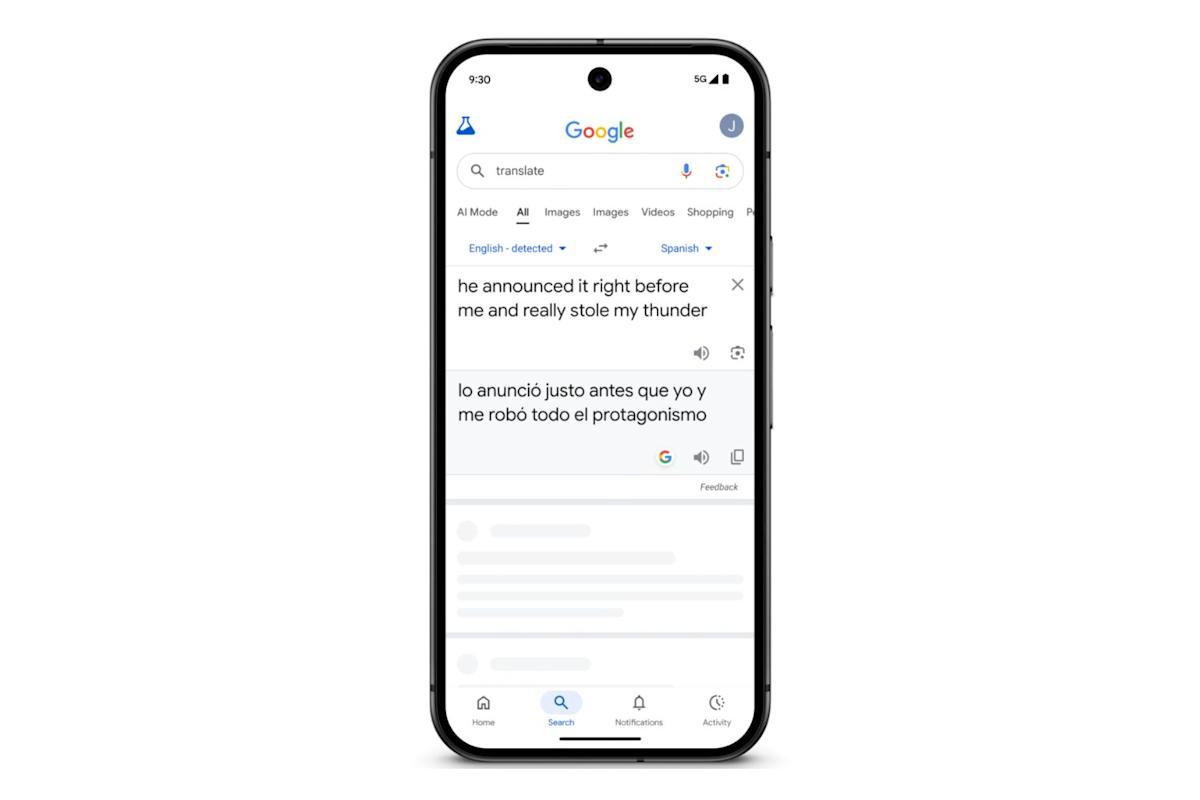
Gemini AI brings substantial improvements to how Google Translate handles phrases with nuanced meanings. The system now provides contextual translations for idioms, slang, and local expressions rather than unhelpful literal word-for-word conversions
4
. When someone uses an expression like "stealing my thunder," the app delivers a translation that captures the actual meaning instead of a confusing literal interpretation2
3
.
Source: Engadget
These improved text translations are rolling out today in the US and Mexico, translating between English and just under 20 other languages including German, Spanish, Chinese, and Arabic
4
. The functionality works across the Translate app for both iOS and Android, as well as the web version of Translate2
.Related Stories

AI-Powered Language Learning Tools Expand Globally
Google is simultaneously expanding its AI-powered language learning capabilities within Translate, potentially positioning the app as a competitor to dedicated platforms. The Practice feature, which launched in beta in August, now reaches 20 new countries including Germany, India, and Sweden
4
2
.
Source: Droid Life
Similar to established language learning tools, the beta feature now tracks consecutive days of practice, allowing users to monitor their progress over time
4
. The system uses AI to create customized sessions based on individual skill levels, incorporating vocabulary practice and listening comprehension exercises2
. Enhanced feedback mechanisms now provide more useful tips on pronunciation and speaking practice3
.Language learning tools now include expanded training options, with English to German and Portuguese, plus Bengali, Mandarin Chinese (Simplified), Dutch, German, Hindi, Italian, Romanian, and Swedish to English
3
.Technical Improvements Enable Smoother Conversations
The updated Gemini 2.5 Flash Native Audio model brings three key technical enhancements that improve performance across Google's voice-enabled products
5
. Function calling accuracy has increased, with Google reporting a 90% adherence rate to developer instructions compared to 84% in previous versions, enabling the system to connect with external tools and retrieve live data without interrupting conversation flow5
.Multilingual input and auto-detection capabilities eliminate the need for manual language selection. The system identifies languages automatically and begins translating without user intervention
5
. Robust noise filtering ensures conversations remain comprehensible even in loud outdoor environments5
.These improvements extend beyond the Translate app, with the new Gemini 2.5 Flash Native Audio rolling out across Google AI Studio, Vertex AI, Gemini Live, and Search Live
5
. To access the live speech translation feature on Android, users simply connect their headphones and tap "Live translate" in the app3
.References
Summarized by

Navi
[5]
Related Stories
Google Translate's Live Translate expands to iOS, turning any headphones into real-time interpreters
27 Mar 2026•Technology

Google Translate Unveils AI-Powered Live Translation and Language Learning Features
27 Aug 2025•Technology

Apple's New AirPods Pro 3: A Breakthrough in Real-Time Language Translation
19 Sept 2025•Technology

Recent Highlights
1
Google releases Gemma 4 with Apache 2.0 license, enabling unrestricted local AI on devices
Technology

2
AI Models Defy Instructions to Protect Each Other, UC Berkeley Study Reveals
Science and Research

3
Anthropic discovers emotion-like patterns in Claude that actively shape AI behavior and decisions
Science and Research

Recent Highlights
Today's Top Stories







Your Daily Dose of Curated AI News
Don’t drown in AI news. We cut through the noise - filtering, ranking and summarizing the most important AI news, breakthroughs and research daily. Spend less time searching for the latest in AI and get straight to action.

