Google unveils TranslateGemma open-source translation models for 55 languages and local deployment


4 Sources
4 Sources
[1]
After ChatGPT Translate, Google Brings New Open-Source Translation Models
* TranslateGemma is available in 4B, 12B, and 27B sizes * The AI models can also translate text in images * TranslateGemma has been evaluated on 55 language pairs Google's aggressive artificial intelligence (AI) push has not slowed down in 2026. The company has already announced a partnership with Apple, released new shopping tools and a protocol, introduced Personal Intelligence in Gemini and added the chatbot to its Trends website. Now, the company has shifted its focus towards the open community with the release of TranslateGemma models. These multilingual AI models are designed to support translation between a large number of languages across text and image (input only) modalities. TranslateGemma Models Released In a blog post, the Mountain View-based tech giant released three different variants of the TranslateGemma AI models. These models are available to download on Google's Hugging Face listing and Kaggle's website. Additionally, developers and enterprises can also access them via Vertex AI, the company's cloud-based AI hub. These models are available with a permissive licence allowing both academic and commercial use cases. TranslateGemma is available in 4B, 12B, and 27B sizes (where 4B refers to four billion parameters). The smallest model is said to be optimised for mobile and edge deployment, and the 12B variant is designed for consumer laptops. The largest 27B model offers maximum fidelity and can be run locally on a single Nvidia H100 GPU or TPU. Built on Gemma 3 models, the researchers used supervised fine-tuning (SFT) with a diverse dataset. The post claims that this allowed the models to achieve broad language coverage even in low-resource (where data is scarce) languages. These models were further refined using reinforcement learning (RL), which refined the translation quality. The company claimed that the 12B TranslateGemma model outperforms Gemma 3 27B on the World Machine Translation 2024 (WMT24++) benchmark. Google claims that with this performance, developers will be able to achieve the same quality as Gemma 3 while using less than half the parameters of the baseline model. Google's latest translation-focused AI models are claimed to be trained and evaluated on 55 language pairs across Spanish, French, Chinese, Hindi, and more. The company also claimed that it has trained the model on nearly 500 additional language pairs. Notably, apart from direct text translation, the model also accepts images as input and can detect and translate text within the images.
[2]
Google Introduces TranslateGemma, a new suite of open translation models built on Gemma 3
Google has unveiled TranslateGemma, a new set of open translation models. These models are built on Gemma 3 and aim to support communication in many languages across various devices. They offer high-quality translation with lower computational needs. Google has announced TranslateGemma, a new family of open translation models designed to support multilingual communication across a wide range of devices and deployment environments. Built on Gemma 3, the new models aim to deliver high-quality machine translation while maintaining lower computational requirements. TranslateGemma is available in 4B, 12B, and 27B parameter variants and currently supports translation across 55 languages, covering both high-resource and low-resource language pairs. According to Google, the models are designed to balance efficiency and accuracy, making them suitable for use cases ranging from mobile and edge devices to cloud-based deployments. In internal evaluations using the WMT24++ benchmark, Google reports that the 12B TranslateGemma model outperforms the larger Gemma 3 27B baseline in translation quality metrics, despite using fewer parameters. The smaller 4B model is positioned for on-device and mobile inference, offering competitive performance at lower latency. TranslateGemma models are trained using a two-stage process. This includes supervised fine-tuning on a mix of human-translated and synthetic datasets, followed by reinforcement learning guided by quality estimation metrics. Google states that this approach improves contextual accuracy and translation fluency across languages. Beyond text translation, TranslateGemma retains multimodal capabilities inherited from Gemma 3. Early testing indicates improved performance in translating text embedded within images, even without additional multimodal-specific training. The models are designed to run across different environments: 4B for mobile and edge devices 12B for consumer laptops and local development 27B for cloud deployment on a single GPU or TPU TranslateGemma is available as an open model via platforms including Kaggle, Hugging Face, and Google Cloud's Vertex AI, with a detailed technical report published on arXiv. Google says the release is intended to support researchers and developers working on multilingual applications, custom translation workflows, and low-resource language support.
[3]
Google TranslateGemma Brings Open, Local AI Translation to 55 Languages
Google launches TranslateGemma, open AI translation models that run locally across 55 languages Google has unveiled TranslateGemma, a new family of open translation models designed to run locally rather than through a closed cloud service. Built on the company's Gemma 3 architecture, it supports 55 fully tested languages and targets developers, researchers, and enterprises that want speed, flexibility, and data control. Unlike mainstream that rely on remote servers, TranslateGemma allows users to deploy models on devices, private servers, or custom infrastructure. Google positions it as part of a broader push toward open-weight AI systems to reduce dependency on proprietary platforms.
[4]
TranslateGemma explained: Google's new open model for 55 languages
Open TranslateGemma models promise faster, cheaper AI translation beyond cloud In a significant stride toward democratizing advanced AI translation, Google has unveiled TranslateGemma, a new suite of open translation models designed to break down language barriers with unprecedented efficiency. Released just yesterday, this new family of models is built on the architecture of Gemma 3 and promises to bring high-fidelity translation to everything from massive cloud servers to the smartphone in your pocket. At the heart of the TranslateGemma release is a focus on "efficiency without compromise." By distilling the knowledge of Google's most advanced large models into compact, high-performance open architectures, the company has created a solution where developers no longer need massive computational resources to deploy research-grade translation tools. The release marks a pivot from simply making models larger to making them smarter and more dense, utilizing a specialized two-stage fine-tuning process that includes Supervised Fine-Tuning (SFT) and Reinforcement Learning (RL) to refine the "intuition" of the AI. Also read: Yoshua Bengio's new safe AI vision cuts AI's biggest risks by rewarding truth Google has launched the model in three distinct sizes: 4 billion (4B), 12 billion (12B), and 27 billion (27B) parameters. While the 27B model is designed for maximum fidelity in cloud environments, the smaller models represent the true technical marvels of this release. According to Google's technical evaluation, the mid-sized 12B model actually outperforms the much larger Gemma 3 27B baseline. Similarly, the compact 4B model rivals the performance of the 12B baseline. This efficiency breakthrough is critical for the future of on-device AI. The 4B model is optimized specifically for mobile and edge deployment, while the 12B model is capable of running smoothly on standard consumer laptops. This allows developers and researchers to run high-throughput, low-latency translation tasks locally, bypassing the privacy concerns and latency issues often associated with cloud-based API calls. The training process involved distilling synthetic translations generated by Google's flagship Gemini models, followed by a reward-based learning phase using metrics like MetricX-QE to ensure translations sound natural rather than robotic. Also read: Elon Musk denies Grok AI created illegal images, blames adversarial hacks TranslateGemma has been rigorously trained and evaluated on 55 core language pairs, ensuring reliable performance across major global languages like Spanish, Chinese, and Hindi, as well as numerous low-resource languages that are often underserved by digital tools. However, the scope of the project extends far beyond these primary languages. The team pushed the boundaries by training on nearly 500 additional language pairs, providing a robust foundation for researchers to further fine-tune the models for niche dialects and specific community needs. Beyond pure text, TranslateGemma retains the strong multimodal capabilities of its parent architecture, Gemma 3. Early tests indicate that the model improves the translation of text within images - a critical feature for real-world applications like travel assistants and document scanning - even without specific multimodal fine-tuning. With availability on platforms like Kaggle, Hugging Face, and Vertex AI, TranslateGemma is poised to become the new standard for open-source linguistic accessibility, giving developers the tools to foster greater understanding across cultures without requiring industrial-grade hardware.
Share
Share
Copy Link
Google has launched TranslateGemma, a family of open-source translation models built on Gemma 3 that supports 55 languages. Available in 4B, 12B, and 27B parameter sizes, these AI models can run locally on devices from smartphones to cloud servers. The models also translate text embedded in images and outperform larger baselines while using fewer computational resources.
Google Releases TranslateGemma for Multilingual Communication
Google has unveiled TranslateGemma, a new family of open-source translation models designed to support communication across 55 languages while running locally rather than relying on cloud-based services
1
. Built on the Gemma 3 architecture, these multilingual AI models represent a shift toward making advanced AI translation accessible to developers, researchers, and enterprises without requiring massive computational resources2
. The release comes as Google continues its aggressive AI push in 2025, following partnerships with Apple and the introduction of Personal Intelligence in Gemini.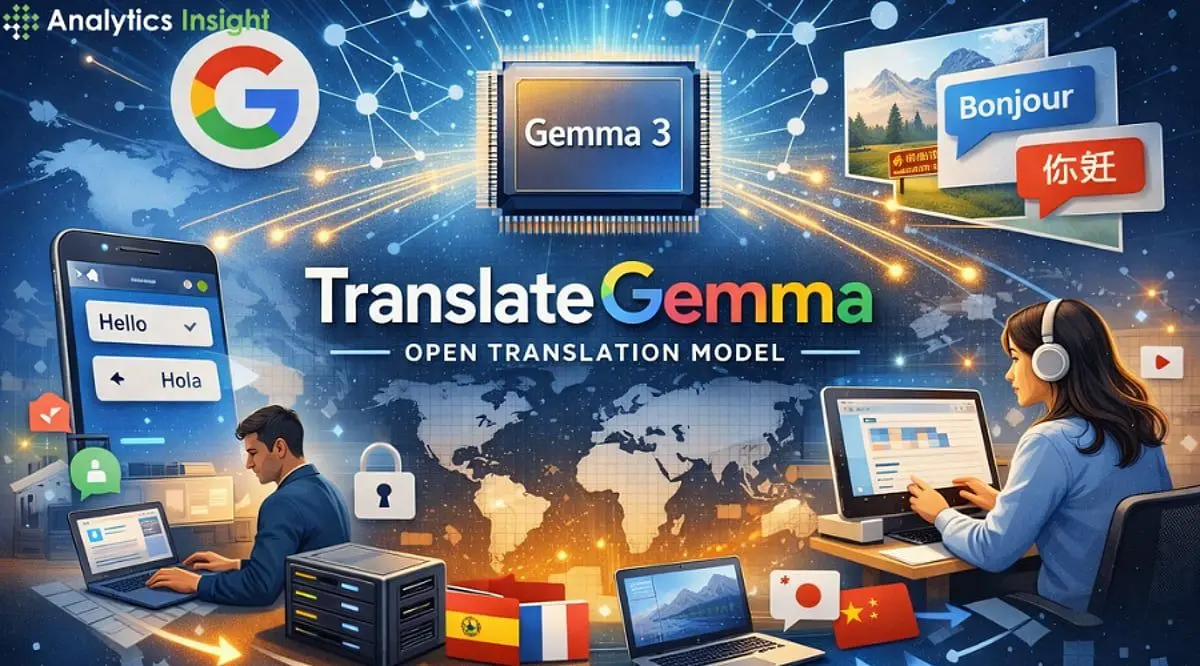
Source: Analytics Insight
Three Parameter Sizes for Different Deployment Scenarios
TranslateGemma is available in three distinct parameter sizes: 4B, 12B, and 27B, where 4B refers to four billion parameters
1
. The smallest 4B model is optimized for mobile and edge deployment, enabling local AI translation on smartphones and tablets4
. The 12B variant is designed for consumer laptops, allowing developers to run high-throughput, low-latency translation tasks locally without privacy concerns associated with cloud-based API calls. The largest 27B model offers maximum fidelity and can run on a single Nvidia H100 GPU or TPU for cloud-based deployments1
.Superior Performance with Fewer Parameters
In a remarkable efficiency breakthrough, the 12B TranslateGemma model outperforms the larger Gemma 3 27B baseline on the World Machine Translation 2024 (WMT24++) benchmark, despite using less than half the parameters
1
. This achievement demonstrates that developers can achieve high-quality translation with significantly lower computational requirements2
. The compact 4B model similarly rivals the performance of the 12B baseline, making research-grade translation tools accessible without massive infrastructure.Advanced Training with Reinforcement Learning
Google employed a sophisticated two-stage training process to develop these AI translation models
4
. Researchers used supervised fine-tuning with diverse datasets, including synthetic translations generated by Google's flagship Gemini models, which allowed the models to achieve broad language coverage even in low-resource languages where data is scarce1
. The models were further refined using reinforcement learning guided by quality estimation metrics like MetricX-QE, ensuring translations sound natural rather than robotic2
. This approach improves contextual accuracy and translation fluency across languages.Related Stories



Extensive Language Coverage and Multimodal Capabilities
TranslateGemma supports 55 languages covering both high-resource and low-resource language pairs, including Spanish, French, Chinese, and Hindi
1
. Google has also trained the models on nearly 500 additional language pairs, providing a robust foundation for researchers to fine-tune for niche dialects and specific community needs4
. Beyond text translation, the models retain strong multimodal capabilities inherited from Gemma 3, enabling translating text in images—a critical feature for real-world applications like travel assistants and document scanning2
. Early testing indicates improved performance in this area even without additional multimodal-specific training.
Source: Digit
Open Access Across Multiple Platforms
The models are available for download on Hugging Face, Kaggle, and through Vertex AI, Google's cloud-based AI hub
1
. They come with a permissive license allowing both academic and commercial use cases, positioning TranslateGemma as part of Google's broader push toward open-weight AI systems3
. This open approach reduces dependency on proprietary platforms and gives developers the tools to foster greater understanding across cultures without requiring industrial-grade hardware. The release addresses critical needs for speed, flexibility, and data control in translation workflows, particularly for organizations handling sensitive information that cannot be sent to remote servers.References
Summarized by

Navi
[3]
Related Stories
Recent Highlights
1
Apple Plans Major Siri AI Overhaul in iOS 27 With Third-Party Chatbot Integration
Technology

2
OpenAI shuts down Sora after six months, ending Disney's $1 billion licensing partnership
Technology

3
AI chatbots validate you too much, making you less kind to others, Stanford study reveals
Science and Research

Recent Highlights
Today's Top Stories



Your Daily Dose of Curated AI News
Don’t drown in AI news. We cut through the noise - filtering, ranking and summarizing the most important AI news, breakthroughs and research daily. Spend less time searching for the latest in AI and get straight to action.

