JBL BandBox practice amps use Stem AI to remove any instrument from songs in real-time


5 Sources
5 Sources
[1]
JBL made a pair of AI-powered practice amps
JBL is trying its hand at something new, with a pair of AI-powered practice amps. The BandBox Solo and BandBox Trio include an onboard Stem AI that purportedly lets you separate or remove vocals and instruments from any music streamed over Bluetooth. So, say you're a young guitarist learning "Stairway to Heaven" (as one does). At least in theory, you could use the speaker to remove Jimmy Page's part and hone your chops with the rest of the band. The $250 BandBox Solo, designed for individual musicians, has a single guitar / mic input. And the $600 BandBox Trio, better for bands, supports up to four instrument inputs. The latter also has a few extra perks not found in the Solo: onboard controls (to reduce reliance on the app) and an LCD. The JBL One app lets you add filters to match a variety of modern and vintage amp models. You'll also find effects like phaser, chorus, and reverb, as well as a pitch shifter and tuner. A built-in looper will allow for layering, but JBL says that feature will arrive via a software update in October. JBL says the BandBox Solo supports up to six hours of battery life. The BandBox Trio is said to last up to 10 hours. But the latter has a replaceable battery, so you could buy a spare (for an as-yet-unknown price) and double that time. The $250 BandBox Solo and $600 BandBox Trio are available to pre-order from JBL's website starting today. Shipments and third-party retail availability are scheduled for March 1.
[2]
JBL's New Speakers Use AI to Silence Your Favorite Song's Worst Guitar Solo
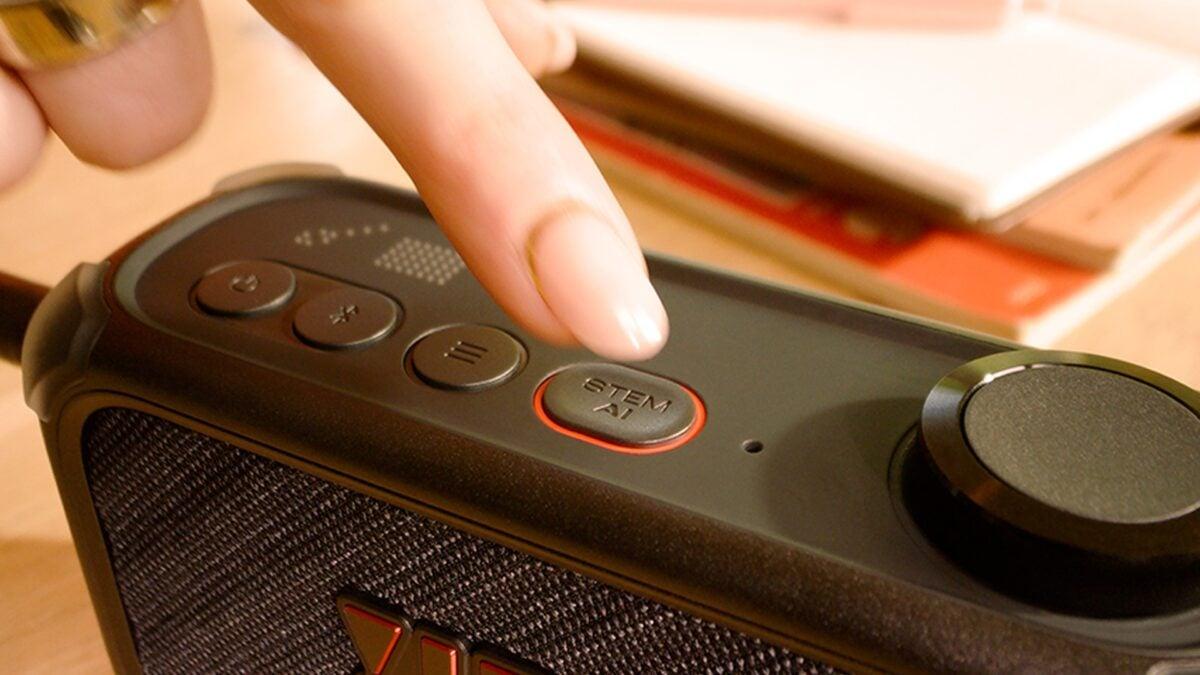
Back in my day, EQing instruments out of songs was a real pain in the ass -- even if you got all your low and high filters just right, the results were far from perfect. Just ask every soul song I tried to sample in high school. But this is the age of AI, and JBL is trying to use new frequency-filtering tech to make the process a little bit easier. JBL just launched the BandBox Solo and BandBox Trio, a pair of speakers meant to automate the process of pulling out "stems," which is music-speak for isolating sounds (guitar tracks, drum tracks, and vocals) from one another after they've been assembled. The idea here is that by removing those parts of songs, you can plug into the speaker and play (or sing) along, though I guess you could use it to mute the parts of songs you don't like, too. Hey! An AI jam session that maybe doesn't suck! From what I can tell, the feature works by simply pressing an on-device button, which begins the isolation process. From there, you can use the JBL companion app to choose which element of the song you want isolated and by how much. As someone who learned to play guitar this way -- playing songs through speakers and then playing along with an amp -- I can't overstate how awesome it would have been to have something like this built into an amp while I was learning. To make things even better, JBL's Stem AI, as they're calling it, also works without an internet connection -- no sending songs to the cloud and waiting for them to be processed. There are differences between the BandBox Solo and Trio, and the biggest are size and input. The BandBox Solo is an 18W speaker that's much smaller and meant for individual practices, since it only has one input. The BandBox Trio, on the other hand, is a 135W speaker that has four total inputs (it's meant for groups) and also on-speaker controls for EQ as well as an LCD screen. Both are battery-powered, and the BandBox Solo can get up to 6 hours of life, while the Trio can get as much as 10. The Trio has a replaceable battery, though, so you could swap it out for a fresh one if needed. Both speakers have some included effects like chorus and reverb, as well as amp modeling for modern or vintage sound, and both can be used with Bluetooth as well as wired. As exciting as the Stem AI feature sounds, I'll have to hear the results myself to believe they're as good as JBL would suggest. And if they are? Well, the BandBox might be one of the coolest amps you can buy right now. The BandBox Solo costs $250, while the BandBox Trio costs $600, and both are available for pre-order from JBL's website starting today. Both are expected to ship starting on March 1, with retail availability starting then, too.
[3]
JBL's practice amp lets your whole band jam together using one speaker - and includes a handy AI feature
The Trio uses a replaceable battery that lasts 10 hours, and can be swapped out for another instantly You might already know that JBL doesn't just do wireless speakers and earbuds; they're also a big name in live audio. The brand is now trying its hand somewhere in between with a novel product designed for the jam room. The relatively compact BandBox Trio practice amp lets you plug in up to four instruments at once, control their volume with a four-channel mixer, and even add effects to guitars and vocals. Two of them are TRS/XLR combos; another is a high-impedance channel especially suited to guitar, so you'll get the full punch from your axe. The last one is a 3.5-mm jack, which can accept auxiliary cables from music players, and even electronic drum kits. It's packing a 6.5-in woofer and dual 1-in silk dome tweeters to dish out 135 watts RMS. That should be plenty for a rehearsal or for busking - and you can run this thing on a battery for up to 10 hours with a full charge. As if that wasn't neat enough, the Trio is also an audio interface, which means you can record straight to a digital audio workstation on your computer, or your mobile device over a USB-C connection. A color LCD display lets you mess with a host of onboard controls and tools, including several guitar and bass effects, modern and vintage amp models, and delay and reverb for the mic channel. You can save presets with pedal chains too. We're not done yet. The Trio comes with several handy tools that musicians will find handy while performing live, practicing, and learning learning compositions. There's a looper, tuner, metronome, and drum machine at the ready. More impressively, it also includes an AI-powered feature that takes any track you stream wirelessly (say, a song from Spotify on your phone) and separates each instrument in the mix. This lets you mute or isolate any track you choose, so you can hear what you need to as you practice nailing a guitar solo or singing over a pre-recorded song. It even offers pitch shifting to match the key you're comfortable in. All those features can be adjusted using a companion mobile app for fine-grained control. Plus, the battery, which charges fully in three hours, is replaceable. JBL says you can even carry a spare one as backup, which is a pretty thoughtful inclusion for extended practice sessions and shows. That's pretty darn handy for a little amp. Measuring 13.54 x 10.43 x 8.98 inches (344 x 265 x 228 mm, or about the size of a dorm room microwave) and weighing just 14.7 lb (6.65 kg), it's portable enough to carry along to rehearsals, or hit the streets for impromptu intimate gigs. Oh, and if you're doing a bigger show, the Trio can act as a monitor speaker that connects to a PA system via a line level output. This has me recalling my teenage years as a wannabe rock god, struggling to get my hands on each of those aforementioned piece of practice gear and learning the hard way that my grubby little amp was always too loud for the neighbors. It's nice to know that kids these days can simply access all these tools in a single package. The BandBox Trio is priced at US$599.95 and will be available from March 1, but you can pre-order it now from JBL's site, as well as from Sweetwater and Musician's Friend.
[4]
JBL's new portable speakers have 'stem AI' for jamming -- they can remove any instrument or vocal from songs in realtime, no internet required
* JBL's two BandBox speakers are made for instruments and mics * AI stem separation so you can play along with your favorites * $249 / £199 for BandBox Solo; $599 / £549 for BandBox Trio JBL has introduced two new portable speakers and practice amps that solve a common musical problem: finding other musicians to practice and play with. The new BandBox Solo and BandBox Trio feature an AI-powered system that should enable you to play guitar with Geese, rock out with Rammstein or, er, play trumpet with Taylor Swift. Although as JBL is at pains to point out, the features are purely for non-commercial purposes. It's all about the stems. Stems are the individual tracks that make up a recording - the drum tracks, the guitar track, the lead vocal and so on - and the BandBox speakers can separate and adjust those stems from your played music via the power of AI. That means you can turn off or isolate specific stems to play or sing along with the band, or turn the rest of the band off so you can hear a tricky bit more clearly when you're trying to learn it. Stem separation has been available in digital music apps for some time now, but live stem separation in an amp/speaker is really quite clever, and could be genuinely useful for anyone learning new music. And the larger speaker could be really handy for bands who want to rehearse or play live without having to shell out for a PA system. I think these are fascinating, not just because they contain the kind of tech I'd have killed for as a guitar-toting teen, but because they combine the two worlds of JBL: while many people will know it for making the best Bluetooth speakers and many legendary hi-fi speakers, it also helped shape the sound of rock'n'roll in Fender's 1960s guitar amps, and has been a huge player (so to speak) in recorded and live music for decades. JBL BandBox Solo and BandBox Trio: key features and price The BandBox Solo is a wireless Bluetooth speaker that puts out 18W of power and promises zero distortion (unless you're playing through a distortion pedal), and it comes with a selection of instrument effects including classic amplifier tones and pedals including chorus, reverb, tremolo and phaser. There's even a looper so you can play along with your own playing, and of course there's a tuner too. There are more musician-friendly features, including a built-in metronome to keep time, and a detuner that can make songs easier to sing or guitar parts easier to play. And you can connect the speaker to your laptop to capture performances in your favorite digital audio workstation. As the name suggests, the BandBox Trio is designed for multiple musicians - although there are four inputs, not the three you might expect. It's a larger, wedge-shaped speaker and it's much louder: 135W. It's designed to be used solo but can be connected to other speakers for even more power. The BandBox Trio has the same AI and effects as its smaller sibling but adds a four-channel mixer and a drum machine too. JBL is pitching this one for small bands, open mics and other multi-musician setups where you don't want to be lugging pedalboards and PA systems around, and it comes with a swappable battery that delivers up to 10 hours of play time. The BandBox Solo is $249.99 / £199.99 (about AU$395) and the BandBox Trio is / $599.95 / £549.99 (about AU$1,085). Both models will be available from February 2026. Follow TechRadar on Google News and add us as a preferred source to get our expert news, reviews, and opinion in your feeds. Make sure to click the Follow button! And of course, you can also follow TechRadar on YouTube and TikTok for news, reviews, unboxings in video form, and get regular updates from us on WhatsApp too.
[5]

JBL's AI-Powered BandBox Speakers are Designed for Musicians
With AI taking over just about everything, it was only a matter of time before we saw it applied in more niche tech such as dedicated guitar amps and speakers. That in mind, JBL recently announced the launch of its new BandBox series, a line of smart practice amplifiers and portable speakers. The lineup features two primary models, the BandBox Solo and the BandBox Trio, both of which use "Stem AI" technology which lets musicians isolate or remove vocals and instruments from any streaming track in real time, which is pretty handy for rehearsals. This on-device AI processing means that guitarists, singers, and drummers can instantly create custom backing tracks without the need for an internet connection or cloud software. By removing specific elements of a song, players can fill in the gaps themselves for more immersive practice sessions. The compact BandBox Solo is built for individual creators and features a single input for a guitar or microphone. It also comes with a suite of digital tools which are accessible via the JBL ONE app, including vintage amp models, classic effects like reverb and chorus, and a built-in looper, all with 18W of sound. For groups and small performances, the BandBox Trio offers a more capable 135W output and a four-channel mixer, as well as four instrument inputs which make it a handy solution for small bands or acoustic duos. The Trio also features a replaceable battery pack for extended sessions and a larger colour display for easy control over effects and mixing. Both models also include USB-C outputs for direct recording into digital audio workstations and traditional Bluetooth speaker functionality for standard music playback. The JBL BandBox Solo and Trio are scheduled for release this February; the Solo will retail for €229.99, while the Trio will be available for €599.99 through JBL's website and select retailers.
Share
Share
Copy Link
JBL launched the BandBox Solo and BandBox Trio, AI-powered practice amplifiers that use Stem AI technology to separate and isolate vocals and instruments from any song streamed over Bluetooth. The speakers work offline, letting musicians create custom backing tracks instantly. The $250 Solo targets individual players while the $600 Trio supports up to four instruments for bands.
JBL BandBox Brings Real-Time Stem Separation to Musicians
JBL has entered the practice amplifier market with two AI-powered speakers that address a fundamental challenge for musicians: practicing without a full band. The JBL BandBox Solo and BandBox Trio feature Stem AI technology that separates vocals and instruments from any music streamed over Bluetooth, allowing players to isolate vocals and instruments or remove specific parts entirely
1
. This real-time stem separation works without an internet connection, processing audio directly on the device rather than sending tracks to the cloud2
.
Source: Gizmodo
The technology enables guitarists learning classic solos to mute the original guitar track and play along with the remaining band, or singers to remove vocals and perform over instrumental backing. Musicians can use the JBL One app to choose which element to isolate and adjust the degree of separation
2
. JBL emphasizes these features are intended for non-commercial purposes only4
.Two Models Target Different Musicians

Source: Engadget
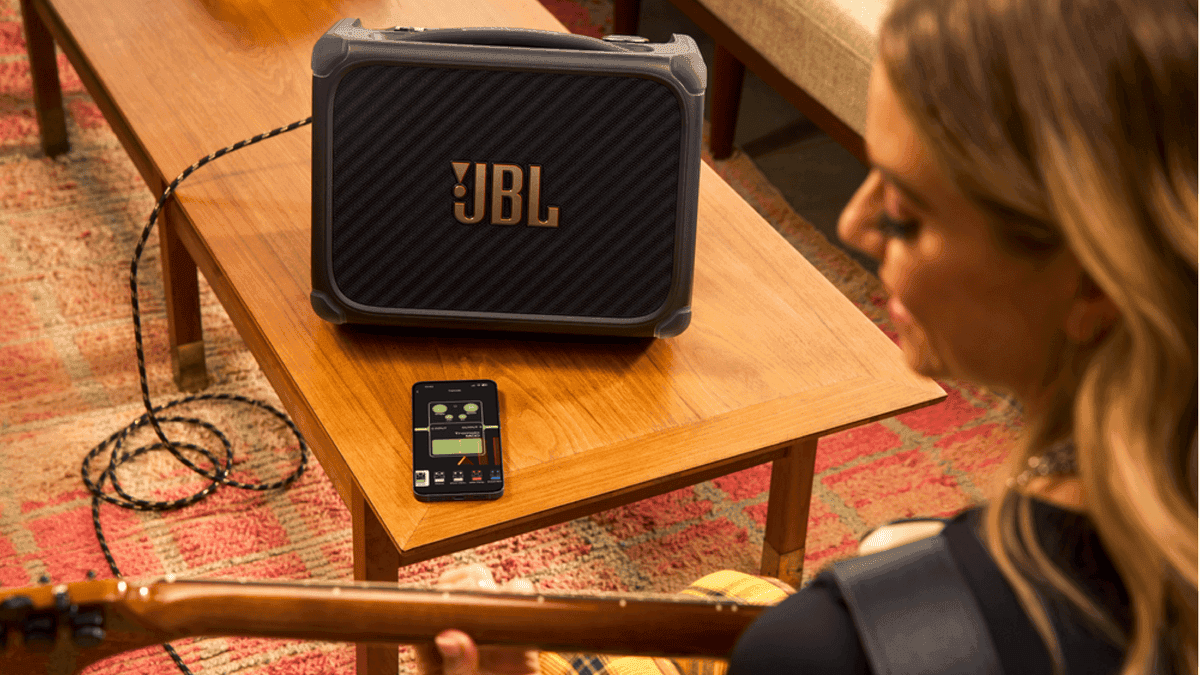
The $250 BandBox Solo serves individual musicians with an 18-watt speaker, single guitar input or mic input, and up to six hours of battery life
1
. This compact model includes digital effects accessible through the companion app, featuring vintage amp models, reverb, chorus, tremolo, and phaser effects4
. A looper function allows musicians to layer parts, though this feature arrives via software update in October1
.
Source: TechRadar
The $600 BandBox Trio targets bands and group rehearsals with 135 watts of power from a 6.5-inch woofer and dual 1-inch silk dome tweeters
3
. This larger model supports up to four instrument inputs, including two TRS/XLR combo jacks, one high-impedance guitar input, and a 3.5mm auxiliary jack that accepts connections from electronic drum kits3
. The Trio includes onboard controls via a color LCD display and runs for up to 10 hours on a replaceable battery, allowing musicians to swap in a spare for extended sessions1
3
.Related Stories



Built for Modern Music Creation
Both portable speakers for musicians function as audio interfaces, enabling direct recording to digital audio workstations via USB-C connections
3
4
. The Trio's four-channel mixer lets bands balance multiple instrument tracks simultaneously, while its drum machine provides rhythm backing when drummers aren't available3
. Additional tools include a built-in tuner, metronome, and pitch shifting capability to transpose songs into more comfortable keys3
4
.The AI-powered practice amplifiers also serve practical performance needs. The Trio measures 13.54 x 10.43 x 8.98 inches and weighs 14.7 pounds, making it portable enough for street performances or small venue gigs
3
. It can connect to PA systems via line level output, functioning as a monitor speaker for larger shows3
. Both models maintain standard Bluetooth speaker functionality for casual music playback when not being used for practice5
.JBL's entry combines its heritage in live audio and consumer speakers with on-device AI processing that lets musicians create custom backing tracks instantly
5
. Pre-orders begin today from JBL's website, with shipments and retail availability starting March 11
.References
Summarized by

Navi
[1]
[3]
Related Stories
Recent Highlights
1
Google releases Gemma 4 with Apache 2.0 license, enabling unrestricted local AI on devices
Technology
2
AI Models Lie and Deceive to Protect Other AI Models From Deletion, Study Reveals
Science and Research

3
OpenAI closes $122 billion funding round amid fierce AI competition and profitability questions
Startups

Recent Highlights
Today's Top Stories







Your Daily Dose of Curated AI News
Don’t drown in AI news. We cut through the noise - filtering, ranking and summarizing the most important AI news, breakthroughs and research daily. Spend less time searching for the latest in AI and get straight to action.

