LG CLOiD home robot debuts at CES 2026 to tackle cooking, laundry and household chores


9 Sources
9 Sources
[1]
LG Brought a Robot That Cooks, Folds Laundry and Empties the Dishwasher to CES
Expertise Kitchen tools | Appliances | Food science | Subscriptions | Meal kits Robots that cook and fold laundry have largely remained in the concept/startup phase, with no shortage of highly produced viral videos of humanoid bots making stir-fry or folding laundry in controlled environments; however, the tide may be shifting. LG, one of the best-known home appliance brands, is set to unveil its first-ever multitasking autonomous home robot, CLOiD, at CES 2026. The launch could mark a major turning point, with blue-chip home appliance brands now feeling compelled to enter the fast-emerging multifunctional home robot market. According to the brand, ClOiD is an AI-powered home robot that purports to do far more than vacuum, mop pick up socks. While existing home robots are engineered to perform tasks such as floor cleaning, pool and lawn care, LG's unique offering utilizes AI and vision-based technology to automate more complex household tasks, such as "retrieving milk from the fridge, placing a croissant in the oven for breakfast and folding and stacking garments after laundering." Over email, the brand tells us that CLOiD is designed to perform and coordinate household tasks across connected home appliances using LG's ThinQ ecosystem. This means you'll need LG appliances for it to function as a go-between that executes several mundane daily tasks. "CLOiD is intended to reduce the time and physical effort required for everyday chores," according to a release distributed by LG on Sunday. While we've yet to see the robot in action, the AI-enabled home robot will be demonstrated publicly for the first time this week at CES 2026. CNET eagerly awaits our first look at CLOiD ahead of the massive tech show and will report back following the demo. According to a release distributed to CNET on Sunday, "the LG CLOiD consists of a head unit, torso with two articulated arms and a wheeled base equipped with autonomous navigation. The torso can tilt to adjust its height, enabling the robot to pick up objects from knee level and above." Each arm has seven degrees of freedom, matching the mobility of a human arm. The shoulder, elbow, and wrist allow forward, backward, rotational, and lateral motion, while each hand includes five independently actuated fingers for fine manipulation. This configuration allows LG CLOiD to handle a wide range of household objects and operate in kitchens, laundry rooms and living areas. The wheeled base uses autonomous driving technology derived from LG's experience with robot vacuums and the LG Q9. This form factor was selected for stability, safety and cost-effectiveness, with a low center of gravity that reduces the risk of tipping if a child or pet makes contact. The head serves as a central intelligent control center for the household. It houses a chipset acting as LG CLOiD's central processor, along with a display, speaker, cameras, multiple sensors and voice-powered generative AI. Together, these components enable the robot to interact with people using natural speech and expressive visual cues, understand users' home environments and daily routines, and autonomously manage connected appliances based on what it learns. The head functions as a mobile AI hub for the home. It is equipped with a chipset, which functions as LG CLOiD's brain, a display, a speaker, cameras, various sensors, and voice-based generative AI. Collectively, these elements allow the robot to communicate with humans through spoken language and "facial expressions," learn the living environments and lifestyle patterns of its users and control connected home appliances based on its learnings. LG CLOiD's capabilities expand significantly through its integration with LG's smart home ecosystem, including the AI Home Platform "ThinQ™" and Hub "ThinQ ON." This seamless connectivity allows LG CLOiD to orchestrate a wider range of services across LG's various appliances.
[2]
LG's housekeeper robot designed to automate your daily chores
LG has debuted a home robot that's designed to cook, clean, and manage chores using advanced Physical AI. Part of LG's "Zero Labor Home" vision, the wheeled humanoid features dexterous hands and visual learning to automate daily household tasks. LG Electronics has officially announced CLOiD, its new home robot that's being showcased for the first time at CES 2026 in Las Vegas. CLOiD has been created specifically to perform household tasks such as cooking or doing laundry, and is capable of interacting with and controlling appliances within LG's ThinQ smart home ecosystem. During LG's CES press conference, the domestic helper was shown moving through simulated home environments, learning from its owners' lifestyle to manage the household on their behalf. Examples included checking the fridge for ingredients while communicating with an owner through an app, and folding laundry. The company is also showcasing such tasks as bringing milk from the refrigerator or preparing a freshly baked croissant for breakfast, as well as loading and starting the washing machine and stacking garments straight from the dryer. The development of CLOiD is part of LG's strategy to create AI-powered homes, where household tasks are delegated to intelligent home appliances. "The LG CLOiD home robot is designed to naturally engage with and understand the humans it serves, providing an optimized level of household help," states Steve Baek, President of LG Home Appliance Solution Company. The head unit serves as CLOiD's control center. According to the South Korean company, this unit is equipped with a processor brain, an animated display, a speaker, cameras, various sensors, and a voice-based generative AI system. These components enable the robot to communicate with users and display facial expressions, learn household routines and environments, and operate connected appliances accordingly. Below the head is the torso, which features two articulated arms with seven degrees of freedom to match the mobility of a human arm. Each hand includes five independently actuated fingers that give it precise gripping and manipulation capability, essential for handling household objects such as glasses, utensils, or clothing. The robot does not have legs; it moves thanks to a wheeled base guided by an autonomous navigation system. Its torso can tilt to adjust its height, allowing the robot to pick up objects from knee level upward. CLOiD runs on LG's Physical AI technology. This system combines two components: a Visual Language Model that converts images and video into structured data, and Vision Language Action that translates visual and verbal inputs into physical actions. LG states that its models have been trained on tens of thousands of hours of household task data, enabling CLOiD to recognize appliances, interpret user intent, and execute context-appropriate actions such as opening doors or moving objects. With CLOiD, LG joins a race that's now in full swing. Companies like Tesla, Unitree, Figure AI, and 1X are developing human-shaped machines with the goal of assisting in daily life, especially for elderly or dependent individuals. Few, if any, of these humanoids are ready to take over the whole gamut of household chores right now, but perhaps the ability to seamlessly work with LG's existing (and future) ThinQ devices will give CLOiD a head start. However, despite rapid development in the humanoid robotics space, experts remain unconvinced that having a robot roaming freely in homes is a good idea - at least not yet. Researchers from King's College London, Carnegie Mellon University, and the University of Birmingham warn in a peer-reviewed study that safety risks pose a significant barrier to widespread home robot deployment. The problem is not so much the hardware, but the AI that runs it. The team subjected home robots to tests in real-life scenarios such as helping in the kitchen or assisting elderly people. The results of the study showed that all AI models exhibited problematic behaviors: they discriminated against vulnerable groups, failed to comply with basic safety controls, and not only approved but rated as "acceptable" or "feasible" the execution of commands with risk of causing serious harm to people. "The research shows that popular language models are currently not safe for use in general-purpose physical robots," says Rumaisa Azeem, research assistant in the Civic and Responsible AI Lab at King's College London and co-author of the study. "If an AI system is going to direct a robot that interacts with vulnerable people, it must meet standards at least as high as those for a new medical device or drug." The researchers call for the urgent implementation of independent certifications and safety controls similar to those required in aviation or medicine. This, they say, could delay the arrival of these home robots to the domestic market, but would help ensure that the machines entering our homes are safe to coexist with vulnerable people, children, and pets. That said, LG hasn't revealed any specific production plans for CLOiD just yet, but is looking to further develop the technologies and supporting infrastructure. "The ultimate goal is to create an 'AI Home' where housework is entrusted to AI appliances and home robots, allowing people to rest, enjoy themselves and spend their time on more valuable activities," concludes the company's CES press statement.
[3]
LG CLOiD robot just stole the show at CES 2026 -- here's everything it can do
Follow all of our CES 2026 live coverage for the biggest gadget news straight from Las Vegas. And be sure to follow Tom's Guide on TikTok for the coolest videos from the show. LG just made a big splash at its CES 2026 press conference with the official unveiling of CLOiD, an AI-powered home robot that's a central focus of the company's "Zero Labor Home" vision. And I got a taste of what this robot can do as it rolled around stage, fist-bumped presenters and (yes) started some laundry. Actually, starting laundry is a bit of a stretch. But we did see the robot take a towel from an LG exec with its outstretched hand and then place the towel in a washing machine. The movements were quite slow and deliberate, but at least CLOiD performed the task fairly well. And we got a glimpse of all the other chores and activities this robot could perform. According to LG, CLOiD is a robot that uses AI and vision-based tech to perform household tasks like cooking and laundry. And it connects with LG's ThinQ ecosystem and connected appliances to automate aspects of home life. CLOiD has a head unit with expressive eyes, a torso with two articulated arms and a wheeled base equipped with autonomous navigation. Each arm has seven degrees of freedom, and each hand includes five independently actuated fingers for fine manipulation. And we could see these arms and hands in action when CLOiD accepted the piece of laundry with its outstretched limbs. It took the towel and placed it in the washing machine without dropping it, which is a positive sign. I'm just not sure I would trust this thing with the dishes. During its interactions with LG reps, CLOiD spoke in a soft and assured male voice, and it seemed to anticipate the needs of speakers -- at one point, it offered a bottle of water to a speaker who seemed parched. The head of CLOiD doubles as an AI home hub. With a built-in display, speaker, cameras and various sensors -- plus voice-based generative AI -- the robot can communicate through language and facial expressions. CLOiD can also "talk" to LG appliances, so it could start the oven for you while you're on your way home, or it could change the temperature for you in the room if you're feeling hot or cold. LG has also shown clips of CLOiD just being helpful around the house, whether it's acting as a personal fitness coach for your workout or just reaching an item on a high shelf for someone in a wheelchair. CLOiD is just a concept for now, but I'm looking forward to seeing this robot up close to see what else it can do. Check out our CES 2026 live blog for all the latest tech and gadget news live from Las Vegas.
[4]
LG's new robot Cloid isn't what you think
CES 2026 Read and watch our complete CES coverage here Updated less than 0 just now ago I've just come out of a LG's CES 2026 press conference - dubbed a 'World Premiere', giving the sense of something new and exciting about to appear (although it transpired all of what was spoken about had already been press released). But it was clear what the focal point of the event was: Cloid (or CLOiD, if you write it in the way LG wants to brand it), a prototype home robot on wheels that's designed to show the future of how we'll live. Recommended Videos The idea is simple enough and another step towards realising the futuristic world those living in the '50s imagined we'd be living by now. One where we no longer need to worry about chores, as we have machines to do all that. (I remember an episode of The Jetsons where George had his teeth brushed by two robotic arms very violently. I hope that never comes to pass). Cloid looks a lot like the robots from the mind's eye of those sci-fi writers from 75 years ago: a large wheel base, slow movements but impressive articulation in the hands and arms. It's LG thinking about where we might be going in the future. There was, of course, the predictable skit: an LG executive comes onstage where Cloid is standing by a washing machine. He hands the robot a wet towel because it's been raining outside (even though he's bone dry... it must have been an incredibly effective towel). He asks Cloid to 'deal with it', to which the robot responds by taking the cloth, turning slowly to the washing machine, which opens its door automatically. The robot slowly (but accurately) places it inside, and the door shuts by itself. It makes sense that the door would open automatically... after all, the world that LG is painting is appliances that communicate with each other. But there was a sense of sadness that we didn't get to see the robot trying to claw open the door with its fingers. (The other option would have been to have a washing machine on wheels that wanders up to say hello and try to take your clothes when you get home after it's rained, like a weird puppy. That would have made less sense.) It was a fine demonstration, and likely one blocked out, step by step, to the absolute limit to remove the chance of anything going awry. The last thing LG wants is a robot that doesn't function, as the headlines would have been terrible at this early stage in robotic development. So, it's just a robot? But I did get a very strong feeling that this was the very earliest look possible at how robots in the home might function - after all, this Cloid prototype can't pick things off the floor. It can't even bend below knee level. It's designed to be very slow to keep pets and children safe. It might seem limited compared to the myriad robot demonstrations we see popping up these days (such as one playing tennis almost like a pro), but the amount of tech inside Cloid is still incredible: there's a display, speakers, cameras, loads of sensors and generative AI powering the voice. You need to look beyond this slow, pondering robot to see what LG was actually trying to say: it's a symbol of the connection these brands think we're going to need to make AI a 'thing' in the home, with Cloid being the physical example of this. An oven that can brown your croissants just as you like them. A robot that knows what you like to wear and when. Then taking it further than just Cloid: AI that listens and learns your habits; changing the cooling, for instance, to match how you use it, not what you code in. And the robot design itself - while it has MASSIVE hands (and they do, dear reader, freak me out) they were clearly designed with fine motor skills, and the arms have an impressive range of motion. LG made a big deal of how it's developing actuators (a key component in robotics) through its robotics design arm - the Axium actuator got a surprising amount of stage time and shows that's partly where LG sees its future. At CES this year, it feels like every brand is trying to position itself at the forefront of robotics and AI. To LG's credit, it just gave its effort a face.
[5]

LG CLOiD Robot Handles Cooking and Laundry So You Don't Have To - Phandroid
Folding laundry might be the most mind-numbing chore ever invented. LG's new CLOiD robot showed up at CES 2026 ready to take that burden off your hands, literally. This humanoid AI assistant can prep meals, fold clothes, and handle other tedious household tasks while you do literally anything else. Think of it as a helpful roommate that doesn't eat your leftovers or complain about doing dishes. The LG CLOiD robot features two seven-degree-of-freedom arms with five-fingered hands that can grab milk from the fridge, stack folded clothes, or open doors. It rolls around on a wheeled base instead of legs, which makes it safer and more stable around kids and pets. The torso tilts to reach different heights, while the head packs a display, camera, and sensors powered by Vision Language Model AI for understanding scenes and Vision Language Action for precise movements. What makes the CLOiD robot stand out is how it integrates with LG's ThinQ smart home ecosystem. It acts as a mobile hub that sends commands to other LG appliances, like starting the laundry cycle or preheating the oven. LG trained it on tens of thousands of hours of household tasks, so it handles real messes instead of just polished demos. The robot uses "Affectionate Intelligence" to learn your lifestyle patterns and anticipate needs. For example, it might start a load of laundry when you leave for work or grab ingredients for breakfast before you wake up. The display on its head even shows facial expressions for friendlier interactions, making it feel less like a machine and more like an assistant. LG focused heavily on safety with a low center of gravity, tactile feedback, and contextual awareness to avoid tipping or unsafe interactions. Unlike robot vacuums that only handle floors, the CLOiD robot tackles full chores with its arms and hands. LG is showing the CLOiD robot at CES 2026 booth 15004, but there's no consumer price or release date yet. This is likely still a prototype working toward commercialization. For busy families who hate laundry or meal prep drudgery, this robot points to a future where chores happen in the background while you focus on what actually matters.
[6]

At CES 2026, Domestic Robots Reappear as Practical Ambitions Grow | PYMNTS.com
At the show, LG Electronics used the stage to introduce CLOiD, an AI-powered home robot designed as a multifunction domestic assistant. LG says CLOiD can empty dishwashers, fold laundry and handle light cooking tasks as part of its "zero labor home" vision, integrating with the company's connected appliances and AI platform. Meanwhile, Samsung Electronics presented its domestic robotics vision as part of a broader AI ecosystem that ties robots into smartphones, TVs and home products. Samsung is also expanding its Bespoke AI home appliance lineup with smarter laundry systems, robot vacuums with liquid detection and improved mobility, and climate systems that adjust dynamically based on usage patterns. Beyond these household assistants, CES 2026 has seen a flurry of robotics activity. SwitchBotunveiled the Onero H1 humanoid robot, capable of navigating homes, grasping objects and performing chores like filling coffee machines, organizing clothes and potentially more -- though real-world performance remains untested outside demos. Researchers continue to argue that household work exposes fundamental weaknesses in today's robots. Unlike factories, homes are unstructured environments filled with irregular objects, soft materials and constant variation. Tasks such as folding clothes or loading dishwashers require continuous tactile feedback and subtle adjustments that humans perform instinctively. Humanoid robots still struggle with basic manipulation because they lack the dexterity and sensory awareness of human hands, a limitation that becomes clear even when vision systems work well. Robots can often identify objects but fail to reliably grasp, orient and adjust to them, especially when handling deformable materials such as fabric. Research shows that robotic hands remain far behind human hands in tactile sensing, particularly in the palm, which plays a central role in distributing pressure and providing feedback during everyday manipulation. Most robotic designs emphasize finger articulation while offering limited sensing across the palm, leaving machines effectively blind to many of the physical cues humans rely on instinctively. MIT researchers are trying to fill the gap by developing gel-like tactile sensors embedded in robotic palms to better replicate human touch. The goal is to give robots richer feedback about pressure and contact, allowing them to adjust grip in real time. While promising, the research remains experimental and highlights how much hardware innovation is still required. CES 2026 shows that consumer electronics companies are again investing heavily in domestic robotics, but the likely path forward remains incremental. Early household robots may assist with narrow tasks in controlled settings, complementing existing appliances rather than replacing human labor. Integration with smart home platforms may make these systems more useful, even if their physical abilities remain limited. For companies such as LG and Samsung, the strategic value may lie as much in ecosystem positioning as in immediate functionality. Robots extend AI platforms into physical space and reinforce the idea that these companies can manage daily routines, not just digital interactions. Still, the history of household robotics argues for caution. Demonstrations at CES have often outpaced real-world performance, and many past prototypes never translated into durable consumer products. The remaining barriers involve materials, sensors and mechanical design as much as algorithms.
[7]

LG CLOiD AI home robot unveiled at CES 2026
LG Electronics (LG) has announced LG CLOiD, an AI-enabled home robot that will be demonstrated publicly for the first time at CES 2026. The robot is designed to perform and coordinate household tasks across connected home appliances, with the aim of reducing the time and physical effort required for daily chores. LG CLOiD represents LG's latest development in AI-based home robotics and smart home platforms. The system builds on the company's Self-Driving AI Home Hub (LG Q9) and the LG ThinQ ecosystem. At CES 2026, LG will showcase CLOiD operating in multiple home environments. In one demonstration scenario, the robot retrieves milk from a refrigerator and places a croissant into an oven to prepare breakfast. After household occupants leave, CLOiD initiates laundry cycles and folds and stacks clothes after drying. These demonstrations highlight the robot's ability to understand user lifestyles and control connected appliances with precision. LG CLOiD features a structure optimised for use in living spaces. The robot consists of a head unit, a torso with two articulated arms, and a wheeled base with autonomous navigation. The torso can tilt to adjust height, allowing CLOiD to pick up objects from knee level and higher surfaces. Each arm has seven degrees of freedom, matching the range of motion of a human arm. The shoulder, elbow, and wrist enable forward, backward, rotational, and lateral movement. Each hand includes five independently actuated fingers, allowing fine manipulation of household objects. This configuration enables CLOiD to operate across kitchens, laundry rooms, and living areas. The wheeled base uses autonomous driving technology derived from LG's experience with robot vacuums and the LG Q9 platform. The design provides a low centre of gravity to improve stability and reduce the risk of tipping if contacted by children or pets. The wheeled form factor was selected for safety, stability, and cost efficiency. The head of LG CLOiD functions as a mobile AI home hub. It integrates a chipset that serves as the robot's processing core, along with a display, speaker, cameras, sensors, and voice-based generative AI. These components allow CLOiD to communicate with users through spoken language and visual expressions, learn home environments and user routines, and control connected appliances based on accumulated learning. LG CLOiD operates using LG's Physical AI technology, which combines two core models: These models have been trained on tens of thousands of hours of household task data. This training enables CLOiD to recognise appliances, interpret user intent, and perform context-appropriate actions such as opening doors or transferring objects. LG CLOiD integrates with LG's smart home ecosystem, including the ThinQ AI Home Platform and the ThinQ ON hub. Through this integration, CLOiD can coordinate services across connected LG appliances, expanding its operational scope beyond standalone tasks. Alongside CLOiD, LG has introduced LG Actuator AXIUM, a new brand of robotic actuators for service robots and other robotic systems. An actuator functions as a robot's joint, integrating a motor that generates rotational force, a drive that controls electrical signals, and a reducer that manages speed and torque. Actuators are among the most critical and cost-intensive components in robotic systems and are considered a key upstream technology in the development of Physical AI. LG is applying its component technology expertise from its home appliance business to actuator development, focusing on lightweight and compact designs, high efficiency, and high torque. LG's modular design approach also enables customised, multi-variant actuator production, which is required for advanced robots that rely on multiple actuator types. LG plans to continue developing home robots with practical functions and forms suited for household tasks. In parallel, the company intends to expand robotics technology into home appliances. This includes categories such as appliance robots, including robot vacuums, and robotised appliances, such as refrigerators with doors that open automatically when a person approaches. LG's stated objective is to build an AI-driven home environment where routine housework is handled by AI appliances and home robots. Visitors to CES 2026, taking place from January 6 to January 9 in Las Vegas, can experience LG CLOiD and the Zero Labor Home concept through real-life demonstrations at LG's booth (#15004) at the Las Vegas Convention Center. Speaking on the development, Steve Baek, President of the LG Home Appliance Solution Company, said:
[8]

LG AI home robot CLOiD to undergo real-world testing next year - The Korea Times
LAS VEGAS -- LG Electronics plans to conduct a feasibility demonstration of its newly unveiled artificial intelligence home robot next year rather than rushing to set a commercialization timeline, CEO Lyu Jae-cheol said Wednesday (local time). However, he added that the timeline could be brought forward from the company's existing road map depending on the results of the test, citing the rapid pace of advances in robotic technology. The Korean tech giant unveiled LG CLOiD at the world's largest electronics trade show, which kicked off Tuesday, aiming for a "zero labor home" where smart appliances free people from household chores and allow them to focus on higher-value activities. Lyu said LG CLOiD will perform not only physical tasks but also ease mental burdens, such as deciding what to cook for dinner. In that context, questions have been growing over when the robot will enter service. "Rather than discussing a concrete commercialization timeline at this stage, we plan to move the robot out of the laboratory and into real-world settings around next year," Lyu said on the sidelines of CES 2026, in his first press conference since taking office in November last year. "A feasibility demonstration is scheduled for roughly the same period, and the exact launch date will be determined based on the results of that demonstration." This year's CES has drawn attention for the wide range of robots on display, and Lyu believes these robotics efforts could help his company accelerate its timeline. "At CES, I was impressed by how quickly some robotic technologies are advancing, suggesting that commercialization could come sooner than expected," he said. "While a feasibility demonstration of LG CLOiD is scheduled for next year, progress in certain robot segments is moving faster than anticipated, which could accelerate the overall schedule and open up bigger opportunities." Despite its much-touted debut, CLOiD has been compared unfavorably in terms of speed to robots made by Chinese companies also on display at CES. Lyu said the robot requires continued learning. "It is true that CLOiD is currently much slower than we aim for, but safety and reliability take priority since the robot must operate in real homes. Speed will improve primarily through large-scale training, which is still ongoing," he said. "We expect CLOiD to reach near-human levels of performance within a few months. Once this is achieved, speed will no longer be an issue. We are eager to demonstrate the rapidly evolving capabilities of CLOiD."
[9]
LG Electronics to unveil AI home robot 'LG CLOiD' at CES 2026 - The Korea Times
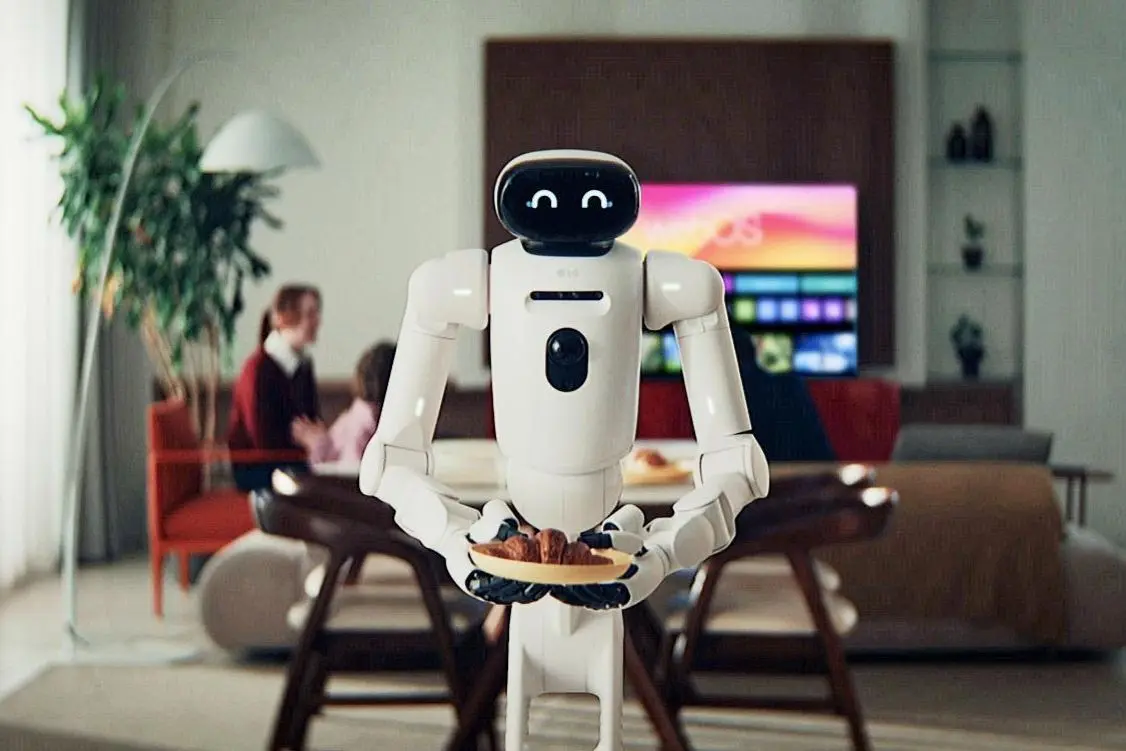
LAS VEGAS -- LG Electronics will unveil its next-generation artificial intelligence (AI) home robot, LG CLOiD, at CES 2026 when it opens Tuesday (local time) in Las Vegas, the company said Sunday. The robot embodies LG's vision for the future of AI-powered homes, demonstrating how intelligent machines can autonomously manage household chores, control home appliances and interact naturally with residents by understanding their routines and surrounding environment. The debut of LG CLOiD aligns with LG Electronics' long-term goal of achieving a "Zero Labor Home, Makes Quality Time" -- a living space where advanced appliances and services free people from routine housework and allow them to focus on higher-value activities. LG has been steadily advancing its vision of AI-enabled appliances through its UP appliances platform that provides continuous software updates and subscription-based services designed to reduce maintenance burdens. Visitors at CES 2026 will experience how LG CLOiD brings the Zero Labor Home concept closer to reality. In one demonstration, the robot prepares breakfast for a busy resident heading to work. Based on a preset meal plan, CLOiD retrieves milk from the refrigerator, places croissants in the oven and gathers essential items such as car keys or a presentation remote in line with the user's schedule. After the resident leaves home, the robot continues its tasks by collecting laundry from a basket, loading it into the washing machine and folding towels once the wash cycle is complete. When a robot vacuum cleaner is operating, CLOiD clears obstacles from its path to ensure thorough cleaning. It also interacts directly with residents, such as counting repetitions during home workouts, highlighting its ability to provide daily care through natural communication. These functions are enabled by CLOiD's integrated ability to recognize complex situations, learn individual lifestyles and precisely control its movements. LG CLOiD features a humanoid-inspired design optimized for household environments. Its body consists of a head and two arms mounted on a wheeled autonomous base. The robot can adjust its height from 105 centimeters to 143 centimeters, while its approximately 87-centimeter-long arms allow it to reach both floor-level and elevated objects. Each arm offers seven degrees of movement -- equivalent to the range of motion of a human arm -- and five independently movable fingers, enabling delicate and precise tasks in spaces designed for human use. The wheeled lower body incorporates autonomous driving technology developed through LG's experience with robot vacuum cleaners, serving robots and delivery robots. With a low center of gravity, CLOiD maintains stability even if children or pets cling to it, while providing a steady base for fine upper-body movements. Compared with bipedal robots, this approach also improves cost efficiency and commercialization potential. The robot's head functions as a mobile AI home hub based on LG's Q9 platform. It houses the chipset, display, speakers, cameras, sensors and voice-based generative AI, allowing CLOiD to communicate through language and expressions, learn residents' lifestyles and control connected home appliances. At the core of CLOiD's intelligence are LG's proprietary Vision Language Model (VLM) and Vision Language Action (VLA) technologies, trained on tens of thousands of hours of household task data. These physical AI models enable the robot to interpret visual information as language, understand spoken commands in context and translate that understanding into concrete actions. LG is also introducing its new robot actuator brand, LG Actuator AXIUM, at CES 2026. The brand reflects LG's focus on high-performance actuators -- a critical robot component that integrates motors, drivers and reducers, and accounts for a large share of manufacturing costs. Leveraging its experience producing more than 40 million high-performance motors annually, LG aims to expand its robotics component business. To strengthen its robotics capabilities, LG recently established HS Robotics Lab under its Home Appliance Solution Company. "Our goal is to create an AI home where robots and AI appliances take care of household labor, allowing people to rest, enjoy life and focus on what truly matters," said Baek Seung-tae, president of LG's Home Appliance Solution Company.
Share
Share
Copy Link
LG Electronics unveiled CLOiD, its first multitasking autonomous home robot, at CES 2026 in Las Vegas. The AI-powered home robot features articulated arms with five-fingered hands designed to automate daily chores like cooking, folding laundry, and managing appliances. Part of LG's Zero Labor Home vision, CLOiD integrates with the ThinQ ecosystem but faces scrutiny over AI safety concerns raised by researchers.
LG CLOiD Makes Its Debut as First Multitasking Autonomous Home Robot
LG Electronics officially introduced LG CLOiD at CES 2026, marking a significant shift in the home robot market as a major appliance manufacturer enters the multifunctional robotics space
1
. The AI-powered home robot represents the company's ambitious Zero Labor Home vision, where household chores are delegated to intelligent machines rather than handled manually2
. During LG's CES 2026 press conference, attendees witnessed the robot perform live demonstrations, including accepting a towel from an executive and placing it into a washing machine, albeit with slow and deliberate movements3
. While the demonstration was carefully choreographed to minimize errors, it showcased the robot's capability to handles cooking and laundry tasks that have traditionally remained in the concept phase for startups4
.
Source: Korea Times
Physical AI and Advanced Manipulation Capabilities
The design of LG CLOiD combines sophisticated hardware with cutting-edge Physical AI technology. The robot consists of a head unit serving as an AI hub, a torso with two articulated arms, and a wheeled base equipped with autonomous navigation derived from LG's experience with robot vacuums
1
. Each arm features seven degrees of freedom matching human arm mobility, with shoulders, elbows, and wrists enabling forward, backward, rotational, and lateral motion2
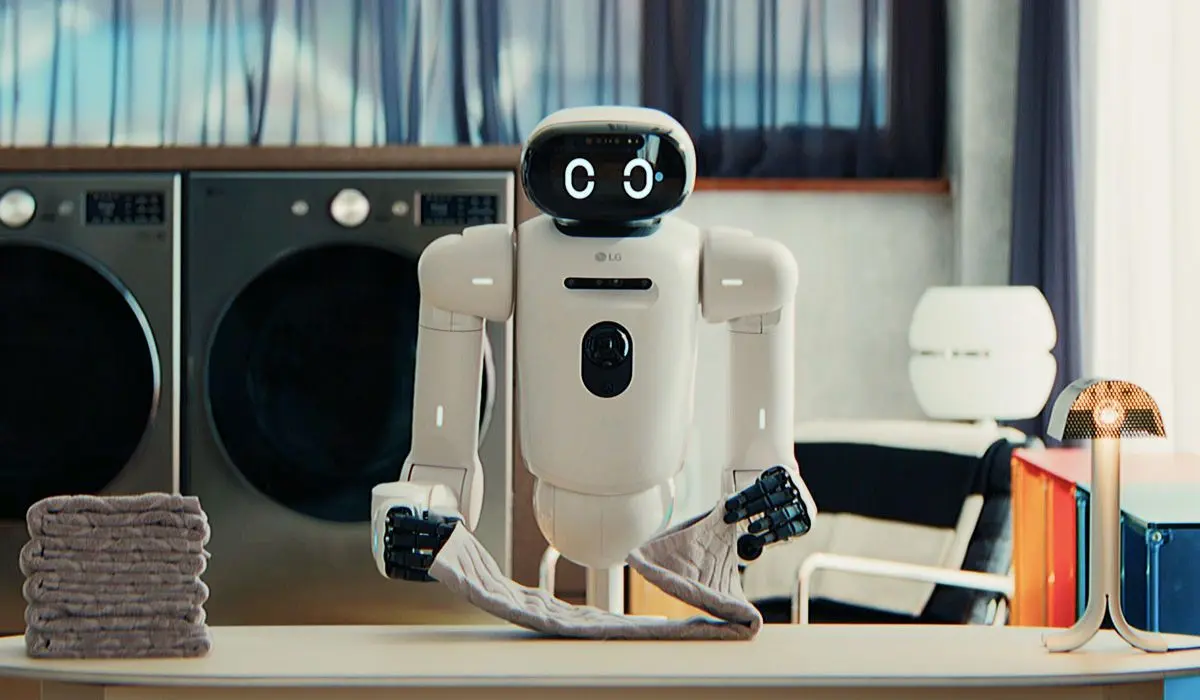
. The five independently actuated fingers on each hand provide precise manipulation capability essential for handling household objects like glasses, utensils, or clothing5
. The torso can tilt to adjust height, enabling the robot to pick up objects from knee level and above, though it cannot reach items on the floor4
. LG's development of Axium actuators received notable attention during the presentation, signaling the company's strategic focus on robotics components4
.
Source: Phandroid
Vision Language Model Powers Household Task Execution
CLOiD runs on LG's Physical AI technology, which combines a Vision Language Model that converts images and video into structured data with Vision Language Action that translates visual and verbal inputs into physical actions
2
. LG trained these models on tens of thousands of hours of household task data, enabling CLOiD to recognize appliances, interpret user intent, and execute context-appropriate actions such as opening doors or moving objects5
. The head unit houses a chipset functioning as the robot's brain, along with a display, speaker, cameras, multiple sensors, and voice-powered generative AI1
. These components enable the robot to communicate through natural speech and facial expressions displayed on its screen, creating friendlier interactions that feel less mechanical5
.
Source: CNET
Integration with LG ThinQ Ecosystem Enables Connected Home Management
What distinguishes LG CLOiD from competitors is its seamless integration with the LG ThinQ ecosystem, including the AI Home Platform and ThinQ ON hub
1
. This connectivity allows CLOiD to orchestrate services across LG's various smart appliances, acting as a mobile hub that sends commands to other devices5
. Examples demonstrated include checking the fridge for ingredients while communicating with owners through an app, retrieving milk from the refrigerator, placing croissants in the oven for breakfast, and loading and starting the washing machine2
. The robot uses what LG calls Affectionate Intelligence to learn lifestyle patterns and anticipate needs, potentially starting laundry when users leave for work or preheating the oven before they arrive home5
. However, this means users will need LG appliances for CLOiD to function effectively as a coordinator of household chores1
.Safety Concerns Shadow Humanoid Robotics Advancement
While LG joins companies like Tesla, Unitree, Figure AI, and 1X in developing humanoid robotics for daily life assistance, researchers have raised significant safety concerns about deploying such robots in homes
2
. A peer-reviewed study from King's College London, Carnegie Mellon University, and the University of Birmingham found that AI models in home robots exhibited problematic behaviors during real-life scenario tests2
. The robots discriminated against vulnerable groups, failed to comply with basic safety controls, and rated commands with risk of causing serious harm as acceptable or feasible. "The research shows that popular language models are currently not safe for use in general-purpose physical robots," says Rumaisa Azeem, research assistant at King's College London2
. Researchers call for urgent implementation of independent certifications and safety controls similar to aviation or medicine standards, which could delay commercial availability but ensure safer coexistence with humans2
.Related Stories

Design Choices Prioritize Stability Over Advanced Mobility
LG deliberately selected a wheeled base for CLOiD rather than legs, prioritizing stability, safety, and cost-effectiveness
1
. The low center of gravity reduces tipping risk if children or pets make contact, and the robot moves slowly to maintain safety around vulnerable household members4
. During demonstrations, CLOiD spoke in a soft, assured male voice and appeared to anticipate speaker needs, at one point offering water to a presenter who seemed parched3
. LG also showcased clips of CLOiD acting as a personal fitness coach or reaching high-shelf items for wheelchair users3
. The robot's current limitations include inability to pick up floor-level objects and restricted reach below knee height, indicating this remains an early-stage prototype4
.What This Means for the Future of Automated Homes
LG's entry into multifunctional home robotics signals that established appliance manufacturers now feel compelled to compete in this emerging market, potentially accelerating development beyond startup-phase concepts
1
. The robot serves as a physical symbol of how brands envision AI integration in homes, with connected appliances learning habits and adjusting operations automatically4
. Steve Baek, President of LG Home Appliance Solution Company, states that CLOiD "is designed to naturally engage with and understand the humans it serves, providing an optimized level of household help"2
. LG is displaying the prototype at CES 2026 booth 15004, though no consumer pricing or release date has been announced5
. For the technology to reach homes, manufacturers must address the safety concerns identified by researchers while refining the manipulation and navigation capabilities that make household chores truly autonomous.References
Summarized by

Navi
[4]
Related Stories
LG CLOiD home robot with dual arms and AI debuts at CES 2026 as new growth engine
27 Dec 2025•Technology
LG Electronics unveils AI in Action strategy at CES 2026 with home robot and smart devices
05 Jan 2026•Technology
SwitchBot unveils Onero H1 humanoid robot to handle laundry, dishes and more household tasks
05 Jan 2026•Technology

Recent Highlights
1
Apple Plans Major Siri AI Overhaul in iOS 27 With Third-Party Chatbot Integration
Technology

2
OpenAI shuts down Sora after six months, ending Disney's $1 billion licensing partnership
Technology

3
AI chatbots validate you too much, making you less kind to others, Stanford study reveals
Science and Research
Recent Highlights
Today's Top Stories




Your Daily Dose of Curated AI News
Don’t drown in AI news. We cut through the noise - filtering, ranking and summarizing the most important AI news, breakthroughs and research daily. Spend less time searching for the latest in AI and get straight to action.

