Lovable raises $330M at $6.6B valuation as vibe-coding startup triples worth in five months


11 Sources
11 Sources
[1]
Vibe-coding startup Lovable raises $330M at a $6.6B valuation | TechCrunch
Swedish vibe coding startup Lovable has more than tripled its valuation in just five months. Stockholm-based Lovable on Thursday said it had raised $330 million in a Series B funding round that was led by CapitalG and Menlo Ventures, at a $6.6 billion valuation. Khosla Ventures, Salesforce Ventures and Databricks Ventures also participated, as did other investors. This raise comes mere months after Lovable raised a $200 million Series A round that valued the company at $1.8 billion in July. One of the quickest to capitalize on the AI boom, Lovable has built a "vibe-coding" tool that lets people use text prompts to write code and build complete apps. The company launched in 2024, and has grown blazing fast: it reached the vaunted $100 million ARR milestone within eight months, and just four months later, doubled that to surpass $200 million in annual recurring revenue. The company counts major software names like Klarna, Uber and Zendesk as customers, and claims that more than 100,000 new projects are built on its platform every day, and more than 25 million projects were created in its first year. Lovable said it would use the new funding for building deeper integrations with third-party apps, expanding its features for enterprise use-cases, and flesh out its platform with the infrastructure needed -- like databases, payments and hosting -- to build full-fledged applications and services. Lovable co-founder and CEO Anton Osika said on stage at this year's Slush conference in Helsinki, Finland that he credits the company's ability to scale to his decision to ignore calls from investors to relocate the company to Silicon Valley. "It was tempting, but I really resisted that," Osika said on stage at the November conference. "I [can] sit here now and say, 'Look, guys, you can build a global AI company from this country.' There is more available talent if you have a strong mission, and you have a lot of urgency coming together as a group and working." In November, the company was called out for not paying VAT, a tax that applies to most goods and services in the European Union (EU). Osika confirmed that this was true in a LinkedIn post, saying that the company would remedy the situation, and shut down comments saying taxes like this are why the EU isn't a good home for high-growth startups. Vibe coding continues to be a hot area of investing for VCs. Cursor, another vibe coding darling, raised $2.5 billion in November at a $29.3 billion valuation. Like Lovable, this was also the company's second funding round of the year, seeing its valuation double between June and November. TechCrunch reached out to Lovable for any additional information.
[2]
Vibe coding startup Lovable's latest funding round values it at $6.6 billion, sources say
Lovable cofounders Anton Osika and Fabian Hedin. Credit: Lovable Vibe coding startup Lovable's latest funding round values the firm at $6.6 billion and includes U.S. VC firm Accel, sources with knowledge of the deal told CNBC. That figure is more than triple the $1.8 billion valuation the Swedish AI company achieved after closing its most recent funding round in July. It's Lovable's third in 2025 and follows a breakneck year of growth that's seen it become one of Europe's most valuable startups. Both sources asked to remain anonymous while discussing private information. Forbes previously reported in November that the round would value the company at "around" $6 billion. Accel was participating in the round, both sources said, which has not been previously reported. Accel participated in Lovable's previous round and has emerged as a key backer in the wave of new AI startups. It's participated in billion-dollar rounds for vibe coding startup Cursor and former OpenAI executive Mira Murati's AI company Thinking Machines. U.S. investor Khosla Ventures is also participating in the latest round, one of the sources told CNBC. Lovable, Accel and Khosla Ventures have been approached for comment by CNBC, but had not responded as this article went live. Founded in 2023, Lovable reported $200 million in annual recurring revenue (ARR) in November, just under a year after achieving $1 million in ARR for the first time. The startup's July fundraise picked up $200 million. As well as Accel, investors then included Creandum, Klarna founder Sebastian Siemiatkowski, ElevenLabs founder Mati Staniszewski and Synthesia founder Victor Riparbelli.
[3]
Lovable, a Start-Up That Makes Anyone a Coder, Raises $330 Million
The Swedish company is now valued at $6.6 billion, more than triple its $1.8 billion valuation set by investors in July. From a young age, Anton Osika wanted to build things. That interest drew him to computer programming in high school and to working in start-ups after college in his native Sweden. Osika doesn't think he is alone. "Humans were born to build," he said in a recent interview with DealBook. That belief set in motion Lovable, the Stockholm-based, multibillion-dollar artificial intelligence start-up Osika co-founded in 2023, which allows users with no coding experience to quickly build websites and apps. Today, Lovable announced that it has raised $330 million in new financing at a $6.6 billion valuation. The funding round was led by both CapitalG and Menlo Ventures, and also includes Khosla Ventures, Accel, EQT and others. And the news comes just a few months after Lovable raised $200 million at a $1.8 billion valuation in July. Lovable, which Osika founded with Fabian Hedin, is yet another example of the way A.I. is disrupting coding. Since the launch of ChatGPT, programming assistants like Cursor and Cognition have become essential tools for software developers. Lovable is among the companies enabling non-coders to build software, a practice that's been called "vibecoding." "It's taking this massive market of people that were never developers and turning them into content creators, developers and publishers," said Matt Murphy, a partner at Menlo Ventures. Lovable's growth has been dramatic since it introduced its latest product late last year. It now has $200 million in annual recurring revenue, up from $100 million in July, and about 320,000 paying customers. Lovable, which is not profitable, offers a free tier of its service as well as a $25 monthly subscription for individuals and a $50 monthly subscription for businesses. The bulk of Lovable's customers, Osika said, are founders or entrepreneurs who use the tool to launch new business ideas or to build product lines for existing businesses. The draw for its customers -- such as Brickwise, a property management company, or QuickTables, a restaurant sales platform -- is time and money. They can produce a website in a matter of hours or days without having to pay a software engineer to build it. A.I. tools like Lovable have existential ramifications for computer scientists. Why pay a developer when you can use Lovable? Still, Osika is optimistic about the tool's potential to generate economic growth. One of the metrics he cares most about is the number of daily visitors to Lovable-built apps, of which there are about six million. "If we can make more of them successful and create more economic opportunities, then I'm going to be very satisfied with the coming 12 months," he said. Lovable's other major customer segment is enterprise customers that use the tool to build prototypes. Conversations with Lovable customers at enterprise companies convinced Laela Sturdy, the CapitalG managing partner who led the deal, of the start-up's value. "We talked to several product managers who said in traditional prototyping it would take weeks for them to build, collaborate and actually get a working prototype," but with Lovable it took them hours, Sturdy said. Klarna, Uber and Deutsche Telekom are among the enterprise companies using Lovable. The $330 million in new funding will be spent achieving two goals, Osika said. The first is to integrate Lovable with other software providers, such as payment processors like Stripe and document builders like Notion. The second is to improve Lovable's engineering capabilities so that customers aren't just making product demos or mock-ups but launching products on Lovable-built software. "If you're a new company and you want to build everything on Lovable, that should be 100 percent possible," Osika said. To achieve that goal, he needs more people. The company expects to double its 120-person team in the next 12 months. Lovable is in competition with existing web design and prototyping developers, such as Figma and Replit, which are investing heavily in coding products. But the bigger competitive threat may come from the large A.I. companies, like Google, OpenAI and Anthropic, that make the models that start-ups like Lovable use as the backbone of their products. Competing with OpenAI or Google requires building a "beloved layer" of software that can sit on top of the those companies' models and that customers want to pay for, Murphy said. With Lovable, he added, "the numbers speak for themselves." At least for now.
[4]
Lovable wants to be 'the last piece of software' for companies, CEO says | Fortune
The round was led by CapitalG and Menlo Ventures' Anthology fund, with participation from NVIDIA's venture arm NVentures, Salesforce Ventures, Databricks Ventures, and strategic investors including Atlassian Ventures and HubSpot Ventures. It comes just one month after Lovable announced it had hit $200 million in annual recurring revenue. The company has grand aims to make software engineering accessible to anyone by promoting "vibe-coding," a process in which a user describes in plain language the product they want to build or the function of a piece of software they want to create, and AI writes the code to produce that result. "Our mission is to let anyone be a builder," Osika said. He predicted a world where every company can build its own bespoke software, rather than depending on expensive, and less customized products from major tech vendors. For instance, rather than purchasing different tools for customer relationship management, project tracking, or inventory management, Osika envisions companies using Lovable to simply build whatever they need on demand. Companies are already seeing results from some of Lovable's products. At Zendesk, teams using Lovable have been able to move from idea to working prototype in three hours instead of six weeks, according to Jorge Luthe, the company's Senior Director of Product. While at management consulting firm McKinsey, Osika said engineers used his company's product to build in a few hours what they had been waiting four to six months for their internal development team to deliver. "Anyone being able to go with an arbitrary software problem and just explain it to Lovable and solve it, is becoming a universal reality," he said. Skeptics say that vibe coding doesn't always result in the best quality software. The code vibe coding tools produce can be inefficient or contain security flaws that could present a serious risk to the company deploying it, depending on what it is being used for. In addition, just because tools like Lovable allow people without any coding experience to create software for their specific needs, it doesn't mean that those non-developers will be able to maintain that code over time, these critics say. Lovable says it sees three main use cases emerge among enterprise customers, Osika said. Some organizations are building core business systems entirely on Lovable; others are using it to build internal tools that previously stalled in development backlogs for months; and some product teams are using it to validate ideas with functional prototypes rather than static designs. "Enterprises are reworking entire workflows with AI, because you can build AI applications with Lovable in just one prompt," Osika said. "It becomes kind of the work where work gets done." Lovable is operating in an increasingly competitive landscape and facing competition from fellow start-ups as well as bigger players that are now releasing their own coding products. While Lovable uses foundational models from OpenAI, Google, and Anthropic to power its own product, these companies are now releasing their own coding tools that could compete more directly. "We just see them as partners," Okisa said of the competition with major AI labs. "I think as software and AI kind of converges, there's going to be more overlap in what companies do, but what people say and why they choose us, despite that there are other alternatives, is that Lovable just works." Matt Murphy, a partner at Menlo Ventures who led the investment, said that Lovable's strategy is to build a "beloved layer" of software on top of the AI labs' models that customers want to pay for. "The numbers speak for themselves," Murphy said, noting that Lovable has transformed a latent market of tens of millions of people into developers. "Lovable has done something rare: built a product that enterprises and founders both love. The demand we're seeing from Fortune 500 companies signals a fundamental shift in how software gets built," Laela Sturdy, Managing Partner at CapitalG added.
[5]

AI coding startup Lovable raises $330M round backed by Nvidia, other tech heavyweights - SiliconANGLE
AI coding startup Lovable raises $330M round backed by Nvidia, other tech heavyweights Lovable Labs Inc., the creator of a popular artificial intelligence tool for building websites and applications, today announced that it has raised $330 million in funding. Alphabet Inc.'s CapitalG fund and Menlo Ventures jointly led the Series B round. They were joined by the venture capital arms of Nvidia Corp., Salesforce Inc., HubSpot Inc., Atlassian Corp. and T-Mobile parent Deutsche Telekom AG. More than half dozen venture capital firms chipped in as well. Lovable is now worth $6.6 billion, a $3.8 billion increase over its July valuation. That jump likely stems the two-year-old company's rapid sales growth: it topped the $200 million annual recurring revenue mark in November. Lovable disclosed on occasion of today's investment that users launch more than 100,000 projects on its AI coding platform every day. Lovable enables developers to generate a website or simple application by entering a prompt into a chatbot interface. Behind the scenes, the platform retrieves any external information that may be required for the project, generates the needed code and runs bug tests. It uses telemetry such as network traffic metrics to find potential software flaws. When developers need help with a less involved task, they can use a Lovable feature called Code Mode. It provides the ability to enter a programming question and have the platform return a natural language answer. Lovable can, for example, provide pointers on the optimal way to implement a new feature in a website or fix a malfunctioning button. A split-screen mode enables developers to manually edit a project's code in a sidebar next to the chatbox interface. For designers, Lovable provides a tool that makes it possible to edit interface elements without writing code. It also eases certain related tasks, such as ensuring that a project adheres to a company's interface style guide. Lovable provides infrastructure that customers can use to host their AI-generated software. The company provides a managed database for storing application data, authentication tools and traffic analytics dashboards. Online retailers can add a pre-built payment processing module to their websites. One of Lovable's revenue sources is an enterprise version of its platform that includes expanded administrative controls. It offers role-based project access restrictions, single sign-on support and an audit log. A GitHub integration enables developers to review non-technical workers' AI-generated code before it's released to production.
[6]

Lovable raises $330M Series B at $6.6B valuation
Stockholm-based Lovable, a Swedish vibe coding startup, raised $330 million in a Series B funding round on Thursday at a $6.6 billion valuation. CapitalG and Menlo Ventures led the round, with participation from Khosla Ventures, Salesforce Ventures, Databricks Ventures, and other investors. The funding supports expansion of its platform that enables users to write code and build apps using text prompts. Lovable launched its product in 2024, quickly capitalizing on demand for AI-driven development tools. The company achieved $100 million in annual recurring revenue within eight months of launch. Four months after that milestone, Lovable surpassed $200 million in annual recurring revenue. This rapid growth positioned the startup among the fastest to reach such financial benchmarks in the AI sector. Prior to the Series B, Lovable completed a $200 million Series A round in July 2024, which valued the company at $1.8 billion. The valuation more than tripled in five months, reflecting investor confidence in the company's trajectory. Vibe coding refers to the process where users describe applications in natural language, and the tool generates the corresponding code and full applications. The startup serves prominent customers including Klarna, Uber, and Zendesk. Lovable reports that more than 100,000 new projects are created on its platform each day. In its first year, the platform facilitated the creation of over 25 million projects, demonstrating substantial user engagement and adoption across various scales of development. Lovable plans to allocate the Series B proceeds toward developing deeper integrations with third-party applications. The company will expand features tailored for enterprise use cases. Additional investments will enhance the platform's infrastructure, incorporating elements such as databases, payments, and hosting to enable the construction of complete, production-ready applications and services. At the 2024 Slush conference in Helsinki, Finland, Lovable co-founder and CEO Anton Osika addressed the company's location strategy. Osika explained his resistance to investor pressure to relocate from Sweden to Silicon Valley. "It was tempting, but I really resisted that," Osika said on stage at the November conference. He emphasized the viability of building in Sweden, stating, "Look, guys, you can build a global AI company from this country. There is more available talent if you have a strong mission, and you have a lot of urgency coming together as a group and working." In November 2024, Lovable faced scrutiny for not paying value-added tax, which applies to most goods and services in the European Union. Osika confirmed the issue in a LinkedIn post. He stated that the company would remedy the situation and disabled comments on the post amid discussions linking such taxes to challenges for high-growth startups in the EU.
[7]

This European AI Startup Tripled Its Valuation Since July
The Stockholm-based AI company enables users to build websites and apps by prompting AI models, no coding necessary. Founded in 2023, Lovable has undergone three funding rounds this year and soared to the top, becoming one of the most valuable startups in Europe. U.S. investor Khosla was included in the round, and U.S. VC firm Accel participated in Lovable's July round and its most recent, sources said. The firm has become a prominent support to AI startups, as it has also reportedly been involved in billion-dollar rounds for Cursor, another vibe coding startup, and for Thinking Machines, the AI company founded by OpenAI executive Mira Murati. Lovable hit $1 million in annual recurring revenue (ARR) roughly a year ago, and already in November it saw $200 million in ARR.
[8]

How This 2-Year-Old AI Startup Just Hit a $6.6 Billion Valuation
Is Lovable the next unicorn? The Stockholm-based AI startup lets users with zero coding experience quickly build websites and apps. It just raised $330 million at a $6.6 billion valuation, tripling its worth from just five months ago when it raised $200 million at $1.8 billion. Lovable now has $200 million in annual recurring revenue, up from $100 million in July. It has 320,000 paying customers, including Klarna, Uber and Deutsche Telekom. Most users are founders and entrepreneurs who launch businesses or build product lines in hours instead of paying software engineers for weeks of work. The $330 million will fund integrations with services like Stripe and Notion, and improve engineering so customers can launch full products -- not just prototypes -- on Lovable.
[9]

Lovable valued at $6.6 billion in latest funding round as AI coding demand surges
The deal also drew investment from Nvidia's venture capital arm among others, underscoring investor demand for agentic AI tools that can handle complex software development work with minimal human input, as enterprises and hobbyists increasingly adopt AI-assisted coding. AI software development startup Lovable said on Thursday it raised $330 million in an early-stage funding round that values the Stockholm-based company at $6.6 billion. Alphabet's CapitalG and Menlo Ventures led the round, which nearly quadruples Lovable's valuation in less than six months. The deal also drew investment from Nvidia's venture capital arm among others, underscoring investor demand for agentic AI tools that can handle complex software development work with minimal human input, as enterprises and hobbyists increasingly adopt AI-assisted coding. Lovable's sharp jump in value comes amid a boom in "vibe coding," in which users describe a project in plain language and expect AI to generate a full program. Competitors including Replit, OpenAI, Google and Cursor offer similar products aimed at the growing market for agentic software development. The company hit $100 million in annual recurring revenue in the summer, about eight months after reaching its first $1 million, and now ranks among Europe's most valuable private technology firms. A funding round that closed in July valued it at $1.8 billion. A roster of strategic backers also joined in the latest funding round, including the venture arms of Salesforce, Databricks, and Atlassian. Lovable said it will use the new capital to expand enterprise features, strengthen collaboration tools and scale infrastructure as usage grows. Founded in late 2023 by Anton Osika and Fabian Hedin, Lovable quickly gained traction with users and venture capital alike by enabling non-technical founders and teams to build and iterate on digital products without traditional coding expertise.
[10]

Lovable valued at $6.6 billion in latest funding round as AI coding demand surges
Dec 18 (Reuters) - AI software development startup Lovable said on Thursday it raised $330 million in an early-stage funding round that values the Stockholm-based company at $6.6 billion. Alphabet's CapitalG and Menlo Ventures led the round, which nearly quadruples Lovable's valuation in less than six months. The deal also drew investment from Nvidia's venture capital arm among others, underscoring investor demand for agentic AI tools that can handle complex software development work with minimal human input, as enterprises and hobbyists increasingly adopt AI-assisted coding. Lovable's sharp jump in value comes amid a boom in "vibe coding," in which users describe a project in plain language and expect AI to generate a full program. Competitors including Replit, OpenAI, Google and Cursor offer similar products aimed at the growing market for agentic software development. The company hit $100 million in annual recurring revenue in the summer, about eight months after reaching its first $1 million, and now ranks among Europe's most valuable private technology firms. A funding round that closed in July valued it at $1.8 billion. A roster of strategic backers also joined in the latest funding round, including the venture arms of Salesforce, Databricks, and Atlassian. Lovable said it will use the new capital to expand enterprise features, strengthen collaboration tools and scale infrastructure as usage grows. Founded in late 2023 by Anton Osika and Fabian Hedin, Lovable quickly gained traction with users and venture capital alike by enabling non-technical founders and teams to build and iterate on digital products without traditional coding expertise. (Reporting by Arnav Mishra in Bengaluru; Editing by Tasim Zahid)
[11]
Lovable triples its valuation and establishes itself as Europe's leader in vibe coding
The Swedish startup Lovable has reached a valuation of $6.6bn following a new funding round, according to people familiar with the matter cited by CNBC. Founded in 2023, the company was worth $1.8bn last July, marking an impressive leap in just a few months. A pioneer of "vibe coding," the company offers a platform that lets users create websites and applications via natural-language instructions, without writing code. This funding round, the third in 2025, reportedly attracted major investors such as Accel and Khosla Ventures. Accel, already an investor, is also a backer of other AI startups including Cursor (Anysphere) and Thinking Machines. Lovable claims 100,000 projects in progress each day and annual recurring revenue that reached $200m in November, just one year after surpassing the $1m mark.
Share
Share
Copy Link
Stockholm-based Lovable has raised $330 million in Series B funding at a $6.6 billion valuation, more than tripling its worth since July. The AI coding startup reached $200 million in annual recurring revenue within a year of launch, letting users build apps using text prompts without any coding experience. Major tech investors including CapitalG, Menlo Ventures, and Nvidia backed the round.
Swedish AI Startup Lovable Secures Massive Funding Round
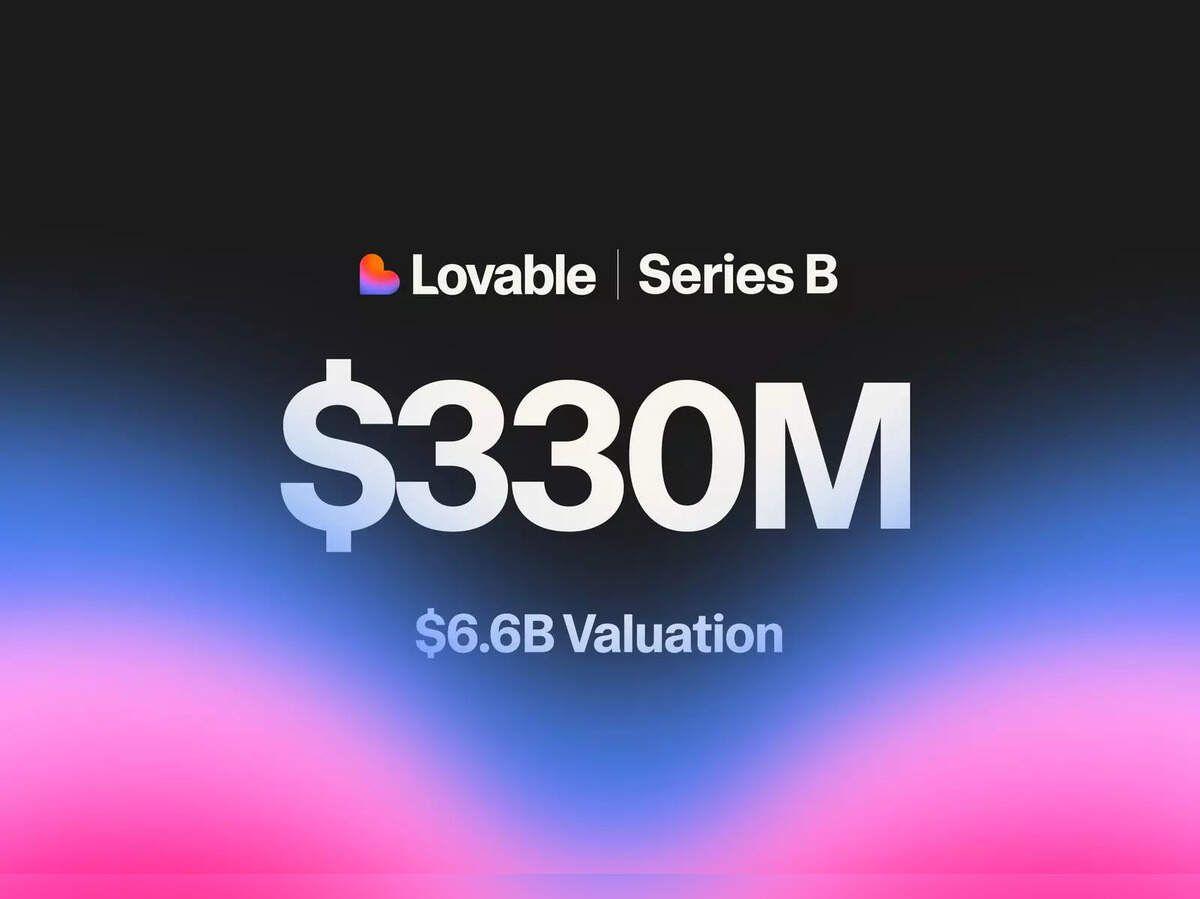
Lovable has closed a $330 million Series B funding round at a $6.6 billion valuation, marking one of the fastest valuation increases in recent startup history
1
. The Swedish AI startup has more than tripled its worth in just five months, up from the $1.8 billion valuation it achieved during its $200 million Series A round in July3
. CapitalG and Menlo Ventures jointly led the round, with participation from Nvidia, Salesforce Ventures, Databricks Ventures, Khosla Ventures, Accel, Atlassian Ventures, and HubSpot Ventures4
.
Source: ET
Vibe-Coding Transforms Software Development
Founded in 2023 by Anton Osika and Fabian Hedin, Lovable has built an AI-powered tool that enables users to build apps using text prompts without requiring any coding experience
3
. This approach, known as vibe-coding, allows people to describe in plain language what they want to build, and the AI writes the code to produce that result4
. The platform retrieves external information, generates code, runs bug tests, and uses telemetry such as network traffic metrics to identify potential software flaws5
.
Source: Market Screener

Source: NYT
Explosive Growth Reaches $200 Million in Annual Recurring Revenue
The AI coding startup has demonstrated remarkable traction since launching its latest product late last year. Lovable reached $100 million in ARR within eight months and doubled that figure to surpass $200 million in annual recurring revenue just four months later
1
. The company now serves approximately 320,000 paying customers and reports that more than 100,000 new projects are built on its platform every day3
5
. More than 25 million projects were created in its first year1
.Enterprise Customers Drive Rapid Prototyping Adoption
Lovable counts major enterprise customers including Klarna, Uber, Zendesk, and Deutsche Telekom among its users
1
3
. At Zendesk, teams using Lovable moved from idea to working prototype in three hours instead of six weeks, according to Jorge Luthe, the company's Senior Director of Product4
. CapitalG Managing Partner Laela Sturdy noted that product managers at enterprise companies reported traditional prototyping would take weeks, but with Lovable it took hours3
. The platform serves three main use cases: building core business systems, creating internal tools that previously stalled in development backlogs, and validating ideas with functional prototypes4
.Related Stories




Investment Focus on Integration and Enterprise Features
Lovable plans to use the new funding for building deeper integrations with third-party apps like payment processors such as Stripe and document builders like Notion
3
. The company aims to expand features for enterprise use-cases and develop infrastructure including databases, payments, and hosting capabilities needed to build full-fledged applications1
. Osika envisions companies using Lovable to build bespoke software on demand rather than depending on expensive, less customized products from major tech vendors4
. The company expects to double its 120-person team in the next 12 months3
.Competition Intensifies in Software Engineering AI Space
Lovable operates in an increasingly competitive landscape, facing rivals like Cursor, which raised $2.5 billion in November at a $29.3 billion valuation
1
. The company also competes with existing web design and prototyping developers such as Figma and Replit3
. A significant competitive threat comes from large AI companies like OpenAI, Google, and Anthropic, which provide the foundational AI models that Lovable uses and are now releasing their own coding tools3
4
. Matt Murphy, a partner at Menlo Ventures, said Lovable's strategy is to build a "beloved layer" of software on top of AI labs' models that customers want to pay for4
.References
Summarized by

Navi
Related Stories
Recent Highlights
1
Anthropic's Claude AI can now control your computer to complete tasks autonomously
Technology

2
Nvidia's Jensen Huang calls OpenClaw the next ChatGPT, sending Chinese AI stocks soaring
Technology

3
Elon Musk unveils $20 billion Terafab chip manufacturing project to produce terawatt of computing
Technology

Recent Highlights
Today's Top Stories






Your Daily Dose of Curated AI News
Don’t drown in AI news. We cut through the noise - filtering, ranking and summarizing the most important AI news, breakthroughs and research daily. Spend less time searching for the latest in AI and get straight to action.

