Mammotion's Robot Lawn Mowers Scale Steep Hills With Lidar and AI Vision at CES 2026


9 Sources
9 Sources
[1]
I'd Struggle to Walk Up That Hill. Mammotion's Robot Mower Scaled It With Ease
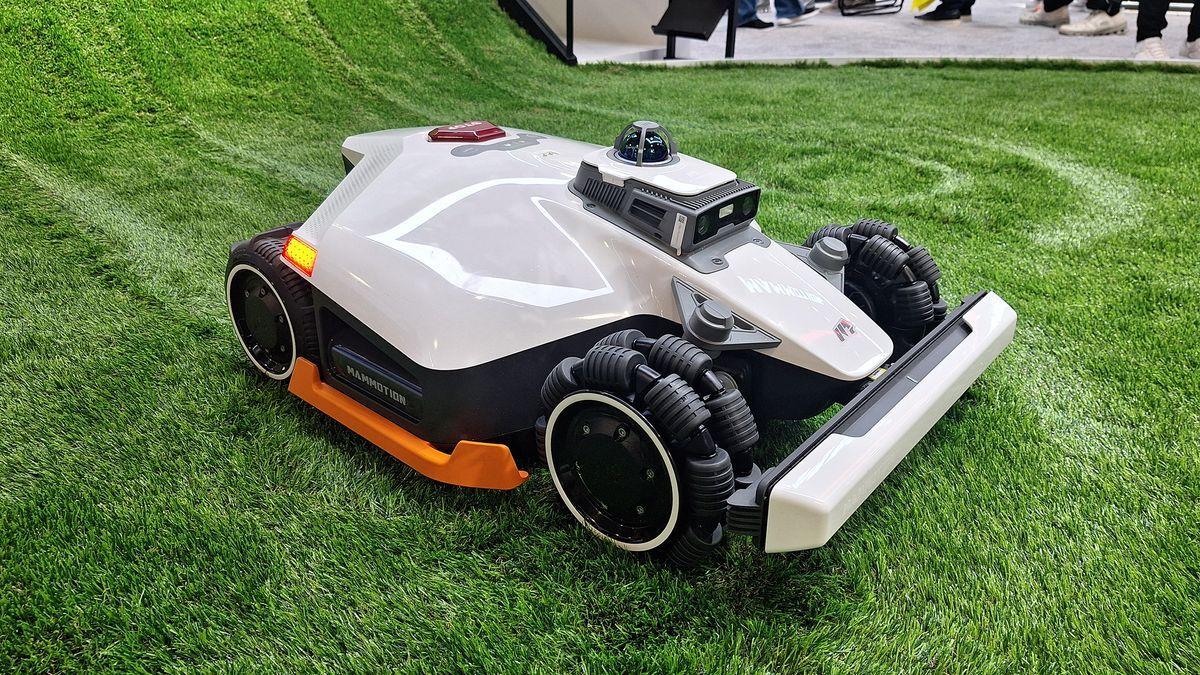
Joe Supan is a senior writer for CNET covering home technology, broadband, and moving. Prior to joining CNET, Joe led MyMove's moving coverage and reported on broadband policy, the digital divide, and privacy issues for the broadband marketplace Allconnect. He has been featured as a guest columnist on Broadband Breakfast, and his work has been referenced by the Los Angeles Times, Forbes, National Geographic, Yahoo! Finance and more. You can usually count on CES for some exciting new developments in robot lawn mower technology, and this year is no exception. None have been more intriguing than Mammotion's 2026 lineup, which includes the Luba 3 AWD, Luba Mini 2 and Yuka Mini 2. CNET's home tech expert, Ajay Kumar, stopped by the Mammotion booth at CES 2026 for a firsthand look at their latest models. The Luba 3 AWD series stole the show, seamlessly navigating obstacles and extreme inclines at the Mammotion demo. (OK, we did see it lightly bump the fake hedgehog on the lawn, but it course-corrected pretty quickly, which isn't always the case for robot lawn mowers -- something we learned the hard way during testing.) "I think there's more credibility to the claims that navigation on these is improving," said Kumar. Maybe the most impressive feature on display was the Luba 3's hill-climbing abilities. The Mammotion demo had a wall-like incline set up to showcase the Luba 3's ability to mow steep inclines. "The incline is enough that even as a person with two legs I'd hesitate to climb it," said Kumar. We watched the Luba 3 run up and down it with ease. According to Mammotion, the Luba 3 AWD Series has a maximum slope capability of 38.6 degrees -- far steeper than anything you're likely to need mowed. Going wire-free is another major innovation for robot mowers, and none of the three new Mammotion mowers require physical boundary wires. Instead, the new Mammotion mowers rely on a combination of lidar sensors that scan "from the ground to the treetops," dual-camera AI vision, and RTK, or Real-Time Kinematic, positioning, which uses beacons to correct a mower's coordinates to improve accuracy. We'll still have to get our hands on the new Mammotion mowers to see how they perform under real-world conditions, but the early returns at CES 2026 were promising. The Luba 3 AWD is currently available for pre-order for $2,399 with an estimated delivery date of early March.
[2]
My favorite no-boundary- wire robot mower just got a worthy successor, and on sale soon
The new AWD robot mower is officially going on sale tomorrow, January 5, in Europe first. Robot mowers are huge at CES, the technology industry's biggest annual showcase, but this may be their biggest year yet. Mammotion, a successful robot mower manufacturer, is releasing a new lineup of devices during CES 2026, including the Mammotion Luba 3, Luba Mini 2, and Yuka Mini 2. If you've read ZDNET's robot mower coverage, you're likely familiar with the fact that the Mammotion Luba 2 is my personal favorite robot mower, even a couple of years after its launch. This makes me all the more excited to see a successor hit the market, especially one with the company's newer Tri-Fusion Navigation System, which offers precise positioning and navigation. Also: CES 2026 live blog: Latest news on TVs, AI, phones, more Instead of relying on a physical boundary wire or just an RTK antenna, the Tri-Fusion system combines three technologies to maintain its position as it mows your lawn: LiDAR, NetRTK, and AI for visual recognition. The robot captures a large LiDAR field of full 360 degrees horizontally and 59 degrees vertically, with a range of up to 330 feet. This generates a live 3D map composed of millions of data points, ensuring the robot detects obstacles within one centimeter and adjusts its course accordingly. The Mammotion Luba 3 also utilizes NetRTK, a simpler way to set up your robot by simply setting boundaries in the Mammotion app, eliminating the need to install base stations. I've used the Luba 2 consistently in my front and back yard, and it's the only RTK robot mower that has stuck to the perimeter of my property without fences or physical boundaries. I trust it to mow along the sides of my front yard that border my neighbor's lawn, and haven't had issues with it veering off course in well over a year. Also: CES 2026 trends to watch: 5 biggest topics we're expecting at the world's biggest tech show Two full HD cameras capture images of the robot's surroundings, which are then processed using an AI Chip for object recognition. This AI-powered visual recognition process rounds out the Luba 3's navigation system for increased accuracy. The robot features a 10 TOPS (Trillion Operations Per Second) processor, which provides it with twice the perception power and decision-making speed, enabling instant object recognition of various obstacles, even in shaded or low-light conditions. Mammotion is also adding new robot mowers to refresh its product lineup. Here are the new products showcased at CES: All new Mammotion products are expected to launch in 2026, although no clear pricing or release date information is yet available for the US market.
[3]
Mammotion's flagship robot lawnmower now uses lidar to map your yard
Mammotion is upgrading its flagship robotic lawnmower with its new lidar-equipped navigation system, allowing it to generate a live 3D map of your yard while it mows. The company revealed the Luba 3 AWD, which comes with lidar sensors that can scan "from the ground to the treetops" with centimeter-level accuracy, during CES 2026. The lidar system is part of Mammotion's "Tri-Fusion" system that combines lidar, geopositioning technology, and an AI chip that uses built-in cameras to analyze your yard for more accurate navigation. Though Mammotion's Luba Mini AWD lidar was the first to come with the tri-sensor tech, the company says the Luba 3 AWD has an even more powerful version. The Luba 3 AWD's lidar system offers a 360-degree horizontal field of view and a 59-degree vertical field that can scan up to 330 feet to create a map of your yard with centimeter-level accuracy. Along with lidar, the Luba 3 AWD has dual 1080p cameras and an upgraded AI chip with 10 TOPS of AI performance, giving it the ability to recognize pets, toys, and more than 300 obstacles throughout your yard in shade or sunlight, according to Mammotion. It also uses a geopositioning technology, called NetRTK (Real-Time Kinematics), that connects to 4G networks or Wi-Fi to navigate your lawn without the need for physical base stations or wires. The cutting specs on the Luba 3 AWD haven't changed much, as it features a slightly larger 15.8-inch cutting width (up from 15.7 on the Luba 2 AWD), dual six-blade discs, and four independently driven motors that can climb 80 percent (38.6-degree) slopes. It comes with a 15Ah battery, making it capable of mowing up to 7,000 square feet per hour (and up to 1.75 acres per day). Mammotion is bringing its upgraded processor to its Luba Mini 2 AWD robot mower, too, which comes with three AI-powered cameras and a new side disc that uses three mini blades to trim the edges of walls, fences, and flower beds. The Yuka Mini 2 features Mammotion's new AI chip as well, offering either a lidar and AI-powered navigation for "precise, boundary-free mapping" or a three-camera system that Mammotion says can handle "most common conditions." The Luba 3 AWD starts at $2,399 / £2,099 / €2,299 and is available for preorder in North America, the UK, and the EU. It comes in four models with maximum mowing sizes ranging from 0.37 to 2.5 acres. Meanwhile, the Luba Mini 2 AWD starts at £1,399 / €1,499 and is available for preorder in the UK and the EU, with a release in North America to follow. The Yuka Mini 2 is launching in the US for $1,399 with a variation designed for cutting larger lawns, while four different versions are coming to the UK and the EU, starting at £749 / €799.
[4]
iGarden debuts wire-free robot lawn mowers with all-terrain nav at CES
New 2WD and AWD models promise 8-hour runtime, LiDAR mapping, and hands-free mowing without perimeter wires. Smart garden tech brand iGarden introduced two new robotic lawn mowers at CES this week, expanding its lineup with 2WD and AWD models aimed at homeowners seeking low-maintenance lawn care. Part of iGarden's growing AI-powered ecosystem, the L Series and L AWD Series mowers feature an 8-hour runtime, smart LiDAR (Light Detection and Ranging) and AI vision, and a 1080p HD camera with a wide-angle field of view to support real-time terrain mapping and obstacle avoidance. Both models are designed for quick setup, requiring no perimeter wires or complex antenna systems like RTK (real-time kinematic) positioning, which is often used for precision navigation in high-end robotic mowers. The L AWD Series offers enhanced all-wheel drive traction for handling slopes up to 70% (35 degrees), targeting yards with challenging topography. Both models use intelligent route planning for even, precise cutting, according to the company. The new models integrate with iGarden's broader app-controlled backyard ecosystem, which was also on display at CES. The company is positioning its AI system as a central hub for connected outdoor devices, though full details on compatibility and feature control through the app were not disclosed. If you're attending CES in person, iGarden is exhibiting its wares at booth #51248. This story is part of TechHive's in-depth coverage of the best robot lawn mowers.
[5]

I just watched Mammotion's new flagship lawnbot scale an astroturf mountain, and it was mesmerizing
Offers ±1 cm positioning precision via an upgraded LiDAR, RTK and Vision navigation system I'm at CES 2026, where Mammotion has unveiled its 2026 range of autonomous robot lawn mowers. The LUBA 3 AWD series sits at the head of the lineup, and it's one of the most capable lawnbots on the market. The upgrades on the LUBA 3 seem to be iterations on the already-excellent tech powering the likes of the LUBA 2. For instance, the Tri-Fusion Navigation System has been enhanced and now offers ±1 cm positioning precision. There's the all-wheel drive (the AWD of the name) for traversing the trickiest of terrain - including an ultra-steep slope in the CES hall (scroll down to watch). Tri-Fusion system combines three different technologies - LiDAR (the primary navigation system), RTK (for improved position accuracy) and AI Vision (for object recognition and avoidance) - to ensure the robot always has a method to find its way about. All three technologies have had an upgrade in the LUBA 3. There's now 360-degree horizontal LiDAR coverage and 59-degree vertical coverage, scanning up to 330ft. This provides the bot with millions of data points, which it can use to create a live 3D map of your yard, from the grass to the tops of the trees. Previous versions have come with an RTK base that needs to be installed separately from the mower and charge station, but the LUBA 3 AWK has a NetRTK module within the lawnbot itself, to save you from the extra hassle. (And of course, there's no need for wires.) Finally, there's 'UltraSense' AI Vision, powered by dual 1080P cameras and a 10 TOPS AI chip. That chip can handle 10 trillion operations per second, which means it can make decisions incredibly quickly. All this is to help the robot react almost instantly to its surroundings - including reading the terrain and recognizing up to 300 obstacles, even in dim light. This not only ensures no yard toys get mown over, but it also means the lawnbot can calculate the speediest, safest routes in real time. Oh and or course, there are cliff sensors to ensure it doesn't try and take a dip in your pool or pond. The AWD is borrowed from previous models, and ensures the lawnbot can handle slopes of up to 80% (38.6°) - I watched it make its way up and down a mini astroturf mountain in the demo hall and it never slipped or faltered. It can also deal with uneven ground, and because all the wheels are independently powered, it can pivot cleanly without churning up your lawn. This model also has upgraded suspension, so it can move smoothly over kerbs or roots up to 3.15 inches tall. Elsewhere, there's an 15.8-inch wide cutting width across two six-blade discs, two 165W high-torque motors and a 15Ah battery. Mammotion says it can mow up to 7,000 sq ft per hour or up to 1.75 acres per day, and there's a new smart power management system that gives users more control over the lawnbot's power use - you can now set charge limits and schedule off-peak charging to reduce costs. This is available across the whole of the latest series. There are four different models included in the LUBA 3 AWD series, geared towards different lawn sizes, with prices starting at €2,299 / $2,299. They've just gone on sale in the UK and EU, and will be available in the US sometime later in 2026.
[6]
Lymow's latest robot mower promises smarter AI and stronger cutting
Improved obstacle avoidance and a self-cleaning traction system aim to handle complex yards with less hassle. Lymow is rolling out a new version of its flagship robot lawn mower that adds more power, intelligence, and durability for hands-free lawn maintenance. Unveiled at CES, the Lymow One Plus is a second-generation upgrade to the company's boundary-wire-free mower, aimed at homeowners with complex or hard-to-mow yards. The One Plus maintains the same tracked propulsion system as the original Lymow One -- a standout feature in a market dominated by wheeled mowers -- but adds 50 percent more cutting power and a redesigned cutting deck. It also introduces a new "cyclone airflow" system that lifts grass blades before cutting them and channels clippings through a discharge tunnel to minimize clogging and keep walkways clear. The mower is powered by a fusion of Real-Time Kinematic (RTK) positioning, Visual Simultaneous Localization and Mapping (VSLAM), and stereo cameras -- technologies more commonly found in autonomous vehicles. This combination enables precise navigation and real-time obstacle avoidance without the need for a perimeter wire, which can be time-consuming to install and difficult to adjust if your landscaping changes. The AI system has been trained on thousands of complex mowing scenarios and can recognize more than 20 common yard objects, including pets and even several hedgehog species. Other upgrades focus on all-weather durability and ease of maintenance. A reinforced frame and drivetrain give the mower automotive-grade toughness, while heated camera housings and an anti-glare display help it operate in fog or bright sunlight. The new self-cleaning traction system includes a rubber barrier to keep grass out of the wheel wells and a detachable cover for easier debris removal. The upgrades aim to help the mower stay functional year-round, even in less-than-ideal conditions like wet grass, gravel, and uneven terrain -- common stumbling blocks for many robotic mowers. The Lymow One Plus is scheduled to ship in March 2026, with a starting price of $2,999 in the US and Europe. Preorders open in February, with early buyers eligible for discounts through Lymow's website. This story is part of TechHive's in-depth coverage of the best robot lawn mowers.
[7]
Mammotion unveils smarter robot lawn mowers at CES
The Luba 3 AWD leads the new lineup, featuring LiDAR, RTK, and AI vision navigation, The more compact Luba and Yuka models target smaller yards. Mammotion is expanding its robotic lawn mower lineup for 2026, introducing three new models at CES that aim to simplify autonomous yard care for a broader range of homeowners. The company unveiled a new flagship model, the Luba 3 AWD, alongside smaller offerings in the Luba Mini 2 AWD and the Yuka Mini 2 series. Mammotion Luba 3 AWD The standout among them is the Luba 3 AWD, a high-end mower designed for large and complex lawns. It debuts a next-generation version of Mammotion's Tri-Fusion Navigation System that combines LiDAR (Light Detection and Ranging) for 3D mapping, RTK (Real-Time Kinematic) satellite correction for centimeter-level positioning, and AI-powered vision for real-time object recognition and obstacle avoidance. Unlike many older robotic mowers that rely on perimeter wires or basic camera systems, the Luba 3 AWD operates without any external equipment. The result is a mower designed to navigate open terrain, tree-lined lawns, and sloped landscapes with minimal setup. According to Mammotion, the Luba 3 AWD scans its environment in 360 degrees using horizontal and vertical LiDAR, identifies obstacles using dual 1080p cameras, and uses satellite correction data via NetRTK to stay precisely on course, even in challenging GPS environments. The Luba 3 AWD is available in four configurations, covering properties from 0.37 to 2.5 acres. The top model can handle slopes up to 80 percent (38.6-degree inclines), navigate up to100 zones, and mow up to 7,000 square feet per hour. It also features all-wheel drive, dual cutting discs, a 15.8-inch cutting width, and an adaptive suspension system that can climb over 3-inch curbs. Pricing starts at $2,299, with availability beginning January 5 in the U.S., E.U., and U.K. Mammotion Luba Mini 2 AWD For homeowners with smaller yards-or tighter budgets-Mammotion is introducing the Luba Mini 2 AWD, which borrows several features from the flagship, including all-wheel drive, slope handling, and obstacle detection. It uses a tri-camera AI system and NetRTK, skipping LiDAR in favor of a simpler, compact design. This model covers up to 10,760 square feet (about 0.25 acres), supports multi-zone mapping, and includes a new side-mounted edge-cutting disc to trim closer to walls and fences, trimming within one inch of edges. Mammotion Yuka Mini 2 Also announced is the Yuka Mini 2 series, a more affordable robot mower with variants tailored to different yard conditions. Some Yuka models include full 360-degree LiDAR and vision navigation, while others stick with tri-camera vision alone. Most models include the same AI chip used across the lineup, offering object detection for pets, toys, and lawn furniture; plus, automated mapping through a smartphone app. Pricing for the Luba Mini 2 starts at 1,499 Euros, with U.S. and U.K. pricing to be announced later. Select models will be available immediately in the U.K. and the E.U., with others opening for preorder in North America from January 5. Mammotion's announcement comes as robotic mowers continue to evolve beyond their early limitations, with manufacturers adopting technologies once reserved for self-driving cars and high-end robot vacuums. While camera-based navigation has been standard in earlier models, new systems incorporating LiDAR and RTK offer higher precision, especially in environments with trees, fences, or subject to inconsistent GPS satellite signals. If you're attending CES in person, Mammotion is exhibiting its wares at Venetian Expo booth #51632. This story is part of TechHive's in-depth coverage of the best robot lawn mowers.
[8]

This robot mower solves one of my biggest gripes: navigation
Mammotion's new Luba 3 AWD combines LiDAR, Vision, and RTK for ultra-precise mapping and navigation in your garden Absolutely nothing tests your patience like watching a robot lawn mower repeatedly slam itself into the same tree, then try to assert dominance over a bush. Trust me, I've tested enough of them to know. Navigation in most smart mowers has been one of my biggest gripes. Fortunately, Mammotion's latest flagship - Luba 3 AWD - promises some of the best navigation you'll find in a robot mower. This thing maps your garden in 3D with 360-degree LiDAR, layers on dual-camera AI Vision, and calls in RTK positioning for extra precision. The result? It knows where it is, where it's going, and what it needs to avoid. When you're setting up a new robot mower, navigation setup is one of the biggest chores. Thankfully, the new Luba 3 models let you skip the entire faff of RTK base stations. No digging, wiring, or explaining to your neighbours why you've erected a mysterious tech monolith in your garden. You just define the boundaries in the app and off it goes to map itself. It's also got all-wheel-drive (AWD), which means it won't get scared off at the sight of a slope. It can climb up to 80% gradients, clear kerbs, and adjust to any terrain thanks to its adaptive suspension. Combine that with a 15.8-inch cutting width, AI-adaptive mowing, and the power to cover up to 1.75 acres a day, and you're looking at one of the few robotic mowers that actually feels... capable. If you don't have a massive plot to maintain, Mammotion's also got the Luba Mini 2 AWD. This model brings the same all-wheel agility to smaller gardens, with a slightly smaller robot. Or there's the Yuka Mini 2 with the same faff-free navigation setup and dual-navigation sensor. All three models go up for pre-order from Mammotion on January 5, after an unveiling at CES 2026. The Luba 3 AWD starts at $2399/£2099/€2299, while the Luba Mini 2 AWD starts at £1399/€1499 in the EU and UK.
[9]

Litheli Brings Vision-Based AI Lawn Care to CES 2026
At CES 2026, Litheli is demonstrating how robotic lawn care is moving beyond simple automation and into real-world intelligence. The company's Skope™ 800 AI-VISION Robotic Lawn Mower replaces traditional boundary wires and RTK positioning with a pure multi-vision AI system designed to work straight out of the box. Rather than asking users to install perimeter cables or set up a base station, the Skope 800 uses multiple onboard cameras and AI perception to map the yard autonomously. Once placed on the lawn, it identifies boundaries, understands terrain changes, and plans efficient mowing routes without manual intervention. The goal is simple: reduce setup friction while increasing accuracy and reliability in everyday residential environments. This shift toward vision-first navigation puts the Skope 800 closer to the way autonomous vehicles and service robots operate -- by seeing and interpreting the world instead of relying on fixed rules. One of the most compelling aspects of the Skope 800 is how it handles unpredictability. Backyards are dynamic spaces filled with children, pets, toys, furniture, and constantly changing layouts. Litheli's AI-powered obstacle recognition system is designed to detect and avoid more than 200 types of objects in real time. In practice, this means the mower can safely reroute around a running child, pause near a pet, or navigate around playground equipment without human intervention. Instead of stopping completely or becoming confused by unexpected obstacles, the system dynamically adjusts its path and continues mowing where it left off. The mower also supports multi-zone lawns and edge-aware navigation, allowing it to clean corners and borders that many robotic mowers struggle to reach. Resume-from-breakpoint mowing ensures that interruptions -- such as recharging or temporary obstacles -- don't result in missed patches or uneven coverage. From a user-experience perspective, this level of adaptability significantly reduces the need for supervision, making robotic mowing feel more trustworthy in family-oriented spaces. Under the hood, the Skope 800 is part of Litheli's broader IPS™ (Infinity Power Share) ecosystem. The same battery used to power the mower can be shared across other Litheli tools and devices, or even used as a portable power source for electronics like phones and laptops. This modular approach improves battery utilization and reduces the need for multiple proprietary power systems -- an increasingly important consideration as households adopt more battery-powered equipment. The mower itself operates quietly, produces zero emissions, and is designed to minimize environmental impact while maintaining consistent performance. For homeowners concerned about noise, air quality, or sustainability, the Skope 800 positions robotic lawn care as both a convenience upgrade and a cleaner alternative to gas-powered equipment. At CES 2026, Litheli is really outlining a future where AI vision, shared energy systems, and autonomous outdoor tools work together to simplify everyday chores. For tech enthusiasts watching the evolution of smart home ecosystems, the lawn may be the next frontier.
Share
Share
Copy Link
Mammotion unveiled its 2026 lineup of autonomous robot lawn mowers at CES 2026, with the Luba 3 AWD leading the pack. The flagship model uses lidar sensors, AI vision, and NetRTK positioning to navigate yards without boundary wires. It climbed a wall-like 38.6-degree incline with ease during demos, showcasing all-wheel drive capabilities that outperform most competitors in the growing smart lawn care market.
Mammotion Unveils Advanced Robot Lawn Mowers With Lidar Technology
Mammotion showcased its 2026 lineup of autonomous robot lawn mowers at CES 2026, introducing the Luba 3 AWD, Luba Mini 2, and Yuka Mini 2 models
1
. The flagship Luba 3 AWD stole the show with its ability to navigate extreme inclines and obstacles, demonstrating why wire-free robot lawn mowers are becoming the new standard for smart yard maintenance. According to CNET's home tech expert Ajay Kumar, "I think there's more credibility to the claims that navigation on these is improving"1
. The most impressive display featured the Luba 3 AWD scaling a wall-like incline that Kumar admitted he would "hesitate to climb" as a person1
.
Source: CNET
Tri-Fusion Navigation System Delivers Centimeter-Level Accuracy
The Luba 3 AWD relies on Mammotion's upgraded Tri-Fusion Navigation System, which combines three technologies to achieve ±1 cm positioning precision
5
. The system integrates lidar sensors that scan 360 degrees horizontally and 59 degrees vertically with a range of up to 330 feet, generating a live 3D map composed of millions of data points2
. This ensures the robot detects obstacles within one centimeter and adjusts its course accordingly2
. The lidar system works alongside NetRTK geopositioning technology, which connects to 4G networks or Wi-Fi to navigate lawns without physical base stations or perimeter wires3
.
Source: TechRadar
AI Vision and 10 TOPS Processor Enable Advanced Obstacle Avoidance
The Luba 3 AWD features dual 1080p cameras paired with a 10 TOPS AI chip that can handle 10 trillion operations per second
3
. This AI vision system provides twice the perception power and decision-making speed compared to previous models, enabling instant object recognition of various obstacles even in shaded or low-light conditions2
. The system can recognize pets, toys, and more than 300 obstacles throughout yards in both shade and sunlight3
. During the CES 2026 demonstration, the mower lightly bumped a fake hedgehog but course-corrected quickly, showcasing improved obstacle avoidance compared to earlier models1
.All-Wheel Drive Conquers Sloped Terrains Up To 38.6 Degrees
The all-wheel drive system on the Luba 3 AWD enables it to handle slopes of up to 80 percent, or 38.6 degrees—far steeper than most residential yards require
1
. The mower features four independently driven motors that allow it to pivot cleanly without churning up lawns, along with upgraded suspension that smoothly handles curbs or roots up to 3.15 inches tall5
. The cutting system includes a 15.8-inch cutting width across two six-blade discs powered by two 165W high-torque motors5
. With its 15Ah battery, the Luba 3 AWD can mow up to 7,000 square feet per hour and up to 1.75 acres per day3
.No-Boundary-Wire Operation Simplifies Setup and Installation
All three new Mammotion models eliminate the need for physical boundary wires, relying instead on terrain mapping through lidar sensors, dual-camera AI vision, and RTK positioning
1
. The NetRTK module built into the Luba 3 AWD removes the hassle of installing separate RTK base stations, allowing users to simply set boundaries in the Mammotion app2
. ZDNET's reviewer noted that the Luba 2—the predecessor to the Luba 3—was "the only RTK robot mower that has stuck to the perimeter of my property without fences or physical boundaries" over more than a year of consistent use2
.Related Stories


Competitive Landscape Expands With iGarden's Entry
While Mammotion dominated headlines at CES 2026, competitor iGarden also introduced wire-free robot lawn mowers with its L Series and L AWD Series models
4
. The iGarden models feature an 8-hour runtime, smart lidar and AI vision, and a 1080p HD camera for real-time terrain mapping and obstacle avoidance4
. The L AWD Series handles slopes up to 70 percent (35 degrees), though this falls short of Mammotion's 80 percent capability4
. Both companies are positioning their products within broader backyard ecosystem strategies, integrating app-controlled outdoor devices into unified platforms4
.
Source: PCWorld
Pricing and Pre-Order Availability
The Luba 3 AWD is currently available for pre-order starting at $2,399 in North America, £2,099 in the UK, and €2,299 in the EU, with an estimated delivery date of early March
1
3
. The series includes four models designed for maximum mowing sizes ranging from 0.37 to 2.5 acres3
. The Luba Mini 2 AWD starts at £1,399 / €1,499 and is available for pre-order in the UK and EU, with North American availability to follow3
. The Yuka Mini 2 launches in the US for $1,399, while UK and EU versions start at £749 / €7993
. A new smart power management system across the series allows users to set charge limits and schedule off-peak charging to reduce costs5
.References
Summarized by

Navi
Related Stories
Recent Highlights
1
AI chatbots validate you too much, making you less kind to others, Stanford study reveals
Science and Research

2
Anthropic's Claude Code Source Leak Reveals Hidden AI Agent Plans and Extensive System Access
Technology

3
Judge blocks Pentagon from branding Anthropic a security risk over AI safety guardrails dispute
Policy and Regulation

Recent Highlights
Today's Top Stories













Your Daily Dose of Curated AI News
Don’t drown in AI news. We cut through the noise - filtering, ranking and summarizing the most important AI news, breakthroughs and research daily. Spend less time searching for the latest in AI and get straight to action.

