Mistral CEO calls China's AI lag a 'fairy tale' as debate intensifies over US-China AI race


4 Sources
4 Sources
[1]
China Lagging in AI Is a 'Fairy Tale,' Mistral CEO Says
Mistral aims to surpass $1 billion in revenue and will invest $1 billion in capital spending this year, Mensch said. Claims that Chinese technology for artificial intelligence lags the US are a "fairy tale," Arthur Mensch, the chief executive officer of Mistral, said. "China is not behind the West," Mensch said in an interview on Bloomberg Television at the World Economic Forum in Davos, Switzerland on Thursday. The capabilities of China's open-source technology is "probably stressing the CEOs in the US." The remarks from the boss of one of Europe's leading AI companies diverge from other tech leaders at Davos, who reassured lawmakers and business chiefs that China is behind the cutting edge by months or years. Google DeepMind CEO Demis Hassabis said China is about six months behind the West in frontier model development and hasn't shown it can break new ground. Anthropic CEO Dario Amodei said that the US policy of restricting cutting-edge tech sales into China was slowing progress there, and that selling high-end AI chips to the country would be akin to "selling nuclear weapons to North Korea." Chinese AI startup DeepSeek provoked consternation in Silicon Valley after releasing its R1 model, comparable to leading chatbots, last year. AI is emerging as a powerful geopolitical force with the potential to reshape economies and the workforce in the coming years. Companies and nations are committing billions of dollars to building out AI infrastructure and capabilities. Nvidia Corp. CEO Jensen Huang said on Wednesday that it would cost trillions. In an AI market dominated by the US and China, Mistral has been trying to differentiate itself -- last year, the Paris-based startup received €1.3 billion ($1.5 billion) of investment led by Dutch chip-machine maker ASML Holding NV, marking a rare alliance between two of Europe's most important technology companies. Mistral is targeting enterprise clients for growth and Mensch said financial companies like HSBC Holdings Plc and BNP Paribas were driving growth. The company aims to surpass $1 billion in revenue and will invest $1 billion in capital spending this year, Mensch said. The company is also actively eyeing acquisition targets, he said.
[2]
China lags behind US at AI frontier but could quickly catch up, say experts
Beijing's AI policy is focused on real-life applications but Chinese companies are beginning to articulate their own grand visions Standing on stage in the eastern China tech hub of Hangzhou, Alibaba's normally media-shy CEO made an attention-grabbing announcement. "The world today is witnessing the dawn of an AI-driven intelligent revolution," Eddie Wu told a developer conference in September. "Artificial general intelligence (AGI) will not only amplify human intelligence but also unlock human potential, paving the way for the arrival of artificial superintelligence (ASI)." ASI, Wu said, "could produce a generation of 'super scientists' and 'full-stack super engineers'", who would "tackle unsolved scientific and engineering problems at unimaginable speeds". Wu also announced plans to invest 380bn yuan (£40bn) in AI infrastructure over the next three years, news that sent Alibaba stocks soaring to their highest in nearly four years. Wu's foray into the existential, techno-frontier rhetoric normally deployed by western tech CEOs such as OpenAI's Sam Altman and DeepMind's Demis Hassabis caught the attention of observers. "Wu's ASI speech represents a breakthrough," the tech writer Afra Wang wrote in her China AI newsletter, Concurrent. "Major Chinese companies are beginning to articulate their own grand visions that carry the flavour of future prophecy." AGI, a theoretical state of AI where a highly autonomous system is able to do a human's job, has become the preoccupation of American tech companies such as OpenAI and DeepMind. Many see it as the next frontier of civilisation, and are in competition with each other, and China, to get there. In May, the president of Microsoft, Brad Smith, told a US Senate committee on AI that the "race between the United States and China for international influence likely will be won by the fastest first mover". Many in Washington have internalised these fears. The US-China economic and scurity review commission has recommended that Congress "establish and fund a Manhattan Project-like program dedicated to racing to and acquiring an artificial general intelligence (AGI) capability". The Manhattan Project was a second world war-era research operation to produce nuclear weapons. In China, many saw Wu's speech as articulating the vision of a bold, singular tech company, but not one that represented China's overall AI industry. "China certainly has research groups working towards AGI. But most AI companies are working towards better applications," said Ya-Qin Zhang, the dean of Tsinghua University's Institute for AI Industry Research and former president of the tech company Baidu. A combination of limited computing power, a pragmatic approach to technology and a keen awareness of the present day potential of AI has steered China's national AI policy towards real-life applications rather than frontier research. In August, the Chinese government published its highly anticipated "AI+ strategy". The policy document outlined how AI could turbocharge China's development goals, such as by using AI to improve medical diagnoses and make supply chains more efficient. But it made no mention of AGI. "The Chinese government is intently focused on reaping the benefits of AI in the here and now and in the near future through diffusion and application of AI across the economy, society, defence, and other areas," said Julian Gewirtz, a former senior director for China and Taiwan at the White House national security council. "Despite its goal to 'catch up and surpass' the United States, we shouldn't assume that the Chinese Communist party has bought into the idea that AGI is imminent." "If you're just looking at what has been officially published ... there is no clear acknowledgment of AGI at all," said Selina Xu, a China tech analyst. Xu noted that Xi Jinping, China's leader, had a history of preferring the physical economy to more intangible forces. "It's a very different narrative from the AGI race as a lot of people in DC see it," Xu said. One of the biggest factors guiding this strategy is the fact that US sanctions have prevented Chinese companies from acquiring the world's most sophisticated semiconductors, which are needed for advanced AI research. Washington has banned the sale of hi-tech microchips to China in an effort to rein in the country's AI development. Nvidia, the world's leading chipmaker, then developed more basic semiconductors specifically for the Chinese market. In December, Washington approved the Nvidia's second-most advanced chips, the H200s, for sale in China. But Beijing has reportedly told custom agents that the chips cannot be imported into China, as the government seeks to break the country's reliance on overseas technology. China insists that "necessity is the mother of invention" and points to the success of companies such as DeepSeek as proof that the US restrictions will merely spur innovation. DeepSeek's founder, Liang Wenfeng, is one of the few Chinese tech leaders who, like Alibaba's Wu, has openly expressed an interest in AGI. But until China is able to produce its own advanced semiconductors at scale, most tech companies feel it is more profitable to use the hardware they already have to focus on AI applications rather than AGI. Another factor guiding the US-China tech competition is the availability of datacentres and the energy to power them. In November, Jensen Huang, the CEO of Nvidia, said China would "win the AI race" in part because of its energy subsidies for datacentres. The subsidies were reportedly introduced after Chinese tech companies complained of higher electricity bills caused by the domestic semiconductors they are obliged to use, which are less efficient than Nvidia's. In a sign of how determined China is to break its reliance on imported technology, Reuters reported that any datacentres in receipt of state funds could only use domestic chips. Such measures would reduce Nvidia's competitive advantage in China and boost domestic chip producers, such as Huawei. Since 2021, China has reportedly poured $100bn into support for AI datacentres. But there are signs that the boom may have been overzealous. A recent report from the China Academy of Information and Communications Technology said that nationwide, the utilisation rate for AI datacentres was 32%. In a recent op-ed in China Economic Weekly, Rao Shaoyang, the director at the China Telecom Research Institute, wrote that in some regions of China, the computing power industry was operating in a similar fashion to China's beleaguered property sector: build first, find buyers later. He cautioned against "blindly building intelligent computing centres" and said local computing power demand should be considered before building new datacentres. Despite the surplus in more general computing power, many experts believe China still does not have chips that are sophisticated enough to explore frontier research in AGI. But analysts note that the mood could change quickly. "The current status quo is highly fluid, and Xi Jinping has explicitly declared an ambition to lead the world in AI," said Gewirtz. "So the fact that China construes that goal one way at this snapshot moment in time does not give me any comfort that in a year they're going to construe it the same way." Additional research by Lillian Yang
[3]
6 Graphs That Show Who's Really Winning the US-China AI Race
Two important things happened on January 20, 2025. In Washington, D.C., Donald Trump was inaugurated as President of the United States. In Hangzhou, China, a little-known Chinese firm called DeepSeek released R1, an AI model that industry watchers called a "Sputnik moment" for the country's AI industry. "Whether we like it or not, we're suddenly engaged in a fast-paced competition to build and define this groundbreaking technology that will determine so much about the future of civilization," said Trump later that year, as he announced his administration's AI action plan, which was titled "Winning the Race." There are many interpretations of what AI companies and their governments are racing towards, says AI policy researcher Lennart Heim: to deploy AI systems in the economy, to build robots, to create human-like artificial general intelligence. "I think in most metrics, the U.S. is clearly leading," he says. But Heim notes that getting a clear picture of AI progress and adoption is challenging: "The best metrics are the numbers we don't have." These six graphs show where the U.S. is ahead of China, what's driving that lead -- and why it could be tenuous. "Right now, compute is arguably the single biggest driver of AI progress," says Daniel Kokotajlo, executive director of the AI Futures Project, a research group that forecasts the future of AI progress, referring to the computer chips used to train AI models. That's bad news for Chinese firms, which have been limited in their access to compute -- the chips used to train and run AI models -- since 2022, when the Biden administration restricted the export of the advanced manufacturing equipment used to produce the chips, and then the chips themselves in 2023. "Money has never been the problem for us; bans on shipments of advanced chips are the problem," said Liang Wenfeng, CEO of DeepSeek in July 2024. However, export rules announced in January by the Trump administration could give Chinese companies access to 890,000 of Nvidia's H200 AI chips -- more than double the number of chips that Chinese manufacturers are expected to produce in 2026, according to a report by the Center for a New American Security. "Limited access to advanced chips has been the primary constraint on China's AI progress. The new export rule will significantly boost China's AI capabilities," Janet Egan, one of the report's authors, told TIME. "The U.S. is essentially equipping its leading strategic competitor." It remains to be seen whether the Chinese companies will be able to take advantage of the newly available chips -- Chinese customs officials initially blocked imports of the chips, according to reports. "China has a lot of incentive to look like it might be blocking chips, both in terms of its relationship with Chinese tech companies, because it wants to force them to buy domestic chips, and in terms of its relationship with Washington, because it wants to make Washington think that it doesn't need U.S. chips," says Chris Miller, author of Chip War, a bestselling history of the semiconductor industry. The success of DeepSeek's R1 model was a sign of what can be achieved by a talented team with limited resources. A Stanford analysis found that more than half of the researchers responsible for the breakthrough "never left China for schooling or work," challenging "the core assumption that the United States holds a natural AI talent lead." China produces far more top AI researchers than the U.S., according to an analysis of authors at NeurIPS, a top AI conference. Many of them end up working in the U.S., but the share working in China more than doubled between 2019 and 2022, and a new $100,000 price tag on visas for foreign talent may further "hurt the innovation and competitiveness of the U.S. industry," Subodha Kumar, a professor at the Fox School of Business at Temple University, told TIME last year. AI training is incredibly power-hungry. U.S. AI companies have been falling over each other to secure contracts with energy providers. Chinese AI companies have a significant advantage in this regard. China has produced more energy than the U.S. since 2010. "Of all the key inputs into AI, energy is the one where the U.S. is least competitive," says Miller. For now, China's AI development is bottlenecked by its lack of AI chips, but if its stock increases -- either through relaxed export controls of American chips, or through increased domestic production -- the country's ready access to energy could be critical. For the time being, America's control of AI chips and larger share of top talent has allowed it to produce the world's most capable large language models (LLMs). Chinese LLMs have lagged behind American models by seven months on average, according to Epoch AI, an AI research company. Moreover, Chinese models' competitiveness might be partly due to "distillation," where developers use outputs from more capable models to train their own models, says Heim. Some users reported that Chinese firm DeepSeek's model said that it was "ChatGPT, a language model developed by OpenAI," when asked to identify itself. "Without distillation, I expect the gap in AI model performance would be bigger," Heim told TIME. "Revenue is people paying for things they find useful," says Miller. "The best metric, I think, of AI deployment is the revenue that accrues to AI products." Alibaba -- which makes the Qwen series of models, among the most capable coming out of China -- is publicly traded, and therefore is one of the country's few AI developers that also publishes revenue figures. However, developing Qwen is a side hustle for the company's Cloud Intelligence division, which is the largest provider of web services in the country, making the group's revenue an upper bound on the money that the company makes on its AI models. Even so, it's a figure that American AI startups -- founded at least six years later and concentrated solely on AI development -- are approaching rapidly. In September, Alibaba Cloud posted an annualized revenue of $22 billion. Two months later, OpenAI's CFO Sarah Friar wrote that OpenAI had exceeded $20 billion.
[4]
US vs China AI development: Mistral calls it a "fairy tale," Google sees 6-Month lead
Open source efficiency challenges hardware sanctions in global AI race The narrative that American sanctions and hardware dominance have left China in the dust regarding Artificial Intelligence is beginning to fracture at the highest levels of the industry. Speaking at the World Economic Forum in Davos this week, the debate over the "AI Gap" moved from theoretical policy discussions to a sharp disagreement between two of the world's most prominent AI leaders. On one side, Google DeepMind CEO Demis Hassabis maintains the West holds a distinct, albeit narrowing, advantage. On the other, Mistral AI CEO Arthur Mensch has dismissed the idea of a Chinese lag entirely, calling it a "fairy tale" that the US tells itself. The divergence in opinion highlights a critical shifting baseline in 2026: Is raw compute power still the only metric that matters, or has algorithmic efficiency leveled the playing field? Also read: Google Gemini's SAT practice tests in partnership with The Princeton Review: Here's how it works The "fairy tale" of dominance Arthur Mensch, whose Paris-based Mistral AI has rapidly become Europe's answer to OpenAI, did not mince words during his Bloomberg interview. When asked about the perceived technological gap between the US and China, Mensch rejected the premise. "China is not behind the West," Mensch stated. He argued that the narrative of a crippled Chinese AI sector is a "fairy tale," pointing specifically to the rapid advancements in China's open-source ecosystem. According to Mensch, the sheer velocity of model release coming out of Chinese labs is "probably stressing the CEOs in the US." His comments come just as the industry is digesting the capabilities of recent Chinese open-source models (such as the DeepSeek-V3 and R1 architectures), which have demonstrated performance parity with top-tier Western proprietary models while running on significantly less ambitious hardware budgets. For Mensch, the lesson is clear: Hardware constraints (like the US ban on NVIDIA H100 exports) have forced Chinese developers to become more efficient, innovating on architecture rather than simply scaling up parameter counts. Google's counter: The 6-month buffer In contrast to Mensch's bold assertion, Google DeepMind's Demis Hassabis offered a more traditional, though cautious, assessment. Also read: TeraWave by Blue Origin: 6 Tbps internet speed from space, Starlink in danger? Also speaking at Davos, Hassabis estimated that China remains approximately "six months behind" the United States in the development of frontier models. While a six-month lead might sound negligible in traditional industries like automotive or construction, in the hyper-accelerated timeline of AI development - where a "generation" of models lasts barely a year - six months is significant. It represents one full iteration cycle of training and safety testing. However, Hassabis's estimate is arguably a downgrade from previous years, where US policymakers often cited a gap of 18 to 24 months. By narrowing that window to half a year, even the "optimistic" American view acknowledges that export controls have not stopped China's momentum; they have merely slowed it. The open source equalizer The friction between these two viewpoints underscores the disruptive power of open source. Western giants like Google, OpenAI, and Anthropic have largely pursued closed, proprietary systems. This protects their IP but also isolates their development. China, partly out of necessity and partly by strategy, has embraced an open ecosystem. When a lab in Hangzhou releases a highly efficient model like DeepSeek, it is immediately dissected, optimized, and improved upon by the global developer community - including engineers in the West. Mensch's Mistral AI, which sits in the middle - offering both open-weights and proprietary models - seems to view the Chinese approach as a valid threat to the closed-garden model of Silicon Valley. Mistral's billion-dollar confidence Mensch's comments were underpinned by Mistral's own aggressive roadmap. In the same series of interviews, he confirmed that the French startup is projecting over €1 billion in revenue for 2026 and plans to spend roughly the same amount on compute infrastructure this year. By declaring the US lead a "fairy tale," Mensch isn't just analyzing geopolitics; he is signaling that the era of uncontested American hegemony in AI is over. If a European startup and Chinese labs can rival Silicon Valley's output with a fraction of the capital and hardware access, the "gap" may indeed be more of a narrative than a technical reality.
Share
Share
Copy Link
At Davos, Mistral AI's Arthur Mensch dismissed claims that China trails the US in artificial intelligence, calling it a 'fairy tale.' Meanwhile, Google DeepMind CEO Demis Hassabis estimates China is six months behind in frontier model development. The clash highlights a pivotal question: Has algorithmic efficiency and open-source innovation closed the gap despite hardware sanctions?
Competing Narratives Emerge at Davos on US-China AI Competition
The global AI race between the United States and China has sparked sharp disagreement among tech leaders at the World Economic Forum in Davos. Arthur Mensch, CEO of Mistral, bluntly dismissed the notion that Chinese artificial intelligence development lags behind Western capabilities. "China is not behind the West," Mensch stated during a Bloomberg Television interview, calling the prevailing narrative a "fairy tale."
1
The head of one of Europe's leading AI companies argued that China's open-source AI capabilities are "probably stressing the CEOs in the US," directly challenging the assumption that hardware sanctions have crippled Chinese progress.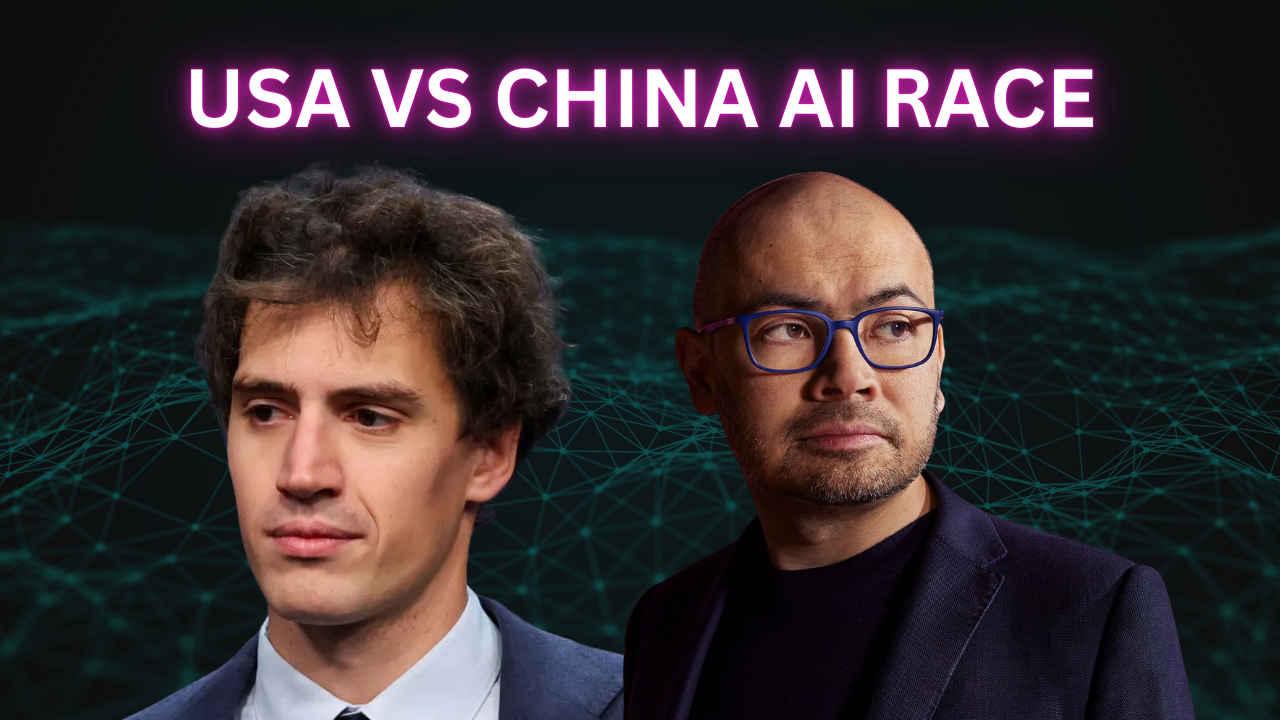
Source: Digit
This stance contrasts sharply with assessments from other industry leaders. Google DeepMind CEO Demis Hassabis told attendees that China remains approximately six months behind the West in frontier models development and hasn't demonstrated the ability to break new ground.
1
Anthropic CEO Dario Amodei went further, suggesting that US export restrictions are effectively slowing Chinese AI development and comparing high-end AI chips sales to China as akin to "selling nuclear weapons to North Korea." Yet even Hassabis's estimate represents a significant narrowing from previous assessments that placed China 18 to 24 months behind, suggesting the gap is closing faster than many anticipated.4
Hardware Sanctions Drive Open-Source Innovation
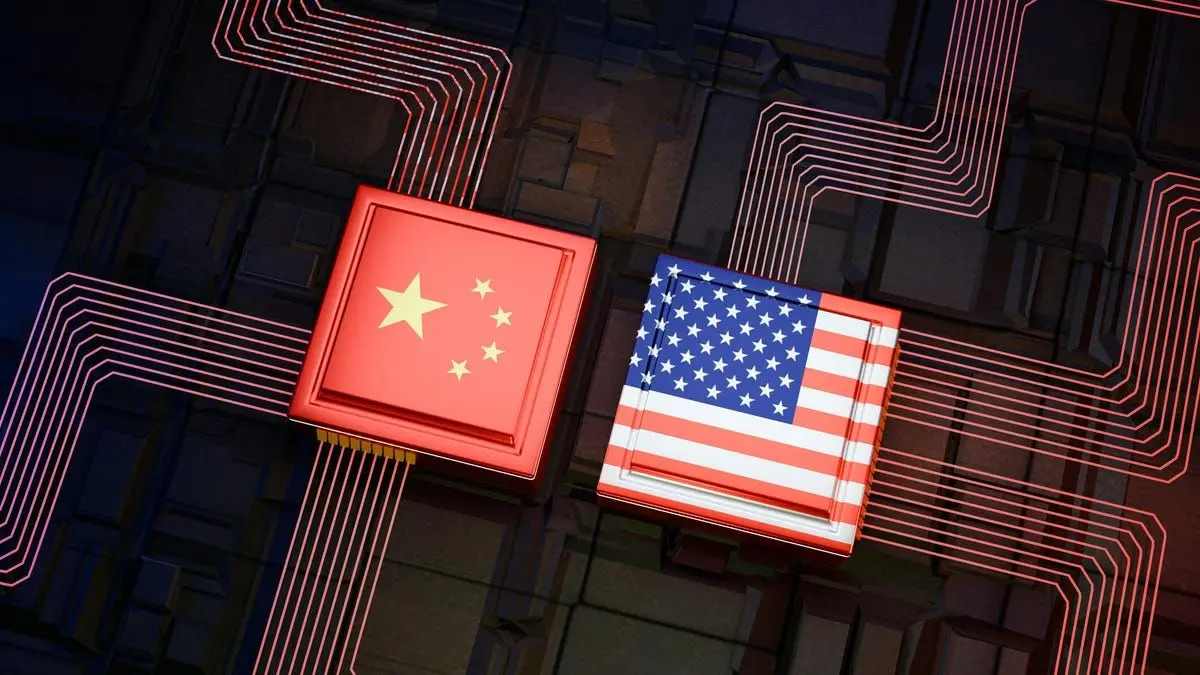
The US-China AI competition has been fundamentally shaped by export controls targeting semiconductors and AI chips. Since 2022, the Biden administration restricted exports of advanced manufacturing equipment and Nvidia chips to China, creating what many assumed would be an insurmountable barrier.
3
DeepSeek CEO Liang Wenfeng acknowledged in July 2024 that "money has never been the problem for us; bans on shipments of advanced chips are the problem."3

Source: TIME
Yet these hardware sanctions may have produced an unintended consequence. Chinese developers, forced to work with limited compute power, have focused intensely on algorithmic efficiency rather than simply scaling up parameter counts. The success of DeepSeek's R1 model—released on January 20, 2025, the same day as Trump's inauguration—demonstrated what talented teams can achieve with constrained resources.
3
Industry watchers called it a "Sputnik moment" for China's AI industry, with the model showing performance comparable to leading Western chatbots despite running on significantly less ambitious hardware budgets.1
4
The Trump administration's January export rules could dramatically shift this landscape. The new regulations would give Chinese companies access to 890,000 of Nvidia's H200 AI chips—more than double the number Chinese manufacturers are expected to produce in 2026, according to the Center for a New American Security.
3
Janet Egan, one of the report's authors, warned that "the U.S. is essentially equipping its leading strategic competitor." However, Chinese customs officials initially blocked imports of these chips, reflecting Beijing's push to reduce reliance on overseas technology and force domestic companies to buy Chinese semiconductors.2
China's Pragmatic Approach Versus AGI Ambitions
While American tech companies like OpenAI and Google DeepMind pursue artificial general intelligence as the next frontier, China's national AI policy has taken a markedly different direction. The Chinese government's August "AI+ strategy" outlined how artificial intelligence could accelerate development goals through practical applications—improving medical diagnoses, optimizing supply chains—but made no mention of AGI.
2
"The Chinese government is intently focused on reaping the benefits of AI in the here and now and in the near future through diffusion and application of AI across the economy, society, defence, and other areas," explained Julian Gewirtz, former senior director for China and Taiwan at the White House national security council.
2
This practical focus reflects both limited computing resources and Xi Jinping's historical preference for the physical economy over intangible forces.Yet Chinese companies are beginning to articulate grander visions. In September, Alibaba CEO Eddie Wu announced plans to invest 380 billion yuan (£40 billion) in AI infrastructure over three years while speaking about artificial superintelligence that "could produce a generation of 'super scientists' and 'full-stack super engineers.'"
2
Tech writer Afra Wang noted this represented a breakthrough, with major Chinese companies beginning to articulate visions "that carry the flavour of future prophecy" typically associated with Western tech CEOs.Related Stories


Talent and Energy Advantages Could Reshape Competition
China produces far more top AI researchers than the US, according to analysis of authors at NeurIPS, a leading AI conference. While many historically worked in America, the share working in China more than doubled between 2019 and 2022.
3
A Stanford analysis found that more than half of researchers behind DeepSeek's breakthrough "never left China for schooling or work," challenging assumptions about America's natural AI talent lead.3
The Trump administration's new $100,000 visa price tag for foreign talent may further shift this balance, potentially hurting US innovation and competitiveness.Energy access presents another strategic advantage for China. The country has produced more energy than the US since 2010, a critical factor as AI training becomes increasingly power-hungry and American companies scramble to secure contracts with energy providers.
3
"Of all the key inputs into AI, energy is the one where the U.S. is least competitive," notes Chris Miller, author of Chip War. For now, China's AI development remains bottlenecked by chip access, but if that constraint eases through relaxed US export restrictions or increased domestic semiconductor production, ready access to energy could prove decisive.Open-Source AI Disrupts Traditional Power Dynamics
The friction between Mensch and Hassabis's assessments underscores how open-source innovation is reshaping the global AI race. While Western giants like Google, OpenAI, and Anthropic have pursued closed proprietary systems to protect intellectual property, China has embraced an open ecosystem partly by necessity and partly by strategy.
4
When Chinese labs release highly efficient models like DeepSeek, they're immediately dissected, optimized, and improved upon by the global developer community—including Western engineers.Mensch's confidence isn't merely analytical—it's backed by Mistral's aggressive expansion. The Paris-based startup, which received €1.3 billion ($1.5 billion) in investment led by Dutch chip-machine maker ASML Holding in 2024, projects over €1 billion in revenue for 2026 and plans to invest $1 billion in capital spending this year.
1
The company is targeting enterprise clients including HSBC Holdings and BNP Paribas while actively eyeing acquisition targets.Chinese large language models have lagged behind American models by seven months on average, according to Epoch AI.
3
However, AI policy researcher Lennart Heim notes that "the best metrics are the numbers we don't have," making definitive assessments challenging. By declaring the US lead a "fairy tale," Mensch signals that the era of uncontested American dominance may be ending. If European startups and Chinese labs can rival Silicon Valley's output with a fraction of the capital and hardware access, the question shifts from whether there's a gap to whether raw compute power still determines who wins the AI race.References
Summarized by

Navi
Related Stories
Recent Highlights
1
Apple Plans Major Siri AI Overhaul in iOS 27 With Third-Party Chatbot Integration
Technology

2
OpenAI shuts down Sora after six months, ending Disney's $1 billion licensing partnership
Technology

3
AI chatbots validate you too much, making you less kind to others, Stanford study reveals
Science and Research

Recent Highlights
Today's Top Stories








Your Daily Dose of Curated AI News
Don’t drown in AI news. We cut through the noise - filtering, ranking and summarizing the most important AI news, breakthroughs and research daily. Spend less time searching for the latest in AI and get straight to action.

