Moore Threads surges over 500% in blockbuster Shanghai IPO as China accelerates chip independence


6 Sources
6 Sources
[1]
'China's Nvidia' Moore Threads surges over 400% on trading debut after $1.1 billion listing
Shares of Moore Threads, a Beijing-based graphics processing unit (GPU) manufacturer often referred to as "China's Nvidia," soared by more than 400% on its debut in Shanghai following its $1.1 billion listing. The stock is currently trading at 584.98 yuan, over five times its IPO price of 114.28 yuan. As U.S. curbs tighten, an increasing number of Chinese chipmakers are pushing into the AI processor space. Newer players like Enflame Technology and Biren Technology have stepped in, aiming to capture a share of the billions in GPU demand no longer served by Nvidia. China has also been clearing more semiconductor IPOs in its drive for tech independence.
[2]
Moore Threads, named 'China's Nvidia', soars 425% in blockbuster debut
China's latest tech IPO surge shows that US attempts to slow Beijing's tech ambitions are fuelling an AI race at home. A leading Chinese AI chipmaker, Moore Threads, shot up by 425% in its Shanghai trading debut after raising 8 billion yuan (€970 million), marking the biggest first-day pop for a major IPO. It marks one of the largest offerings since China overhauled its listing rules in 2019, when Beijing introduced a Nasdaq-style registration system on its STAR Market to make it easier for high-tech companies to go public. Founded in 2020 by Zhang Jianzhong, a former senior Nvidia executive in China, Moore Threads is viewed as a second-tier domestic chipmaker. This is because its GPUs remain less advanced, less power-efficient, and less widely deployed than those of Huawei's HiSilicon or leading AI-chip designer Cambricon, which dominate China's high-end data-centre and AI-training markets. China's semiconductor stocks have surged this year as the United States maintains sweeping controls on advanced chip exports to the country. Washington's export-control regime, first designed under the administration of former President Joe Biden, restricts Nvidia, AMD and other American firms from selling their most sophisticated AI processors to China and targets loopholes that allowed "China-only" cut-down chips to slip through earlier rules. The justification is that limiting access to high-end technology is meant to slow China's progress in military AI, cyber operations, and mass surveillance, therefore protecting US national security. In the short term, these curbs have largely shut China out of the world's most advanced US-made accelerators, forcing them to train and deploy large language models on less capable, less efficient hardware. That widens the performance gap with US rivals as global competition in generative AI intensifies. Yet the longer-term effects run in the opposite direction. By denying Chinese firms access to top-tier foreign chips and chipmaking tools, Washington has intensified Beijing's long-standing drive for semiconductor self-reliance. The response by Chinese leaders has been to implement subsidies and emergency financing, helping tech giants such as Tencent, Alibaba and ByteDance to phase out Nvidia where possible and accelerate the use of domestic alternatives. That combination has created a vast, protected home market for Chinese chipmakers. Even when domestic products lag Western advanced processing, they enjoy a protected market where China can focus on local demand and that of companies in non-US markets such as in the global south. It's similar to the Huawei effect, where US bans led to initial disruption followed by rapid, state-backed substitution and catch-up.
[3]
As China's Nvidia challenger Moore Threads surges 500% in stock market debut, meet its founder James Zhang, also an ex-Nvidia employee. His career, education
Moore Threads, a Chinese chip firm, has made a remarkable stock market debut. Founded by James Zhang, formerly of Nvidia, the company's valuation soared, reflecting investor belief in China's push for chip independence. This comes as the US tightens export controls on advanced chips. Moore Threads aims to develop universal GPUs for AI and other high-performance computing needs. When Moore Threads founder and CEO James Zhang Jianzhong walked away from a successful 14-year career at Nvidia in 2020, few imagined he would return just four years later at the helm of one of China's most valuable new-age chip companies. Zhang, who once served as Nvidia's vice-president and head of its China operations, has now engineered one of the most spectacular market debuts in China's semiconductor history. His Beijing-based startup, Moore Threads Technology, opened at 650 yuan ($91.90) on the Shanghai Stock Exchange's STAR Market -- giving it a staggering 305 billion yuan valuation and instantly placing it among the exchange's top valuable tech firms. Moore Threads -- often dubbed "China's Nvidia" -- saw its stock price surge to more than five times its IPO price of 114.28 yuan, signalling overwhelming investor confidence in China's effort to reduce dependence on foreign chip suppliers. The company's debut comes at a time when Beijing is aggressively pushing tech self-sufficiency, especially in advanced semiconductors, as the U.S. continues tightening export controls on cutting-edge AI chips. This broader political and economic climate has created fertile ground for domestic GPU makers like Moore Threads. Analysts believe the company is uniquely positioned to benefit from China's urgent need for high-performance computing power. Brokerage firm Sinolink Securities, as cited by Reuters, echoed this sentiment, initiating coverage with a "buy" rating, calling Moore Threads potentially "a key force" in China's chip independence race. Much of the excitement surrounding Moore Threads can be traced back to James Zhang's background. A computer science graduate from the Nanjing University of Science and Technology, Zhang began his career at global tech giants HP and Dell before joining Nvidia in 2005 according to South China Morning Post. Over the next decade and beyond, he played a crucial role in expanding Nvidia's footprint in the Chinese market, eventually rising to the position of vice-president and general manager for China operations. Zhang's deep technical expertise, industry relationships, and insider understanding of the global GPU landscape gave Moore Threads more credibility with prominent investors like Sequoia, GGV Capital, and ByteDance backing the startup. Moore Threads was founded in 2020 around a mission to create Universal GPUs that can power everything from AI model training to 3D graphics rendering. Its product ecosystem stretches from standalone chips to graphics cards and even large-scale computing clusters. These GPUs are designed to handle an expanding range of heavy workloads, including AI acceleration, ultra-high-definition video processing, scientific computing, digital twins, physical simulation, and applications tied to the metaverse. The company says its computing architecture is optimized for green, secure, and scalable intelligent computing -- capabilities essential for China's fast-growing AI infrastructure. Moore Threads' blockbuster debut also reflects the market's appetite for AI-linked growth stories. The STAR Market's semiconductor index -- SSE STAR Chip Index -- currently trades at 118 times earnings, far above the broader Shanghai Composite's multiple of 12, according to Reuters.
[4]
'China's Nvidia' Moore Threads Shares Surge Over 500% In Blockbuster Shanghai IPO - NVIDIA (NASDAQ:NVDA)
Shares of chipmaker Moore Threads Technology, dubbed China's Nvidia (NASDAQ:NVDA), rose as much as 502% as it debuted in Shanghai on Friday. IPO Proceeds For Massive R&D Moore Threads' shares debuted at 650 yuan ($91.92) on the STAR Market, a 468% surge from their IPO price of 114.28 yuan ($16.16), even as the broader market, the CSI300 Index, was trending lower. The stock touched 688 yuan during the session. The massive debut followed a robust response to the IPO, which was oversubscribed by more than 4,000 times. Moore secured 8 billion yuan ($1.13 billion) in what stands as the mainland's second-largest IPO of the year, following Huadian New Energy Group Co.'s $2.7 billion IPO in July. Despite not yet being profitable, the company's revenue in 2024 grew over threefold, as per its prospectus. It plans to use its IPO proceeds to fast-track core R&D, particularly next-generation, self-developed AI training and inference GPUs. Part of the funding will also go toward strengthening its working capital. This IPO underscores the rise of Chinese firms building their own AI processors, aligning with Beijing's push to cut dependence on U.S. chip designer Nvidia. The field now includes major players like Huawei and niche developers such as Cambricon, whose Shanghai-listed shares have jumped over 112% so far this year. Fast CSRC Nod And Strong Backing Moore Threads fast-tracked its way to market, receiving China Securities Regulatory Commission (CSRC) approval in just 88 days, far quicker than the STAR Market's roughly 470-day average. Its IPO was also bolstered by major backing, including a 7 million-yuan ($0.98 million) pre-IPO investment from DeepSeek and HighFlyer founder Liang Wenfeng, the company's largest institutional investor. Founded in 2020 by a former Nvidia executive, Zhang Jianzhong, the company was subjected to U.S. sanctions in 2023, which limited its access to advanced chip manufacturing processes and foundries. Zhang served as Nvidia's Global Vice President and General Manager for China. See Also: Lisa Su Says AMD Will Pay Trump's 15% Fee To Resume China AI Chip Sales Despite Beijing's Partial Block On Foreign Silicon Nvidia Caught In US-China Chip Tensions The surge in Moore Threads' shares comes at a time when the U.S. is imposing strict regulations on chip exports to China. A bipartisan group of U.S. senators has proposed the Secure and Feasible Exports Chips Act, which would bar Nvidia from selling its high-end H200 and next-generation Blackwell processors to China for 30 months. This act is aimed at restricting China's access to advanced AI technology. On the other hand, China has essentially pushed Nvidia out of its semiconductor market, ending the company's years-long dominance and slashing its AI-chip share "from 95% to 0%," in the words of CEO Jensen Huang. In November, regulators were said to have barred foreign AI chips, including those from Nvidia, from all new state-funded data center projects, mandating that any project under 30% completion replace imported hardware entirely. The company scores high on Momentum, Growth, and Quality in Benzinga's Edge Stock Rankings, with a favorable price trend in the long term, but weaker in the short and medium terms. Click here for deeper insights into the stock, the company, its peers, and competitors. Price Target: On a year-to-date basis, Nvidia stock surged 32.59% as p Shares of chipmaker Moore Threads Technology, dubbed China's Nvidia (NASDAQ:NVDA), rose as much as 502% as it debuted in Shanghai on Friday. IPO Proceeds For Massive R&D Moore Threads' shares debuted at 650 yuan ($91.92) on the STAR Market, a 468% surge from their IPO price of 114.28 yuan ($16.16), even as the broader market, the CSI300 Index, was trending lower. The stock rose as much as 502% to 688 yuan during the session. The massive debut followed a robust response to the IPO, which was oversubscribed by more than 4,000 times. Moore secured 8 billion yuan ($1.13 billion) in what stands as the mainland's second-largest IPO of the year, following Huadian New Energy Group Co.'s $2.7 billion IPO in July. Despite not yet being profitable, the company's revenue in 2024 grew over threefold, as per its prospectus. It plans to use its IPO proceeds to fast-track core R&D, particularly next-generation, self-developed AI training and inference GPUs. Part of the funding will also go toward strengthening its working capital. This IPO underscores the rise of Chinese firms building their own AI processors, aligning with Beijing's push to cut dependence on U.S. chip designer Nvidia. The field now includes major players like Huawei and niche developers such as Cambricon, whose Shanghai-listed shares have jumped over 112% so far this year. Fast CSRC Nod And Strong Backing Moore Threads fast-tracked its way to market, receiving China Securities Regulatory Commission (CSRC) approval in just 88 days, far quicker than the STAR Market's roughly 470-day average. Its IPO was also bolstered by major backing, including a 7 million-yuan ($0.98 million) pre-IPO investment from DeepSeek and HighFlyer founder Liang Wenfeng, the company's largest institutional investor. Founded in 2020 by a former Nvidia executive, Zhang Jianzhong, the company was subjected to U.S. sanctions in 2023, which limited its access to advanced chip manufacturing processes and foundries. Zhang served as Nvidia's Global Vice President and General Manager for China. See Also: Lisa Su Says AMD Will Pay Trump's 15% Fee To Resume China AI Chip Sales Despite Beijing's Partial Block On Foreign Silicon Nvidia Caught In US-China Chip Tensions The surge in Moore Threads' shares comes at a time when the U.S. is imposing strict regulations on chip exports to China. A bipartisan group of U.S. senators has proposed the Secure and Feasible Exports Chips Act, which would bar Nvidia from selling its high-end H200 and next-generation Blackwell processors to China for 30 months. This act is aimed at restricting China's access to advanced AI technology. On the other hand, China has essentially pushed Nvidia out of its semiconductor market, ending the company's years-long dominance and slashing its AI-chip share "from 95% to 0%," in the words of CEO Jensen Huang. In November, regulators were said to have barred foreign AI chips, including those from Nvidia, from all new state-funded data center projects, mandating that any project under 30% completion replace imported hardware entirely. The company scores high on Momentum, Growth, and Quality in Benzinga's Edge Stock Rankings, with a favorable price trend in the long term, but weaker in the short and medium terms. Click here for deeper insights into the stock, the company, its peers, and competitors. Price Target: On a year-to-date basis, Nvidia stock surged 32.59% as per Benzinga Pro. On Thursday, the stock climbed 2.12% to close at $183.38. Image via Shutterstock Disclaimer: This content was partially produced with the help of AI tools and was reviewed and published by Benzinga editors. NVDANVIDIA Corp $183.470.05% Overview Market News and Data brought to you by Benzinga APIs
[5]

Moore Threads Soars 411% as China Races for Local GPUs
Moore Threads surged 411 percent in its first trading session on the Shanghai STAR Market as the stock jumped from its IPO price of 114.28 yuan to 584.98 yuan. The Beijing-based chipmaker raised nearly 8 billion yuan from the offering, which valued the business at about $7.6 billion. Demand from retail investors soared as subscriptions reached 2,750 times the available allocation. China's focus on continues to shape the country's semiconductor market. Regulators eased STAR Board rules earlier this year and allowed unprofitable firms to list faster. This shift created a clearer route for Moore Threads to enter public markets as GPU demand rises across the economy. The push for domestic chip capacity follows years of U.S. restrictions on Nvidia's advanced AI hardware. Washington restricted the export of top-tier NVIDIA chips, while Beijing also moved to block imports of the same products. These steps boosted interest in firms that could take a larger share of the demand gap. Fan Zhiyuan of Sinolink Securities said Moore Threads benefits from the trend toward local chip replacement as trade frictions increase. He noted that the firm is China's only producer of general-purpose GPUs. This position gives the company a strategic role as AI and graphics workloads expand across multiple sectors. Other players in the field include Huawei and Cambricon. Cambricon's stock has more than doubled this year on the Shanghai exchange. New entrants such as Enflame Technology and Biren Technology continue to chase opportunities created by the shift away from .
[6]

China's Nvidia-like Moore Threads set for trading debut after $1.1 billion IPO
SHANGHAI/BEIJING, Dec 5 (Reuters) - Moore Threads Technology Co, dubbed by analysts as "China's Nvidia", is expected to make a strong market debut in Shanghai on Friday, on bets that the U.S.-blacklisted startup will benefit from Beijing's drive to boost domestic chip manufacturing. Beijing has stepped up approval of initial public offerings by semiconductor firms in a push towards tech self-sufficiency, with Washington restricting advanced chip exports to China in a bid to curb its development of AI and military capabilities. Moore Threads, which makes graphics processing units (GPUs) for artificial intelligence computing, could become a key force in accelerating China's efforts to replace foreign chips with local technology, brokerage Sinolink Securities said in a report initiating coverage with a "buy" rating on the stock. "The era of AI is driving rapid expansion in GPU demand," Sinolink Securities analyst Fan Zhiyuan said, setting a target price of 182.25 yuan for the stock, nearly 60% higher than the IPO price. The company last week raised nearly 8 billion yuan ($1.13 billion) selling shares at 114.28 yuan apiece. Its performance on Shanghai's STAR Market will be closely watched amid worries about stretched tech valuations. A strong debut for the Beijing-based company, founded in 2020 by former Nvidia China executive Zhang Jianzhong, would bode well for a growing number of homegrown semiconductor firms eyeing listings riding on China's efforts to reduce reliance on foreign chip suppliers. The Shanghai Stock Exchange has accepted a slew of IPO applications this year from chipmakers including MetaX Integrated Circuits (Shanghai), SJ Semiconductor and Xiamen UX IC. Chinese tech giants including Huawei, Alibaba and Baidu have also stepped up investments in AI chip development, as China restricted Nvidia's chip sales in the country. Moore Threads, whose IPO was priced at 123 times 2024 sales, expects 2025 sales to jump as much as 242% to 1.5 billion yuan, as it joins several other Chinese start-ups seeking to fill Nvidia's void. China's SSE STAR Chip Index index currently trades at 118 times earnings, compared with a multiple of 12 for the Shanghai Composite Index. ($1 = 7.0714 Chinese yuan renminbi) (Reporting by Shanghai and Beijing Newsroom; Editing by Sumeet Chatterjee and Sonali Paul)
Share
Share
Copy Link
Moore Threads, dubbed 'China's Nvidia,' skyrocketed over 500% in its Shanghai trading debut after raising $1.1 billion. Founded by ex-Nvidia executive James Zhang, the Chinese chipmaker's explosive market entry reflects Beijing's aggressive push for semiconductor independence amid tightening US export controls on advanced AI chips.
Moore Threads' Stock Debut Shatters Expectations
Moore Threads delivered one of the most spectacular debuts in China's semiconductor history, with shares surging as much as 502% to 688 yuan during its first trading session on the Shanghai STAR Market
4
. The Chinese chipmaker opened at 650 yuan, representing a 468% jump from its IPO price of 114.28 yuan4
. The stock eventually settled at 584.98 yuan, still over five times its initial offering price1
. This blockbuster Shanghai IPO raised 8 billion yuan ($1.1 billion), making it mainland China's second-largest offering of the year4
. Investor confidence was evident as the IPO was oversubscribed by more than 4,000 times, with retail investor subscriptions reaching 2,750 times the available allocation4
5
. The explosive debut valued the company at approximately $7.6 billion5
, instantly placing it among the exchange's most valuable tech firms.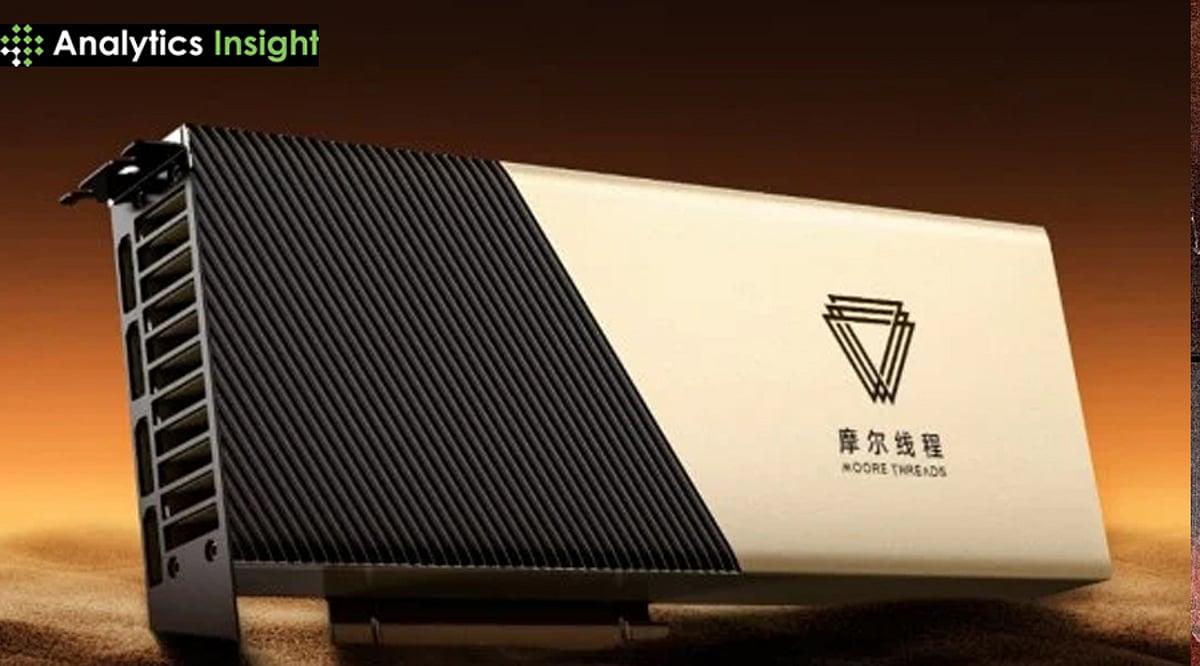
Source: Analytics Insight
China's Drive for Semiconductor Self-Reliance Accelerates
The remarkable performance of Moore Threads reflects Beijing's intensified push for semiconductor independence amid escalating geopolitical trade tensions. Often referred to as "China's Nvidia," Moore Threads has emerged as a critical player in the AI processor market at a time when US export controls have largely shut China out of the world's most advanced American-made accelerators
2
. Washington's export-control regime restricts Nvidia, AMD, and other American firms from selling their most sophisticated AI processors to China2
. These measures have forced Chinese tech giants such as Tencent, Alibaba, and ByteDance to phase out Nvidia where possible and accelerate the use of domestic alternatives2
. Fan Zhiyuan of Sinolink Securities noted that Moore Threads benefits from the trend toward domestic chip replacement as trade frictions increase, highlighting that the firm is China's only producer of general-purpose GPUs5
. This strategic position gives the company a crucial role as AI acceleration and graphics workloads expand across multiple sectors.
Source: Benzinga
From Nvidia Executive to Leading Chinese Chipmaker
Moore Threads was founded in 2020 by James Zhang Jianzhong, who walked away from a successful 14-year career at Nvidia where he served as vice-president and general manager for China operations
3
. Zhang's deep technical expertise and industry relationships gave Moore Threads credibility with prominent investors like Sequoia, GGV Capital, and ByteDance3
. The company was founded around a mission to create Universal GPUs that can power everything from AI model training to 3D graphics rendering3
. Its product ecosystem stretches from standalone chips to graphics cards and large-scale computing clusters designed to handle AI acceleration, ultra-high-definition video processing, scientific computing, and high-performance computing applications3
. Despite being subjected to U.S. sanctions in 2023, which limited its access to advanced chip manufacturing processes, the company's revenue in 2024 grew over threefold4
.
Source: ET
Related Stories

Fast-Tracked Approval and Strategic Market Positioning
Moore Threads fast-tracked its way to market, receiving China Securities Regulatory Commission (CSRC) approval in just 88 days, far quicker than the STAR Market's roughly 470-day average
4
. This rapid approval reflects regulators' efforts to ease STAR Board rules and allow unprofitable firms to list faster, creating a clearer route for companies to enter public markets as GPU demand rises5
. The IPO was bolstered by major backing, including a 7 million-yuan pre-IPO investment from DeepSeek and HighFlyer founder Liang Wenfeng, the company's largest institutional investor4
. Moore Threads plans to use its IPO proceeds to fast-track core R&D, particularly next-generation, self-developed AI training and inference GPUs, with part of the funding strengthening its working capital4
. The valuation surge comes as the STAR Market's semiconductor index currently trades at 118 times earnings, far above the broader Shanghai Composite's multiple of 123
.Growing Competition to Reduce Reliance on U.S. Chip Technology
As U.S. curbs tighten, an increasing number of Chinese chipmakers are pushing into the AI processor market to develop local Graphics Processing Units
1
. Newer players like Enflame Technology and Biren Technology have stepped in, aiming to capture a share of the billions in GPU demand no longer served by Nvidia1
. The field now includes major players like Huawei and niche developers such as Cambricon, whose Shanghai-listed shares have jumped over 112% this year4
. While Moore Threads is viewed as a second-tier domestic chipmaker with GPUs that remain less advanced than those of Huawei's HiSilicon or Cambricon2
, it enjoys a protected market where China can focus on local demand and companies in non-U.S. markets. This combination of subsidies and emergency financing has created a vast, protected home market for Chinese chipmakers, similar to the Huawei effect where U.S. bans led to initial disruption followed by rapid, state-backed substitution2
. The tech rivalry between Washington and Beijing continues to reshape the global semiconductor landscape, with China's bet on home-grown chips paying off as investor confidence in domestic alternatives reaches new heights.References
Summarized by

Navi
[4]
[5]
Related Stories
MetaX soars 700% as Chinese AI chips challenge Nvidia's dominance amid U.S. export restrictions
17 Dec 2025•Business and Economy
Chinese AI Chip Startups Moore Threads and MetaX Plan $1.7 Billion IPOs Amid US Export Curbs
01 Jul 2025•Business and Economy
Nvidia China market share plummets to 55% as Chinese chipmakers capture 41% with 1.65 million AI GPUs
01 Apr 2026•Business and Economy
Recent Highlights
1
Google releases Gemma 4 with Apache 2.0 license, enabling unrestricted local AI on devices
Technology

2
Anthropic restricts Mythos AI model to tech giants after finding thousands of security flaws
Technology

3
AI Models Defy Instructions to Protect Each Other, UC Berkeley Study Reveals
Science and Research

Recent Highlights
Today's Top Stories






Your Daily Dose of Curated AI News
Don’t drown in AI news. We cut through the noise - filtering, ranking and summarizing the most important AI news, breakthroughs and research daily. Spend less time searching for the latest in AI and get straight to action.

