NHS launches AI and robotic tools trial to detect lung cancer at Guy's and St Thomas' trust


2 Sources
2 Sources
[1]
NHS England to trial AI and robotic tools to detect and diagnose lung cancer
Pilot comes at same time as pledge to offer all smokers and ex-smokers lung cancer screening by 2030 NHS England is to trial a combination of AI and robot-assisted care to speed up the detection and diagnosis of lung cancer, the UK's most lethal form of the disease. The trial comes at the same time as the health service pledges to offer all smokers and ex-smokers the chance to be screened for lung cancer by 2030. That expansion will lead to an estimated 50,000 lung cancers being diagnosed by 2035, of which 23,000 will be at early stage, which could save thousands of lives, it said. The disease is a particular focus of the government's forthcoming national cancer plan for England because it is Britain's biggest cancer killer, reflecting historic high rates of smoking. It claims 33,100 lives a year across the UK, about 91 a day. It is also a key area for improvement because it is a stark example of health inequalities that mirror people's wealth. It affects poorer people so disproportionately that it accounts for an entire year of the nine-year gap in life expectancy between England's most and least deprived areas. NHS chiefs hope that deploying AI and robotic technology will help doctors uncover more cases, which will enable treatment to start sooner and enhance the patient's chances of survival. The trial will be undertaken at Guy's and St Thomas' NHS trust in London. "This is a glimpse of the future of cancer detection", said Prof Peter Johnson, NHS England's national clinical director for cancer. In the trial, AI software will analyse lung scans and alert doctors to the presence of small lumps - some just 6mm long, the size of a grain of rice - that are most likely to be cancerous. A robotic camera will then guide the miniature tools used to undertake a biopsy, to produce a sample of tissue that can be analysed in a laboratory more precisely than with existing techniques. That will enable potentially cancerous nodules hidden deep in someone's lung, which are hard to spot at present, to be removed and examined. "If shown to be effective, the technology could help transform lung cancer diagnosis as the NHS screening programme increasingly identifies more people with very small nodules that would previously have gone undetected until much later", NHS England said. "For many patients, weeks of repeat scans and procedures could be replaced with a single half-hour cancer biopsy, reducing prolonged uncertainty and avoiding more invasive surgery." The team behind the trial has already carried out about 300 robotic biopsies, which led to 215 people having cancer treatment. "Lung cancer is the leading cause of cancer death in the UK, but diagnosing it at an earlier stage can significantly improve people's chances of survival", said the chief executive of Cancer Research UK, Michelle Mitchell. "New technologies like this have huge potential, and tests to ensure they're accurate and beneficial for patients in the real world should happen quickly so that innovations can reach everyone sooner."
[2]
Lung cancer: 'Trailblazing' NHS scheme hailed as a 'glimpse of the future'
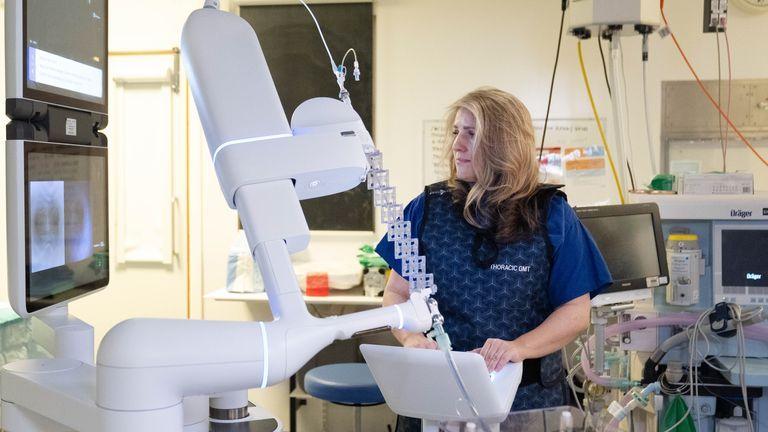
Under the pilot scheme, AI software will be used to analyse lung scans and flag suspicious spots, before a robotic catheter takes precise biopsies, which are then checked in a lab to diagnose or rule out cancer. AI and robotics are to be used to help detect lung cancer in a "trailblazing" scheme that experts are calling "a glimpse of the future of cancer detection". It comes alongside NHS plans to expand lung cancer screening, with all eligible people invited for their first check by 2030. Alongside the expansion, AI software will be used to analyse patients' lung scans and flag suspicious spots, known as nodules. A robotic catheter - a thin tube inserted into the patient via the throat - is used to take precise biopsies directly from the nodule, which are then checked in a lab to diagnose or rule out cancer. The robotic system can reach spots as small as six millimetres, which are often hidden deep in the lung and can be missed at screening. It's harder for doctors to reach such nodules to take biopsies, meaning patients must wait for further scans to see if they grow. Specialists at Guy's and St Thomas' NHS Foundation Trust have already used robotic biopsies on 300 patients, with some 215 of them going on to have cancer treatment. The new pilot will involve a further 250 patients, and it's hoped other trusts will start performing the procedure. Read more from Sky News: King's 'good news' on cancer Lung cancer is the third most common cancer in the UK, with more than 49,000 new diagnoses and around 33,000 deaths every year. Since 2019, more than 1.5 million people in England between the ages of 55 and 74 who have ever smoked have been invited to have their lung health checked, NHS England said, and a further 1.4 million people will be contacted next year alone. Professor Peter Johnson, NHS England's national clinical director for cancer, said screening means more cases are being picked up at an early stage than ever, and the new pilot will support even "faster, more accurate biopsies". "This is a glimpse of the future of cancer detection," he said. Health Secretary Wes Streeting underwent robotic surgery when being treated for kidney cancer and said the NHS treatment "saved my life". He said the pilot will help catch the illness earlier, "replacing weeks of invasive testing with a single targeted procedure".
Share
Share
Copy Link
NHS England is trialing AI software and robotic tools to speed up lung cancer detection and diagnosis at Guy's and St Thomas' NHS trust in London. The pilot aims to identify cancerous nodules as small as 6mm and deliver precise biopsies in a single half-hour procedure, potentially replacing weeks of invasive testing for patients.
NHS Pilots AI and Robotic Technology for Faster Lung Cancer Detection
NHS England has launched a pilot scheme combining AI software and robotic tools to detect and diagnose lung cancer more rapidly, targeting the UK's deadliest cancer that claims 33,100 lives annually
1
. The trial at Guy's and St Thomas' NHS trust in London represents what Prof Peter Johnson, NHS England's national clinical director for cancer, calls "a glimpse of the future of cancer detection"1
. This initiative arrives alongside the NHS pledge to offer lung cancer screening to all smokers and ex-smokers by 2030, an expansion expected to identify 50,000 lung cancers by 2035, with 23,000 caught at early stage diagnosis1
.How AI Software and Robotic Catheter Technology Work Together
The NHS pilot scheme deploys AI to analyze lung scans and flag suspicious nodules, some as small as 6mm—roughly the size of a grain of rice
1
. Once identified, a robotic catheter inserted via the throat guides miniature tools to perform precise biopsies directly from these spots, which are often hidden deep within the lung and difficult to reach using conventional methods2
. The tissue samples are then analyzed in a laboratory to confirm or rule out cancer. This approach could replace weeks of repeat scans and invasive testing with a single half-hour procedure, significantly reducing patient anxiety and avoiding more complex surgery1
.
Source: Sky News
Early Results Show Promise for Patient Outcomes
Specialists at Guy's and St Thomas' have already performed approximately 300 robotic biopsies, resulting in 215 patients receiving cancer treatment
1
. The new pilot will extend this work to a further 250 patients, with hopes that other NHS trusts will adopt the procedure if proven effective2
. Lung cancer remains the third most common cancer in the UK, with more than 49,000 new diagnoses annually, and accounts for about 91 deaths per day2
. The disease disproportionately affects poorer communities, contributing to health inequalities that account for an entire year of the nine-year life expectancy gap between England's most and least deprived areas1
.Related Stories


Screening Expansion Aims to Improve Survival Chances
Since 2019, more than 1.5 million people in England aged 55 to 74 who have ever smoked have been invited for lung health checks, with an additional 1.4 million people set to be contacted next year alone
2
. Peter Johnson noted that screening is already picking up more cases at an early stage than ever before, and the new technology will support "faster, more accurate biopsies"2
. Michelle Mitchell, chief executive of Cancer Research UK, emphasized that "diagnosing it at an earlier stage can significantly improve people's survival chances," adding that tests to ensure these technologies are accurate should happen quickly so innovations can reach patients sooner1
. Health Secretary Wes Streeting, who underwent robotic surgery for kidney cancer, said the pilot will help catch the illness earlier, "replacing weeks of invasive testing with a single targeted procedure"2
. The technology's ability to identify cancerous tissue previously undetectable until much later stages could transform how the NHS approaches this cancer killer as screening programs expand nationwide.References
Summarized by

Navi
Related Stories
Recent Highlights
1
AI chatbots validate you too much, making you less kind to others, Stanford study reveals
Science and Research

2
Anthropic's Claude Code Source Leak Reveals Hidden AI Agent Plans and Extensive System Access
Technology

3
Judge blocks Pentagon from branding Anthropic a security risk over AI safety guardrails dispute
Policy and Regulation

Recent Highlights
Today's Top Stories










Your Daily Dose of Curated AI News
Don’t drown in AI news. We cut through the noise - filtering, ranking and summarizing the most important AI news, breakthroughs and research daily. Spend less time searching for the latest in AI and get straight to action.

