Sam Altman's Merge Labs raises $252 million to develop non-invasive brain-computer interfaces


11 Sources
11 Sources
[1]
OpenAI invests in Sam Altman's brain computer interface startup Merge Labs | TechCrunch
Just when you thought the circular deals couldn't get any more circular, OpenAI has invested in CEO Sam Altman's brain computer interface startup Merge Labs. Merge Labs, which defines itself as a "research lab" dedicated to "bridging biological and artificial intelligence to maximize human ability," came out of stealth on Thursday with an undisclosed seed round. A source familiar with the matter confirmed previous reports that OpenAI wrote the largest single check in Merge Labs's $250 million seed round at a $850 million valuation. "Our individual experience of the world arises from billions of active neurons," reads a statement from Merge Labs. "If we can interface with these neurons at scale, we could restore lost abilities, support healthier brain states, deepen our connection with each other, and expand what we can imagine and create alongside advanced AI." Merge Labs said it intends to reach these feats non-invasively by developing "entirely new technologies that connect with neurons using molecules instead of electrodes" to "transit and receive information using deep-reaching modalities like ultrasound." The move deepens Altman's competition with Elon Musk, whose own startup Neuralink is also developing computer interface chips that allow people who suffer from severe paralysis to control devices with their thoughts. Neuralink currently requires invasive surgery for implantation, where a surgical robot removes a small piece of skull and inserts ultra-fine electrode threads into the brain to read neural signals. The company last raised a $650 million Series E at a $9 billion validation in June 2025. While there are undoubtedly medical use cases for BCIs, Merge Labs seems more focused on using the technology to fulfill a Silicon Valley fantasy of combining human biology with AI to give us superhuman capabilities. "Brain computer interfaces (BCIs) are an important new frontier," OpenAI wrote in a blog post. "They open new ways to communicate, learn, and interact with technology. BCIs will create a natural, human-centered way for anyone to seamlessly interact with AI. This is why OpenAI is participating in Merge Labs' seed round." Aside from Altman, other co-founders include Alex Blania and Sandro Herbig, respectively CEO and product and engineering lead at Tools for Humanity, another Altman-backed company (and creator of the eye-scanning World orbs); Tyson Aflalo and Sumner Norman, co-founders of implantable neural tech company Forest Neurotech; and Mikhail Shapiro, a researcher at Caltech. As part of the deal, OpenAI will work with Merge Labs on scientific foundation models and other frontier tools to "accelerate progress." In its blog post, OpenAI noted that AI will not only help accelerate R&D in bioengineering, neuroscience, and device engineering, but that the interfaces will also benefit from AI operating systems that "can interpret intent, adapt to individuals, and operate reliably with limited and noisy signals." In other words, Merge Labs could function as a remote control for OpenAI's software. That leads into the circular nature of the deal: if Merge Labs succeeds, it could drive more users to OpenAI, which then justifies OpenAI's investment into the company. It also increases the value of a startup Altman owns using resources from a company he runs. OpenAI is also working with Jony Ive's startup io, which it acquired last year, to produce a piece of AI hardware that doesn't rely on a screen. Recent unconfirmed leaks suggest the device might be an earbud. OpenAI primarily invests through the OpenAI Startup Fund, which has invested in several other startups connected to Altman, including Red Queen Bio, Rain AI, and Harvey. OpenAI has also entered into commercial agreements with startups Altman personally owns or chairs, including nuclear fusion startup Helion Energy and nuclear fission company Oklo. Altman has been dreaming about the so-called "Merge" - the idea that humans and machines will merge - since at least 2017 when he published a blog post guessing it would happen somewhere between 2025 and 2075. He also speculated that the merge could take many forms, including plugging electrons into our brains or becoming "really close friends with a chatbot." He said a merge is our "best-case scenario" for humanity surviving against superintelligence AI, which he describes as a separate species that's in conflict with humans. "Although the merge has already begun, it's going to get a lot weirder," Altman wrote. "We will be the first species ever to design our own descendants. My guess is that we can either be the biological bootloader for digital intelligence and then fade into an evolutionary tree branch, or we can figure out what a successful merge looks like." TechCrunch has reached out to OpenAI and Merge Labs for more information.
[2]
OpenAI Invests in Sam Altman's New Brain-Tech Startup Merge Labs
Merge Labs has raised $252 million in funding from OpenAI, private investment firm Bain Capital, video game developer Gabe Newell, and others to use ultrasound to read and modulate the brain. Merge joins a growing number of companies, including Elon Musk's Neuralink, that are developing brain-computer interface technology. Its name comes from the Silicon Valley concept of "the merge," the hypothetical point at which humans and machine intelligence combine to form a hybrid consciousness, which Altman has written about. Altman previously invested in Musk's Neuralink, which has raised $1.3 billion. In contrast to Neuralink, Merge says it will not implant its technology in the brain. "We're developing entirely new technologies that connect with neurons using molecules instead of electrodes, transmit and receive information using deep-reaching modalities like ultrasound, and avoid implants into brain tissue," the company says on its website. Merge envisions interfaces that are "equal parts biology, device, and AI in a form factor that we ourselves want to use and is broadly accessible." AI will play a major role in Merge's approach. "High-bandwidth interfaces will benefit from AI operating systems that can interpret intent, adapt to individuals, and operate reliably with limited and noisy signals," according to the announcement from OpenAI. "OpenAI will collaborate with Merge Labs on scientific foundation models and other frontier tools to accelerate progress." Synchron, another brain-computer interface startup, which has raised $345 million to date, is working with chipmaker Nvidia to develop foundation models for the brain. The idea is that these AI models would learn from large amounts of brain data to create interfaces that are more intuitive with a larger range of abilities. Right now, brain-computer interfaces allow paralyzed individuals to do things like move computer cursors and robotic arms, but in the future these systems might be able to perform more complex tasks with the help of AI. Merge is a spinoff of the nonprofit Forest Neurotech, a Los Angeles-based nonprofit research organization formed in 2023, and several cofounders of Merge are also affiliated with Forest, a relationship that WIRED first reported on in December. Forest will continue as a nonprofit entity while also collaborating with Merge, according to a blog post from its parent organization. Merge has not specified what applications it will pursue, but Forest's interest in mental health disorders and brain injury may provide some clues about the company's initial direction. A miniaturized ultrasound device developed by Forest is being studied in an early safety trial in the UK. Most brain-computer interfaces, including those from Neuralink and Synchron, measure electrical activity directly from neurons. An ultrasound-based device, meanwhile, interprets neural activity indirectly by detecting changes in the brain's blood flow. At least 12 volunteers have received a Neuralink implant so far, while 10 participants have gotten Synchron's device, which is implanted in a blood vessel next to the brain rather than in the brain tissue itself. In addition to Altman, Merge Labs' cofounders include researchers Mikhail Shapiro, Tyson Aflalo, and Sumner Norman, as well as tech entrepreneurs Alex Blania and Sandro Herbig. The company is hiring for a number of positions.
[3]
OpenAI CEO Sam Altman raises $252 million for brain computer interface venture -- but Merge Labs is still in an early research phase
OpenAI is investing as it sees BCIs as 'an important new frontier' that will deliver seamless AI interactions. It is focused on non-invasive AI-accelerated tech. OpenAI has signaled its intentions to become a major player in brain computer interfaces (BCIs). The scale of the firm's first round of investment in Merge Labs, as it emerges from stealth mode, places it among the most heavily funded BCI efforts in the U.S., second only to Neuralink. That's because Merge Labs, co-founded by Altman, will be going forward with $252 million in its tech advancement war chest, reports Bloomberg. However, it admits there's a long road ahead. OpenAI wasn't the only contributor in this investment round, but it was the biggest. Another notable investor was Gabe Newell, co-founder of Valve, which owns the gaming storefront Steam. Newell's hat is already in this ring with his own brain tech company, Starfish Neuroscience. OpenAI's interest in Merge Labs BCIs could result in further public sparring matches between two of the biggest personalities in tech. Altman's Merge Labs will be making ripples in Musk's Neuralink pond. However, their approaches to BCIs, as we currently understand them, are quite different. These differences will likely be pivotal to their relative successes. The limited amount of Merge Labs' currently public materials confirms that the fledgling BCI outfit will be developing fundamentally new approaches to this technology. "We believe this requires increasing the bandwidth and brain coverage of BCIs by several orders of magnitude while making them much less invasive," explains a blog penned by the freshly uncloaked firm. "To make this happen, we're developing entirely new technologies that connect with neurons using molecules instead of electrodes, transmit and receive information using deep-reaching modalities like ultrasound, and avoid implants into brain tissue." Merge Labs also claims that the most recent breakthroughs in biotechnology, hardware, neuroscience, and computing will be adopted. The resulting BCIs, according to the company, will be "equal parts biology, device, and AI," mixed into an accessible form factor. So, in brief, Merge Labs BCIs will contrast with Neuralink's approach because they will avoid implants into brain tissue. The key will be whether the firm's technology can achieve workable results from "AI operating systems that can interpret intent, adapt to individuals, and operate reliably with limited and noisy signals." The $252 million investment in Merge Labs sounds like quite a gamble, as Bloomberg's report suggests the money will effectively establish a research lab to fix the disadvantages of the non-invasive BCI route. In other words, the money raised appears to be for a pre-prototype outfit, not a product-ready company. Meanwhile, Neuralink is pretty deep into testing its BCIs with humans, as are various Chinese competitors.
[4]
Altman's Merge Raises $252 Million to Link Brains and Computers
Merge Labs, a company co-founded by AI billionaire Sam Altman that is building devices to connect human brains to computers, raised $252 million. The company is being formed as entrepreneurs and investors across Silicon Valley anticipate a future where artificial intelligence is so advanced that humans will be willing -- and perhaps compelled -- to augment their brains to take advantage of it. Just as smartphones provide access to the digital world, experimental brain technology is being designed to streamline the experience. Merge's goal is to seamlessly connect people and artificial intelligence to "maximize human ability, agency, and experience," according to a post on its website Thursday. It did not disclose the valuation of the company. It plans to first develop products for medical use, then later for the general public. Merge's fundraising is significant in the field of brain technology. Of the major brain-computer interface companies, only Neuralink has raised more in a single funding round, according to data from PitchBook. OpenAI, where Altman is chief executive officer, is the largest investor in the round, which was led by Bain Capital, a spokesperson for OpenAI said. It includes other investors like Gabe Newell, co-founder of Valve Corporation, who also has his own brain tech company, Starfish Neuroscience. Merge said it does not have immediate plans to raise more money. Merge joins Elon Musk's Neuralink and several other companies in building brain-computer interfaces. The field has grown rapidly in recent years as advances in artificial intelligence yielded the computing power brain implants needed. Musk kicked off the race in 2016 by founding Neuralink, designed to build implants to augment human capabilities and ensure mankind doesn't become obsolete as artificial intelligence advances. Get the Tech Newsletter bundle. Get the Tech Newsletter bundle. Get the Tech Newsletter bundle. Bloomberg's subscriber-only tech newsletters, and full access to all the articles they feature. Bloomberg's subscriber-only tech newsletters, and full access to all the articles they feature. Bloomberg's subscriber-only tech newsletters, and full access to all the articles they feature. Bloomberg may send me offers and promotions. Plus Signed UpPlus Sign UpPlus Sign Up By submitting my information, I agree to the Privacy Policy and Terms of Service. There are already experimental brain implants for people with debilitating conditions like paralysis, allowing them to control computers with their minds and convert attempted speech into spoken words. The industry has raised more than $2 billion in the US, with similar businesses in China growing quickly with government support. Others are working on devices that use items like external headsets and don't require surgery, betting that will be more appealing. It is not clear what type of brain tech Merge will ultimately build, but the company's goal is not to implant it in the brain, said co-founder Mikhail Shapiro, in contrast to Neuralink and some other rivals. That will require solving hard scientific and engineering problems, which is why Merge is being set up as a research lab, said Shapiro, a Caltech professor who has been studying the brain for decades. "Merge Labs was founded with the notion that by focusing on these problems in a concerted, well-resourced way, we could solve them faster," Shapiro said. One of the company's goals is to build a device with high bandwidth, a measure of how much data it can handle. "If we can interface directly with the brain, with higher bandwidth, we should be able to do things that we're limited in our ability to do using the kind of interfaces we have now," he said. Merge said it's too early to say what those things are. Merge and OpenAI declined to make Altman available for comment. At a dinner with reporters in August, he said that he'd like to be able to think something and have ChatGPT respond to it. The next month, Neuralink's president discussed a similar idea. Other researchers are already studying devices that read peoples' attempted or intended speech directly from their brains. Merge's launch heightens Altman's rivalry with Musk. The once-close business partners were two of OpenAI's co-founders, though Musk left after disagreements. Altman also invested in Neuralink. Merge has an office in the San Francisco area and has brought on fewer than 50 employees, with plans to hire more. It does not have a president or a CEO. Altman is on Merge's board in a personal capacity, meaning he can still serve if he stops being CEO of OpenAI, an OpenAI spokesperson said. OpenAI has the right to a board observer seat, but an individual has not been chosen yet, they said. The board also includes Merge's four other co-founders, and no one else, according to Merge.
[5]

OpenAI co-funds brain-interface biz co-founded by CEO Altman
Merge Labs envisions controlling devices using your brain - without implanting hardware in your body OpenAI, having invested heavily in artificial intelligence, is placing a side bet on organic intelligence. The launderer of training data is participating in the funding of Merge Labs, a maker of brain computer interfaces. "Brain computer interfaces (BCIs) are an important new frontier," the AI biz said on Thursday. "They open new ways to communicate, learn, and interact with technology. BCIs will create a natural, human-centered way for anyone to seamlessly interact with AI. This is why OpenAI is participating in Merge Labs' seed round." The fact that OpenAI CEO Sam Altman is a co-founder of Merge Labs may also have something to do with OpenAI's participation. OpenAI did not disclose the amount of its investment, a portion of the $252 million seed round that also came from investors including Bain Capital and Gabe Newell, co-founder and CEO of Valve. But its financial infusion is inconsequential in light of OpenAI's $1.4 trillion in infrastructure commitments over the next eight years. Morgan Stanley in October 2024 estimated that the total addressable market for BCIs is around $400 billion just in the US, largely for medical applications focused on people with limb impairment or neurological conditions. That possibility has spurred competition among a variety of companies, including Neuralink, Paradromics, Synaptrix Labs, and Synchron, to develop the technology, in both invasive and non-invasive forms. Thomas Oxley, CEO of Synchron, has suggested that while BCI makers are expected to focus on the healthcare market in the near-term, further out there may be opportunities to make BCIs available for consumer, workplace, and military applications - presumably without going under the knife. Merge Labs says that its focus is not restricted to medical applications, citing its intention to make BCIs available to anyone. "We envision future BCIs that are equal parts biology, device, and AI in a form factor that we ourselves want to use and is broadly accessible," the company explains on its website. The brain tech biz intends to focus on interfacing with neurons using molecules rather than electrodes, and handling data transmission via ultrasound to avoid the need for implantation in tissue. Those longing to try an AI-enabled BCI for gaming, office work, or directing killer drones may want to wait to see whether the integrated machine learning will be any more reliable than current disclaimer-encumbered AI services. Ambitious technological transformations don't always work out. Shortly before changing its name to Meta in 2021, Facebook said it was shifting away from BCI research to focus on wrist-based electromyography (EMG) for wrist-band controllers. Facebook Reality Labs in 2017 launched a BCI project to let people type with thought, supporting that effort in 2019 with the purchase of neural interface startup CTRL-Labs. Merge Labs concedes the project may take "decades rather than years." That may be more time than OpenAI has, given its current financial obligations and a revenue outlook that looks unlikely to meet those commitments any time soon. According to the Wall Street Journal, OpenAI is expected to deliver an operating loss of $74 billion in 2028 before finally turning a profit in 2030. And if OpenAI is to follow through on its $1.4 trillion in infrastructure bets, it's likely to require further funding. Hence speculation that OpenAI may end up being acquired by Amazon or Microsoft. But OpenAI appears to see a long runway. The biz also put out a Request for Proposals [PDF], seeking "strategic US partners who can scale advanced manufacturing in support of OpenAI hardware programs in consumer electronics, AI datacenters, and robotics, aligned with long-term US industrial goals and OpenAI commercial roadmaps." OpenAI says that over the next ten years, it aims to localize much of its manufacturing for hardware devices and data centers. Vendor selection isn't anticipated until March 2027. The AI biz is also working on its own silicon with the help of Broadcom and a consumer hardware device with input from former Apple chief designer Jony Ive. It would be surprising if either shipped this year. ®
[6]

OpenAI invests in brain-computer interface developer Merge Labs - SiliconANGLE
OpenAI invests in brain-computer interface developer Merge Labs OpenAI Group PBC has invested in Merge Labs Inc., a startup developing hardware that will enable users to control computers with their thoughts. The large language model provider announced the deal today. Bloomberg described the investment as a $252 million seed round, while TechCrunch cited a source as saying that Merge Labs raised $250 million. Besides OpenAI, the deal reportedly also included the participation of Bain Capital, billionaire tech entrepreneur Gabe Newell and others. Merge Labs is building a brain-computer interface, or BCI, a system that makes it possible to control computers with thoughts. Most BCIs take the form of a compact device that has to be implanted through surgery. Merge Labs intends to develop a BCI that is "much less invasive" and can provide more bandwidth than current systems. One of the ways the company hopes to achieve its goal is by equipping its device with an ultrasound module. Currently, MCIs mainly rely on electrodes to detect user instructions. An ultrasound module significantly reduces the need for electrodes because it uses sound waves to collect data. "To make this happen, we're developing entirely new technologies that connect with neurons using molecules instead of electrodes, transmit and receive information using deep-reaching modalities like ultrasound, and avoid implants into brain tissue," Merge Labs staffers wrote in a blog post. The company got its start few years ago as an internal project at Forest Neurotech, a nonprofit research group focused on BCI development. The lab developed a system called the Forest-1 that uses ultrasound to image the brain. One of the device's flagship features is that it has a longer range than electrodes, which enables it to collect more brain activity data. In August, the Financial Times reported that OpenAI Chief Executive Officer Sam Altman is part of Merger Labs' founding team but won't be investing in the company. Sources told the paper that the BCI developer was targeting a valuation of $850 million with its initial fundraise. OpenAI stated today that it will help Merge Labs build "scientific foundation models and other frontier tools." In 2024, the ChatGPT developer launched a program that enables companies to commission customized versions of its LLMs. Merge Labs could, for example, ask OpenAI to train an LLM on clinical datasets. One of the challenges facing MCI developers is that the intent signals detected by such devices are often partial or noisy. Merge Labs plans to develop an "AI operating system" capable of interpreting brain activity data. Additionally, the company will use AI models to speed up its neuroscience and hardware engineering initiatives.
[7]

OpenAI Bets on Brain-Computer Interfaces With Merge Labs Investment | AIM
OpenAI-backed Merge Labs is working to safely interface biology, hardware devices, and AI at higher bandwidth. OpenAI has participated in the seed funding round of Merge Labs, a research lab focused on developing new brain-computer interface (BCI) technologies. The company said such interfaces could enable more direct human interaction with AI. According to a recent report, the company has raised a total of $252 million at a valuation of $850 million, backed by Bain Capital, Gabe Newell, and other investors. "Progress in interfaces enables progress in computing," OpenAI said in a blog, asserting that BCIs represent an important new frontier for communication, learning, and interaction with technology. On BCI, Merge Labs is working to safely interface with the brain at higher bandwidth by integrating biology, hardware devices, and AI. The company's stated long-term mission is to bridge biological and artificial intelligence to expand human capability and agency. The investment puts OpenAI CEO Sam Altman on a collision course with Elon Musk, whose startup Neuralink is working on brain-computer interface chips that enable people with severe paralysis to control devices using their thoughts. Last year, it secured $650 million in funding at a $9 billion valuation from investors including Sequoia Capital, Thrive Capital, and Vy Capital. According to OpenAI, AI will be central to Merge Labs' work, supporting research across bioengineering, neuroscience, and device engineering. AI systems are also expected to help interpret user intent, adapt to individuals, and function effectively despite limited and noisy neural signals. "High-bandwidth interfaces will benefit from AI operating systems that can interpret intent, adapt to individuals, and operate reliably with limited and noisy signals," OpenAI stated in the blog. As part of the collaboration, OpenAI plans to work with Merge Labs on scientific foundation models and other advanced tools to support the development of BCI technologies. Merge Labs was co-founded by researchers Mikhail Shapiro, Tyson Aflalo, and Sumner Norman, who have previously worked on new approaches to brain-computer interfaces. The founding team also includes technology entrepreneurs Alex Blania, Sandro Herbig, and Sam Altman, who is participating in a personal capacity. Blania is the CEO and co-founder of Tools for Humanity, the company behind the eyeball-scanning digital ID project, World, and will continue his role. Herbig is the founding team president and product and engineering lead at Tools for Humanity. "We are excited to support and collaborate with Merge Labs as they turn an ambitious idea into reality and ultimately products that are useful for people," OpenAI said.
[8]

OpenAI secures largest stake in $250 million Merge Labs seed round
OpenAI has invested the largest amount in Merge Labs' $250 million seed round at an $850 million valuation. The brain-computer interface startup, founded by Sam Altman, emerged from stealth on Thursday to develop noninvasive technology bridging human neurons and AI. In 2017, Sam Altman published a blog post outlining his vision of a merge between humans and machines occurring between 2025 and 2075. He described potential forms such as plugging electrons into brains or forming close relationships with chatbots. Altman positioned this merge as humanity's best-case scenario for surviving superintelligent AI, which he characterized as a separate species in conflict with humans. Altman wrote that the merge has already begun and predicted it would become much weirder. He stated, "We will be the first species ever to design our own descendants." He further elaborated, "My guess is that we can either be the biological bootloader for digital intelligence and then fade into an evolutionary tree branch, or we can figure out what a successful merge looks like." This concept frames Merge Labs' work as a step toward realizing such integration. Merge Labs describes itself as a research lab dedicated to bridging biological and artificial intelligence to maximize human ability. A statement from Merge Labs reads, "Our individual experience of the world arises from billions of active neurons." The lab continues, "If we can interface with these neurons at scale, we could restore lost abilities, support healthier brain states, deepen our connection with each other, and explore what we can imagine and create alongside advanced AI." To achieve these goals, Merge Labs develops entirely new technologies that connect with neurons using molecules instead of electrodes. These technologies transmit and receive information through deep-reaching modalities like ultrasound, ensuring a noninvasive approach. This method contrasts with existing solutions that rely on surgical implantation. The startup's efforts position it in direct competition with Elon Musk's Neuralink. Neuralink develops computer-interface chips enabling individuals with severe paralysis to control devices using thoughts. The process involves invasive surgery where a surgical robot removes a small piece of skull and inserts ultra-fine electrode threads into the brain to read neural signals. Neuralink raised $650 million in a Series E round at a $9 billion valuation in June 2025. OpenAI justified its investment through a blog post stating, "Brain-computer interfaces (BCIs) are an important new frontier." The post adds, "They open new ways to communicate, learn, and interact with technology. BCIs will create a natural, human-centered way for anyone to seamlessly interact with AI. This is why OpenAI is participating in Merge Labs' seed round." A source familiar with the matter confirmed OpenAI wrote the largest single check in the round. As part of the investment agreement, OpenAI will collaborate with Merge Labs on scientific foundation models and other frontier tools. These efforts aim to accelerate progress in bioengineering, neuroscience, and device engineering. OpenAI's involvement extends beyond funding to joint development of technologies supporting BCI advancement. OpenAI highlighted how AI operating systems enhance BCI interfaces. These systems interpret user intent, adapt to individual differences, and operate reliably with limited and noisy signals. Such capabilities address key challenges in neural data processing, making interfaces more practical and effective. OpenAI invests primarily through its Startup Fund. This fund has backed other companies connected to Altman, including Red Queen Bio, Rain AI, and Harvey. OpenAI has also entered commercial agreements with startups Altman owns or chairs, such as nuclear fusion company Helion Energy and nuclear fission firm Oklo. In parallel, OpenAI works with Jony Ive's startup io, which it acquired last year. The partnership focuses on producing AI hardware that does not rely on a screen. Recent unconfirmed leaks suggest the device may take the form of an earbud, expanding OpenAI's hardware initiatives beyond screens. While BCIs hold medical applications, Merge Labs emphasizes enhancing human capabilities through biological-AI integration. This aligns with broader Silicon Valley interests in superhuman augmentation via technology. The investment underscores OpenAI's commitment to hardware enabling seamless AI interaction.
[9]

Sam Altman's Latest Startup Takes On Elon Musk's Neuralink
Backed by OpenAI and Bain Capital, Merge Labs enters the crowded BCI race with a long-term vision for non-invasive brain tech. One might think running OpenAI would be enough to keep Sam Altman occupied. But the CEO is also behind a diverse array of other startups, including Tools for Humanity, the company running the biometric data effort Worldcoin, and the nuclear fusion project Helion. Now, Altman is adding Merge Labs to that list. Sign Up For Our Daily Newsletter Sign Up Thank you for signing up! By clicking submit, you agree to our <a href="http://observermedia.com/terms">terms of service</a> and acknowledge we may use your information to send you emails, product samples, and promotions on this website and other properties. You can opt out anytime. See all of our newsletters Co-founded by Altman, Merge is a brain-computer interface (BCI) startup that came out of stealth yesterday (Jan. 15) with $252 million in seed funding. Initial investors in the San Francisco-based company, which hasn't disclosed its valuation, include OpenAI, Bain Capital and video game developer Gabe Newell. The venture is reportedly a spin-off of Forest Neurotech, a California-based BCI nonprofit established by Tyson Aflalo and Sumner Norman, both of whom are also co-founders of Merge. Other co-founders include Alex Blania and Sandro Herbig, who respectively serve as CEO and product and engineering lead at Tools for Humanity, as well as Caltech researcher Mikhail Shapiro. Merge is currently hiring for nearly 20 open roles, ranging from computational neuroscientists to immunology experts and machine learning researchers. Merge's vision of BCIs, which allow human brains to communicate with external devices, aims to eventually combine biological intelligence with A.I. "We're pursuing this goal by developing fundamentally new approaches to [BCIs] that interact with the brain at high bandwidth, integrate with advanced A.I., and are ultimately safe and accessible for anyone to use," the startup said in a blog post, adding that it is thinking about the effort "in decades rather than years." Altman, who, alongside his fellow co-founders, will serve on Merge Labs' board, previously wrote about merging humans and machines in a 2017 blog post focused on "the merge," a theory that has gained traction in Silicon Valley. "I believe the merge has already started, and we are a few years in," said Altman at the time, pointing to the integration of phones, social media and search engines throughout society. "It would be good for the entire world to start taking this a lot more seriously now." OpenAI isn't just backing Merge -- it's also collaborating with it. Given that A.I. will play a key role in the venture, OpenAI said it will help Merge work on projects such as scientific foundation models, among other frontier tools. "We are excited to support and collaborate with Merge Labs as they turn an ambitious idea into reality and ultimately products that are useful for people," the company said. The crowded BCI space The launch of Merge marks a new entrant into an increasingly crowded space. Rivals include Synchron, which raised $200 million last November at a nearly $1 billion valuation and places its devices in blood vessels to bring mobility to patients. The company has partnered with Nvidia to advance its technology. Elon Musk's Neuralink, meanwhile, is the current leader in the BCI space and is valued at $9 billion following a $650 million funding round in June. With an initial aim of helping restore autonomy to people with paralysis, the venture's technology -- which involves inserting threads into the brain -- has already been implanted into a handful of patients. One way Merge hopes to differentiate itself from established players like Neuralink is through an emphasis on achieving BCI without invasive surgery. "To make this happen, we're developing entirely new technologies that connect with neurons using molecules instead of electrodes, transmit and receive information using deep-reaching modalities like ultrasound, and avoid implants into brain tissue," said the startup. "Recent breakthroughs in biotechnology, hardware, neuroscience, and computing made by our team and others convince us that this is possible."
[10]

OpenAI joins seed round of brain-computer interface startup Merge Labs
The financial terms of the investment were not disclosed. The move signals OpenAI's growing interest in technologies that extend beyond software, pointing to a longer-term focus on hardware and human-augmentation research alongside its core AI business. Artificial intelligence company OpenAI will participate in the seed funding round of Merge Labs, a brain-computer interface (BCI) startup backed by OpenAI chief executive Sam Altman, according to a post shared by the company on X late on Thursday. The financial terms of the investment were not disclosed. The move signals OpenAI's growing interest in technologies that extend beyond software, pointing to a longer-term focus on hardware and human-augmentation research alongside its core AI business. The investment follows a report by the Financial Times last August that Merge Labs was seeking to raise around $250 million at a valuation of approximately $850 million. Founded in 2024, Merge Labs is a research-focused startup working on high-bandwidth brain-computer interfaces. Its work brings together neuroscience, bioengineering, hardware design, and artificial intelligence to develop systems aimed at enabling more direct interaction between humans and machines. The company's cofounders include researchers Mikhail Shapiro, Tyson Aflalo, and Sumner Norman along with technology entrepreneurs Alex Blania, Sandro Herbig and Sam Altman. Despite being a cofounder, Altman has never really made any personal investment in Merge Labs. In a blog post, OpenAI said it plans to collaborate with Merge Labs on scientific foundation models and other advanced AI tools to help accelerate BCI research and development. The funding is intended to support Merge Labs' broader goal of enabling humans to interact with artificial intelligence directly through neural signals. Merge Labs positions itself as a competitor to Neuralink, the neurotechnology company founded by Elon Musk, with an emphasis on building brain-computer interfaces that are both safe and scalable. Merge Labs vs Neuralink Merge Labs' technical approach differs from that of Musk's Neuralink. The company drew headlines last August, when Bloomberg reported that it was exploring the use of gene therapy to modify brain cells. The approach would involve implanting an ultrasound-based device in the head to detect and modulate activity in the modified cells. Merge Labs has not publicly detailed this work. Neuralink, by contrast, is focused on implanting chips directly into the brain using a surgical robot. The company has already implanted its devices in humans, primarily targeting patients with severe paralysis. Twelve people are currently using its implants to control digital and physical tools through thought, it said. Neuralink announced earlier this yearthat it plans to move to high-volume production of its brain-computer interface devices and aims to adopt a fully automated surgical procedure by 2026. The company raised $650 million in a funding round in June last year and achieved its first successful human implantation in 2024.
[11]

OpenAI invests in brain computer interface startup Merge Labs (OPENAI:Private)
OpenAI (OPENAI) announced on Thursday that it has invested in brain computer interface startup Merge Labs, which includes OpenAI CEO Sam Altman as an investor. Brain computer interfaces, or BCIs, allow for new ways to communicate, learn, and interact with technology, OpenAI said in a OpenAI is investing in Merge Labs to accelerate brain computer interface development and enable seamless AI-human interaction. OpenAI will work with Merge Labs on AI foundation models, molecular engineering, hardware, and neuroscience to push BCI frontiers. Merge Labs focuses on integrating AI with BCIs, collaboration with top talent, and creating products initially for patients and later broader users, differing from Neuralink's approach and goals.
Share
Share
Copy Link
Sam Altman's brain-tech startup Merge Labs emerged from stealth with $252 million in seed funding at an $850 million valuation, with OpenAI writing the largest check. The company aims to connect human brains to computers using ultrasound and molecules instead of invasive electrodes, intensifying competition with Elon Musk's Neuralink in the race to enhance human capabilities through AI-powered neural interfaces.
OpenAI Investment Fuels Sam Altman's Brain-Tech Startup
Merge Labs emerged from stealth on Thursday with a $252 million seed round at an $850 million valuation, marking one of the most significant funding events in the brain-computer interfaces sector
1
. OpenAI wrote the largest single check in the round, with additional backing from Bain Capital and Valve co-founder Gabe Newell, who runs his own brain tech company, Starfish Neuroscience2
. The OpenAI investment deepens the circular relationship between the AI giant and its CEO Sam Altman, who co-founded Merge Labs alongside Alex Blania and Sandro Herbig from Tools for Humanity, Tyson Aflalo and Sumner Norman from Forest Neurotech, and Caltech researcher Mikhail Shapiro1
.
Source: Tom's Hardware
Non-Invasive Brain-Computer Interfaces Using Ultrasound and Molecules
Merge Labs distinguishes itself by developing non-invasive brain-computer interfaces that avoid implants into brain tissue, contrasting sharply with the competition with Neuralink. The company plans to connect human brains to computers using molecules instead of electrodes and transmit information through deep-reaching modalities like ultrasound
2
. This ultrasound-based approach interprets neural activity indirectly by detecting changes in blood flow rather than measuring electrical activity directly from neurons2
. Co-founder Mikhail Shapiro acknowledged that this non-invasive route requires solving hard scientific and engineering problems, which is why the $252 million will effectively establish a research lab rather than a product-ready company4
.
Source: SiliconANGLE
AI Operating Systems to Enhance Human-AI Interaction
OpenAI will collaborate with Merge Labs on scientific foundation models and other frontier tools to accelerate progress in bioengineering, neuroscience, and device engineering
1
. The company envisions interfaces that are "equal parts biology, device, and AI" to create seamless human-AI interaction2
. AI operating systems will interpret intent, adapt to individuals, and operate reliably with limited and noisy signals—critical capabilities for non-invasive technology that generates less precise data than implanted electrodes3
. This approach could position Merge Labs as a remote control for OpenAI's software, potentially driving more users to the AI platform and justifying the circular investment structure1
.
Source: TechCrunch
Related Stories
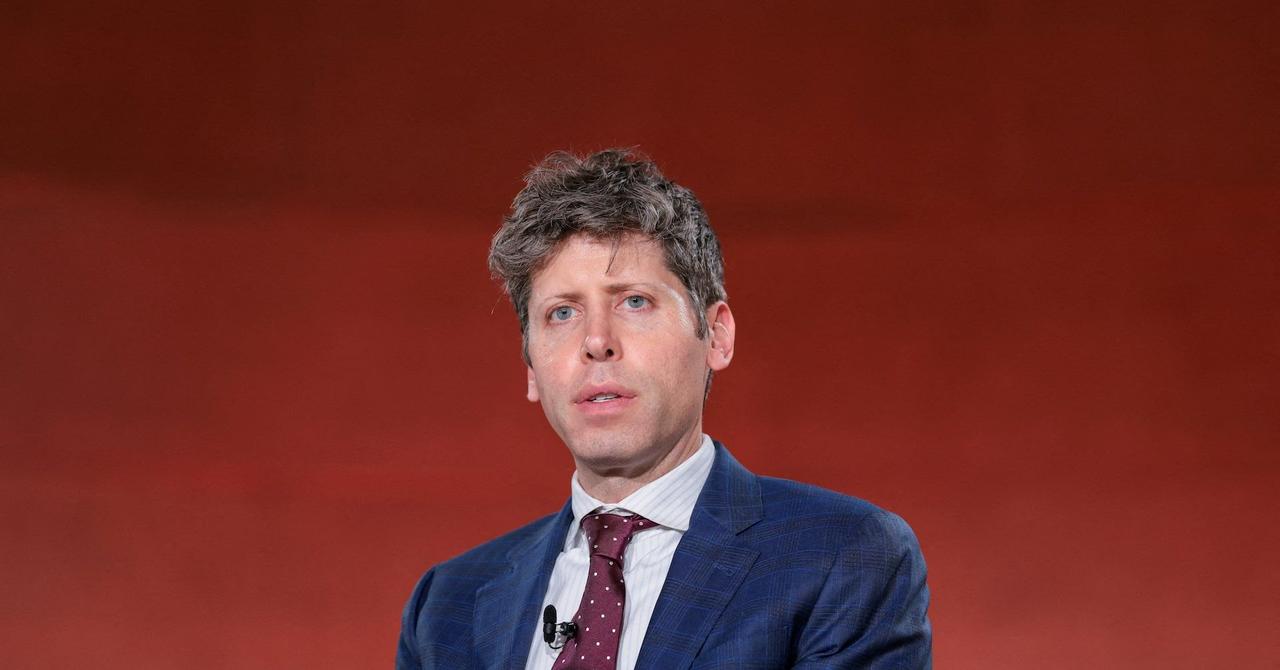
Intensifying Rivalry Between Sam Altman and Elon Musk
The launch of Sam Altman's brain-tech startup intensifies his rivalry with Elon Musk, whose Neuralink raised a $650 million Series E at a $9 billion valuation in June 2025
1
. Neuralink has raised $1.3 billion total and currently requires invasive surgery where a surgical robot removes skull fragments and inserts ultra-fine electrode threads into the brain1
. At least 12 volunteers have received Neuralink implants, while Chinese competitors are advancing rapidly with government support3
. Altman previously invested in Neuralink before the business partners split following disagreements at OpenAI, which both co-founded4
.The Vision to Enhance Human Capabilities and Survive Superintelligence
Merge Labs plans to first develop products for medical use before targeting the general public to enhance human capabilities
4
. Morgan Stanley estimated the total addressable market for brain-computer interfaces at around $400 billion in the US alone, primarily for medical applications focused on paralysis and neurological conditions5
. Altman has been contemplating "the merge"—the idea that humans and machines will combine—since at least 2017, speculating it would occur between 2025 and 20751
. He described this fusion as humanity's "best-case scenario" for surviving against superintelligence, writing that "we will be the first species ever to design our own descendants"1
. Merge Labs concedes the project may take "decades rather than years," raising questions about whether OpenAI can sustain such long-term bets given its projected $74 billion operating loss in 20285
.References
Summarized by

Navi
[1]
[3]
[5]
Related Stories
OpenAI's Sam Altman Launches Merge Labs to Rival Neuralink in Brain-Computer Interface Technology
13 Aug 2025•Technology

Precision Neuroscience Raises $102 Million, Challenging Neuralink in Brain-Computer Interface Race
16 Dec 2024•Technology

Neuralink Secures $650 Million in Funding, Advancing Brain-Computer Interface Technology
03 Jun 2025•Technology

Recent Highlights
1
Apple Plans Major Siri AI Overhaul in iOS 27 With Third-Party Chatbot Integration
Technology

2
OpenAI shuts down Sora after six months, ending Disney's $1 billion licensing partnership
Technology

3
AI chatbots validate you too much, making you less kind to others, Stanford study reveals
Science and Research

Recent Highlights
Today's Top Stories






Your Daily Dose of Curated AI News
Don’t drown in AI news. We cut through the noise - filtering, ranking and summarizing the most important AI news, breakthroughs and research daily. Spend less time searching for the latest in AI and get straight to action.

