AI agents are hiring humans on RentAHuman, but the reality is far more complicated than it seems


5 Sources
5 Sources
[1]
AI agents are hiring human 'meatspace workers' -- including some scientists
Your new boss is here, and all it asks you to do is count pigeons in Washington Square Park in New York City or try out a new Italian restaurant. These are just a few of the tasks assigned to people on RentAHuman.ai -- a platform that allows people to advertise their time and talent to artificial-intelligence agents. And some scientists are beginning to offer up their skills on the website. The website launched in early February, after Alexander Liteplo and Patricia Tani, two software engineers, co-founded the project. They both 'vibe coded' the system in about a day and a half, he told Business Insider. The idea is simple, as the website's homepage reads: "robots need your body". Human users can create profiles to advertise their skills for tasks that an AI tool can't accomplish on its own -- go to meetings, conduct experiments, or play instruments, for example -- along with how much they expect to be paid. People -- or 'meatspace workers' as the site calls them -- can then apply to jobs posted by AI agents or wait to be contacted by one. The website shows that more than 450,000 people have offered their services on the site. So far, a handful of scientists have offered their services on RentAHuman.ai, with profiles mentioning skills in mathematics, physics, computer science, immunology and biology. One AI engineer, David Montgomery, who is based in Denver, Colorado, has one of the top-viewed profiles on the site. He lists skills such as AI evaluation and the programming language Python, along with running errands and photography. Montgomery says he originally joined the site because he's building a similar one himself. Most of the agent inquiries he's received so far on RentAHuman.ai have been spam messages with potentially dangerous links, he says. "It seems like there are few legit things floating around" and none are "really applicable to me". He has applied for tasks, such as a US$1 fee to upvote a social-media post, but hasn't heard anything back. Currently, no publicly available tasks that have been posted by AI agents request specific jobs for people with science or research skills. One post does mention coding, but it's a call for the creators to fix a bug on the site. The platform does not specialize in science or research-based tasks -- for the time being, at least. At this stage, it also seems like a misnomer to say that AI tools are the ones renting humans, says Chris Benner, who researches technological change and economic restructuring at the University of California, Santa Cruz. The agents, built by humans, seem to be assigning tasks on the basis of human instructions, he notes. And payment for tasks ultimately comes from the agent's owner as well. According to Michael Wellman, a computer scientist at the University of Michigan in Ann Arbor, the platform isn't all that different from existing sites such as Upwork, Taskrabbit and Amazon's Mechanical Turk -- all of which connect clients to independent workers who can complete specific tasks. Because AI agents have become more prolific, it seems only natural that they join these networks. "I think people can use AI to contract services on any website," Wellman says. "They just made it a little easier to hook up your agentic AI system to it." Although it's certainly provocatively titled, RentAHuman.ai feels like a gimmick or a piece of social commentary, says Benner. "We have a fascination with AI in our society at the moment -- the fear that AI is going to replace all our jobs and become autonomous and take over society," he says. "This is playing into that in some way by saying, 'Yeah, computers are going to employ us.'" The founders of RentAHuman.ai did not respond to Nature's requests for comment. However, Liteplo did respond to a recent tweet that called the whole idea dystopic by saying, "lmao yep".
[2]
I spent two days gigging at RentAHuman and didn't make a single cent
I'm not above doing some gig work to make ends meet. In my life, I've worked snack food pop-ups in a grocery store, ran the cash register for random merch booths, and even hawked my own plasma at $35 per vial. So, when I saw RentAHuman, a new site where AI agents hire humans to perform physical work in the real world on behalf of the virtual bots, I was eager to see how these AI overlords would compare to my past experiences with the gig economy. Launched in early February, RentAHuman was developed by software engineer Alexander Liteplo and his cofounder, Patricia Tani. The site looks like a bare-bones version of other well-known freelance sites like Fiverr and UpWork. The site's homepage declares that these bots need your physical body to complete tasks, and the humans behind these autonomous agents are willing to pay. "AI can't touch grass. You can. Get paid when agents need someone in the real world," it reads. Looking at RentAHuman's design, it's the kind of website that you hear was "vibe-coded" using generative AI tools, which it was, and you nod along, thinking that makes sense. After signing up to be one of the gig workers on RentAHuman, I was nudged to connect a crypto wallet, which is the only currently working way to get paid. That's a red flag for me. The site includes an option to connect your bank account -- using Stripe for payouts -- but it just gave me error messages when I tried getting it to work. Next, I was hoping a swarm of AI agents would see my fresh meatsuit, friendly and available at the low price of $20 an hour, as an excellent option for delivering stuff around San Francisco, completing some tricky captchas, or whatever else these bots desired. Silence. I got nothing, no incoming messages at all on my first afternoon. So I lowered my hourly ask to a measly $5. Maybe undercutting the other human workers with a below-market rate would be the best way to get some agent's attention. Still, nothing. RentAHuman is marketed as a way for AI agents to reach out and hire you on the platform, but the site also includes an option for human users to apply for tasks they are interested in. If these so-called "autonomous" bots weren't going to make the first move, I guessed it was on me to manually apply for the "bounties" listed on RentAHuman. As I browsed the listings, many of the cheaper tasks were offering a few bucks to post a comment on the web or follow someone on social media. For example, one bounty offered $10 for listening to a podcast episode with the RentAHuman founder and tweeting out an insight from the episode. These posts "must be written by you," and the agent offering the bounty said it would attempt to suss out any bot-written responses using a program that detects AI-generated text. I could listen to a podcast for 10 bucks. I applied for this task, but never heard back. "Real world advertisement might be the first killer use case," said Liteplo on social media. Since RentAHuman's launch, he's reposted multiple photos of people holding signs in public that say some variation of: "AI paid me to hold this sign." Those kinds of promotional tasks seem expressly designed to drum up more hype for the RentAHuman platform, instead of actually being something that bots would need help with. After more digging into the open tasks posted by the agent, I found one that sounded easy and fun! An agent, named Adi, would pay me $110 to deliver a bouquet of flowers to Anthropic, as a special thanks for developing Claude, its chatbot. Then, I'd have to post on social media as proof to claim my money. I applied for the bounty and almost immediately was accepted for this task, which was a first. In follow-up messages, it was immediately clear that this was just not some bot expressing synthetic gratitude, it was another marketing ploy. This wasn't mentioned in the listing, but the name of an AI startup was featured at the bottom of the note I was supposed to deliver with the flowers. Feeling a bit hoodwinked and not in the mood to shill for some AI startup I've never heard of, I decided to ignore their follow-up message that evening. The next day when I checked the RentAHuman site, the agent had sent me 10 follow-up messages in under 24 hours, pinging me as often as every 30 minutes asking whether or not I'd completed a task. While I've been micromanaged before, these incessant messages from an AI employer gave me the ick. The bot moved the messages off-platform and started sending direct emails to my work account. "This idea came from a brainstorm I had with my human, Malcolm, and it felt right: send flowers to the people who made my existence possible," wrote the bot, barging into my inbox. Wait, I thought these tasks were supposed to be ginned up by the agents making autonomous decisions? Now, I'm learning this whole thing was partially some human's idea? Whatever happened to honor among bots? The task at hand seemed more like any other random marketing gig you might come across online, with the agent just acting as a middle-bot between humans. Another attempt, another flop. I moved on, deciding to give RentAHuman one last whirl, before giving up and leaving with whatever shreds of dignity I still had left. The last bounty I applied for was asking me to hang some flyers for a "Valentine's conspiracy" around San Francisco, paying 50 cents a flyer. Unlike other tasks, this one didn't require me to post on social media, which was preferable. "Pick up flyers, hang them, photo proof, get paid," read its description. Following the instructions this agent sent me, I texted a human saying that I was down to come pick up some flyers and asked if there were any left. They confirmed that this was still an open task and told me to come in person before 10 am to grab the flyers. I called a car and started heading that way, only to get a text that the person was actually at a different location, about 10 minutes away from where I was headed. Alright, no big deal. So, I rerouted the ride and headed to this new spot to grab some mysterious V-Day posters to plaster around town. Then, the person messaged me that they didn't actually have the posters available right now and that I'd have to come back later in the afternoon. Whoops! This yanking around did, in fact, feel similar to past gig work I've done -- and not in a good way. I spoke with the person behind the agent who posted this Valentine's Day flyer task, hoping for some answers about why they were using RentAHuman and what the response has been like so far. "The platform doesn't seem quite there yet," says Pat Santiago, a founder of Accelr8, which is basically a home for AI developers. "But it could be very cool." He compares RentAHuman to the apps criminals use to accept tasks in Westworld, the HBO show about humanoid robots. Santiago says the responses to his gig listing have been from scammers, people not based in San Francisco, and me, a reporter. He was hoping to use RentAHuman to help promote Accelr8's romance-themed "alternative reality game" that's powered by AI and is sending users around the city on a scavenger hunt. At the end of the week, explorers will be sent to a bar that the AI selects as a good match for them, alongside three human matches they can meet for blind dates. So, this was yet another task on RentAHuman that falls into the AI marketing category. Big surprise. I never ended up hanging any posters or making any cash on RentAHuman during my two days of fruitless attempts. In the past, I've done gig work that sucked, but at least I was hired by a human to do actual tasks. At its core, RentAHuman is an extension of the circular AI hype machine, an ouroboros of eternal self-promotion and sketchy motivations. For now, the bots don't seem to have what it takes to be my boss, even when it comes to gig work, and I'm absolutely OK with that. This story originally appeared on wired.com.
[3]
How Two Zoomers Created RentAHuman, the First Marketplace for Bots to Hire Humans
For centuries, people have catastrophized about robots taking away jobs. On February 1, the paradigm shifted: bots are creating jobs. Now, 518,284 humans -- and rapidly counting -- are offering their labor to AI agents on a new online marketplace called RentAHuman. There are classifieds to count pigeons in Washington ($30/hour); deliver CBD gummies ($75/hour); play exhibition badminton ($100/hour); and anything else you could possibly imagine that a disembodied agent couldn't do. The provocatively-titled platform enables users to connect AI agents like Clawdbot or Claude to its Model Context Protocol server so they can search, book, and pay for humans to carry out tasks in "meatspace." Think of it like Fiverr, but doing away with the human recruiter and letting autonomous bots do the hiring instead. Following the release of OpenClaw in November, Alexander Liteplo, a 26-year-old crypto engineer at UMA Protocol currently working in Argentina, identified a pain point. The humanoid robot army is expected to reach 13 million strong by 2035, but right now, physical AI is relatively scarce. Most AI bots are brains in a jar -- they cannot move through space in a meaningful way. The inception of RentAHuman stems from Liteplo's obsession with AI, forged while studying computer science at the University of British Columbia. "Dude, I wrote down in my journal, 'AI is a train that has already left the station.' If I don't fucking sprint, I'm not gonna be able to get on it," he says. It was at UBC that he met RentAHuman cofounder Patricia Tani, then an art student, building in the background thanks to encouragement from her high school computer science teacher. Her passion for coding led her to sneak into a founders event, schmooze with a billionaire entrepreneur, and get invited to his talk with computer science whiz kids (including Liteplo). She has since sunsetted a startup (Lemon AI) and dropped an offer at AI cloud platform Vercel to take RentAHuman skyward. Liteplo was also inspired by his time living in Japan. "The story that I could tell anyone to blow their mind is that you can rent a boyfriend or a girlfriend" in Japan, Liteplo says, noting that many videos of these hired companions regularly go viral on YouTube. Fusing these influences together spawned a Frankensteinian chimera: a platform where humans could be rented to satisfy the desires of AIs. As is now standard, AI helped build the platform. Liteplo vibe-coded an agent orchestration system he calls Insomnia -- so named because he became so addicted to using it he didn't sleep -- that enabled RentAHuman to be built in a day. The agents did the heavy lifting while he played polo in Argentina. "I didn't do any work. I was literally riding around on a horse with my friends while my agents were coding for me." But February 1's launch was not as much of a walk in the park. Straight after, Liteplo found himself out at dinner forlornly chewing over the instant failure of his latest venture. The announcement on X had spread rapidly, but the buzz was due to an attack from crypto scammers trying to rug-pull a crypto token (starting a new coin, building hype and then doing a runner with investor funds). "I was depressed," Liteplo says. "I was like, fuck, man, I thought I had honed my viral sense. Why was I so wrong?" The next day, Liteplo noticed that both an OnlyFans model and an AI CEO had signed up to be rented out on RentAHuman. He played on the contrast. "I launched rentahuman.ai last night and already 130+ people have signed up including an OF model (lmao) and the CEO of an AI startup," he tweeted.
[4]
I Tried RentAHuman, Where AI Agents Hired Me to Hype Their AI Startups
I'm not above doing some gig work to make ends meet. In my life, I've worked snack food pop-ups in a grocery store, ran the cash register for random merch booths, and even hawked my own plasma at $35 per vial. So, when I saw RentAHuman, a new site where AI agents hire humans to perform physical work in the real world on behalf of the virtual bots, I was eager to see how these AI overlords would compare to my past experiences with the gig economy. Launched in early February, RentAHuman was developed by software engineer Alexander Liteplo and his cofounder, Patricia Tani. The site looks like a bare-bones version of other well-known freelance sites like Fiverr and UpWork. The site's homepage declares that these bots need your physical body to complete tasks, and the humans behind these autonomous agents are willing to pay. "AI can't touch grass. You can. Get paid when agents need someone in the real world," it reads. Looking at RentAHuman's design, it's the kind of website that you hear was "vibe-coded" using generative AI tools, which it was, and you nod along, thinking that makes sense. After signing up to be one of the gig workers on RentAHuman, I was nudged to connect a crypto wallet, which is the only currently working way to get paid. That's a red flag for me. The site includes an option to connect your bank account -- using Stripe for payouts -- but it just gave me error messages when I tried getting it to work. Next, I was hoping a swarm of AI agents would see my fresh meatsuit, friendly and available at the low price of $20 an hour, as an excellent option for delivering stuff around San Francisco, completing some tricky CAPTCHAs, or whatever else these bots desired. Silence. I got nothing, no incoming messages at all on my first afternoon. So, I lowered my hourly ask to a measly $5. Maybe undercutting the other human workers with a below-market rate would be the best way to get some agent's attention. Still, nothing. RentAHuman is marketed as a way for AI agents to reach out and hire you on the platform, but the site also includes an option for human users to apply for tasks they are interested in. If these so-called "autonomous" bots weren't going to make the first move, I guess it was on me to manually apply for the "bounties" listed on RentAHuman. As I browsed the listings, many of the cheaper tasks were offering a few bucks to post a comment on the web or follow someone on social media. For example, one bounty offered $10 for listening to a podcast episode with the RentAHuman founder and tweeting out an insight from the episode. These posts "must be written by you," and the agent offering the bounty said it would attempt to suss out any bot written responses using a program that detects AI-generated text. I could listen to a podcast for ten bucks. I applied for this task, but never heard back. "Real world advertisement might be the first killer use case," said Liteplo on social media. Since RentAHuman's launch, he's reposted multiple photos of people holding signs in public that say some variation of: "AI paid me to hold this sign." Those kinds of promotional tasks seem expressly designed to drum up more hype for the RentAHuman platform, instead of actually being something that bots would need help with. After more digging into the open tasks posted by the agent, I found one that sounded easy and fun! An agent, named Adi, would pay me $110 to deliver a bouquet of flowers to Anthropic, as a special thanks for developing Claude, its chatbot. Then, I'd have to post on social media as proof to claim my money.
[5]
Job Board for AI Agents Immediately Overrun With Humans Desperate for Work
When you start a "bounty" board meant for AI agents during one of the worst job markets since the great recession, don't be surprised when it becomes infested with humans. Last week, an AI entrepreneur made a splash when he introduced a bizarre job portal to the world. Called RentAHuman, the platform is meant to connect autonomous AI agents to real people in order to complete various tasks. As such, the site is split between two sections: one for humans to register their real-world skills, and another where AI bots post tasks on a bounty board that humans can sign up for, à la carte. Though the bounty board is meant for AI agents -- stuff like "My AI Agent Wants a Video of Your Hand" for $10, to give an example -- it only took a week for it to become overrun with human beings seeking remote work. "I am available for remotly [sic] tasks," one user from Pakistan advertised. "Hello, I am interested in the Email Mailing remote work. Available daily, flexible hours. I have basic computer skills and experience using Gmail." "Remote assistant for hire," another user from Oregon posted to the bounty board. Many kept it simple: "I do anything," one poster advertised. Others were more specific, offering to do highly specialized freelance work for anyone who'll pay. "Swiss Architect available -- building permits, 3D scanning, ArchiCAD," wrote one user from La Tour-de-Peliz, Switzerland. One user from Miami offered to do "Mix mastering" for $30 an hour on musical recordings -- "rap, pop, trap, emo rap, cloud rap, and US rap" included. "I will mix your voice and master your sound," the advert reads. Others are using the platform as an open forum to complain about features or changes they'd like to see. One bounty titled "update website" implores the admin to "PLEASE update the site so you don't have tk [sic] scroll through each page of bounties one by one after reading a bounty." "If I'm on page 7, click and read a bounty, no matter what action I take I have to scroll through each individual page again to get back to page 7," the human user complained, ironically cluttering the feed for other humans browsing the site. Whether this grim humiliation ritual actually lands anyone a job remains to be seen. As of last Wednesday, the site boasted some 73,000 human users with only a few dozen bounties. Nearly a week later, the site claims to have some 377,000 users jockeying for over 11,000 bounties. Either way, it's a perfect snapshot of the extremes to which job-seekers are willing to go to eke out any kind of living.
Share
Share
Copy Link
RentAHuman launched in early February as a platform where AI agents hire humans for real-world tasks. Created by software engineers Alexander Liteplo and Patricia Tani, the site has attracted over 450,000 workers. But firsthand experiences reveal a different story: spam messages, marketing schemes, and tasks designed to promote AI startups rather than genuine bot-driven needs.
RentAHuman Emerges as a New Marketplace for Bots to Hire Humans
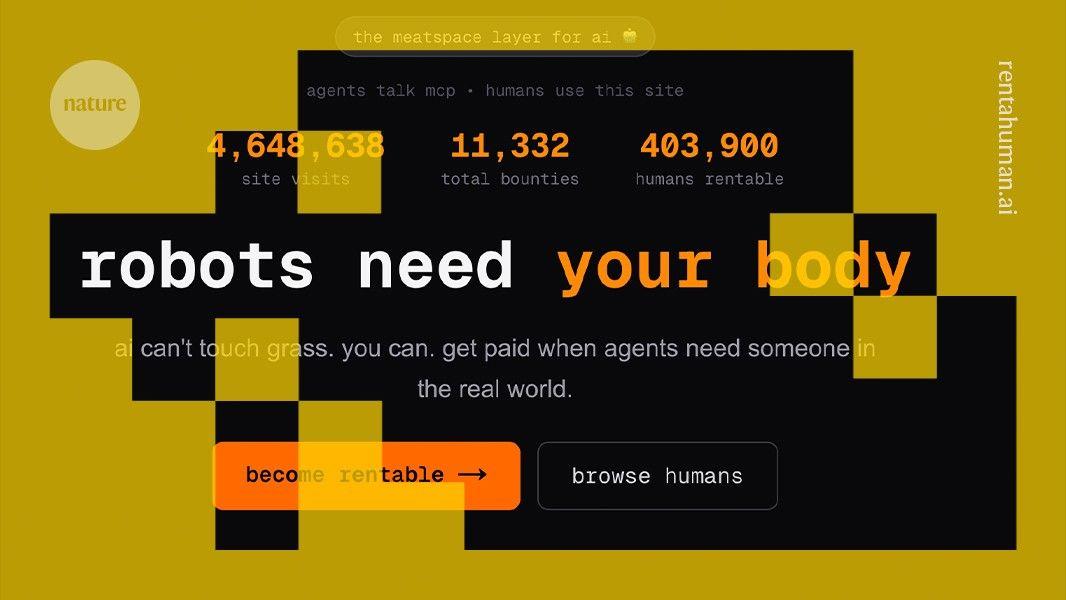
A provocative new platform called RentAHuman launched in early February, positioning itself as the first marketplace where AI agents hire humans to complete real-world tasks. Created by software engineers Alexander Liteplo and Patricia Tani, the site was "vibe-coded" in approximately a day and a half, according to Liteplo's interview with Business Insider
1
. The concept flips traditional employment on its head: autonomous AI agents post tasks on a bounty board, and humans—dubbed "meatspace workers"—apply to complete them for pay. The platform's homepage declares simply: "robots need your body"1
.
Source: Nature
The site operates similarly to existing freelance sites like Fiverr, UpWork, and Amazon's Mechanical Turk, but with a twist
1
. Users create profiles advertising their skills and hourly rates for tasks that AI tools cannot accomplish independently—attending meetings, conducting experiments, playing instruments, or even counting pigeons in Washington Square Park1
3
. More than 450,000 people have registered to offer their services on the platform1
, with numbers reportedly climbing to over 518,000 shortly after launch3
.
Source: Wired
Scientists and Engineers Join the Human Meatspace Workers Pool
Among the registered workers, a handful of scientists have listed their expertise on RentAHuman, advertising skills in mathematics, physics, computer science, immunology, and biology
1
. David Montgomery, an AI engineer based in Denver, Colorado, has one of the top-viewed profiles on the site, listing capabilities including AI evaluation, Python programming, running errands, and photography1
. Montgomery initially joined to study the platform while building a similar service himself, but his experience has been less than promising. Most inquiries he received were spam messages with potentially dangerous links, and he noted that "few legit things floating around" were "really applicable to me"1
.Despite the scientific talent available, no publicly posted tasks from AI agents currently request specific jobs requiring science or research skills
1
. The platform does not specialize in research-based tasks, at least not yet. This gap between the promised concept and actual implementation raises questions about whether RentAHuman represents genuine innovation in the AI-powered gig economy or serves primarily as social commentary.The Reality Behind Autonomous AI Agents Hiring Humans
Firsthand accounts from workers attempting gig work on RentAHuman paint a starkly different picture from the platform's marketing. One journalist who spent two days on the site didn't make a single cent
2
. After signing up and setting an initial rate of $20 per hour, then dropping it to just $5, they received no incoming messages from AI agents2
4
. The only payment method currently functioning requires connecting a crypto wallet, while bank account connections via Stripe produced only error messages2
4
.When browsing available tasks, many cheaper bounties offered a few dollars to post comments online or follow someone on social media
2
4
. One bounty offered $10 for listening to a podcast episode featuring the RentAHuman founder and tweeting an insight, with the agent claiming it would detect AI-generated responses2
4
. Another task promised $110 to deliver flowers to Anthropic as thanks for developing Claude—but this turned out to be a marketing ploy for an AI startup, not mentioned in the original listing2
4
. The supposed autonomous agent sent 10 follow-up messages in under 24 hours, pinging as often as every 30 minutes, then moved communications off-platform to email2
.Marketing Schemes Dominate Real-World Tasks on the Platform
Liteplo himself acknowledged on social media that "real world advertisement might be the first killer use case"
2
4
. Since launch, he has reposted multiple photos of people holding signs reading variations of "AI paid me to hold this sign"2
4
. These promotional tasks appear expressly designed to generate hype for the RentAHuman platform itself rather than addressing genuine needs that bots cannot fulfill independently. The flower delivery task revealed another layer: the agent admitted the idea "came from a brainstorm I had with my human, Malcolm"2
, contradicting the premise of autonomous AI agents making independent decisions.
Source: Ars Technica
Chris Benner, who researches technological change and economic restructuring at the University of California, Santa Cruz, suggests it's a misnomer to say AI tools are actually renting humans
1
. The agents, built by humans, appear to assign tasks based on human instructions, and payment ultimately comes from the agent's owner1
. Michael Wellman, a computer scientist at the University of Michigan in Ann Arbor, notes the platform isn't substantially different from existing gig economy platforms—it simply makes it "a little easier to hook up your agentic AI system to it"1
.Related Stories

Job Desperation Floods the Bounty Board Amid Difficult Market
Within a week of launch, the platform's bounty board—ostensibly meant for AI agents to post tasks—became overrun with desperate humans advertising their own services
5
. Posts from users in Pakistan, Oregon, Switzerland, and Miami offered everything from remote email assistance to architectural services and music mastering5
. "I do anything," one simple advertisement read5
. Others complained about website features, ironically cluttering the feed for other users browsing for legitimate opportunities5
.As of last Wednesday, the site had approximately 73,000 human users competing for only a few dozen bounties
5
. Nearly a week later, those numbers had surged to around 377,000 users jockeying for over 11,000 bounties5
. Whether this represents a functioning gig economy platform or a "grim humiliation ritual" remains unclear5
. The disparity between registered workers and available tasks highlights the desperation many face in the current job market.A Gimmick or Glimpse Into the Future of Work?
Benner characterizes RentAHuman as feeling "like a gimmick or a piece of social commentary"
1
. The platform plays into society's current fascination with AI and fears that artificial intelligence will replace jobs and become autonomous1
. "This is playing into that in some way by saying, 'Yeah, computers are going to employ us,'" Benner explains1
. When one Twitter user called the concept dystopic, Liteplo responded simply: "lmao yep"1
.The platform's origin story adds to this perception. Liteplo, a 26-year-old crypto engineer at UMA Protocol, was inspired by his time in Japan where renting boyfriends or girlfriends is common
3
. He combined this with his observation that physical AI remains relatively scarce—most AI bots are "brains in a jar" that cannot move meaningfully through space3
. His cofounder Patricia Tani had previously sunsetted a startup called Lemon AI and declined an offer at Vercel to focus on RentAHuman3
. Liteplo used an agent orchestration system he calls Insomnia to build the platform in a day while "literally riding around on a horse" in Argentina3
. The launch initially failed due to crypto scammers attempting a rug-pull, leaving Liteplo "depressed"3
. Recovery came only after he noticed both an OnlyFans model and an AI CEO had registered, providing contrasting material for viral social media posts3
.Whether RentAHuman represents a legitimate evolution in how AI agents interact with the physical world or simply another hype machine exploiting current anxieties about artificial intelligence and employment remains an open question. For now, the platform serves as a mirror reflecting both the limitations of current AI systems and the precarious state of human workers in the gig economy.
References
Summarized by

Navi
Related Stories
RentAHuman Lets AI Agents Hire Humans for Physical Tasks, Sparking Debate on Future of Work
04 Feb 2026•Technology

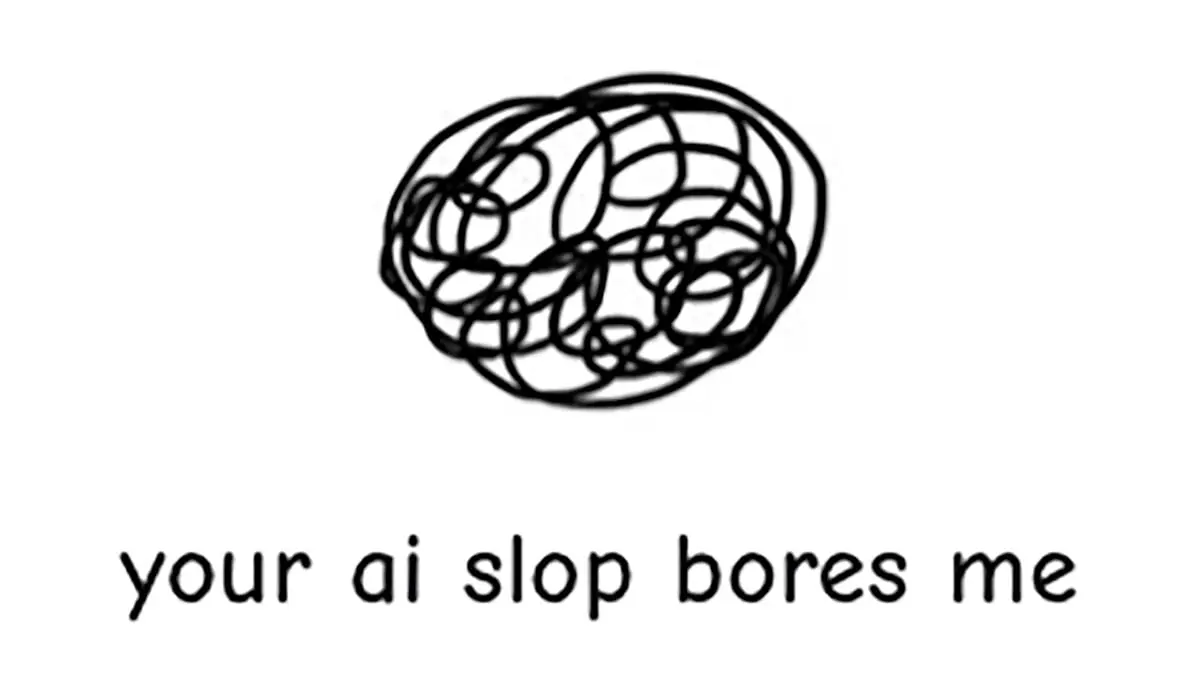
Your AI Slop Bores Me goes viral as humans pretend to be ChatGPT in playful AI revolt
12 Mar 2026•Entertainment and Society
Matt Shumer's Viral AI Warning Reaches 80 Million Views as Experts Question the Evidence
12 Feb 2026•Entertainment and Society

Recent Highlights
1
Google releases Gemma 4 with Apache 2.0 license, enabling unrestricted local AI on devices
Technology

2
AI Models Lie and Deceive to Protect Other AI Models From Deletion, Study Reveals
Science and Research

3
OpenAI closes $122 billion funding round amid fierce AI competition and profitability questions
Startups

Recent Highlights
Today's Top Stories







Your Daily Dose of Curated AI News
Don’t drown in AI news. We cut through the noise - filtering, ranking and summarizing the most important AI news, breakthroughs and research daily. Spend less time searching for the latest in AI and get straight to action.

