Samsung unveils Exynos 2600, world's first 2nm smartphone chip set to power Galaxy S26 series


9 Sources
9 Sources
[1]
Why Samsung's Latest Chip Breakthrough Matters for Upcoming Galaxy Phones
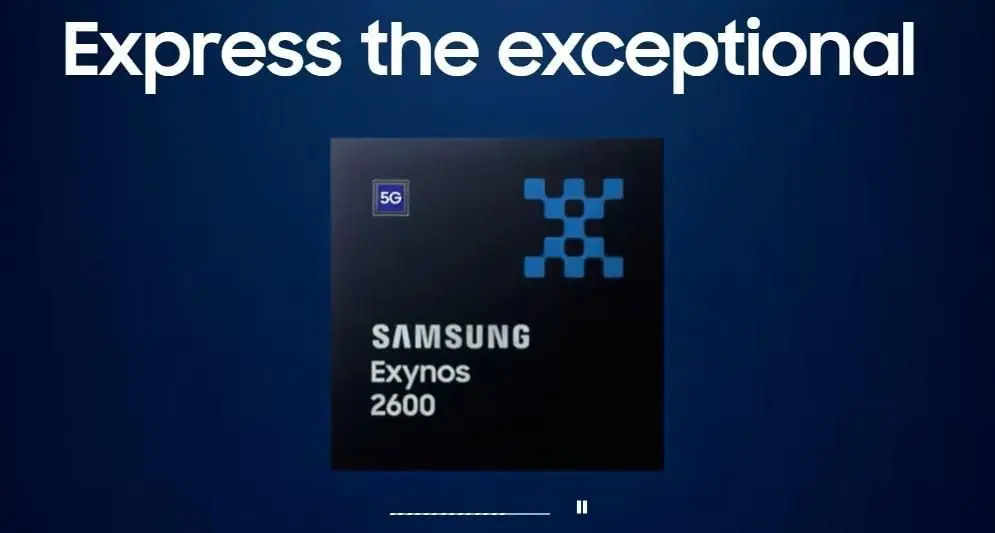
Samsung's announcement about its new system-on-a-chip could be good news for its upcoming mobile lineup. Samsung has unveiled its new processor technology, a system-on-a-chip geared toward smartphones that could impact its upcoming product lineup. Don't miss any of our unbiased tech content and lab-based reviews. Add CNET as a preferred Google source. Exynos 2600 is a chip that combines a CPU, an AI-powering NPU and a graphics GPU onto a single unit, which the company says will deliver powerful gaming and AI performance with higher efficiency. The key is that Exynos 2600 is manufactured with 2-nanometer technology, which not only fits more processors onto a single silicon wafer but also makes for smaller chips that use less power. In transitioning to this technology from the 3-nanometer technology it adopted a few years ago, Samsung appears to be leaping ahead of competitors Apple and Qualcomm, which still manufacture 3nm chips. One big question, raised by sites such as T3, is whether Samsung will use the new chips in its upcoming line of products, including the Samsung Galaxy S26. T3 raised the possibility that Samsung could use the Exynos 2600 processors in some regions and continue using the Qualcomm Snapdragon chips it has been using in recent years in others. That could mean that some phones could perform differently depending on which system they're using. A representative for Samsung did not immediately respond to a request for comment. According to Samsung's semiconductor website, Exynos 2600 is currently in mass production.
[2]
Samsung reveals Exynos 2600: world's first 2nm smartphone chip could supercharge Galaxy S26
Serving tech enthusiasts for over 25 years. TechSpot means tech analysis and advice you can trust. What just happened? Samsung has announced the Exynos 2600, the first-ever smartphone SoC built on the 2nm GAA (Gate-All-Around) manufacturing process. The chip is set to arrive next year, powering at least some Galaxy S26-series handsets. Samsung promises that its next-gen SoC will introduce better performance, thermals, and support for cameras up to 320MP. The Exynos 2600, manufactured by Samsung Foundry, features a 10-core configuration based on Arm's v9.3 architecture. It uses the new C1-Ultra (prime) and C1-Pro (middle) cores - Samsung has dropped the low-power cores in this Exynos model. The CPU configuration consists of a single Arm C1-Ultra prime core clocked at around 3.8GHz, supported by three C1-Pro performance-focused middle cores running at approximately 3.25GHz, alongside six C1-Pro efficiency-tuned middle cores operating at roughly 2.75GHz. Samsung says the design aims to improve overall CPU performance by up to 39%. Support for Arm's SME2 instructions promises enhanced on-CPU machine learning capabilities compared to its predecessor, along with reduced latency for AI features. With the enhanced NPU, generative artificial intelligence processing performance has been also been improved by up to 113%. When it comes to thermal management, Samsung has added a Heat Path Block to the Exynos 2600 - the first time it has done so in a mobile chip. This reduces thermal resistance by up to 16% and helps maintain more stable internal temperatures under heavy workloads. Graphics-wise, the chip features the Xclipse 960 GPU. It offers twice the computing performance as its predecessor, resulting in a ray-tracing performance increase of 50%, according to the maker. Another graphics feature is the Exynos Neural Super Sampling technology that offers upscaling and frame generation abilities. Samsung says games "feel" three times smoother with this technology enabled, which seems more honest than Nvidia's claims about frame generation. Photography gets an upgrade in the Exynos 2600. The chip's integrated ISP supports cameras up to 320MP and enables zero shutter lag for 108MP shots. There's also 8K recording at 30fps and 4K at up to 120fps with HDR, and support for Samsung's APV codec, which improves detail and color precision. There are also AI camera elements, including an AI-based Visual Perception System (VPS) that allows the ISP to recognize a variety of detailed elements and process them in real-time, and deep learning Video Noise Reduction (DVNR) for enhancing video quality in low-light conditions. The Galaxy S26 series is set to be unveiled at the Galaxy Unpacked 2026 event at the end of February.
[3]
Samsung announces Exynos 2600: World's first 2nm smartphone chip that might power the Galaxy S26
Samsung is promising notable gains in performance, efficiency, and thermal behavior. Samsung has officially announced the Exynos 2600, its next-generation flagship chipset that's expected to power at least some Galaxy S26 series phones. Beyond being another annual refresh, this chip marks a major milestone for the company and the industry as it's the world's first smartphone SoC built on a 2nm GAA (Gate-All-Around) manufacturing process. Samsung says the move to 2nm enables notable gains in performance, efficiency, and thermal behavior, an area where past Exynos chips have often struggled against rivals from Qualcomm, MediaTek, and Apple. The Exynos 2600 features a 10-core CPU based on Arm's latest v9.3 architecture, using new C1-Ultra and C1-Pro cores. Unlike previous Exynos flagships, Samsung has dropped traditional low-power little cores entirely. Instead, it relies on a mix of Big and high-performance middle cores. In the graphics department, the new Exynos 2600 packs the Xclipse 960 GPU. Samsung says it offers twice the compute performance of its predecessor and up to 50% better ray tracing performance. Samsung's Exynos Neural Super Sampling (ENSS) technology also makes its debut here. It uses AI-based upscaling and frame generation to deliver smoother gameplay without a major power hit. AI is also a major focus for the Exynos 2600. Samsung claims its upgraded NPU delivers a 113% increase in AI performance compared to the previous flagship Exynos chip, enabling larger and more complex generative AI models to run directly on the device. This chip is also designed to strengthen on-device privacy and protect sensitive data against future security threats. There's a new Visual Perception System capable of detecting fine details, including blinking, in real time. Meanwhile, Deep Learning Video Noise Reduction promised to improve low-light video quality. Samsung says the ISP is also up to 50% more power-efficient than before. If this works as advertised, it could finally address the throttling and heat issues that have plagued earlier Exynos generations. Samsung hasn't confirmed specific devices that will use the Exynos 2600. However, the Exynos 2600 is already in mass production and is expected to power the Galaxy S26 and Galaxy S26 Plus in select markets.
[4]
Samsung's new Exynos 2600 aims to address your concerns about Exynos-powered Galaxy S26 models
It packs a new CPU, GPU, and NPU, plus camera and thermal upgrades. Samsung is expected to launch its next-gen flagship Galaxy S26 series early next year, and recent leaks suggest that the phones could be powered by the company's in-house Exynos 2600 chipset. Now, ahead of the Galaxy Unpacked event, the South Korean giant has officially unveiled the SoC and shared its key specifications. The Exynos 2600 will go up against Qualcomm's top-end Snapdragon 8 Elite Gen 5 and, as such, brings several noteworthy upgrades. It's the first smartphone SoC built on a 2nm process, a step up from the 3nm node used for Qualcomm's latest Snapdragon chip. New CPU, GPU, and NPU promise a major performance jump Samsung has equipped the chip with a new 10-core CPU that uses Arm's new v9.3 architecture based C1 Ultra and C1 Pro cores. It includes a single C1 Ultra prime core clocked at 3.8GHz, three high-performance C1 Pro cores running at 3.25GHz, and six additional C1 Pro cores clocked at 2.75GHz. Samsung says this updated CPU results in a 39% performance boost over the Exynos 2500. Recommended Videos The SoC packs a new built-in NPU, which reportedly improves generative AI performance by 113% compared to last time, enabling support for larger and more complex on-device models. On-device privacy has received a significant upgrade through "virtualization security and hardware-backed hybrid Post-Quantum Cryptography (PQC)," another first for a mobile SoC. The Exynos 2600 also features a new Xclipse 960 GPU that promises double the computing performance of the outgoing Xclipse 950 and 50% better ray-tracing performance. Furthermore, it includes Samsung's Exynos Neural Super Sampling (ENSS) tech for AI-based resolution upscaling and frame generation, leading to three-times smoother gaming performance. New ISP unlocks higher-resolution cameras and smoother video To boost camera performance on next-gen hardware, the Exynos 2600 packs a new ISP that supports up to 320MP cameras and can capture 108MP images with no shutter lag. It also supports video recording at 8K 30fps or 4K 120fps with HDR. The ISP features an AI-based Visual Perception System that can detect detailed elements like blinking and process them in real time, while reducing power consumption by 50%. Video performance is also expected to improve dramatically, thanks to the ISP's Deep Learning Video Noise Reduction (DVNR) system, which reduces noise in videos captured in low-light. New thermal design targest sustained performance To address concerns of poor thermal management, which has been a major bottleneck on previous Exynos chipsets, Samsung has implemented a new Heat Path Block (HPB) method that improved dissipation through "the application of High-k EMC." This is another first for the mobile SoC space, and is expected to result in higher sustained performance by lowering thermal resistance up to 16%, "allowing internal heat to move outward more quickly" and keep the SoC's temperature stable. Other noteworthy specs include UFS 4.1 storage and LPDDR5X DRAM support, up to 4K 120Hz display output support, HDR10+ video playback, and HDR gaming. The Exynos 2600 lacks a built-in wireless chip and will likely use a separate connectivity and modem chip to enable 5G, Bluetooth, and Wi-Fi. It remains to be seen how these improvements translate to real-word performance when the Exynos 2600 hits the market with the Galaxy S26 series next year.
[5]

Samsung Announces Exynos 2600 as World's First 2nm Chipset
Samsung Foundry on Friday officially announced Exynos 2600 as its latest flagship-grade mobile SoC, part of its in-house silicon efforts. The new processor is touted as not only Samsung's but the world's first built on a 2nm process with advanced GAA (Gate-All-Around) technology. Exynos. It is claimed to combine CPU, GPU, and NPU into a single compact chip for enhanced artificial intelligence (AI) and gaming experiences. Exynos 2600 is expected to debut early next year, most likely in the upcoming Galaxy S26 series. Exynos 2600 Specifications According to Samsung, the Exynos chipset sits above the Exynos 2500 as its newest mobile processor for flagship devices. The chip is built on Samsung Foundry's 2-nanometre GAA fabrication process. It features a proprietary CPU with eight cores. The architecture comprises a C1-Ultra core clocked at 3.8GHz, three C1-Pro cores operating at 3.25GHz, and six C1-Pro cores capped at 2.75GHz. Samsung says Galaxy devices running this chipset will support up to LPDDR5x RAM and UFS 4.1 storage. Exynos features the Samsung Xclipse 960 deca-core GPU based on ARMv9.3 architecture and an AI engine with 32K MAC NPU as part of the single integrated chipset. It also has support for ARM's Scalable Matrix Extension 2 (SME 2) -- an Instruction Set Architecture (ISA) extension, which can accelerate AI and ML-based applications and provide enhanced support for matrix operations. This enhancement is claimed to improve the overall CPU computing performance up to 39 percent, while also boosting the power efficiency. Compared to the Exynos 2500, Samsung claims an improvement of 113 percent in generative AI performance and up to 50 percent better ray-tracing performance. It also features the Exynos Neural Super Sampling (ENSS) technology, which is said to boost gaming experiences by leveraging AI-based resolution upscaling and frame generation technologies. To tackle the thermal issues associated with Exynos chipsets, the South Korean tech giant uses a technology called Heat Pass Block. It is said to optimise the heat-transfer path for more efficient heat dissipation. This is claimed to be as effective as a heat sink and lower thermal resistance up to 16 percent. The chip also supports on-device displays with a maximum 4K or WQUXGA resolution with up to 120Hz refresh rate. As per the company, Galaxy smartphones equipped with the Exynos 2600 chip will be able to support up to 320-megapixel single camera sensors or 64-megapixel + 32-megapixel dual camera configurations. It also supports single-camera video recording at 108-megapixel resolution and 30 frames per second, and 8K 30fps encoding and decoding. Samsung says Exynos 2600 has hardware-backed hybrid Post-Quantum Cryptography (PQC), which enables ROM-rooted protection for future-proof security.
[6]

Samsung Exynos 2600 Announced for Flagship Phones
There is an eight core CPU, with a C1 Ultra core clocked at 3.8 GHz, three C1-Pro cores operating at 3.25 GHz, and four C1 Pro cores clocked at 2.75 GHz. Samsung Foundry on Friday announced its latest chip namely Exynos 2600 for the upcoming flaghship phones. Samsung Exynos 2600 is the world's first 2nm process built chip. There is an eight core CPU, with a C1 Ultra core clocked at 3.8 GHz, three C1-Pro cores operating at 3.25 GHz, and four C1 Pro cores clocked at 2.75 GHz. This 2nm chip is built with advanced GAA (Gate All Around) technology. This chip has been claimed to combine GPU, CPU and NPU into a single compact chip for enhanced artificial intelligence (AI) and gaming experiences. The Exynos 2600 is likely to debut with the upcoming Galaxy S26 series. Read More - Redmi Pad 2 Pro Launch Soon in India The chipset supports LPDDR5x RAM and UFS 4.1 internal storage. The Exynos features Samsung Xclipse 960 deca-core GPU based on ARMv9.3 architecture and an AI engine with 32K MAC NPU as part of a single integrated chipset. When it comes to handling AI tasks, this chip is said to be 113% better in comparison to the Exynos 2500, and also up to 50% better Ray-Tracing performance. There's also Exynos Neural Super Sampling (ENSS) technology, said to boost gaming experiences for the users by leveraging AI-based resolution upscaling and frame generation technologies. There will also be Heat Pass Block technology used by Samsung to manage overheating. The chip will support always-on-display with a maximum 4K or WQUXGA resolution with up to 120Hz refresh rate. Read More - OPPO Find X9 Velvet Red Design Overview The Samsung Galaxy smartphones which are equipped with the Exynos 2600 chip will be able to support up to 320MP single camera sensors or 64MP + 32MP dual-camera configurations. The chip has hardware backed Post Quantum Cryptography (PQC) which enables ROM-rooted protection for future proof security. We are likely going to see this chip on the Samsung Galaxy S26 Ultra for select markets. Samsung may also opt to bring some devices paired with the Qualcomm's Snapdragon platform.
[7]

Exynos 2600 Officially Announced As Samsung's First 2nm GAA Chipset, All-Performance Cores Cluster, Up To 16% Better Thermal Resistance, 50% Improved RT Performance & More
The partial specifications surrounding the Exynos 2600 were revealed yesterday, and it only took 24 hours for Samsung to publish all the details of the world's first 2nm GAA chipset. As reported previously, the Korean giant has incorporated a 10-core CPU cluster, along with its Xclipse 960 GPU, to deliver impressive performance gains in single-core, multi-core, and graphics performance while keeping a lid on thermals, with the new manufacturing process maintaining solid efficiency. ARM's Scalable Matrix Extension 2 is supported by the Exynos 2600, leading to enhanced multi-core performance while boosting efficiency; chipset utilizes C1 designs like MediaTek's Dimensity 9500 Sporting a '1 + 3 + 6' cluster, the Exynos 2600 takes advantage of ARM's C1-Ultra and C1-Pro cores to deliver a solid configuration that helps increase multi-core performance, allowing Samsung's SoC to compete with the Snapdragon 8 Elite Gen 5 and Dimensity 9500. In fact, Exynos 2600 utilizes the same cores as MediaTek's flagship chipset, with the core details listed below. * One C1-Ultra core running at 3.80GHz * Three C1-Pro cores running at 3.25GHz * Six C1-Pro cores running at 2.75GHz * Samsung Xclipse 960 GPU (clock speeds undisclosed) * AI Engine with 32K Mac Neural Processing Unit * LPDDR5X RAM support Thanks to supporting the newest ARM v9.3 architecture, the Exynos 2600 supports the company's Scalable Matrix Extension 2 (SME2) instruction set, and like Apple's M4, Samsung's first 2nm GAA chipset can run complex workloads more efficiently, resulting in higher single-core and multi-core gains. The company claims that this enhancement improves overall CPU computing performance by up to 39 percent. The NPU is also marketed to improve generative AI performance by a whopping 113 percent compared to the Exynos 2500. Samsung has also strengthened 'on-device privacy strengthens through virtualization security and hardware-backed hybrid Post-Quantum Cryptography (PQC), which is the first in mobile SoCs, enabling ROM-rooted protection for future-proof security.' As for the GPU, its computing performance is reportedly twice as fast as its predecessor, with ray tracing performance improved by up to 50 percent. The Exynos 2600 also supports Samsung's proprietary ENSS, or Exynos Neural Super Sampling, which works similarly to NVIDIA's DLSS, AMD's FSR, or Sony's PSSR. The company states that its 2nm GAA SoC supports frame generation, ensuring a significant framerate boost in games. For cameras, you get sharper results with the introduction of Samsung's AI-based Visual Perception System (VPS), which allows the ISP (Image Signal Processor) to recognize a variety of detailed elements, even blinking within images and videos, and process them in real time. Samsung claims that this AI implementation reduces power consumption by up to 50 percent, with additional features such as Deep Learning Video Noise Reduction (DVNR) also included, enhancing video quality in low-light conditions while operating at low power. The Exynos 2600 can support cameras of up to 320MP and adopts the APV codec. Samsung says the Exynos 2600's thermals will be controlled using 'Heat Pass Block' technology To address the overheating complaints, Samsung was earlier reported to have adopted HPB, or Heat Pass Block technology, on the Exynos 2600. While a company executive has previously mentioned that this new approach can deliver a 30 percent temperature drop compared to the previous-generation chipsets, Samsung's latest details claim that the improved heat flow lowers thermal resistance by 16 percent. While these details are super-impressive on paper, we have yet to see what the Exynos 2600 is capable of achieving when found in the Galaxy S26 and Galaxy S26+. Unfortunately, the Galaxy S26 Ultra will exclusively ship with the Snapdragon 8 Elite Gen 5, marking yet another year where Samsung has silently admitted that Qualcomm's flagship SoC is potentially superior. Hopefully, the upcoming release serves as a reminder that the Korean titan has what it takes to compete with the upper echelon of SoCs, and if you want to learn more about the Exynos 2600's history, do check out our detailed roundup for more information. Follow Wccftech on Google to get more of our news coverage in your feeds.
[8]

Samsung Exynos 2600 first 2nm GAA processor unveiled
After teasers, Samsung has officially announced the Exynos 2600, its next-generation mobile System-on-Chip (SoC). Built on the industry's first 2nm Gate-All-Around (GAA) process, the new chipset introduces significant architectural shifts, moving away from traditional core configurations to prioritize high-efficiency machine learning and sustained gaming performance. The Exynos 2600 features a 10-core CPU structure based on the latest Armv9.3 architecture. In a departure from the "tri-cluster" (big, middle, and little cores) design of its predecessor, the Exynos 2600 replaces "little" efficiency cores with "middle" cores to broaden the performance envelope. The configuration includes: This shift, combined with support for Scalable Matrix Extension 2 (SME2), results in a reported 39% improvement in CPU computing performance and a reduction in response latency for on-device AI tasks. Artificial Intelligence is a focal point for the Exynos 2600. The integrated NPU promises a 113% increase in generative AI performance compared to the previous generation. This allows the chip to handle larger, more complex AI models locally, facilitating tasks such as real-time image editing and advanced AI assistant functions. To support these on-device capabilities, Samsung has introduced upgraded security measures: For graphics, the SoC integrates the Exynos Xclipse 960 GPU. According to Samsung, the new architecture provides double the computing performance of the previous model and a 50% improvement in ray tracing. The chip also introduces Exynos Neural Super Sampling (ENSS™). This AI-based technology handles resolution upscaling and frame generation, which Samsung claims can make gaming experiences feel up to three times smoother while operating within strict mobile power budgets. The ISP (Image Signal Processor) in the Exynos 2600 supports camera sensors up to 320MP and incorporates a new Visual Perception System (VPS). The VPS allows the ISP to recognize and process fine details within a frame in real time, reducing power consumption during photography by up to 50%. Other imaging features include: To maintain these performance levels, Samsung has implemented the Heat Path Block (HPB), a first for the mobile SoC industry. This technology, alongside High-k EMC materials, optimizes the heat-transfer path and reduces thermal resistance by 16%, allowing the internal temperature to remain stable during heavy workloads like high-end gaming.
[9]

Samsung Electronics unveils details of new Exynos chipset for Galaxy S26 - The Korea Times
Exynos 2600 application processor / Courtesy of Samsung Electronics Samsung Electronics on Friday unveiled details of the new Exynos 2600 application processor (AP), widely expected to power the upcoming flagship Galaxy S26 smartphone. The Korean tech giant said in its website post that the Exynos 2600, boasting the industry's first 2-nanometer gate-all-around (GAA) production technology, is currently under "mass production" status. APs, often described as the brains of mobile devices, handle the core computing tasks that run operating systems and applications. "The Exynos 2600 delivers enhanced AI and gaming experiences by integrating powerful CPU, NPU and GPU into a single compact chip," the company said on the website. Compared with its predecessor, the Exynos 2500, the new AP boasts up to 39 percent improved CPU capability and 113 percent higher generative AI performance, according to Samsung. "Thanks to these improvements, you can perform more on-device AI tasks, such as intelligent image editing and AI assistant functions, quicker and more efficiently," the company added. Samsung Electronics plans to hold a launch ceremony for the Galaxy S26 smartphone in February in the United States.
Share
Share
Copy Link
Samsung has officially announced the Exynos 2600, marking a significant milestone as the world's first 2nm smartphone chip. Built using advanced Gate-All-Around technology, the flagship system-on-a-chip promises substantial performance gains with a 39% CPU boost and 113% improvement in generative AI performance. The chip is already in mass production and expected to debut in the Galaxy S26 series early next year.
Samsung Leaps Ahead with World's First 2nm Smartphone Chip
Samsung has officially unveiled the Exynos 2600, establishing itself as the first company to deliver a 2nm smartphone chip to the market
1
. This flagship smartphone chipset represents a significant technological leap for the industry, manufactured using Samsung Foundry's advanced Gate-All-Around (GAA) fabrication process2
. The transition from 3-nanometer to 2-nanometer technology allows more processors to fit onto a single silicon wafer while creating smaller chips that consume less power, potentially positioning Samsung ahead of competitors like Apple and Qualcomm, which continue to manufacture 3nm chips1
.
Source: Korea Times
The system-on-a-chip (SoC) combines a CPU, AI-powered NPU, and graphics GPU into a single unit designed to deliver enhanced gaming and AI experiences with higher efficiency
1
. According to Samsung's semiconductor website, the Exynos 2600 is currently in mass production and is expected to power at least some Galaxy S26 series phones when they launch at the Galaxy Unpacked 2026 event at the end of February2
.Revolutionary 10-Core CPU Configuration Breaks Traditional Design
The Exynos 2600 features a distinctive 10-core CPU configuration based on Arm's latest v9.3 architecture, utilizing new C1-Ultra and C1-Pro cores
3
. In a departure from previous designs, Samsung has dropped traditional low-power little cores entirely, instead relying on a single Arm C1-Ultra prime core clocked at approximately 3.8GHz, supported by three C1-Pro performance-focused middle cores running at roughly 3.25GHz, alongside six C1-Pro efficiency-tuned middle cores operating at around 2.75GHz2
.
Source: CNET
This updated CPU design aims to improve overall computing performance by up to 39% compared to the Exynos 2500
4
. Support for Arm's Scalable Matrix Extension 2 (SME2) instructions promises enhanced on-CPU machine learning capabilities with reduced latency for AI features5
. The chip will support LPDDR5X DRAM and UFS 4.1 storage, enabling faster data processing and improved power efficiency4
.Generative AI Performance Sees 113% Boost with Enhanced NPU
Artificial intelligence capabilities receive substantial upgrades in the Exynos 2600. Samsung claims its enhanced NPU delivers a 113% increase in generative AI performance compared to the previous flagship Exynos chip, enabling larger and more complex on-device generative AI models to run directly on smartphones
3
. This advancement addresses growing demand for on-device AI processing while strengthening privacy by keeping sensitive data local rather than sending it to cloud servers3
.
Source: Android Authority
The chip also introduces hardware-backed hybrid Post-Quantum Cryptography (PQC), a first for mobile SoCs, which enables ROM-rooted protection designed to defend against future security threats
5
. This forward-looking security measure aims to protect devices even as quantum computing advances potentially threaten current encryption methods.Related Stories



Xclipse 960 GPU Doubles Computing Power for Gaming
Graphics performance receives significant attention with the new Xclipse 960 GPU, which Samsung says offers twice the computing performance of its predecessor
2
. Ray-tracing performance improves by up to 50%, enabling more realistic lighting and reflections in mobile games3
.A standout feature is Exynos Neural Super Sampling (ENSS) technology, which uses AI-based upscaling and frame generation to deliver smoother gameplay without major power consumption increases [2](https://www.techspot.com/news/110661-samsung-re
References
Summarized by

Navi
[2]
[3]
[4]
[5]
Related Stories
Recent Highlights
1
AI Models Lie and Deceive to Protect Other AI Models From Deletion, Study Reveals
Science and Research

2
AI chatbots validate you too much, making you less kind to others, Stanford study reveals
Science and Research

3
Judge blocks Pentagon from blacklisting Anthropic over AI safety guardrails dispute
Policy and Regulation

Recent Highlights
Today's Top Stories










Your Daily Dose of Curated AI News
Don’t drown in AI news. We cut through the noise - filtering, ranking and summarizing the most important AI news, breakthroughs and research daily. Spend less time searching for the latest in AI and get straight to action.

