Sarvam AI Launches Indus Chat App as Indian Startup Takes on ChatGPT and Gemini


9 Sources
9 Sources
[1]
India's Sarvam launches Indus AI chat app as competition heats up | TechCrunch
Sarvam, an Indian AI startup focused on building models for local languages and users, on Friday launched its Indus chat app for web and mobile users, entering a fast-growing market dominated by global players including OpenAI, Anthropic, and Google. The launch comes as India has become a key battleground for generative AI adoption. Recently, OpenAI CEO Sam Altman said ChatGPT has more than 100 million weekly active users in India, while Anthropic said India accounts for 5.8% of total Claude usage, second only to the U.S. Indus serves as a chat interface for its newly announced Sarvam 105B model, the company's 105-billion-parameter large language model. The app's launch comes two days after Bengaluru-based Sarvam unveiled its 105B and 30B models at the India AI Impact Summit in New Delhi earlier this week. At the summit, the startup also outlined enterprise initiatives and hardware plans and announced partnerships with companies including HMD to bring AI to Nokia feature phones and Bosch for AI-enabled automotive applications. Currently available in beta on iOS, Android, and the web, the Indus app allows users to type or speak queries and receive responses in text and audio. Users can sign in using their phone number, Google account, or Apple ID, though the service appears to be limited to India for now. The app currently comes with some limitations. Users cannot delete their chat history without deleting their account, and there is no option to turn off the app's reasoning feature, which can sometimes slow response times. Sarvam has also warned that access may be restricted as it gradually expands its compute capacity. "We're gradually rolling out Indus on a limited compute capacity, so you may hit a waitlist at first. We will expand access over time," Sarvam co-founder Pratyush Kumar wrote on X, adding that the company is seeking feedback from users. Founded in 2023, Sarvam has raised $41 million to date from investors, including Lightspeed Venture Partners, Peak XV Partners, and Khosla Ventures as it builds large language models tailored for India. Sarvam is one of a small but growing group of Indian startups attempting to build domestic alternatives to global artificial intelligence platforms as India seeks greater control over its AI infrastructure.
[2]
Indian AI lab Sarvam's new models are a major bet on the viability of open-source AI | TechCrunch
Indian AI lab Sarvam on Tuesday unveiled a new generation of large language models, as it bets that smaller, efficient open-source AI models will be able to grab some market share away from more expensive systems offered by its much larger U.S. and Chinese rivals. The launch, announced at the India AI Impact Summit in New Delhi, aligns with New Delhi's push to reduce reliance on foreign AI platforms and tailor models to local languages and use cases. Sarvam said the new lineup includes 30-billion and 105-billion parameter models; a text-to-speech model; a speech-to-text model; and a vision model to parse documents. These mark a sharp upgrade from the company's 2-billion-parameter Sarvam 1 model that it released in October 2024. The 30-billion- and 105-billion-parameter models use a mixture-of-experts architecture, which activates only a fraction of their total parameters at a time, significantly reducing computing costs, Sarvam said. The 30B model supports a 32,000-token context window aimed at real-time conversational use, while the larger model offers a 128,000-token window for more complex, multi-step reasoning tasks. Sarvam said the new AI models were trained from scratch rather than fine-tuned on existing open-source systems. The 30B model was pre-trained on about 16 trillion tokens of text, while the 105B model was trained on trillions of tokens spanning multiple Indian languages, it said. The models are designed to support real-time applications, the startup said, including voice-based assistants and chat systems in Indian languages. The startup said the models were trained using computing resources provided under India's government-backed IndiaAI Mission, with infrastructure support from data center operator Yotta and technical support from Nvidia. Sarvam executives said the company plans to take a measured approach to scaling its models, focusing on real-world applications rather than raw size. "We want to be mindful in how we do the scaling," Sarvam co-founder Pratyush Kumar said at the launch. "We don't want to do the scaling mindlessly. We want to understand the tasks which really matter at scale and go and build for them." Sarvam said it plans to open-source the 30B and 105B models, though it did not specify whether the training data or full training code would also be made public. The company also outlined plans to build specialized AI systems, including coding-focused models and enterprise tools under a product it calls Sarvam for Work, and a conversational AI agent platform called Samvaad. Founded in 2023, Sarvam has raised more than $50 million in funding and counts Lightspeed Venture Partners, Khosla Ventures and Peak XV Partners (formerly Sequoia Capital India) among its investors.
[3]
Upstart Sarvam Unveils AI Model Customized for India Market
An Indian startup called Sarvam AI is making a push to create a viable competitor for the domestic market, unveiling an artificial-intelligence model that it says is more tailored to the languages and cultures of the world's biggest market than the likes of ChatGPT and Claude. The Bangalore-based company announced two models at a high-profile AI summit in New Delhi, a showcase for Prime Minister Narendra Modi's efforts to make his country a leading player in the emerging technology. Sarvam's models are built to be used through voice commands and are accessible through 22 Indian languages, which the company says will be a competitive advantage in the country of 1.45 billion where the vast majority can't read, write or type in English. "Today we show we can bring our own AI to a billion Indians," said Sarvam co-founder Pratyush Kumar during an event in Delhi. Sarvam also offers what's known as "agentic" AI models that can carry out tasks like coding or meeting planning in large part autonomously and with minimal human intervention. The company says its agents could drive enterprise automation in one of the world's fastest growing economies. The startup's unveiling of India-specific models trained from scratch comes as the AI race between the US and China is intensifying. The Modi government is funding AI accelerators and pushing model makers to launch services so the country, one of the largest reservoirs globally of technical talent, isn't left behind. Sarvam has steep challenges in fending off global competitors. The startup has received more than $50 million in funding, including from Lightspeed Ventures LLC and Khosla Ventures, and was last valued at about $200 million. That's tiny compared with Silicon Valley leaders like OpenAI and Anthropic PBC, last valued at $500 billion and $380 billion respectively. It's also small next to companies like Mistral AI, a French pioneer in the technology that is valued at $13.25 billion and is expanding in India with local languages. Sarvam touts its India-first approach and the security it offers by running its models from inside the country. The startup's models are trained on trillions of Indian data sets, particularly those in Indian languages, making it suitable for real-time deployment at scale in the world's most populous country not just in individual languages but also mixed languages such as Hinglish, a spoken language that blends Hindi and English. Get the Tech Newsletter bundle. Get the Tech Newsletter bundle. Get the Tech Newsletter bundle. Bloomberg's subscriber-only tech newsletters, and full access to all the articles they feature. Bloomberg's subscriber-only tech newsletters, and full access to all the articles they feature. Bloomberg's subscriber-only tech newsletters, and full access to all the articles they feature. Bloomberg may send me offers and promotions. Plus Signed UpPlus Sign UpPlus Sign Up By submitting my information, I agree to the Privacy Policy and Terms of Service. In recent benchmark tests, the startup said its models performed with superior accuracy on tasks like optical character recognition for Indian scripts, a breakthrough that could be used for a host of practical utilities in a country where language has been a barrier for digital inclusion. For instance the Sarvam vision model achieved an accuracy of over 84% on document intelligence tasks, eclipsing global models hundreds of times larger in size. "Sovereignty matters much more in AI than building the biggest models," said Sarvam's other co-founder, Vivek Raghavan, at the same event. India is hosting dozens of leading global chief executives, AI founders, country leaders, researchers and policy experts this week as it attempts to position itself as an alternative to the US and China, by leading in "democratizing AI" and taking a cost-efficient, language-diverse route. India's digital infrastructure has relied on foreign technologies for decades so the launch of the Sarvam models is seen as a step toward developing a "sovereign AI" ecosystem within the country. Indian AI startups like Sarvam and BharatGen, which also released a series of India-made models this week, are looking to export their AI systems to other developing economies in the world where neither Chinese nor US models are favored.
[4]
This Indian AI startup is claiming victory over Gemini and ChatGPT, here's why
Sarvam AI claims top-tier OCR and multilingual speech performance built specifically for Indian users * Sarvam AI says its Sarvam Vision model beats Gemini and ChatGPT on key OCR benchmarks * The startup focuses on all 22 official Indian languages * Its "sovereign AI" approach aims to build technology tailored specifically to India's needs ChatGPT, Gemini, and other AI chatbots are often very good at reading English and many other languages, but while they can interpret Hindi, they begin to wobble when confronted with more complex scripts or regional nuance among Indian languages. Now, a Bengaluru startup called Sarvam AI is stepping up with models it says can outperform the global rivals when it comes to optical character recognition (OCR) and multilingual speech, particularly when it comes to the tongues of the sub-continent. The Sarvam Vision and Bulbul V3 models are built with India's linguistic complexity in mind. Sarvam Vision can interpret complex tables, understand charts, recognize text in real-world scenes, and generate captions, while Bulbul V3 handles the text-to-speech system. They support all 22 official Indian languages. With 35 voices, Bulbul is able to always sound like a local. As many multilingual users know, the awkwardness of hearing their language pronounced as if it were a distant cousin of English can make someone reluctant to try the technology. A well-trained text-to-speech model that captures rhythm and tone more accurately can make people feel more comfortable using it. And while OCR may not sound glamorous, it quietly powers everything from when you scan a document with your phone, upload a PDF, or digitize an old record. Garbled characters, misread names, and missing context can be a real issue. Sarvam says it will help small business owners and government offices convert records into searchable archives faster and more accurately than otherwise possible. Sovereign AI Sarvam AI calls itself a builder of sovereign AI. The idea is to distinguish itself from foreign platforms. With AI models spreading across government, business, and education, questions of who builds them and whose data they understand matter a lot. Sarvam wants to have tools tailored to India. Sarvam's emergence also nudges a larger conversation about where innovation originates. The AI boom has often been framed as a race among a few dominant players. Yet breakthroughs increasingly come from focused teams solving specific problems. Sarvam appears to have identified a gap in high-quality, language-rich OCR and speech systems for Indian scripts. Of course, benchmarks are snapshots, not guarantees of performance, especially in the real world. The proof of Sarvam's impact will lie in adoption. Plus, if Sarvam's claims hold up, larger AI companies will feel pressure to improve their own support for more languages and scripts. At its best, Sarvam AI's story goes beyond beating Gemini or ChatGPT on a leaderboard and becomes a way of showing technology reflecting the people who use it. If AI is going to shape the next decade of digital life, it will need to speak many languages fluently and read more than just clean English text. Sarvam is betting that attention to detail and cultural specificity can compete with sheer scale. For millions of users who have felt underserved by mainstream AI tools, that bet may feel more like a sure thing. Follow TechRadar on Google News and add us as a preferred source to get our expert news, reviews, and opinion in your feeds. Make sure to click the Follow button! And of course you can also follow TechRadar on TikTok for news, reviews, unboxings in video form, and get regular updates from us on WhatsApp too.
[5]
'Frugal' Sarvam AI did a DeepSeek with just 40 researchers
Sarvam is already deploying its models in enterprise and government use cases, including voice AI and language technologies. Cofounder Pratyush Kumar said the company trained multiple models internally, without relying on any external technology stack. Sarvam AI has built its foundational models from the ground up with a lean team and limited compute, positioning itself as a frugal but ambitious Indian AI lab, said Pratyush Kumar, co-founder. He said the company trained multiple models internally, without relying on any external technology stack. "DeepSeek had around 5,000 researchers working on its models, whereas we did it with 40 researchers," Kumar told ET. The comparison highlights Sarvam's operating model. While global frontier labs deploy vast research teams and massive compute systems, Sarvam worked with 4,000 GPUs over six months to train models of varying sizes, including 3B, 30B, and 105B parameters. "In global standards, this was extremely frugal," he said. He described this phase as the company's first innings, focused on proving it could build the entire stack independently. "Innings one was to show that we can build this entire stack end-to-end," said Kumar. "In neither the data nor the algorithms nor the engineering, do we have a dependency on any external company." With its core models ready, the company is now turning them into products. Kumar said the next phase will focus on building applications and generating revenue, while continuing to invest in research. "Monetisation is important for survival and growth. But R&D is what gives us the muscle," he said. Sarvam is already deploying its models in enterprise and government use cases, including voice AI and language technologies. While the company has also built a consumer-facing interface, 'Indus AI,' Kumar explained that it is not meant to compete in the free chatbot race. "We don't want to be in the race of putting free products out there," he said. The consumer interface is instead meant to gather feedback and improve the models, with the company's primary focus remaining on enterprise use cases and B2B applications, said Kumar, adding that the broader aim is to translate foundational research into products deployed from India. Backed by venture capital firms such as Lightspeed Venture Partners, Peak XV Partners, and Khosla Ventures, and supported by the government's India AI Mission for sovereign AI capabilities, the startup is preparing to raise additional capital to scale its infrastructure and expand its teams. "It's not just about Sarvam. It's India's hunger to prove itself. This is the decade to do it," he said.
[6]
Sarvam unveils two new large language models focused on real-time use, advanced reasoning - The Economic Times
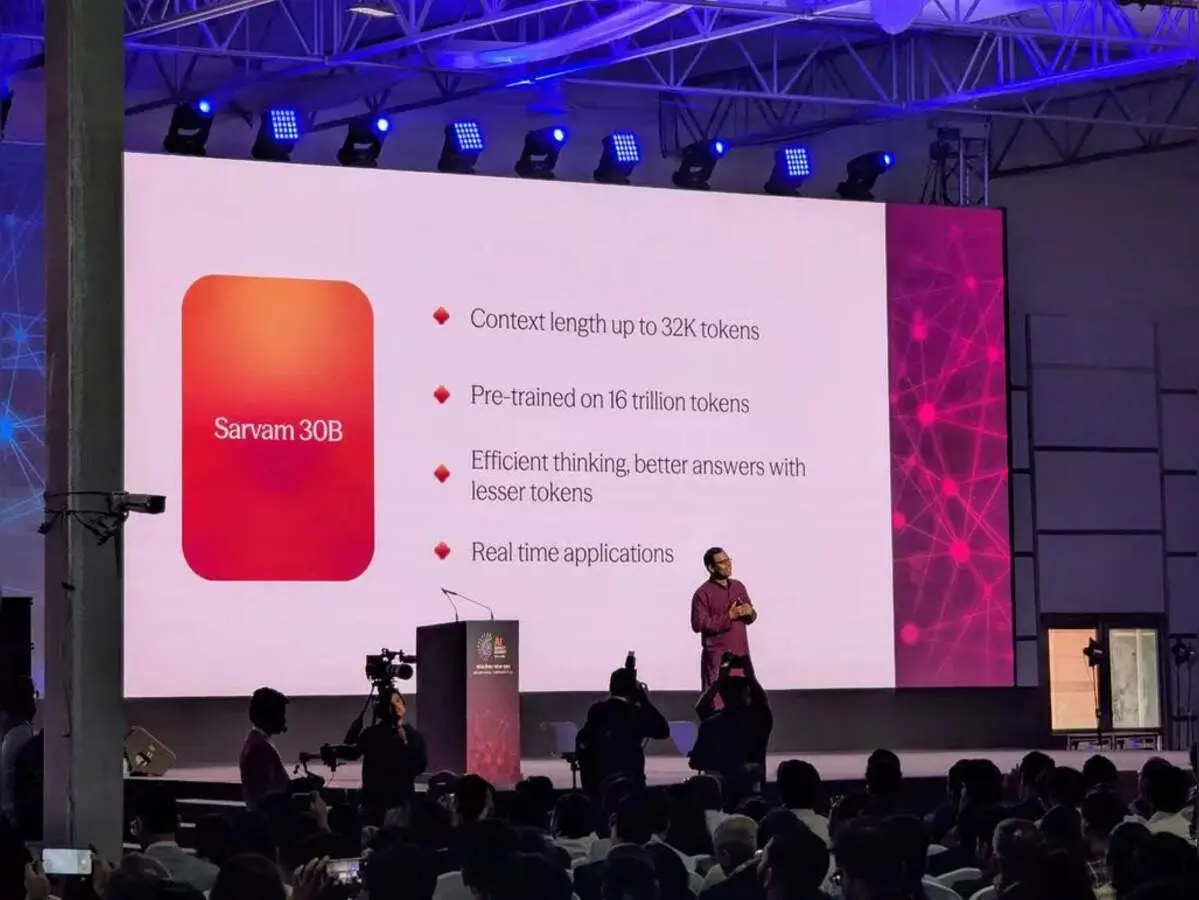
The company said the model is optimised for "efficient thinking", delivering stronger responses while using fewer tokens -- a key factor in reducing inference costs in production environments.Artificial intelligence startup Sarvam on Wednesday launched two new large language models -- Sarvam-30B and Sarvam-105B -- as the Bengaluru-based company expands its push into advanced reasoning and enterprise deployments. The lighter Sarvam-30B is designed for efficient, real-time applications. It supports a context window of up to 32,000 tokens and has been trained on 16 trillion tokens. The company said the model is optimised for "efficient thinking", delivering stronger responses while using fewer tokens -- a key factor in reducing inference costs in production environments. In benchmarks shared at the launch, Sarvam-30B was evaluated against models including Gemma 27B, Mistral-32-24B, OLMo 31.32B, Nemotron-30B, Qwen-30B and GPT-OSS-20B across tasks such as Math500, HumanEval, MBPP, Live Code Bench v6 and MMLU, which test mathematical reasoning and functional correctness. The company indicated competitive performance across general reasoning and coding benchmarks. On the AIME benchmark -- which measures mathematical reasoning under varying compute "thinking budgets" -- Sarvam-30B showed improved performance as compute allocation increased, positioning it alongside other 30B-class reasoning models. Sarvam also introduced Sarvam-105B, a higher-parameter model aimed at more complex reasoning tasks. The model supports a context length of 128,000 tokens and, according to the company, performs on par with several frontier open and closed-source models in its category. The launch marks Sarvam's move into larger-parameter models at a time when Indian AI startups are seeking to build foundational capabilities domestically rather than rely solely on global APIs. As enterprises prioritise cost efficiency, controllability and data residency, mid- to large-parameter open models are emerging as a viable deployment alternative. The Lightspeed and Peak XV Partners-backed startup did not disclose pricing but said both models are built for enterprise use cases including coding assistance, research, analytics and real-time AI agents.
[7]

Sarvam AI Launches Indus Chatbot for Mobile and Web Users
The app could become a major competitor for global ai chatbots due to its ability to interact in multiple Indian languages Indian AI Startup Sarvam, hitherto working on AI models for Indian languages and users, has launched its 'Indus' chat app for both mobile and web users. The app is currently available to download on the Apple Appstore and Google Play Store. According to the app listing description, Indus would function as an AI assistant for Indian users and is built entirely in India. Users can interact with the AI chatbot in "every Indian language" with the ability to switch between languages mid-conversation. This move brings Sarvam, founded in 2023 and funded to the tune of $41 million from investors including Peak XV Partners, Lightspeed Venture Partners and Khosla Ventures, directly into competition with the Big Tech giants Google, OpenAI and Anthropic whose AI chatbots - Gemini, ChatGPT, and Claude respectively have a stranglehold on this market in India. In fact, the company got the backing of Alphabet CEO Sundar Pichai at the India AI Impact Summit held in New Delhi last week. Pichai said developing local AI models tailored for Indian languages and contexts would be the key differentiator in the future of AI use across India. Indus works as a chat interface for Sarvam's 105B large language model that allows users to type or ask questions and receive response in both text and audio. Sign-ins are possible via user phone numbers, Google or Microsoft accounts or even an Apple ID. Of course, there are a few limitations which Sarvam itself acknowledges upfront. For starters, users cannot delete chat history without deleting their account and for now there is no option to turn off the app's reasoning mode, which causes responses to be slow. "We're gradually rolling out Indus on a limited compute capacity, so you may hit a waitlist at first," Sarvam co-founder Pratyush Kumar said in a post he made on X last week. Sarvam's entry may not cause concerns, at least not in the near term, for the likes of OpenAI whose ChatGPT boasts of 100 million active users per week from India or Anthropic that claims 5.8% of total usage from this country. As for Google, we all know that India is the second largest market for the company after the US.
[8]

Sarvam AI's Indus app quietly hits Play Store and App Store: Features, benefits and more
The app can write, edit, and analyse files, likely using Sarvam's in-house AI models. Sarvam AI is a Bengaluru-based technology company that recently gained attention after claiming its model performed better than ChatGPT. The company is also known for building its own large language models entirely in India. Now, the AI firm has entered the consumer market with a new product called Indus. It has launched Indus as an AI assistant app for smartphone users, available on both Android and iOS. Unlike many tech launches, there was no big event or heavy promotion. The app quietly appeared on the Google Play Store and Apple App Store. Although users can download it, access is currently limited. This suggests that Sarvam AI may be testing the app's features and performance before making it widely available across the country. Indus is an AI assistant designed by Sarvam specifically for the Indian users and landscape. The company claims that the app focuses strongly on multilingual conversations and is indigenous (built in India). The AI firm also said that the users can chat in English and switch to Hindi mid-conversation without restarting the session, and the session will continue smoothly with no disruptions. The makers said that the assistant is aimed to reflect on how people naturally speak in daily life across the country. Also read: Apple under fire for alleged iCloud role in spread of child abuse media Much like other popular AI chat tools available in the market, Sarvam Indus can also answer questions, explain topics and search for information online. Furthermore, the app is said to support voice interaction, letting users speak their queries instead of typing. Sarvam Indus does more than just answer questions. The app also lets users write and edit documents directly inside it. This makes it useful for writing notes, doing assignments, and improving content. Users can also upload files like PDFs and images. After you upload a file, the AI reads and understands it. Then you can ask questions about the file, and the assistant will answer using information from that document. The company has also said that more AI agents may be added in the future to help automate different tasks inside the app. Also read: India AI Impact Summit 2026: What is Pax Silica that India joined today and why are people talking about it Sarvam Indus is available on the Apple App Store and Google Play Store. You can go to the store on your phone, search for Indus by Sarvam, and download the app. Furthermore, a web version of the Indus by Sarvam is also live. Just open your web browser, search for Indus by Sarvam, and click on the first link to use it. If you are a new user, you need to sign up using your phone number, Google account, or Apple ID. You will then join a waitlist. If you have an invite code, you can skip the waitlist and start using the app right away. Also read: WhatsApp gets Group Message History feature to help new members catch up: How it works Although Sarvam has not yet officially confirmed the model powering the chatbot, industry experts suggest that it might be using Sarvam 30B or Sarvam 105B. These are the two large language models (LLMs) launched by the company at the India AI Impact Summit 2026. However, the technicalities of the same have not yet been revealed.
[9]
India AI Impact Summit: Sarvam AI unveils 30B and 105B foundational models, aims to take on OpenAI and other giants
The launch marks a significant push toward India-controlled AI infrastructure focused on cost, privacy, and local accessibility. Bengaluru-based AI startup Sarvam AI has introduced two new large language models- Sarvam-30B and Sarvam-105 B. The announcement was made at the India AI Impact Summit 2026, where the company showcased its AI ambitions, including the Kaze smartglasses. These foundational models are large neural networks trained on vast datasets to understand and generate text across a wide range of tasks. Once developed, they can be customised for applications such as coding assistance, research, translation, enterprise analytics, and conversational AI. The startup aims to offer Indian enterprises more control over data, lower dependency on global APIs and stronger support for regional languages. Starting off, Sarvam-30B, the smaller of the two systems, has 30 billion parameters and can support 32,000 tokens in its context window. It is trained on 16 trillion tokens and is intended to strike a balance between performance and efficiency, producing competitive results in reasoning, coding, and problem-solving benchmarks. At the summit, the company demonstrated Vikram, a multilingual chatbot powered by the model. The bot interacted in languages such as Hindi, Punjabi, and Marathi, and it even worked on feature phones. Sarvam-105B, the larger model with 105 billion parameters and a 128,000-token context window, is built for more demanding enterprise workloads. During a live demonstration, it analysed a company's balance sheet in real time, responding to detailed financial queries and contextual prompts. The model is intended for applications that require processing large volumes of structured and unstructured data, including analytics, long-document summarisation, and advanced coding tasks. Interestingly, this is the first time any Indian startup has created large-scale AI models that can compete with global systems in different tasks like reasoning, coding and data analysis, while supporting multiple Indian languages.
Share
Share
Copy Link
Bengaluru-based Sarvam AI has launched its Indus chat app, powered by a 105-billion-parameter model built specifically for India's 22 official languages. The startup trained its AI models for Indian market with just 40 researchers and 4,000 GPUs over six months, positioning itself as a frugal alternative to global rivals like ChatGPT and Gemini while advancing India's sovereign AI ambitions.
Sarvam AI Enters Competitive Chat Market with India-First Approach
Sarvam AI, a Bengaluru-based startup focused on building AI models for Indian market, launched its Indus AI chat app on Friday, marking a significant entry into a space dominated by OpenAI, Anthropic, and Google
1
. The timing is strategic: OpenAI CEO Sam Altman recently revealed that ChatGPT has more than 100 million weekly active users in India, while Anthropic reported that India accounts for 5.8% of total Claude usage, second only to the U.S.1
Currently available in beta on iOS, Android, and web platforms, the Indus chat app serves as the interface for Sarvam's newly announced 105-billion-parameter large language model. Users can type or speak queries and receive responses in both text and audio formats, signing in via phone number, Google account, or Apple ID
1
. The app's launch follows Sarvam's unveiling of its 30B and 105B models at the India AI Impact Summit in New Delhi earlier this week1
.
Source: Digit
Frugal AI Development Distinguishes Indian AI Startup
What sets Sarvam AI apart is its remarkably efficient development process. Co-founder Pratyush Kumar told Economic Times that the company built its foundational models with just 40 researchers, compared to DeepSeek's approximately 5,000 researchers
5
. The startup trained multiple models using 4,000 GPUs over six months, a scale Kumar described as "extremely frugal" by global standards5
.The 30-billion and 105-billion parameter models employ a mixture-of-experts architecture, which activates only a fraction of total parameters at a time, significantly reducing computing costs
2
. The 30B model supports a 32,000-token context window aimed at real-time conversational use, while the larger model offers a 128,000-token window for complex, multi-step reasoning tasks2
. These open-source large language models were trained from scratch on trillions of tokens spanning multiple Indian languages, rather than fine-tuned on existing systems2
.
Source: ET
Sovereign AI Strategy Targets Indian Linguistic Landscape
Sarvam's approach centers on what it calls "sovereign AI"—building technology tailored specifically to India's needs and running models from inside the country
3
. The models support all 22 official Indian languages and are trained on trillions of Indian data sets, making them suitable for real-time deployment in mixed languages such as Hinglish, a spoken blend of Hindi and English .
Source: Bloomberg
The Sarvam Vision model achieved over 84% accuracy on document intelligence tasks involving optical character recognition for Indian scripts, eclipsing global models hundreds of times larger in size . Meanwhile, Bulbul V3, the text-to-speech model, offers 35 voices that capture the rhythm and tone of local languages more accurately than global alternatives
4
. "Sovereignty matters much more in AI than building the biggest models," said co-founder Vivek Raghavan at the India AI Impact Summit .Related Stories


Enterprise AI Applications Drive Revenue Focus
While the consumer-facing Indus interface exists, Pratyush Kumar emphasized that it's not meant to compete in the free chatbot race. "We don't want to be in the race of putting free products out there," he explained, noting that the consumer interface primarily gathers feedback to improve models . The company's primary focus remains on enterprise AI applications and B2B deployments .
Sarvam is already deploying its models in enterprise and government use cases, including voice AI and language technologies . At the summit, the startup announced partnerships with HMD to bring AI to Nokia feature phones and Bosch for AI-enabled automotive applications
1
. The company also outlined plans for specialized systems, including coding-focused models and enterprise tools under Sarvam for Work, plus a conversational AI agent platform called Samvaad2
.Competition with Global AI Rivals Intensifies
Founded in 2023, Sarvam has raised more than $50 million from investors including Lightspeed Venture Partners, Peak XV Partners, and Khosla Ventures, with a valuation of approximately $200 million
2
. This remains modest compared to OpenAI's $500 billion valuation and Anthropic's $380 billion, and even smaller than Mistral AI's $13.25 billion valuation .The startup trained its models using computing resources provided under the India AI Mission, with infrastructure support from data center operator Yotta and technical support from Nvidia
2
. The launch aligns with Prime Minister Narendra Modi's push to make India a leading player in AI and reduce reliance on foreign platforms . Kumar noted that the startup is preparing to raise additional capital to scale infrastructure and expand teams, stating: "It's not just about Sarvam. It's India's hunger to prove itself. This is the decade to do it"5
.References
Summarized by

Navi
[2]
Related Stories
Recent Highlights
1
Google releases Gemma 4 with Apache 2.0 license, enabling unrestricted local AI on devices
Technology

2
AI Models Lie and Deceive to Protect Other AI Models From Deletion, Study Reveals
Science and Research

3
OpenAI closes $122 billion funding round amid fierce AI competition and profitability questions
Startups

Recent Highlights
Today's Top Stories






Your Daily Dose of Curated AI News
Don’t drown in AI news. We cut through the noise - filtering, ranking and summarizing the most important AI news, breakthroughs and research daily. Spend less time searching for the latest in AI and get straight to action.

