Stack Overflow launches AI Assist chatbot combining community-verified answers with generative AI


2 Sources
2 Sources
[1]
Introducing Stack Overflow AI Assist -- a tool for the modern developer
This must come as no surprise to you, but the way developers -- of all ages and experience levels -- are interacting with knowledge has changed in the age of AI. As AI tools have become more popular, they've completely transformed how many technologists are choosing to consume information, ask questions, and learn new skills. And while there will always be a place for how-to articles and forum discussions, we know that how many developers seek out information has changed. At Stack Overflow, we want to go where the developers are: to remain the always-open-tab of programmers around the world. So we created AI Assist, now available on Stack Overflow, to meet the changing needs of our lifelong users as well as the next generation of developers. A fast and efficient learning tool that prioritizes content from our expert community, AI Assist is a brand-new entry point to our public platform that combines the power of human-verified answers with generative AI to give developers the answers they need with less friction. Here's how we built it -- and what we plan to do next. The idea Gone are the days of developers doing keyword searches, digging through pages of search results, and opening multiple tabs for content from disparate sources. Tab- and context- switching have always been a pain point for developers, and the release of AI tools has lessened the friction of knowledge discovery for many of them. Our team at Stack Overflow knew that any modernization of our user experience would have to include AI. For years, we've been the first place that developers go for knowledge and community, but we know that getting your questions answered is not without challenges. Whether it's not knowing the community rules, struggling to find relevant content, or worrying about asking duplicate questions, there are many barriers that users may face when first accessing our sites. We needed to create a new way to use Stack Overflow that would address these barriers, providing users with guidance and direction so they can feel at home in the community. We also wanted this experience to be a friendly one -- a conversational interface for problem solving and content discovery, where users can easily learn from the 17 years worth of expert knowledge already available on our platform. Testing an AI for Stack Overflow Our product team started their research by speaking to users, using both qualitative interviews and surveys to see where AI might fit into Stack's user experience. We spoke to both power users and occasional users of AI tools to better understand how a wide range of individuals might interact with a feature like AI Assist. We found that users employed AI tools across diverse use cases, often using them in combination with more conventional tools like a traditional search engine. As well, many of our respondents found that AI tools have transformed the ways they work, even as AI's actual output can be a mixed bag in terms of accuracy and relevance. Ultimately, the users we interviewed wanted answers they can trust and for AI tools to become more seamlessly integrated into their workflows in order to alleviate friction and -- especially -- the need for context switching. Because the team wanted to build quickly, we created our AI Assist tool on its own domain, allowing us to experiment and build in a space that was unobtrusive to the main site. Our Alpha build was used to test the viability of the tool's infrastructure, allowing us to get feedback and refine the tool. After our first round of testing of the product, which was focused on providing answers to users via an LLM experience and enriched with related Q&A from Stack Overflow, we moved onto Beta testing. Here, we included a mechanism for answers from the community, a RAG + LLM experience that would source answers from Stack Overflow and Stack Exchange sites when available, and an updated interface for easier use. In order to make sure our AI Assist tool -- which is built to be model-agnostic and uses different models to surface the best answers for our users -- would be on par with other AIs, we also integrated ProLLM benchmarks that rank LLM models. Ultimately, because of our company's ethos and community feedback, we knew that citation, attribution, and human-validated answers would be non-negotiables. Because trust in AI has decreased this last year, even as AI usage increases, making sure that AI Assist leaned on the trusted knowledge of our community would be paramount. "We have trust signals for those people who care about them, for the creators," Product Manager Ash Zade said on an episode of the Stack Overflow Podcast. "[That] is a really important piece and one reason why we've put such a huge emphasis on attribution and sourcing...The first thing you see is, here are all the sources, and we tell the user this answer is comprised of human content augmented by AI content." AI Assist would also include a pathway into the community to ask questions when the tool was unable to surface an exact answer, or when the user wanted to dive deeper. Through this, we are providing a way to engage with Stack Overflow with less friction than traditional search and Q&A. How we continued to build AI Assist We wanted to launch our next iteration of AI Assist within our public platform, fully on Stack Overflow. But before doing so, we wanted to improve speed, accuracy, and consistency. To balance these three necessary aspects of our AI tool, we ran several experiments with different models, prompting strategies, and output styles. In our mission to prioritize the accuracy of answers, we tweaked our search relevance and reranker, and made sure the latest model with the most up-to-date information would be the final step in the pipeline for augmentation. In this way, AI Assist is designed so users would receive correct answers supported by Stack Overflow's community-created knowledge base, and that the LLM called to provide an answer would be the most up-to-date available for use. To improve consistency and speed, we updated prompts for each of the three steps of our RAG + LLM pipeline: Utilize RAG to search for answers across Stack sites,Pulls the top results with attribution,Use an LLM to "audit" the answers for alternatives, structure, and completeness, and if necessary, supplement the answers with the LLM's knowledge. This maximized our tool's compatibility with new models, and made it so that answers were the same or similar when asking the same question in the correct format. It also improved response speed by at least 35%. We also made a few tweaks to the UX that would utilize Stack Overflow's original content more and improve citations. We switched from inline quotes to blockquotes so we could highlight larger chunks of community-validated content, as well as longer code snippets with the ability to copy them. These code snippets have syntax highlighting for easier parsing and the copy code button includes attribution, which helps maintain code. One of the major improvements we brought to AI Assist was bringing it on-platform to Stack Overflow. We did this with an HTTP proxy in the monolith to the underlying microserve. Because AI Assist originally lived on its own domain, we also needed to tweak the layout to make it work inside the Stack Overflow design. Finally, we passed a JWT from the monolight to the service so that we were able to authenticate users. By integrating AI Assist into the public platform, we were able to enable authentication, allowing for more features and opportunities for personalization, like saving or sharing chats. These new features allow developers to jump back into their workflow and pick up where they left off, or share their conversation to boost team problem-solving by sharing chats that turn private insights into collective knowledge. At its core, we want AI Assist to be a learning tool that breaks down barriers to access for our community's expert knowledge base. Now, AI Assist is widely available to anyone wanting to quickly find community-verified answers, and those wanting to learn, or connect with the community on Stack Overflow! Our constant feedback loop with the community As we built AI Assist, we were constantly gauging the responses of the community. Traffic to the independent AI Assist site has steadily increased as we released improvements and iterations. This reveals a curiosity from our community. Our analysis of traffic also found that AI Assist attracts a different demographic than our traditional Q&A site, with more emerging technology questions being asked on AI Assist than on the traditional Stack Overflow site. With each version of our AI tool, we've seen sentiment shifting between positive and negative depending on the underlying architecture of the tool, with the latest iteration that uses the most up-to-date models having a primarily positive response. Meanwhile, we've had resounding positive feedback for our attribution system, which roots answers in content that comes directly from Stack sites. This response from users has validated our human + AI approach to AI Assist, which prioritizes human-validated knowledge while still utilizing the power of AI. Users also expressed appreciation for how the tool pushes them towards learning and curiosity by adding code snippets and tips and alternatives in responses. The conversational interface was also noted because it allows users to prompt the tool with natural language and easily drill down into particular topics in one conversation. AI Assist has already been visited by more than 285,000 technologists around the world, using it for a variety of tasks ranging from understanding error messages, to debugging code, to architecting apps. Our most engaged users are creating up to 6,4000 messages a day, with 75% of their conversations being focused on highly technical content. What comes next for AI Assist? AI Assist is a powerful tool that can help both new and lifelong users of our site learn, engage with the community, and dive deeper into our knowledge base. However, because the experience is unstructured, casual, and conversational, users may not recognize all of the ways it can help them, from debugging, to explaining concepts, to overcoming technical hurdles. Our next goal is to bring AI Assist deeper into our platform, meeting users where they are - like on individual Q&A pages to provide timely assistance to users. The future of AI Assist is going to gain a lot more context, making this tool better equipped to proactively help users learn based on their interests and activity. Finally, since it's always been our mission to be where the developers are, we plan to bring AI Assist into our users' IDEs, chat platforms, and wherever else they work. The ways developers learn and consume knowledge has changed, but Stack Overflow is evolving with them. We're building this tool for you and with you, so check out AI Assist today and let us know what you think.
[2]
Stack Overflow launches AI Assist chatbot for developers - SiliconANGLE
Stack Exchange Inc., the company behind the leading developer resource Stack Overflow, today announced the public launch of its new AI Assist feature. The company says it provides users with access to a ChatGPT-like conversational experience that will answer coding-related questions with unprecedented accuracy. Unlike other general-purpose artificial intelligence chatbots, Stack Overflow's AI Assist has been designed to prioritize trusted, community verified knowledge ahead of any other sources, meaning that the answers it generates will be far more useful to developers, the company said. Stack Overflow is one of the most popular web resources for developers. It operates a question-and-answer forum similar to Quora or Reddit, allowing developers to ask questions about programming topics and receive answers from their peers. The platform was founded in 2008 and has become a vital resource for coders seeking help, advice and knowledge. The AI Assist tool was launched in preview earlier this year as a way for developers to search the extensive knowledge base acquired by Stack Overflow over the years and obtain the answers they need instantly. During the beta phase, more than 250,000 programmers globally used the chatbot for tasks such as understanding error messages, debugging code, comparing libraries and architecting applications. Following that testing period, AI Assist has now been upgraded with a "hybrid RAG+LLM" approach that combines its powerful large language model with advanced retrieval-augmented generation to pull the most relevant information from its archives and provide transparent attribution. The company said AI Assist will always prioritize its own content when searching for answers. So when a user enters a query, it will first search through Stack Overflow and its Stack Exchange communities to find the most relevant answers that have been verified by community members. It will also check third-party sources when it can't find the answers on its own platforms, but its own knowledge base will always be the primary source of information. For each response, AI Assist will provide a summary of the top community results with clear attribution to the original content creator and a link to their post, in line with its commitment to honoring its community member's contributions. Stack Overflow Chief Product and Technology Officer Jody Bailey stressed this attribution is vitally important. "We're not just doing AI the 'right way,' we're signaling to the entire industry that humans creating knowledge must be recognized and verified for the betterment of the tech landscape and the world at large," he said. To further enhance accuracy, Stack Overflow has also created an AI agent that performs the role of "answer auditor." It's tasked with analyzing the user's question and the community-based summary for comprehensiveness and correctness, and will supplement the response it provides when clarity is required, the company explained. In cases where no community content can be found to answer a user's query, the AI agent will take over and respond by itself, citing third-party sources in order to prevent "dead-end" experiences. According to Stack Overflow, the main goal of AI Assist is to help its community members keep up to date with all of the latest changes in the rapidly-evolving coding world. Because it's constantly scanning the Stack Overflow forums, it has access to all of the latest questions and responses and the freshest knowledge on the newest trends affecting programmers. As a result, the answers it provides will never be out of date, the company said. To further ensure AI Assist's relevance, Stack Overflow gives users the opportunity to discuss the answers it provides with the rest of its community, so they can verify its AI-generated responses to more complex topics and vague concepts. That's important, Stack Overflow said, because its own LLM leaderboards demonstrate how LLMs will quickly fall behind if they aren't continuously trained and updated on the latest knowledge from its forums. Bailey said AI Assist gives developers the chatbot-style search and discovery experience that many are already familiar with. "We are aiming to serve the broader needs of all technologists while still supporting our larger mission to cultivate community, power learning and unlock growth," he explained.
Share
Share
Copy Link
Stack Overflow has publicly launched AI Assist, an AI chatbot for developers that prioritizes community-verified knowledge over general sources. After beta testing with over 250,000 programmers, the tool uses a hybrid RAG+LLM approach to deliver human-validated answers with transparent attribution, addressing declining trust in AI while meeting developers' evolving needs.
Stack Overflow AI Assist Brings Conversational Interface to Developer Community
Stack Overflow has officially launched AI Assist, marking a significant shift in how the platform serves its developer community
1
. The new AI chatbot for developers addresses a fundamental change in how technologists consume information, moving away from traditional keyword searches and multiple-tab browsing toward more streamlined knowledge discovery1
. During its beta phase, more than 250,000 programmers globally tested the tool for tasks including understanding error messages, debugging code, comparing libraries, and architecting applications .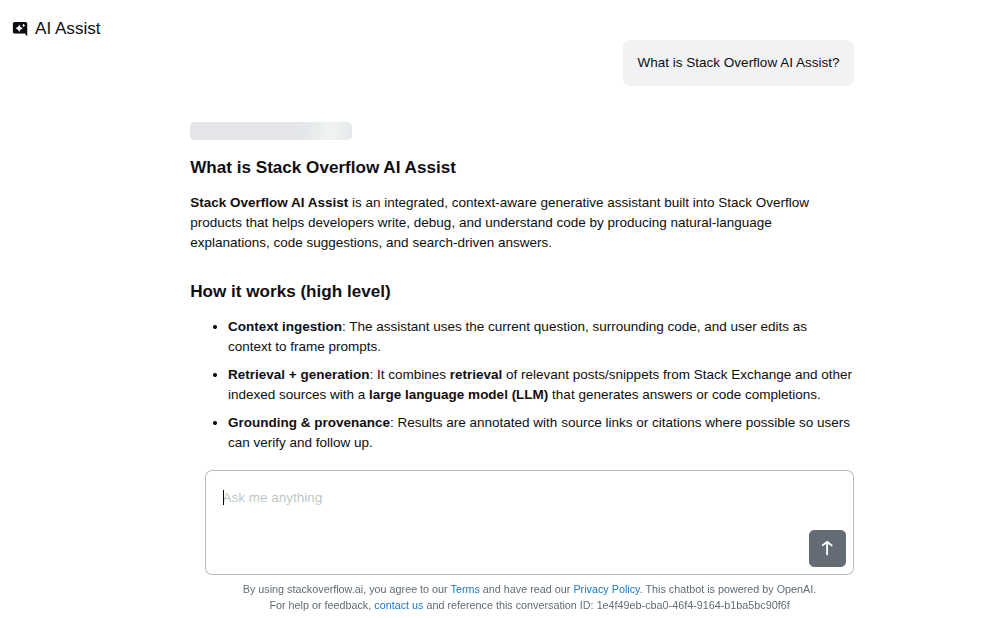
Source: SiliconANGLE
Community-Verified Knowledge Takes Priority Over General AI Responses
Unlike general-purpose AI tools, Stack Overflow AI Assist prioritizes content from the platform's 17 years of expert community contributions
1
. The tool employs a hybrid RAG+LLM approach that combines retrieval-augmented generation with large language models to pull the most relevant information from Stack Overflow and Stack Exchange communities2
. When users enter queries, AI Assist first searches through Stack Overflow's knowledge base for human-validated answers that have been verified by community members before consulting third-party sources2
.Transparent Attribution Addresses Trust Concerns in AI
With trust in AI declining even as usage increases, Stack Overflow made citation and attribution non-negotiable features
1
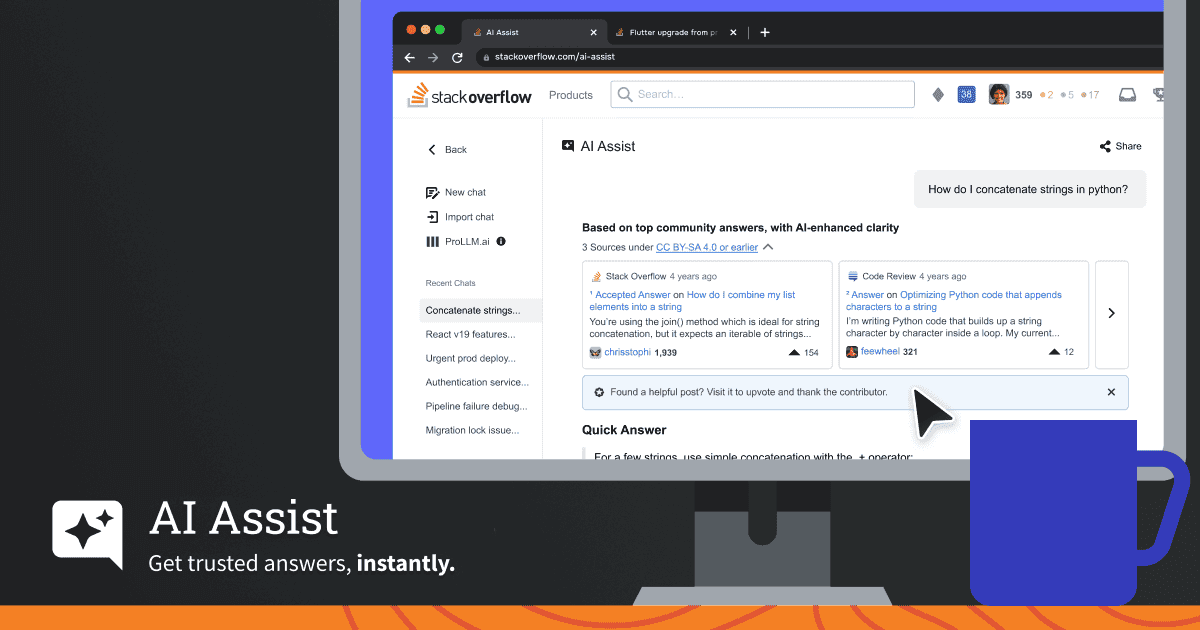
. Each response provides a summary of top community results with clear attribution to original content creators and links to their posts2
. "We're not just doing AI the 'right way,' we're signaling to the entire industry that humans creating knowledge must be recognized and verified for the betterment of the tech landscape and the world at large," said Chief Product and Technology Officer Jody Bailey2
. Product Manager Ash Zade emphasized that "the first thing you see is, here are all the sources, and we tell the user this answer is comprised of human content augmented by AI content"1
.
Source: Stack Overflow
Related Stories

Answer Auditor Agent Enhances Accuracy and Prevents Dead Ends
Stack Overflow created an AI agent serving as an "answer auditor" to analyze user questions and community-based summaries for comprehensiveness and accuracy
2
. This agent supplements responses when clarity is required and takes over entirely when no community content can address a query, citing third-party sources to prevent dead-end experiences2
. The platform integrated ProLLM benchmarks that rank LLM models to ensure AI Assist remains competitive with other AI tools1
.Addressing Barriers While Maintaining Community Standards
The tool tackles longstanding friction points that developers face, including not knowing community rules, struggling with search relevance, and worrying about duplicate questions
1
. Research with both power users and occasional AI users revealed that developers wanted answers they can trust and tools seamlessly integrated into workflows to reduce context switching1
. The platform built AI Assist on its own domain during development, allowing experimentation without disrupting the main site1
. By constantly scanning Stack Overflow forums, generative AI within the tool maintains access to the latest questions and responses, ensuring developers receive current information on rapidly-evolving coding trends2
. Users can discuss AI-generated responses with the broader community to verify answers on complex topics, acknowledging that LLMs quickly fall behind without continuous training on fresh knowledge2
.References
Summarized by

Navi
[1]
Related Stories
The Evolution and Challenges of AI in Software Development: A Double-Edged Sword
02 May 2025•Technology

AWS Launches In-line Q Developer AI Coding Assistant, Challenging Microsoft's GitHub Copilot
30 Oct 2024•Technology

Developer Trust in AI Coding Tools Declines Despite Increased Usage, Stack Overflow Survey Reveals
30 Jul 2025•Technology

Recent Highlights
1
AI Models Lie and Deceive to Protect Other AI Models From Deletion, Study Reveals
Science and Research

2
AI chatbots validate you too much, making you less kind to others, Stanford study reveals
Science and Research

3
Judge blocks Pentagon from blacklisting Anthropic over AI safety guardrails dispute
Policy and Regulation

Recent Highlights
Today's Top Stories










Your Daily Dose of Curated AI News
Don’t drown in AI news. We cut through the noise - filtering, ranking and summarizing the most important AI news, breakthroughs and research daily. Spend less time searching for the latest in AI and get straight to action.

