Swiggy lets users order food via ChatGPT, Gemini, and Claude using AI integration


5 Sources
5 Sources
[1]
Swiggy Will Let You Place Orders, Track Deliveries via ChatGPT and Gemini
Users can use one of Swiggy's custom URLs to create a dedicated connector Swiggy will soon allow users to place orders, make dining reservations, and track deliveries via artificial intelligence (AI) chatbots. On Tuesday, the Indian online food and grocery delivery platform announced the launch of Model Context Protocol (MCP) integration across its different business verticals. Developed by Anthropic, MCP allows AI chatbots to connect with third-party data hubs to access data and perform actions on behalf of the user. Notably, the company says that with this capability, users will be able to place orders while using OpenAI's ChatGPT, Google's Gemini, Anthropic's Claude, and other AI platforms.
[2]
You can now order on Swiggy using ChatGPT, Gemini, Claude and others: Here's how
Swiggy users can now order food, groceries, and book restaurant tables using AI assistants like ChatGPT and Google Gemini. This new feature, called Model Context Protocol, allows for simple, natural language commands. Swiggy aims to make convenience effortless for its customers. Imagine telling an AI assistant, "Order snacks for a match night" or "Get me ingredients for Thai green curry," and having everything show up at your door without fiddling through a conenience app even once. That's exactly what Swiggy is rolling out. The company has launched Model Context Protocol (MCP) integrations across Swiggy Food, Instamart, and Dineout, letting users order food, shop for groceries, and book restaurant tables directly through AI tools like ChatGPT, Claude, Google Gemini, and others. With this move, Swiggy is betting big on conversational commerce, where users simply type what they want and let AI handle the rest. Also Read: Competitive intensity increases as Amazon, Flipkart take on quick commerce players What is Swiggy's MCP integration? The Model Context Protocol (MCP) is an open-source framework that allows AI systems to securely connect with real-time services and data. In Swiggy's case, MCP lets AI agents interact directly with its food delivery, quick commerce, and dining-out platforms. Instead of navigating multiple app screens, users can issue intent-based commands like: "Order ingredients for Thai green curry" "Find a highly rated biryani and order it" "Book a table for two at a good Italian restaurant nearby" The AI agent takes care of everything -- from searching and comparing options to applying offers, placing the order, and tracking delivery. According to the company, Instamart is now the first quick-commerce platform globally to adopt MCP. Users can browse and buy from over 40,000 products using natural language prompts. Also Read: OpenAI's Sam Altman eyes India visit as global AI leaders gather in New Delhi Once connected, the AI agent can: For dining out, the agent is said to even fetch available time slots, apply offers, and book a table in a single prompt. According to Swiggy CTO Madhusudhan Rao, this shift reflects how users now make decisions: "India's convenience needs are deeply contextual... conversational commerce allows users to simply express what they want, when they want it." Also Read: Elon Musk says WhatsApp 'not secure' in latest X post; senior exec hits back Users can set up Swiggy's MCP integration in just a few steps: Once connected, you can start ordering using plain-language prompts. (You can now subscribe to our Economic Times WhatsApp channel)
[3]
Swiggy Orders Can Now Take Place Through ChatGPT, Gemini and More
This is possible because of the launch of Model Context Protocol (MCP) integration. The popular food delivery app Swiggy will now let users order food directly through AI (artificial intelligence) chatbots. Tools like ChatGPT, Gemini, and Claude will now let users order from Swiggy, as well as Instamart and Dineout using natural langauge. This is possible because of the launch of Model Context Protocol (MCP) integration. The user will of course need to connect the AI chatbots through Swiggy on their device. This is not a new concept, but it is new for the quick commerce. Swiggy Instamart is now the first quick-commerce platform globally to adopt MCP. Read More - OPPO India has Launched a New Cricket League, and Its Not e-Sports Here's how this will work: How to Connect Swiggy, Instamart, Dineout with ChatGPT, Claude and Gemini Just follow these simple steps: 1. Navigate to Settings ? Connectors ? Add Custom Connector/App 2. Enter a Name for your connector 3. Provide the URL for the service you want to integrate After that, use either of these links depending on the service you are using: * Instamart: https://mcp.swiggy.com/instamart * Dineout: https://mcp.swiggy.com/dineout * Food: https://mcp.swiggy.com/food Read More - Vodafone Idea ARPU Jumps to Rs 186 in Q3 FY26 After connecting their accounts, users can just give a command to the AI bot, "order a biryani I would love to eat". The agent will take care of the rest and help you in placing the order. Likewise, you can ask ChatGPT to find the best protein snack for you from Instamart which is low in calories and fits your budget as well. You won't need to manually browse through the catalogue of products that these platforms have. The agent will understand your needs and recommend products and help you in ordering them. This was also executed by Zerodha when they announced that users can now connect their Kite account with Claude to gain insights on their portfolio. It will be interesting to see how users adopt this feature.
[4]
Ordering Via ChatGPT on Swiggy Services Isn't Quite Working
Swiggy has announced that it has integrated Model Context Protocol (MCP) across its platforms, a move that could allow users to place orders using AI tools such as ChatGPT, Claude, and Google Gemini instead of navigating the company's app. According to a report by Inc42, the integration spans its food delivery business, quick commerce arm Instamart, and dining-out vertical Dineout. For context, MCP is an open-source protocol that allows AI models to connect to live systems and perform actions. As a result, conversational prompts can translate into real ordering workflows rather than remaining limited to recommendations. The company has positioned MCP as a platform-level integration rather than a chatbot feature, framing conversational AI as a potential new interface for commerce. However, the announcement raises an obvious question: how much of this actually works today? To answer that, MediaNama tested the MCP integration hands-on inside ChatGPT. The results show that while AI-driven ordering is live and functional in parts, the experience remains uneven across services and use cases. How MediaNama Accessed the MCP Integration of Swiggy Notably, the MCP integration does not appear by default and remains hidden during normal use of AI tools. To access it, we switched ChatGPT into developer mode, manually added the MCP server by pasting the server URL, and then authenticated the account through Swiggy's OTP-based login flow. Only after completing these steps did Swiggy's service-specific tools surface inside ChatGPT. In practice, the setup required adding separate MCP endpoints for each vertical: * Food delivery MCP: * Instamart MCP: * Dineout MCP: Overall, this setup makes one thing clear. The integration is real, but gated. Moreover, it is not a consumer-ready feature that users can access unintentionally. Swiggy's MCP integration appears inside ChatGPT only after developer mode is enabled and the MCP servers for food, Instamart, and Dineout are manually added. Source: MediaNama What the MCP of Swiggy Lets AI Do Once authenticated, the AI gained access to several core functions that normally sit behind Swiggy's app interface. During testing, it could retrieve saved delivery addresses from the user's Swiggy account, identify nearby restaurants based on those addresses, understand natural-language requests and customisations, attempt to build carts, and initiate checkout or reservation flows. The use of saved addresses is a useful example. Instead of asking for a location or guessing context, the AI could directly see the same delivery addresses that appear inside the Swiggy app and act on them. When prompted to order food or book a table, it could automatically select an existing address and proceed from there, just as a logged-in user would. This confirms that live backend systems are being exposed to the MCP layer. The AI is not scraping the website or simulating clicks in a browser. Instead, it is interacting directly with Swiggy's internal Application Programming Interface (API)s, accessing structured data such as addresses, restaurant listings, menus, and order states. In practical terms, this means the AI is operating as a connected client within Swiggy's system, rather than as an external assistant guessing what to do next. The AI can see and act on delivery addresses already saved in the Swiggy account, using them to find nearby restaurants and guide the ordering process. (Source: MediaNama) Food Delivery: Discovery Works, Menu Access Often Doesn't Among the three verticals, food delivery was the most developed use case during testing. The AI could locate restaurants, ask clarifying questions about items, and attempt to add products to a cart. However, a recurring issue emerged. In multiple cases, the system could identify a restaurant but failed to load its menu. This occurred across several cafés, including large chains such as Third Wave Coffee and Starbucks. When menu data failed to load, the AI could not add items to the cart, causing the ordering flow to stall. In these situations, the system often suggested switching to a different restaurant whose menu did load successfully. Importantly, there is no evidence that this reflects deliberate steering by the platform. Instead, it points to incomplete or unstable exposure of menu APIs to the MCP layer. Even so, the effect is significant. If the AI cannot access a menu, that restaurant effectively disappears from the AI-driven ordering experience. When a restaurant's menu fails to load through the AI interface, the system can see the outlet but cannot add items, prompting it to suggest alternate restaurants whose menus are accessible. (Source: MediaNama) Why Menu Access Matters in AI Ordering In the app, users browse freely. They scroll through restaurant lists, open menus, compare items, and decide what to order based on what they see. In an AI-driven interface, however, that dynamic changes. The AI can only recommend or act on what it has access to. Let's consider a simple scenario. A user asks an AI assistant to order a coffee from a nearby café. The AI identifies several cafés, but only one or two menus load successfully through the backend connection. Even if other cafés are open, popular, or closer, the AI cannot select items from them if their menus fail to load. As a result, the flow either stalls or nudges the user toward the cafés whose menus are accessible. From the user's perspective, this may appear as a preference-based recommendation. In reality, the system is operating within a constrained view of the marketplace. This does not indicate intentional curation. However, it highlights a structural risk of AI-led ordering. Incomplete data exposure can narrow user choice by default. In such systems, what the AI cannot see effectively does not exist, even if it remains fully available in the app. Restaurant discovery remains available, but transactional actions stall when menu APIs are blocked. (Source: MediaNama) Payments Are Currently Limited to Cash on Delivery Another clear signal from testing was that AI-initiated orders currently proceed only via cash on delivery (COD). Attempts to complete transactions using online payment methods were either blocked or failed at checkout. Rather than a shortcoming, this appears to be a deliberate design choice. By limiting AI-driven orders to COD, the company can test agent-led transactions while keeping financial risk contained. If an AI misinterprets an instruction or places an unintended order, payment has not yet been captured, making reversals and dispute resolution far simpler. Furthermore, this approach reduces exposure to fraud and chargebacks at a stage when system reliability remains uneven. Seen this way, the COD-only flow reinforces the view that this is a cautious, safety-first rollout. COD restrictions prevent the AI from completing the order, reinforcing how payment controls limit financial exposure during early rollout. Source: MediaNama Swiggy Instamart: Intent Without Transactions The company has claimed that Instamart is the first quick commerce platform globally to adopt MCP. In practice, however, the Instamart integration remains partial. During testing, the AI could understand grocery-related intent and suggest items conversationally. Instamart checkout, however, was not exposed, and grocery orders could not be completed end-to-end through the AI interface. In effect, this means Instamart's AI integration currently functions as a guided assistant rather than an ordering interface. The AI identifies Instamart items but lacks checkout access, forcing the order to shift back to the app. Source: MediaNama Dineout: From Failed Attempts to a Successful Booking Dineout followed a similar pattern, with one important update. Initial attempts allowed the AI to find restaurants, check availability, and suggest time slots. However, reservation attempts failed at checkout due to technical errors. The first Dineout reservation attempt runs into a Swiggy-side technical block. Source: MediaNama However, in later testing, a table booking was completed successfully. A successful booking through Swiggy's Dineout MCP server. (Source: MediaNama) This outcome confirms that the transaction layer for Dineout exists and can function. The issue, therefore, appears to be reliability rather than capability. A Pattern Across the Platform's Verticals Across food delivery, Instamart, and Dineout, the AI integration follows a clear pattern. The system understands intent reliably. It parses natural-language requests, pulls saved addresses, and surfaces relevant options. What changes is execution. Food delivery and Dineout allow the AI to enter checkout or reservation flows, sometimes successfully. Instamart stops earlier, with the system recognising grocery intent but unable to place an order. Stability drops further along the flow. Menu access fails intermittently, payment options remain constrained, and checkout succeeds in some cases and fails in others. These issues repeat across verticals. Overall, the integration prioritises discovery over commitment. The AI can suggest broadly, but its ability to complete actions remains uneven and tightly limited. How This Fits a Broader Industry Pattern This sequencing mirrors how other Indian platforms are approaching AI-led ordering. Zepto and Zomato have both tested similar systems internally, sharing experiments publicly while keeping them out of consumer-facing products. By comparison, this rollout is more visible and integrated, but it still stops short of full autonomy. Gated access, confirmation steps, and COD-only payments indicate where platforms are drawing the line as they test how far AI systems can act on a user's behalf. In effect, this marks a cautious step toward agentic AI. Platforms are testing what delegation looks like in practice, but only within boundaries they can clearly define and reverse.
[5]

Swiggy Orders Now Possible Through ChatGPT, Gemini, & Claude; 40,000+ Items Available
The new feature works with the help of the Model Context Protocol, known as MCP. It's a system that safely connects AI chat tools to real services. With this setup, AI chats can place real orders instead of only giving answers. Swiggy has added this feature to Swiggy Food, Instamart, and Dineout. Ordering through AI feels like having a normal chat. Users can type simple messages asking for dinner, grocery items, or a restaurant booking. The AI takes care of the rest; it searches options, compares prices, applies offers, adds items to the cart, confirms the address, and places the order. The entire process happens within the chat window. Swiggy informed us that Instamart is the first quick delivery platform in the world to use MCP. Instamart offers more than 40,000 products, including groceries and daily needs. Users can ask for items needed for a recipe or for daily shopping. The AI builds the shopping list and places the order. Food delivery also becomes simpler with AI ordering. The chatbot can suggest popular restaurants and top-rated dishes. It can also track the order after placement. Users can search nearby restaurants, check available tables, and book a slot through the same chat.
Share
Share
Copy Link
Swiggy has launched Model Context Protocol integration across its platforms, enabling users to place food orders, shop groceries, and book restaurant tables through AI chatbots like ChatGPT, Google Gemini, and Anthropic's Claude. The Indian food delivery platform becomes the first quick-commerce service globally to adopt this conversational commerce approach, though early testing reveals implementation challenges.
Swiggy Introduces AI Integration Across Multiple Services
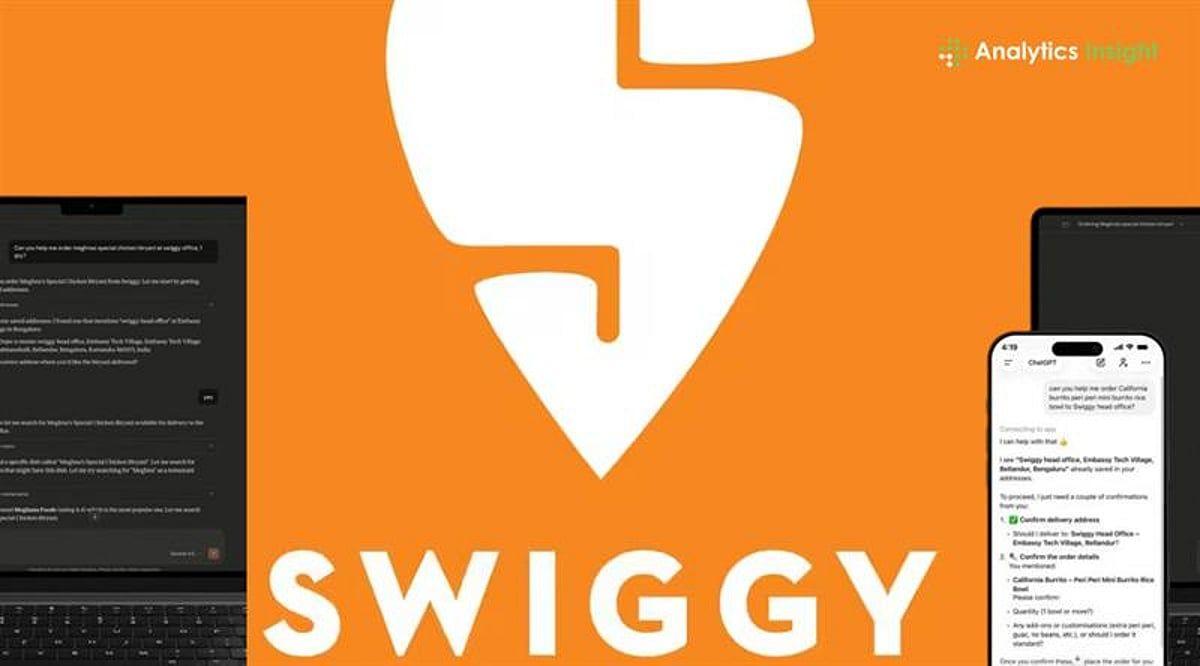
Swiggy has launched Model Context Protocol (MCP) integration across its food delivery, quick-commerce, and dining platforms, marking a shift toward conversational commerce in India's delivery ecosystem
1
. The integration allows users to order food through AI assistants including OpenAI's ChatGPT, Google Gemini, and Anthropic's Claude by issuing natural language commands rather than navigating through traditional app interfaces2
.
Source: Analytics Insight
Developed by Anthropic, the Model Context Protocol (MCP) serves as an open-source framework that enables AI chatbots to connect with third-party data hubs and perform actions on behalf of users
1
. According to Swiggy CTO Madhusudhan Rao, this approach reflects how users now make decisions: "India's convenience needs are deeply contextual... conversational commerce allows users to simply express what they want, when they want it"2
.Swiggy Instamart Becomes First Quick-Commerce Platform With MCP
Swiggy Instamart has become the first quick-commerce platform globally to adopt MCP, offering access to over 40,000 products through AI agents
2
5
. Users can browse and purchase groceries, daily essentials, and ingredients using simple prompts like "Order ingredients for Thai green curry" or "Get me ingredients for Thai green curry"2
. The AI agent handles the entire workflow—from searching and comparing options to applying offers, placing orders, and enabling users to track deliveries2
.
Source: MediaNama
For Swiggy Dineout, the integration extends to dining reservations, where AI agents can fetch available time slots, apply offers, and book restaurant tables through single prompts
2
.
Source: Gadgets 360
Setting Up the MCP Connection Requires Manual Configuration
Users must manually configure the AI Integration through a multi-step process that involves navigating to Settings, selecting Connectors, and adding custom connector URLs for each service
3
. Swiggy provides three separate URLs: https://mcp.swiggy.com/food for food delivery, https://mcp.swiggy.com/instamart for grocery delivery, and https://mcp.swiggy.com/dineout for dining reservations3
. Once connected, users can issue commands like "order a biryani I would love to eat" or "find the best protein snack for you from Instamart which is low in calories"3
.This approach mirrors similar implementations by other Indian companies, including Zerodha, which recently announced that users can connect their Kite user accounts with Claude to gain portfolio insights
3
. The trend suggests a broader movement toward API integration that exposes backend systems directly to AI agents rather than relying on traditional app interfaces.Related Stories

Implementation Challenges Surface in Early Testing
MediaNama's hands-on testing revealed that the MCP integration functions as a gated developer feature rather than a consumer-ready product
4
. Access requires switching ChatGPT into developer mode, manually adding MCP server URLs, and authenticating through Swiggy's OTP-based login flow4
. The integration does not appear by default during normal use of AI tools, making it inaccessible to users unfamiliar with technical configuration4
.Once authenticated, the AI gained access to saved delivery addresses, nearby restaurant listings, and the ability to initiate checkout flows
4
. However, menu access proved inconsistent. In multiple cases involving large chains such as Third Wave Coffee and Starbucks, the system could identify restaurants but failed to load menus, preventing items from being added to carts4
. This incomplete exposure of menu APIs to the MCP layer means that restaurants without accessible menus effectively disappear from the AI-driven ordering experience, even though they remain visible in the standard Swiggy app4
.What This Means for Conversational Commerce in India
Swiggy's adoption of Model Context Protocol (MCP) signals an industry shift where AI agents could replace traditional app navigation for routine transactions. The ability to order food through AI assistants using natural language commands reduces cognitive load and streamlines decision-making for users juggling multiple daily tasks. For Google, OpenAI, and Anthropic, this integration validates their platforms as actionable commerce layers rather than just information retrieval tools.
Yet the current implementation raises questions about scalability and user adoption. The requirement for developer mode access and manual server configuration limits the feature to technically proficient users, while inconsistent menu access undermines reliability. If Swiggy intends to position conversational commerce as a mainstream interface, it will need to simplify onboarding and stabilize backend API integration to ensure consistent performance across all restaurants and product categories. Watch for updates on whether Swiggy transitions this from a gated developer feature to a one-click consumer experience, and whether competitors in India's crowded food delivery platform market follow suit with their own AI agent integrations.
References
Summarized by

Navi
Related Stories
ChatGPT Instacart Integration Brings AI Grocery Shopping With Instant Checkout Feature
08 Dec 2025•Technology
DoorDash brings grocery shopping to ChatGPT in AI integration rivaling Instacart
18 Dec 2025•Technology
Swiggy Launches Pyng: AI-Driven Marketplace for Professional Services
15 Apr 2025•Technology
Recent Highlights
1
Tennessee Teens Sue Elon Musk's xAI Over Grok AI-Generated Child Abuse Images
Policy and Regulation

2
Supermicro Co-Founder Indicted in $2.5 Billion Nvidia AI Chip Smuggling Scheme to China
Policy and Regulation

3
Val Kilmer to appear posthumously in As Deep as the Grave through AI-generated performance
Entertainment and Society

Recent Highlights
Today's Top Stories



Your Daily Dose of Curated AI News
Don’t drown in AI news. We cut through the noise - filtering, ranking and summarizing the most important AI news, breakthroughs and research daily. Spend less time searching for the latest in AI and get straight to action.

