SwitchBot unveils Onero H1 humanoid robot to handle laundry, dishes and more household tasks


4 Sources
4 Sources
[1]
I Watched a Robot Slowly and Inefficiently Load Laundry at CES
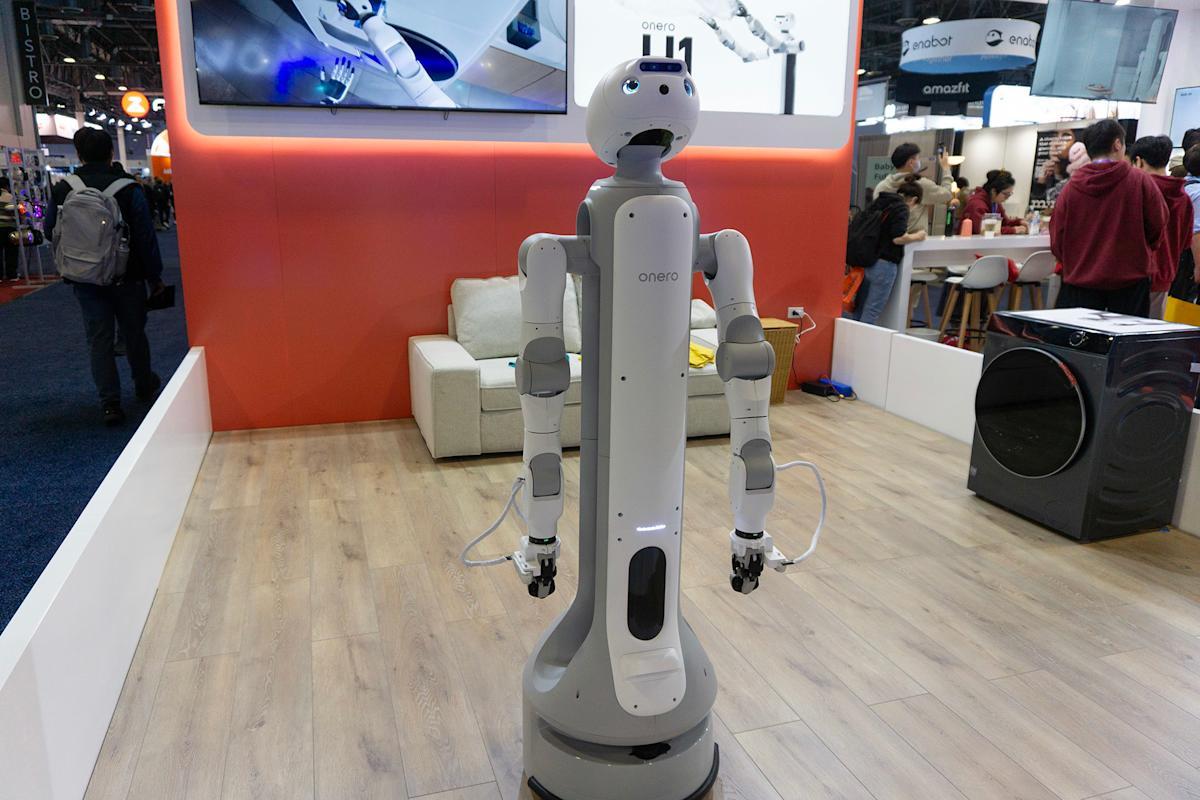
Expertise 13+ years of experience in consumer product reviews, buying guides, best lists, and tech news across a variety of tech categories. As a homeowner, Ajay is also familiar with the unique electrical issues that can crop up in a prewar apartment building. Since the washing machine and dryer were invented, humans have dreamed about offloading all the other chores involved with laundry, including sorting, loading and folding. I watched Switchbot's Onero H1 attempt the first two of these tasks, and I wasn't impressed, especially since, unlike most other humanoid robots we've seen at CES 2026, you might actually be able to buy this one. The Onero H1 is another one of the many vaguely humanoid cleaning and sorting robots that popped up at CES. The H1 is designed to be a general-purpose chore robot, capable of not only doing laundry but also loading a dishwasher and organizing items. The promotional video Switchbot posted suggests that it can do essentially anything a human servant can, including serving food and drinks, similar to LG's CLOiD robot. After seeing it in action at Switchbot's booth at CES, I don't think it's one you should consider preordering, as it still feels very much like a proof of concept and not a consumer product. It took the H1 nearly a full two minutes to very slowly move to a couch, pick up a single item of clothing, and put it into the washing machine, making it even slower than LG's version that David Watsky, CNET managing editor, saw. The version I saw for the demo didn't have a fully articulated five-fingered hand, like the one shown in the demo video. It seems there will be at least two models. I'd like to assume that it's capable of carrying more than one item of clothing via a basket, but even at the most optimistic level, you're likely looking at an hour for it to load a single load of laundry, or even longer for a larger household. Notably, it also had to physically bump its body against the washing machine door in order to push it open, despite initially reaching out to open it with its arms. Between the demo sessions, I also watched a booth representative have to go in and manually change the battery. I assume this is because it's a prototype and the future consumer model will have a docking station that charges it. But this also raises the question of battery life. While a robot vacuum can last for an hour or more of cleaning, how long does a fully humanoid robot last without needing a charge? If the answer is any shorter than that of a robot vacuum, then this isn't a practical product, as it'll constantly be running back to the dock to recharge rather than getting anything done, which is one of consumers' biggest gripes about robot vacuums. As a person with three cats who are none too bright, I also have concerns about how well it can recognize and avoid pets. A robot vacuum's ability to avoid a cat or a dog isn't nearly as significant a deal. It's unlikely that it would be able to do much damage to them. The H1 is a much bigger and heavier device. If it runs over or tips over on a pet or a child, it could very well cause serious injury or death. That said, I don't want to be unrelentingly negative about the H1. To its credit, it did work in the demo, and it managed to load the washer multiple times. Switchbot has also created a variety of robot vacuums and smart home devices that work quite well, including the Switchbot S20 Auto Fill & Drain, which had one of the better object avoidance capabilities we've tested. In terms of hardware, it features RealSense cameras for vision and navigation, and an AI model is integrated under the hood, as expected. Currently, we don't have any concrete information about pricing, availability, or other hardware details. However, it's rumored that the device will be priced under $10,000 and will be available in 2026, which still places it in the very expensive luxury range rather than the affordable consumer appliance range.
[2]
Are our homes ready for a real-life Rosie the Robot? SwitchBot thinks so
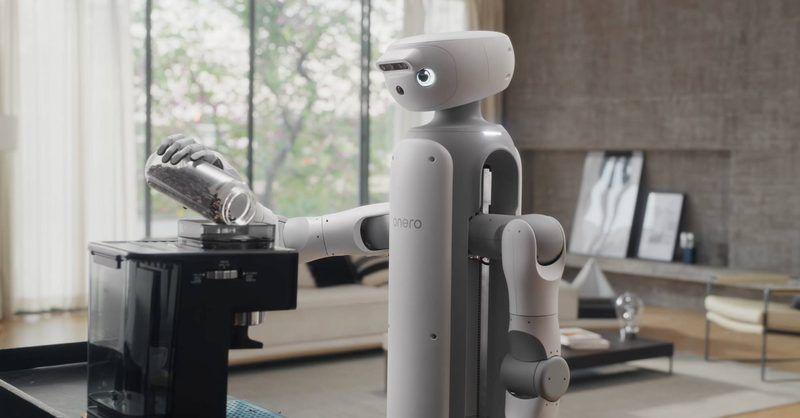
The company also announced a new smart lock to its SwitchBot Lock Vision Series, an AI MindClip, a Weather Station, and an interactive light display. It's CES time, which means it's also time to read about the latest innovations in robotics and see more futuristic robots on the news than are in the I, Robot movie. Most of the robots we see at CES, however, are prototypes and far from making sense for the average consumer to attain. Yet SwitchBot is working on one that may actually turn smart home enthusiasts onto the robot market. The SwitchBot Onero H1 is an embodied AI robot -- that is, a humanoid robot meant to eliminate the need for humans to do housework. Think of Rosie the Robot from The Jetsons -- the Onero H1 is like a tall, less tinny version of that: a wheeled robot that can do anything from laundry to dishes to picking up your kids' toys. Also: CES 2026 live blog: Latest news on TVs, AI, phones, more SwitchBot shared a video of the Onero H1 in action, and it's quite enthralling. The robot can be seen navigating a home, preparing coffee, cooking breakfast, loading the dishwasher, and washing the windows. It even asks like a servant to receive a jacket someone throws at it when they come home. It sounds too good to be true, right? It might not be, since SwitchBot claims the Onero H1 is coming to the market "soon," though no specific date has been announced. In terms of functionality, the Onero H1 features an on-device OmniSense VLA model and 22 degrees of freedom. It's capable of learning and adapting to various tasks, while also working in coordination with existing SwitchBot devices. The robot learns and reacts to its environment using visual perception and tactile feedback to perform tasks such as grasping, pushing, and opening, which are necessary for household chores. Having a robot that can wash and fold your laundry, bring you food and drinks, and pick up after everyone at home sounds like a dream, precisely because such a thing is extremely difficult to create. Many of us with robot vacuums at home know how far those devices have to go to clean like a person, so creating a robot that can handle all housework currently done by humans is a huge ask. Also: CES 2026 trends to watch: 5 biggest topics we're expecting at the world's biggest tech show I'm no robotics expert, but I believe a household robot should have either a very high degree of intelligence to perform changing household tasks effectively. I can't imagine a robot coming to my home and going straight to the kitchen to load the dishwasher without at least some learning process or involvement from me. Using AI and visual learning algorithms, robots can learn and adapt to varying scenarios in real-time, but we're not yet at the point of having an affordable robot that can react and adapt like a human. Here's the thing, though: SwitchBot has been perfecting multiple different technologies to automate household tasks over the years, so if there's a company that can actually deliver a functional household robot, SwitchBot may be it. The company already has the SwitchBot K20+ Pro, a multitasking robot that goes over the K10+ robot vacuum and can transport anything from cameras to air purifiers around your home. I'm excited to test the SwitchBot Onero H1 at CES, and will continue to update this story as I gain more experience with it.
[3]
Switchbot came to CES with a laundry robot you might actually be able to buy
CES 2026 isn't the first year we've seen a wave of interesting robots or even useful robots crop up in Las Vegas. But it's the first year I can remember when there have been so many humanoid and humanoid-like robots performing actually useful tasks. Of those, Switchbot's Onero H1 has been one of the most intriguing robot helpers I've seen on the show floor, especially because the company says that it will actually go on sale later this year (though it won't come cheap). Up to now, Chinese company Switchbot has been known for its robot vacuums and smart home devices. Much of that expertise is evident in Onero. The unexpectedly cute robot has a wheeled base that looks similar to the company's robot vacuums, but is also equipped with a set of articulated arms that can help it perform common household tasks. I was able to see some of its abilities at Switchbot's CES booth, where Onero dutifully picked up individual articles of clothing from a couch, rolled over to a washing machine, opened the door, placed the items inside and closed the door. The robot moved a bit slowly; it took nearly two minutes for it to grab one piece of clothing and deposit it inside the appliance which was only a few feet away. I'm not sure if its slowness was a quirk of the poor CES Wi-Fi, a demo designed to maximize conference-goers attention or a genuine limitation of the robot. But I'm not sure it matters all that much. The whole appeal of a chore robot is that it can take care of things when you're not around; if you come home to a load of laundry that's done, it's not that concerning if the robot took longer to complete the task than you would have. The laundry is done and you don't have to do it. That's the dream. Under the hood, Onero is powered by RealSense cameras and other sensors that help it learn its surroundings, as well as on-device AI models. The demo of course only offered a very limited glimpse of Onero's potential capabilities. In a promotional video shared by Switchbot, the company suggests the robot can so much, much more: serve food and drinks, put dishes away, wash windows, fold clothes and complete a bunch of other -- frankly, impressive -- tasks. The Onero in the video also has an articulated hand with five fingers that gives it more dexterity than the claw-hand one I saw at CES. A Switchbot rep told me, though, that it plans to offer both versions when it does go on sale. Which brings me to the most exciting part about watching Onero: the company is actually planning on selling it this year. A Switchbot rep confirmed to me it will be available to buy sometime in 2026, though it will likely be closer to the end of the year. The company hasn't settled on a final price, but I was told it will be "less than $10,000." While we don't know how much less, it's safe to say Onero won't come cheap. It also seems fair to say that this will be a very niche device compared to many of Switchbot's other products. But, if it can competently handle everything the company claims it can, then there's probably a lot of people and businesses that would be willing to pay.
[4]
SwitchBot's new robot could take household chores off your plate
CES always brings a flood of futuristic tech, and this year, robot butlers are stealing the spotlight. LG has already teased its CLOiD robot, and SwitchBot is joining the fray with its first humanoid robot built to handle household chores. SwitchBot says the onero H1 is a completely automatic and collaborative robot that can help users with a wide range of domestic tasks. The robot features two fully articulating arms with 22 degrees of freedom, giving it near-human dexterity. Recommended Videos The onero H1 scans its surroundings using multiple Intel RealSense cameras in its head, arms, hands, and abdomen, and processes the data with SwitchBot's OmniSense VLA AI algorithm. According to SwitchBot's marketing video, this lets the robot perform tasks like making and delivering coffee, cooking meals, rinsing dishes and loading them into the dishwasher, and even doing the laundry. SwitchBot adds the robot can also integrate seamlessly into its broader smart home ecosystem, interacting with other smart devices to coordinate tasks. Unlike other humanoid robots we've seen of late, the onero H1 moves on wheels, which should allow for more stability and faster navigation around the house. Pre-orders open soon, but the price tag is still a mystery There's no word on pricing yet, but SwitchBot plans to open pre-orders on its official website soon. How well it performs in real-world use remains to be seen. We're keeping our expectations in check, especially considering the number of overhyped demos and hilarious fails we've seen lately. Humanoid robots like the onero H1 hint at a future where daily chores could be automated, giving people more time for work, hobbies, or just to relax. While we're still a long way from having fully capable robot butlers in every home, this year's CES showcase suggests companies are serious about turning that sci-fi dream into reality.
Share
Share
Copy Link
SwitchBot introduced its Onero H1 humanoid robot at CES 2026, promising to automate household chores from laundry to dishwashing. While demos showed the robot successfully loading a washing machine, it took nearly two minutes per item, raising questions about practicality. The company plans to launch the robot later in 2026 for under $10,000.
SwitchBot Enters the Robot Butler Market with Onero H1
SwitchBot, known for its robot vacuums and smart home devices, unveiled the Onero H1 at CES 2026, marking the company's ambitious entry into the humanoid robot market
1
2
. This embodied AI robot represents a significant shift from the company's previous offerings, designed specifically to automate household chores that have long been the domain of humans2
. Unlike many CES prototypes that remain concepts, SwitchBot confirmed the Onero H1 will actually go on sale later in 2026, with pricing expected to stay under $10,0003
. The announcement positions SwitchBot alongside competitors like LG's CLOiD robot in the emerging market for robot helpers that can perform various household chores4
.
Source: Engadget
Technical Capabilities and Design Features
The Onero H1 features two fully articulating arms with 22 degrees of freedom, giving it near-human dexterity for handling common household tasks
4
. The humanoid robot uses multiple Intel RealSense cameras positioned in its head, arms, hands, and abdomen to scan its surroundings4
. An on-device OmniSense VLA AI model processes visual data, enabling the robot to learn and adapt to various tasks through visual perception and tactile feedback2
. Unlike bipedal humanoid robots, the Onero H1 moves on a wheeled base similar to the company's robot vacuum line, which should provide more stability and faster navigation around homes4
. The laundry robot will be available in at least two versions, including one with a fully articulated five-fingered hand for enhanced dexterity3
.
Source: Digital Trends
Real-World Performance Raises Questions
During live demonstrations at CES, the Onero H1 successfully completed its assigned tasks but revealed significant limitations. The humanoid chore robot took nearly two minutes to pick up a single piece of clothing from a couch and place it into a washing machine just feet away
1
3
. At this pace, observers estimate it could take an hour or more to complete a single load of laundry and dishwashing tasks1
. The prototype also had to physically bump its body against the washing machine door to push it open, despite initially reaching out with its arms1
. Battery life concerns emerged when booth representatives had to manually change the battery between demo sessions, though this may be addressed with a charging dock in the consumer version1
.
Source: CNET
Related Stories

Safety Concerns and Smart Home Integration
The Onero H1's size and weight raise important safety questions that differentiate it from smaller devices like robot vacuums. If the robot runs over or tips onto a pet or child, it could cause serious injury, making object avoidance capabilities critical
1
. SwitchBot has demonstrated strong object avoidance in products like the S20 Auto Fill & Drain, which could inform the Onero H1's safety features1
. The robot is designed to integrate seamlessly into SwitchBot's broader smart home ecosystem, coordinating with existing devices to complete tasks2
4
. This integration could enable more complex automation scenarios where robot butlers work alongside other smart devices.Market Positioning and Future Outlook
SwitchBot's promotional video showcases the Onero H1 performing an impressive range of tasks including preparing coffee, cooking breakfast, washing windows, and folding clothes—essentially functioning like Rosie the Robot from The Jetsons
2
3
. The company's years of experience perfecting technologies to automate household chores through robotics and visual learning algorithms positions it well to deliver a functional household robot2
. While the $10,000 price point places the Onero H1 in the luxury range rather than as an affordable consumer appliance, it remains significantly more accessible than many humanoid robots1
. The 2026 release timeline, expected toward the end of the year, gives SwitchBot time to refine the prototype and address concerns about battery life and performance speed3
. For households and businesses willing to invest, the appeal lies not in speed but in the ability to come home to completed chores, fundamentally changing how people allocate their time between work, hobbies, and relaxation3
4
.References
Summarized by

Navi
[4]
Related Stories
LG CLOiD home robot debuts at CES 2026 to tackle cooking, laundry and household chores
04 Jan 2026•Technology

1X's $20,000 Neo Robot Promises Home Automation But Relies on Human Remote Control
29 Oct 2025•Technology

Humanoid Robots Tackle Laundry: Figure 02 and Others Showcase Advanced AI Capabilities
16 Aug 2025•Technology

Recent Highlights
1
Google releases Gemma 4 with Apache 2.0 license, enabling unrestricted local AI on devices
Technology

2
AI Models Lie and Deceive to Protect Other AI Models From Deletion, Study Reveals
Science and Research

3
OpenAI closes $122 billion funding round amid fierce AI competition and profitability questions
Startups

Recent Highlights
Today's Top Stories







Your Daily Dose of Curated AI News
Don’t drown in AI news. We cut through the noise - filtering, ranking and summarizing the most important AI news, breakthroughs and research daily. Spend less time searching for the latest in AI and get straight to action.

