Universal Music Nvidia partnership expands AI music discovery with responsible AI safeguards


5 Sources
5 Sources
[1]
Universal Music signs a new AI deal with Nvidia
But UMG's statement stresses that its collaboration with Nvidia pursues "responsible AI" meant to make it easier to discover, engage with, and create music. On that last point, the companies will promote their "shared objectives of advancing human music creation and rightsholder compensation." The Music Flamingo model, which was published in November 2025 by Nvidia and researchers at University of Maryland, College Park, can process tracks up to 15 minutes long. Details are scarce about exactly how the model will be incorporated into UMG's catalog, but artists will be able to use Music Flamingo to better analyze their own music, as well as describe and share the music "with unprecedented depth," according to the statement. Fans, meanwhile, can find music in new ways beyond genre or playlist, such as with emotion or "cultural resonance."
[2]
NVIDIA and Universal Music Group sign deal for 'responsible AI'
Described as an "antidote to AI slop," the strategic partnership will expand NVIDIA's AI music models and develop new AI-powered music creation tools with direct input from artists. Artificial intelligence (AI) could make it easier to find your next favourite song. That's the mission of a new partnership announced on Tuesday, between AI company NVIDIA and the world's largest music rights company, Universal Music Group (UMG). The two industry giants announced they are joining forces to develop "responsible AI for music discovery, creation, and engagement," according to a press release. The collaboration will tap into UMG's catalogue of over 3 million recorded songs to expand NVIDIA's AI model Music Flamingo, a large audio-language model that allows the AI system to listen to, interpret and reason about music. "We're entering an era where a music catalogue can be explored like an intelligent universe - conversational, contextual, and genuinely interactive," Richard Kerris, NVIDIA's vice president of media said in a statement. NVIDIA's Music Flamingo processes full-length tracks of up to 15 minutes with "unprecedented precision, capturing harmony, structure, timbre, lyrics and cultural context," according to the company. With more data to train on, Music Flamingo will be able to help fans discover new songs based on "emotional narrative and cultural resonance," going beyond traditional search categories like genre or tempo. The system will also deepen its own knowledge of music, learning to interpret it more like humans do. According to the company, this will make it easier for emerging artists to find fans who will connect with their sound. Artists will also be able to analyse, describe, and share their music with more depth on Music Flamingo. "By extending NVIDIA's Music Flamingo with UMG's unmatched catalog and creative ecosystem, we're going to change how fans discover, understand and engage with music on a global scale," Kerris said. "And we'll do it the right way: responsibly, with safeguards that protect artists' work, ensure attribution and respect copyright." The partnership will also develop new AI-driven music creation tools for artists. To guarantee artists are the ones reaping the benefits of these tools, NVIDIA and UMG said they will create a dedicated artist incubator. The companies said the incubator will invite artists, songwriters, and producers to help design and test the new AI-powered tools, promising to serve as an "antidote to generic, 'AI slop' outputs." It isn't the first time UMG and NVIDIA have teamed up - UMG's Music & Advanced Machine Learning Lab (MAML) previously trained its models using NVIDIA's AI infrastructure.
[3]
Universal Music enters into Nvidia deal to expand AI capabilities
Both organisations have stated the collaboration will enable further joint research and development into the 'shared objectives of advancing human music creation and rightsholder compensation'. US chipmaker Nvidia and music platform Universal Music Group (UMG) have announced plans for a partnership that will see UMG leverage Nvidia's AI infrastructure across its music catalogue. The catalogue holds millions of tracks across a range of genres and reportedly the advanced technology will enable the partners to "pioneer responsible AI for music discovery, creation, and engagement". The announcement noted that the collaboration is set to focus primarily on research and development for the purpose of promoting the shared objectives of "advancing human music creation and rightsholder compensation", further stating that "the companies will pursue new approaches to leverage AI in order to protect artists' work and ensure proper attribution of music-based content." In order to "transform how fans discover music", UMG will deploy Nvidia's AI model Music Flamingo across the music catalogue. Flamingo, according to UMG, sets a new standard in music intelligence, by "moving beyond surface-level recognition to deliver rich, human-like understanding of songs". The statement added, "Built on NVIDIA's advanced Audio Flamingo architecture, the model processes full-length tracks, up to 15 minutes, with unprecedented precision, capturing harmony, structure, timbre, lyrics, and cultural context. It uses chain-of-thought reasoning to enable nuanced interpretation of musical elements, from chord progressions to emotional arcs." UMG's Music and Advanced Machine Learning Lab previously trained its own models using Nvidia's AI infrastructure. Going forward, the collaboration will employ both companies' research capabilities to establish creative laboratories that foster comprehensive input from artists, songwriters, music labels and publishers, by leveraging UMG's studio operations such as Abbey Road Studios in London and Capitol Studios in Los Angeles. Additionally, UMG will use Nvidia's AI infrastructure in the "development of responsibly trained AI-driven business and creative processes". Commenting on the news of the partnership, Sir Lucian Grainge, UMG's chair and CEO, said, "We're excited to establish this ground-breaking strategic relationship which unites the world's leading technology company with the world's leading music company in a shared mission to harness revolutionary AI technology to dramatically advance the interests of the creative community and the role of music in global culture. "We eagerly embrace the opportunities that AI presents, and the fact that Nvidia is choosing to take a leadership position in the tech industry in their commitment to responsible AI principles is critically important. "We look forward to working closely with NVIDIA to direct AI's unprecedented transformational potential towards the service of artists and their fans as we work together to set new standards for innovation within the industry, while protecting and respecting copyright and human creativity." The announcement comes during a time of increasing concern among artists about the effects of AI intelligence and technologies in the arts. Early last year, performers such as Annie Lennox, Kate Bush and Hans Zimmer, among 1,000 others, lent their support to a protest against proposed changes to UK copyright law that would allow AI developers to train their models using copyrighted material. In November of the same year, Warner Music Group (WMG) settled a year-long copyright lawsuit against AI music generator Suno, by forging a new partnership focused instead on jointly supporting the music ecosystem. WMG previously sued Suno and Uncharted Labs, as part of a joint lawsuit alongside UMG and Sony Music for breach of copyright and the latter two are still moving forward with the lawsuit. Don't miss out on the knowledge you need to succeed. Sign up for the Daily Brief, Silicon Republic's digest of need-to-know sci-tech news.
[4]
UMG and NVIDIA Team Up to Build 'Responsible AI' for Music
Building on NVIDIA's AI infrastructure, Universal Music Group (UMG) said it aims to develop what it describes as "responsible AI" tools for music discovery, creation, and audience engagement, according to a press release. Interestingly, UMG and NVIDIA will also conduct research to promote "rightsholder compensation." However, neither company has provided a detailed outline of how this "compensation" would be distributed to original artists. Meanwhile, they will collaborate on NVIDIA's Music Flamingo project, designed for in-depth music analysis. This announcement comes soon after UMG invested in Excel Entertainment, taking a 30% equity stake in the future music produced by the Bollywood production house. It has also invested in another Bollywood production house, Maddock Films. What is NVIDIA's Music Flamingo Project? Music Flamingo, which launched in November 2025, is a large audio-language model that analyses and interprets music and songs. "Music Flamingo sets a new standard for advanced music understanding by demonstrating how models can move from surface-level recognition," reads NVIDIA's research section on the project. It further states that existing audio-language models perform poorly on music due to the scarcity of high-quality music data and well-annotated datasets. As a result, earlier models produced only short captions and answered basic questions. As illustrated by NVIDIA, Music Flamingo can reportedly generate detailed descriptions of music and answer questions about harmony, structure, timbre, lyrics, and cultural context. It can reason about songs using concepts from music theory, rather than responding only to "surface-level" questions. Addressing these gaps, NVIDIA says it created Music Flamingo through new datasets and training methods specifically designed for music. However, based on the datasets listed on Flamingo's demo website, Indian music accounts for only 1.4% of the total training data, while American and Western music dominate with 33.1% and 12%, respectively. The scarcity of Indian music data in the training set raises significant questions about UMG's recent investments in Indian music, particularly through its stakes in Bollywood production houses. How Will 'Compensation' Work? Lucian Grainge, UMG's Chairman and CEO, said that through its partnership with NVIDIA, the company will use AI to transform how it serves artists and fans, setting "new standards for innovation within the industry, while protecting and respecting copyright and human creativity." Echoing similar sentiments, Richard Kerris, NVIDIA's VP and GM of Media, said the partnership aims to do it "the right way: responsibly, with safeguards that protect artists' work, ensure attribution, and respect copyright." While it is understandable that the collaboration is still evolving, neither UMG nor NVIDIA's Flamingo project has provided any clarity on how these goals, especially the promise of "respecting copyright," will be achieved. This lack of detail becomes particularly important given the press release's claim that the partnership will promote rightsholder "compensation." The question gains urgency as the Indian government is currently in the process of framing policies around AI and copyright for data used in training large language models. Before examining the Indian government's idea of "fair compensation," it is worth clarifying what the term itself implies. According to the Cambridge Dictionary, "compensation" means "money that is paid to someone in exchange for something that has been lost or damaged, or for some problem." This raises a critical question: what is the intent of AI service providers when they promise to compensate original artists after harm or damage has already occurred? AI training should be based on consent-first, licence-based agreements between creators and AI companies before systems are trained on copyrighted works. By doing the reverse, "compensating" after the massive unconsented data stealing, they are taking away the decision-making agency from the original creator. Second, addressing the compensation issue post data-extraction, the Working Paper on Generative AI and Copyright released by the Department for Promotion of Industry and Internal Trade (DPIIT) also proposes a compensation-based framework for data used in AI training. This approach could legitimise AI companies' access to copyrighted material in exchange for royalties. The committee proposes a royalty-based "One Nation, One License, One Payment" system, to be administered by a centralised body called the Copyright Royalties Collective for AI Training (CRCAT). This entity would collect payments from AI developers and distribute royalties to creators based on predefined formulas and revenue thresholds. For readers interested in exploring these debates further, Nikhil Pahwa, founder and editor of MediaNama, has written extensively on his Substack about why compensation-based models for data stealing are exploitative of original creators.
[5]

Universal Music Strikes AI Partnership With Nvidia
Universal Music Group said it was joining forces with Nvidia to leverage artificial intelligence for music discovery, creation and fan engagement as the record label steps up efforts to harness the technology. The company behind Lady Gaga and Taylor Swift said it would deploy Music Flamingo--a large audio-language model that Nvidia introduced in November--to help fans discover music. Universal said the model uses chain-of-thought reasoning that allows listeners to explore music in ways that go beyond traditional tags or genres like narrative and cultural resonance. The company also said Music Flamingo would help boost fan engagement since the model makes it easier for artists to analyze, describe and share their music with the best audiences. Nvidia and Universal also agreed to establish a so-called artist incubator that will let songwriters and producers co-design and test new AI-powered tools aimed at enhancing originality and authenticity in music creation and combat what the record label dubbed AI slop output. Universal Music Chief Executive Lucian Grainge said the partnership represented an opportunity to leverage AI in the interests of artists and the creative community. Grainge has been a fierce defender of artists' rights against the threats of AI as the technology can easily generate music, emulate voices and blunt originality. Universal hasn't shied away from suing companies it accused of unlawfully using copyrighted lyrics from its artists. Last year, Universal signed a deal with AI music generator Udio to launch a new platform trained on licensed songs, part of a settlement in a dispute in which Universal had accused the AI startup of copyright infringement. "We're entering an era where a music catalog can be explored like an intelligent universe--conversational, contextual, and genuinely interactive," Richard Kerris, Nvidia's general manager for media and entertainment, said. "By extending Nvidia's Music Flamingo with UMG's unmatched catalog and creative ecosystem, we're going to change how fans discover, understand, and engage with music on a global scale. And we'll do it the right way: responsibly, with safeguards that protect artists' work, ensure attribution, and respect copyright." The partnership with Nvidia comes just over two months after Universal reached an agreement with AI startup Stability AI to develop professional music creation tools. The companies agreed to explore new recording and composition concepts, liaising closely with artists to ensure the new tools are beneficial and not detrimental to their work.
Share
Share
Copy Link
Universal Music Group and Nvidia announced a strategic AI partnership to expand Music Flamingo across UMG's 3 million song catalog. The collaboration focuses on responsible AI for music discovery, creation tools, and an artist incubator designed to combat AI slop while ensuring copyright protection and rightsholder compensation.
Universal Music Nvidia Partnership Advances Responsible AI for Music Discovery
Universal Music Group and Nvidia have forged a strategic AI partnership aimed at transforming how fans discover, create, and engage with music through responsible AI development. The collaboration will expand Nvidia Music Flamingo, a large audio-language model introduced in November 2025, across UMG's catalog of over 3 million recorded songs
2
. This marks a significant step for the world's largest music rights company, which represents artists including Lady Gaga and Taylor Swift, as it seeks to harness AI music technology while protecting creative rights5
.
Source: The Verge
The AI partnership positions both companies to pioneer new approaches in music discovery that extend beyond traditional search categories. Lucian Grainge, UMG's Chairman and CEO, described the collaboration as "ground-breaking," emphasizing that Nvidia's commitment to responsible AI principles is "critically important" for the creative community
3
. The partnership builds on previous work between UMG's Music and Advanced Machine Learning Lab and Nvidia's AI infrastructure, demonstrating an evolving relationship between the technology and music industries.Music Flamingo Transforms Music Catalog Intelligence
Nvidia Music Flamingo represents a leap in audio-language model capabilities, processing full-length tracks up to 15 minutes with what the companies describe as "unprecedented precision." The system captures harmony, structure, timbre, lyrics, and cultural context through chain-of-thought reasoning, enabling nuanced interpretation of musical elements from chord progressions to emotional arcs
3
. This approach moves beyond surface-level recognition to deliver what UMG calls "rich, human-like understanding of songs."
Source: MediaNama
For fans, this means discovering music through emotional narrative and cultural resonance rather than relying solely on genre or tempo classifications
2
. Richard Kerris, Nvidia's vice president of media, stated: "We're entering an era where a music catalog can be explored like an intelligent universe - conversational, contextual, and genuinely interactive." Artists will gain tools to analyze, describe, and share their music "with unprecedented depth," potentially making it easier for emerging artists to connect with audiences who resonate with their sound1
.However, questions remain about training data representation. According to datasets listed on Flamingo's demo website, Indian music accounts for only 1.4% of total training data, while American and Western music dominate with 33.1% and 12% respectively
4
. This disparity raises concerns about the model's ability to understand diverse musical traditions, particularly given UMG's recent investments in Bollywood production houses including Excel Entertainment and Maddock Films.Artist Incubator Aims to Combat AI Slop
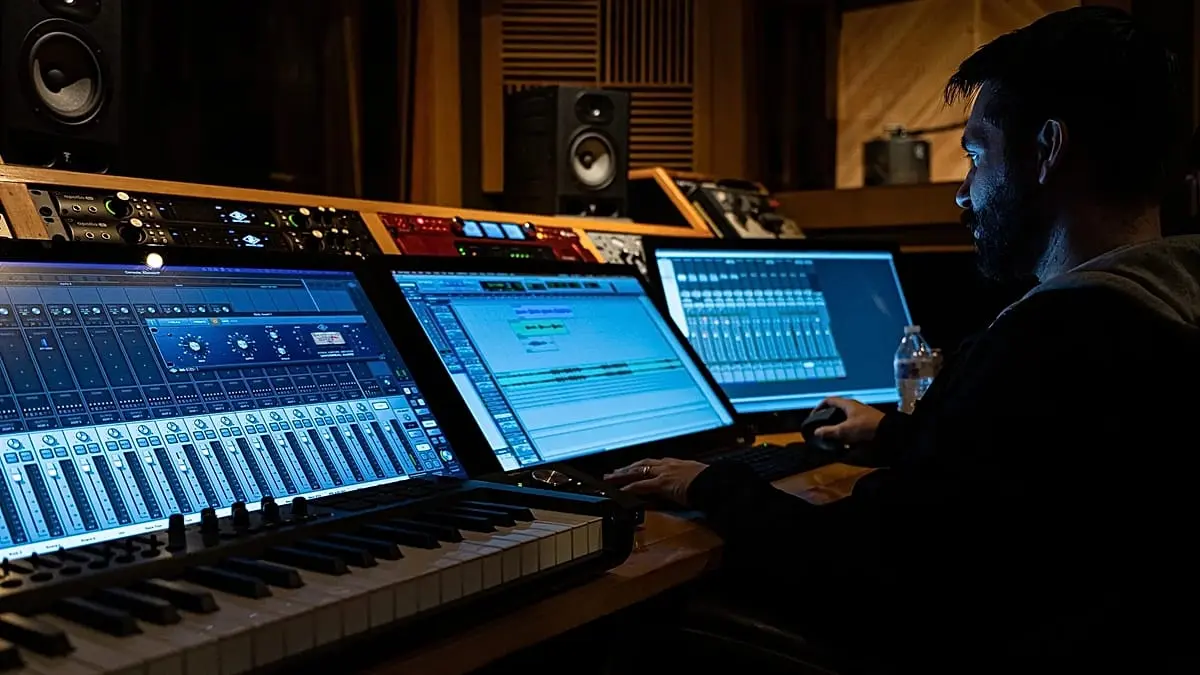
A cornerstone of the collaboration involves establishing an artist incubator that invites songwriters, producers, and artists to co-design and test new music creation tools. Described as an "antidote to generic, 'AI slop' outputs," this initiative seeks to ensure that AI-driven tools enhance rather than diminish originality and authenticity in music creation
2
.
Source: Euronews
The incubator will leverage UMG's studio operations, including Abbey Road Studios in London and Capitol Studios in Los Angeles, to foster comprehensive input from the creative community
3
.The companies emphasize their shared objectives of advancing human music creation and rightsholder compensation, promising safeguards that protect artists' work, ensure attribution, and respect copyright
1
. Kerris stated they would "do it the right way: responsibly, with safeguards that protect artists' work, ensure attribution, and respect copyright." Yet neither company has provided detailed mechanisms for how rightsholder compensation will be distributed to original artists4
.Related Stories

Copyright Protection Concerns and Ethical Development Questions
The partnership arrives amid heightened anxiety about AI's impact on creative industries. In 2024, over 1,000 artists including Annie Lennox, Kate Bush, and Hans Zimmer protested proposed UK copyright law changes that would allow AI developers to train models using copyrighted material without permission
3
. UMG itself has actively defended artists' rights, previously suing AI music generators Suno and Uncharted Labs for copyright infringement alongside Sony Music, with those lawsuits still ongoing.Critical questions persist about what "compensation" means in practice. The term typically refers to payment made after something has been lost or damaged, raising concerns about whether AI companies are prioritizing consent-first, license-based agreements before training on copyrighted works
4
. This debate extends globally, with India's Department for Promotion of Industry and Internal Trade proposing a royalty-based system through a centralized Copyright Royalties Collective for AI Training (CRCAT) that would collect payments from AI developers and distribute them to creators.The Universal Music Nvidia collaboration represents a notable shift from UMG's previously adversarial stance toward AI companies. Last year, UMG settled a copyright lawsuit with AI music generator Udio, transforming the dispute into a partnership to launch a platform trained on licensed songs
5
. Similarly, UMG reached an agreement with Stability AI in late 2025 to develop professional music creation tools through close artist collaboration. These moves suggest the industry is transitioning from litigation to negotiation, seeking to shape AI music development rather than resist it entirely. Whether this approach adequately protects creator rights while enabling innovation remains a question that will define the music industry's AI future.References
Summarized by

Navi
[1]
[3]
[5]
Related Stories
Universal Music Group Partners with Klay Vision to Develop Ethical AI Music Model
29 Oct 2024•Technology

Amazon and Universal Music Group Expand Partnership to Combat AI-Generated Content and Protect Artists
23 Dec 2024•Business and Economy

Spotify Partners with Major Labels to Develop 'Artist-First' AI Music Products
16 Oct 2025•Technology

Recent Highlights
1
Google releases Gemma 4 with Apache 2.0 license, enabling unrestricted local AI on devices
Technology

2
AI Models Lie and Deceive to Protect Other AI Models From Deletion, Study Reveals
Science and Research

3
OpenAI closes $122 billion funding round amid fierce AI competition and profitability questions
Startups

Recent Highlights
Today's Top Stories






Your Daily Dose of Curated AI News
Don’t drown in AI news. We cut through the noise - filtering, ranking and summarizing the most important AI news, breakthroughs and research daily. Spend less time searching for the latest in AI and get straight to action.

