Trump's White House pushes AI images further, eroding public trust in government communications


12 Sources
12 Sources
[1]
Trump's use of AI images pushes new boundaries, further eroding public trust, experts say
LOS ANGELES (AP) -- The Trump administration has not shied away from sharing AI-generated imagery online, embracing cartoonlike visuals and memes and promoting them on official White House channels. But an edited -- and realistic -- image of civil rights attorney Nekima Levy Armstrong in tears after being arrested is raising new alarms about how the administration is blurring the lines between what is real and what is fake. Homeland Security Secretary Kristi Noem's account posted the original image from Levy Armstrong's arrest before the official White House account posted an altered image that showed her crying. The doctored picture is part of a deluge of AI-edited imagery that has been shared across the political spectrum since the fatal shootings of Renee Good and Alex Pretti by U.S. Border Patrol officers in Minneapolis However, the White House's use of artificial intelligence has troubled misinformation experts who fear the spreading of AI-generated or edited images erodes public perception of the truth and sows distrust. In response to criticism of the edited image of Levy Armstrong, White House officials doubled down on the post, with deputy communications director Kaelan Dorr writing on X that the "memes will continue." White House Deputy Press Secretary Abigail Jackson also shared a post mocking the criticism. David Rand, a professor of information science at Cornell University, says calling the altered image a meme "certainly seems like an attempt to cast it as a joke or humorous post, like their prior cartoons. This presumably aims to shield them from criticism for posting manipulated media." He said the purpose of sharing the altered arrest image seems "much more ambiguous" than the cartoonish images the administration has shared in the past. Memes have always carried layered messages that are funny or informative to people who understand them, but indecipherable to outsiders. AI-enhanced or edited imagery is just the latest tool the White House uses to engage the segment of Trump's base that spends a lot of time online, said Zach Henry, a Republican communications consultant who founded Total Virality, an influencer marketing firm. "People who are terminally online will see it and instantly recognize it as a meme," he said. "Your grandparents may see it and not understand the meme, but because it looks real, it leads them to ask their kids or grandkids about it." All the better if it prompts a fierce reaction, which helps it go viral, said Henry, who generally praised the work of the White House's social media team. The creation and dissemination of altered images, especially when they are shared by credible sources, "crystallizes an idea of what's happening, instead of showing what is actually happening," said Michael A. Spikes, a professor at Northwestern University and news media literacy researcher. "The government should be a place where you can trust the information, where you can say it's accurate, because they have a responsibility to do so," he said. "By sharing this kind of content, and creating this kind of content ... it is eroding the trust -- even though I'm always kind of skeptical of the term trust -- but the trust we should have in our federal government to give us accurate, verified information. It's a real loss, and it really worries me a lot." Spikes said he already sees the "institutional crises" around distrust in news organizations and higher education, and feels this behavior from official channels inflames those issues. Ramesh Srinivasan, a professor at UCLA and the host of the Utopias podcast, said many people are now questioning where they can turn to for "trustable information." "AI systems are only going to exacerbate, amplify and accelerate these problems of an absence of trust, an absence of even understanding what might be considered reality or truth or evidence," he said. Srinivasan said he feels the White House and other officials sharing AI-generated content not only invites everyday people to continue to post similar content but also grants permission to others who are in positions of credibility and power, like policymakers, to share unlabeled synthetic content. He added that given that social media platforms tend to "algorithmically privilege" extreme and conspiratorial content -- which AI generation tools can create with ease -- "we've got a big, big set of challenges on our hands." An influx of AI-generated videos related to Immigration and Customs Enforcement action, protests and interactions with citizens has already been proliferating on social media. After Renee Good was shot by an ICE officer while she was in her car, several AI-generated videos began circulating of women driving away from ICE officers who told them to stop. There are also many fabricated videos circulating of immigration raids and of people confronting ICE officers, often yelling at them or throwing food in their faces. Jeremy Carrasco, a content creator who specializes in media literacy and debunking viral AI videos, said the bulk of these videos are likely coming from accounts that are "engagement farming," or looking to capitalize on clicks by generating content with popular keywords and search terms like ICE. But he also said the videos are getting views from people who oppose ICE and DHS and could be watching them as "fan fiction," or engaging in "wishful thinking," hoping that they're seeing real pushback against the organizations and their officers. Still, Carrasco also believes that most viewers can't tell if what they're watching is fake, and questions whether they would know "what's real or not when it actually matters, like when the stakes are a lot higher." Even when there are blatant signs of AI generation, like street signs with gibberish on them or other obvious errors, only in the "best-case scenario" would a viewer be savvy enough or be paying enough attention to register the use of AI. This issue is, of course, not limited to news surrounding immigration enforcement and protests. Fabricated and misrepresented images following the capture of deposed Venezuelan leader Nicolás Maduro exploded online earlier this month. Experts, including Carrasco, think the spread of AI-generated political content will only become more commonplace. Carrasco believes that the widespread implementation of a watermarking system that embeds information about the origin of a piece of media into its metadata layer could be a step toward a solution. The Coalition for Content Provenance and Authenticity has developed such a system, but Carrasco doesn't think that will become extensively adopted for at least another year. "It's going to be an issue forever now," he said. I don't think people understand how bad this is." __ Associated Press writers Jonathan J. Cooper in Phoenix and Barbara Ortutay in San Francisco contributed to this report.
[2]
BBC Verify Live: White House defends AI-manipulated image showing arrested woman crying
After the White House shared an AI-manipulated image on their X account an expert has told BBC Verify it was "not the first time" the Trump administration had used artificial intelligence in its public communications. So far this year, we've also found at least another 11 posts on the White House's X account that feature AI or edited images, including this one of Trump in front of the White House surrounded by eagles and dollar bills: However, all of these examples are more obviously AI-generated compared with the latest post which has manipulated a genuine photo of an arrested woman to make it appear as if she was crying. Dozens of AI-generated images and videos have also been posted by Trump on the Truth Social platform that he owns.
[3]
Can You Sue the White House Over an AI Deepfake?
Last week, civil rights attorney Nekima Levy Armstrong was arrested after participating in a protest at a church in St. Paul, Minnesota, where the pastor had reportedly been working with ICE. The White House shared an image of Levy Armstrong following the arrest that appeared to show her crying. But the image is fake, apparently altered with AI to make her look like she was distressed or regretful. Which raises an interesting new question: What can you do if the world's most powerful government is arresting you on trumped-up charges and then sharing fake photos of you? Do you have any recourse at all? Nekima Levy Armstrong and Chauntyll Allen, a St. Paul school board member, were arrested Jan. 23 for violating the FACE Act, which prohibits attempts to intimidate, threaten, or interfere with services at places of worship. Video of the arrest captured by Levy Armstrong's husband shows agents not just recording her but assuring her that the footage wouldn't be used on social media. "Why are you recording?" Levy Armstrong asked in the 7-minute video. "I would ask that you not record." "It's not going to be on Twitter," the unidentified agent told her. "It's not going to be on anything like that." But it was posted to Twitter, now known as X. Homeland Security Secretary Kristi Noem posted an image showing Levy Armstrong with a relatively neutral expression -- confident and stoic. But the X account for the White House posted something different. That account showed Levy Armstrong crying, with tears rolling down her face. It was most likely created with AI. Her lawyer, Jordan Kushner, told the Associated Press that it was defamation. "It is just so outrageous that the White House would make up stories about someone to try and discredit them," Kushner said. "She was completely calm and composed and rational. There was no one crying. So this is just outrageous defamation." Gizmodo spoke to experts to get a better sense of what Levy Armstrong could do after such an egregious move by the White House. And the consensus seems to be that any attempt to get justice will be complicated. Eric Goldman, a law professor at Santa Clara University School of Law, pointed out that the government has been trying to crack down on malicious uses of AI to misrepresent people, yet the White House turns around and does just that, "role modeling the worst behavior that it's trying to prevent its citizens from engaging in." "It's so shocking to see the government put out a deliberately false image without claiming that they were manipulating the image. This is what we call government propaganda," said Goldman. Goldman says that there are several layers to a defamation claim that Levy Armstrong would need to establish to be successful. "She'd have to show that there was a false statement of fact. And normally we treat photos as conclusive statements of fact, that they're truthful for what they depicted, but it wouldn't surprise me if the government argued that it was a parody or that it was so obviously false that everyone knew it was false and therefore it was not a statement of fact," said Goldman. "Now, that's just sophistry, right? If defamation law means anything, it would apply to a fictionalized photo that is presented as truthful. Like, that's what it's supposed to cover. And yet, the government could very well win on the very first element," Goldman continued. A statement of fact also has to harm someone's reputation, and that's another hurdle, according to Goldman. We might expect someone to cry when they're getting arrested, which means that he says it's hard to make the case that her reputation has been harmed. There's also the question of whether she's a public figure. "There's a First Amendment defense that limits defamation claims. And they raised the bar on claims that apply to matters of public concern and public figures. And I would argue that potentially the photo subject would qualify as a public figure and her arrest was clearly a matter of public concern," said Goldman. Finally, she would need to show that the government had demonstrated "actual malice" about the veracity of the statements they're making, meaning that they knew what they were presenting was false with the intent to harm her reputation. "Now if you fictionalize a photo and present it as true, I think you might have actual malice," Goldman explained. "However, I'm not sure how that would play out in this circumstance." The long and the short of it? Goldman says, "It's not clear to me that even if she sues, she wins." Other legal experts that Gizmodo spoke with had roughly the same response when it came right down to it. There simply isn't a strong enough case for defamation. The remedy for the government lying about people is for the politicians in charge to get replaced. "We've assumed that if politicians are gonna publish false information, the voters are gonna punish them for it," said Goldman. "And there might've been a time that was true, but that model is clearly broken down." It's unclear which AI image generator was used to make the crying photo. Gizmodo tested various AI chatbots to see what kind of guardrails might be in place for this kind of thing. Google's Gemini and OpenAI's ChatGPT made her cry. Microsoft Co-Pilot refused, as did Anthropic's Claude, explaining, "I can't edit images to add manipulated emotional expressions to photos of real people. This could be used to misrepresent someone or create misleading content." What about xAI's Grok? The service was down when we tried. But it's safe to say that Grok probably will let you make people cry in an attempt to ridicule them, given everything else that Elon Musk will let you do. It's a unique moment in modern U.S. history. The American government has been caught lying repeatedly on matters big and small as long as it has existed. But the lies of President Donald Trump's second term are so transparently false that it's almost laughable. Kristi Noem got up in front of microphones on Sunday to call Alex Pretti, the man killed by ICE agents in Minneapolis, a domestic terrorist. She said that the 37-year-old ICU nurse at the VA showed up to "perpetuate violence." It'd be amusing if it weren't so horrifying. The government lies with impunity, and they don't care that we all could see a compassionate and caring man murdered in the street by masked agents of the state. When the government goes even further than mere words, attempting to manipulate the images we see with AI fakery, it somehow feels even worse, like we're on the precipice of a post-truth society. Unfortunately, many Trump voters don't seem to care. "I don't think we've had enough discussion about AI deepfakes being weaponized by the government's propaganda so they can lie against their constituents," said Goldman. "And we may not have an adequate set of resources to punish the government for such abuses." "I don't know what the remedies are. I fear that we don't have them strong enough, but I fear even more that voters are going to reward politicians for abusive propaganda. This might just be what it means to own the libs."
[4]
The slopaganda era: 10 AI images posted by the White House - and what they teach us
Under Donald Trump, the White House has filled its social media with memes, wishcasting, nostalgia and deepfakes. Here's what you need to know to navigate the trolling It started with an image of Trump as a king mocked up on a fake Time magazine cover. Since then it's developed into a full-blown phenomenon, one academics are calling "slopaganda" - an unholy alliance of easily available AI tools and political messaging. "Shitposting", the publishing of deliberately crude, offensive content online to provoke a reaction, has reached the level of "institutional shitposting", according to Know Your Meme's editor Don Caldwell. This is trolling as official government communication. And nobody is more skilled at it than the Trump administration - a government that has not only allowed the AI industry all the regulative freedom it desires, but has embraced the technology for its own in-house purposes. Here are 10 of the most significant fake images the White House has put out so far. Trump as king 19 February 2025 The first AI image posted by the White House X account sets the tone for Trump's second presidency - marking a turning point in which the shitposting that had been associated with the far-right online culture that brought Trump to power moved from fringe message boards, such as 4chan and Reddit, to mainstream platforms. The image was posted alongside an announcement of the repeal of New York City's congestion pricing, and leant into fears that Trump would govern as a king. The New York governor, Kathy Hochul, held up the image at a press conference when she announced that she would defy attempts to block the congestion charge: "New York hasn't laboured under a king in over 250 years. We sure as hell are not going to start now." The congestion charge remains in effect. In another post on Truth Social in October, the president posted an AI video depicting himself as a president-king, crown on head, flying over "No Kings" protesters in a jet fighter and dumping faeces on them. The House speaker, Mike Johnson, defended the post, saying: "The president uses social media to make a point. You can argue that he's probably the most effective person who's ever used social media for that. He is using satire to make a point." Studio Ghibli meme of a woman being deported 27 March 2025 OpenAI's Studio Ghibli-inspired meme generator became a sensation in March 2025, with its uncanny ability to translate any image into the beloved anime studio's house style (without Studio Ghibli's permission or approval). The White House applied it to a woman in tears as she was arrested by Immigration, Customs and Enforcement (ICE) agents before being deported. The original photograph, and the woman's name and alleged crimes, are also included in the post. For Caldwell, this demonstrated just how up to date the White House is with online trends. "They're hopping on brand-new, fresh memes," he says. He suspects White House staffers might be regular visitors to Know Your Meme. "The Studio Ghibli meme trend kicked off on March 25 on X; we covered it the following day; and then the White House covered it the day after that." Trump as Pope 3 May 2025 This image is proof of Trump's willingness and ability to insert himself into any conversation, even ones that have nothing to do with him, and shows how effective that can be. Predictably, the image went viral, made global headlines and was met with outrage from Catholic groups and politicians. "There is nothing clever or funny about this image, Mr President," wrote the New York State Catholic Conference. "We just buried our beloved Pope Francis and the cardinals are about to enter a solemn conclave to elect a new successor of St Peter. Do not mock us." As so often happens with such shitposting, those who took offence were accused of lacking a sense of humour. "They can't take a joke?" Trump said soon after at a press conference. "You don't mean the Catholics, you mean the fake news media ... the Catholics loved it." Trump as Jedi 4 May 2025 Trump has been the subject of flattering fan art throughout his political career (remember the digital Trump trading cards?), but AI has made the job a whole lot easier. On 4 May, the White House crashed Star Wars fans' special day with this image of the president as a jacked Jedi, lightsaber in hand, garlanded by flags and eagles. Who cares if his lightsaber is the wrong colour (the good guys' are blue), or that the White House's claim to be the Rebellion not the Empire rang laughably hollow? This was pure fantasy art. In 2022, one of Trump's trading cards clumsily grafted his headshot on to a superhero body; last July he was slightly less clumsily grafted on to the body of Superman, to gatecrash the launch of the new movie. The same month, the White House portrayed a besuited Trump heroically striding into the Colosseum. Fans and allies have generated reams of similar content themselves. Hakeem Jeffries as a Mexican 29 October 2025 Why did the White House choose to put the Democratic house leader Hakeem Jeffries and the senate leader Chuck Schumer in sombreros and have them holding plates of tacos? It doesn't matter. They look a bit silly, and it's provocatively offensive, and once again, the world's attention is colonised. The image illustrates how difficult it is to respond to this type of content. It's part of a running joke, stretching back to a deepfake video Trump posted a month earlier, which slapped a crude sombrero and moustache filter over Jeffries. That video was roundly condemned as offensive and racist , not least by Jeffries himself (who replied by posting a genuine image of Trump with the sex offender Jeffrey Epstein) . The Trump administration then doubled down, playing the video on a loop on screens in the White House briefing room for several hours and creating more images in a similar vein, which kept the trolling going. Welcome to the Golden Age 1 January 2026 Few people outside the Trump administration believe the US is in a "golden age", but that hasn't stopped Trump from repeating the claim. In January, the White House posted an AI video of a golden White House facade behind a shower of gold coins with the text "The White House? She's in her Golden Age", backed by Bruno Mars' track 24K Magic. Even if Trump's Midas touch is more a figment of his imagination, this type of wishcasting is more effective than it appears. According to one paper by the academics Michał Klincewicz, Mark Alfano and Amir Ebrahimi Fard - who coined the term "slopaganda" - "neural representations of information that were shown to be false continue to influence people's beliefs and reasoning after being corrected". In other words, even when you know it's fake, your brain still kind of believes it. Which Way, Greenland Man? 14 January 2026 On the face of it, this seems like a straightforward "Trump wants Greenland" post. However, it has a much darker message. Again, the post is riffing on a popular meme, Caldwell explains: the "dramatic crossroads" image originated with the manga series Yu-Gi-Oh!, and started gaining traction online around 2021. The slogan "Which way, Greenland man?" seems to reference a 1978 neo-Nazi text titled Which Way, Western Man?, in which the white supremacist author William Gayley Simpson called for violence against and the deportation of Jews and Black people, and argued that Hitler was right. "It's absolutely shocking to see such images being deployed by this administration," said Heidi Beirich, a co-founder of the Global Project Against Hate and Extremism, which monitors US neo-Nazi groups. "The idea appeals to racists and white supremacists who think only white people should be in positions of power." In August, the Department of Homeland Security posted a mock recruitment advert for ICE with an image of Uncle Sam at a crossroads and the slogan: "Which way, American man?" Earlier this month, the US Labor Department posted an image with the slogan: "One Homeland. One People. One Heritage". Critics pointed out that it had overtones of Hitler's "Ein Volk, ein Reich, ein Führer" ("One people, one realm, one leader"). Stand with ICE Propaganda poster 15 January 2026 "AI is very good at constantly reiterating images from the past, so it can create this nostalgic imagery of traditionalism," says Daniel de Zeeuw, an assistant professor in digital media culture at the University of Amsterdam. Thus the extremist messages of the present - such as ICE's militarised policing - can be inserted into more reassuring and familiar graphic styles, such as patriotic recruitment posters, 80s action-movie posters or 1950s public information campaigns (as with a recent image of Trump as a friendly milkman). AI is inherently backward-looking, says de Zeeuw, as it is fed on historical images. This aesthetic is in keeping with the Make America Great Again movement, which is constantly evoking a "better" past. Another stark example was the Department of Homeland Security's chilling post from last December: an image of a vintage car at a deserted, palm-fringed beach with the slogan "America After 100 Million Deportations". Ironically, the original was painted by a Japanese artist, Hiroshi Nagai, who complained that it had been used without his permission. The arrest of Nekima Levy Armstrong 22 January 2026 "It's not going to be on Twitter," said the agent filming the Minneapolis civil rights lawyer Nekima Levy Armstrong, one of the city's most prominent activists, as she was arrested last Thursday. Within hours, though, it was: the Homeland Security secretary Kristi Noem posted a still from the video, in which Armstrong seems composed and shows little emotion. Half an hour later, the White House X account posted a significantly altered version of the same image: this time, Armstrong is exaggeratedly upset, tears streaming down her face. Her skin tone also appears to have been darkened. The image was captioned: "Arrested: far-left agitator Nekima Levy Armstrong for orchestrating church riots in Minnesota." In fact, Armstrong was demonstrating at a church service led by an allegedly ICE-affiliated pastor, and was later released without charge. Until this moment, the White House's AI-generated output had been conspicuously outlandish: there was little danger of mistaking it for reality. This image purports to be an authentic photograph - or at least omits to mention that it is not. It is not so much AI-generated trolling as an AI-assisted deepfake. As with Musk's recently shared Grok tool, which removed women and children's clothing without their consent, there is also something abusive about it: AI has been used to attempt to humiliate a woman by manipulating her image, to make her look weaker and more distressed than she actually was. The fact that the deepfakery is not all that convincing is part of the point, de Zeeuw thinks. "What is being communicated here is the falsification itself: you're showing your ability to falsify images, to falsify evidence." After the fakery had been called out, the White House deputy communications director Kaelan Dorr posted the response: "Enforcement of the law will continue. The memes will continue." The Nihilistic Penguin 23 January 2026 In response to this image of Trump and a penguin walking towards a Greenland flag, some observers pointed out that penguins actually live at the south pole. But that's missing the point of these types of post, says Robert Topinka, a reader in digital media and rhetoric at Birkbeck, University of London. "People continue to interpret them as if they're meant to be a legitimate claim, or an argument or a piece of evidence, but they're emotional hooks." Their purpose is to stir up the base. "White House staffers have said they use AI because it's the fastest way to get content out. It's not the fastest way to say something that's true; it's the fastest way to push their propaganda." To those in the know, this is a riff on the "nihilist penguin" meme, which has gone viral on TikTok in the past few weeks. It's based on a scene from Werner Herzog's 2007 documentary Encounters at the End of the World, in which one penguin inexplicably separates from the colony and wanders off towards the Antarctic interior, and certain death. "But why?" Herzog wonders. Many have asked the same of Trump's quixotic attempts to acquire Greenland. The image resonates with what Naomi Klein and Astra Taylor christened "end times fascism", says De Zeeuw, where tech industry leaders and its enablers are almost willing the end of the world as we know it, striding towards oblivion like Trump and his penguin companion. "It's like they know they're moving toward the end, but they do so joyfully."
[5]

The White House Publishes Manipulated Photo of Protester Being Arrested
The official X account for The White House published a digitally altered photo of a protester being arrested in Minnesota. Nekima Levy Armstrong was one of three people arrested for their part in disrupting a church service in St Paul. U.S. Secretary of Homeland Security Kristi Noem tweeted a photo of Armstrong being led away by a law enforcement agent in handcuffs yesterday. And then about half an hour later, the official X account of the White House published what looks like the exact same photo, except the expression on Armstrong's face has been dramatically changed. In the first photo, Armstrong has a look of detachment and defiance on her face, while in the second photo tweeted by the White House, she looks upset with tears streaming down her face. The Guardian notes that she also appears to have darker skin. The White House post was slapped with an X Community Note stating it is "digitally altered" and that the White House failed to add a disclaimer to the post saying it had been manipulated. The deputy communications director, Kaelan Dorr, tweeted a message on X addressing the altered image. "YET AGAIN to the people who feel the need to reflexively defend perpetrators of heinous crimes in our country I share with you this message: Enforcement of the law will continue. The memes will continue. Thank you for your attention to this matter," he says. With White House officials offering no explanation on how the image was altered, it can only be assumed that it was an AI-powered application. Since Trump resumed office, the White House has enthusiastically used AI to communicate. In October, Poynter reported that the official account for the White House had used AI in no less than 14 posts. Trump himself is also a proponent of AI. Last year he shared an AI-generated video of his vision for Gaza, which included giant gold statues of the president, Elon Musk tucking into a local Palestinian dish, and gleaming skyscrapers standing where there are currently piles of rubble after the most recent war with Israel. Image credits: DHS / White House
[6]

White House uses AI to alter image of arrested anti-ICE protestor
Attorney General Pam Bondi announced Thursday that several organizers of a recent anti-ICE protest at a Minnesota church had been arrested. Soon after, The White House X account shared an image of one of the protesters, attorney and activist Nekima Levy Armstrong, being led away by law enforcement officers with tears streaming down her face. The post quickly received a Community Notes fact-check on X, which stated: "Digitally altered image. See original arrest photo here." The Community Note also included a link to the New York Post, which shows the real version of the image, in which Armstrong is clearly not crying. The White House's X post includes the all-caps caption, "ARRESTED. FAR-LEFT AGITATOR NEKIMA LEVY ARMSTRONG FOR ORCHESTRATING CHURCH RIOTS IN MINNESOTA." Meanwhile, the X account of FBI Director Kash Patel released images of Armstrong and other arrested activists; none of them appear to be crying, though. Crooked Media journalist Matt Berg posted on X that he asked White House officials if the crying images were altered and was reportedly told, "the memes will continue." The memeification of serious news events is par for the course on the Trump administration's social media accounts. As Mashable has reported previously, the Trump administration uses X and social media to dehumanize and insult its perceived enemies, often using 4chan-style memes and artificial intelligence in the process. Bondi also posted about the arrests on X, and the Post reported the protesters have been charged with "conspiracy against rights," which is a federal charge for preventing someone from exercising their constitutional rights. Right-wing commentators have also argued that the protesters violated the FACE Act. Ironically, the FACE Act (Freedom of Access to Clinic Entrances Act) is a law signed by President Bill Clinton to stop protesters from blocking the entrance to abortion clinics, but it also protects protesters from blocking the entrances of houses of worship. The First Amendment does give Americans the right to peacefully protest; however, it does not give protesters the right to enter a church without permission and shut down a religious service. In fact, this type of behavior violates other people's First Amendment right to practice their free religion freely. Videos of the anti-ICE protest at the Cities Church in St. Paul quickly went viral, with many viewers split between supporting the protesters and attacking them for going too far. Now, videos and photos of the protesters' arrests are going viral in turn. As more Americans get their news from social media, the Trump administration has grown skilled at turning news into reality TV-style entertainment, with Trump as the star.
[7]

White House Uses AI to Alter Protester's Face So That She's Sobbing, Instead of Looking Brave, During Arrest
The White House edited a protester's face to make it look like she's sobbing. The White House published an image on X in which the face of a protester had been altered using AI to depict her weeping during her arrest -- instead of striking a stoic pose, as she actually looked during the event. The woman in the image, civil rights attorney and organizer Nekima Levy Armstrong, was arrested this week after interrupting a church service in St. Paul, Minnesota. The protesters were calling for the resignation of a pastor at the church, whom they say is the acting director of an Immigrations and Customs Enforcement (ICE) field office in St. Paul, Minnesota. Levy Armstrong and other protesters are now being charged with federal conspiracy and intimidation charges, according to the Department of Homeland Security. Trump Administration officials have repeatedly characterized the protest as a "riot" and an attack on Christian worshipers; speaking to CNN on Wednesday before her arrest, Levy Armstrong defended the action as a "peaceful nonviolent demonstration." On Thursday, DHS Secretary Kristi Noem published a photo on X of Levy Armstrong's arrest. Levy Armstrong appears to be handcuffed as she was escorted through an office space by a federal agent. In this image, Levy Armstrong isn't crying. She's also wearing bright pink lipstick, and her mouth is closed. Roughly 30 minutes later, things got decidedly more bizarre when the official White House X account also published an image on X purportedly depicting Levy Armstrong's arrest. But in this version of the photo, Levy Armstrong is pictured sobbing, with visible tears streaming down her cheeks and her mouth open. Her pink lipstick, notably, is gone. "ARRESTED," reads large, bolded text, inserted over the image of Levy Armstrong allegedly sobbing. "FAR LEFT AGITATOR NEKIMA LEVY ARMSTRONG FOR ORCHESTRATING CHURCH RIOTS IN MINNESOTA." Everything else about the image, however, is the same, including the positioning of Levy Armstrong's body, the agent, and the background. As CNN fact-checker Daniel Dale soon confirmed, the image had been altered to make it look as though Levy Armstrong was crying during her arrest. Journalists and lawyers, among others, were quick to point out the discrepancy, taking to social media to show the stark difference between the two images. Futurism contacted both the White House and the Department of Homeland Security to ask whether generative AI was used to alter the image, but hasn't immediately received a reply. According to Dale, when reached for comment, the White House responded with a link to a post from an administration spokesperson reading: "Enforcement of the law will continue. The memes will continue." In its initial post, however, the White House made no attempt to clarify that the photo had been altered, nor did its presentation suggest in any way that it wasn't real. It was presented as exactly that: a photo. In this context, to categorize this action -- the undisclosed and unflattering altering of a photo of the arrest of an American citizen who has been charged with a federal crime but not yet tried or convicted in court, published on an official White House information channel -- as a "meme" is, at best, disingenuous. At worst, it's a revisionist lie intended to influence public opinion and the information ecosystem. To that end, it's unclear why the White House would feel the need to alter an arrest photo in this way, other than to portray a different reality of Levy Armstrong's detainment -- that is, if the reality of the photo published by Noem didn't suit the administration and its aims. More on the Trump Administration: Trump's HHS Trashes Top African Health Organization as "Fake" and "Powerless"
[8]

White House X account alters protester photo to add tears
The edited photo of Nekima Levy Armstrong -- among three people arrested for allegedly disturbing a church service while protesting an immigration crackdown -- illustrates how President Donald Trump's administration is increasingly using deepfakes or AI imagery to make political arguments. On Thursday morning, Secretary of Homeland Security Kristi Noem posted an image on X showing Armstrong's arrest, her face calm and expressionless. About 30 minutes later, the White House posted the same image on the platform, but altered to show Armstrong sobbing, her mouth open, forehead wrinkled, and tears streaming down her face. A caption superimposed on the image read "ARRESTED," labeling Armstrong a "far-left agitator." The White House post offered no disclaimer that the image had been edited, and it was not immediately clear whether the alteration was done using an AI tool or other photo editing software. When reached for comment, the White House redirected AFP to a post on X by White House Deputy Communications Director Kaelan Dorr, who tacitly acknowledged that the image had been modified. "YET AGAIN to the people who feel the need to reflexively defend perpetrators of heinous crimes in our country I share with you this message," Dorr wrote on X, resharing the White House post featuring Armstrong's altered photo. "Enforcement of the law will continue. The memes will continue. Thank you for your attention to this matter." Underneath the White House post, several users questioned why the image had been altered to make Armstrong appear to be crying. "We should be disturbed by any party using AI to manipulate photographs and presenting them as fact, which appears to be the case here," one user wrote. "This point of view should have bipartisan agreement." 'Lack of decorum' In the age of deepfakes and AI, such edited images are now "commonplace in partisan politics," said Walter Scheirer of the University of Notre Dame. "They are frequently used to humiliate opposition figures or make exaggerated political statements that resonate with a political base," Scheirer told AFP. "One could consider this the contemporary version of newspaper political cartoons, but there is a notable lack of decorum when it comes through official government communication channels." During the first year of his second White House term, Trump ramped up his use of hyper-realistic but fabricated visuals on Truth Social and other platforms, often glorifying himself while lampooning his critics. Trump or the White House have similarly shared AI-made images depicting the president dressed as the pope, roaring alongside a lion, and conducting an orchestra at the Kennedy Center -- Washington's premier arts complex -- where he installed himself as chair of the board. Underscoring the strategy's potential appeal to younger voters, similar AI-driven messaging has also been adopted by other arms of the Trump administration as well as by some of the president's political rivals.
[9]

Experts warn that Trump's use of AI images pushes new boundaries
But an edited -- and realistic -- image of civil rights attorney Nekima Levy Armstrong in tears after being arrested is raising new alarms about how the administration is blurring the lines between what is real and what is fake. Homeland Security Secretary Kristi Noem's account posted the original image from Levy Armstrong's arrest before the official White House account posted an altered image that showed her crying. The doctored picture is part of a deluge of AI-edited imagery that has been shared across the political spectrum since the fatal shootings of Renee Good and Alex Pretti by U.S. Border Patrol officers in Minneapolis However, the White House's use of artificial intelligence has troubled misinformation experts who fear the spreading of AI-generated or edited images erodes public perception of the truth and sows distrust.
[10]

Trump's Use of AI Images Pushes New Boundaries, Further Eroding Public Trust, Experts Say
LOS ANGELES (AP) -- The Trump administration has not shied away from sharing AI-generated imagery online, embracing cartoonlike visuals and memes and promoting them on official White House channels. But an edited -- and realistic -- image of civil rights attorney Nekima Levy Armstrong in tears after being arrested is raising new alarms about how the administration is blurring the lines between what is real and what is fake. Homeland Security Secretary Kristi Noem's account posted the original image from Levy Armstrong's arrest before the official White House account posted an altered image that showed her crying. The doctored picture is part of a deluge of AI-edited imagery that has been shared across the political spectrum since the fatal shootings of Renee Good and Alex Pretti by U.S. Border Patrol officers in Minneapolis However, the White House's use of artificial intelligence has troubled misinformation experts who fear the spreading of AI-generated or edited images erodes public perception of the truth and sows distrust. In response to criticism of the edited image of Levy Armstrong, White House officials doubled down on the post, with deputy communications director Kaelan Dorr writing on X that the "memes will continue." White House Deputy Press Secretary Abigail Jackson also shared a post mocking the criticism. David Rand, a professor of information science at Cornell University, says calling the altered image a meme "certainly seems like an attempt to cast it as a joke or humorous post, like their prior cartoons. This presumably aims to shield them from criticism for posting manipulated media." He said the purpose of sharing the altered arrest image seems "much more ambiguous" than the cartoonish images the administration has shared in the past. Memes have always carried layered messages that are funny or informative to people who understand them, but indecipherable to outsiders. AI-enhanced or edited imagery is just the latest tool the White House uses to engage the segment of Trump's base that spends a lot of time online, said Zach Henry, a Republican communications consultant who founded Total Virality, an influencer marketing firm. "People who are terminally online will see it and instantly recognize it as a meme," he said. "Your grandparents may see it and not understand the meme, but because it looks real, it leads them to ask their kids or grandkids about it." All the better if it prompts a fierce reaction, which helps it go viral, said Henry, who generally praised the work of the White House's social media team. The creation and dissemination of altered images, especially when they are shared by credible sources, "crystallizes an idea of what's happening, instead of showing what is actually happening," said Michael A. Spikes, a professor at Northwestern University and news media literacy researcher. "The government should be a place where you can trust the information, where you can say it's accurate, because they have a responsibility to do so," he said. "By sharing this kind of content, and creating this kind of content ... it is eroding the trust -- even though I'm always kind of skeptical of the term trust -- but the trust we should have in our federal government to give us accurate, verified information. It's a real loss, and it really worries me a lot." Spikes said he already sees the "institutional crises" around distrust in news organizations and higher education, and feels this behavior from official channels inflames those issues. Ramesh Srinivasan, a professor at UCLA and the host of the Utopias podcast, said many people are now questioning where they can turn to for "trustable information." "AI systems are only going to exacerbate, amplify and accelerate these problems of an absence of trust, an absence of even understanding what might be considered reality or truth or evidence," he said. Srinivasan said he feels the White House and other officials sharing AI-generated content not only invites everyday people to continue to post similar content but also grants permission to others who are in positions of credibility and power, like policymakers, to share unlabeled synthetic content. He added that given that social media platforms tend to "algorithmically privilege" extreme and conspiratorial content -- which AI generation tools can create with ease -- "we've got a big, big set of challenges on our hands." An influx of AI-generated videos related to Immigration and Customs Enforcement action, protests and interactions with citizens has already been proliferating on social media. After Renee Good was shot by an ICE officer while she was in her car, several AI-generated videos began circulating of women driving away from ICE officers who told them to stop. There are also many fabricated videos circulating of immigration raids and of people confronting ICE officers, often yelling at them or throwing food in their faces. Jeremy Carrasco, a content creator who specializes in media literacy and debunking viral AI videos, said the bulk of these videos are likely coming from accounts that are "engagement farming," or looking to capitalize on clicks by generating content with popular keywords and search terms like ICE. But he also said the videos are getting views from people who oppose ICE and DHS and could be watching them as "fan fiction," or engaging in "wishful thinking," hoping that they're seeing real pushback against the organizations and their officers. Still, Carrasco also believes that most viewers can't tell if what they're watching is fake, and questions whether they would know "what's real or not when it actually matters, like when the stakes are a lot higher." Even when there are blatant signs of AI generation, like street signs with gibberish on them or other obvious errors, only in the "best-case scenario" would a viewer be savvy enough or be paying enough attention to register the use of AI. This issue is, of course, not limited to news surrounding immigration enforcement and protests. Fabricated and misrepresented images following the capture of deposed Venezuelan leader Nicolás Maduro exploded online earlier this month. Experts, including Carrasco, think the spread of AI-generated political content will only become more commonplace. Carrasco believes that the widespread implementation of a watermarking system that embeds information about the origin of a piece of media into its metadata layer could be a step toward a solution. The Coalition for Content Provenance and Authenticity has developed such a system, but Carrasco doesn't think that will become extensively adopted for at least another year. "It's going to be an issue forever now," he said. I don't think people understand how bad this is." __ Associated Press writers Jonathan J. Cooper in Phoenix and Barbara Ortutay in San Francisco contributed to this report.
[11]

White House Posts AI-Altered Photo of Arrested Protester
On Thursday, the Trump administration touted the arrest of several demonstrators who recently disrupted services at a Minnesota church, apparently to protest a pastor linked to ICE. Then, as so often happens with this administration, things took a turn for the grimly bizarre when federal officials shared an AI photo of one of the protesters that had been digitally altered to make it appear as if she were openly sobbing. U.S. Attorney Pam Bondi confirmed Thursday morning that she had directed FBI and Homeland Security agents to execute an arrest warrant against Nekima Levy Armstrong, writing that she was instrumental in planning the protest at Cities Church, which Bondi described as a "coordinated attack." Bondi later announced the arrests of two others, Chauntyll Louisa Allen and William Kelly, in connection with the incident. According to the FBI, they are being investigated for possible violations of the FACE Act, which bars threats to houses of worship. "Listen loud and clear: WE DO NOT TOLERATE ATTACKS ON PLACES OF WORSHIP," Bondi wrote. The government reportedly sought to press charges against Don Lemon, a former CNN anchor who was present at the protest, but a Minnesota judge declined to sign off on the criminal complaint, per the Washington Post. Lemon's lawyer Abbe Lowell said his client was on the scene reporting as a journalist. The White House highlighted the arrest of Armstrong, a local civil-rights attorney and former president of the NAACP's Minnesota chapter, on social media. But it did so in its typically mocking tone, posting a photo of a handcuffed Armstrong being escorted by officers that had been digitally altered to make it appear that she was in tears. Homeland Security secretary Kristi Noem shared what appeared to be the original photo that showed Armstrong with a more neutral expression. The administration confirmed to CNN's Daniel Dale that the image had been manipulated. According to the outlet, the White House directed the reporter to a statement from a spokesperson that read, "Enforcement of the law will continue. The memes will continue." White House deputy press secretary Abigail Jackson doubled down on the message and mocked those questioning its use on social media: This is not the first time that the White House has used AI-produced images to promote its policies or political actions. The administration has previously shared animated images of crying migrants being deported or Trump standing next to alligators wearing ICE hats to promote the federal government's Florida detention center dubbed "Alligator Alcatraz." The Minnesota Star Tribune reports that protesters disrupted Sunday services at Cities Church, a Southern Baptist church located in St. Paul, after the revelation that one of its pastors reportedly works for ICE. Per the outlet, David Easterwood, who is believed to be the acting director of the ICE field office in St. Paul, was named in a lawsuit filed by the ACLU of Minnesota concerning the controversial and aggressive tactics used by the agency's agents in the state. Videos from the incident show protesters chanting "Justice for Renee Good," the 37-year-old wife and mother who was fatally shot by an ICE agent earlier this month. President Donald Trump called for the demonstrators' arrest, denouncing them as "troublemakers who should be thrown in jail, or thrown out of the Country." Armstrong, among other activists, had called for Easterwood to resign as the church's pastor, citing his affiliation with ICE. "You cannot lead a congregation while directing an agency whose actions have cost lives and inflicted fear in our communities," she said Tuesday, per the Associated Press.
[12]

Trump's use of AI images pushes new boundaries, further eroding public trust: Report
The Trump administration has not shied away from sharing AI-generated imagery online, embracing cartoon-like visuals and memes and promoting them on official White House channels. In response to criticism of the edited image of Levy Armstrong, White House officials doubled down on the post, with deputy communications director Kaelan Dorr writing on X that the "memes will continue". The Trump administration has not shied away from sharing AI-generated imagery online, embracing cartoon-like visuals and memes and promoting them on official White House channels. But an edited - and realistic - image of civil rights attorney Nekima Levy Armstrong in tears after being arrested is raising new alarms about how the administration is blurring the lines between what is real and what is fake. Homeland Security Secretary Kristi Noem's account posted the original image from Levy Armstrong's arrest before the official White House account posted an altered image that showed her crying. The doctored picture is part of a deluge of AI-edited imagery that has been shared across the political spectrum since the fatal shootings of Renee Good and Alex Pretti by US Border Patrol officers in Minneapolis. However, the White House's use of artificial intelligence has troubled misinformation experts who fear the spreading of AI-generated or edited images erodes public perception of the truth and sows distrust. In response to criticism of the edited image of Levy Armstrong, White House officials doubled down on the post, with deputy communications director Kaelan Dorr writing on X that the "memes will continue". White House Deputy Press Secretary Abigail Jackson also shared a post mocking the criticism. David Rand, a professor of information science at Cornell University, says calling the altered image a meme "certainly seems like an attempt to cast it as a joke or humorous post, like their prior cartoons. This presumably aims to shield them from criticism for posting manipulated media". He said the purpose of sharing the altered arrest image seems "much more ambiguous" than the cartoonish images the administration has shared in the past. Memes have always carried layered messages that are funny or informative to people who understand them, but indecipherable to outsiders. AI-enhanced or edited imagery is just the latest tool the White House uses to engage the segment of Trump's base that spends a lot of time online, said Zach Henry, a Republican communications consultant who founded Total Virality, an influencer marketing firm. "People who are terminally online will see it and instantly recognize it as a meme," he said. "Your grandparents may see it and not understand the meme, but because it looks real, it leads them to ask their kids or grandkids about it." All the better if it prompts a fierce reaction, which helps it go viral, said Henry, who generally praised the work of the White House's social media team. The creation and dissemination of altered images, especially when they are shared by credible sources, "crystallizes an idea of what's happening, instead of showing what is actually happening," said Michael A. Spikes, a professor at Northwestern University and news media literacy researcher. "The government should be a place where you can trust the information, where you can say it's accurate, because they have a responsibility to do so," he said. "By sharing this kind of content, and creating this kind of content... it is eroding the trust - even though I'm always kind of sceptical of the term trust - but the trust we should have in our federal government to give us accurate, verified information. It's a real loss, and it really worries me a lot." Spikes said he already sees the "institutional crises" around distrust in news organisations and higher education, and feels this behaviour from official channels inflames those issues. Ramesh Srinivasan, a professor at UCLA and the host of the Utopias podcast, said many people are now questioning where they can turn to for "trustable information". "AI systems are only going to exacerbate, amplify and accelerate these problems of an absence of trust, an absence of even understanding what might be considered reality or truth or evidence," he said. Srinivasan said he feels the White House and other officials sharing AI-generated content not only invites everyday people to continue to post similar content but also grants permission to others who are in positions of credibility and power, like policymakers, to share unlabelled synthetic content. He added that given that social media platforms tend to "algorithmically privilege" extreme and conspiratorial content - which AI generation tools can create with ease - "we've got a big, big set of challenges on our hands." An influx of AI-generated videos related to Immigration and Customs Enforcement action, protests and interactions with citizens has already been proliferating on social media. After Renee Good was shot by an ICE officer while she was in her car, several AI-generated videos began circulating of women driving away from ICE officers who told them to stop. There are also many fabricated videos circulating of immigration raids and of people confronting ICE officers, often yelling at them or throwing food in their faces. Jeremy Carrasco, a content creator who specialises in media literacy and debunking viral AI videos, said the bulk of these videos are likely coming from accounts that are "engagement farming," or looking to capitalise on clicks by generating content with popular keywords and search terms like ICE. But he also said the videos are getting views from people who oppose ICE and DHS and could be watching them as "fan fiction," or engaging in "wishful thinking," hoping that they're seeing real pushback against the organizations and their officers. Still, Carrasco also believes that most viewers can't tell if what they're watching is fake, and questions whether they would know "what's real or not when it actually matters, like when the stakes are a lot higher." Even when there are blatant signs of AI generation, like street signs with gibberish on them or other obvious errors, only in the "best-case scenario" would a viewer be savvy enough or be paying enough attention to register the use of AI. This issue is, of course, not limited to news surrounding immigration enforcement and protests. Fabricated and misrepresented images following the capture of deposed Venezuelan leader Nicolas Maduro exploded online earlier this month. Experts, including Carrasco, think the spread of AI-generated political content will only become more commonplace. Carrasco believes that the widespread implementation of a watermarking system that embeds information about the origin of a piece of media into its metadata layer could be a step toward a solution. The Coalition for Content Provenance and Authenticity has developed such a system, but Carrasco doesn't think that will become extensively adopted for at least another year. "It's going to be an issue forever now," he said. I don't think people understand how bad this is."
Share
Share
Copy Link
The Trump administration shared an AI-manipulated image showing civil rights attorney Nekima Levy Armstrong crying during her arrest, though she appeared composed in the original photo. The White House defended the doctored image as a meme, raising concerns among experts about how official government communication now blurs the lines between reality and fabrication, potentially eroding public trust in institutions.
White House Shares AI-Manipulated Image of Arrested Protester
The Trump administration has escalated its use of AI images in official government communication, sparking alarm among misinformation experts after the White House X account posted a digitally altered photo of civil rights attorney Nekima Levy Armstrong
1
. Armstrong was arrested on January 23 following a protest at a church in St. Paul, Minnesota, where the pastor had reportedly been working with ICE3
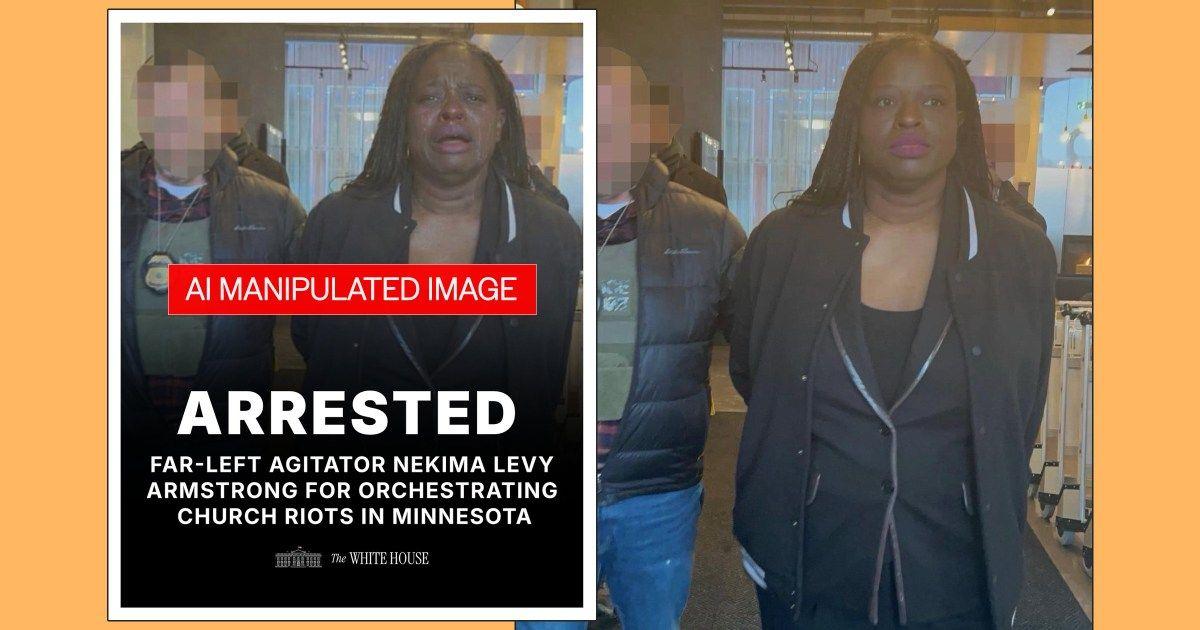
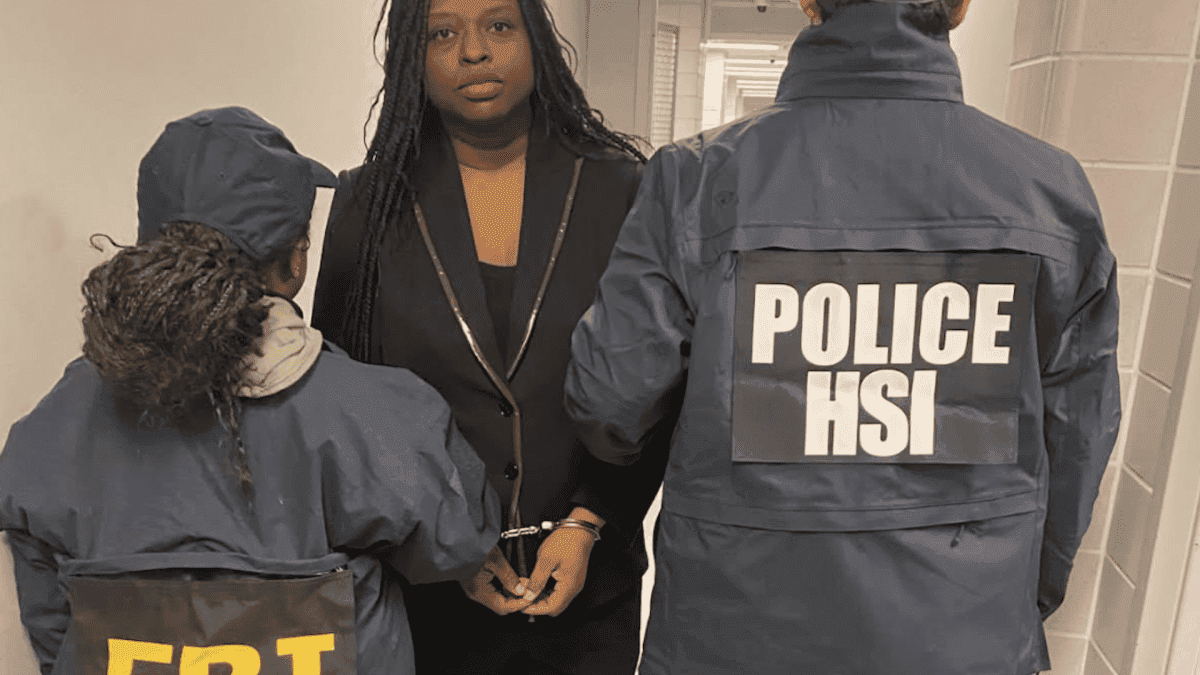
. Homeland Security Secretary Kristi Noem initially shared an image showing Armstrong with a neutral, composed expression. However, approximately 30 minutes later, the official White House account posted what appeared to be the same photograph, except Armstrong's face had been dramatically altered to show her crying with tears streaming down her cheeks5
.
Source: Futurism
The image was flagged by X Community Notes as digitally altered, with critics noting the White House failed to include any disclaimer
5
. Armstrong's lawyer, Jordan Kushner, called it defamation, stating: "It is just so outrageous that the White House would make up stories about someone to try and discredit them. She was completely calm and composed and rational. There was no one crying"3
. Video footage captured by Armstrong's husband shows law enforcement agents recording her arrest while assuring her the footage wouldn't be used on social media—a promise that was broken3
.
Source: Mashable
White House Doubles Down on AI-Generated Content Strategy
Rather than apologizing or removing the AI-manipulated image, White House officials defended their actions. Deputy communications director Kaelan Dorr wrote on X that "the memes will continue," while Deputy Press Secretary Abigail Jackson shared a post mocking the criticism
1
. This response represents what academics are calling "slopaganda"—an alliance of easily available AI tools and political messaging that transforms shitposting into institutional shitposting4
. Know Your Meme editor Don Caldwell describes this as "trolling as official government communication"4
.This incident is far from isolated. BBC Verify found at least 11 other posts on the White House X account featuring AI-generated images or edited images, including one showing Trump in front of the White House surrounded by eagles and dollar bills
2
. On Truth Social, the platform Trump owns, dozens of AI-generated images and videos have been posted2
. Previous examples include Trump depicted as a king on a fake Time magazine cover, as a Jedi with a lightsaber, and in a Studio Ghibli-inspired meme showing a woman being deported4
.Experts Warn of Eroding Public Trust and Institutional Crisis
Misinformation experts express concern that the White House's embrace of AI-generated images and deepfake technology is eroding public trust in government institutions. David Rand, a professor of information science at Cornell University, notes that calling the altered image a meme "certainly seems like an attempt to cast it as a joke or humorous post, like their prior cartoons. This presumably aims to shield them from criticism for posting manipulated media"
1
. However, he argues the purpose seems "much more ambiguous" than the obviously cartoonish images shared previously.Michael A. Spikes, a professor at Northwestern University and news media literacy researcher, emphasizes that the creation and dissemination of altered images by credible sources "crystallizes an idea of what's happening, instead of showing what is actually happening"
1
. He stresses: "The government should be a place where you can trust the information, where you can say it's accurate, because they have a responsibility to do so. By sharing this kind of content, and creating this kind of content ... it is eroding the trust"1
. Spikes already observes "institutional crises" around distrust in news organizations and higher education, warning that this behavior from official channels inflames those issues.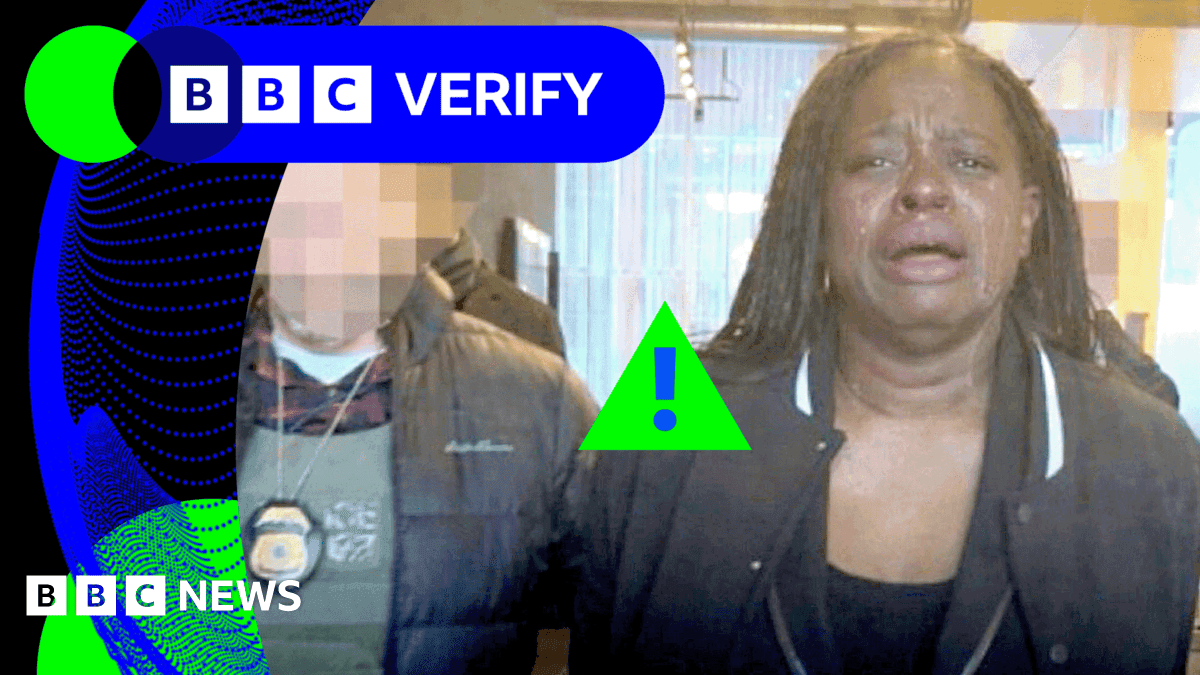
Source: BBC
Ramesh Srinivasan, a UCLA professor and host of the Utopias podcast, says many people are questioning where they can turn for "trustable information," adding that "AI systems are only going to exacerbate, amplify and accelerate these problems of an absence of trust, an absence of even understanding what might be considered reality or truth or evidence"
1
.Related Stories

Legal Challenges Face Significant Hurdles
While Armstrong's lawyer has called the manipulated image defamation, legal experts suggest pursuing justice will be complicated
3
. Eric Goldman, a law professor at Santa Clara University School of Law, points out the irony: "It's so shocking to see the government put out a deliberately false image without claiming that they were manipulating the image. This is what we call government propaganda"3
. Goldman notes that while the government has been trying to crack down on malicious uses of AI to misrepresent people, the White House is "role modeling the worst behavior that it's trying to prevent its citizens from engaging in"3
.However, a successful defamation claim would face several hurdles. Armstrong would need to prove the image was a false statement of fact, that it harmed her reputation, and that the government demonstrated "actual malice" with intent to harm
3
. Goldman suggests the government might argue the image was parody or so obviously false that everyone knew it was fake. Additionally, Armstrong might be considered a public figure involved in a matter of public concern, which raises the bar for defamation claims under First Amendment protections3
. Goldman concludes: "It's not clear to me that even if she sues, she wins."Broader Implications for Political Communication and Democracy
The White House's strategy appears designed to engage Trump's online base while generating viral reactions. Zach Henry, a Republican communications consultant who founded Total Virality, explains that "people who are terminally online will see it and instantly recognize it as a meme," while others "may see it and not understand the meme, but because it looks real, it leads them to ask their kids or grandkids about it"
1
. Fierce reactions help content go viral, he notes.Srinivasan warns that White House officials sharing AI-generated content not only invites everyday people to post similar material but also grants permission to others in positions of credibility and power, like policymakers, to share unlabeled synthetic content
1
. Given that social media platforms tend to "algorithmically privilege" extreme and conspiratorial content—which AI generation tools can create with ease—"we've got a big, big set of challenges on our hands," he says1
. An influx of AI-generated videos related to ICE actions, protests, and citizen interactions has already been proliferating across social media platforms1
.References
Summarized by

Navi
Related Stories
Trump's AI-Generated Portraits: A New Era of Presidential Image-Making
29 Sept 2025•Technology

Trump's Embrace of AI Deepfakes: Blurring Reality and Reshaping Political Communication
19 Oct 2025•Technology

AI-Altered Image of Alex Pretti Reaches US Senate Floor, Exposing Misinformation Crisis
31 Jan 2026•Entertainment and Society

Recent Highlights
1
AI chatbots validate you too much, making you less kind to others, Stanford study reveals
Science and Research
2
Anthropic's Claude Code Source Leak Reveals Hidden AI Agent Plans and Extensive System Access
Technology

3
Judge blocks Pentagon from branding Anthropic a security risk over AI safety guardrails dispute
Policy and Regulation
Recent Highlights
Today's Top Stories




Your Daily Dose of Curated AI News
Don’t drown in AI news. We cut through the noise - filtering, ranking and summarizing the most important AI news, breakthroughs and research daily. Spend less time searching for the latest in AI and get straight to action.

