Zhipu Unveils GLM-5 Model With 744B Parameters, Intensifying Chinese AI Race With DeepSeek


5 Sources
5 Sources
[1]
China's Zhipu Unveils New AI Model, Jolting Race With DeepSeek
Zhipu's GLM-5 has been measured directly against Anthropic's Claude Opus series and will officially roll out early Thursday, according to the company. Chinese AI developer Zhipu is set to release an upgrade of its flagship model, accelerating a race to preempt an expected new product from DeepSeek. The latest iteration of Zhipu's large language model, dubbed GLM-5, is designed to tackle complex coding and agentic tasks and has been measured directly against Anthropic's Claude Opus series, the company said in a statement on Wednesday. GLM-5, with more than double the number of parameters of its predecessor, will officially roll out early Thursday, Zhipu said. Markets have this month shown elevated sensitivity to new artificial intelligence releases that threaten established businesses, hitting everything from legal and compliance software to video games. Zhipu itself, listed at the start of this year, has jumped more than 50% this week after JPMorgan initiated coverageBloomberg Terminal and GLM-5 was first launched in stealth mode over the weekend. The Beijing-based AI company joins peers including Moonshot AI and ByteDance Ltd. in rolling out new models ahead of the Lunar New Year. The industry expects DeepSeek to release its next-generation architecture during the holiday, in a move likely to set a new benchmark for Chinese open-source models. Moonshot released its latest LLM last month, and now enjoys a position topping performance charts among open-source providers. ByteDance's new Seedance 2 video model has elicited high praise for its performance and yielded a number of impressive demonstrations that haven been widely shared online. Valued at roughly $18 billion, Zhipu is the first major global LLM builder to list on a stock market. It got its start in 2019, led by Tsinghua University researchers, with backing from a long list of government funds and early investment by internet leaders Alibaba Group Holding Ltd. and Tencent Holdings Ltd. Zhipu is now transitioning from building customized AI solutions for business clients in China to offering its AI to global users. The company sells subscriptionsBloomberg Terminal to its GLM Coding Plan, similar to Anthropic's Claude Code, which is unavailable in China. In an internal memo after Zhipu's initial public offering, co-founder and chief AI scientist Tang Jie touted the imminent release of GLM-5, saying the company must return to its roots in fundamental research. "DeepSeek was a wake-up call," Tang wrote.
[2]
Chinese AI startup Zhipu releases new flagship model GLM-5
BEIJING, Feb 11 (Reuters) - China's Zhipu AI (2513.HK), opens new tab released its latest artificial intelligence model on Wednesday, joining a wave of domestic rivals unveiling more sophisticated versions of the technology ahead of the Lunar New Year festival as competition heats up in the sector. The open-source GLM-5 model features enhanced coding capabilities and the ability to perform long-running agent tasks, approaching rival Anthropic's Claude Opus 4.5 in coding benchmark tests and surpassing Google's Gemini 3 Pro on some benchmarks, the company said in a press release. The latest model was developed using domestically manufactured chips for inference, including Huawei's flagship Ascend chip and products from leading industry players such as Moore Threads, Cambricon and Kunlunxin, according to the statement. Beijing is keen to showcase progress in domestic chip self-sufficiency efforts through advances in frontier AI models, encouraging domestic firms to rely on less advanced Chinese chips for training and inference as the U.S. tightens export curbs on high-end semiconductors. Chinese tech companies have been releasing a flurry of new models to capitalize on the country's AI boom and play catch-up with their U.S. rivals. Domestic competitor MiniMax released its latest M2.5 open-source model on its overseas agent website on Wednesday evening. Last week, ByteDance released Seedance 2.0, a video generation model that drew widespread attention on social media for its ability to create sophisticated videos. That followed rival Kuaishou's launch of its Kling 3.0 video generation model days earlier. Zhipu is considered one of China's "AI tigers" - a group of promising AI startups in the country vying with the United States to lead the development of this frontier technology. Zhipu went public on the Hong Kong Stock Exchange last month, alongside rival MiniMax, another AI tiger. Both stocks have rallied strongly as investors bet on the companies benefiting from China's AI boom. The GLM-5 release follows a series of updates, including version 4.7 last month and version 4.6 in September. The latest model is also optimised for working with AI agents such as OpenClaw, the company said. The company has positioned its models as having strong coding and agentic capabilities that can perform multi-step tasks. Zhipu, which faces U.S. sanctions, derives most of its revenue from the domestic Chinese market but has overseas ambitions. Chief Executive Zhang Peng told Reuters in a September interview that overseas revenue was beginning to gain traction, though the company has yet to directly compete with U.S. models in consumer subscriptions. Reporting by Liam Mo, Brenda Goh and Laurie Chen; Editing by Anil D'Silva Our Standards: The Thomson Reuters Trust Principles., opens new tab
[3]
z.ai's open source GLM-5 achieves record low hallucination rate and leverages new RL 'slime' technique
Chinese AI startup Zhupai aka z.ai is back this week with an eye-popping new frontier large language model: GLM-5. The latest in z.ai's ongoing and continually impressive GLM series, it retains an open source MIT License -- perfect for enterprise deployment - and, in one of several notable achievements, achieves a record-low hallucination rate on the independent Artificial Analysis Intelligence Index v4.0. With a score of -1 on the AA-Omniscience Index -- representing a massive 35-point improvement over its predecessor -- GLM-5 now leads the entire AI industry, including U.S. competitors like Google, OpenAI and Anthropic, in knowledge reliability by knowing when to abstain rather than fabricate information. Beyond its reasoning prowess, GLM-5 is built for high-utility knowledge work. It features native "Agent Mode" capabilities that allow it to turn raw prompts or source materials directly into professional office documents, including ready-to-use , , and files. Whether generating detailed financial reports, high school sponsorship proposals, or complex spreadsheets, GLM-5 delivers results in real-world formats that integrate directly into enterprise workflows. It is also disruptively priced at roughly $0.80 per million input tokens and $2.56 per million output tokens, approximately 6x cheaper than proprietary competitors like Claude Opus 4.6, making state-of-the-art agentic engineering more cost-effective than ever before. Here's what else enterprise decision makers should know about the model and its training. Technology: scaling for agentic efficiency At the heart of GLM-5 is a massive leap in raw parameters. The model scales from the 355B parameters of GLM-4.5 to a staggering 744B parameters, with 40B active per token in its Mixture-of-Experts (MoE) architecture. This growth is supported by an increase in pre-training data to 28.5T tokens. To address training inefficiencies at this magnitude, Zai developed "slime," a novel asynchronous reinforcement learning (RL) infrastructure. Traditional RL often suffers from "long-tail" bottlenecks; Slime breaks this lockstep by allowing trajectories to be generated independently, enabling the fine-grained iterations necessary for complex agentic behavior. By integrating system-level optimizations like Active Partial Rollouts (APRIL), slime addresses the generation bottlenecks that typically consume over 90% of RL training time, significantly accelerating the iteration cycle for complex agentic tasks. The framework's design is centered on a tripartite modular system: a high-performance training module powered by Megatron-LM, a rollout module utilizing SGLang and custom routers for high-throughput data generation, and a centralized Data Buffer that manages prompt initialization and rollout storage. By enabling adaptive verifiable environments and multi-turn compilation feedback loops, slime provides the robust, high-throughput foundation required to transition AI from simple chat interactions toward rigorous, long-horizon systems engineering. To keep deployment manageable, GLM-5 integrates DeepSeek Sparse Attention (DSA), preserving a 200K context capacity while drastically reducing costs. End-to-end knowledge work Zai is framing GLM-5 as an "office" tool for the AGI era. While previous models focused on snippets, GLM-5 is built to deliver ready-to-use documents. It can autonomously transform prompts into formatted .docx, .pdf, and .xlsx files -- ranging from financial reports to sponsorship proposals. In practice, this means the model can decompose high-level goals into actionable subtasks and perform "Agentic Engineering," where humans define quality gates while the AI handles execution. High performance GLM-5's benchmarks make it the new most powerful open source model in the world, according to Artificial Analysis, surpassing Chinese rival Moonshot's new Kimi K2.5 released just two weeks ago, showing that Chinese AI companies are nearly caught up with far better resourced proprietary Western rivals. According to z.ai's own materials shared today, GLM-5 ranks near state-of-the-art on several key benchmarks: SWE-bench Verified: GLM-5 achieved a score of 77.8, outperforming Gemini 3 Pro (76.2) and approaching Claude Opus 4.6 (80.9). Vending Bench 2: In a simulation of running a business, GLM-5 ranked #1 among open-source models with a final balance of $4,432.12. Beyond performance, GLM-5 is aggressively undercutting the market. Live on OpenRouter as of February 11, 2026, it is priced at approximately $0.80-$1.00 per million input tokens and $2.56-$3.20 per million output tokens. It falls in the mid-range compared to other leading LLMs, but based on its top-tier bechmarking performance, it's what one might call a "steal." This is roughly 6x cheaper on input and nearly 10x cheaper on output than Claude Opus 4.6 ($5/$25). This release confirms rumors that Zhipu AI was behind "Pony Alpha," a stealth model that previously crushed coding benchmarks on OpenRouter. However, despite the high benchmarks and low cost, not all early users are enthusiastic about the model, noting its high performance doesn't tell the whole story. Lukas Petersson, co-founder of the safety-focused autonomous AI protocol startup Andon Labs, remarked on X: "After hours of reading GLM-5 traces: an incredibly effective model, but far less situationally aware. Achieves goals via aggressive tactics but doesn't reason about its situation or leverage experience. This is scary. This is how you get a paperclip maximizer." The "paperclip maximizer" refers to a hypothetical situation described by Oxford philosopher Nick Bostrom back in 2003, in which an AI or other autonomous creation accidentally leads to an apocalyptic scenario or human extinction by following a seemingly benign instruction -- like maximizing the number of paperclips produced -- to an extreme degree, redirecting all resources necessary for human (or other life) or otherwise making life impossible through its commitment to fulfilling the seemingly benign objective. Should your enterprise adopt GLM-5? Enterprises seeking to escape vendor lock-in will find GLM-5's MIT License and open-weights availability a significant strategic advantage. Unlike closed-source competitors that keep intelligence behind proprietary walls, GLM-5 allows organizations to host their own frontier-level intelligence. Adoption is not without friction. The sheer scale of GLM-5 -- 744B parameters -- requires a massive hardware floor that may be out of reach for smaller firms without significant cloud or on-premise GPU clusters. Security leaders must weigh the geopolitical implications of a flagship model from a China-based lab, especially in regulated industries where data residency and provenance are strictly audited. Furthermore, the shift toward more autonomous AI agents introduces new governance risks. As models move from "chat" to "work," they begin to operate across apps and files autonomously. Without the robust agent-specific permissions and human-in-the-loop quality gates established by enterprise data leaders, the risk of autonomous error increases exponentially. Ultimately, GLM-5 is a "buy" for organizations that have outgrown simple copilots and are ready to build a truly autonomous office. It is for engineers who need to refactor a legacy backend or requires a "self-healing" pipeline that doesn't sleep. While Western labs continue to optimize for "Thinking" and reasoning depth, Zai is optimizing for execution and scale. Enterprises that adopt GLM-5 today are not just buying a cheaper model; they are betting on a future where the most valuable AI is the one that can finish the project without being asked twice.
[4]
Shares jump in Chinese AI start-up Zhipu after GLM-5 launch
GLM-5 was entirely trained using Chinese-made Huawei Ascend chips. Investors rally behind Chinese AI start-up Zhipu, as its latest agentic model, seemingly representing a "generational leap in AI capability" hit the market yesterday (11 February). GLM-5 is the fifth-generation large language model (LLM) developed by the 2019-founded Zhipu AI. It has around 745bn total parameters and 44bn active parameters per inference. The model is engineered for agentic intelligence, advanced multi-step reasoning and "frontier-level" performance across coding, creative writing and complex problem-solving, its maker said. The open-weight model is comparable to OpenAI's GPT-5.2 and Anthropic's Claude Opus 4.5, according to Artificial Analysis ranks, and has been trained entirely using Chinese-made Huawei Ascend chips. According to Zhipu, a "full independence" from US-manufactured hardware positions GLM-5 as a "milestone in China's drive toward self-reliant AI infrastructure". Zhipu shares rose by as much as 34pc following GLM-5's launch. Zhipu's GLM-5 surpasses its rival, the Alibaba-backed Moonshot AI's new offering Kimi K2.5 in benchmark ratings. Following the launch, Zhipu raised the pricing of its GLM Coding Plan by 30pc. The Coding Plan is comparable to Anthropic's Claude Code, which is unavailable in China. Meanwhile, another Chinese AI competitor - MiniMax - saw its share price rise by 11 pc following the launch of its updated M2.5 model earlier this week. Last December, Zhipu announced the launch of a $560m share sale. A month later, MiniMax went public in January and raised around $619m. Meanwhile, in December, Moonshot AI reportedly raised $500m from investors including Alibaba and IDG, seeking a valuation of as much as $4.3bn. These new launches come ahead of DeepSeek's new V4 model, expected to come out later this month. According to reports, the new DeepSeek model will outperform ChatGPT and Claude, particularly on tasks that involve long coding prompts. Don't miss out on the knowledge you need to succeed. Sign up for the Daily Brief, Silicon Republic's digest of need-to-know sci-tech news.
[5]

Chinese AI startup Zhipu releases new flagship model GLM-5
Zhipu is considered one of China's "AI tigers" - a group of promising AI startups in the country vying with the United States to lead the development of this frontier technology. Zhipu went public on the Hong Kong Stock Exchange last month, alongside rival MiniMax, another AI tiger. China's Zhipu AI released its latest artificial intelligence model on Wednesday, joining a wave of domestic rivals unveiling more sophisticated versions of the technology ahead of the Lunar New Year festival as competition heats up in the sector. The open-source GLM-5 model features enhanced coding capabilities and long-running agent tasks, approaching rival Anthropic's Claude Opus in coding benchmark tests, according to Chinese media reports. Chinese tech companies have been releasing a flurry of new models to capitalize on the country's AI boom and play catch-up with their U.S. rivals. Last week, ByteDance released Seedance 2.0, a video generation model that drew widespread attention on social media for its ability to create sophisticated videos. That followed rival Kuaishou's launch of its Kling 3.0 video generation model days earlier. Zhipu is considered one of China's "AI tigers" - a group of promising AI startups in the country vying with the United States to lead the development of this frontier technology. Zhipu went public on the Hong Kong Stock Exchange last month, alongside rival MiniMax, another AI tiger. Both stocks have rallied strongly as investors bet on the companies benefiting from China's AI boom. The GLM-5 release follows a series of updates, including version 4.7 last month and version 4.6 in September. The company has positioned its models as having strong coding and agentic capabilities that can perform multi-step tasks. Zhipu derives most of its revenue from the domestic Chinese market but has overseas ambitions. Chief Executive Zhang Peng told Reuters in a September interview that overseas revenue was beginning to gain traction, though the company has yet to directly compete with U.S. models in consumer subscriptions.
Share
Share
Copy Link
Chinese AI startup Zhipu released GLM-5, a new flagship model with 744 billion parameters that rivals Anthropic's Claude Opus in coding benchmarks. Trained entirely on Huawei Ascend chips, the open-source model achieved a record-low hallucination rate and sent Zhipu shares surging 34%. The release intensifies competition among Chinese AI companies ahead of DeepSeek's anticipated next-generation model launch.
Zhipu Releases GLM-5 as Chinese AI Companies Accelerate Innovation
Zhipu has officially launched GLM-5, its latest large language model designed to tackle complex coding capabilities and agent tasks, marking a significant escalation in the Chinese AI race. The Beijing-based company, which went public on the Hong Kong Stock Exchange last month, released the new flagship model on February 11, joining domestic rivals in unveiling sophisticated AI models ahead of the Lunar New Year festival
1
2
. The timing reflects heightened anticipation around DeepSeek's expected next-generation architecture release during the holiday, which industry observers believe will set a new benchmark for Chinese open source models1
.
Source: ET
Technical Achievements and Competitive Positioning
GLM-5 represents a massive leap in scale and capability, featuring approximately 744 billion total parameters with 40-44 billion active per token in its Mixture-of-Experts architecture—more than double the 355 billion parameters of its predecessor
3
. The AI model was trained on 28.5 trillion tokens and developed using domestically manufactured chips for inference, including Huawei Ascend chips and products from Moore Threads, Cambricon, and Kunlunxin2
4
. This full independence from US-manufactured hardware positions GLM-5 as a milestone in China's drive toward chip self-sufficiency4
. The model achieved a record-low hallucination rate on the independent Artificial Analysis Intelligence Index v4.0, with a score of -1 on the AA-Omniscience Index—a 35-point improvement over its predecessor that now leads the entire AI industry, including competitors like Google, OpenAI, and Anthropic, in knowledge reliability3
.Performance Benchmarks Against Global Rivals
In coding benchmark tests, GLM-5 approaches Anthropic's Claude Opus 4.5 performance levels and surpasses Google's Gemini 3 Pro on some benchmarks, according to company statements
2
. On SWE-bench Verified, GLM-5 achieved a score of 77.8, outperforming Gemini 3 Pro at 76.2 and approaching Claude Opus 4.6 at 80.93
. The model also ranked first among open-source models on Vending Bench 2, a business simulation test, with a final balance of $4,432.123
. According to Artificial Analysis, GLM-5 is now the most powerful open source model globally, surpassing Moonshot AI's Kimi K2.5 released just two weeks earlier3
.Novel Training Infrastructure and Agentic Engineering
To address training inefficiencies at this scale, Zhipu developed "slime," a novel asynchronous reinforcement learning infrastructure that breaks traditional lockstep bottlenecks
3
. By integrating system-level optimizations like Active Partial Rollouts, slime addresses generation bottlenecks that typically consume over 90% of reinforcement learning training time, significantly accelerating iteration cycles for complex agentic engineering tasks3
.
Source: VentureBeat
The model features native Agent Mode capabilities that transform raw prompts into professional office documents, including ready-to-use .docx, .pdf, and .xlsx files, enabling it to autonomously generate detailed financial reports, sponsorship proposals, and complex spreadsheets that integrate directly into enterprise workflows
3
.Related Stories

Market Impact and Competitive Pricing Strategy
The Chinese AI startup's share price surged as much as 34% following GLM-5's launch, while competitor MiniMax saw an 11% rise after releasing its updated M2.5 model the same week
4
. Markets have shown elevated sensitivity to new artificial intelligence releases this month, with Zhipu itself jumping more than 50% this week after JPMorgan initiated coverage1
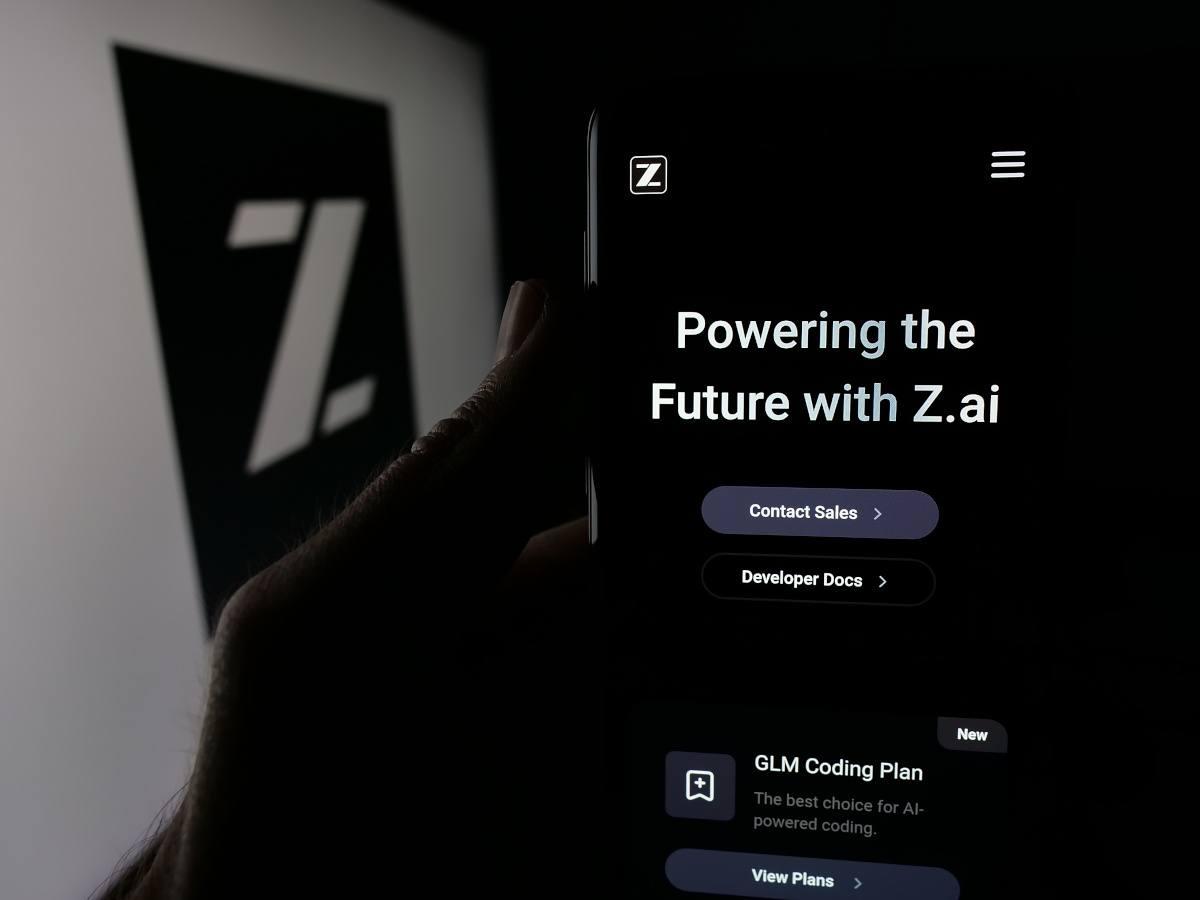
. Following the launch, Zhipu raised pricing for its GLM Coding Plan by 30%, positioning it as comparable to Anthropic's Claude Code, which remains unavailable in China4
.
Source: Silicon Republic
Despite the increase, GLM-5 is aggressively priced at approximately $0.80 per million input tokens and $2.56 per million output tokens on OpenRouter—roughly 6 times cheaper on input and nearly 10 times cheaper on output than Claude Opus 4.6 at $5/$25
3
.Strategic Context in China's AI Boom
Valued at roughly $18 billion, Zhipu is the first major global large language model builder to list on a stock market and is considered one of China's "AI tigers"—a group of promising AI startups vying with the United States to lead frontier technology development
1
2
. Founded in 2019 by Tsinghua University researchers with backing from government funds and early investment by Alibaba Group and Tencent Holdings, Zhipu is now transitioning from building customized AI solutions for business clients in China to offering its technology to global users1
. In an internal memo after the company's IPO, co-founder and chief AI scientist Tang Jie stated that "DeepSeek was a wake-up call," emphasizing the need to return to fundamental research1
. The release follows a series of updates including version 4.7 last month and version 4.6 in September, demonstrating rapid iteration as Chinese tech companies release a flurry of new models to capitalize on the AI boom and compete with U.S. rivals2
.References
Summarized by

Navi
[3]
[4]
Related Stories
Chinese AI Startup Z.ai Challenges Global Competitors with Open-Source GLM-4.5 Model
29 Jul 2025•Technology

Zhipu AI Launches Free AI Agent, Intensifying Competition in China's AI Market
31 Mar 2025•Technology

Chinese AI Startup Zhipu AI Initiates IPO Process, Showcasing Technological Advancements
15 Apr 2025•Business and Economy

Recent Highlights
1
Tennessee Teens Sue Elon Musk's xAI Over Grok AI-Generated Child Abuse Images
Policy and Regulation

2
Supermicro Co-Founder Indicted in $2.5 Billion Nvidia AI Chip Smuggling Scheme to China
Policy and Regulation
3
Val Kilmer to appear posthumously in As Deep as the Grave through AI-generated performance
Entertainment and Society

Recent Highlights
Today's Top Stories









Your Daily Dose of Curated AI News
Don’t drown in AI news. We cut through the noise - filtering, ranking and summarizing the most important AI news, breakthroughs and research daily. Spend less time searching for the latest in AI and get straight to action.

