Air Street Capital raises $232M, becoming Europe's largest solo GP venture fund for AI investment


2 Sources
2 Sources
[1]
Solo investor Air Street raises $232mn to chase hot AI bets
A sizeable new fund raised by a solo UK-based venture capitalist highlights a shift in the AI investment boom, as specialist investors seek to challenge multibillion-dollar firms for the sector's hottest deals. London-based Air Street Capital has raised $232mn for a new fund, bringing assets under management to about $400mn and making it Europe's largest one-person VC. Founded in 2018 by Nathan Benaich, Air Street invests exclusively in AI groups and reflects a broader bet that speed and focus can deliver returns as the cost of backing leading start-ups rises sharply. Air Street has backed Germany's Black Forest Labs and UK-based groups Synthesia and ElevenLabs. Its new fund is almost twice the size of its previous $121mn raising in 2023. "One of the reasons to go bigger now is the opportunity set has accelerated dramatically," he told the FT. "Companies want to raise faster and raise larger rounds, so you need to adapt the model for the game that's being played." Total European venture capital investment rose 5 per cent to €66bn in 2025, a post-pandemic high, according to PitchBook. Those gains were driven by big deals for the continent's top AI and defence companies. The fast-paced funding environment favours one-person funds that can move quickly, he said, without needing the approval of other partners. But top Silicon Valley groups such as OpenAI and Anthropic are raising tens of billions of dollars in a single round. Start-ups such as Thinking Machines, Safe Superintelligence, Reflection AI and AMI Labs have raised more than $1bn before launching a product. The escalating cost of access to the top AI companies has driven the biggest VC firms such as Thrive Capital, Founders Fund and Andreessen Horowitz to raise far larger multibillion-dollar funds than in previous eras. This has left many smaller VC firms struggling to find a foothold in the most explosive tech boom in decades. Benaich said the trend forces smaller VC firms to focus and find ways to get noticed. Air Street publishes an annual State of AI report to raise its profile among entrepreneurs. "If you are not in a game of investing in the massive labs, you focus a lot more pragmatically on the deployment market and vertical applications and selected infrastructure tools," he said. Benaich said there is particular opportunity for back AI-powered defence start-ups on the continent. Air Street has backed Delian Alliance Industries, a maritime defence start-up based in Greece which raised $14mn last year. "The decade or two decades of rearmament has really only just begun," he said. "Countries need to ensure their own domestic capability on defence for the attack vectors they are most likely to see."
[2]
Air Street Capital's $232m fund is now Europe's biggest solo GP raise
For most of the past decade, the received wisdom in European venture capital was simple enough: if you wanted a serious fund, you needed a partnership. The large teams, the committee structures, the distributed decision-making, these were treated not merely as operational choices but as a kind of institutional legitimacy. Nathan Benaich has spent the better part of five years dismantling that assumption, one fund close at a time. On Monday, Air Street Capital announced the close of its third fund at $232 million, a figure that makes it the largest solo GP venture fund ever raised in Europe, according to Sifted. The milestone is not just a record for one investor; it is a statement about the structural shift underway in the continent's technology funding landscape. Benaich, who founded Air Street in 2019 after years as a researcher and investor at the intersection of science and AI, has built the firm around a deliberately concentrated thesis: back AI-first companies at the earliest stages, lead rounds, and hold conviction long enough for the science to compound into commercial reality. Fund III will write initial cheques of $500,000 to $15 million for early-stage companies in North America and Europe, with a small allocation for growth-stage investments of up to $25 million. The fund's track record, assembled across Funds I and II, gives a reasonable map of what 'AI-first' means to Benaich in practice. Synthesia, the AI video platform, now generates more than $150 million in annual recurring revenue and counts customers across more than 90% of the Fortune 100. Black Forest Labs, whose FLUX models have become widely adopted by developers and enterprises building visual applications, sits alongside Poolside, a frontier AI lab that has carved out a position serving enterprise and government clients at the higher end of the risk-and-capability spectrum. Defence appears explicitly in the fund's mandate, a choice that would have been quietly controversial in European VC circles as recently as 2022, but which now draws comparatively little friction. Air Street's portfolio includes Delian Alliance Industries, a defence-oriented company that signals Benaich's willingness to operate in sectors where the capital requirements, procurement timelines, and regulatory constraints make most generalist funds nervous. The firm has also deepened its relationship with large technology infrastructure providers. Last year, Air Street partnered with NVIDIA on a £2 billion commitment to the UK AI ecosystem, joining a cohort of investors, alongside Accel, Balderton, and Hoxton Ventures, in a programme designed to accelerate compute access and talent development across London, Oxford, Cambridge, and Manchester. The structural argument for solo GPs is not new, but $232 million of LP conviction behind a single-decision-maker fund at this scale is still unusual enough to warrant attention. Solo GPs can move faster on term sheets, maintain consistent investment philosophy across fund cycles, and avoid the internal politics that sometimes cause larger partnerships to pass on unusual or contrarian bets. The tradeoff is concentration risk on the human side, there is no committee to catch a blind spot. That Benaich has now demonstrated LP appetite for a fund of this size suggests that, at least in AI-focused deep-technology investing, track record and thesis clarity can substitute for institutional scale. It is, in microcosm, the same argument that the best AI-first companies make about their own products: quality of signal matters more than size of team.
Share
Share
Copy Link
Nathan Benaich's Air Street Capital has closed a $232 million fund, making it Europe's largest solo GP venture fund. The London-based firm invests exclusively in AI-first companies, backing startups like Synthesia, Black Forest Labs, and ElevenLabs. The raise signals a shift in the AI investment landscape as specialized investors challenge multibillion-dollar firms.
Solo Investor Challenges Traditional VC Model
Air Street Capital has closed its third fund at $232 million, establishing itself as Europe's largest solo GP venture fund and marking a decisive shift in how AI investment is structured across the continent
1
2
. Founded in 2019 by Nathan Benaich, the London-based firm now manages approximately $400 million in assets, nearly doubling its previous $121 million raise in 2023. The venture capital fund invests exclusively in AI-first companies, demonstrating that speed and focused expertise can compete with institutional scale in today's fast-paced funding environment.
Source: The Next Web
Benaich, who spent years as a researcher and investor at the intersection of science and AI before founding Air Street Capital, has built the firm around a concentrated thesis: back early-stage AI-first companies at their earliest stages, lead rounds, and maintain conviction long enough for the science to translate into commercial success
2
. The solo GP model allows for faster decision-making without requiring committee approval, a critical advantage when companies want to raise faster and larger rounds.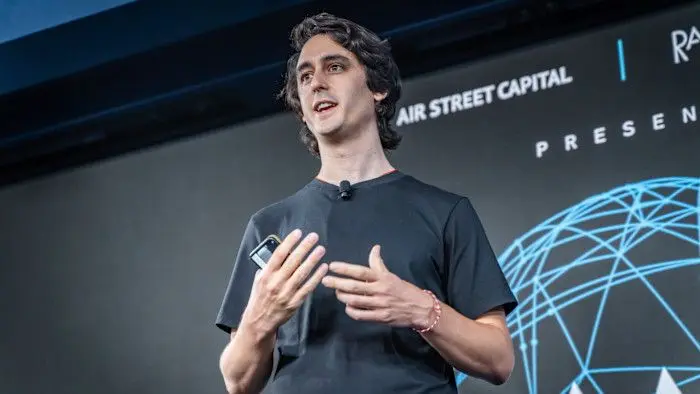
Source: FT
Portfolio Success Validates Specialized Approach
The firm's track record across its first two funds illustrates what specialized deep-technology investing looks like in practice. Air Street has backed Synthesia, the AI video platform that now generates more than $150 million in annual recurring revenue and counts customers across more than 90% of the Fortune 100
2
. Other notable portfolio companies include Black Forest Labs in Germany, whose FLUX models have become widely adopted by developers building visual applications, and UK-based groups ElevenLabs and Poolside, a frontier AI lab serving enterprise and government clients1
2
.Fund III will write initial checks ranging from $500,000 to $15 million for early-stage companies in North America and Europe, with a small allocation for growth-stage investments of up to $25 million
2
. This flexibility allows Air Street to adapt to the escalating costs of accessing top AI companies while maintaining focus on the deployment market and vertical applications rather than competing for massive lab investments alongside firms like Andreessen Horowitz, Thrive Capital, and Founders Fund.Strategic Positioning in Changing Market Dynamics
The timing of this raise reflects broader market trends. Total European venture capital investment rose 5 per cent to €66 billion in 2025, a post-pandemic high, with gains driven by large deals for the continent's top AI and defence companies
1
. "One of the reasons to go bigger now is the opportunity set has accelerated dramatically," Benaich told the Financial Times. "Companies want to raise faster and raise larger rounds, so you need to adapt the model for the game that's being played"1
.Defence technology represents a growing focus area for Air Street Capital. The portfolio includes Delian Alliance Industries, a maritime defence startup based in Greece that raised $14 million last year
1
. "The decade or two decades of rearmament has really only just begun," Benaich said. "Countries need to ensure their own domestic capability on defence for the attack vectors they are most likely to see"1
.Related Stories

Building Visibility and Infrastructure Partnerships
Air Street Capital has developed strategic approaches to compete for attention in an increasingly crowded market. The firm publishes an annual State of AI report to raise its profile among entrepreneurs, helping offset the brand recognition advantages held by larger institutional investors
1
. Last year, Air Street partnered with NVIDIA on a £2 billion commitment to the UK AI ecosystem, joining Accel, Balderton, and Hoxton Ventures in a programme designed to accelerate compute access and talent development across London, Oxford, Cambridge, and Manchester2
.The $232 million raise demonstrates significant LP conviction in the solo GP model for deep-technology sectors. While solo GPs can move faster on term sheets and maintain consistent investment philosophy across fund cycles, they also carry concentration risk on the human side without a committee to catch blind spots
2
. That Benaich has secured LP appetite for a fund of this scale suggests that in AI-focused investing, track record and thesis clarity can substitute for institutional scale, challenging the assumption that serious funds require large partnership structures.References
Summarized by

Navi
Related Stories
AI Frenzy Fuels Record-Breaking Venture Capital Investments in US Startups
10 Mar 2025•Business and Economy

AI Funding Surge: Big Tech and VCs Lead $118 Billion Investment in 2025
21 Aug 2025•Business and Economy

AI Dominates Venture Capital Landscape in 2025, Driving Record Investments and Reshaping Startup Ecosystem
04 Oct 2025•Business and Economy

Recent Highlights
1
Tennessee Teens Sue Elon Musk's xAI Over Grok AI-Generated Child Abuse Images
Policy and Regulation

2
Pentagon designates Palantir Maven AI as core US military system in major defense shift
Technology

3
Supermicro Co-Founder Indicted in $2.5 Billion Nvidia AI Chip Smuggling Scheme to China
Policy and Regulation
Recent Highlights
Today's Top Stories








Your Daily Dose of Curated AI News
Don’t drown in AI news. We cut through the noise - filtering, ranking and summarizing the most important AI news, breakthroughs and research daily. Spend less time searching for the latest in AI and get straight to action.

