AMD launches FSR Redstone with AI frame generation to directly challenge Nvidia DLSS dominance


8 Sources
8 Sources
[1]
AMD just struck at Nvidia with a huge ray and frame-gen GPU driver update
AMD dropped FSR 4 earlier this year with the launch of the RX 9000 series graphics cards, and we're here yet again with one massive driver update. Codenamed Redstone, this colossal update implements machine learning frame and ray generation technologies. Although we already saw FSR upscaling with FSR 4, AMD just opened up access to these other features for all gamers with compatible graphics cards. Redstone adds neural radiance caching, ray generation, and AI-driven frame generation. Though we've already seen analytical-based attempts from AMD, this is the real deal and incorporates some fairly powerful algorithms and networks to make everything happen. These are some heavy-hitting features to strike back at Nvidia's prowess with its own DLSS offering and bring its Radeon GPUs on a level playing field to better compete against established RTX counterparts. What is all this jargon? FSR just got a whole lot smarter The FSR Radiance Cache is something Nvidia has had for a short while with its RTX 50-series GPUs and happens to be one of the cornerstones of neural rendering, which is why we've yet to see machine learning for frame and ray gen from AMD. Now that supported Radeon GPUs have this significant feature for games with path tracing, these cards can now maintain a small cache of rays for the AI model instead of tracing each ray for every pixel. As expected, this is huge for performance. Through predicting light behavior, neural radiance cache lowers the required render time while maintaining visual fidelity, offering gamers efficiency without sacrificing quality. At least, that's AMD's hope. We weren't yet able to test out these new features with our own Radeon RX 9000 series GPUs, though it's something we plan to rectify in the coming days. This is due to logistics on our end, which haven't been able to facilitate much in the way of hardware testing. FSR Frame Generation is precisely as you'd expect -- and know from Nvidia. It's smooth, fluid gameplay when enough real frames are available for some fake frames to be generated by a neural network. This AI is trained on some of the most demanding scenarios in modern games, and we've seen how much of a boost it can provide to frame rates. Although not quite black magic and requiring a decent number of frames to work with, it's something that can have a positive impact on mid-range systems. Like Nvidia, AMD recommends games to be running at a minimum of 60 FPS before applying Frame Generation. AMD's FSR Ray Regeneration is simply another name for Nvidia's ray reconstruction within DLSS. This is tasked with creating more realistic lighting and reflections. Again, like Frame Generation within FSR, this is all driven through a neural-based network, taking low samples-per-pixel and removing noise, making them viable for upscaling and interpolation. Is my GPU supported? Good question! Depending on which RDNA Radeon GPU you have from AMD determines which features are available. RDNA 4 GPUs are the Radeon RX 9000 series. RDNA 1 through 3.5 are everything released before this generation. If you have an older GPU, this driver update won't magically improve your experience tenfold. But for RDNA 4 owners, you're going to see some positive results, so long as your initial frame rates at your selected resolution are stable enough for sampling. Feature RDNA 1 to 3.5 RDNA 4 FSR Upscaling Analytical Machine Learning FSR Frame Generation Analytical Machine Learning FSR Ray Regeneration - ✓ FSR Radiance Caching - ✓ 4 ways FSR 4 gives DLSS 4 a run for its money FSR is no longer an afterthought for gamers Posts 2 By Tanveer Singh Mar 13, 2025 Giving Adrenaline a shot of ... adrenaline? Almost reaching the feature parity AMD included some much-needed gifts for Radeon GPU owners ahead of the festive holidays, and while some are existing features, this is quite the improvement, bringing Adrenaline closer to Nvidia DLSS 4 in terms of feature parity, though we have noticed the absence of Multi Frame Generation (MFG). Nvidia forces one to use its entire suite of tools, whereas I much prefer AMD's modular approach, which was noted in my RX 9070 XT review with FSR 4. Interestingly, though not surprisingly, Nvidia is pushing hard on AI, but not on the GPU front. I'm talking big AI, a la LLMs like ChatGPT. Nvidia should start to be worried on the consumer front as AMD is certainly making headway with its FSR driver improvements. Redstone is a fantastic step forward for the company as it continues playing catch-up, having only recently gone all-in with neural network-based tools. As it did with Ryzen and Intel, AMD has the scope to really hit a home run and take the market by storm. Right, I'm off to unpack the testbenches and set everything up so we can get some driver testing done over the weekend. I'll likely return with some results and thoughts, which you can read up on in due course. Or, you can go right ahead and download the latest drivers from AMD and give these new FSR features a try on your Radeon RX 9000 series GPU.
[2]
AMD’s New Gaming Upscaler Is Here to Knock Nvidia Off Its Throne
AMD, eschewing a number in favor of an esoteric moniker, is now positioning the new version of its upscaling tech, dubbed “Redstone,†as a true competitor to Nvidia’s DLSS (deep learning super sampling) software suite. You’ll need the latest AMD GPUs to get most of these updated features, but even if you don’t game on PC, you should be paying attention. This kind of software will inevitably change how we experience gaming on consoles and beyond. The reason why most of your games remain playable at 4K resolutions is because of AI. Specifically, AI upscaling technology takes frames rendered at a lower resolution and bumps them up to a higher resolution, all while keeping the enhanced performance. That’s the simplified explanation of how this works. There are a multitude of other software working in tandem with upscalers to make these games look better without relying solely on native GPUs. "Redstone" is merely the barn where all these various software enhancements now roost. But upscaling may not be enough to give some games the true frame rate boost that some players demand. To that end, AMD is now pushing a new machine learning-powered version of frame generation. Yes, that's another version of the infamous "fake frames." The software uses an AI pipeline to insert frames in between each rendered frame, artificially increasing frame rates in games. AMD’s older version of FSR (FidelityFX Super Resolution) 3.1 and later also included a frame generation feature. The Redstone update promises to provide better visuals and lower latency for each generated frame. For instance, AMD showed a scene from F1 24, where the shadows produced odd flickering on the old version. The Redstone frame gen appeared much smoother. Nvidia’s DLSS 4 was the first to make multi-frame generation technology popular. Though “popular†may be an incongruous word considering many PC gamers didn’t appreciate Nvidia’s focus on upscaling software to make up for less-stellar performance boosts from the RTX 40-series GPUs to the RTX 50-series. Multi-frame generation, also called frame interpolation, is also a major feature of the upcoming XeSS 2 update. However, compared to AMD and Nvidia’s options, Intel’s version will be supported on whatever hardware you’re using. It’s why benchmarking games using frame generation becomes more awkward than it needs to be. AMD promises that with frame generation and Redstone on “performance†settingsâ€"which means it's upscaling from a low resolution up to 4Kâ€"you can go from 23 fps in Call of Duty: Black Ops 7 to 109 fps. Of course, AMD recommends users already have at least 60 fps after upscaling to make sure there aren’t any odd artifacts. So all this technology does is take already playable games and push them to the max of what they can do. In addition to the enhancements to AMD’s FSR upscaler, the chipmaker is also pushing extra features like "Radiance Caching," which is supposed to enhance ray tracing performance in supported games by using a machine learning model. Ray tracing features enhance lighting for scenes in games, making them reflect off surfaces more realistically. The new "Ray Regeneration" feature works in tandem to restore details in scenes after you apply ray-traced effects. To enable these features, users need to dig into their AMD Software app on a per-game basis. You also need to enable the FSR 4 features within each title. Some of these Redstone-specific features are available natively in a little more than 200 PC games, like Warhammer 40K: Darktide and Call of Duty: Black Ops 7 (those games are the only ones to feature Radiance Caching and Ray Regeneration, respectively). That number is comparable to Nvidia’s DLSS 4, with around 175 supported games going back to August. AMD promised Redstone will be inside more games coming in 2026. Just how many will depend on how hard AMD can lean on publishers to include this tech. AMD previously announced its plans for an upgraded FSR at Computex back in August. The update is locked to the current RDNA 4-based GPUs, specifically the Radeon RX 9000 series GPUs such as the RX 9070 and the RX 9070 XT. There’s a reason you should care even if you’re a console gamer. PlayStation worked with AMD on crafting FSR 4, which was released back in March. Leaks show Sony’s gaming brand is prepping an update to its PSSR (PlayStation Spectral Super Resolution) that could enable better performance on PS5 Pro. The company has already stated it was working to get FSR 4 onto the console as well, though that will prove a challenge considering the original PS5 is using older RDNA 2 microarchitecture. Instead, Redstone could prove a milestone for the rumored PlayStation 6. Upscaling technology benefits lower-end systems much more than top-end gaming hardware. That means future handhelds, whether PC or PlayStation, would benefit even more from RDNA 4-based internals. Either way, your next gaming system could be more reliant on software than any of its novel hardware.
[3]
AMD's FSR Redstone is finally here to take on Nvidia's DLSS 4 -- here's everything you need to know
It was first announced way back at Computex 2025, but finally, AMD has launched FSR Redstone -- its own platform of AI trickery to make supported PC games perform even better. This is Team Red's effort to close in on the reigning champ of resolution scaling and frame generation: Nvidia's DLSS 4. So what does FSR Redstone do exactly? And how does it stack up to what Nvidia has cooked up? Let's get into it. In a way, Redstone is AMD realizing its initial approach wasn't working -- a plan B approach. You see, previous versions of FSR didn't use machine learning/AI to do all of its performance optimizations. Instead, it would rely on preset algorithms for resolution scaling and frame generation. This always meant it was a step behind what Nvidia was doing with DLSS, fully embracing AI. FSR Redstone is the all-important transition point, as AMD is now all-in on similar machine learning capabilities to do the following things: The end result of all of this is a less clunky process flow for optimizing game performance. Using neural networks, particularly for frame generation, virtually eliminates ghosting compared to AMD's past efforts. Plus, it will make the calculations for ray tracing and upscaling far less GPU-intensive, delivering sharper textures and smoother frame rates at higher levels of detail (at least that's what I've seen from my friends testing it out). One look at the list on AMD's website shows a whole lot of titles that support FSR Redstone technology. Specifically, Team Red claims over 200 games will support it by the end of 2025. But scroll down this list a little bit, and you see it's not that simple. There's a secondary list at the bottom titled "AMD FSR Frame Generation (ML) Support." This seems like the neural frame gen part of Redstone is only coming to 32 games. DLSS 4 has been around for a while now and has had much more time to mature into its new feature set. It offers pretty much all the same features as AMD's FSR Redstone does, but Nvidia seems to be doing these a little bit better, given they've been around the block a while. First up, the Transformer AI used in DLSS 4 has been around a lot longer than FSR upscaling (even when it was called FSR 4 for a couple of months before). That means you should get a more stable game output from Team Green. Second, frame generation. While the frame interpolation of FSR Redstone is 1 new frame for every 1 rendered, DLSS 4 has multi-frame generation -- giving you a 3:1 ratio. And third is compatibility: you can use DLSS 4 features on cards all the way back to RTX 30-series, but AMD is locking Redstone just to Radeon RX 9000 cards and newer (when they're launched). The big disadvantage here to FSR Redstone is game support. Nvidia maintains a massive game compatibility lead with over 800 games benefiting from DLSS 4 automatically. AMD's made an admirable effort with over 200 titles by the end of the year (and they can catch up from that), but it's a huge gulf. So here's my take on it. In the Windows PC gaming space, Nvidia should be a little worried. Its top competitor has finally got its act together with FSR Redstone for its GPUs, which are a better value for money for gaming. And while there is still a clear lead in terms of game support, that's a gap AMD can close. But I see a far bigger threat coming in somewhere else: SteamOS. While the Steam Machine looks set to disrupt both the console market and PC gaming in a big way next year, that hasn't stopped people from building AMD-laden machines and installing SteamOS. The outgoing FSR 4 is supported on the underlying Linux after all -- it should only be a matter of time before the Proton layer for translating DirectX 12 code used in Windows games gets updated for Redstone. Imagine a super-powered Steam machine with all of this new AI-aided gaming goodness, but without the bulk of Windows 11... To me, that sounds like a mighty exciting proposition, and if I were in any post-release planning meeting in AMD's HQ, I'd be shouting for a closer tie with Valve to make something like this happen.
[4]
Confused about AMD's FSR Redstone update? You're not alone - here's what it all means for PC gamers
AMD's FSR Redstone update was finally launched earlier this week - roll out the rendered red carpet - and it arrived boasting four separate pieces of tech. Well, I say these four features have arrived, but they haven't - or one of them hasn't, rather, and it seems a long way off - plus one of them is actually here already, and isn't new at all. Confused? Well, it all feels a bit murky, messy, or even chaotic, which is surprising given how long PC gamers have been keenly awaiting Redstone as AMD's effort to catch up with Nvidia DLSS 4 (which has been out for almost a year now). You'd have thought Team Red would've had time to craft and hone its launch material and marketing message for Redstone, but that doesn't seem to be the case. On the face of it, the four pieces of tech that comprise FSR Redstone are as follows: If you thought AMD already had frame generation in FSR, you're confused about what FSR Frame Generation is, or if you thought FSR 4 was upscaling, you're scratching your head about what FSR Upscaling is - is it FSR 4, FSR 4.1, or a new version entirely? - then I totally get where you're coming from. AMD has not done a very good job of making some of this clear, so I'm going to step in and offer my take. I'm going to go through these four features, one by one, and define what they really are and whether they've actually arrived or are still waiting in the wings (cough, Radiance Caching, cough). Upscaling, for the uninitiated, takes a lower-resolution frame and scales it to a higher resolution, delivering near-native quality while running faster and more smoothly. As AMD officially bills this, FSR Upscaling was "formerly AMD FidelityFX Super Resolution 4," otherwise known as FSR 4. It was formerly FSR 4, but it's now called FSR Upscaling, dropping the numbering scheme. This is confusing because we're all used to the numbers at this point, and AMD doesn't make it explicit that there's no difference between FSR 4 and the new take. However, buried slightly lower in the blurb, AMD says: "FSR 4 has been renamed FSR Upscaling to better distinguish between the various features that now make up FSR Redstone." So, FSR Upscaling is FSR 4, and this is why the launch press slides compared FSR Upscaling to FSR 3.1, and not FSR 4 - because it is FSR 4, just renamed. That doesn't mean FSR Upscaling isn't a slightly tweaked version of FSR 4, but if there is any under-the-hood tinkering, it's not worth mentioning (as you can be sure that if there were a selling point in that respect, AMD would have said something). To sum up, then, FSR Upscaling isn't a new technology; it's just AMD's existing FSR 4 given a different naming convention for Redstone. And, of course, it's up and running now with all the games that FSR 4 was compatible with. So, nothing much to see here, let's move along... As I mentioned at the outset, this one could have you confused because FSR 4 already had frame generation (and indeed FSR 3 did, long before it). What's different here is that Redstone's take on frame generation is a sizeable step forward, as it employs AI (machine learning) to produce higher frame rates by inserting AI-generated frames between real frames. AMD's previous takes on frame gen did not use AI. So, this is a major difference, and it has a big impact on the image quality of frame generation, at least based on early testing. Redstone's FSR Frame Generation looks to be a winner, then, and catches up with DLSS 4, albeit what it doesn't offer is Multi Frame Generation, which Nvidia's GeForce graphics cards benefit from (the RTX 5000 models, anyway). The catch with Redstone, and the switch to AI for frame generation, is that it requires hardware acceleration that makes it exclusive to RDNA 4 graphics cards. This is also true for FSR 4, which was already machine-learning-based, and for the other two pieces of tech we'll look at next. As PC Gamer observes, to differentiate between the old (non-AI) frame generation and the new AI-powered Redstone version, AMD has two names. These are FSR Frame Generation (Analytical) and FSR Frame Generation (ML), the latter being the AI take (which uses machine learning or ML). Messy? Yes, it's hardly very friendly for less tech-savvy consumers. AMD's FSR Frame Generation (ML) is already supported by around 30 games (that'll be up to 40 titles by the end of this year, AMD tells us). This is a completely new addition to Redstone, and it's a way to use AI to improve ray tracing results. It aims to remove noise and glitches and implement those fancy rays at a lower rendering cost, so it's more performant overall with RDNA 4 GPUs. This is essentially the equivalent of Nvidia's Ray Reconstruction (maybe Intel can eventually implement a tech called Ray Revitalization for Arc GPUs, perhaps). Now, I say FSR Ray Regeneration is new, but it isn't exactly, as it was already out well before AMD launched Redstone this week, oddly. In fact, this feature arrived with Call of Duty: Black Ops 7 a month ago, although only in certain modes. It seems to work well enough in this limited incarnation, again based on initial tests, but Ray Regeneration is only in parts of that Call of Duty game right now. This is another new piece of AI-powered tech, and this time it aims to deliver better lighting in a more performant manner, akin to Nvidia's RTX Neural Radiance Cache feature. However, FSR Radiance Caching is the odd one out here, as this particular innovation isn't actually in any games at all right now - and it may not be for quite some time. At the Redstone launch, AMD showcased Radiance Caching with Warhammer 40K Darktide, which led gamers to assume this title would be the first to carry the fancy new lighting innovations - but apparently not. According to a Wccftech report, the developer of the Warhammer game, Fatshark, said that this tech is still 'experimental' and not planned for Darktide's live build. Apparently, Radiance Caching still requires development and optimization, so it's not clear when it might eventually grace Darktide - but it doesn't sound like it'll be any time soon. Indeed, we don't know when this fourth piece of the puzzle for Redstone will be in any game, and there could be quite a long wait before we see it in action. All we know is that this tech will debut sometime in 2026, AMD promises. All in all, this has seemed like a rather haphazard deployment of Redstone, and I feel AMD has got this launch and the associated messaging around its neck rather. The revelation of all these different elements feels disjointed, and some of the naming is confusing. Does this matter all that much, though? Well, perhaps I'm making a song and dance about it, and granted, the real meat of Redstone is how well all this tech works, not how it's framed. And on that score, the initial signs are promising, and that's the most important thing. The biggest pain for gamers, though, won't be any confusion around names, or what this or that tech does, or used to be called - it'll be the RDNA 4-only barrier to entry, which forbids previous-gen Radeon graphics cards from getting the benefit of Redstone. That's going to hurt many RDNA 3 owners, especially if they forked out for a flagship RX 7900 XTX at a wallet-quaking price.
[5]

FSR Redstone tested: AMD's long awaited AI-powered frame gen delivers the goods but it's very late to market
Actually, it's not FSR Redstone. It's all just FSR now because of reasons that only make sense to AMD. It's been almost seven months since it was first announced, but at long last, AMD's much-vaunted machine learning-powered update to FSR is finally here. With the AMD Adrenalin 25.12.1 driver releasing today, you too can get on the new FSR bandwagon. So long as you have an RDNA 4 card, that is. Better known as FSR 'Redstone', the work done here essentially brings AMD on par with Nvidia and Intel, in terms of applying AI to upscaling, frame generation, and other rendering technologies. However, it's worth pointing out now that AMD still doesn't have multi-frame generation, so it's not quite at the same level. It's also a little too early to tell whether the new FSR frame generation is as good as DLSS MFG or XeSS-MFG in terms of image quality, and that's because it only works on a relatively small number of games. Something else that I need to get out of the way is AMD's bizarre decision to drop any numbering with FSR. For example, FSR 4 was announced in February and brought AI-powered upscaling to games on RDNA 4 graphics cards. That's now simply called AMD FSR Upscaling. But that's also the same name for FSR 3's upscaler. And FSR 2. But they don't use machine learning, so to help differentiate between them all, AMD's more expansive terminologies are AMD FSR Upscaling (Analytical) and AMD FSR Upscaling (ML). It's the same thing with FSR 3 Frame Generation: that's now called AMD FSR Frame Generation (Analytical), with the new one in Redstone sporting the same label with ML in parentheses. I'll come back to this later, as it's something that's bugging me a touch (just a touch? -Ed.). FSR Redstone introduces three items, though one has already been released (FSR Ray Regeneration), and of the two remaining, FSR Frame Generation and FSR Radiance Cache, the latter isn't available to preview and won't appear in games until next year anyway. So that means the entirety of my FSR Redstone testing consists of the new frame gen system. Good job it's bang on the money, then. For the same reasons that FSR 4 upscaling is so much better than FSR 3, the use of AI to calculate the colours for the generated frame means that you can pretty much wave goodbye to almost all of the weird artefacts that you get with FSR 3 frame gen. As I've already mentioned, FSR Frame Generation (the ML one) only works on a few games at the moment -- 31 to be precise. I've picked out some of them for you to see, first testing them using FSR 3 upscaling and frame gen, then once more, but with Redstone in full action. The test PC comprised a Ryzen 9 9900X in an MSI MEG X870 Godlike, with 32 GB of DDR5-6000 CL32, and an Asus Prime Radeon RX 9070 XT. For some of the games, I used their built-in benchmarks, so that you can directly compare the visuals/performance to your own system. To get a game to use Redstone (i.e. FSR 4 upscaling and the new AI frame gen), you first enable FSR 3 or FSR 3.1 in the game, then exit. Then, in Adrenalin Software, you activate the relevant toggles for the specific game, which forces the drivers to override which FSR gets used. Until developers are directly implementing Redstone (FSR, if you prefer AMD's name for it all now), this is the only way to do it. Some games already automatically convert the name for FSR 3/3.1 upscaling to FSR 4 (e.g. Cyberpunk 2077), but it will probably be a good while before any consistent naming is used in games. I ran Black Myth: Wukong at 4K, using the Cinematic graphics preset, but without Full Ray Tracing enabled. For both captures, Performance upscaling (i.e. 50%) was used, along with frame generation. I also completely forgot to move the darn cursor out of the way, both times, and only noticed it far too late. Err, sorry about that... Admittedly, seeing only half the frame isn't the best way to judge it all, but there's enough visible to spot that FSR Redstone is notably better than FSR 3. Most of the quality gains are down to FSR 4 -- sorry, FSR Upscaling (ML) -- which retains almost all native texture details and doesn't blur objects such as falling leaves. Frame gen is pretty well implemented in this game, so it's very hard to spot where the new version works better, even in the full videos. You notice it more during gameplay, when you're spinning the camera around very quickly: with FSR 3 frame gen, it can blur and 'pull' objects in view, but not with the AI system. Best of all, there is no performance difference in using Redstone frame gen compared to FSR 3. There is a performance hit to using FSR 4 (for the sake of simplicity, I'm just going to keep calling FSR Upscaling (ML) this instead of its new name), but it's pretty minor, all things considered. It's a similar story with Cyberpunk 2077, tested at 4K again, using the RT Ultra graphics preset. There's a slightly larger performance hit using Redstone than in Black Myth: Wukong, but again, it's not big enough to be worried about, and it's the upscaler that's doing this, not the frame generator. It's a little hard to see in the above video, but AMD's machine learning systems do a better job of retaining dust, fog, and smoke detail than standard FSR 3. But, just as with Wukong, the older tech has been well implemented in the game, so the fixes were only going to be minor for the most part. Redstone's frame gen is pretty happy with rapid camera changes and thin objects in the distance, such as power lines, but I did spot the odd shimmering on some surfaces during gameplay. I tried my best to capture them, but they just disappear in video compression. If there's one game that desperately needs some AI loving, it's F1 25. Just watch the first 30 or so seconds of the above video to see what I mean. FSR 3 frame gen absolutely butchers the shadows of the cars, especially the player's. Not so with Redstone. It generates those almost perfectly, though not always, and you can still see some glitches with cars in the distance. However, some of that is still present without frame gen, so it's probably down to the engine using low-resolution shadows for cars once they're a certain distance away from the camera. Once again, all of this is achieved with only a very small performance hit compared to FSR 3. Without the use of upscaling, at 4K Ultra High, F1 25 runs at around 40 frames per second, with 1% lows of 29 fps. If you have an RDNA 4 card, jump into Adrenalin Software, hit the toggles, and then fire up the game. Once in, activate FSR 3 upscaling and frame gen, and the software will override it all and use the good stuff. For a final quick test of FSR Redstone's frame generator, I picked GTA 5: Enhanced out of the list of 31 games. Small correction: I picked Mafia: The Old Country first, but that game's settings menu was just completely blank for me, no matter what I tried. Testing GTA 5 is fiddly at the best of times, because when you restart the whole game (which you have to, in order to enable Redstone), you never begin at the exact point where you last saved. So please forgive the fact that the above videos don't synchronise whatsoever, and try to just focus on how well FSR 3 handles things compared to the AI stuff. I think it's fair to say that there isn't a whole heap of difference when it comes to visual quality. Redstone does a slightly better job of keeping power lines solid and stopping foliage from blurring as it rapidly passes by, but it's not exactly a stark contrast. Tested once more at 4K with the High RT graphics preset, GTA 5 shows the biggest performance drop out of all the games I tested: around 30 fps from the average frame rate, and 25 fps from the 1% lows. The ray tracing in this game can be brutal on a GPU, especially when cranked right up, so I suspect there's just a little bit too much going on for the RDNA 4 card, when it's having to juggle lots of ray and AI upscaling. While Call of Duty: Black Ops 7 is one of the few games that will happily switch over to the AI frame gen, I instead focused on something else out of Redstone: FSR Ray Regeneration. This is AMD's answer to Nvidia's DLSS Ray Reconstruction and essentially does a better job of denoising and reconstructing images off reflected surfaces. Black Ops: 7 is the only game that supports right now, and I have to say that it's an odd choice to showcase the tech. I mean, who's going to take time to check out the accuracy of a reflection in a shiny floor in the middle of a raging battle? Anyway, the above video is a comparison of 'straight' Redstone (i.e. FSR 4 + AI frame gen) and Redstone with Ray Reconstruction enabled. If you look hard enough, you can certainly see where the AI denoiser is actually improving things. Interestingly, you can also see where the frame gen is borking stuff, too, though not very easily. For a handful of frames, between 19 and 20 seconds in the video, the straight Redstone run generates some odd-looking steps coming out of the pool. You can only spot by inching through, frame at a time, so you'd never spot it during actual gameplay. It just shows that, as good as Redstone is, like all frame generators, it's not perfect. FSR Ray Regeneration doesn't seem to generate much of a performance impact in Black Ops 7, or at least not in the game's benchmark. We'll obviously need to see it in use a lot more before we can make any overall judgement about it. The final part of FSR Redstone to discuss is a bit of an odd one. That's because it's not something that PC gamers will ever be able to use themselves directly, as it has to be used by developers within the engine. This is also true of any part of FSR (you can't force it to magically work in a game that doesn't have it implemented), but there is still some degree of user interactivity with those. AMD's Josh Hort, Senior Director and Head of ISV Enabling, described the process behind FSR Radiance Cache: "We sample the scene, the camera viewport and geometry are used to generate accurate radiance values, which are then fed to a neural network for training. We train the network to understand how radiance behaves in the scene, how light interacts with surfaces, how indirect lighting propagates, and so on. "During runtime, the FSR radiance caching phase, we use the train network to provide radiance results early, as soon as the second ray intersection. That means we can get high-quality lighting much faster with fewer rays and less brute force computation, which directly translates into performance." What's not super clear at this stage is what Hort means by 'we': Is the training stage done entirely by AMD, or does this have to be done by the developer? An updated FSR SDK with a preview of FSR Radiance Cache should be available on GPUopen by the time this article goes live, so I'll hopefully be able to check then. AMD showed a very short clip of Warhammer 40,000: Darktide running with FSR Radiance Cache, and while it looked very pretty, the total lack of any performance metrics made it useless, because improving the speed of ray tracing is what this aspect of Redstone is all about. Let me be clear on one thing here: Whatever you want to call it, FSR Redstone is a success. The AI upscaler is very good; the AI frame generator is perhaps even better. A single use case sample of the AI denoiser isn't enough to judge whether it's something you'd always want to enable, but it seems good, too. But that doesn't mean AMD is getting off the hook, here. For starters, it's late, very late, to market. Nvidia introduced AI-powered frame generation back in September 2022, and Intel followed suit in December 2024, and both have released updated versions since. Meanwhile, AMD's RDNA 4 GPUs have been around since March of this year, and while they got FSR 4 very quickly, it shouldn't have taken this long to get FSR Frame Generation out of the door. Why FSR Ray Regeneration got a priority release is puzzling. I suspect that AMD originally planned for FSR 4 to be the full Redstone package, but development woes and delays just pushed it further and further back. Another gripe I have with FSR Redstone is the whole naming thing. I don't think the full names are expected to be used in games, just FSR Upscaling, etc, and while I appreciate the move to simplify the whole nomenclature, AMD could have simply called Redstone, FSR 5 or even just 4.5, or anything with a number. The number is important because when they inevitably get updated, how are gamers and developers supposed to tell the difference between the versions? There will be version codes used by AMD's FSR developers, so why bury them under marketing fluff? Lastly, I'm not super happy about the fact that to use the main features of the new FSR, it all has to be done via the Adrenalin Software tool. That's already the case with FSR 4, but now you have to do the same with the ML version of frame generation. I admit it's not really a big deal, because if you have an RDNA 4 graphics card, you really want to use Redstone all the time, but for newcomers to PC gaming, the interface is pretty messy. The engineers behind AMD's GPUs and software are bona fide magicians, and both RDNA 4 and FSR are the real deal. It's just a shame that the company can't or won't get a better handle on its marketing division.
[6]
AMD's Redstone update could revitalize FSR for PC games - here's why Nvidia should be worried
Ray Regeneration is available in Call of Duty: Black Ops 7 and will come to other games later Nvidia is heavily focused on AI these days, having distanced itself from gaming, recently telling us that it's no longer (primarily) a gaming graphics card company - and now, with AMD's FSR Redstone launch finally happening, Team Green has a reason to be worried about losing its GeForce GPU market domination. AMD's FSR Redstone update is now available via the latest AMD Adrenalin 25.12.1 driver, and it includes new FSR Frame Generation, Ray Regeneration, and Radiance Caching, alongside FSR Upscaling (formerly known as FSR 4). All this is exclusive to RDNA 4 hardware, namely the Radeon RX 9060 XT and Radeon RX 9070 XT (and RX 9070) GPUs. While Nvidia's DLSS 4 upscaling tech - bolstered by its impressive Frame Generation, Super Resolution (via the new transformer model), and Ray Reconstruction capabilities - has been available throughout 2025, AMD's FSR Redstone aims to close the gap with an improved level of quality. Part of this new recipe will be AMD's FSR Ray Regeneration, the equivalent to Nvidia's Ray Reconstruction, which promises to deliver improved and realistic ray tracing and path tracing effects via a neural network-based denoiser. This is one I'm pumped to try, and it's already available in Call of Duty: Black Ops 7, while being set to arrive in more games in the future. That's not all, though. Obviously AMD is keen on pushing ahead with FSR Upscaling to improve image quality levels, and get nearer to native rendering when upscaling from a lower resolution. Team Red supplied some comparative screenshots of Redstone upscaling versus FSR 3.1, and it's a big leap in quality, but it's not clear how much difference there is with FSR 4 as it existed before this Redstone update. In 2026, FSR Radiance Caching will become available in several titles, and this is poised to benefit ray tracing in games, improving performance around lighting effects. This and the FSR Redstone SDK are available on GPUOpen, making FSR implementation for games much easier via simple upgradable DLLs. It's arguable how much Nvidia might be worried about the prospect of losing its crown as the leading force in desktop graphics cards, given its heavy focus on AI these days, but I'm sure Team Green won't want to give up this dominance in a hurry. But there's certainly a threat here from AMD FSR Redstone, which should be a major push towards closing the quality gap in upscaling and frame rate boosting technologies with Team Green's DLSS 4. The main concern I have is that Redstone won't be available on non-RDNA 4 GPUs, and whether older graphics cards are going to be left out in the cold more as AMD treads this new upscaling path. Especially given that Nvidia's DLSS 4 is compatible with all RTX cards (albeit not with every feature). If Team Green doesn't have anything up its sleeve in the near future, more specifically at CES 2026, I could see the spotlight starting to shift to AMD for PC gamers - it just depends on how well FSR Redstone is realized, and how well it's received by RDNA 4 GPU owners.
[7]

AMD FSR Redstone Official: Over 200 Games Supported By End of 2025, 40+ Games With Redstone Frame-Gen & Up To 3x Performance
AMD has officially unveiled its FSR Redstone update, coming to the latest Radeon RX 9000 "RDNA 4" GPU family with over 200 game support. AMD FSR Redstone is Available on Radeon RX 9000 "RDNA 4" GPUs, Over 200 Games Support With 40 Frame-Gen Titles Today, AMD introduces its biggest update to the FSR (FidelityFX Super Resolution) suite in the form of "Redstone". The new update is designed to work with AMD's modern GPU family starting with the new Radeon RX 9000 "RDNA 4" lineup, so previous graphics architectures such as RDNA 3.5, RDNA 3, and RDNA 2 are not supported (officially). As for the launch itself, AMD says that FSR Redstone update will support 200 games by the end of 2025, and this support is for the upscaling technology alone. Do remember that there are certain features that may or may not be supported by every title that AMD has on the list such as Frame-Generation, which is only supported by 40 of those 200 titles. We have already seen a glimpse of the AMD FSR Redstone update in Call of Duty: Black Ops 7, which supports ML-based Ray Regeneration. The tech offers a similar function as NVIDIA's Ray Reconstruction, which essentially replaces the in-game denoise with an AI/ML-based algorithm, offering better visuals at zero performance cost. You can check out our impressions of Black Ops 7's PC performance here. Follow Wccftech on Google to get more of our news coverage in your feeds.
[8]

AMD's FSR 'Redstone' AI Upscaling Update Is Here - IGN
AMD has released FSR "Redstone," bringing a set of new upscaling tricks to the company's collection of ML-powered upscaling tools. Unfortunately, as was the case when it was just FSR 4, Redstone is only available for current-generation cards like the Radeon RX 9070 XT and Radeon RX 9060 XT - two of IGN's favorite GPUS. One such feature is Ray Regeneration, which AMD says can "clean up noisy ray-traced reflections and shadows before upscaling and interpolation." Gamers Nexus tried the feature in the only game that supports this feature, Call of Duty: Black Ops 7, and it's impressive, resulting in much sharper lighting bouncing off of, for instance, the surface of a pool or glossy floor tiles. Surprisingly, the differences are actually less apparent in an AMD comparison video hosted by Jack Huynh, SVP and GM of AMD's computing and graphics group, showing the same game running in native 4K and with FSR Redstone on. Here are a couple of screengrabs from that: AMD promises the feature will be available in "more titles coming soon." More players will get FSR Upscaling and Frame Generation - that's the latest version of features that employ generative AI to create frames between traditionally rendered frames to improve framerates. The new Frame Generation update works with 32 games, according to a list on AMD's website, as The Verge points out. As that list also shows, more than 200 games - including AAA titles like Black Myth: Wukong and ARC Raiders - get general FSR Redstone support. The last big trick up Redstone's sleeve with this update is Radiance Caching, a trick that the company says can predict light behavior to beef up ray tracing in a more efficient way. But that feature... isn't available in any games. AMD says it'll come to games starting in 2026. If you have one of the GPUs that Redstone works with, you can the update that brings it - AMD Software: Adrenalin Edition 25.12.1 - is available on AMD's website. Wes is a freelance writer (Freelance Wes, they call him) who has covered technology, gaming, and entertainment steadily since 2020 at Gizmodo, Tom's Hardware, Hardcore Gamer, and most recently, The Verge. Inside of him there are two wolves: one that thinks it wouldn't be so bad to start collecting game consoles again, and the other who also thinks this, but more strongly.
Share
Share
Copy Link
AMD released its FSR Redstone driver update, introducing machine learning-powered frame generation and ray tracing features for RDNA 4 graphics cards. The update brings AMD closer to feature parity with Nvidia DLSS 4, though it arrives seven months after its initial announcement and currently supports only around 30 games with full AI capabilities.
AMD Shifts to Machine Learning with FSR Redstone
AMD has officially launched FSR Redstone, a comprehensive AMD driver update that marks a fundamental shift in the company's approach to gaming upscaling technology. After months of anticipation since its Computex 2025 announcement, the update introduces machine learning-powered features that position AMD as a serious contender in competing with Nvidia and its established DLSS 4 technology
1
3
. The Redstone update represents AMD's transition from analytical-based algorithms to neural network-driven solutions, implementing AI frame generation, neural radiance caching, and FSR Ray Regeneration technologies that leverage the specialized hardware in RDNA 4 graphics cards1
.
Source: IGN
The shift to machine learning addresses longstanding criticisms that AMD's previous FSR versions lagged behind Nvidia's offerings in improved image quality and performance. By embracing AI-driven rendering, AMD aims to eliminate the ghosting and artifacts that plagued earlier iterations while delivering enhanced ray tracing performance through more efficient processing
3
.Understanding the Core Technologies in FSR Redstone
FSR Redstone bundles four distinct features under a unified platform, though AMD's naming conventions have created confusion among PC gamers. FSR Upscaling, formerly known as FSR 4, now uses machine learning instead of analytical methods to scale lower-resolution frames to higher resolutions while maintaining visual fidelity
4
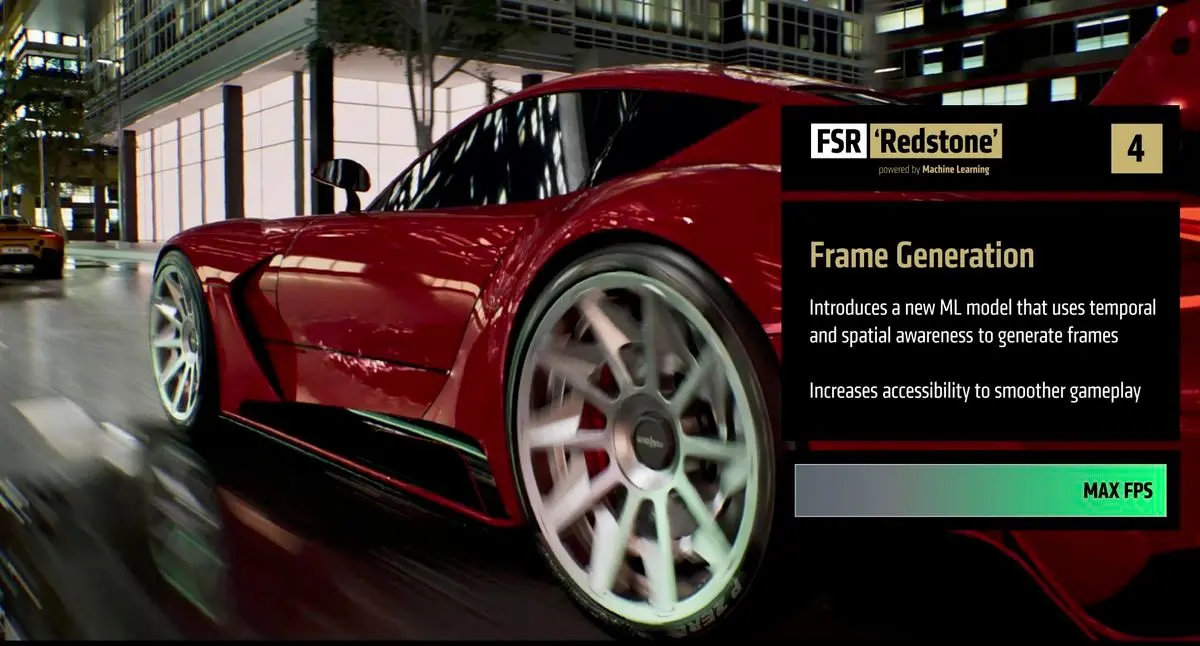
. The new AI frame generation technology represents the most significant advancement, using neural networks to insert generated frames between real frames, dramatically improving frame rates. Early testing shows this approach virtually eliminates the weird artifacts present in FSR 3's analytical frame generation5
.FSR Ray Regeneration works to remove noise and enhance ray tracing details at lower rendering costs, functioning as AMD's answer to Nvidia's ray reconstruction technology
1
. Meanwhile, Radiance Caching enables GPUs to maintain a small cache of rays for AI models instead of tracing each ray for every pixel, significantly reducing render time in path-traced games1
. However, Radiance Caching won't appear in games until 2026, making it the only Redstone feature not yet available4
.Performance Gains and Hardware Requirements
AMD claims substantial performance improvements with FSR Redstone enabled. In Call of Duty: Black Ops 7, the company demonstrated frame rates jumping from 23 fps to 109 fps when using performance settings with resolution scaling and frame generation
2
. However, AMD recommends games already run at a minimum of 60 fps after upscaling to avoid artifacts, meaning these technologies primarily enhance already playable experiences rather than salvaging poor performance1
2
.
Source: Tom's Guide
The catch is that all machine learning features in FSR Redstone require RDNA 4 graphics cards, specifically the Radeon RX 9000 series including the RX 9070 and RX 9070 XT
2
3
. Older RDNA 1 through 3.5 GPUs remain limited to analytical versions of upscaling and frame generation, missing out on the neural network advantages1
. This hardware restriction puts AMD at a disadvantage compared to Nvidia, which supports DLSS 4 features on cards dating back to the RTX 30-series3
.Game Support Remains a Critical Challenge
While AMD promises over 200 games will support FSR Redstone by the end of 2025, the reality is more nuanced
2
3
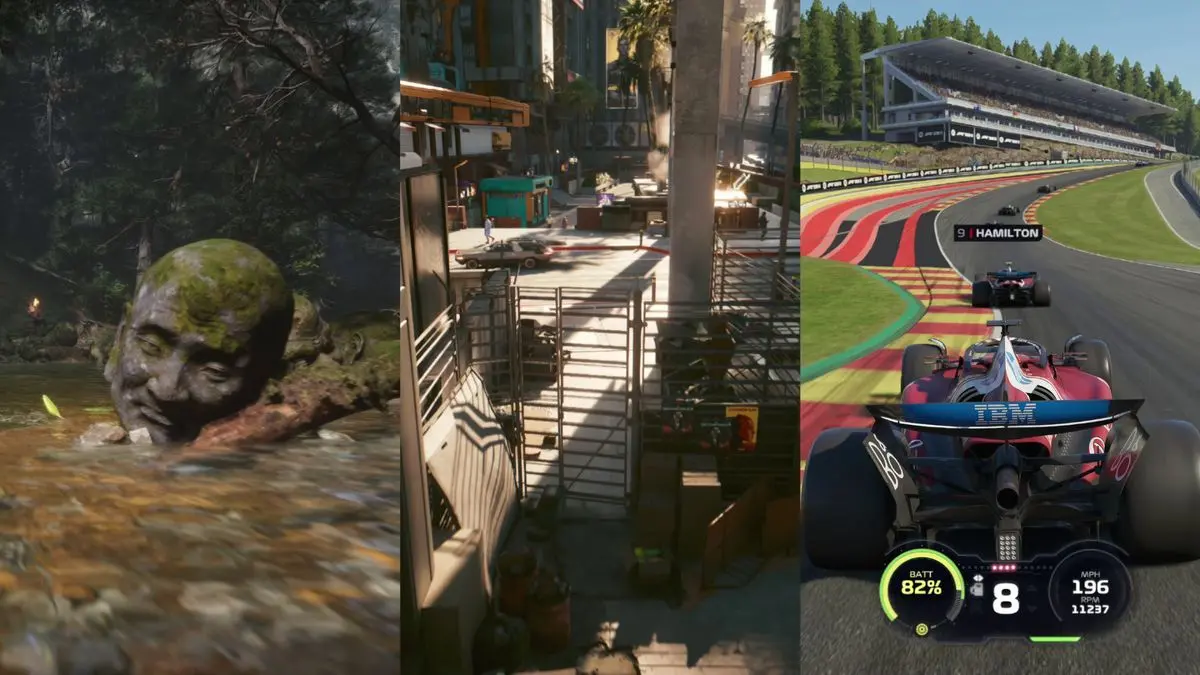
. Only around 30 to 40 games currently support the crucial machine learning-powered frame generation feature, with titles like Black Myth: Wukong, Cyberpunk 2077, and F1 24 among the early adopters2
5
. Radiance Caching and FSR Ray Regeneration have even more limited availability, with only Warhammer 40K: Darktide and Call of Duty: Black Ops 7 supporting these features respectively2
.
Source: PC Gamer
This represents a massive gap compared to Nvidia DLSS, which boasts compatibility with over 800 games
3
. The disparity highlights AMD's challenge in convincing developers to implement its technologies, though the company promises more games will arrive in 20262
. For now, users must manually enable Redstone features through AMD's Adrenalin Software on a per-game basis, adding complexity to the user experience5
.Closing the Gap with Nvidia but Missing Key Features
FSR Redstone brings AMD closer to feature parity with Nvidia DLSS 4, but notable differences remain. AMD's approach uses a 1:1 ratio for frame generation, inserting one AI-generated frame between each rendered frame
3
. In contrast, Nvidia's multi-frame generation technology offers a 3:1 ratio on RTX 50-series cards, potentially delivering smoother performance1
3
. The absence of multi-frame generation in Redstone means AMD hasn't fully matched its competitor's capabilities.However, AMD maintains one advantage: its modular approach allows users to selectively enable individual features rather than forcing adoption of the entire suite, as Nvidia does
1
. Early testing suggests the quality of AMD's AI frame generation delivers substantial improvements over FSR 3, with testers noting that artifacts and blurring during rapid camera movements have been virtually eliminated5
.Related Stories


Implications for Console Gaming and Future Hardware
The significance of FSR Redstone extends beyond PC gaming. Sony collaborated with AMD on developing FSR 4, which launched in March, and the company has indicated plans to bring the technology to PS5 Pro
2
. While the original PS5's RDNA 2 architecture presents challenges for implementation, speculation suggests Redstone could prove transformative for the rumored PlayStation 6, which would likely incorporate RDNA 4-based internals2
. Upscaling technology benefits lower-end systems more dramatically than high-end hardware, meaning future gaming handhelds from Sony or PC manufacturers could see substantial performance gains from these advancements2
.The potential integration with SteamOS also presents intriguing possibilities. With AMD-powered machines running Valve's Linux-based operating system, the combination of FSR Redstone and SteamOS could create compelling alternatives to traditional Windows-based gaming PCs
3
. This matters because it could accelerate adoption of AMD's GPU technologies across multiple gaming platforms, from handhelds to consoles to PCs.What This Means for the GPU Market
FSR Redstone arrives seven months after its initial announcement, giving Nvidia DLSS 4 nearly a year of market dominance
5
. The delayed launch and limited initial game support suggest AMD faces an uphill battle, yet the technical quality of the implementation demonstrates the company's commitment to catching up. For consumers, this competition drives innovation in gaming performance technologies, potentially making high-quality gaming experiences more accessible across different price points. The focus on machine learning and neural networks signals that AI will continue shaping how games render and perform, with implications for hardware requirements and game development practices going forward. AMD's success with Ryzen processors against Intel shows the company can execute comeback strategies, and FSR Redstone represents a critical step in applying that same approach to the GPU market1
.References
Summarized by

Navi
[3]
[4]
Related Stories
Recent Highlights
1
OpenAI Releases GPT-5.4, New AI Model Built for Agents and Professional Work
Technology

2
Pentagon's Anthropic showdown exposes who controls AI guardrails in military contracts
Policy and Regulation

3
Anthropic challenges Pentagon supply chain risk label in court over AI usage restrictions
Policy and Regulation

Recent Highlights
Today's Top Stories









Your Daily Dose of Curated AI News
Don’t drown in AI news. We cut through the noise - filtering, ranking and summarizing the most important AI news, breakthroughs and research daily. Spend less time searching for the latest in AI and get straight to action.

