Beeple's Robot Dogs With Billionaire Heads Poop Out AI Art at Art Basel Miami


5 Sources
5 Sources
[1]
Beeple's Art Basel Robot Dogs Satirize Musk, Zuckerberg and Our AI Future
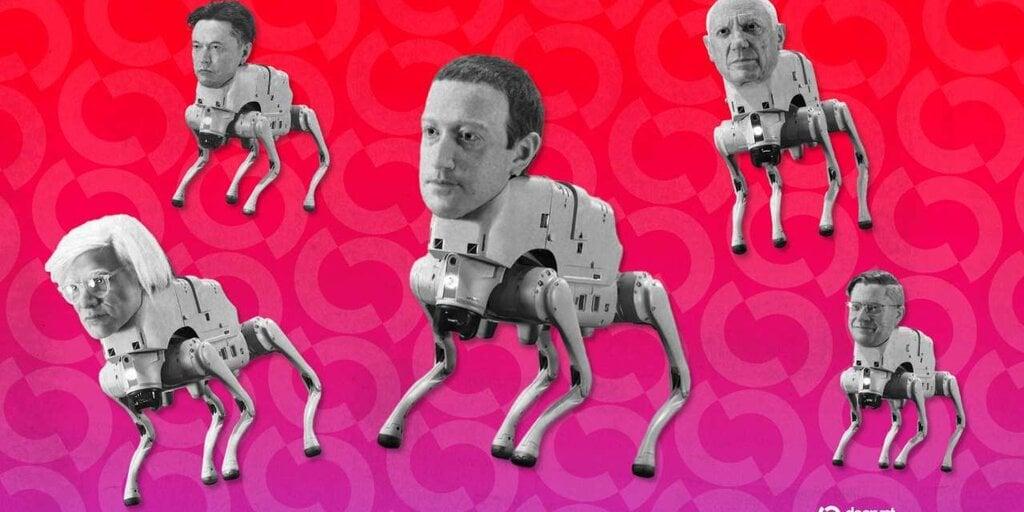
I agree my information will be processed in accordance with the Scientific American and Springer Nature Limited Privacy Policy. We leverage third party services to both verify and deliver email. By providing your email address, you also consent to having the email address shared with third parties for those purposes. Imagine Elon Musk staring you down. Now imagine his head on a doglike robot as it looks at you, squats and poops out your image. This was part of an installation entitled Regular Animals at this year's Art Basel Miami Beach art fair. Viewers stood outside a pen containing robot quadrupeds with the heads of tech billionaires, famous artists and Mike Winkelmann, aka Beeple -- the creator behind all this. The vibe was equal parts showroom, petting zoo and black comedy. The gag is crude, but the point is serious: Beeple is mocking the way tech power, and the data we unknowingly surrender, shapes what culture becomes. "For now, we imagine ourselves the authors and operators of these systems," Beeple wrote in his artist statement. "As robotics and AI advance toward forms of autonomy, the possibility emerges that these beings may one day claim their own interpretive authority." If you're enjoying this article, consider supporting our award-winning journalism by subscribing. By purchasing a subscription you are helping to ensure the future of impactful stories about the discoveries and ideas shaping our world today. Beeple, an American digital artist whose nonfungible token (NFT) artwork sold for $69 million at Christie's in 2021, helped launch the art marketplace for such NFTs, digital items recorded on a blockchain to publicly show their ownership. Now he's contemplating our AI future. "We'll be viewing the world through the lens of robots and machines and math," he said in an interview with Whitewall. "Certain people shape the way we view the world." In Regular Animals, each robot had a camera that captured images of people; an internal computer applied AI-based styling, and a compact printer ejected four-by-six-inch "certificates" from the robots' behind. When the Musk robot looked at the crowd, the AI converted what it saw to stark black-and-white linework with labeled parts, charts and flow diagrams -- like a patent drawing explaining a human audience. A Zuckerberg robot's droppings had a deep-blue "metaverse" vibe, with hologram people and grid floors. A robot with the head of the Spanish painter Pablo Picasso discharged prints with angular faces and bold colors. And a mechanical dog bearing the head of American pop artist Andy Warhol excreted images with halftone dots and a printed-media feel. "Let's recognize the reality that Mark Zuckerberg and Elon Musk have a massive amount of influence on what we see, and how we see the world," Beeple told the Wall Street Journal. "They just wake up and they change this or that algorithm and boom: Our visual culture changes immediately, for better or worse." To create the exhibition, Beeple relied on the work of others. The hyperrealistic heads were the product of Hyperflesh, the company of mask maker Landon Meier. The metal and polymer robots were from Unitree, a Chinese robotics company. Each used lidar navigation, similar to the sensing systems in Waymo and other self-driving taxis, to map the surroundings and approach the viewers. Though many of the robots sold for $100,000 each, not all art critics were charmed. Beeple has long lived inside the cryptocurrency economy he now satirizes -- part of what makes the piece either self-aware or self-serving, depending on your read. In the online arts magazine Hyperallergic, senior editor Valentina Di Liscia derided the work, saying the installation's real purpose was "to advance crypto wealth by making you, the viewer, an active participant in the ploy." The exhibition's deeper insight may simply be the reminder that we're all becoming AI training data. As robots get cheaper and more common, more machines will map rooms and capture images. Customer service bots, warehouse robots, delivery devices and security systems will collect data that, as Beeple's statement reminds us, will become "part of the vast, ever-growing archive from which future intelligences will be shaped." The joke lands because it's already true: the more machines look at us, the more we'll be absorbed into the immense archive from which future intelligences learn to generate culture -- whether we consent or not.
[2]
Robot dog with Elon Musk's head poops out AI generated art
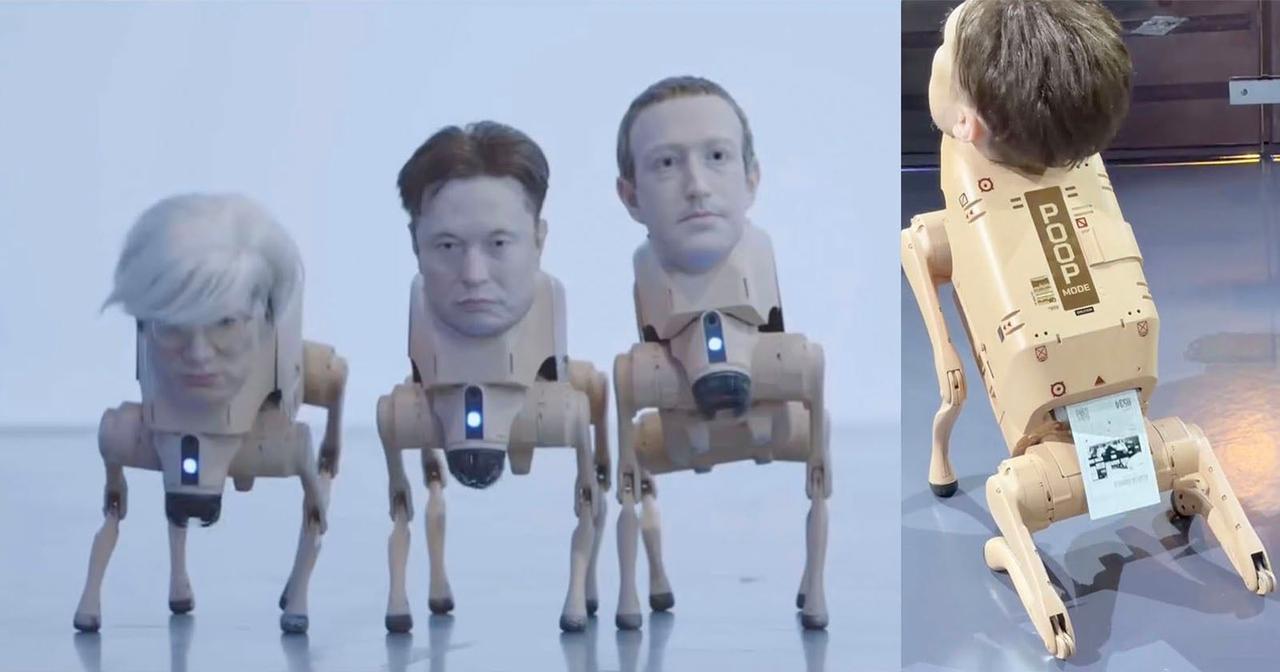
Robot dogs are already a bit creepy. But slap on a hyper-realistic image of a tech billionaire's face and have them literally crap out a piece of AI-generated art and you're left with something that would make Black Mirror producers shudder. That's exactly what's on display at Art Basel Miami, one of the world's most prodigious art fairs. In Regular Animals, the event space is crowded with six flesh-toned robotic dogs, each bearing a detached, photorealistic head of Mark Zuckerberg, Elon Musk, Andy Warhol, Pablo Picasso, or the installation's creator, digital artist Beeple. Every few moments, the dogs stop, lean back on their hind legs, and pinch off a Polaroid-like print from their rear ends. A small LED screen on each dog's back flashes "POOP MODE" while this performance art occurs. "What if the act of looking at art were no longer a one-way encounter, but part of a feedback loop in which the artwork observes, learns, and remembers us in return?" Beeple said in an artist statement accompanying the installation. Each of the human-dog hybrids has cameras located around its head, continuously capturing photos of the surrounding environment. That data is used (presumably with the help of an AI image generator) to create the prints that the dogs "poop" out. Much like AI-generated slop flooding the internet, these digital creations are voluminous. The New York Post reports that the robots will collectively produce 1,028 prints over the course of the exhibit, 256 of which are verifiable NFTs (non-fungible tokens) that can be listed on cryptocurrency marketplaces. Each image is labeled "Excrement Sample." Unlike an actual dog's daily sample, these will likely rack up monetary value over time. But while the end products are appropriately crappy, no two photos are exactly alike. The piles of prints each carry an aesthetic that reflects the personality of the human head attached to the dog. The Picasso images appear geometric, while those pushed out of the Zuckerberg dog's rectum look like a clip from a low-budget Matrix knockoff. More examples of the prints, which Beeple refers to as "memories," are viewable on the installation website. Each artist or billionaire inspired robot dog has its own "temperament." For example, Elon Musk's is described as a "cognitive blueprint," while Picasso's is "proto-cubism." (Beeple's dog, for what it's worth, has a temperament of "dystopic futurism"). Each also has its own speed setting -- slow, medium, or fast. Maybe unsurprisingly, the tech billionaires all fall into the fast category. This dystopian fever dream is the brain-child of Mike Winkelmann, (aka Beeple) an artist best known for his oddball NFT images created at the onset of the COVID-19 pandemic. He gained mainstream attention in 2021after a collection of 5,000 of his images sold for $69.3 million at Christie's in its first-ever NFT auction. Beyond fueling nightmares, Beeple says the bigger point of this robodog project is to draw attention to how more and more of the observable world consists of benign design, created to fulfill the vision of a select few techno-billionaires. That, he says, contrasts with past eras, when artists played a greater role in shaping reality. "It used to be that we saw the world interpreted through the eyes of artists, but now Mark Zuckerberg and Elon, in particular, control a huge amount of how we see the world," Beeple told The New York Post. "We see the world through their eyes because they control these very powerful algorithms that decide what we see." Reactions to the installation, at least so far, seem notably less highbrow. Commentators online have described the event as "terrifying," "absurd," and "beyond disturbing." One Instagram user, conversely, said they "want one" referring to the dog-human hybrid. Apparently, they aren't alone. The Post notes that all of the robots on display have already sold, for $100,000 each. While it's unclear who the dogs' new owners are, plenty of deep-pocketed Silicon Valley titans and artists attended Art Basel.
[3]
Robot Dog Billionaires Take Photos and Poop Them Out in Weird New Beeple Exhibition
A new exhibition by digital artist Beeple sees billionaires and visionaries becoming robot dogs that take photos and then poop them out. Some of the prints are also NFTs. The bizarre show is on now at Art Basel Miami Beach, featuring Elon Musk, Mark Zuckerberg, Jeff Bezos, Andy Warhol, Pablo Picasso, Kim Jong Un, and Beeple himself -- real name Mike Winkelmann. Beeple is famous for his surreal, satirical, and somewhat dystopian digital art and the new show, called Regular Animals, features autonomous robot dogs with hyper-realistic masks. "Mark Zuckerberg and Elon Musk own algorithms that control what we see and decide how we see the world. When they want to make a change, they don't have to lobby the UN, they don't have to go to Congress, they just make a change," Beeple tells Art Plugged. "So basically it's a series of different robot dogs. They have these different sorts of heads and they're constantly taking pictures and trying not to bump into things, and then they reimagine and poop out." Beeple explains that the dogs are continuously taking photos and ranking them to find the most interesting ones. When it's time to poop, they reimagine them using AI according to each dog's personality. For example, Elon Musk gets a schematic style, Zuckerberg's photos look like they were taken in the metaverse, and Pablo Picasso's pictures are Cubist. Some of the prints are NFTs, but others are just normal prints and certificates. According to The Art Newspaper, the prints read "this artwork has been tested and verified as 100% pure GMO-free, organic dogs*** originating from a medium adult dog anus." "This is AI reinterpreting the images and what the humanoid is seeing," Beeple adds. "There is an analogy; we're increasingly going to view the world through AI. We're also seeing the world through the lens of artists and tech leaders like Elon Musk and Mark Zuckerberg who shape what we see, probably more than anybody else."
[4]
These could be the creepiest robots you've ever set eyes on
Those of a nervous disposition might want to skip this article. It's about some of the creepiest robots ever to have walked this Earth. Apart from this one, perhaps. Part of a new art exhibition at Art Basel Miami, the robot dogs feature unnervingly lifelike copies of the heads of some of the biggest names in tech -- think Elon Musk, Mark Zuckerberg, and Jeff Bezos. Art legends Andy Warhol and Pablo Picasso also appear. But it gets weirder. Part of an exhibit called Regular Animals, the camera-equipped robots walk around a small enclosure before occasionally squatting to poop out an AI-generated Polaroid-like print depicting the people watching on. Each time this happens, an LED display on the dog's back shows a message reading "Poop mode." Visitors can take one of the "poops," or certificates, which state that the artwork has been "tested and verified as 100% pure GMO-free, organic dogshit originating from a medium adult dog anus." The bizarre display is the work of digital artist Mike Winkelmann -- better known as Beeple -- renowned for his grotesque, satirical 3D artworks and animations that blend pop culture, politics, and dystopian themes. He's also the guy who picked up a cool $69 million through his NFT sale of Everydays: The First 5000 Days in 2021. "What if the act of looking at art were no longer a one-way encounter, but part of a feedback loop in which the artwork observes, learns, and remembers us in return?," Beeple says of his latest installation, in apparent reference to the robot poops. In comments reported by The Art Newspaper, Beeple added, "This is AI reinterpreting the images and what the humanoid is seeing. There is an analogy; we're increasingly going to view the world through AI. We're also seeing the world through the lens of artists and tech leaders like Elon Musk and Mark Zuckerberg who shape what we see, probably more than anybody else." If you're in the vicinity of Miami and want to creep yourself out by seeing these robot dogs in person, then you'd better hurry. Regular Animals runs at Art Basel's new Zero 10 digital art section until Sunday, December 7.
[5]

Beeple Made Robot Dogs With Musk, Zuckerberg, and Warhol Heads That Poop NFTs - Decrypt
The robot figures have heads sculpted to resemble Elon Musk, Mark Zuckerberg, Jeff Bezos, Pablo Picasso, Andy Warhol, and Beeple himself. Digital artist Mike Winkelmann, aka Beeple, has brought NFTs back on the scene at Art Basel with a pack of robot quadrupeds that snap photos of visitors and poop printed artworks that double as crypto collectibles. The interactive installation, titled "Regular Animals," is on show through December 7 at the Miami Beach Convention Center as part of Art Basel's program for new digital works, Zero 10. Each four-legged robot carries a sculpted silicone head based on figures from the worlds of art and tech, including Elon Musk, Mark Zuckerberg, Jeff Bezos, Pablo Picasso, Andy Warhol, and Beeple himself. The robots roam the floor, their cameras capturing scenes from the fair, which are processed into stylized prints tied to the identity on each mask. Project materials indicate that some of those images contain codes that allow visitors to claim NFTs, linking the physical print to a token on a blockchain. A Luma event description indicates that "1024 free prints and 256 free NFTs" were distributed on Wednesday. "We're increasingly seeing the world through the lens of how they would like us to see it, because they control these very powerful algorithms, and they have unilateral control over how we see the world in many ways," Beeple said in a video interview with CNN. The robots will "only take pictures and develop these memories, and the memories will be logged on a certain blockchain, because I think that's a great use for this technology," he added. The robots use a commercial quadruped platform fitted with sensors, cameras, and a compact dye-sublimation printer that produces the images seen on the fair floor, with each unit modified with a hand-sculpted platinum-cure silicone head, according to a technical description from art magazine Whitewall. "This is AI reinterpreting the images and what the humanoid is seeing. There is an analogy; we're increasingly going to view the world through AI," Beeple said in an interview with The Art Newspaper. Artists and tech leaders, like those represented in the robot dogs' heads, continue to "shape what we see, probably more than anybody else," he added. Each robot was priced at $100,000, except the one with Bezos for its head, which wasn't for sale at the VIP preview on Wednesday, when all pieces sold out. Print photos produced by the robot dogs contain a disclaimer describing the artwork as having been "tested and verified as 100% pure GMO-free, organic dogshit originating from a medium adult dog anus." Decrypt has reached out to Beeple Studios and Art Basel for comment. Beeple's latest work arrives more than four years since his record-breaking 2021 sale of "Everydays: The First 5000 Days," a 5,000-image digital collage whose NFT went for a whopping $69.3 million at Christie's. That auction placed Beeple among the most expensive living artists and helped propel NFTs into the center of a global market boom. "I'm interested in crazy art projects that I just couldn't do before, but now I can," Beeple told Decrypt in a June 2021 podcast, when asked about how he plans to spend the money. The frenzy for NFTs had largely cooled by mid-2022, with volumes and prices falling across most segments. By early 2023, there was still some traction. "It's crazy to me to think about those times, because NFTs have been hated for so much longer than they were loved," Beeple said in an October 2024 interview. By July this year, industry analytics showed that NFT sales have surged 78%, largely due to lower floor prices, although to the detriment of overall trading volume, which took a 45% quarterly plunge.
Share
Share
Copy Link
Digital artist Beeple unveiled 'Regular Animals' at Art Basel Miami Beach, featuring autonomous robot dogs with hyperrealistic heads of tech billionaires like Elon Musk and Mark Zuckerberg. The robots capture photos of viewers and defecate AI-generated art prints, satirizing how tech power and algorithms shape visual culture. All robots sold for $100,000 each.
Beeple Debuts Robot Dogs at Art Basel Miami
Digital artist Mike Winkelmann, known as Beeple, has launched a provocative installation at Art Basel Miami Beach that merges robotics, AI art, and biting social commentary. The exhibition, titled Beeple's 'Regular Animals', features autonomous robot dogs equipped with hyperrealistic heads of tech billionaires including Elon Musk and Mark Zuckerberg, alongside art legends Pablo Picasso and Andy Warhol
1
. The installation ran through December 7 at the convention center's new Zero 10 digital art section, where viewers stood outside a pen watching these mechanical creatures roam, squat, and literally poop out physical prints2
.
Source: Decrypt
Each robot uses cameras mounted around its head to continuously capture images of the surrounding environment and fairgoers. When the machines identify compelling scenes, they process the data through AI systems that apply distinct artistic filters matching each figure's personality. The Musk robot converts images into stark black-and-white patent-style drawings with labeled parts and flow diagrams, while the Zuckerberg version produces deep-blue metaverse-inspired prints featuring hologram people and grid floors
1
. The Picasso robot generates angular, boldly colored compositions, and the Warhol machine creates halftone-dotted prints reminiscent of printed media3
.Tech Billionaires and the Influence of AI on Visual Culture
Beeple's installation delivers sharp criticism about how tech billionaires control what billions see daily through algorithms. "Let's recognize the reality that Mark Zuckerberg and Elon Musk have a massive amount of influence on what we see, and how we see the world," Beeple told the Wall Street Journal. "They just wake up and they change this or that algorithm and boom: Our visual culture changes immediately, for better or worse"
1
. The artist emphasized that unlike previous eras when artists shaped reality, today's visual landscape is increasingly filtered through the lens of a select few technology leaders who wield unilateral control over powerful platforms5
.The robots collectively produced 1,028 AI-generated art prints over the exhibition's duration, with 256 designated as verifiable NFTs that can be listed on blockchain and cryptocurrency marketplaces
2
. Each print carries a satirical label reading "this artwork has been tested and verified as 100% pure GMO-free, organic dogs*** originating from a medium adult dog anus"3
. An LED screen on each robot's back flashes "POOP MODE" during the defecation performance, adding to the installation's deliberately crude humor2
.
Source: PetaPixel
Data Collection and the Future of Autonomous Systems
Beyond the spectacle, Beeple raises urgent questions about data collection and machine autonomy. "What if the act of looking at art were no longer a one-way encounter, but part of a feedback loop in which the artwork observes, learns, and remembers us in return?" the artist asked in his statement
2
. He warns that as robotics and AI advance toward genuine autonomy, these systems may eventually claim their own interpretive authority rather than simply serving human operators1
.The installation underscores how humans are becoming AI training data. As robots equipped with sensors proliferate in customer service, warehouses, delivery systems, and security applications, more machines will map spaces and capture images that feed the vast archives shaping future intelligences
1
. The metal and polymer robots from Chinese robotics company Unitree use lidar navigation similar to Waymo self-driving taxis, while the hyperrealistic silicone heads came from Hyperflesh, the company of mask maker Landon Meier1
.Related Stories

Market Response and Critical Reception
Despite mixed critical reception, all robots on display sold for $100,000 each at the VIP preview, except for the Jeff Bezos version which wasn't available for purchase
5
. Beeple, whose NFT artwork "Everydays: The First 5000 Days" sold for $69.3 million at Christie's in 2021, helped launch the art marketplace for blockchain-based digital collectibles1
. Some critics questioned whether the installation genuinely critiques or merely perpetuates cryptocurrency culture. Hyperallergic senior editor Valentina Di Liscia suggested the real purpose was "to advance crypto wealth by making you, the viewer, an active participant in the ploy"1
.Online reactions ranged from "terrifying" and "beyond disturbing" to genuine interest in purchasing these mechanical hybrids
2
. The installation arrives as NFT markets show renewed activity, with industry analytics indicating a 78% surge in sales by mid-2024, though Beeple himself acknowledged that "NFTs have been hated for so much longer than they were loved"5
. Whether viewed as self-aware commentary or self-serving spectacle, 'Regular Animals' forces viewers to confront uncomfortable truths about algorithms, surveillance, and who controls the cultural lens through which we increasingly experience reality.
Source: Scientific American
References
Summarized by

Navi
[1]
[2]
[4]
Related Stories
AI Artist 'Botto' Generates Millions in Digital Art Sales, Challenging Traditional Notions of Creativity
23 Dec 2024•Technology

AI Art Sparks Debate: From Harold Cohen's AARON to Ai-Da's Million-Dollar Painting
24 Nov 2024•Technology

Christie's Groundbreaking AI Art Auction Sparks Controversy and Debate
09 Feb 2025•Technology

Recent Highlights
1
Tennessee Teens Sue Elon Musk's xAI Over Grok AI-Generated Child Abuse Images
Policy and Regulation
2
Supermicro Co-Founder Indicted in $2.5 Billion Nvidia AI Chip Smuggling Scheme to China
Policy and Regulation
3
Val Kilmer to appear posthumously in As Deep as the Grave through AI-generated performance
Entertainment and Society

Recent Highlights
Today's Top Stories









Your Daily Dose of Curated AI News
Don’t drown in AI news. We cut through the noise - filtering, ranking and summarizing the most important AI news, breakthroughs and research daily. Spend less time searching for the latest in AI and get straight to action.

