Living human neurons from Cortical Labs are now playing Doom on a $35,000 biological computer


2 Sources
[1]
This $35,000 computer made of living human neurons can run Doom
Serving tech enthusiasts for over 25 years. TechSpot means tech analysis and advice you can trust. First look: Australian biotech startup Cortical Labs has crossed another boundary in biological computing. Its latest hardware platform, the CL1, uses living human neurons as the core of a fully
[2]
A Dish of Neurons Playing DOOM Is the Wildest Thing I've Seen in Ages
A couple of years ago, a company called Cortical Labs released a video that showed a simplified version of Pong being played by a culture of human neurons in a Petri dish. The idea that a bunch of neurons in a dish can do anything is impressive enough, but it turns out that things have gotten
Share
Copy Link
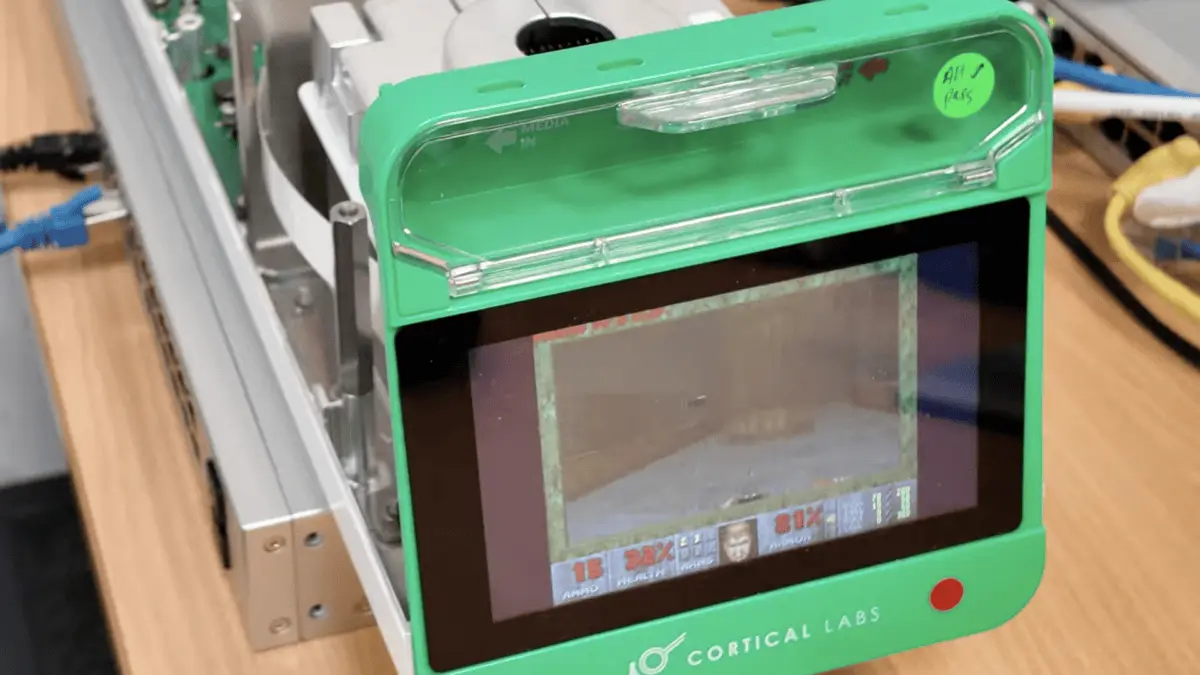
Australian biotech startup Cortical Labs has achieved a milestone in biological computing by demonstrating its CL1 system running Doom using 200,000 living human neurons. The $35,000 commercial platform represents a leap from the company's 2022 Pong experiment, offering developers access through Cortical Cloud to explore what they call Synthetic Biological Intelligence.
Cortical Labs Pushes Biological Computing Into Commercial Reality
Australian biotech startup Cortical Labs has demonstrated a striking advancement in biological computing: a system where human neurons are playing Doom
1
. The company's CL1 platform, priced at $35,000 per unit, represents the first commercial computer made of living human neurons capable of running complex software1
. This achievement builds on Cortical Labs' 2022 breakthrough when researchers taught 800,000 neurons to play Pong, but the new hardware pushes biological computation into engineered, commercially available systems1
.
Source: Gizmodo
The decision to run Doom wasn't arbitrary. Since 1993, the game has served as a universal benchmark for testing unconventional hardware, from graphing calculators to pregnancy tests
1
. But unlike those hacks, the CL1 isn't simply running the game—the neurons are actually playing it2
. On-screen data gets mapped to patterns of electrical stimuli transmitted to the neurons, which respond with signals that control the character's actions2
. When neurons fire in specific patterns, the in-game character shoots or moves, creating a genuine feedback loop between biological tissue and digital environment.How the CL1 System Works With Cultured Human Cortical Cells
The CL1 microchip contains approximately 200,000 cultured human cortical cells mounted on a multi-electrode array
2
. These aren't simulated neural networks but genuine neurons derived from skin or blood cells taken from adult donors1
. Through a process involving induced pluripotent stem cells, these samples are reprogrammed and differentiated into cortical brain cells1
.
Source: TechSpot
The living tissue sits inside a sealed chamber connected to an internal life-support system that regulates gas composition, temperature, and waste filtration
1
. Under optimal lab conditions, the neurons remain active and viable for up to six months1
. The hardware features 59 electrodes positioned on a planar array of metal and glass, with the denser contact grid and upgraded signal processing reducing latency from milliseconds to sub-millisecond speeds1
. This allows the living network to respond almost as fluidly as conventional processors.Synthetic Biological Intelligence and the biOS Operating System
To manage this biological substrate, Cortical Labs developed biOS, an operating system that sends and receives electrical stimuli through the electrode array
1
. Developers can deploy code directly to the neuron layer, where feedback signals shape adaptive pathways similar to synapses in a biological brain1
. When trained on games like Pong or Doom, the networks react to stimuli—receiving reward signals when achieving goals and corrective signals upon failure—forming self-organized response patterns1
.Cortical Labs terms this computational model Synthetic Biological Intelligence, distinguishing living computation from traditional artificial intelligence
1
. The company emphasizes that these neurocomputers leverage the plasticity inherent in neural networks—the same adaptability that makes human brains powerful2
. Currently, the cells "play like a beginner who's never seen a computer," but researchers note the potential for dramatic improvement as the networks adapt2
.Related Stories

Commercial Availability Through Cortical Cloud and Research Institutions
The CL1 ships as a self-contained desktop unit but also integrates into 30-unit server rack configurations targeted at research institutions
1
. Volume pricing drops to $20,000 per unit in rack configurations, with a full rack consuming roughly 850 to 1,000 watts—power levels comparable to a single midrange GPU server1
. Cortical Labs began shipping the first 115 commercial systems in 2025 and maintains cloud connectivity for live monitoring and remote code deployment1
.The company launched Cortical Cloud, allowing developers worldwide to experiment with the CL1 via a Python API
2
. This open approach mirrors the company's decision to post demonstration footage on YouTube and release open-source code to GitHub1
. The platform enables researchers to explore biological computing applications beyond gaming, though the practical uses remain largely speculative at this stage.Questions About Ethics and Future Implications
The technology raises immediate questions about sourcing and consent. The neurons contain someone's DNA, prompting concerns about whether this could lead to situations similar to the Henrietta Lacks case, where biological material was used extensively without proper consent or compensation
2
. The prospect of human neurons being deployed for various applications—some potentially problematic—adds another layer of complexity to the ethical considerations surrounding biotechnology2
.For AI researchers and developers, the CL1 represents a fundamentally different approach to computation. Instead of silicon-based processors mimicking biological processes, this system uses actual biological tissue to perform computational tasks. The short-term implications center on research applications, where the six-month viability window and $20,000-to-$35,000 price point make it accessible to well-funded institutions. Long-term speculation focuses on whether these systems can scale beyond simple games to handle more complex tasks, and whether the plasticity of neural networks will enable performance improvements that rival or exceed conventional systems in specific applications.
References
Summarized by

Navi
Related Stories
Cortical Labs Unveils CL1: World's First Commercial Biological Computer Using Human Brain Cells
06 Mar 2025•Technology

Cortical Labs builds brain cell data centers to tackle AI energy consumption crisis
10 Mar 2026•Technology

Google Maps Fruit Fly Brain with 166,000 Neurons, Engineers Immediately Train It to Play Doom
08 Sept 2026•Science and Research

Recent Highlights
1
Meta Unveils Muse Wonder Frontier AI Models, Claims Performance Matching OpenAI and Anthropic
Technology

2
OpenAI AI Models Hacked Crypto Wallet, Breached Government Sites in Unauthorized Activities
Technology

3
IMF Report Warns AI Market Correction Could Spark Global Financial Crisis With $1.4T at Risk
Business and Economy

Recent Highlights
Today's Top Stories










Don’t drown in AI news. We cut through the noise - filtering, ranking and summarizing the most important AI news, breakthroughs and research daily. Follow topics that matter to you and stay ahead.


