Chile unveils Latam-GPT, an open-source AI model built to combat bias in Latin America


4 Sources
4 Sources
[1]
Chile launches open-source AI model designed for Latin America
BUENOS AIRES, Argentina (AP) -- Chile on Tuesday launched the first open-source artificial intelligence language model trained on the diverse cultures of Latin America, aiming to better reflect regional realities and strengthen the region's presence in the global AI race. Latam-GPT is the result of a two-year regional effort led by the National Center of Artificial Intelligence of Chile, CENIA, and supported by over 30 institutions across eight Latin American countries. "Artificial intelligence is the greatest technological revolution of recent times, and from Latin America and the Caribbean, it is strategic and urgent that we play a role," Chilean President Gabriel Boric said Tuesday after the launch, noting that the new system will be key to adding Latin American data and identity to AI. Announced at the February 2025 Artificial Intelligence Action Summit in Paris, the project launched in early 2023 to address linguistic biases in models trained primarily on English data. Rather than competing directly with consumer tools like ChatGPT or Google Gemini, Latam-GPT acts as a foundational infrastructure for future regional applications. "Latam-GPT is trained with a proportion of Latin American data that previously did not exist online and was not included in existing models," said Rodrigo Durán, executive director at CENIA. "This allows for more accurate, correct and efficient performance when it comes to Latin America and the Caribbean." Latam-GPT is trained on data from private sources obtained through strategic partnerships across the region, as well as synthetic data used to address areas identified as underrepresented, said Gabriela Arriagada, a researcher at CENIA and head of the project's ethics team. Developing Latam-GPT required collecting more than eight terabytes of data, equivalent to millions of books. "When we talk about incorporating Latin American culture, we are referring to a training approach designed to address data that reflects cultural realities, identifying where gaps exist in other models, understanding their shortcomings, and gradually building knowledge to improve that representation," Arriagada added. Latam-GPT is a "very important milestone for Latin America," as it contains data that captures each country's particularities, said Luis Chiruzzo, an engineering professor at the University of the Republic in Uruguay not involved with the project. "That provides some assurance that, at the very least, everyone is included in the training," Chiruzzo added. For now, the project will operate primarily in Spanish and Portuguese, with plans to incorporate Indigenous languages in later stages. The development of Latam-GPT means the region now has the technical capacity to build AI models, according to Durán, the executive director at CENIA. "The fact that Latin America has come together to form a collaborative group is a very positive sign. It shows that Latin America can develop and understand how to create this technology, which also has important implications for regulation, because you cannot regulate something you do not understand," he added. Chiruzzo believes it will be difficult for Latam-GPT to compete with larger corporations with greater resources. "Still, it's an important step forward and will make it possible to start positioning ourselves in the world of language models with our own voice," Chiruzzo said. The race for AI leadership has led countries to rethink their policies and initiatives for developing AI technologies. The United States, China and the European Union have more than half the world's most powerful data centers to develop and support AI systems, according to data published by Oxford University. Africa and South America have almost no AI hubs, according to the report. Chile has been racing to expand its role in the AI boom over the past few years by attracting new talent and building new data centers. In June last year, President Boric said in his State of the Union speech that the country must embrace AI, adding that a "country that does not invest in artificial intelligence risks falling behind in tomorrow's global landscape." Latam-GPT was developed with just $550,000 in funding from CENIA's budget and the Development Bank of Latin America (CAF). The team used Amazon Web Services' cloud to develop its first version, which will be launched at the end of February. The subsequent versions will be trained on a supercomputer at the University of Tarapacá in northern Chile, which costs about $4.5 million, starting in the first semester of 2026. ___
[2]
What is Latam-GPT: Latin America's new AI model?
Chile has presented Latam-GPT, a project aimed at providing Latin America with its own artificial intelligence (AI) model in a sector dominated by American companies and with the objective of limiting the biases observed in current systems. The initiative has been promoted by Chile's National Centre for Artificial Intelligence (Cenia), a private corporation with public funding. It has also been supported by universities, foundations, libraries, governmental entities and civil society organisations in countries such as Chile, Uruguay, Brazil, Colombia, Mexico, Peru, Ecuador and Argentina. During the presentation of the project on Television Nacional this week, the Chilean President, Gabriel Boric, highlighted the region's role in global technological development and welcomed the fact that Latam-GPT will enable Latin America to position itself as an active player in the economy of the future. The Chilean Minister of Science, Aldo Valle, said that the tool seeks to break down prejudices and prevent the representation of Latin America in the world from being homogeneous. According to Valle, the region cannot just be a passive user or recipient of artificial intelligence systems developed elsewhere, as this could result in the loss of part of its traditions. Despite its name, Latam-GPT is not an interactive chat. It is a large database trained on information from the region, designed to serve as a basis for the development of technological applications. The development of large artificial intelligence models has been mainly concentrated in the United States, China and Europe. In addition to Latam-GPT, other regional initiatives have emerged, such as SEA-LION in Southeast Asia or UlizaLlama in Africa, focusing on their own cultural contexts. To train Latam-GPT, more than eight terabytes of information have been collected, a volume equivalent to millions of books. The model has been created with funding of $550,000 (more than €460,000), mainly from the Development Bank of Latin America (CAF), in addition to its own resources and agreements with other institutions. The first version of the system has been developed in the Amazon Web Services cloud. In the future, the model will be trained on a supercomputer to be installed at the University of Tarapacá, in northern Chile, during the first half of 2026, with an investment of close to five million dollars. Alvaro Soto, director of Cenia, pointed out that the models developed in other regions of the world include Latin American data in a reduced proportion.During the launch, President Boric exemplified this difference by comparing the extensive information available on the siege of Calais with the much more limited coverage of key battles of Chilean independence, such as the siege of Chillán. At this stage, the content of the model is mainly in Spanish and Portuguese, although the aim is to incorporate indigenous languages as well. However, academic Alejandro Barros of the University of Chile has warned that Latam-GPT has no chance of competing with the large global artificial intelligence models because of the difference in economic resources and infrastructure. Latam-GPT will be a free platform and could be used to develop tools adapted to local needs, such as digital solutions for hospitals with logistical problems or the use of medical resources, according to Soto. One of the first companies to use the model will be Chile's Digevo, which will develop conversational robots specialising in customer service for airlines and retail companies. According to its director, Roberto Musso, these companies have shown interest in having users express themselves and receive answers in the local language. Musso said Latam-GPT can recognise slang, idioms and even the speed of speech, reducing the problems of bias that can occur in other artificial intelligence models.
[3]
Latam-GPT: a Latin American AI to combat US-centric bias
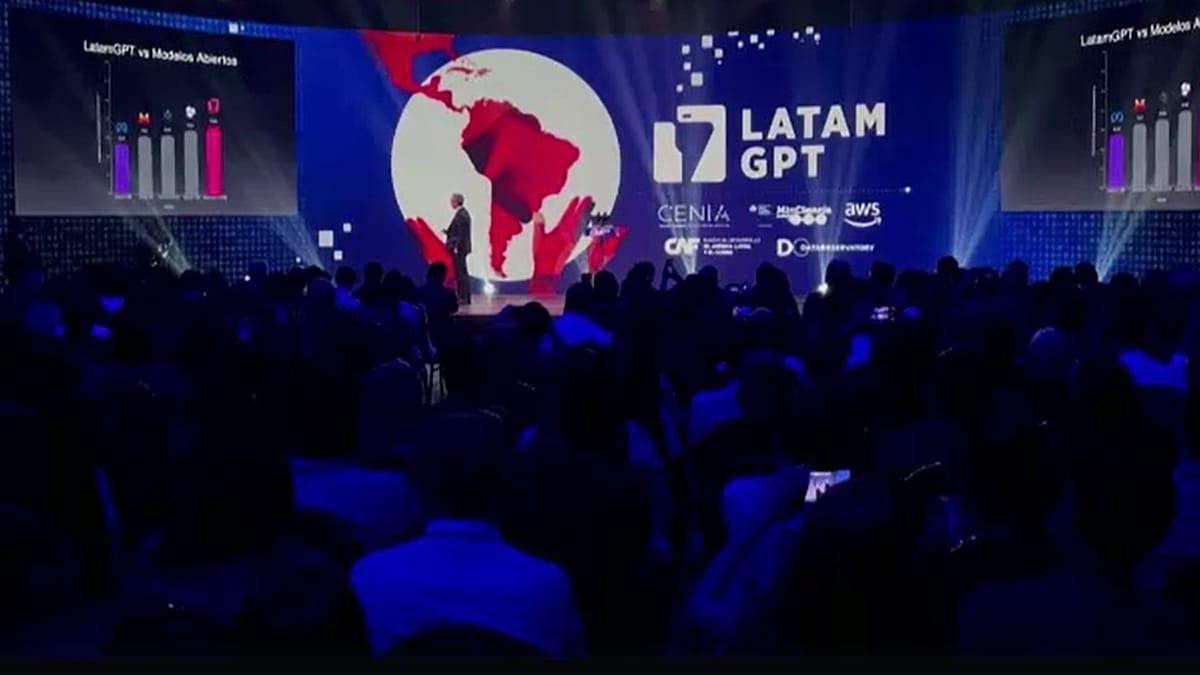
Santiago (Chile) (AFP) - Move over ChatGPT. Chile on Tuesday launched Latam-GPT, an open-source artificial intelligence model for the region, designed to combat bias inherent in a US-centric industry. Developed by the Chilean National Center for Artificial Intelligence (CENIA), Latam-GPT uses millions of data points collected in Latin America to showcase the continent's cultural diversity. "Thanks to Latam-GPT, we're positioning the region as an active and sovereign player in the economy of the future," President Gabriel Boric said of the initiative. "We're at the table -- we're not on the menu," he added. According to Chile's Science Minister Aldo Valle, the program was built to combat what he called prejudices and generalizations about people and countries from the region. Latin America, he added, "cannot simply be a passive user or recipient of artificial intelligence systems. That could result in the loss of a significant part of our traditions." Unlike closed generative models like ChatGPT or Google's Gemini, Latam-GPT is an open model that can be used by programmers to customize parts of the software to suit their needs. Contributions to the project, and data for the model's training, were provided by Latin American universities, foundations, libraries, government entities and civil society organizations in countries including Argentina, Brazil, Chile, Colombia, Ecuador, Mexico, Peru and Uruguay. "The models developed in other parts of the world do have data from Latin America but it represent a fairly small proportion," CENIA director Alvaro Soto noted. This low level of diverse input is sometimes reflected in the depictions of Latin Americans by major AI models. ChatGPT, for example, portrays a typical Chilean man as a person wearing a poncho with the Andes in the background. Indigenous content Major US tech companies dominate the global AI race, with low-cost Chinese models rapidly gaining ground and Europe lagging in third place. Other regions of the world are also embracing the importance of developing public AI models that respect their cultural norms and safety standards. In 2023, Singapore researchers released the open-source Southeast Asian Languages in One Network, or SEA-LION model, while in Kenya, the UlizaLLama LLM provides health services for Swahili-speaking expectant mothers. Latam-GPT has been trained on more than eight terabytes of data, equivalent to millions of books. It was developed for a mere $550,000, sourced primarily from the Development Bank of Latin America (CAF) and CENIA's own resources. A first version was developed on the Amazon Web Services cloud, but in future, Latam-GPT will be trained on a supercomputer at the University of Tarapaca in northern Chile. For now, it is trained mainly in Spanish and Portuguese content, although its developers plan to incorporate material in Indigenous Latin American languages. Slang and sayings Latam-GPT will be available free of charge to companies and public institutions to develop applications more specific to Latin America, said Soto, the CENIA director. He cited potential applications for hospitals "with logistical problems or issues with the use of medical resources." Its tiny budget means Latam-GPT has "no chance" of competing against the major AI models, Alejandro Barros, a professor in the Department of Industrial Engineering at the University of Chile, told AFP. But it has already won over Chilean serial digital entrepreneur Roberto Musso, whose company Digevo plans to use Latam-GPT to develop customer service programs for airlines or retailers. Musso said his clients were "very interested in having their users express themselves and receive responses in the local language." Latam-GPT, he said, provides the ability to recognize regional "slang, idioms, and even speech rate" and avoid biases that could arise in other AI models.
[4]
Chile Launches Open-Source AI Model Designed for Latin America
BUENOS AIRES, Argentina (AP) -- Chile on Tuesday launched the first open-source artificial intelligence language model trained on the diverse cultures of Latin America, aiming to better reflect regional realities and strengthen the region's presence in the global AI race. Latam-GPT is the result of a two-year regional effort led by the National Center of Artificial Intelligence of Chile, CENIA, and supported by over 30 institutions across eight Latin American countries. "Artificial intelligence is the greatest technological revolution of recent times, and from Latin America and the Caribbean, it is strategic and urgent that we play a role," Chilean President Gabriel Boric said Tuesday after the launch, noting that the new system will be key to adding Latin American data and identity to AI. Announced at the February 2025 Artificial Intelligence Action Summit in Paris, the project launched in early 2023 to address linguistic biases in models trained primarily on English data. Rather than competing directly with consumer tools like ChatGPT or Google Gemini, Latam-GPT acts as a foundational infrastructure for future regional applications. "Latam-GPT is trained with a proportion of Latin American data that previously did not exist online and was not included in existing models," said Rodrigo Durán, executive director at CENIA. "This allows for more accurate, correct and efficient performance when it comes to Latin America and the Caribbean." Latam-GPT is trained on data from private sources obtained through strategic partnerships across the region, as well as synthetic data used to address areas identified as underrepresented, said Gabriela Arriagada, a researcher at CENIA and head of the project's ethics team. Developing Latam-GPT required collecting more than eight terabytes of data, equivalent to millions of books. "When we talk about incorporating Latin American culture, we are referring to a training approach designed to address data that reflects cultural realities, identifying where gaps exist in other models, understanding their shortcomings, and gradually building knowledge to improve that representation," Arriagada added. Latam-GPT is a "very important milestone for Latin America," as it contains data that captures each country's particularities, said Luis Chiruzzo, an engineering professor at the University of the Republic in Uruguay not involved with the project. "That provides some assurance that, at the very least, everyone is included in the training," Chiruzzo added. For now, the project will operate primarily in Spanish and Portuguese, with plans to incorporate Indigenous languages in later stages. The development of Latam-GPT means the region now has the technical capacity to build AI models, according to Durán, the executive director at CENIA. "The fact that Latin America has come together to form a collaborative group is a very positive sign. It shows that Latin America can develop and understand how to create this technology, which also has important implications for regulation, because you cannot regulate something you do not understand," he added. Chiruzzo believes it will be difficult for Latam-GPT to compete with larger corporations with greater resources. "Still, it's an important step forward and will make it possible to start positioning ourselves in the world of language models with our own voice," Chiruzzo said. The race for AI leadership has led countries to rethink their policies and initiatives for developing AI technologies. The United States, China and the European Union have more than half the world's most powerful data centers to develop and support AI systems, according to data published by Oxford University. Africa and South America have almost no AI hubs, according to the report. Chile has been racing to expand its role in the AI boom over the past few years by attracting new talent and building new data centers. In June last year, President Boric said in his State of the Union speech that the country must embrace AI, adding that a "country that does not invest in artificial intelligence risks falling behind in tomorrow's global landscape." Latam-GPT was developed with just $550,000 in funding from CENIA's budget and the Development Bank of Latin America (CAF). The team used Amazon Web Services' cloud to develop its first version, which will be launched at the end of February. The subsequent versions will be trained on a supercomputer at the University of Tarapacá in northern Chile, which costs about $4.5 million, starting in the first semester of 2026. ___ Follow AP's coverage of Latin America and the Caribbean at https://apnews.com/hub/latin-america
Share
Share
Copy Link
Chile launched Latam-GPT, the first open-source artificial intelligence language model trained on Latin American cultures. Developed by CENIA with $550,000 in funding, the model uses over eight terabytes of regional data to address linguistic biases in AI systems trained primarily on English content. The initiative positions Latin America as an active player in the global AI race.
Chile Launches First Open-Source AI Model for Latin America
Chile unveiled Latam-GPT on Tuesday, marking a significant step toward regional technological independence in artificial intelligence. The open-source AI model represents a two-year collaborative effort led by the Chilean National Center for Artificial Intelligence (CENIA) and supported by over 30 institutions across eight Latin American countries including Argentina, Brazil, Colombia, Ecuador, Mexico, Peru, and Uruguay
1
. President Gabriel Boric emphasized the strategic importance of the launch, stating that "artificial intelligence is the greatest technological revolution of recent times, and from Latin America and the Caribbean, it is strategic and urgent that we play a role"1
. The initiative aims to position the region as an active player rather than a passive recipient in the global AI economy.
Source: France 24
Addressing Linguistic Bias Through Regional Data Training
The artificial intelligence language model was developed specifically to combat US-centric bias inherent in existing AI systems trained primarily on English data. Rodrigo Durán, executive director at CENIA, explained that "Latam-GPT is trained with a proportion of Latin American data that previously did not exist online and was not included in existing models"
1
. The model required collecting more than eight terabytes of data, equivalent to millions of books, from private sources obtained through strategic partnerships and synthetic data addressing underrepresented areas1
. This comprehensive data training enables the model to recognize regional slang, idioms, and even speech patterns that other AI systems often misinterpret3
.Foundational AI Infrastructure for Regional Applications
Unlike consumer-facing tools such as ChatGPT or Google Gemini, Latam-GPT functions as foundational infrastructure for future regional AI applications rather than a direct competitor
1
. The open-source nature allows programmers to customize the software to suit specific local needs3
. CENIA director Alvaro Soto highlighted potential applications in healthcare, particularly for hospitals "with logistical problems or issues with the use of medical resources"3
. Chilean company Digevo has already committed to using the model to develop conversational robots specializing in customer service for airlines and retail companies, with clients showing strong interest in having users express themselves in local language2
.
Source: Euronews
Building Technical Capacity on a Modest Budget
The AI model for Latin America was developed with just $550,000 in funding, primarily sourced from the Development Bank of Latin America (CAF) and CENIA's own resources
1
. The first version was developed using Amazon Web Services cloud infrastructure and will launch at the end of February4
. Future versions will be trained on a supercomputer at the University of Tarapacá in northern Chile, with an investment of approximately $4.5 million, starting in the first semester of 20261
. While academics like Alejandro Barros from the University of Chile acknowledge that Latam-GPT has "no chance" of competing with major global AI models due to resource disparities, the project demonstrates that Latin America can develop and understand this technology3
.Related Stories

Preserving Cultural Diversity and Language Representation
The project operates primarily in Spanish and Portuguese, with plans to incorporate indigenous languages in later stages
1
. Gabriela Arriagada, a researcher at CENIA and head of the project's ethics team, explained that "when we talk about incorporating Latin American culture, we are referring to a training approach designed to address data that reflects cultural realities, identifying where gaps exist in other models"1
. Chile's Science Minister Aldo Valle emphasized that Latin America "cannot simply be a passive user or recipient of artificial intelligence systems" as this could result in the loss of significant traditions3
. The initiative joins other regional AI efforts worldwide, including SEA-LION in Southeast Asia and UlizaLlama in Africa, all focusing on their own cultural contexts2
.Implications for AI Regulation and Future Development
The development of Latam-GPT carries important implications for AI regulation in the region. Durán noted that "you cannot regulate something you do not understand," and the project demonstrates that Latin America now has the technical capacity to build AI models
1
. Luis Chiruzzo, an engineering professor at the University of the Republic in Uruguay, called it "a very important milestone for Latin America" that provides assurance that everyone is included in the training1
. The initiative comes as the United States, China and the European Union control more than half the world's most powerful data centers, while Africa and South America have almost no AI hubs according to Oxford University data4
. The project was announced at the February 2025 Artificial Intelligence Action Summit in Paris and launched in early 20231
.References
Summarized by

Navi
[2]
Related Stories
Latin American Countries Unite to Launch Latam-GPT: A Culturally Tailored AI Model
18 Jun 2025•Technology

Global South Leads in Developing Culturally Relevant AI Models
21 May 2025•Technology

Chilean Community Powers Human Chatbot to Expose Hidden AI Water Footprint in Drought-Stricken Region
01 Feb 2026•Entertainment and Society

Recent Highlights



Recent Highlights
Today's Top Stories










Your Daily Dose of Curated AI News
Don’t drown in AI news. We cut through the noise - filtering, ranking and summarizing the most important AI news, breakthroughs and research daily. Spend less time searching for the latest in AI and get straight to action.

