Chinese tech giants wage $431 million chatbot war as AI competition hits new heights


7 Sources
7 Sources
[1]
Alibaba to spend $431 million for Lunar New Year AI push as chatbot war heats up
BEIJING, Feb 2 (Reuters) - Alibaba (9988.HK), opens new tab said on Monday it will spend 3 billion yuan ($431 million) to attract users to its Qwen AI app during the Lunar New Year holiday, heating up a race between China's largest tech firms. The pledge by Alibaba, which triples the spending promised earlier by rivals Tencent and Baidu, is set to start on February 6. It will involve incentives for dining, drinks, entertainment and leisure, with "large red envelopes distributed continuously," Alibaba said in a statement. Tencent (0700.HK), opens new tab and Baidu (9888.HK), opens new tab announced late last month they would spend 1 billion yuan and 500 million yuan respectively on similar promotions for their AI chatbots. Chinese tech companies have long used the Lunar New Year festive period - when hundreds of millions travel home and spend time with family - as a marketing battleground to acquire new users. The most notable case was in 2015, when Tencent leveraged its WeChat messaging app to distribute digital red envelopes, helping its WeChat Pay service gain ground against Alipay, which then dominated China's mobile payments market. The public holiday period this year begins on February 15 and is nine days long, longer than in most previous years. Competition in China's AI sector has accelerated since DeepSeek's R1 model launch in January last year rattled global AI markets, spurring both faster adoption and fiercer rivalry among domestic players. Tencent's campaign focuses on its Yuanbao chatbot app and starts on Sunday. Users must upgrade the app to the latest version to claim digital red envelopes that can be withdrawn to their WeChat wallets. Users can also share links with cash rewards for others to claim. Alibaba did not specify whether rewards would be distributed as cash red envelopes or discount coupons redeemable on its platforms including e-commerce site Taobao. Several other Chinese AI firms have also been releasing upgrades in the run-up to the holiday. DeepSeek is expected to launch its next-generation AI model V4, featuring strong coding capabilities, in mid-February, The Information has reported. ($1 = 6.9519 yuan) Reporting by Liam Mo and Brenda Goh; Editing by Stephen Coates Our Standards: The Thomson Reuters Trust Principles., opens new tab
[2]
The AI Race is so hot that chatbot users are getting paid in real cash, iPhones, and TVs
With billions at stake and Apple watching closely, China's AI giants are turning user acquisition into a high-stakes giveaway war ahead of next-generation model launches. AI giants in China, including Alibaba, Tencent, and Baidu, are offering "red envelopes" or cash gifts to lure more users to their chatbots before the reported release of their new AI models later this month (via a Techxplore report citing AFP). Alibaba, for instance, has formulated a budget of CNY 3 billion (around USD 430 million) to be offered as cash gifts to users of its AI app, Qwen. The promotional campaign begins on February 6, 2026, right in time for the Chinese New Year. Chinese companies are preparing for next-gen AI showdown After Alibaba, Tencent and Baidu will also commence with their campaigns. While the former has pledged CNY 1 billion (with top prizes of around CNY 10,000), the latter is giving away CNY 500 million, not only in cash, but also in the form of iPhones and TVs. Recommended Videos To claim cash prizes (or iPhones), Chinese users must register with the relevant AI apps and interact with them (asking questions about complex topics, planning holidays, etc.) during the promotional period; it's really that simple. It's clear that the Chinese AI giants want to increase their active user base before rolling out their new and more advanced models later this month, but that doesn't seem to be the only motivation behind the promotional pile of around CNY 4.5 billion. Why Apple might be watching China's AI battle closely As they release advanced AI models, these companies are competing with global AI players like Google and OpenAI. Alibaba, for instance, claims that its Qwen3-Max-Thinking model outperforms Google's Gemini 3 in reasoning. In doing that, the Chinese firms are also eyeing a chance to become Apple's local AI facilitator in the region. Since the iPhone maker can't use Gemini to power its advanced AI features (including the new Siri) in China, it has to outsource the back-end to a platform that meets its stringent standards. A Bloomberg report from February 2025 also claims that Apple will use Alibaba's AI in China, but the iPhone maker hasn't confirmed anything yet. As and when Apple finalizes a Chinese firm for its upcoming Apple Intelligence features, it should announce the provider (either to the public or to its investors).
[3]
Chinese tech giants trade cash for AI buzz
Chinese tech giants are luring users with cash offers before their reported upcoming releases of competing AI models this month. Chinese AI models are surging globally, favored by some companies for their functionality and low cost, sparking fierce domestic competition. Tech giant Alibaba's AI app Qwen on Monday said it would dish out three billion yuan ($430 million) to users in digital "red envelopes" -- a form of traditional cash gifts -- starting February 6, following similar campaigns by competitors Tencent and Baidu. Users who register with the apps have daily chances to snap up red envelopes, usually only worth a few cents. Baidu, doling out 500 million yuan, is offering larger prizes, including iPhones and TVs. Tencent's AI app Yuanbao is giving out one billion yuan, with a top prize worth 10,000 yuan. Interacting within the app, like discussing the holiday with its chatbot, can earn users additional chances. Alibaba's announcement comes a week after it released its latest model, Qwen3-Max-Thinking, which it claims beats Google's newest model on reasoning, according to a statement. Baidu also released a new model on January 22. US media outlet the Information reported that the tech companies are also looking to release new AI models during the Lunar New Year holiday, following last year's DeepSeek surprise. During last year's Lunar New Year in January, Chinese startup DeepSeek stunned the world with its low-cost AI model that performed on par with US rivals. Analysts say DeepSeek's decision to make its system's inner workings public, in contrast to the closed AI models sold by OpenAI and other Western rivals, has boosted adoption of its tools by developers and businesses.
[4]
Chinese tech giants trade cash for AI buzz - The Economic Times
Chinese tech giants are luring users with cash offers before their reported upcoming releases of competing AI models this month. US media outlet the Information reported that the tech companies are also looking to release new AI models during the Lunar New Year holiday, following last year's DeepSeek surprise.Chinese tech giants are luring users with cash offers before their reported upcoming releases of competing AI models this month. Chinese AI models are surging globally, favoured by some companies for their functionality and low cost, sparking fierce domestic competition. Tech giant Alibaba's AI app Qwen on Monday said it would dish out three billion yuan ($430 million) to users in digital "red envelopes" -- a form of traditional cash gifts -- starting February 6, following similar campaigns by competitors Tencent and Baidu. Users who register with the apps have daily chances to snap up red envelopes, usually only worth a few cents. Baidu, doling out 500 million yuan, is offering larger prizes, including iPhones and TVs. Tencent's AI app Yuanbao is giving out one billion yuan, with a top prize worth 10,000 yuan. Interacting within the app, like discussing the holiday with its chatbot, can earn users additional chances. Alibaba's announcement comes a week after it released its latest model, Qwen3-Max-Thinking, which it claims beats Google's newest model on reasoning, according to a statement. Baidu also released a new model on January 22. US media outlet the Information reported that the tech companies are also looking to release new AI models during the Lunar New Year holiday, following last year's DeepSeek surprise. During last year's Lunar New Year in January, Chinese startup DeepSeek stunned the world with its low-cost AI model that performed on par with US rivals. Analysts say DeepSeek's decision to make its system's inner workings public, in contrast to the closed AI models sold by OpenAI and other Western rivals, has boosted adoption of its tools by developers and businesses.
[5]

Alibaba Launches $432 Million AI 'Red Packet' Blitz To Crush Tech Rivals - Alibaba Gr Hldgs (NYSE:BABA)
Alibaba Group Holding Limited (NYSE:BABA) is ramping up its push into consumer-facing artificial intelligence, committing billions of yuan to a Lunar New Year promotion. Alibaba said it will spend 3 billion yuan ($432 million) to promote its Qwen AI app during the Spring Festival, joining rivals Tencent Holding Ltd (OTC:TCEHY) and Baidu Inc (NASDAQ:BIDU) in rolling out red-packet giveaways to drive mass-market adoption. The campaign, which officially launches on Feb. 6, will include incentives such as lottery-style free orders and cash-filled red envelopes. Alibaba said the effort positioned Qwen as more than a chatbot. Instead, the app acts as a personal AI agent that can carry out tasks directly across Alibaba's platforms. AI Red-Packet War Intensifies Across China's Tech Giants Alibaba's move escalates an already fierce competition among China's largest tech companies during the Lunar New Year. Tencent and Baidu recently announced plans to spend 1 billion yuan and 500 million yuan, respectively, to promote their consumer AI apps through similar holiday incentives. Alibaba Pushes Full-Stack AI Strategy Alibaba overhauled its AI chatbot in November, relaunching it as Qwen and powering it with the latest version of its proprietary large language models. The company said the app surpassed 100 million monthly active users within two months. Alibaba's chip design arm, T-Head, released technical details for its Zhenwu 810E parallel-processing unit. The company said the chip targets the heavy data demands of generative AI and delivers performance broadly comparable to Nvidia's China-focused H20 processor. Alibaba stock gained 72% in the last 12 months. BABA Price Action: Alibaba Gr Hldgs shares were down 0.18% at $169.25 at the time of publication on Monday, according to Benzinga Pro data. Photo by Poetra.RH via Shutterstock Market News and Data brought to you by Benzinga APIs
[6]

Alibaba Raises Stakes in China's Chatbot War Ahead of Lunar New Year | PYMNTS.com
By completing this form, you agree to receive marketing communications from PYMNTS and to the sharing of your information with our sponsor, if applicable, in accordance with our Privacy Policy and Terms and Conditions. The move escalates a marketing and incentives battle among China's largest technology firms as consumer-facing AI chatbots compete for users, the report said. In January, Alibaba added agentic and payments capabilities to Qwen that let consumers complete in-chat purchases. The spending pledge, which Alibaba said will begin Feb. 6, is designed to attract users through incentives tied to dining, drinks, entertainment and leisure, including what the company described as large red envelope-style rewards distributed throughout the holiday period, according to the Reuters report. The commitment is roughly triple the sums announced by domestic rivals Tencent and Baidu, underscoring how aggressively China's tech giants are using the festive season to drive adoption of new AI products, the report said. China's Lunar New Year has long functioned as a proving ground for digital services, with hundreds of millions of people traveling, socializing and spending more time on their phones, according to the report. The period famously reshaped the mobile payments market a decade ago, when red envelope campaigns helped accelerate the use of digital wallets across the country. This year's public holiday begins Feb. 15 and runs for nine days, longer than in many prior years, giving companies an extended window to lock in user habits, the report said. Alibaba did not specify whether its incentives would be paid out as cash or as coupons redeemable across platforms such as its Taobao eCommerce marketplace, per the report. Rivals are taking similar approaches. Tencent said it would spend 1 billion yuan promoting its Yuanbao chatbot, with rewards that can be withdrawn to users' WeChat wallets, while Baidu has earmarked 500 million yuan for its own AI promotions, the report said. The marketing push comes as competition in China's AI sector intensifies following the launch of advanced domestic models that have shaken up the market. The debut of DeepSeek's R1 model last year accelerated adoption and raised expectations for performance among Chinese developers, according to the report. Several AI firms have timed product upgrades to coincide with the holiday rush. DeepSeek is expected to release its next-generation V4 model in mid-February, featuring stronger coding capabilities, Reuters reported Jan. 9.
[7]

Alibaba to spend $431 million for Lunar New Year AI push as chatbot war heats up
BEIJING, Feb 2 (Reuters) - Alibaba said on Monday it will spend 3 billion yuan ($431 million) to attract users to its Qwen AI app during the Lunar New Year holiday, heating up a race between China's largest tech firms. The pledge by Alibaba, which triples the spending promised earlier by rivals Tencent and Baidu, is set to start on February 6. It will involve incentives for dining, drinks, entertainment and leisure, with "large red envelopes distributed continuously," Alibaba said in a statement. Tencent and Baidu announced late last month they would spend 1 billion yuan and 500 million yuan respectively on similar promotions for their AI chatbots. Chinese tech companies have long used the Lunar New Year festive period - when hundreds of millions travel home and spend time with family - as a marketing battleground to acquire new users. The most notable case was in 2015, when Tencent leveraged its WeChat messaging app to distribute digital red envelopes, helping its WeChat Pay service gain ground against Alipay, which then dominated China's mobile payments market. The public holiday period this year begins on February 15 and is nine days long, longer than in most previous years. Competition in China's AI sector has accelerated since DeepSeek's R1 model launch in January last year rattled global AI markets, spurring both faster adoption and fiercer rivalry among domestic players. Tencent's campaign focuses on its Yuanbao chatbot app and starts on Sunday. Users must upgrade the app to the latest version to claim digital red envelopes that can be withdrawn to their WeChat wallets. Users can also share links with cash rewards for others to claim. Alibaba did not specify whether rewards would be distributed as cash red envelopes or discount coupons redeemable on its platforms including e-commerce site Taobao. Several other Chinese AI firms have also been releasing upgrades in the run-up to the holiday. DeepSeek is expected to launch its next-generation AI model V4, featuring strong coding capabilities, in mid-February, The Information has reported. (Reporting by Liam Mo and Brenda Goh; Editing by Stephen Coates)
Share
Share
Copy Link
Alibaba pledges 3 billion yuan ($431 million) to attract users to its Qwen AI app during Lunar New Year, tripling spending by rivals Tencent and Baidu. The escalating promotional battle comes as Chinese tech giants prepare to launch next-generation AI models, with cash incentives, iPhones, and TVs offered to users who register and interact with their chatbots.
Chinese Tech Giants Launch Massive Cash Campaigns for AI Apps
Chinese tech giants are turning user acquisition into an unprecedented spending battle, with Alibaba committing 3 billion yuan ($431 million) to promote its Qwen AI app during the Lunar New Year holiday
1
. The pledge triples the spending promised by rivals Tencent and Baidu, which announced they would spend 1 billion yuan and 500 million yuan respectively on similar promotions for their AI chatbots1
. This escalating chatbot war reflects how AI competition among Chinese tech giants has intensified following DeepSeek's surprise launch last year.
Source: Benzinga
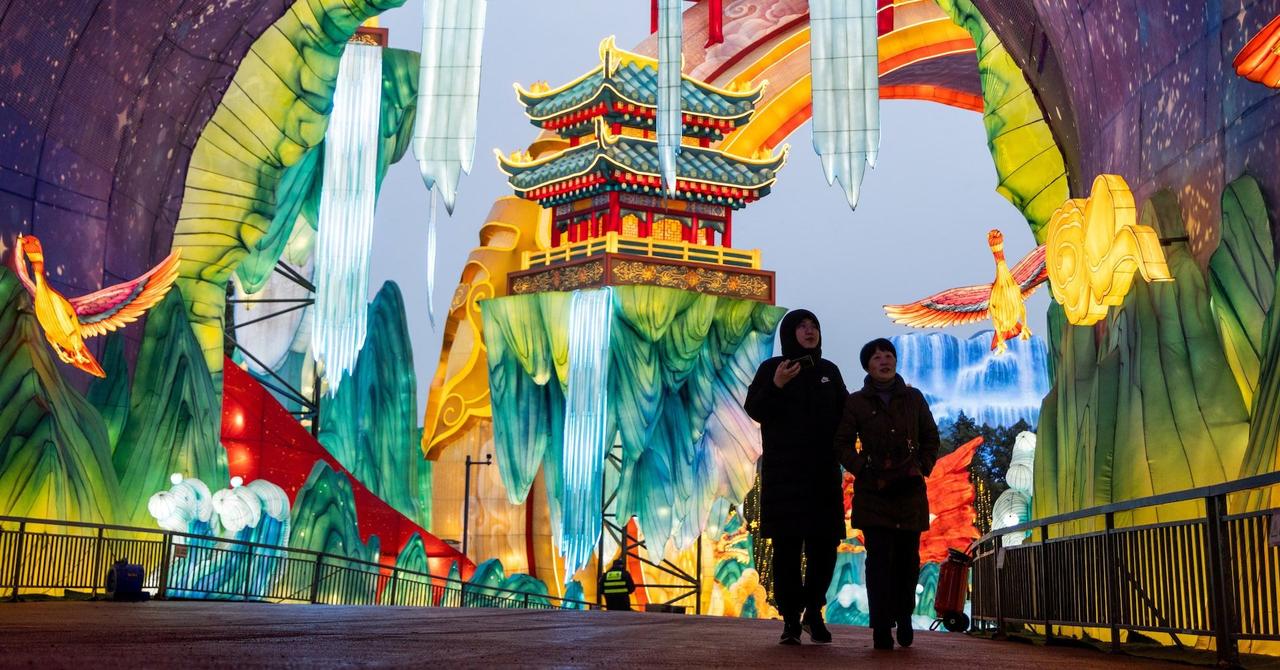
The Alibaba Qwen AI app campaign begins on February 6 and will involve incentives for dining, drinks, entertainment and leisure, with digital red envelopes distributed continuously
1
. Users who register with the apps have daily chances to claim these traditional cash gifts, though individual red envelopes are usually worth only a few cents. Tencent's Yuanbao chatbot app offers a top prize worth 10,000 yuan, while Baidu is providing larger rewards including iPhones and TVs alongside its 500 million yuan budget4
.
Source: Reuters
Lunar New Year Promotion Timing Signals Strategic Push
Chinese tech companies have long used the Lunar New Year festive period as a marketing battleground to acquire new users, with hundreds of millions traveling home and spending time with family
1
. The most notable case was in 2015, when Tencent leveraged its WeChat messaging app to distribute digital red envelopes, helping its WeChat Pay service gain ground against Alipay in China's mobile payments market1
. The public holiday period this year begins on February 15 and is nine days long, longer than in most previous years1
.These cash incentives for AI apps aren't just about holiday marketing. The Information reported that tech companies are looking to release next-generation AI models during the Lunar New Year holiday, following last year's DeepSeek surprise
4
. DeepSeek is expected to launch its next-generation AI model V4, featuring strong coding capabilities, in mid-February1
. During last year's Lunar New Year in January, Chinese startup DeepSeek stunned the world with its low-cost AI model that performed on par with US rivals, rattling global AI markets and spurring faster adoption among domestic players1
4
.Mass-Market Adoption Drives Competitive Strategy
Alibaba said the effort positions Qwen as more than a chatbot, instead acting as a personal AI agent that can carry out tasks directly across Alibaba's platforms
5
. The company overhauled its AI chatbot in November, relaunching it as Qwen and powering it with the latest version of its proprietary large language models, and said the app surpassed 100 million monthly active users within two months5
. Alibaba's announcement comes a week after it released its latest model, Qwen3-Max-Thinking, which it claims beats Google's newest model on reasoning4
.Chinese AI models are surging globally, favored by some companies for their functionality and low cost, sparking fierce domestic competition
4
. Analysts say DeepSeek's decision to make its system's inner workings public, in contrast to the closed AI models sold by OpenAI and other Western rivals, has boosted adoption of its tools by developers and businesses4
. As Chinese firms compete with global AI players like Google and OpenAI, they're also eyeing a chance to become Apple's local AI facilitator in the region2
. Since Apple can't use Google's Gemini to power its advanced AI features including the new Siri in China, it must outsource the back-end to a platform that meets its standards, with a Bloomberg report from February 2025 claiming that Apple will use Alibaba's AI in China, though the iPhone maker hasn't confirmed anything yet2
.Related Stories


AI App Promotion Extends Beyond Software
Alibaba's chip design arm, T-Head, released technical details for its Zhenwu 810E parallel-processing unit, with the company saying the chip targets the heavy data demands of generative AI and delivers performance broadly comparable to Nvidia's China-focused H20 processor
5
. This full-stack AI strategy demonstrates how Chinese tech giants are building comprehensive ecosystems to support mass-market adoption of their AI applications. Baidu also released a new model on January 22, positioning itself ahead of the holiday rush4
. With billions at stake and the combined promotional pile reaching around 4.5 billion yuan, this AI competition signals a critical inflection point for consumer AI adoption in China and potentially beyond.
Source: ET
References
Summarized by

Navi
[2]
[3]
Related Stories
Recent Highlights


Recent Highlights
Today's Top Stories









Your Daily Dose of Curated AI News
Don’t drown in AI news. We cut through the noise - filtering, ranking and summarizing the most important AI news, breakthroughs and research daily. Spend less time searching for the latest in AI and get straight to action.

