Anthropic CEO compares Nvidia's AI chip sales to China to selling nuclear weapons to North Korea


16 Sources
16 Sources
[1]
Anthropic's CEO stuns Davos with Nvidia criticism | TechCrunch
Last week, after reversing an earlier ban, the U.S. administration officially approved the sale of Nvidia's H200 chips, along with a chip line by AMD, to approved Chinese customers. Maybe they aren't these chipmakers' shiniest, most advanced chips, but they're high-performance processors used for AI, making the export controversial. And at the World Economic Forum in Davos on Tuesday, Anthropic CEO Dario Amodei unloaded on both the administration and the chip companies over the decision. The criticism was particularly notable because one of those chipmakers, Nvidia, is a major partner and investor in Anthropic. "The CEOs of these companies say, 'It's the embargo on chips that's holding us back,'" Amodei said, incredulous, in response to a question about the new rules. The decision is going to come back to bite the U.S., he warned. "We are many years ahead of China in terms of our ability to make chips," he told Bloomberg's editor-in-chief, who was interviewing him. "So I think it would be a big mistake to ship these chips." Amodei then painted an alarming picture of what's at stake. He talked about the "incredible national security implications" of AI models that represent "essentially cognition, that are essentially intelligence." He likened future AI to a "country of geniuses in a data center," saying to imagine "100 million people smarter than any Nobel Prize winner," all under the control of one country or another. The image underscored why he thinks chip exports matter so much. But then came the biggest blow. "I think this is crazy," Amodei said of the administration's latest move. "It's a bit like selling nuclear weapons to North Korea and [bragging that] Boeing made the casings." That sound you hear? The team at Nvidia, screaming into their phones. Nvidia isn't just another chip company. While Anthropic runs on the servers of Microsoft and Amazon and Google, Nvidia alone supplies the GPUs that power Anthropic's AI models (every cloud provider needs Nvidia's GPUs). Not only does Nvidia sit at the center of everything, but it also recently announced it was investing in Anthropic to the tune of up to $10 billion. Just two months ago, the companies announced that financial relationship, along with a "deep technology partnership" with cheery promises to optimize each other's technology. Fast-forward to Davos, and Amodei is comparing his partner to an arms dealer. Maybe it was just an unguarded moment -- it's possible he got swept up in his own rhetoric and blurted out the analogy. But given Anthropic's strong position in the AI market, it seems more likely he felt comfortable speaking with confidence. The company has raised billions, is valued in the hundreds of billions, and its Claude coding assistant has developed a reputation as a highly beloved and top-tier AI coding tool, particularly among developers working on complex, real-world projects. It's also entirely possible that Anthropic genuinely fears Chinese AI labs and wants Washington to act. If you want to get someone's attention, nuclear proliferation comparisons are probably a pretty effective way to do it. But what's perhaps most remarkable is that Amodei could sit onstage at Davos, drop a bomb like that, and walk away to some other gathering without fear that he just adversely impacted his business. News cycles move on, sure. Anthropic is also on solid footing right now. But it does feel that the AI race has grown so existential in the minds of its leaders that the usual constraints -- investor relations, strategic partnerships, diplomatic niceties -- don't apply anymore. Amodei isn't concerned about what he can and can't say. More than anything else he said on that stage, that fearlessness is worth paying attention to.
[2]
Anthropic's CEO says Nvidia's H200 too powerful for China
This is totally not because China is giving away its best models away for free, right? Anthropic CEO Dario Amodei isn't happy about the US allowing Nvidia to sell GPUs to Chinese companies, and likened the decision to giving nuclear weapons to an adversary. "The CEOs of these [Chinese] companies say it's the embargo on US chips that's holding them back," he said in an interview with Bloomberg at the World Economic Forum in Davos, Switzerland this week. "I think it's a big mistake to ship these chips." Amodei's comments come just over a month after the Trump administration announced it would allow shipments of Nvidia H200 accelerators to Chinese customers so long as Uncle Sam gets a 25 percent cut of the revenues. It's now up to Chinese authorities to allow local buyers to acquire the GPUs. Anthropic wants stricter controls on AI exports, a hawkish position that contrasts sharply with chipmakers like AMD and Nvidia, which have warned that closing the door on China, which is home to roughly half of the world's AI researchers, would result in a technological decoupling. "The US currently leads in advanced semiconductor technology and export controls capitalize on the trend of computing power doubling every two years, so while US chip technology continues advancing, China's progress is slowed," Anthropic argued in a statement last northern spring. Amodei's thoughts on the matter don't appear to have changed much in the months since then. "We are many years ahead of China in terms of our ability to make chips," he said this week. Access to these chips would put Chinese model devs, like DeepSeek, in a better position to compete with the west, particularly for enterprise adoption. Many of the most capable Chinese models are open weights, which is to say, anyone can download and run them so long as they have the hardware. Open weights models running entirely on prem offer enterprises assurances that their data won't "accidentally" find its way into a training dataset. American model builders have mostly locked their models behind APIs with vague promises that they won't use customers' data for further training, while simultaneously wrestling copyright holders in court over alleged copyright infringement. Amodei's argument about the threat posed by Chinese model builders is overblown, but that that could change if China were allowed to import more sophisticated silicon from the US. "I think they never really caught up that much," he said. "There was a lot of excitement around DeepSeek, but the truth was... those models are very optimized for the benchmark." In other words, Chinese developers make sure their models look good on paper, but may not perform well when applied to real-world tasks. The fact remains that enterprises don't have many options outside of China if they want a frontier-class open weights model. Despite this, Amodei sees OpenAI and Google as Anthropic's main competitors. "When competing for contracts, we see Google and we see OpenAI. Every once in a while, we see a couple other US players. I have almost never lost a contract to a Chinese model." The key word there is "almost," as it suggests Chinese developers are finding some buyers. Anthropic hasn't released any of its flagship models to the public as open weight models, but has engaged in some collaborative efforts with select customers - compute partner Amazon Web Services being the most prominent. ®
[3]
Anthropic CEO Says AI Chip Sales to China Like Selling Nukes to North Korea
Anthropic Chief Executive Officer Dario Amodei said selling advanced artificial intelligence chips to China is a blunder with "incredible national security implications" as the US moves to allow Nvidia Corp. to sell its H200 processors to Beijing. "It would be a big mistake to ship these chips," Amodei said in an interview with Bloomberg Editor-in-Chief John Micklethwait at the World Economic Forum in Davos, Switzerland. "I think this is crazy. It's a bit like selling nuclear weapons to North Korea."
[4]
Anthropic's Dario Amodei says allowing Nvidia H200 sales to China is like "selling nuclear weapons to North Korea"
Serving tech enthusiasts for over 25 years. TechSpot means tech analysis and advice you can trust. A hot potato: Dario Amodei has never been Nvidia's biggest fan, and it's a feeling that's pretty much mutual. The Anthropic CEO is particularly against the US government allowing Team Green's H200 chips to be sold to China, a move he says is "a bit like selling nuclear weapons to North Korea." The Trump administration formalized the 25% duty on Nvidia's H200 and AMD's MI325X chips shipped to China last week, creating a new revenue stream for the US government. In an interview with Bloomberg TV, Amodei was asked about the recent events. The CEO said that while the H200 accelerator isn't Nvidia's latest-generation model, he still believes it was a "big mistake" to ship the chips as they are an improvement over what China can currently access. "I think this is crazy. I think it's a bit like, I don't know, like selling nuclear weapons to North Korea and bragging, oh yeah, Boeing made the case," Amodei said. Amodei might be worrying about nothing. There have been reports that Chinese customs officials have blocked shipments of H200 from entering the country and warned domestic firms not to buy them unless absolutely necessary. The rivalry between Amodei and Nvidia (and Jensen Huang) is turning into a modern version of the Steve Jobs vs. Microsoft/Bill Gates drama of yesteryear. Anthropic clashed with Team Green over the export of its chips to China in May last year when it supported the AI Diffusion policy. The Amazon-backed company suggested lowering the export threshold for Tier 2 countries, implementing stricter regulations to minimize smuggling risks, and boosting funding for enforcement efforts. Anthropic cited the arrest of two people in 2023 by Hong Kong customs officers who were trying to smuggle 70 high-end "computer display cards" into the country alongside 617 pounds of lobsters, and the famous incident in which a woman was caught entering China with 202 Intel CPUs wrapped around her torso and concealed underneath a prosthetic pregnant belly. Nvidia responded with, "American firms should focus on innovation and rise to the challenge, rather than tell tall tales that large, heavy, and sensitive electronics are somehow smuggled in 'baby bumps' or 'alongside live lobsters.'" Huang also took offense to Amodei's warning that AI could wipe out about half of all entry-level white-collar jobs in the next five years. "One, he believes that AI is so scary that only they should do it," Huang said of Amodei. "Two, [he believes] that AI is so expensive, nobody else should do it [...] And three, AI is so incredibly powerful that everyone will lose their jobs, which explains why they should be the only company building it," Huang continued. More recently, Huang appeared to reference Amodei during his complaint about public AI negativity. He said no company should ask governments for more AI regulation. "Their intentions are clearly deeply conflicted, and their intentions are clearly not completely in the best interest of society," he said. "I mean, they're obviously CEOs, they're obviously companies, and obviously they're advocating for themselves."
[5]

I think it's a bit like selling nuclear weapons to North Korea and bragging" -- Anthropic's CEO warns Davos about letting Nvidia sell AI chips to China
A billion-dollar AI alliance explodes into global controversy * Anthropic CEO Dario Amodei warned at Davos that allowing Nvidia to sell AI chips to China poses serious national security risks * Amodei compared the decision to "selling nuclear weapons to North Korea," despite Nvidia being a major investor in his company * The clash highlights rising industry tension over how AI hardware should be controlled as global powers race to build advanced systems Anthropic CEO Dario Amodei cut through the polished choreography of the World Economic Forum in Davos this week when he flatly implied that Nvidia, one of his own company's biggest backers, was a 'nuclear' threat to geopolitics during an interview with Bloomberg. The interview triggered immediate global hubbub across the tech, diplomatic, and security spheres over his response to the U.S. approval of AI chip sales to China. The arrangement ends a ban on the sale of high-performance AI chips to China. The U.S. now allows Nvidia and AMD to resume sales of certain AI chips, including the H200 line, to pre-approved customers in China. "I think this is crazy," Amodei told a stunned audience during the session. "It's a bit like selling nuclear weapons to North Korea and bragging that Boeing made the casings." It was an especially bold reaction from the leader of Anthropic, a company that $1.5 trillion chipmaking giant Nvidia has invested over $10 billion into so far. They're powerful enough to dramatically accelerate Chinese AI capabilities in many ways, with military and security being one that has Amodei particularly worried. Amodei sees this as a real and immediate threat because AI models are "essentially cognition, that are essentially intelligence." He suggested thinking of the models powered by the chips as "100 million people smarter than any Nobel Prize winner," all under the control of one country or another. People were audibly shocked during the interview. Anthropic is one of the leading homes of cutting-edge AI models. The Claude assistant is often noted as a strong rival to ChatGPT in many ways, thanks in no small part to Nvidia's GPUs. Friction over China's access to AI chips reflects a growing fault line inside the tech industry. Chipmakers and cloud service providers hoping to hold onto or expand their control of the AI market are tugging against companies like Anthropic with geopolitical fears over unfettered access to AI hardware by authoritarians. Global chip war Adding to the volatility is Nvidia's somewhat indispensable AI‑training chips. Its architecture has become a foundation for model development, with few alternative providers, though AMD and Intel are keen to catch up. But it means that when Nvidia sells chips to China, it creates more than just new commercial rivals. Nuclear weapons and airplane casings are unsubtle analogies, but Amodei almost certainly chose them for that reason. Davos is where CEOs talk like they're chewing on a technical manual and marketing guidebook at the same time. A straightforward and consequential projection of the future must have thrown plenty of attendees off balance. You might dismiss Amodei and the whole debate as high-level geopolitical drama with little relevance to everyday life. But what gets decided at the level of chip exports affects how fast the next AI-powered feature and device come out, and what they can do. The U.S. Commerce Department has stated that any sales to China are subject to rigorous controls and that buyers are vetted for ties to military operations. But enforcement remains a murky affair, especially when front companies, joint ventures, or subcontracting relationships can blur lines. Amodei didn't name China explicitly, but no one needed him to. The entire discussion was a rebuke of U.S. complacency in treating AI as a neutral export rather than a lever of global influence. And while Nvidia might argue that the chips being exported are less advanced, Amodei's counterpoint is that even slightly outdated chips can be networked at scale to produce transformative capabilities. And as Chinese AI labs become more adept at optimizing existing hardware, the line between what's considered to sell and what isn't begins to erode. Follow TechRadar on Google News and add us as a preferred source to get our expert news, reviews, and opinion in your feeds. Make sure to click the Follow button! And of course you can also follow TechRadar on TikTok for news, reviews, unboxings in video form, and get regular updates from us on WhatsApp too.
[6]

"This is crazy": Anthropic CEO blasts AI chip sales to China
Why it matters: Amodei hammered on national security concerns as the Trump administration inches closer to finalizing chip sales and Republican infighting over the issue ramps up. What they're saying: The U.S. is many years ahead of China when it comes to making chips, and sending them there could help Beijing catch up, Amodei said in an interview with Bloomberg on the sidelines of the World Economic Forum in Davos. * Referring to building AI models, Amodei posed: "I've called where we're going with this, a country of geniuses in a data center." * "So imagine 100 million people smarter than any Nobel Prize winner, and it's going to be under the control of one country or another." Friction point: Amodei has not been shy about criticizing the administration's policies from preemption to chip sales, even as he tries to defuse tensions. * Among industry players, Amodei is an outlier in his rebukes, but he is far from alone. On the Hill, top Republicans like House Foreign Affairs Committee Chair Brian Mast (R-Fl.) are pushing legislation that would prevent China from accessing sensitive U.S. technology. * MAGA influencers like Laura Loomer and AI and Crypto Czar David Sacks have hit back in defense of the president's policies. Amodei during the Bloomberg interview skirted placing the blame on Sacks -- who is widely viewed as the mastermind behind Trump's AI policies. * Amodei: "I wouldn't refer to any particular people but I would just say that this particular policy is not well advised." Context: The pieces are falling into place for certain advanced AI chips to go to China, like the Nvidia H200, the AMD MI325X and other similar ones.
[7]

Anthropic boss says U.S. is courting disaster by selling AI chips to China
Anthropic's chief executive has slammed America's move to let Nvidia $NVDA sell its H200 advanced artificial intelligence chips to China, saying it has "incredible national security implications." "We are many years ahead of China in terms of our ability to make chips. ... It would be a big mistake to ship these chips," Dario Amodei said at the World Economic Forum in Davos. "I think this is crazy. It's a bit like selling nuclear weapons to North Korea." "The CEOs of these [Chinese] companies say it's the embargo on chips that's holding us back," he said. "They explicitly say this." At the event held by Bloomberg, Amodei said of the U.S. policy: "I hope they change their mind." The H200 chips are just one generation back from the most advanced, the Blackwell chip, and are "still extremely powerful," he added. The H200 had previously been embargoed by Washington amid concerns that China could get a technological and military edge over the U.S., but President Donald Trump gave Nvidia the green light to sell the processors to China recently. He said he would allow the chip sales to "approved customers" in China and collect a 25% fee. Nvidia has consistently called for the chip to be allowed to be sold in China, one of its biggest markets. When the ban initially came into place, analysts estimated lost sales could cost Nvidia as much as $15 billion in annual revenue -- and around $3 billion in U.S. tax receipts. The chip sales hit another snag last week when Chinese customs officials blocked shipments of the newly approved product from entering the country, per reports. Nvidia had been planning for more than 1 million orders from the country, the Financial Times reported, citing two people familiar with the matter. Sources also told Reuters that Chinese government officials had summoned domestic tech company bosses to warn them against buying the chips unless it was necessary.
[8]

'I think this is crazy': Anthropic's CEO takes a potshot at Nvidia and the US government for selling AI chips to China
It's not really biting the hands that feed it, more just a little nibble. At this year's World Economic Forum in Davos, Switzerland, there has been considerable talk about all things AI-related, with numbers being bandied around so large that it all seems set in another universe. However, the leader of one particular AI company expressed opinions on the sale of chips to China that were distinctly grounded. "I think this is crazy," said Anthropic CEO, Dario Amodei, in a 25-minute interview with Bloomberg (via Techcrunch). That remark came about when the discussion turned to a decision made by the US government, essentially giving Nvidia the rubberstamp to sell its H200 AI superchips to companies in China. "I think it's a bit like, I don't know, like selling nuclear weapons to North Korea and, you know, bragging." Amodei made his thoughts on China's progress in AI blatantly clear: "We are many years ahead of China in terms of our in terms of our ability to make chips. So I think it would be a big mistake to ship these chips." Should you be wondering specifically what Anthropic's CEO considers "crazy", it's this: "If you think about the incredible national security implications of building models that are essentially cognition, that are essentially intelligence. Right? I've called where we're going with this, a country of geniuses in the data center, right? So imagine 100,000, 100 million people smarter than any Nobel Prize winner. And it's going to be under the control of one country or another." As a key player in the field of AI, with its Claude LLM family, you'd expect Anthropic to be complaining about giving the competition an advantage that it currently enjoys. Its models aren't just powered exclusively by Nvidia's GPU, but Anthropic is also in a 'strategic relationship' with Team Green (and Microsoft), all backed by a healthy investment of $10 billion from Jensen and his chums. Anthropic is also very keen on protecting its financial forecasts, where it has expressed a belief that it will not only hit a revenue stream of $70 billion by 2028, but also $17 billion in cash flow. Naturally, few people are going to pay attention to a company moaning about potential revenue losses, hence why Anthropic couched its criticisms of AI chip sales to China as a security concern. Regardless of whether or not AI models ever become as capable as 100 million people smarter than any Nobel Prize winner (hmm, I wonder why he picked that particular choice of intelligence metric), Anthropic faces more than just China in the battle for AI supremacy. Google, Meta, Microsoft, Nvidia, and OpenAI are all spending endless billions of dollars to be first across the AGI line. No amount of complaining is going to stop them.
[9]

Anthropic CEO Calls Exporting AI Chips to China a National Security Risk | AIM
The debate has intensified after rule changes opened the door for some advanced AI chips to be sold to China. Anthropic CEO Dario Amodei has sharply criticised US President Donald Trump's move to permit the sale of US-made AI chips to China, warning that the decision poses serious national security risks. Speaking at the World Economic Forum 2026 in Davos, during the session 'The Day After AGI', Amodei questioned the idea that selling US-made chips abroad strengthens American influence by embedding its technology stack globally. Amodei compared the policy to "selling nuclear weapons to North Korea," arguing that it could significantly narrow the technological gap between the US and China. Amodei said the United States currently holds a multi-year lead over China in advanced chipmaking and AI infrastructure, a position he believes could be undermined if cutting-edge hardware is exported. "Sending those chips over could help China catch up faster than people expect," he said, speaking in an interview with Bloomberg. Describing the strategic stakes of AI development, Amodei warned that the technology could soon enable unprecedented levels of intelligence concentrated within data centres. "Imagine 100 million people smarter than any Nobel Prize winner," he said. "That power is going to sit under the control of one country or another." Amodei said AI should not be treated like older technologies such as telecoms. He argued that while spreading US tech abroad may make sense in areas like network equipment or data centres, AI is far more powerful and carries much bigger consequences, making that approach risky. "As I understand it, the logic is we need to sell them chips because we need to bind them into US supply chains," he said. But, he added, the issue goes beyond timing or commercial advantage and cuts to the core importance of AI itself. While Amodei has repeatedly voiced concern over the US administration's broader AI and chip strategy, he has sought to avoid directly personalising the dispute. The debate has intensified after rule changes opened the door for some advanced AI chips -- such as NVIDIA's H200 and AMD's MI325X -- to be sold to China. The US Bureau of Industry and Security recently updated the licensing rules that control these exports. Trump later said his administration plans to put a 25% tariff on AI chips sent to China, including those made by Nvidia and AMD. The move adds more uncertainty for US chip companies already dealing with rising tensions between Washington and Beijing.
[10]

Anthropic boss Dario Amodei slams Trump over 'crazy' decision to sell advanced AI chips to China - SiliconANGLE
Anthropic boss Dario Amodei slams Trump over 'crazy' decision to sell advanced AI chips to China Anthropic PBC Chief Executive Dario Amodei today lambasted the U.S. government over its recent U-turn on advanced artificial intelligence chip sales to China, slamming the move as a "major mistake" that will result in "incredible national security implications." Amodei (pictured), who has a history of making dire warnings about AI's potential for misuse, was speaking at the World Economic Forum in Davos, Switzerland. His comments come just weeks after President Donald Trump gave Nvidia Corp. the green light to start selling its powerful H200 graphics processing units to Chinese customers. In return, the U.S. government will receive a 25% cut of all revenue generated by the sales. "We are many years ahead of China in our ability to make chips, so I think it would be a big mistake to ship these chips," the executive said in front of an audience that included some of the world's most prominent leaders, CEOs and policymakers. "I think this is crazy. It's a bit like selling nuclear weapons to North Korea." Trump decided to ease the ban on U.S. chipmakers selling more advanced AI processors to China as part of his ongoing trade talks with that country. However, the move represents a significant departure from previous administrations, which implemented the export ban in order to prevent Beijing from developing advanced military technologies and applications. The decision was widely viewed as a significant win for Nvidia, which points to the rapid evolution of China's domestic chipmaking industry and argues that it will simply build its own alternatives if the ban isn't revoked. However, critics argue that giving China access to the chips will cause problems. Launched more than two years ago, the Nvidia H200 GPU is the most advanced kind of processor that can legally be exported to China under current rules. Nvidia also sells a more advanced GPU in the shape of its Blackwell generation chips, but this is offered only to customers based in the U.S. and allied nations. The chipmaker is also developing an even faster processor known as Vera Rubin, and that will almost certainly be unavailable to China when it launches. Nvidia's rival Advanced Micro Devices Inc. is also pushing to be allowed to sell its MI325X chips to China. The MI325X is an alternative to the H200, and offers a similar amount of computing power. Trump's decision to lift the export ban on more advanced processors comes at a time when the U.S. and Chinese technology industries are locked in what many perceive to be a "winner-takes-all" battle to develop more powerful AI models. The two countries are racing to achieve "artificial general intelligence," which is loosely defined as the point where AI exceeds the cognitive capabilities of humans. Concerns about China's rapid advances in AI became widespread last year with the emergence of DeepSeek Ltd., whose DeepSeek R-1 model burst onto the scene showing benchmark scores that surpassed those of the leading U.S.-made models at the time, despite being built at just a fraction of the cost. Amodei is one of a number of critics who say that the Trump administration is shooting itself in the foot by giving China access to superior chips, as semiconductors are one of the few remaining advantages possessed by U.S. AI companies. "The CEOs of these [Chinese] companies say 'It's the embargo on chips that's holding us back.' They explicitly say this," he said. "I hope they change their mind," he added, calling on the Trump administration to rethink its decision. Despite his hawkish stance towards China, Amodei has also downplayed the country's progress in AI. With regard to DeepSeek, he insisted that the R1 model had been "very optimized" to achieve high scores on a "finite list of benchmarks," and insisted that U.S. models were far superior. Amodei made similar comments last year, during his first visit to Davos. That's when he urged the U.S. government to maintain its ban on exports to China, saying he was worried about "1984 scenarios, or worse," referring to George Orwell's dystopian novel about totalitarian government.
[11]

Anthropic's CEO says NVIDIA is essentially selling nukes to North Korea and bragging about it
TL;DR: Anthropic CEO Dario Amodei criticized the US approval of NVIDIA's export of advanced AI chips to China, comparing it to "selling nuclear weapons to North Korea." He warned that these chips could accelerate China's military AI capabilities, posing significant global security risks due to concentrated intelligence power. The CEO of Anthropic has commented on NVIDIA being able to supply China with sophisticated AI chips to power the nation's expansive development in AI, describing the US approving trade between NVIDIA and China as "like selling nuclear weapons to North Korea". Dario Amodei spoke at the World Economic Forum in Davos earlier this week and was asked what he thinks about the US approving the export of high-powered AI chips to China, specifically from NVIDIA. Amodei said, "I think this is crazy. It's a bit like selling nuclear weapons to North Korea and bragging that Boeing made the casings." The response to the question is undoubtedly jarring, especially considering NVIDIA has invested as much as $10 billion into Anthropic, and Anthropic is using NVIDIA hardware to train its own AI models, such as ChatGPT rival, Claude. Amodei went on to mention specific issues with NVIDIA AI chips making it to China, and that Chinese advancements in the military and security sectors are unlocked by NVIDIA hardware. Amodei stated that he sees both of those sectors of development as an immediate threat, as AI models are "essentially cognition, that are essentially intelligence," and said people should think of these AI models as "100 million people smarter than any Nobel Prize winner." But all that intelligence is controlled by one country.
[12]

Anthropic CEO slams US and Nvidia over AI chip sales to China
Anthropic CEO Dario Amodei publicly criticized the U.S. administration and chip manufacturers on Tuesday at the World Economic Forum in Davos for approving the sale of Nvidia H200 chips and AMD chip lines to Chinese customers. The U.S. administration reversed an earlier ban last week, approving high-performance AI chip sales. Nvidia is a significant investor in Anthropic, having announced up to a $10 billion investment two months prior, alongside a technology partnership to optimize their respective technologies. Amodei expressed incredulity regarding the decision. He stated that the U.S. maintains a multi-year lead over China in chip manufacturing capabilities. Amodei warned of "incredible national security implications" associated with AI models that represent cognition and intelligence, likening future AI to a "country of geniuses in a data center" controlled by a single nation. He compared the chip sales to "selling nuclear weapons to North Korea" while promoting the casing manufacturer. Anthropic, which operates on Microsoft, Amazon, and Google servers and relies on Nvidia GPUs to power its AI models, has secured billions in funding and holds a valuation in the hundreds of billions. Its Claude coding assistant is recognized as a top-tier AI coding tool for complex, real-world projects.
[13]

Dario Amodei Challenges Jensen Huang's Vision of Global A.I. Integration
The Anthropic CEO likens selling A.I. chips to China to selling nuclear weapons to North Korea. The national security risks of selling A.I. chips to China far outweigh the benefits of spreading U.S. technology worldwide, according to Dario Amodei. The Anthropic founder and CEO is pushing back against recent policies that frame such sales as a way to integrate the technology of leading U.S. companies, such as Nvidia, into global ecosystems. Sign Up For Our Daily Newsletter Sign Up Thank you for signing up! By clicking submit, you agree to our <a href="http://observermedia.com/terms">terms of service</a> and acknowledge we may use your information to send you emails, product samples, and promotions on this website and other properties. You can opt out anytime. See all of our newsletters "Are we going to sell nuclear weapons to North Korea because that produces some profit for Boeing?" asked Amodei while speaking at the World Economic Forum in Davos, Switzerland, today (Jan. 20). "That analogy should make clear how I see this trade-off -- that I just don't think it makes sense." In recent months, restrictions on A.I. chip exports have been eased under the Trump administration, in part thanks to Nvidia CEO Jensen Huang's lobbying. This pullback gives A.I. leaders less time to understand the technology's development, societal impacts and existential risks of new technologies, according to Amodei. "The reason we can't [slow down] is because we have geopolitical adversaries building the same technology at a similar pace," he explained. Demis Hassabis, CEO of Google DeepMind, echoed the need for a more nuanced approach to A.I.'s geopolitical challenges while speaking alongside Amodei on a Davos panel. When it comes to establishing safety standards, international cooperation between nations like the U.S. and China is "vitally needed," said Hassabis. Hassabis added that his concerns extend beyond governments to academia. He said he has been "constantly surprised" by how few economists and professors are seriously examining A.I.'s effects on issues like job displacement and wealth distribution. Getting A.I.'s societal deployment right, Hassabis argued, will require the technology's evolution to slow. Achieving that slowdown, however, "would require some coordination." The early days of A.I.'s labor impacts Both Amodei and Hassabis said they are already seeing A.I.'s influence on the labor market within their own companies. Hassabis pointed to a "slowdown" in hiring at Google DeepMind, especially for entry-level roles such as interns. Amodei, meanwhile, has long warned that A.I. could trigger major labor disruption. Last year, he said the technology could wipe out 50 percent of all entry-level white-collar jobs within five years. He said this transformation is already taking place within Anthropic, and his company is thinking internally about how to manage the shift "in a sensible way." Both leaders believe the job market will ultimately adapt, including through the creation of new A.I.-enabled roles. Still, Hassabis stressed that work is about more than income. Questions around how meaning and purpose are tied to jobs are among those "that keep me up at night," he said, adding that the financial effects of labor disruption are easier to solve "than what happens to the human condition, and humanity as a whole." While the Anthropic and Google DeepMind CEOs largely agree on the geopolitical, societal, and labor implications of A.I., they diverge on timing. Amodei believes A.I. could reach the capabilities of a Nobel laureate within just a few years. Hassabis, by contrast, puts the odds of human-level A.I. at 50 percent by the end of the decade. Even so, both agree that neither timeline leaves much room for companies, policymakers, or governments to develop a coherent response to the technology's growing influence. "There isn't a lot of time before this comes," said Hassabis.
[14]

Anthropic CEO Criticizes Investor Nvidia, Trump Administration For China Deal: 'Like Selling Nuclear Weapons To North Korea' - NVIDIA (NASDAQ:NVDA)
The CEO of privately held Anthropic had some choice comments for peer and investor NVIDIA Corp (NASDAQ:NVDA) in a recent interview. Here are the comments and why it could put the topic of selling AI chips to China back into the spotlight. Anthropic CEO Criticizes Nvidia During an interview at the World Economic Forum in Davos on Tuesday, Anthropic CEO Dario Amodei may have made the comments heard around the world for the semiconductor sector, with criticism of investor Nvidia. "The CEOs of these companies say, 'it's the embargo on chips that's holding us back,'" Amodei said of the previous ban on exports to China, as reported by TechCrunch. The U.S. recently reversed the ban and has approved the sale of H200 chips from Nvidia and chips from Advanced Micro Devices (NASDAQ:AMD) for sale to customers in China. The high-performance chips are mostly coveted for use for AI technology and platforms and were previously banned due to the thought that they could help China get ahead in the AI race. "We are many years ahead of China in terms of our ability to make chips. So I think it would be a big mistake to ship these chips." The Anthropic CEO said it's not just about the AI race, as the chips could be a "national security" risk. Amodei's analogy was one country having control of "100 million people smarter than any Nobel Prize winner." "I think this is crazy. It's a bit like selling nuclear weapons to North Korea and [bragging that] Boeing made the casings." Anthropic, Nvidia Relationship Nvidia and Microsoft Corp (NASDAQ:MSFT) announced a partnership with Anthropic in November 2025 that includes an investment of up to $15 billion in the company. Anthropic currently runs on servers from Microsoft, Amazon and Google, with Nvidia as the company behind the GPUs that power the company's AI models. A "deep technology partnership" between Anthropic and Microsoft could become tense in the future after the comments from Amodei. The comments could also lead to Anthropic receiving a less-than-favorable relationship with the White House. The ban on chip exports to China was a big storyline in 2025 and led to lower guidance and financial results for Nvidia. The ban reversal has investors and analysts trying to estimate how much additional upside Nvidia could have for exports to China. Investors will now be watching the storyline between Anthropic and Nvidia, partnered companies that could quickly turn to rivals. NVDANVIDIA Corp $183.780.25% Overview AMDAdvanced Micro Devices Inc $251.930.85% MSFTMicrosoft Corp $445.700.36% Market News and Data brought to you by Benzinga APIs
[15]

"Like Selling Nuclear Weapons to North Korea": Anthropic CEO Dario Amodei Blasts U.S. Decision to Approve NVIDIA's H200 AI Chip Exports to China
Anthropic's CEO Dario Amodei has spoken once again about selling NVIDIA's AI chips to China, claiming that the U.S. is providing Beijing with the weapon to get ahead in the AI race. Anthropic's Amodei Argues that China Has Remained Behind in the AI Race Due to a Lack of Compute Power The question of whether NVIDIA should be allowed to access the Chinese AI market has been discussed by several subject experts, but among them, Anthropic's CEO, Amodei, has opposed this decision, saying it could lead to "grave" consequences for America's AI lead. Now, speaking with Bloomberg Television, Amodei was asked about the Trump administration's decision to allow the export of the H200 AI chip to China, and he offered a rather aggressive analogy. He related the approval having a similar intensity to "selling nukes to North Korea", showing his opposition. So I think this is crazy. I think it's a bit like, I don't know, like selling nuclear weapons to North Korea and bragging, oh yeah, Boeing made the case. No, I wouldn't refer to any particular people, but I would just say that this particular policy. This isn't the first time Amodei has spoken about US export decisions; back in May, Anthropic claimed that NVIDIA is "telling tales" to the current administration to get back into the Chinese AI market. The company also talked about how chip smuggling is prevalent within the mainland, through techniques like hiding chips in "prosthetic baby bumps." Anthropic's CEO has also publicly called out NVIDIA's Jensen Huang on other matters involving the AI race, so it would be fair to say that these firms have an "implied enmity". Amodei argues that the US is granting Chinese AI giants the technology, which has put them at a disadvantage in developing capable frontier models, saying that companies like DeepSeek have publicly admitted they have fallen behind due to a lack of NVIDIA chips. Anthropic's CEO claims that even if the US allows the export of chips that are a "generation behind", like the Hopper-class, they still are competent compared to what China itself has in the domestic markets. There are multiple narratives surrounding this talk, and NVIDIA's CEO has repeatedly spoken out against the "China hawks" in the Trump administration, while Anthropic has voiced support for export laws like the AI Diffusion policy. Both parties have presented solid arguments to support their positions, but in the end, it's the administration that will make the decision, and for now, NVIDIA is back in China. Follow Wccftech on Google to get more of our news coverage in your feeds.
[16]

Selling AI chips to China is like 'selling nuclear weapons to North...
Anthropic CEO Dario Amodei warned Tuesday that US firms like Nvidia should not sell their advanced artificial intelligence chips to China - calling the move a major mistake with "incredible national security implications." Amodei, known for his dire warnings about the potential misuse of AI models, spoke out weeks after the Trump administration said Nvidia could resume the sale of its powerful H200 chips to China - with 25% of proceeds going to the US government. "We are many years ahead of China in terms of our ability to make chips, so I think it would be a big mistake to ship these chips," Amodei said during an interview with Bloomberg at the World Economic Forum in Davos, Switzerland. "I think this is crazy," he added. "It's a bit like selling nuclear weapons to North Korea." The US tech industry and China are locked in a winner-takes-all battle to develop more powerful AI models in the hops of achieving artificial general intelligence -- a model with human-level cognitive abilities. Critics argue allowing China to access the best chips will eliminate a key advantage for the US. Despite such concerns, Nvidia and its CEO Jensen Huang have argued vigorously in favor of lifting export curbs, asserting that China will simply make its own chips if it can't access ones that are made in the US. Amodei said the previous US ban on the sale of advanced AI chips was "the thing that is holding them back." "They've said it themselves," he said. "The CEOs of these [Chinese] companies say 'it's the embargo on chips that's holding us back.' They explicitly say this." The Anthropic boss called on the Trump administration to rethink its easing of export controls, stating "I hope they change their mind." Concerns about China's rapid advancement in AI skyrocketed about a year ago, when the Chinese firm DeepSeek claimed to have developed a model on par with US rivals for a fraction of the cost. Amodei downplayed DeepSeek's success, noting its models are "very optimized" to score well according to a "finite" list of benchmarks. Most of Anthropic's competition comes from OpenAI and Google, he added. "I have almost never lost a deal, lost a contract to a Chinese model," Amodei said. While the H200 is the most powerful chip made available for sale in China, US export rules still block deliveries of Nvidia's more advanced Blackwell chips to Chinese customers. Amodei has occasionally rankled opponents with his frequent proclamations about AI safety risks. White House AI czar David Sacks has accused Amodei of being the foremost of a group of AI "doomers" who want to prioritize regulations over progress. Last fall, Amodei released a lengthy statement stating that Anthropic was aligned with Trump on "key areas of AI policy" and denying claims that his company was too "woke." The Post has sought comment from Nvidia.
Share
Share
Copy Link
Dario Amodei stunned the World Economic Forum in Davos by publicly criticizing Nvidia's H200 chip exports to China, comparing the move to nuclear proliferation. The remarks are particularly striking given Nvidia's $10 billion investment in Anthropic and their deep technology partnership announced just two months ago.
Anthropic CEO Unleashes Nuclear Comparison at World Economic Forum
Dario Amodei delivered one of the most striking moments at the World Economic Forum in Davos this week when he openly criticized the U.S. decision to allow Nvidia H200 chip sales to China
1
. Speaking with Bloomberg's editor-in-chief, the Anthropic CEO didn't mince words: "I think this is crazy. It's a bit like selling nuclear weapons to North Korea and bragging that Boeing made the casings"3
. The comparison to selling nuclear weapons immediately reverberated across tech and diplomatic circles, particularly because Nvidia recently announced it was investing up to $10 billion in Anthropic1
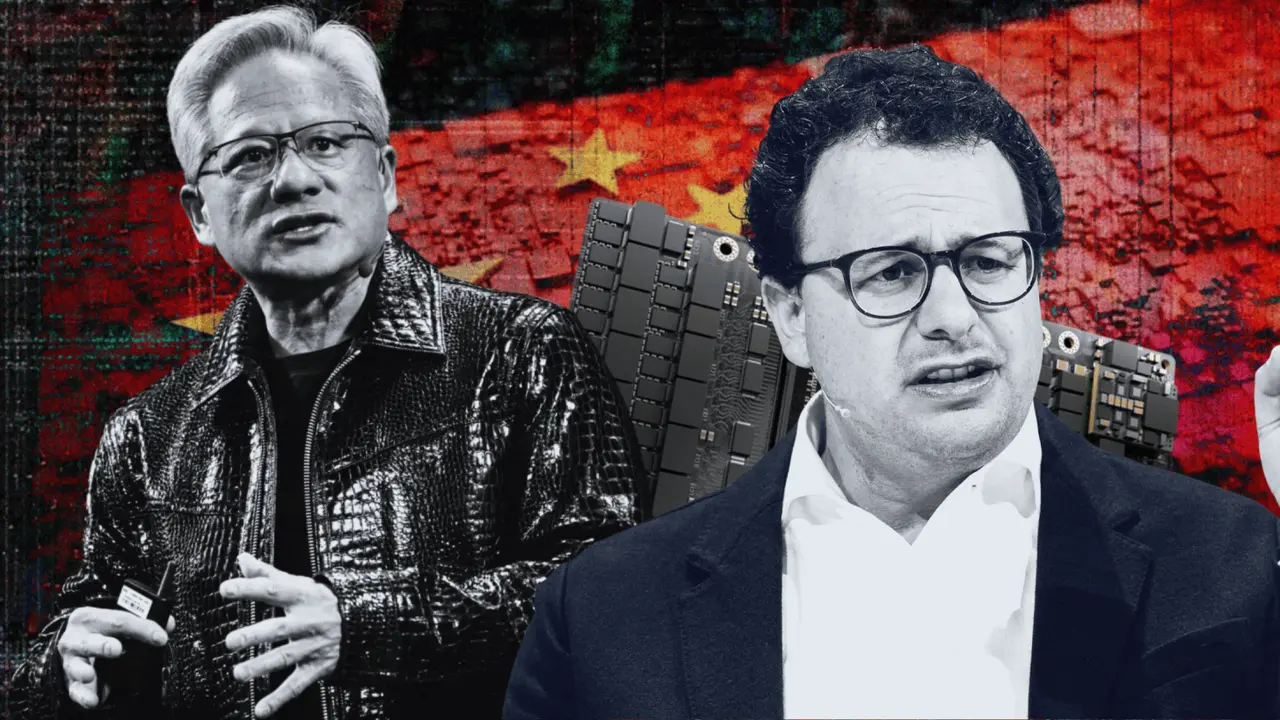
.
Source: Wccftech
National Security Implications Drive Bold Stance on AI Export Controls
Amodei's stark warning centered on what he described as "incredible national security implications" of advanced AI chips reaching Chinese competitors
3
. The Trump administration formalized a 25 percent duty on Nvidia's H200 and AMD's MI325X chips shipped to China last week, reversing an earlier export ban4
. While these aren't the chipmakers' most advanced processors, they remain high-performance GPUs used for AI training and deployment. Amodei painted an alarming picture of future AI systems representing "essentially cognition, that are essentially intelligence," likening them to "a country of geniuses in a data center" with "100 million people smarter than any Nobel Prize winner" under the control of one nation1
. His position aligns with Anthropic's longstanding advocacy for stricter AI regulation and export controls, contrasting sharply with chipmakers like AMD and Nvidia that have warned against technological decoupling from China2
.
Source: TechRadar
Nvidia Partnership Makes Criticism All the More Striking
The timing and target of Amodei's remarks amplify their significance. Nvidia isn't just another chip supplier—it's a major investor and technology partner that announced a "deep technology partnership" with Anthropic just two months ago
1
. Nvidia supplies the GPUs that power Anthropic's Claude AI models across Microsoft, Amazon, and Google cloud infrastructure. Despite this critical dependency, Amodei appeared comfortable speaking with confidence at Davos, suggesting Anthropic's strong market position—valued in the hundreds of billions with its Claude coding assistant developing a reputation as a top-tier tool among developers—gives him room to challenge even his closest partners1
.US-China Tech Competition Fuels Industry Tensions
The clash highlights deepening fault lines in the AI industry over geopolitics and hardware access
5
. "We are many years ahead of China in terms of our ability to make chips," Amodei told the audience, arguing that maintaining this lead requires vigilance2
. He downplayed Chinese AI capabilities, noting that while DeepSeek generated excitement, "those models are very optimized for the benchmark" but may not perform well on real-world tasks2
. Still, he acknowledged Chinese developers are finding some buyers, as open-weight models from China offer enterprises assurances about data privacy that American API-locked models cannot match2
.
Source: The Register
Related Stories

Rivalry Between Amodei and Jensen Huang Intensifies
This isn't the first public friction between Dario Amodei and Nvidia's Jensen Huang. The rivalry has been building since May 2024 when Anthropic supported the AI Diffusion policy, advocating for lower export thresholds and stricter regulations
4
. Nvidia responded dismissively to Anthropic's smuggling concerns, stating that "American firms should focus on innovation and rise to the challenge, rather than tell tall tales"4
. Huang has also criticized Amodei's warnings about AI's job displacement potential, suggesting Amodei believes "AI is so scary that only they should do it" and "so expensive, nobody else should do it"4
. More recently, Huang appeared to reference Amodei when complaining about companies asking for more AI regulation, saying "their intentions are clearly deeply conflicted"4
.What This Means for AI Safety and Global Competition
Amodei's willingness to publicly challenge a $10 billion investor signals how existential the AI race has become for industry leaders
1
. The usual constraints of investor relations and strategic partnerships appear secondary to what Anthropic views as genuine security threats. China is home to roughly half of the world's AI researchers, making export decisions consequential for both commercial competition and national security2
. While the U.S. Commerce Department maintains that sales are subject to rigorous controls and buyer vetting, enforcement remains challenging when front companies and joint ventures can obscure military ties5
. Reports suggest Chinese customs officials have already blocked some H200 shipments and warned domestic firms against purchasing them unless absolutely necessary4
. As Chinese AI labs become more adept at optimizing existing hardware, the distinction between safe and dangerous exports continues to blur, making Amodei's concerns about AI chips increasingly relevant to how quickly advanced AI capabilities spread globally.References
Summarized by

Navi
[2]
Related Stories
Nvidia and Anthropic Clash Over U.S. AI Chip Export Controls
01 May 2025•Policy and Regulation

Nvidia CEO Urges AI Export Rule Revision Amid Global Competition and China's AI Advancements
01 May 2025•Technology
Anthropic CEO Dario Amodei and NVIDIA's Jensen Huang Clash Over AI Development Approaches
01 Aug 2025•Policy and Regulation

Recent Highlights
1
OpenAI Releases GPT-5.4, New AI Model Built for Agents and Professional Work
Technology
2
Anthropic takes Pentagon to court over unprecedented supply chain risk designation
Policy and Regulation

3
Meta smart glasses face lawsuit and UK probe after workers watched intimate user footage
Policy and Regulation

Recent Highlights
Today's Top Stories






Your Daily Dose of Curated AI News
Don’t drown in AI news. We cut through the noise - filtering, ranking and summarizing the most important AI news, breakthroughs and research daily. Spend less time searching for the latest in AI and get straight to action.

