DuckDuckGo Launches Private AI Voice Chat on Duck.ai With Encrypted Audio Streaming


3 Sources
3 Sources
[1]
DuckDuckGo adds private real-time AI voice chat to Duck.ai - 9to5Mac
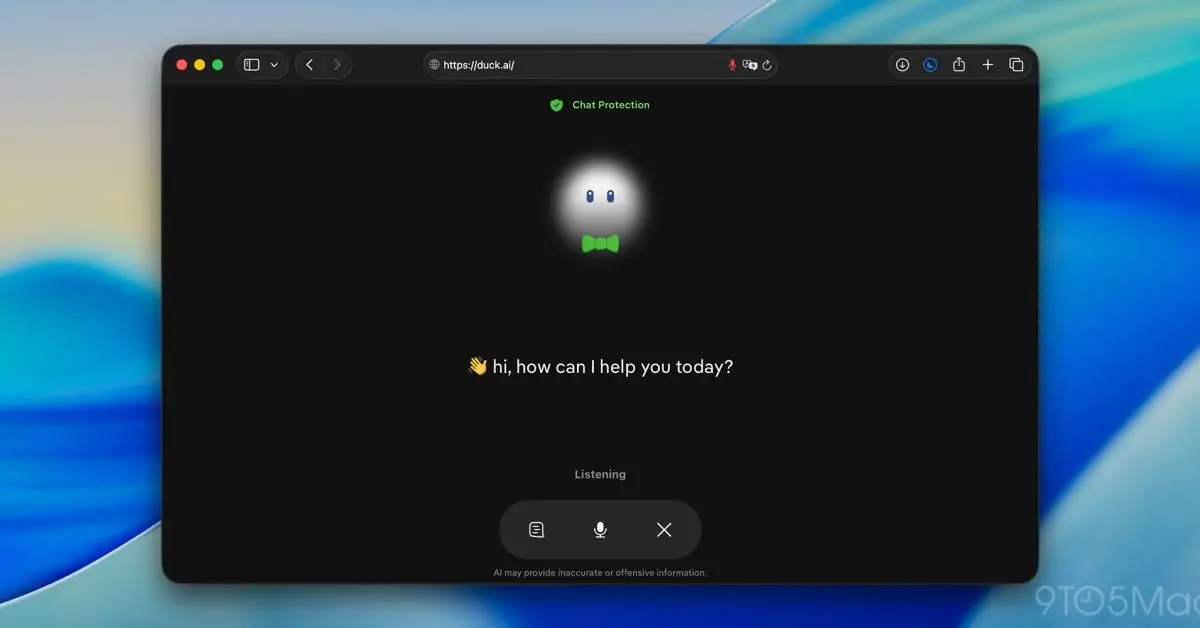
For those who choose to use AI as part of their search workflow, the feature is rolling out for free with daily limits, with higher caps for DuckDuckGo subscribers. Here are the details. Last March, DuckDuckGo announced Duck.ai, its chatbot platform that offers a private way to search or talk to 3rd-party LLMs from frontier AI labs such as OpenAI, Meta, Anthropic, and Mistral. As the year progressed, Duck.ai got new features, such as image generation, which we covered here. Today, the platform released yet another feature: voice mode. It follows the same privacy principles as the rest of the company's tools and features, meaning that chats are anonymized by DuckDuckGo and never used to train the underlying AI. DuckDuckGo explains that OpenAI is the model provider for all voice chats, but that the streamed audio "is not stored by DuckDuckGo or by OpenAI (...) after the chat ends." The company also says that "OpenAI is contractually limited in how they can use voice chat data to what is necessary to perform their services." Here's a bit more, directly from DuckDuckGo: When you start a voice chat, Duck.ai connects you to an OpenAI model through an encrypted relay connection that we cannot decrypt. Your microphone audio is streamed in real time to OpenAI, where the model listens, transcribes what you say, and generates both a spoken and text response. Duck.ai's voice chat is currently available on most browsers, except Firefox, for which support is "coming soon." The company also says that while every user is subject to daily limits, subscribers have a higher cap than in the free version. Given the recent pushback on AI-based features, DuckDuckGo wants to make sure users understand that this, alongside every other AI feature to come out of its labs, is entirely optional. And even for users who decide to use Duck.ai's voice mode and change their minds later, they can disable it from Duck.ai Settings. To learn more about Duck.ai's new real-time voice mode and go deeper into the company's data handling policies for the feature, follow this link.
[2]
DuckDuckGo Adds AI Voice Chat to Duck.ai With Privacy Protections
DuckDuckGo has announced new voice chat capabilities for Duck.ai, the private AI chatbot platform it launched last March. The new feature lets users have real-time voice conversations with large language models (LLMs) through an encrypted relay connection. OpenAI provides the LLMs that power voice chats, but DuckDuckGo says that neither it nor OpenAI stores any audio after conversations end. "Voice chats in Duck.ai are private, anonymized by us, and never used to train the underlying AI," the company said in its announcement. OpenAI is also contractually limited in how it can use voice chat data. Here's how DuckDuckGo describes the service: DuckDuckGo protects your audio stream and voice data in several ways, to ensure it can only be accessed by OpenAI, (the model provider for voice chats) and only for the purpose of responding to your prompts: The feature works in most browsers except for Firefox, for which support is still in the works, according to the company. Voice chat is free within daily limits and doesn't require an account, while subscribers ($10/month) get higher daily limits in addition to DuckDuckGo VPN access, Personal Information Removal, and Identity Theft Restoration. Users can disable voice chat at any time through Duck.ai's settings if they change their mind about using the feature. Duck.ai also offers access to non-voice models from OpenAI, Meta, Anthropic, and Mistral.
[3]
DuckDuckGo's AI lets you talk to it without giving up privacy
DuckDuckGo's Duck.ai voice chat is now live, promising no recording, no storage, and no training. DuckDuckGo's Duck.ai voice chat is now live, giving you a hands-free way to talk to its AI while it leans on a familiar promise, your audio won't be recorded or stored, and it won't be used for training. Voice is creeping into every AI app, and it usually comes with a quiet tradeoff, more data flowing somewhere you can't see. Duck.ai voice chat is aimed at people who want spoken answers without feeling like they're feeding another voice dataset. Recommended Videos The rollout is real, but a few practical bits still take digging. DuckDuckGo says voice chat works in its own browser and most other browsers, with Firefox support listed as coming soon. It also applies daily usage limits, but doesn't publish a number. The promise is the product Duck.ai voice chat runs at Duck.ai. Turn it on, grant mic permission, and you can start speaking and get spoken replies back. DuckDuckGo is also leaning on plumbing details to back up the privacy pitch. It says your mic audio is streamed using WebRTC through an encrypted relay, then processed to generate a response. The company says it doesn't store your voice. Limits and tradeoffs you should know The privacy claim is clear, but voice is still touchy. A single question can include names, places, or other personal details, and your voice itself can be identifying. There's also the usage cap. DuckDuckGo confirms voice chats have a daily limit, and subscribers get higher limits than free users. It says it won't spell out the exact method to prevent abuse. It also warns that VPNs or being on a cellular network can sometimes make you hit the limit sooner. A practical way to try it If you test Duck.ai voice chat, treat the first run like a quick checkup. Look at the permissions it requests, how easy it is to shut off, and whether it behaves the same on your phone and your laptop. For now, keep sensitive topics out of voice mode and use it for low-stakes tasks where convenience is the main win. If DuckDuckGo adds clearer disclosures on providers and handling, that's the moment to reassess whether it's ready for more personal conversations.
Share
Share
Copy Link
DuckDuckGo has rolled out AI voice chat capabilities for Duck.ai, its private AI chatbot platform. The feature enables real-time voice conversations with large language models while maintaining strict privacy protections. Audio streams are encrypted and not stored by DuckDuckGo or OpenAI, addressing growing concerns about data collection in AI applications.
DuckDuckGo Expands Duck.ai With Real-Time Voice Capabilities
DuckDuckGo has introduced AI voice chat to Duck.ai, its private AI chatbot platform launched in March 2025, marking a significant expansion of the company's privacy-focused AI offerings
1
. The new feature allows users to engage in real-time voice conversations with third-party large language models while maintaining the privacy principles that define DuckDuckGo's approach to AI integration2
. Unlike many AI voice features that quietly collect user data, Duck.ai's implementation prioritizes user privacy through encrypted relay connections and strict data handling policies3
.
Source: MacRumors
How Private Real-Time AI Voice Chat Works
When users initiate a voice chat on Duck.ai, the platform connects them to OpenAI models through an encrypted relay connection that DuckDuckGo cannot decrypt
1
. Microphone audio is streamed in real time to OpenAI, where large language models (LLMs) listen, transcribe the spoken input, and generate both spoken and text responses. DuckDuckGo emphasizes that voice chats are anonymized and the streamed audio data is not stored by either DuckDuckGo or OpenAI after the chat ends2
. The company has also secured contractual limitations on how OpenAI can use voice chat data, restricting usage to what is necessary to perform their services1
.
Source: 9to5Mac
Privacy Protections Address Growing AI Data Concerns
The rollout comes amid increasing pushback against AI-based features that collect user information without clear disclosure. DuckDuckGo's approach to talk without giving up privacy directly addresses concerns about voice data being recorded, stored, or used for AI model training
3
. The encrypted audio streaming process uses WebRTC technology to ensure audio can only be accessed by OpenAI and only for the purpose of responding to user prompts2
. However, experts note that voice itself can be identifying, and users should remain cautious about sharing sensitive information even with privacy protections in place3
.Related Stories



Availability and Usage Limits
The voice chat feature is currently available on most browsers, with Firefox support coming soon
1
. DuckDuckGo offers the feature free within daily usage limits and does not require an account to access2
. Subscribers paying $10 per month receive higher daily limits along with additional benefits including DuckDuckGo VPN access, Personal Information Removal, and Identity Theft Restoration2
. The company deliberately avoids publishing exact limit numbers to prevent abuse, though it warns that VPNs or cellular networks can sometimes cause users to hit limits sooner3
.Optional Integration With Third-Party Models
DuckDuckGo stresses that voice chat, like all AI features from the company, is entirely optional and can be disabled at any time through Duck.ai Settings
1
. Beyond voice capabilities, Duck.ai provides access to multiple third-party models from OpenAI, Meta, Anthropic, and Mistral, allowing users to choose which large language models they prefer for different tasks2
. The platform previously added image generation capabilities and continues to expand while maintaining its core commitment to anonymization and user privacy1
. As voice interfaces become standard across AI applications, DuckDuckGo's implementation offers a template for balancing convenience with privacy principles, though users should evaluate whether the privacy protections meet their specific needs for sensitive conversations3
.References
Summarized by

Navi
[3]
Related Stories
Recent Highlights
1
Tennessee Teens Sue Elon Musk's xAI Over Grok AI-Generated Child Abuse Images
Policy and Regulation

2
Supermicro Co-Founder Indicted in $2.5 Billion Nvidia AI Chip Smuggling Scheme to China
Policy and Regulation

3
Val Kilmer to appear posthumously in As Deep as the Grave through AI-generated performance
Entertainment and Society

Recent Highlights
Today's Top Stories



Your Daily Dose of Curated AI News
Don’t drown in AI news. We cut through the noise - filtering, ranking and summarizing the most important AI news, breakthroughs and research daily. Spend less time searching for the latest in AI and get straight to action.

