Eridu emerges from stealth with $200M Series A to solve AI networking bottlenecks


3 Sources
3 Sources
[1]
AI network startup Eridu emerges from stealth with hefty $200M Series A | TechCrunch
Drew Perkins has been inventing computer network tech and building startups since the dawn of the internet age. Now he's back as a co-founder and CEO of AI networking startup Eridu that's officially coming out of stealth on Tuesday with an oversubscribed $200 million Series A round. The round was led by Socratic Partners, renowned VC John Doerr, Matter Venture Partners, and others. Eridu has now raised a total of $230 million, the company said. Perkins began his career in the 1980s, and helped create the Point-to-Point Protocol (PPP) that became a key part of TCP/IP, the protocol upon which the internet relies. In 1999, the optical switch company he co-founded, Lightera Networks, was sold to Ciena for over $500 million. Next was Infinera, which IPO'd and was later sold to Nokia for $2.3 billion in 2025. He also co-founded Gainspeed (also sold to Nokia) and, most recently, the AR startup Mojo Vision. But after OpenAI released ChatGPT, Perkins had an epiphany. In February 2023, Perkins and OpenAI CEO Sam Altman were speaking at a small conference. They got to chatting, and "Sam told me that what enabled AI and ChatGPT was just enormous amounts of compute. At which time, I think he meant 4,000 GPUs, but now we're talking about millions of GPUs," Perkins told TechCrunch. He realized from that conversation that the bottleneck to progress won't just be access to more chips; it will be the methods the chips use to communicate with one another across their systems. "What we needed to do in the networking sector, in the networking industry, was come up with a brand-new way of thinking about how you build networks and build network equipment, network chips, and the entire thing." By late 2023, Perkins had met his co-founder, Omar Hassen, whose roots are in networking chip design for the big industry players like Broadcom and Marvell. In 2024, they founded Eridu. They began to rethink computer networking from scratch starting with the silicon, meaning new chips designed for AI that integrate more networking functionality. Eridu will eventually sell complete systems that take the spot in an AI data center that a classic network gear provider, like Arista Networks, takes in a classic data center. These systems will replace many tiered optical connections with on-chip communications. Today, when more networking is needed, more boxes are added, which increases the number of hops each data bit may have to travel and increases latency - which contributes to that delay between typing in a prompt and getting a reply. Eridu is working on a switch that puts more functions on the chip itself. "So now I'm saving a ton of power, I'm saving a ton of cost, and then my network is much more reliable because the optics are the least reliable part of the network," Perkins said. "GPU compute and memory bandwidth are improving by roughly 10x per year, while data center switches from Broadcom, Marvell, Cisco, etc. are still only improving 2-3x every 2-3 years," Perkins added. The founders made a few calls to VCs who Perkins has known over the years and landed Wen Hsieh as a key investor. Hsieh is the founding managing partner of Matter Venture Partners and previously helped lead Kleiner Perkins' China investing group. Hsieh told Doerr about Eridu, after which the legendary former Kleiner Perkins investor (who had backed one of Perkins' previous startups) also wanted in. That set off a VC frenzy. "My phone has been ringing off the hook," Perkins said. "It's been a fun time raising money for this venture ... we're very oversubscribed." Perkins would not comment on valuation except to say that it is comparable to others raising this much in a Series A round and that he feels it's not too low, nor too high. He wants his 100 or so current employees to do well on their stock options. He also declined to comment on whether the startup had achieved unicorn status (valued at over $1 billion). Needless to say, if Eridu can deliver on its promise to create a new kind of AI-friendly networking chip and system, it will be in the middle of the largest data center build-out in history. And, unlike a vibe-coded product built by a 20-something college dropout, Eridu's founders have something increasingly rare in Silicon Valley these days: deep experience. All of that bodes well for the company's future. Other leads in the round include Hudson River Trading and Capricorn Investment Group, with participation by SBVA, MediaTek, Bosch Ventures, TDK Ventures, Eclipse and VentureTech Alliance (an investing vehicle of chip fab giant TSMC), among others.
[2]
With $200M in funding, Eridu wants to break through the network wall holding back AI - SiliconANGLE
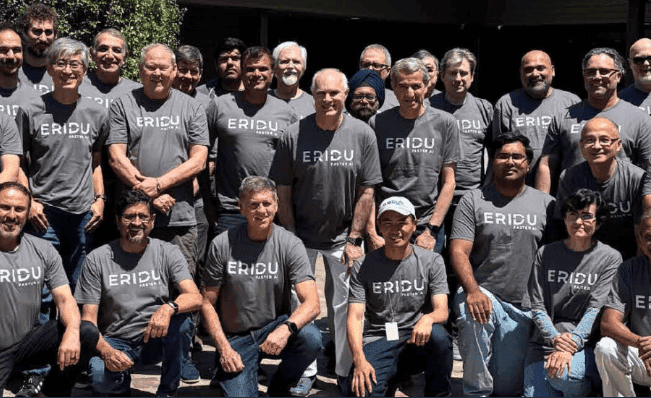
With $200M in funding, Eridu wants to break through the network wall holding back AI Eridu Corp. wants to break through the artificial intelligence networking "wall" after raising $200 million in early-stage funding today. The money from the Series A round will help it to commercialize an all-new network switch that promises to scale AI workloads to unprecedented heights. Today's round was led by Socratic Partners, venture capitalist John Doerr, Hudson River Trading, Capricorn Investment Group and Matter Venture Partners. It also saw participation from some major players in the chipmaking industry, including MediaTek Inc. and Taiwan Semiconductor Manufacturing Co., which invested through its VentureTech Alliance investment vehicle. Chief Executive Drew Perkins (pictured center, alongside his team) told SiliconANGLE that billions of dollars of investment in data centers are going to waste because of a huge bottleneck in AI networks, which simply cannot cope with the massive volumes of data that need to be moved around. The situation is getting worse, he said, because new chip architectures and algorithmic innovations are increasing the demands for data, but existing networks simply cannot keep up. According to Perkins, existing networking companies have laid out roadmaps that only promise incremental enhancements in performance, because they're focused on improving existing architectures. But these are being pushed to their limits. "Networking technology has fallen so far behind that a completely new design is required," he said. "The plodding pace of subscale improvement promised by other existing and new solutions is simply inadequate to solve the problem." Perkins said that the bandwidth, latency, power consumption and radix (the number of input/output ports) of existing network switches are tightly coupled to the silicon architecture they're based on, which was designed for cloud data centers that are much smaller than today's emerging AI factories. "This silicon architecture has fundamentally been the same for the last two decades and is only incrementally improved with a doubling of capacity every two to 2.5 years," he said. "We believe that these incremental improvements leave a lot of performance on the table." Eridu's solution, Perkins explained, is a completely redesigned network switch architecture that promises to deliver an "order-of-magnitude" advance in performance and efficiency and enable previously impossible capabilities. He didn't reveal too much about the new switch because it has not yet launched, but said it's based on a "clean-sheet silicon architecture" that's designed to take full advantage of the most advanced silicon and packaging technologies. That allows a single high-radix Eridu switch to replace up to 30 lower-level radix switches, resulting in a much flatter network with lower latency and significantly lower power dissipation, with improved tokens-per-watt and tokens-per-dollar metrics. The switch reduces both latency and network "jitter" to enable data center operators to dramatically increase the scale of their graphics processing unit clusters, he said. He believes customers will ultimately be able to scale out their domains to millions of GPUs, while enjoying savings of up to 40% on their capital expenditures and benefit from faster deployment. The funding from today's round will help to accelerate the development of the switch and support the company's recruiting efforts as it looks to take the next step and bring it to market. Dylan Patel, an analyst with SemiAnalytics, said Eridu's switch is a promising development because there's an urgent need for redesigned network switches because the demands for bandwidth and scale are accelerating beyond what existing architectures can feasibly support. He was effusive in his praise for the startup's technology. "Eridu's networking technology is purpose-built for massive AI scale, supporting both scale-out and scale-up," he said. "It will enable more bandwidth, larger AI clusters and lower costs and deliver the next level of interconnect scale required to meet the insatiable demands of accelerated compute." Eridu doesn't have any official customers yet, but Perkins said the development of its silicon, systems and software has come far along, and the company is working closely with a number of "leading hyperscalers." He added that they have "completely validated" the company's product definition and have been deeply involved in helping to shape its design to fit the requirements of their data centers. "We cannot name them due to NDAs, but they are deeply engaged," he promised.
[3]
AI Networking Startup Eridu Steps Out Of Stealth With More Than $200M In Funding
Joining the AI networking fray is Eridu, a new upstart armed with an oversubscribed Series A funding round that's ready to take on network infrastructure constraints impeding AI adoption, the company said. A new AI networking company has surfaced from stealth mode with more than $200 million in funding in an effort it says to disrupt the $200 billion AI networking market. Eridu, based in Saratoga, California, and led by entrepreneur Drew Perkins, believes that networking is not keeping up with the demands coming from AI compute and scale that's rapidly increasing. The startup's mission is to meet current and future AI demands by "breaking infrastructure barriers holding it back," in the data center, the company revealed on Tuesday. Eridu's oversubscribed Series A round was led by Socratic Partners, John Doerr, Hudson River Trading, Capricorn Investment Group and Matter Venture Partners, with participation by SBVA, MediaTek, Bosch Ventures, TDK Ventures, Eclipse Ventures, and VentureTech Alliance, among others, the company said. [Related: The 10 Hottest Networking Startups Of 2025] Eridu has built what it calls a "clean-sheet" networking design, which includes a network switch that provides an "order-of-magnitude advance in performance, radix and efficiency needed to meet current and future AI demands," the company said. The design removes limits associated with current networking architectures, and as such, Eridu is promising fewer network tiers to reduce latency and network jitter, single-hop scale-up domains with thousands of GPUs, scale-out domains of millions of GPUs, up to 40 percent savings in CapEx for enterprises and upwards of 70 percent in networking power savings, as well as faster deployment of AI data centers, the company said. Eridu said that its Series A funding will be used to complete development of its offering. A spokesperson for the company told CRN that while its initial customers will be hyperscalers and business will direct as a result, once it expands to neocloud, service provider and large enterprise customers, the company plans to work through the channel. Eridu's CEO Perkins, a longtime entrepreneur in the tech space, most recently served as CEO of Mojo Vision, a company he founded that created what he called the first smart contact lens after his own bout with cataracts. Prior to that, he founded and led a handful of telecom companies, including Gainspeed, which was acquired by Nokia, and Infinera, which also later became part of Nokia. Prior to that, he founded and acted as CTO for Lightera Networks, which was later acquired by Ciena. "Billions of dollars of investment in AI data centers are being wasted because of the network wall," Perkins (pictured above) said in a statement on his company's funding announcement. "The plodding pace of improvement promised by the existing industry vendors is simply inadequate to solve the problem. Even new companies and solutions promising higher performance are in fact still subscale. Eridu has taken on and solved the key challenges across silicon, packaging, systems and optics needed to break through that wall."
Share
Share
Copy Link
Veteran entrepreneur Drew Perkins is back with Eridu, an AI networking startup that just raised an oversubscribed $200 million Series A round. The company promises to break through the network wall holding back AI with a redesigned switch architecture that could scale GPU clusters to millions of units while cutting costs by up to 40 percent.
Veteran entrepreneur tackles AI networking with $200 million war chest
Eridu, an AI networking startup led by serial entrepreneur Drew Perkins, has emerged from stealth mode with an oversubscribed $200 million Series A funding round
1
. The round was led by Socratic Partners, renowned venture capitalist John Doerr, Hudson River Trading, Capricorn Investment Group, and Matter Venture Partners, bringing the Saratoga, California-based company's total funding to $230 million1
. The investor lineup also includes chip industry heavyweights MediaTek and Taiwan Semiconductor Manufacturing Co. through its VentureTech Alliance investment vehicle, signaling strong industry confidence in Eridu's approach2
.
Source: CRN
Perkins brings decades of networking expertise to the venture. He helped create the Point-to-Point Protocol that became integral to TCP/IP in the 1980s, co-founded optical switch company Lightera Networks (sold to Ciena for over $500 million in 1999), and led Infinera through its IPO before Nokia acquired it for $2.3 billion in 2025
1
. His epiphany came in February 2023 during a conversation with OpenAI CEO Sam Altman, who explained that ChatGPT's success required enormous amounts of compute—initially around 4,000 GPUs, now scaling to millions1
.Breaking through the network wall in AI data centers
Perkins argues that billions of dollars invested in AI data centers are going to waste because of what he calls the "network wall"
2
. The core problem is that GPU compute and memory bandwidth are improving by roughly 10x per year, while data center switches from Broadcom, Marvell, and Cisco are only improving 2-3x every 2-3 years1
. This growing gap creates networking bottlenecks that prevent AI workloads from scaling effectively, no matter how many GPUs are deployed.Existing network architectures were designed for traditional cloud data centers, not the massive AI factories being built today. When more networking capacity is needed, operators add more boxes, increasing the number of hops each data bit must travel and driving up latency—the delay between typing a prompt and receiving a response
1
. Perkins told SiliconANGLE that existing networking companies only promise incremental enhancements because they're focused on improving legacy architectures that are being pushed to their limits2
.Clean-sheet silicon architecture promises order-of-magnitude improvements
Eridu's solution centers on a completely redesigned AI network switch built from a clean-sheet silicon architecture that takes full advantage of the most advanced silicon and packaging technologies
2
. By late 2023, Perkins had partnered with co-founder Omar Hassen, whose background includes networking chip design for industry giants like Broadcom and Marvell, and together they founded Eridu in 20241
.The company's approach integrates more networking functionality directly onto the chip itself, reducing reliance on optical connections that Perkins identifies as the least reliable part of networks
1
. A single high-radix Eridu switch can replace up to 30 lower-level radix switches, creating a much flatter network architecture2
. Radix refers to the number of input/output ports on a switch, and increasing this metric is critical for improving GPU communication at scale.Related Stories

Promising metrics for hyperscalers and enterprise customers
Eridu promises fewer network tiers to reduce both latency and network jitter, enabling data center operators to dramatically increase the scale of their GPU clusters
2
. The company claims its design will support single-hop scale-up domains with thousands of GPUs and scale-out domains of millions of GPUs, while delivering up to 40 percent savings in CapEx and upwards of 70 percent reduction in networking power consumption3
. Improved tokens-per-watt and tokens-per-dollar metrics would directly impact the economics of running large language models and other AI workloads2
.Dylan Patel, an analyst with SemiAnalytics, endorsed Eridu's approach, stating that the networking technology is "purpose-built for massive AI scale, supporting both scale-out and scale-up" and will "enable more bandwidth, larger AI clusters and lower costs"
2
. While Eridu doesn't have publicly announced customers yet, Perkins said the company is working closely with leading hyperscalers who have validated the product definition and been deeply involved in shaping its design, though NDAs prevent naming them2
.Market positioning and go-to-market strategy
Eridu will eventually sell complete systems that occupy the same position in AI data centers that classic network gear providers like Arista Networks hold in traditional data centers
1
. The company currently employs around 100 people and plans to use the Series A funding to complete development of its offering and accelerate recruiting efforts1
2
.
Source: SiliconANGLE
Initial customers will be hyperscalers through direct business relationships, but the company plans to work through channel partners once it expands to neocloud, service provider, and large enterprise customers
3
. This positions Eridu to address what it describes as a $200 billion AI networking market3
.Perkins declined to comment on valuation but indicated it's comparable to others raising similar amounts in Series A rounds, and he wants his employees to benefit from their stock options
1
. The fundraising process itself became competitive, with Perkins noting his phone was "ringing off the hook" after Wen Hsieh, founding managing partner of Matter Venture Partners, introduced the opportunity to Doerr, who had backed one of Perkins' previous startups1
. If Eridu delivers on its promise, it will position itself at the center of the largest data center build-out in history, armed with the deep technical experience increasingly rare in Silicon Valley's current startup landscape.References
Summarized by

Navi
[2]
Related Stories
Upscale AI Hits $1 Billion Valuation With $200M Funding to Challenge Nvidia and Broadcom
22 Jan 2026•Startups

Nexthop AI Raises $500M at $4.2B Valuation to Build Next-Gen AI Data Center Networks
11 Mar 2026•Technology

Nexthop AI Secures $110M to Revolutionize AI Infrastructure for Hyperscalers
26 Mar 2025•Technology

Recent Highlights
1
AI chatbots validate you too much, making you less kind to others, Stanford study reveals
Science and Research

2
Anthropic's Claude Code Source Leak Reveals Hidden AI Agent Plans and Extensive System Access
Technology

3
Judge blocks Pentagon from branding Anthropic a security risk over AI safety guardrails dispute
Policy and Regulation

Recent Highlights
Today's Top Stories











Your Daily Dose of Curated AI News
Don’t drown in AI news. We cut through the noise - filtering, ranking and summarizing the most important AI news, breakthroughs and research daily. Spend less time searching for the latest in AI and get straight to action.

