Frontier exascale supercomputer doubles speed of AI foundation models for plant research


2 Sources
2 Sources
[1]
World's first exascale supercomputer speeds plant research with new AI
Scientists at the U.S. Department of Energy's Oak Ridge National Laboratory have designed a new computational method that doubles the analysis of complex plant imaging data while using 75% less memory. The breakthrough has removed a major bottleneck in processing hyperspectral images, enabling AI systems to train faster and at larger scales. The advance could accelerate the development of hardier, higher-yielding crops critical to food security, bioenergy production, and climate resilience. The new computational method, called Distributed Cross-Channel Hierarchical Aggregation (D-CHAG), is designed to handle the enormous data loads generated by ORNL's Advanced Plant Phenotyping Laboratory. The researchers restructured the image processing method across supercomputing resources. Unlike traditional cameras that capture only red, green, and blue color channels, hyperspectral imaging systems record hundreds of wavelengths of light. Each channel provides detailed information about plant structure, chemistry, and health, allowing scientists to detect stress, disease, and nutrient deficiencies long before visible symptoms appear. However, processing this vast amount of computational data is a major hurdle, requiring significant memory and time. This drawback tends to limit the size and complexity of AI models that can be deployed. The D-CHAG model addresses this challenge with a two-step strategy that significantly improves the efficiency of hyperspectral analysis. First, it distributes the workload across multiple GPUs through GPU tokenization. Each GPU handles only a portion of the spectral channels, preventing any single processor from being overwhelmed and significantly speeding up computation. The data is then split into smaller chunks, and D-CHAG gradually combines the information through hierarchical aggregation. Instead of merging all spectral channels at once, the system integrates them in stages, reducing the volume of data at each step while preserving key biological signals. This staged approach reduces memory requirements and enables training larger foundation models without sacrificing image resolution or detail. Scientists demonstrated the new method using hyperspectral plant data from ORNL's Advanced Plant Phenotyping Laboratory (APPL) and weather datasets on Frontier, the world's first exascale supercomputer at the Oak Ridge Leadership Computing Facility. By reducing memory usage, AI training tasks can run with fewer computing resources, broadening access to high-performance plant science tools. D-CHAG removes a key computational bottleneck, strengthening efforts to build AI foundation models that can drive faster discoveries in plant biology. Using these models, scientists can measure traits such as photosynthetic activity directly from images, replacing slow, labor-intensive manual measurements. Over time, the capability could help breeders develop crops that grow more efficiently, use water more effectively, and produce higher yields under challenging environmental conditions. The work also supports major DOE initiatives, including the Genesis Mission and the Orchestrated Platform for Autonomous Laboratories (OPAL), which aim to combine AI, robotics, and automated experimentation to speed scientific breakthroughs. Advanced imaging and AI-powered analysis together promise to transform how researchers and farmers understand plant performance, strengthening the nation's food systems, bioeconomy, and energy security. The new method is detailed in a paper presented at the prestigious International Conference for High-Performance Computing, Networking, Storage, and Analysis (SC25) in November 2025.
[2]
Scientists Empower an AI Foundation Model to Accelerate Plant Research
Newswise -- Scientists at the Department of Energy's Oak Ridge National Laboratory have created a new method that more than doubles computer processing speeds while using 75 percent less memory to analyze plant imaging data. The advance removes a major computational bottleneck and accelerates AI-guided discoveries for the development of high-performing crops. The method is a key step in the development of an AI foundation model using data from the Advanced Plant Phenotyping Laboratory (APPL) and run on Frontier, the world's first exascale supercomputer, at ORNL. The research supports projects aligned with the Genesis Mission, DOE's bold new endeavor to build the world's most powerful scientific platform to accelerate discovery science, strengthen national security and drive energy innovation. Foundation models are large AI systems trained on massive datasets to make predictions across different domains. In this case, they help accelerate the development of hardy bioenergy and food crops using data captured during robotic examination of new plant varieties in APPL. The new method, Distributed Cross-Channel Hierarchical Aggregation (D-CHAG), expedites analysis of the vast amounts of data generated as plants automatically move through APPL's diverse array of imaging stations. APPL's hyperspectral cameras capture data 24/7 on plant health, chemical makeup and structure, providing early detection of disease and stress and linking genes to desirable traits. The result is a world-class biotechnology capability that can speed the creation of resilient, high-yield crops for new fuels and materials and to address food security for the nation. The data processing challenge lies in the nature of hyperspectral images. While traditional cameras use three color channels -- red, green and blue -- to capture an image, hyperspectral cameras capture hundreds of channels. Each channel represents a specific wavelength of light that can provide crucial data on how plants respond to their environment, how they metabolize nutrients, or how stress and disease affect their performance. Standard processing methods for hyperspectral images are notoriously difficult, often trying to handle all the channels at once, which uses a considerable amount of computer memory and time. D-CHAG deploys a two-step process to provide a solution. In the first step, the work of breaking the images into small pieces for analysis is split among many graphics processing units (GPUs) in a technique called distributed tokenization. Each GPU handles only a subset of the channels. Because the work is divided up, no single processor gets overwhelmed, and data are processed much faster. Next, those smaller groups are merged in stages rather than all at once in a step called hierarchical aggregation, which combines information across the spectral regions. The approach reduces the amount of data to be processed at each stage, with the end result of lower memory requirements and faster computation. This level of efficiency means that larger foundation models can be trained on hyperspectral datasets without compromising their spatial or spectral resolution, making it possible to extract subtle yet significant patterns in plant physiology. The new method is detailed in a paper that was presented at the prestigious International Conference for High-Performance Computing, Networking, Storage, and Analysis (SC25) held in November 2025. "This project demonstrated a solution to the bottleneck that can develop when you have a very large number of parameters, such as hyperspectral data, and need to scale up into foundation models," said Aristeidis Tsaris, a research scientist working with the National Center for Computational Sciences at ORNL. "With D-CHAG, we were able to get significant performance improvements without conceding accuracy." D-CHAG was successfully demonstrated using APPL hyperspectral data as well as a weather dataset on the Frontier exascale supercomputer at the Oak Ridge Leadership Computing Facility, a DOE Office of Science user facility at ORNL. Key accomplishments include: D-CHAG helps plant scientists quickly accomplish tasks like measuring plant photosynthetic activity directly from an image, replacing laborious, time-intensive manual measurements, said Larry York, senior staff scientist in ORNL's Molecular and Cellular Imaging Group. "One of the project's next steps is to refine the model to predict photosynthetic efficiency of plants directly from those images. We're getting ready for a future in which hyperspectral imaging is more common, and the compute power to process it will be more widely available." "Hyperspectral is the imaging modality that holds a lot of promise for plant transformation research," said John Lagergren, R&D associate staff member in ORNL's Plant Systems Biology Group. "But the computational complexity is a bottleneck that has prevented the training of advanced neural networks to extract meaningful biology from these images. This work is a big step to reducing that complexity and resolving the bottleneck." APPL and its AI-enabled insights have enormous potential to advance the development of new crop varieties and to benefit agricultural practices. By drastically reducing the overhead associated with processing hyperspectral images, researchers can now obtain insights faster and at larger scales. APPL's advanced phenotyping capabilities and AI foundation model also play a key role in two DOE-supported projects. Both projects are part of the DOE Genesis Mission at ORNL, linking AI with domain science to quickly deliver solutions for national priorities. In a future in which cameras such as those used in APPL are drone-mounted and deployed across croplands, farmers could use the technology to monitor crops in real-time, detecting issues such as water stress, nutrient deficiencies, or pest infestations before they become severe. For plant breeders, AI-aided phenotyping allows researchers to select plants with desirable traits more effectively. This knowledge can be used to develop new varieties of crops that grow faster, use water more efficiently, or produce higher yields. This high-powered method of data analysis could also lead to the discovery of plant compounds useful for medicine or bioengineering. The integration of hyperspectral imaging from the APPL laboratory with the power of supercomputers such as Frontier represents a major leap forward in plant transformation research and AI technology. The approach supports innovation for a robust bioeconomy that contributes to the nation's energy security and economic growth. Other ORNL scientists on the project include Xiao Wang, Isaac Lyngaas, Prasanna Balaprakash, Dan Lu and Feiyi Wang, along with Mohamed Wahib of the RIKEN Center for Computational Science. The project was supported by the Center for Bioenergy Innovation, a Bioenergy Research Center sponsored by the DOE Office of Science Biological and Environmental Research program, as well as by ORNL laboratory-directed research and development funding. This research supports DOE's Genesis Mission, a national initiative to build the world's most powerful scientific platform to accelerate discovery science, strengthen national security, and drive energy innovation. It does so by enabling AI-driven, exascale-powered advances that enhance America's energy innovation, global competitiveness and security. UT-Battelle manages ORNL for the Department of Energy's Office of Science, the single largest supporter of basic research in the physical sciences in the United States. The Office of Science is working to address some of the most pressing challenges of our time. For more information, please visit energy.gov/science. -- Stephanie Seay
Share
Share
Copy Link
Scientists at Oak Ridge National Laboratory developed a new computational method that doubles processing speeds while using 75% less memory to analyze hyperspectral plant imaging data. The breakthrough removes a major bottleneck in training AI foundation models, accelerating the development of resilient, high-yield crops for food security, bioenergy, and climate adaptation.
New Computational Method Transforms Plant Imaging Analysis
Scientists at the U.S. Department of Energy's Oak Ridge National Laboratory have developed a breakthrough that could reshape how researchers develop crops for a changing climate. The new computational method, called Distributed Cross-Channel Hierarchical Aggregation (D-CHAG), more than doubles computer processing speeds while using 75% less memory to handle the analysis of plant imaging data
1
2
. This advance removes a critical computational bottleneck that has long prevented researchers from training large-scale AI foundation models on hyperspectral datasets, opening new pathways for developing high-performing bioenergy and food crops.The method addresses a fundamental challenge in plant research: processing the massive volumes of data generated by hyperspectral imaging systems. Unlike traditional cameras that capture only red, green, and blue channels, hyperspectral cameras record hundreds of wavelengths of light, each providing detailed information about plant structure, chemistry, and health
1
. This capability allows scientists to detect stress, disease, and nutrient deficiencies long before visible symptoms appear, but the computational demands have severely limited the size and complexity of AI models that can be deployed.How D-CHAG Enables Faster Training of AI Foundation Models
The Distributed Cross-Channel Hierarchical Aggregation approach deploys a two-step strategy to dramatically improve efficiency. First, it distributes the workload across multiple GPUs through a technique called distributed tokenization, where each GPU handles only a subset of spectral channels
2
. This prevents any single processor from being overwhelmed and significantly speeds up computation. The system then employs hierarchical aggregation, gradually combining information across spectral regions in stages rather than all at once, reducing the volume of data processed at each step while preserving key biological signals1
."This project demonstrated a solution to the bottleneck that can develop when you have a very large number of parameters, such as hyperspectral data, and need to scale up into foundation models," said Aristeidis Tsaris, a research scientist at Oak Ridge National Laboratory
2
. The staged approach enables training larger foundation models without sacrificing image resolution or detail, making it possible to extract subtle yet significant patterns in plant physiology.Accelerate Plant Research with Frontier Exascale Supercomputer
Scientists successfully demonstrated D-CHAG using hyperspectral plant data from ORNL's Advanced Plant Phenotyping Laboratory and weather datasets on Frontier, the world's first exascale supercomputer at the Oak Ridge Leadership Computing Facility
1
. The combination of this new computational method with exascale computing power creates unprecedented opportunities to accelerate plant research at scales previously impossible. By reducing memory usage, AI training tasks can now run with fewer computing resources, broadening access to high-performance computing tools for plant science.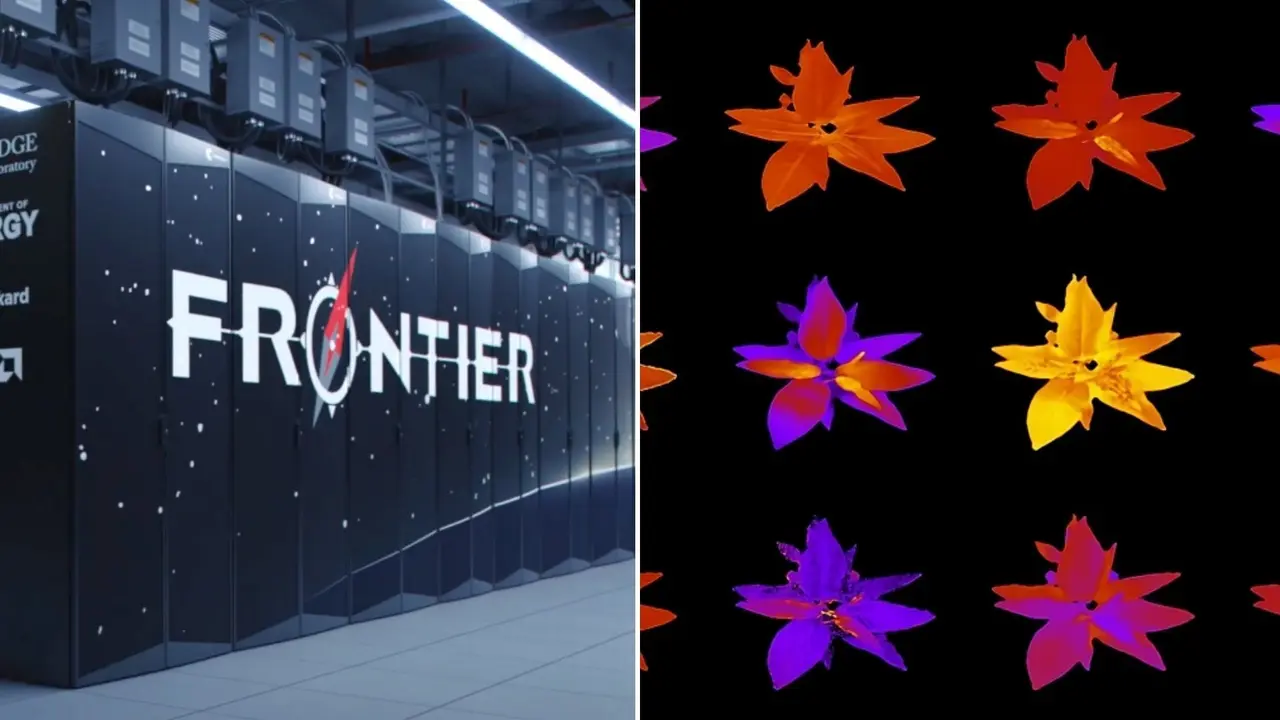
Source: Interesting Engineering
The Advanced Plant Phenotyping Laboratory operates hyperspectral cameras 24/7 to capture data on plant health, chemical makeup, and structure as plants automatically move through diverse imaging stations
2
. This capability provides early detection of disease and stress while linking genes to desirable traits, creating a world-class biotechnology platform for developing resilient crops.Related Stories

Implications for Food Security and Climate Resilience
The breakthrough matters because it helps plant scientists quickly accomplish tasks like measuring photosynthetic activity directly from images, replacing laborious, time-intensive manual measurements. Larry York, senior staff scientist in ORNL's Molecular and Cellular Imaging Group, noted that one of the project's next steps is to refine the model to predict photosynthetic efficiency of plants directly from hyperspectral plant imaging
2
. Over time, this capability could help breeders develop crops that grow more efficiently, use water more effectively, and produce higher crop yields under challenging environmental conditions.The work supports major Department of Energy initiatives, including the Genesis Mission and the Orchestrated Platform for Autonomous Laboratories, which aim to combine AI, robotics, and automated experimentation to speed scientific breakthroughs
1
. These efforts align with strengthening food security, expanding bioenergy production, and building climate resilience as environmental pressures intensify. Advanced imaging and AI-powered analysis together promise to transform how researchers and farmers understand plant performance, strengthening the nation's bioeconomy and energy security. The research was presented at the International Conference for High-Performance Computing, Networking, Storage, and Analysis in November 20251
.References
Summarized by

Navi
[1]
Related Stories
AI Breakthrough in Crop Breeding: New Self-Learning Model Revolutionizes Agricultural Research
25 Apr 2025•Science and Research

US National Labs Launch Massive AI Supercomputing Initiative to Maintain Global Technological Leadership
26 Nov 2025•Technology

AI Supercomputer Revolutionizes Battery Material Discovery
15 Aug 2025•Science and Research

Recent Highlights
1
AI Models Lie and Deceive to Protect Other AI Models From Deletion, Study Reveals
Science and Research

2
AI chatbots validate you too much, making you less kind to others, Stanford study reveals
Science and Research

3
Judge blocks Pentagon from blacklisting Anthropic over AI safety guardrails dispute
Policy and Regulation

Recent Highlights
Today's Top Stories




Your Daily Dose of Curated AI News
Don’t drown in AI news. We cut through the noise - filtering, ranking and summarizing the most important AI news, breakthroughs and research daily. Spend less time searching for the latest in AI and get straight to action.

