AI Breakthrough in Crop Breeding: New Self-Learning Model Revolutionizes Agricultural Research


2 Sources
[1]
New approach makes AI adaptable for computer vision in crop breeding
Scientists developed a machine-learning tool that can teach itself, with minimal external guidance, to differentiate between aerial images of flowering and nonflowering grasses -- an advance that will greatly increase the pace of agricultural field research, they say. The work was conducted using
[2]
New approach makes AI adaptable for computer vision in crop breeding
Scientists developed a machine-learning tool that can teach itself, with minimal external guidance, to differentiate between aerial images of flowering and nonflowering grasses -- an advance that will greatly increase the pace of agricultural field research, they say. The work was conducted using
Share
Copy Link
Scientists develop an innovative AI tool that can differentiate between flowering and non-flowering grasses with minimal human input, potentially accelerating crop breeding and agricultural research.

Innovative AI Approach Transforms Crop Breeding Research
Scientists at the University of Illinois Urbana-Champaign have developed a groundbreaking machine-learning tool that could revolutionize agricultural field research. This self-teaching AI model can differentiate between aerial images of flowering and non-flowering grasses with minimal human guidance, significantly accelerating the pace of crop breeding studies
1
.The Challenge of Crop Trait Differentiation
Accurately distinguishing crop traits under varied conditions throughout the growing cycle has long been a formidable task for researchers. Professor Andrew Leakey, who led the study, explains that traditional methods involving repetitive visual inspections of thousands of individual plants in extensive field trials are extremely labor-intensive
2
.ESGAN: A Novel AI Approach
To address this challenge, the research team developed an "efficiently supervised generative and adversarial network" (ESGAN). This innovative approach builds upon the concept of generative adversarial networks (GANs), where two AI models compete to improve each other's performance
1
.The ESGAN method significantly reduces the need for human-annotated training data, which has been a major bottleneck in adopting AI tools for agricultural research. According to the study, ESGAN "reduced the requirement for human-annotated data by one-to-two orders of magnitude" compared to traditional supervised learning approaches
2
.Related Stories
Implications for Agricultural Research and Bioeconomy
This breakthrough has far-reaching implications for crop breeding and agricultural research:
-
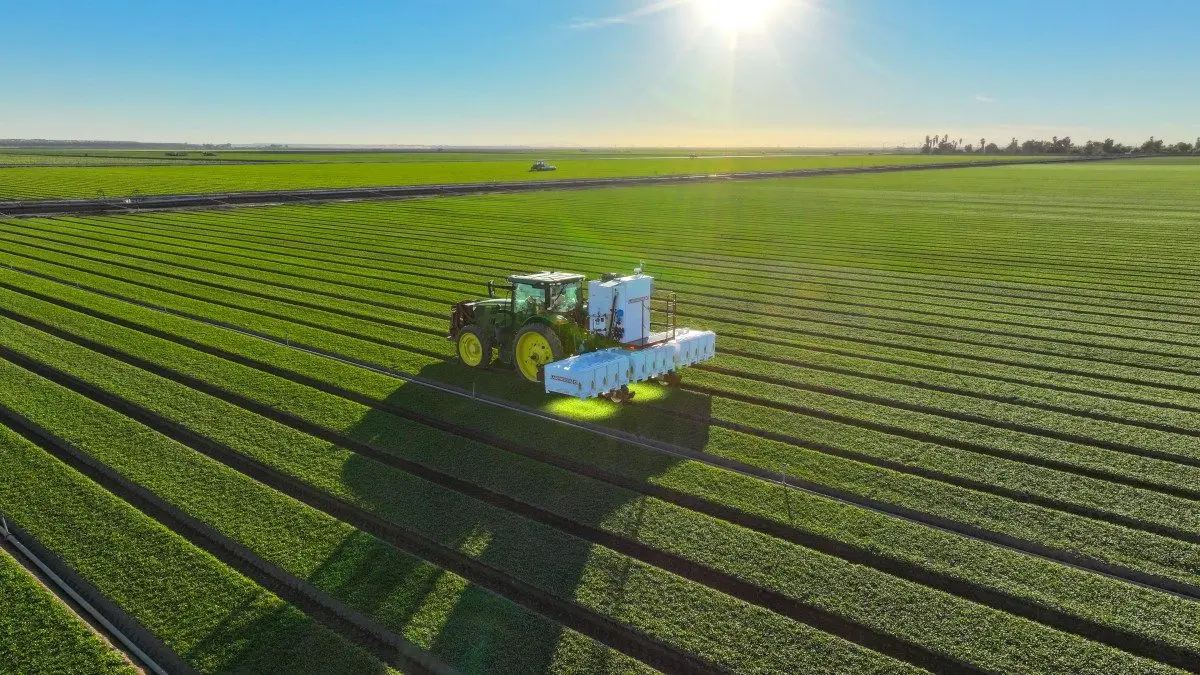
Accelerated research: The AI tool can quickly analyze aerial images collected by drones, streamlining the process of identifying crucial traits like flowering time
1
. -
Adaptability: The model's self-learning capability makes it more adaptable to different crops, locations, and growing conditions without extensive retraining
2
. -
Broader applications: The approach could be applied to various crops and computer-vision problems in agriculture, potentially transforming multiple areas of biological research and digital agriculture
1
.
Future Directions and Potential Impact
The research team, including Leakey and scientist Sebastian Varela, plans to apply this new method to a multistate Miscanthus breeding trial. Their goal is to develop regionally adapted Miscanthus varieties for biofuel and high-value bioproduct production on currently unprofitable land
2
.Leakey expressed hope that this approach will facilitate the adoption of AI tools for crop improvement across a wider variety of traits and species, ultimately bolstering the bioeconomy
1
.This research, supported by the U.S. Department of Energy, the U.S. Department of Agriculture, and Tito's Handmade Vodka, represents a significant step forward in the integration of AI and agricultural science, promising to enhance food security and sustainable crop production in the face of global challenges.
References
Summarized by

Navi
Related Stories
AI-Driven Breakthrough in Soybean Breeding: UTokyo and NARO Develop Novel Vertical Seed Distribution Trait
14 Nov 2024•Science and Research

Frontier exascale supercomputer doubles speed of AI foundation models for plant research
30 Jan 2026•Science and Research
Citizen science photos and AI reveal how switchgrass adapts across a continent
04 Jun 2026•Science and Research

Recent Highlights
1
Microsoft and Nvidia Launch Surface Laptop Ultra: A $2,599 AI-Ready PC With RTX Spark Chip
Technology

2
OpenAI Releases 722 AI-Generated Math Papers on GitHub, Igniting Fury Among Mathematicians
Science and Research

3
Trump Consulted Grok AI Before Ordering Venezuela Invasion and Capture of Nicolás Maduro
Policy and Regulation

Recent Highlights
Today's Top Stories












Don’t drown in AI news. We cut through the noise - filtering, ranking and summarizing the most important AI news, breakthroughs and research daily. Follow topics that matter to you and stay ahead.


