FuriosaAI launches RNGD chip in mass production to challenge Nvidia's AI inference dominance


2 Sources
2 Sources
[1]
Can Anyone Beat Nvidia? This South Korean Firm Is Going to Try
Despite China's best efforts, no one's going to steal the AI training crown from Nvidia's hardware any time soon, but inference is another matter entirely. Whole industries are gearing up to compete with Team Green on that front. South Korea-based FuriosaAI's RNGD platform, for example, is entering mass production and could offer stiff competition when it comes to energy savings and performance, The Wall Street Journal reports. The RNGD chip is a neural processor designed to power the kind of matrix computations and parallel operations that running AI inference workloads require. That gives companies like FuriosaAI, with bespoke neural processing hardware, a real chance to capture some of Nvidia's dominance in the inference space. Just as Chinese companies are looking to fill the gap left by trade-blocked Nvidia chips, FuriosaAI is looking to provide an alternative for Western markets eager for options. Founded by former AMD GPU and Samsung Electronics engineer June Paik, and several of his previous Samsung colleagues, FuriosaAI has been developing machine learning hardware since 2017, but it's finally set to launch its first inferencing hardware. The RNGD, short for "Renegade," is designed to shake up an industry that Paik feels has become too reliant on Nvidia. "A market dominated by a single player -- that's not a healthy ecosystem, is it?" he tells the WSJ. The company has now secured enough funding to value it at over $700 million, giving it a strong foundation to launch its underdog attempt to steal market share from under Nvidia. Meta tried to acquire the company in 2025 for a cool $800 million, but Paik refused. LG has reportedly tested out the AI hardware and claims it has shown excellent performance, with other companies now said to be in talks with FuriosaAI about leveraging its new hardware when available. In its collaboration with LG in 2025, FuriosaAI showed that the company's EXAONE AI model could run on RNGD hardware with up to 2.25 times the inference performance of competing GPUs. "We can support a wide variety of AI models efficiently. But unlike GPUs, which are still fundamentally general-purpose processors, our architecture is natively built for AI computing. We do not develop our chip for rendering or mining," Paik said at the time. With mass production of the RNGD chip beginning this January, it won't be long before FuriosaAI will be able to make good on some of its promises. How Nvidia and its other competitors respond will be interesting to see.
[2]
Startup FuriosaAI moves toward mass production with an AI chip aimed at Nvidia
Serving tech enthusiasts for over 25 years. TechSpot means tech analysis and advice you can trust. What just happened? When FuriosaAI introduced its new chip, RNGD, at Stanford University's Hot Chips conference in 2024, founder and CEO June Paik positioned it as a device designed for the industry's next pivot point - efficient inference computing. On stage before hundreds of chip specialists, Paik called the hardware "a solution for sustainable AI computing," claiming it could run Meta's latest Llama model at twice the power efficiency of Nvidia's top-tier processors. Crowds formed around the company's booth at the event, where engineers from Google, Meta, and Amazon came to see RNGD's live demo. For Paik, it was the first public acknowledgment that his young startup could compete with the most dominant force in AI hardware. "It was a moment where we felt we could really move forward with our chip with confidence," he told The Wall Street Journal. The chip, called RNGD, is scheduled to move into mass production this month, marking FuriosaAI's first large-scale rollout of its neural processing unit for AI inference workloads. This milestone had been hard-earned. FuriosaAI was founded in Seoul in 2017 after Paik, a former Samsung Electronics engineer, left his role in memory-chip design to pursue machine learning hardware. He said the decision started in an unlikely place: a hospital room. Recovering from a torn Achilles tendon sustained at a company soccer game, Paik spent months bedridden, watching online courses from Stanford University about the emerging field of artificial intelligence. That period left him convinced that the technology would reshape computing and industry alike. "I left with absolute certainty that I had to get into the AI space," he said. Paik recruited former colleagues from Samsung, including engineer Hanjoon Kim, who would later become Furiosa's chief technology officer. "I found his approach quite striking," Kim recalled. The pair focused on designing chips optimized for AI tasks rather than general-purpose processors. Unlike GPUs, which are initially built for graphics rendering, NPUs are specialized for matrix computations and parallel operations central to deep learning; they consume less power during inference. Furiosa's goal has been to deliver inference performance comparable to Nvidia's A100 and H100 GPUs while reducing electricity consumption, thereby lowering operational costs for customers. Paik has argued that relying so heavily on a single supplier - Nvidia - creates risk for an industry that needs greater hardware choice. "A market dominated by a single player - that's not a healthy ecosystem, is it?" he said. But the road to production was not smooth. Furiosa's initial round of seed funding in 2017, just under $1 million, was quickly depleted. Paik took out loans to keep the project alive, and in 2019, the company delayed executive salaries for months to avoid lowering its valuation while securing a new round of financing. His recruiting efforts stretched globally. Paik even flew from Seoul to Princeton, New Jersey, to personally convince an engineer to join. "He had incredible energy. I just knew he was going to make waves one day," said Jae W. Lee, director of Seoul National University's AI Institute, who met Paik at a conference in 2015. Paik named his company after the title character of Mad Max: Fury Road, seeing a reflection of both resilience and determination in the film's protagonist. The firm's chip name - RNGD, short for "renegade" - extends that metaphor to its technology. FuriosaAI is now valued at roughly $700 million following multiple fundraising rounds and has drawn attention from global tech leaders. Meta sought to acquire the company last year, though Furiosa declined. OpenAI used its chip during a demonstration event in Seoul, and LG's AI research division reported that the processor offered "excellent real-world performance." South Korea's growing emphasis on AI sovereignty helped reinforce demand for homegrown semiconductor firms. The government has promoted local AI computing capacity, securing a major GPU supply deal with Nvidia and supporting domestic chip R&D. As part of this ecosystem, Furiosa now employs about 200 people. At 48, Paik still carries a keyboard-sized demo board equipped with the RNGD chip everywhere he goes. A competitive swimmer and runner, he treats each hardware rollout like another endurance event. He has said he sees his old injury as part of the preparation. "I think it could have been a blessing in disguise," he said. Image credit: The Wall Street Journal
Share
Share
Copy Link
South Korean startup FuriosaAI has begun mass production of its RNGD neural processing chip, designed specifically for AI inference workloads. Founded by former Samsung engineer June Paik, the company claims its chip delivers up to 2.25 times better inference performance than competing GPUs while consuming less power. Valued at over $700 million after rejecting an $800 million acquisition offer from Meta, FuriosaAI aims to break Nvidia's market dominance.
FuriosaAI Enters Mass Production with RNGD AI Chip
South Korean startup FuriosaAI has officially moved its RNGD AI chip into mass production this January, marking a significant milestone in the company's effort to challenge Nvidia's dominance in the AI hardware market
1
2
. The RNGD chip—short for "Renegade"—is a neural processing unit specifically designed to handle AI inference workloads through matrix computations and parallel operations. Founded in 2017 by June Paik, a former Samsung Electronics engineer, along with several of his Samsung colleagues, FuriosaAI has spent years developing specialized machine learning hardware that could offer Western markets an alternative to Nvidia's GPUs.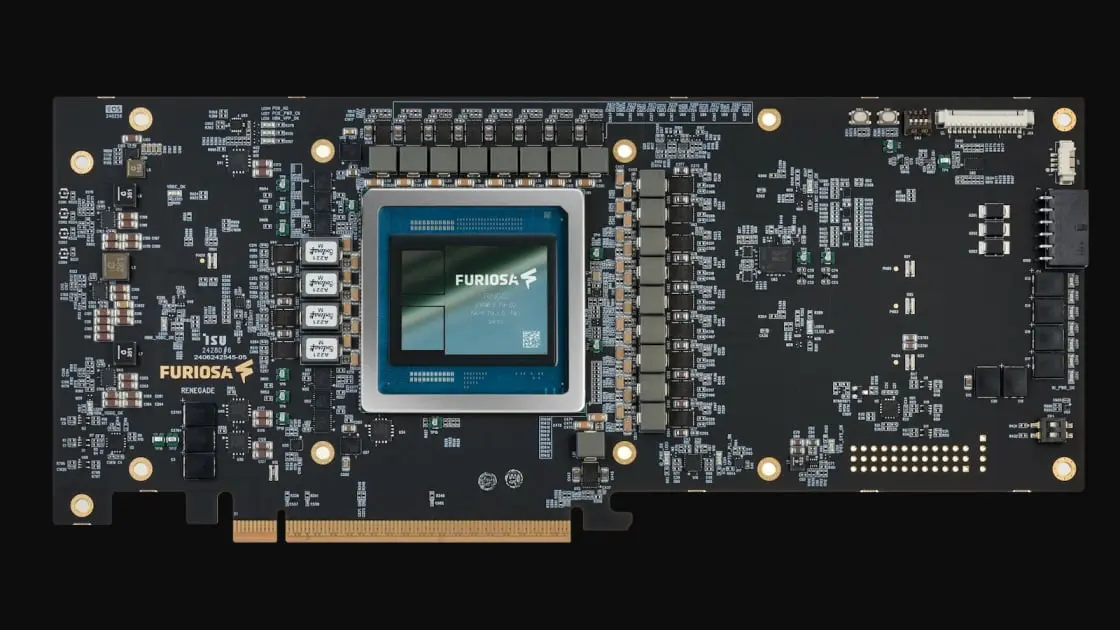
Source: PC Magazine
Power Efficiency Gains Target Nvidia's Market Share
The RNGD chip positions itself as a direct competitor in the AI inference chip space, where FuriosaAI claims it can deliver substantial power efficiency advantages over traditional GPUs. In collaboration with LG in 2025, the company demonstrated that its hardware could run the EXAONE AI model with up to 2.25 times the inference performance of competing GPUs
1
. When Paik introduced the chip at Stanford University's Hot Chips conference in 2024, he positioned it as "a solution for sustainable AI computing," claiming it could run Meta's latest Llama model at twice the power efficiency of Nvidia's top-tier processors2
. Unlike GPUs, which were initially built for graphics rendering, NPUs like the RNGD are specialized for the deep learning tasks central to AI computing, consuming less electricity during inference and thereby reducing operational costs.
Source: TechSpot
From Hospital Bed to $700 Million Valuation
The journey to mass production was far from straightforward for this South Korean startup. Paik's pivot into AI hardware began unexpectedly while recovering from a torn Achilles tendon sustained at a company soccer game. Bedridden for months, he watched online courses from Stanford University about artificial intelligence, which left him convinced the technology would reshape computing. "I left with absolute certainty that I had to get into the AI space," he told The Wall Street Journal
2
. After recruiting former colleagues including engineer Hanjoon Kim, who became chief technology officer, the company faced severe financial challenges. FuriosaAI's initial seed funding of just under $1 million in 2017 was quickly depleted, forcing Paik to take out personal loans and delay executive salaries for months in 2019 to avoid lowering the company's valuation2
. Despite these hurdles, FuriosaAI has now secured enough funding to reach a valuation of over $700 million and employs about 200 people1
2
.Related Stories

Tech Giants Show Interest in Alternative AI Hardware
The company's technology has attracted attention from major players in the AI ecosystem. Meta attempted to acquire FuriosaAI in 2025 for $800 million, but Paik refused the offer
1
. At the Hot Chips conference, crowds formed around FuriosaAI's booth as engineers from Google, Meta, and Amazon came to see the RNGD's live demonstration2
. LG has reportedly tested the AI hardware and claims it has shown excellent performance, with other companies now in talks about leveraging the new hardware1
. OpenAI also used the chip during a demonstration event in Seoul2
. This interest from semiconductor firms and tech leaders suggests genuine demand for alternatives in a market where reliance on a single supplier creates risk.Breaking the Single-Player Market
Paik has been vocal about his concerns regarding Nvidia's market position, arguing that the industry needs greater hardware choice. "A market dominated by a single player—that's not a healthy ecosystem, is it?" he stated
1
2
. The company emphasizes that unlike GPUs, which remain fundamentally general-purpose processors, the RNGD architecture is natively built for AI inference workloads. "We do not develop our chip for rendering or mining," Paik explained1
. South Korea's government has reinforced this push for AI sovereignty by promoting local AI computing capacity and supporting domestic chip R&D, creating a favorable environment for companies like FuriosaAI2
. As mass production begins, the industry will watch closely to see whether FuriosaAI can deliver on its promises and how Nvidia responds to this emerging competition in the AI inference space.References
Summarized by

Navi
Related Stories
FuriosaAI Secures Major Partnership with LG After Rejecting Meta's $800M Acquisition Offer
22 Jul 2025•Technology

FuriosaAI targets $500M funding round as RNGD chip production begins, eyes 2027 IPO
20 Jan 2026•Startups

Nvidia Rivals Target AI Inference Chip Market to Challenge GPU Dominance
20 Nov 2024•Technology

Recent Highlights



Recent Highlights
Today's Top Stories












Your Daily Dose of Curated AI News
Don’t drown in AI news. We cut through the noise - filtering, ranking and summarizing the most important AI news, breakthroughs and research daily. Spend less time searching for the latest in AI and get straight to action.

