Google Gemini rolls out Lyria 3 to generate 30-second AI songs from text and images


20 Sources
20 Sources
[1]
Gemini can now generate AI music for you, no lyrics required
The American poet Henry Wadsworth Longfellow called music "the universal language of mankind." Is that still true when the so-called music is being generated by a probabilistic robot instead of a human? We're about to find out. Google has announced its latest Lyria 3 AI model is being deployed in the Gemini app, vastly expanding access to AI music generation. Google DeepMind has been tinkering with Lyria for a while now, offering limited access in developer-oriented products like Vertex AI. Lyria 3 is more capable than previous versions, and it's also quicker to use. Just select the new "Create music" option in the Gemini app or web UI to get started. You can describe what you want and even upload an image to help the robot get the right vibe. And in a few seconds, you get music (or something like it). In case there was any uncertainty about whether Lyria tracks still counted as a human artistic endeavor, worry not! Unlike past versions of the model, you don't even have to provide lyrics in your prompt. You can be vague with your request, and the model will create suitable lyrics for the 30-second song. Although with that limit, "jingle" might be more accurate. In addition to the track, each music creation job will come with an album cover-style image created by the Nano Banana model. Gemini will also have a pre-loaded set of AI tracks that you can choose to remix to your heart's content. The Lyria 3 tools are also coming to Google's Dream Track toolkit for YouTube Shorts, which will pair nicely with the Veo AI video options. So what kind of tracks can you expect Gemini to spit out? Google has provided some examples: "Sweet Like Plantain" Prompt: I'm feeling nostalgic. Create a track for my mother about the great times we had as kids and the memories of her home-cooked plantains. Make it a fun afrobeat track with a true African vibe. "Motown Parody" Prompt: Quintessential 1970s Motown soul. Lush, orchestral R&B production. Warm bassline with melodic fills, locked into a steady drum groove with crisp snare and tambourine. Vintage organ harmonic bed. Three-piece brass section. Gritty, gospel-tinged male tenor lead. "Pop Flutter" Prompt: Wistful and airy. Soft, breathy female vocals with intimacy. Rapid-fire drum and bass rhythm, low-passed and softened. Deep, warm bass swells. Dreamy electric piano chords and subtle chime textures. Rainy city vibes. "Sea Shanty" Prompt: An authentic A capella Sea Shanty featuring a robust male choir singing in a traditional call-and-response format. The piece is entirely vocal, relying on synchronized foot-stomps on a wooden deck and sharp handclaps to provide the rhythmic pulse. The lead is a weathered male baritone with a gravelly timbre who sings the narrative 'chant' lines. He is immediately answered by a powerful male choir singing in rich, rugged harmony on the 'response' lines. The voices are recorded with a natural room reverb that simulates the acoustic environment of a wooden ship's deck, giving the vocals a resonant, atmospheric quality. The performance is energetic and driving, with the choir leaning into the rhythm of the stomps to create a sense of focused, communal effort. There are no instruments, only the layered textures of collective male voices spanning tenor, baritone, and bass ranges, all contributing to a confident, monolithic sound. Sour notes AI-generated music is not a new phenomenon. Several companies offer models that ingest and homogenize human-created music, and the resulting tracks can sound remarkably "real," if a bit overproduced. Streaming services have already been inundated with phony AI artists, some of which have gathered thousands of listeners who may not even realize they're grooving to the musical equivalent of a blender set to purée. Still, you have to seek out tools like that, and Google is bringing similar capabilities to the Gemini app. As one of the most popular AI platforms, we're probably about to see a lot more AI music on the Internet. Google says tracks generated with Lyria 3 will have an audio version of Google's SynthID embedded within. That means you'll always be able to check if a piece of audio was created with Google's AI by uploading it to Gemini, similar to the way you can check images and videos for SynthID tags. Google also says it has sought to create a music AI that respects copyright and partner agreements. If you name a specific artist in your prompt, Gemini won't attempt to copy that artist's sound. Instead, it's trained to take that as "broad creative inspiration." Although it also notes this process is not foolproof, and some of that original expression might imitate an artist too much. In those cases, Google invites users to report such shared content. Lyria 3 is going live in the Gemini web interface today and should be available in the mobile app within a few days. It works in English, German, Spanish, French, Hindi, Japanese, Korean, and Portuguese, but Google plans to add more languages soon. While all users will have some access to music generation, those with AI Pro and AI Ultra subscriptions will have higher usage limits, but the specifics are unclear.
[2]
Google adds music generation capabilities to the Gemini app
Google announced on Wednesday that it's adding a music generation feature to the Gemini app. The company is using DeepMind's Lyria 3 music generation model to power the feature, which is still in beta. To use the feature, you'll describe the song you want to create, and the app will generate a track along with lyrics. For instance, you could ask Gemini to create a "comical R&B slow jam about a sock finding its match," and the app will generate a 30-second track along with a cover art made by Nano Banana. Google said that you can even upload a photo or a video, and the AI-powered tool will create a song to match the mood of the media file. The company said that Lyria 3 improves on the previous generation of models, creating more realistic and complex music tracks. Users can also change and control other elements like style, vocals, and tempo. Along with rolling out Lyria 3 to the Gemini app, Google is making the model available to YouTube creators through the Dream Track feature on YouTube, a tool that helps creators make AI-generated tracks. The option was only available to YouTube creators in the U.S. until now. But with this release, Google is expanding Dream Track availability globally. Google said that you can't mimic an artist outright, but if you add an artist's name to your prompt, Gemini will create a track in a similar style or a mood. (It's not clear if generation will make it easier for others to decode the music style of a particular artist.) "Music generation with Lyria 3 is designed for original expression, not for mimicking existing artists. If your prompt names a specific artist, Gemini will take this as broad creative inspiration and create a track that shares a similar style or mood. We also have filters in place to check outputs against existing content," the company said in a blog post. Google noted that all songs created with the Lyria 3 model will have a SynthID watermark to identify AI-generated content. The company said that it's also adding capabilities to identify AI-generated music with SynthID within Gemini. Users will be able to upload tracks and ask Gemini if it is AI-generated. Music generation is rolling out to all 18+ Gemini users across the world with support for English, German, Spanish, French, Hindi, Japanese, Korean, and Portuguese. AI-generated music has created mixed sentiments among artists and listeners. On one hand, companies like YouTube and Spotify are adopting AI and signing contracts with music labels to monetize AI-generated music. On the other hand, AI model and tooling companies are facing lawsuits from the music industry over copyrights of the training material. Platforms like Deezer have published tools to mark AI-generated music to curb fraudulent streams of this kind of music.
[3]
Gemini Can Now Generate 30-Second Songs From Text, Images with Lyria 3
After image and video generation, it's time for music generation on Google's Gemini chatbot. The company just announced its latest music-generation model, Lyria 3, which will enable Gemini users to generate 30-second audio clips from textual and visual prompts. Getting started is as easy as generating images using Nano Banana. Click the "Create Music" button below the prompt box. You can choose from a set of tunes based on genres, such as 90s rap, Latin pop, R&B romance, Afropop, and more, or describe the mood, style, vocals, and tempo you'd like your track to have. Lyria 3 will also add lyrics based on your description, which can contain images for reference. Google's example for an image-based prompt says: "Use these photos to create a track about my dog Duncan on a hike in the woods." Once you hit Enter, Gemini will generate a 30-second clip with album art from Nano Banana. You'll be able to download the audio track and also share it using a link. The goal here isn't "to create a musical masterpiece, but rather to give you a fun, unique way to express yourself," Google says. The model is "designed for original expression, not for mimicking existing artists," and its filters should detect existing content. Additionally, all songs generated by Gemini will carry Google's Synth ID watermark. If you are unsure whether a clip was generated by Gemini, you can upload it to Gemini and ask the chatbot to verify. AI song generation isn't entirely new. Platforms like Suno and Udio have been at it for a couple of years, but they ran into copyright issues with major music labels like Sony, Universal Music, and Warner Bros. Suno settled its case with Warner, and Udio settled its case with Warner and Universal by signing licensing deals. YouTube was reportedly also considering licensing its AI tools in 2024. Earlier this month, it introduced AI Playlist generation for YouTube Premium and YouTube Music Premium. Lyria 3 in Gemini will roll out to all users aged 18+ on desktop starting today, and on the mobile app in the coming days. Gemini's music generation currently produces tracks in English, German, Spanish, French, Hindi, Japanese, Korean, and Portuguese. Google plans to add support for additional languages in the future. Google didn't specify the limit for free users, but said that AI Plus, Pro, and Ultra subscribers will enjoy higher limits. The model will also be made available in YouTube's Dream Track tool for creating Shorts.
[4]
Gemini will now generate musical slop for users
Who needs to express themselves through music when a bot will do it for you with nothing but a prompt? If you've ever wanted to make music but have neither the talent nor the inspiration, Google has the AI tool for you. Gemini will now generate a 30-second song for you directly from a text prompt, photo, or video. Google launched Lyria 3, the latest iteration of its music creation AI, on Wednesday, and has made it far more available than the previous versions of the engine. Like image creation tool Nano Banana and video-making AI Veo, Lyria 3 lives right in the Gemini Tools menu, where it can be selected and used to create a song with little more than a short description. Google's examples in its announcement post include an R&B song about socks finding their matches in a washing machine and an afrobeat track about childhood memories cooking plantain-based meals with one's mother, both of which included lyrics that Google appeared proud to say were written on the fly by AI. "No need to provide your own lyrics! They'll be generated for you based on your prompt," senior product managers Joël Yawili (Gemini) and Myriam Hamed Torres (Google DeepMind) wrote in the announcement before unironically adding that "the goal of these tracks [is] to give you a fun, unique way to express yourself." Because nothing says "I love you, Mom" like a song written and performed by a Google AI for the low, low cost of ruining the environment. Oh, and Google is also throwing in cover art generated by Nano Banana, so no need to actually find a sentimental picture to include. Lyria first launched in 2023, with Google later deploying it in YouTube experiments such as Dream Track, which let creators generate 30-second soundtracks for YouTube Shorts in the style of participating artists, and in Music AI Sandbox, a separate set of tools aimed at musicians looking to sketch and iterate on ideas with AI assistance. According to Wednesday's announcement, Lyria 3 improves on previous Lyria models by adding the aforementioned lyric generation feature, as well as giving prompters more control over style, vocals, and other particulars. Lyria 3 can also "create more realistic and musically complex tracks," Google said. Dream Track, naturally, is being updated with Lyria 3, though it's not clear whether YouTube creators will be able to spin tracks longer than 30 seconds, which Google said is Lyria 3's current limit. Lyria's original iteration, as paired with Dream Track, included training data from licensed artists like T-Pain, Demi Lovato, Sia, and other pop middleweights. Google didn't mention who it may have signed partnership agreements with to train Lyria 3, but did say that it programmed the model to be "very mindful of copyright" and agreements it signed with musicians who offered up their intellectual property as meat for its AI grinder. "Music generation with Lyria 3 is designed for original expression, not for mimicking existing artists," Google explained. "If your prompt names a specific artist, Gemini will take this as broad creative inspiration and create a track that shares a similar style or mood." There are also filters in place to prevent Lyria 3 from creating something too close to an extant song, Google explained, but it admitted those filters might not get everything right, and asked users to report content that might be a copyright infringement. For those who wish to experiment with generating a bit of soulless, 30-second musical AI slop, Lyria 3 is rolling out globally beginning February 18 for all Gemini users 18+, and is available now in English, German, Spanish, French, Hindi, Japanese, Korean, and Portuguese with additional languages to be added. It's launching on desktop first, though not everyone appears to have access yet (it's not showing up for this vulture), with the Gemini mobile app set to get access over the next several days. ®
[5]

Google Gemini, Apple Add Music-Focused Generative AI Features
Alphabet Inc.'s Google and Apple Inc. are adding music-focused generative artificial intelligence features to their core consumer apps, underscoring how advanced AI tools are moving into mainstream use. Google's Gemini AI assistant can now create 30-second music tracks based on text, photos or video uploaded by users using Google DeepMind's latest Lyria 3 model, the company said in a blog post on Wednesday. The feature, which can generate custom lyrics or purely instrumental audio, will be available to users over the age of 18 in multiple languages. It is being rolled out on the desktop version of Gemini and will appear in the mobile app over the next few days, the company said. Its popular image-creation model, Nano Banana, will also generate custom cover art alongside the track, adding a visual element when users share links to the tracks with others, Google said. Adding audio-creation tools to its mobile app can potentially strengthen Google's consumer offerings as it remains locked in a race with OpenAI's ChatGPT to win over users. Google won widespread praise from investors and users for its Gemini 3 AI model released in November, prompting OpenAI Chief Executive Officer Sam Altman to declare a "code red" to spur faster ChatGPT improvements. Get the Tech Newsletter bundle. Get the Tech Newsletter bundle. Get the Tech Newsletter bundle. Bloomberg's subscriber-only tech newsletters, and full access to all the articles they feature. Bloomberg's subscriber-only tech newsletters, and full access to all the articles they feature. Bloomberg's subscriber-only tech newsletters, and full access to all the articles they feature. Bloomberg may send me offers and promotions. Plus Signed UpPlus Sign UpPlus Sign Up By submitting my information, I agree to the Privacy Policy and Terms of Service. Separately this week, Apple said consumers can soon use AI to create playlists in Apple Music. The feature, called Playlist Playground, uses Apple Intelligence to let people turn text prompts into playlists that will include cover art, description and 25 songs. It is included in iOS 26.4, which was released in beta on Monday and will become more widely available this spring. Apple Music's new feature rivals a similar one offered by Spotify Technology SA. Apple, which has been a laggard in artificial intelligence, is working to add more AI features across its apps and devices, including in its recently launched software bundle Creator Studio. But some highly anticipated updates to its Siri virtual assistant may be delayed after they were first announced in 2024, Bloomberg News reported last week. Google, for its part, has been working to show investors that its investments in AI-driven products can help boost revenue. For releases like this, that means the product is not completely free. Similar to how Gemini places limits on daily image creation, users of the free product can generate 10 tracks per day, while paying users get 20 to 100 daily depending on the plan their subscription tier. Users will have a right to use their generated tracks, the company said, adding it has filters in place to check outputs against existing content so that it doesn't violate intellectual property or privacy rules. Generative AI tools have been met with a wary, and sometimes hostile, reception from the music industry, which views some of the technology as a threat to its business and IP. In 2024, Universal Music Group NV, Warner Music Group Corp. and Sony Music Entertainment sued startups Suno AI and Uncharted Labs Inc., the developer of Udio AI, for copyright infringement. Warner Music has since settled with Suno, and both it and Universal Music have reached agreements with Udio to keep the app functioning with proper licensing and controls. Google said in the blog post that it has safeguards in place that prohibits the AI from lifting content from specific artists. If users name real musicians, Gemini will only take that prompt as "broad creative inspiration and create a track that shares a similar style or mood," it added. "Our training for Lyria 3 is designed to use music that YouTube and Google has a right to use under our terms of service, partner agreements and applicable law," a company spokesperson added.
[6]

Google's new music tool, Lyria 3 is here
"The two things you can't fake are good food and good music" - Etta James Google's announcement that its Gemini app now writes music for you isn't just one of those "blowing my mind" product updates. It feels like a symbolic surrender to a long-standing refrain from Big Tech: creative work is now just another checkbox for a machine. If you don't know what I am talking about, yesterday Google launched a new feature, Lyria 3, in the Gemini app, that allows us to cook up 30-second tracks complete with lyrics and cover art from a text prompt or a photo, of course, generated by Nano Banana; basically, no instruments, no experience, no pesky tactile skill required. It's essentially a LEGO set for "songs" that lasts about as long as a TikTok loop. They say it's designed for YouTube Creators, and I tend to agree with them, because you can't make to much with 30 seconds. Still, the underlying problem is another one, as I am seeing different projects/songs made with AI, including AI artists. And this is what I want to highlight in this piece. "Behind every beautiful thing, there's some kind of pain, " said Bob Dylan, and I could not agree more. If we take a look at the history ( art, music, literature, poetry, and so on), the main fuel for creation was indeed pain. Now, how should I put this? Probably the only pain that Lyria can feel is more like a faint server-overload alert than heartbreak. Real songwriters know that soul isn't born in a 30-second prompt, it's extracted through years of mistakes, late nights, losses, and tiny revelations. Call it a toy if you like. Google will, too. They even watermark the outputs with a SynthID tag so the 30-second ditties are officially AI-generated, not "inspired." That's a nod to copyright concerns, but it also reads like an admission: these aren't really art, they're chemical by-products of pattern statistics. What's striking isn't the novelty. Much of this has been possible in labs and APIs for years, and creators have been experimenting with generative music tools as collaborators. What Lyria 3 does, and what makes this moment worth watching, is normalising the idea that anyone can "write" a song with a chatbot and a mood descriptor. That's not empowerment; it's a devaluation of craft. Just because you pay a subscription to Suno, that's another AI music generator, and that one is more complex, that doesn't make you an artist or a singer. Just because you learn how to write a prompt for any LLM model and generates you pages, you are not a writer. Imagine a world where every blog has AI-generated copy, not that we are not almost in the middle of this, and every company can churn out half-baked music for their ads or social posts. In that economy, a professional songwriter's unique skill becomes as optional as knowing how to use a metronome. You could ask Gemini for an "emotional indie ballad about a lost sock," and voilà, you have something. Whether it has actual coherence or soul is left to the listener to decide. It is fun to use it with your friends, shorts, to impress your date. Video: Gemini Lyria Music Generation Feature - Socks, uploaded by Google on YouTube Still, Lyria 3's music is capped at 30 seconds, and that's no accident. It sidesteps deeper legal and ethical quarrels about training data and mimicry of existing works by keeping outputs short and legally fuzzy. That's a thumbs up from me. But even within that limit, it's now possible for someone with no craft or cultural context to generate riffs, lyrics, and chord progressions that sound, to the casual ear, adequately musical. In an attention economy obsessed with shareability, "adequate" quickly becomes plenty. This matters because real songs, the ones that endure, that carry human experience, aren't just collections of musical atoms. They're shaped by story, risk, cultural memory, and sometimes contradiction. One of my favorite artists, Tom Waits, said, "I don't have a formal background. I learned from listening to records, from talking to people, from hanging around record stores, and hanging around musicians and saying, "Hey, how did you do that? Do that again. Let me see how you did that." This was the research and prompting before, and it's not only about reducing time, or getting things faster, and "having more time for you." It's about the entire process, the contact with other artists, humans, and IDEAS. Those are qualities machines can mimic but not originate. When the machines own the first pass at creation, and the commercial ecosystem embraces that output because it is cheap and fast, the incentives shift. Not gradually. Suddenly. The record industry is already grappling with AI. Streaming services, publishers, and even labels have begun experimenting with algorithmic playlists and automated composition. What Gemini's Lyria 3 does is extend that experiment to public perception. A whole generation may come to think that "making music" means typing a description and choosing a style. Songwriting becomes a UX problem, not a craft one. That raises a serious question: in a world where AI can conjure up a half-decent hook on demand, what will distinguish professional artists? If the answer is only brand story or marketing muscle, we aren't celebrating creativity; we are monetising it out of existence. Tech companies like Google will frame this as liberation. And in a literal sense, anyone who's ever wanted to hear a short tune about a sock's existential crisis now can. But liberation without value for the creator is just consumerism by another name. Lyria 3 might be good for GIF soundtracks and social clips, and TikTok viral reels, but it doesn't make professional musicians obsolete; it makes their work less necessary to the platforms that reward hyper-consumable content. That's a different threat from outright replacement: it's obsolescence by trivialisation. If AI is going to be part of musical creation, then let it be as an assistant to the composer, someone who improves ideas, not replaces them. What we're seeing with Gemini is not collaboration but outsourcing. And the lesson for artists isn't to fear the algorithm. It's to insist on clarity about where AI replaces labour and where it augments human sensibility. Because once the marketplace equates the two, the humans who do the work will be the ones left asking for royalties in a language no one else wants to speak. And, as a personal recommendation, not sponsored, there are streaming platforms like Deezer that have built AI detection tools that flag and label AI-generated tracks, excluding them from recommendations and royalties so that human songwriters aren't buried under synthetic spam, and consumers can make the difference between AI and human. If you care about preserving real artistry in a world of text-to-tune generative models, start paying attention to how platforms handle AI-tagging and choose services that give you transparency about what you're actually listening to. Yet, I'm not here to throw shade at Lyria 3; if anything, the idea of letting people turn a photo or a mood into a short track sounds like fun for casual use and creative experimentation. It is what Google says it's meant for.
[7]

Google Launches Music Generation Model to Make Songs 30-Seconds at a Time
Need an AI-generated soundtrack to go with your AI-generated video that you're planning to send to your AI-generated friends? Google has you covered. The company announced today that Lyria 3, its music generation model, will be available to use in its Gemini app. The feature is still in beta, but it'll be available over the coming days to all users with the Gemini app, so long as they are 18 years of age or older. Out of the gates, users will be able to generate songs in English, German, Spanish, French, Hindi, Japanese, Korean, and Portuguese, with more languages planned for the future. For now, free subscribers will have their music "creations" capped at 30 secondsâ€"so basically an iTunes preview length of song time. Google AI Plus, Pro, and Ultra subscribers will get higher limits, though the company didn't specify what that means. But you can assume that you're probably not going to be able to do your version of "Free Bird." Lyria 3 is the latest generative AI model to make it out of the DeepMind lab, and the first version of Lyria to get a wider public release. Previous models were available to musicians via Google's Music AI Sandbox, a suite of tools that Google launched to figure out how AI could be used in the music creation process. Lyria was also available to some YouTube creators with a feature designed to turn speech into song. This latest version allegedly improves on several areas where previous models struggled, per Google. First, it now generates its own lyrics, so you can offload the difficult task of figuring out what rhymes with "orange." It also gives users more control over elements of the song, like style, tempo, and vocals. Finally, Google claims Lyria 3 can create "more realistic and musically complex tracks." Users who decide to make Lyria 3 the only instrument they know how to play will be able to offer either a text-based prompt or upload images and videos to ask the model to create a track based on visual prompts. The app will spit out a 30-second track, complete with album art that's also AI-generated by Google's Nano Banana model. "The goal of these tracks isn't to create a musical masterpiece, but rather to give you a fun, unique way to express yourself," the company said. (Seems like a nice way to say some of these songs are gonna be bad.) Per Google, all outputs from Lyria will be embedded with SnythID, the company's watermark for identifying AI-generated content. While that won't be immediately visible the way watermarks on images or video are, users will be able to upload an audio clip to Gemini and have the app determine if the SnythID is present. So even if you don't use Gemini to spit out some songs, at least you can use it as a slop detector.
[8]

I made 3 songs with Gemini's Lyria 3 -- one was shockingly good
I tapped into my inner music producer and came up with three AI-created tunes with the aid of the Lyria music app inside Google Gemini Without music, I'd have a permanent hole in my soul that wouldn't be filled by anything else. Not a day goes by that I don't have a pair of headphones in, or the volume turned up to an obnoxiously high level. There are so many genres I enjoy -- hip-hop, R&B, house, metal, electronic dance music, etc. And I'm always on the lookout for something new once the clock strikes midnight on Friday and iTunes debuts a wide swath of albums to sit down with all weekend long. I've always had a passing interest in producing my own music, but I quickly realized I wasn't cut out for it when I cooked up atrocious beats on Fruity Loops. So when I found out about Lyria 3, the AI music generator inside the Gemini app, I was excited to give it a try. As Google's latest AI music generator, it can turn your text prompts and uploaded photos into 30-second tunes. I decided to revisit my music producer dreams and create three songs with Lyria 3. And to my surprise, one of them wouldn't sound out of place on my Spotify playlist or a radio station. I kicked off my career as a music producer by making a hip-hop track with a simple prompt I reside in New York (the borough of Queens, to be more exact). And at the time of this writing, my city is getting assaulted by yet another snowstorm. It's only right that I chose to air my grievances over the frigid, snowy weather with the assistance of Gemini's music creator. I decided to put this fun prompt to good use to describe and craft an original hip-hop song that wouldn't sound out of place in the 80s or 90s: "A grumbling hip-hop song bemoaning the snowstorm in New York City, with gritty boom-bap beats and a cold-distorted bassline." Now I have to be real with you all -- the song Gemini made for me was... quite bad. While the beat was decent enough, the rapper's flow and bars made me cringe since he sounded like a diehard Will Smith fan who showed up for an after-school talent show performance. "The whole city's buried under snow!" is a fun crowd callout, at least. The song was so bad that it ended up being a comedic first attempt at seeing how my music-themed prompts turned out. So far, I sadly haven't produced a banger worth adding to anyone's playlist. Then I created a rock tune inspired by an image that highlighted one of my favorite memories Gemini's Lyria 3 has a cool feature where you can upload an image, enter a prompt that mentions the attached picture, and create a track that offers a rousing description of what's on display. I went perusing through my Instagram page to find something that would be fitting for this next step in my AI music generator experiment, and happened upon a good one -- a picture of me meeting wrestling legend Jake "The Snake" Roberts at New York Comic-Con 2021. To match the vibes of the WWE Hall of Famer, I put this prompt to work: "Create a celebratory rock song that describes the excitement that came with meeting Jake "The Snake" Roberts at New York Comic-Con." The final product Gemini produced wouldn't sound out of place as someone's actual theme song at a live wrestling show. And to be quite honest, I quite enjoyed this one more than I expected. I'm so used to listening to wrestling theme songs, which is why I took to this one so much after a few repeated listens. Are the lyrics a bit corny? Yeah, but the majority of songs that wrestlers walk out to have some cringy lyrics attached to them, and still sound good. I'm pleasantly surprised by the result of this photo-inspired, AI-made rock song. And finally, I got super descriptive by cooking up a house music song with detailed, structured prompts For my third and final foray into the world of AI-generated music, I got as descriptive as possible to come up with something catchy. This time, I chose to delve into the electronic dance music genre and put Gemini to work with this super descriptive prompt: "An energetic, vivacious house music song evoking the party atmosphere of a massive music festival. The tempo is 120 to 130 beats per minute." With all that in mind, Gemini got to work constructing a song that would definitely get the crowd to come alive at an EDM festival. The track that emerged was a solid house music tune performed by a male and female duo that wasn't half bad. While it did have a generic feel to it (I've heard a bunch of EMD songs like this one in clubs and during commercials advertising some new mood-enhancing pill), it still came across as a respectable effort from Gemini when it comes to cooking up a rave-worthy song. Feel free to fist bump to this one in the comfort of your own home if you're too embarrassed to play this in public. Final thoughts Gemini continues to add the sort of features that are fun for a creative like me to play around with. Creating images is cool and all, but I get way more enjoyment out of getting in the digital music producer booth and seeing what the newly embedded Lyria app can make out of my custom prompts. I cringed at the sound of my snow-hating hip-hop diss track, fell in love with my rock wrestling theme, and nodded my head as if I was partying at the Roxbury once my house music tune was finalized. Gemini's incorporation of Lyria 3 is a cool new way to make music that may just be perfect for YouTubers looking for copyright-free music to use on their content and randoms who just want to test the AI's music producer skills. Follow Tom's Guide on Google News and add us as a preferred source to get our up-to-date news, analysis, and reviews in your feeds.
[9]

Google introduces Lyria 3, a free AI music generator for Gemini
On Wednesday, Google rolled out a new AI music generator called Lyria 3. It's a fairly big upgrade over earlier versions of the model, as it makes music generation a lot easier for users. Lyria 3 can create high-fidelity, 30-second audio tracks in a variety of genres, from short jingles and lo-fi beats to more complex arrangements and songs. This Tweet is currently unavailable. It might be loading or has been removed. Google says that Lyria 3 is available now in the Gemini desktop app (it will be rolling out into the mobile app in the coming days), and it's free for all users 18 and up. Lyria can be used in English, German, Spanish, French, Hindi, Japanese, Korean, and Portuguese, with support for additional languages to come. To get started, simply head to the Gemini app. In the "Tools" dropdown menu, look for the "Music" option, which is accompanied by a music note icon. Google also released a Lyria 3 prompt guide to help users get started. Lyria 3 can generate a short 30-second song based on a simple text, image, audio, or video prompt. Users can control the music style, vocals, and tempo all within the prompt. In addition, users no longer have to provide their own lyrics. Lyria 3 can create them based on the prompt. Nano Banana will even generate album artwork to go with it. If users want to create music to go along with a specific photo or video, they can upload it along with their prompt. For instance, social creators could upload a video and generate a custom music track to go along with it in seconds. Furthermore, there is a template option with dynamic suggestions for people who'd like to create an AI song but need some inspiration. According to Google, all tracks that are generated within the Gemini app have a SynthID watermark embedded, which marks content as AI-generated. While free users will have access to Lyria 3, paying Google AI Plus and AI Ultra subscribers will receive higher usage limits. Many musicians and music publishers have criticized the AI industry for training models like Lyria 3 on copyright-protected works without permission or payment, and multiple lawsuits are working their way through the court system based on these concerns. Most AI companies argue that training models on copyrighted works is protected by fair use. While Big Tech companies generally decline to comment on the specific training materials used for their frontier models, Google did say that it was "mindful" of musical copyrights. A Google blog post announcing the new model said the company has "been very mindful of copyright and partner agreements as we've trained Lyria 3. Further, Google says that Lyria is not designed to mimic existing artists, and musicians can report content if they believe it violates their rights. The blog post states: Music generation with Lyria 3 is designed for original expression, not for mimicking existing artists. If your prompt names a specific artist, Gemini will take this as broad creative inspiration and create a track that shares a similar style or mood. We also have filters in place to check outputs against existing content. We recognize that our approach might not be foolproof, so you can report content that may violate your rights or the rights of others. Additionally, in order to use our products, users must adhere to our Terms of Service and Gen AI prohibited use policies, which prohibit violations of others' intellectual property and privacy rights.
[10]

Google Gemini adds Lyria 3, an AI model that can create music with words and photos
Lyria 3 is now available on desktop, and will be rolling out to the Gemini mobile app in the coming days. Google is expanding the multimodal capabilities of Gemini, once again. Following the success of the viral Nano Banana image generator, the company is releasing Lyria 3, an AI model that can generate music. Google says you can get started with your words and describe what kind of music you want to generate, and the model will comply. Alternatively, you can feed it a picture or even a video, and Lyria 3 will generate a "high-fidelity track," with custom lyrics in tow. "From funny jingles to lo-fi beats, you can create custom 30-second soundtracks for any moment," says the company. Lyria 3 is already rolling out to the desktop version of Gemini, which you can access in a web browser. It will also be expanding to the Gemini mobile app for users in the coming days across the globe. What is Lyria 3 in Gemini? Lyria has been developed by Google's DeepMind division, which is at the frontier of pushing AI for cutting-edge innovations and research, such as using Gemini 3 Deep Think for turning sketches and ideas in 3D printing files. DeepMind is also behind the SynthID tech that puts an invisible watermark on media generated by AI tools. Recommended Videos With Lyria 3, Google is diving into a fun and controversial side of AI usage. The idea is pretty simple. You can pick any topic, idea, genre, or mood, and Gemini will create a 30-second sample for you. All you have to do is click on the tool picker in the Gemini chat box and select the new music option. How does it work? Just like image generation, or making videos in using Google's Veo engine, Lyria 3 will take your words, images, or videos, and create a fitting tune. If you are running out of creative ideas, there are plenty of templates where you can pick an existing track and modify it using prompts. It's somewhat like tweaking Gemini Gems or remixing mini-apps created in the Nothing Playground ecosystem. Using Lyria 3 in Gemini is free, in case you are wondering. I can imagine a lot of people sharing their photos and videos to create a suitable background track for posting on social media. Google won't be the first company to offer this convenience. Suno is the biggest name in the AI music generation segment, and has courted plenty of controversy for alleged copyright infringement.
[11]
I tried Gemini's new Lyria 3 in-app AI song generator -- and it turned my to-do list into a punk rock anthem
If you had fun with Nano Banana, hang on to your phones, because I think this is going to be the next new trend. Google is turning Gemini into a creative studio once again, but this time it's letting you make music. Starting today, the Gemini app is rolling out Lyria 3, its most advanced music generation model yet, allowing users to create 30-second songs from a simple text prompt or even a photo. The feature lets anyone produce short tracks complete with vocals, lyrics and cover art in seconds -- I've already played around with it and can honestly say it's a ton of fun. Just note that it's still in beta and may have a few hiccups. Here's how it works. How Gemini's AI music generator works The move expands Gemini's creative toolkit beyond images and video and signals Google's growing push into AI-powered creative expression. With Lyria 3, users can describe an idea -- or upload an image -- and Gemini generates a fully produced track to match. For example, I've already created: * A comical punk rock song for my husband's to-do list * An upbeat pop song to pump my son up for his soccer game * A fun day-in-the-life mom anthem Gemini then produces a 30-second track, complete with lyrics and AI-generated cover art created using Google's Nano Banana image model. Tracks can be downloaded or shared via a link, making them easy to send to friends or post on social media. I sent my husband's "to do list" song via text message. Google says the goal isn't to produce polished commercial songs, but to offer a fun, expressive way to add a custom soundtrack to everyday moments. How to try it Music generation with Lyria 3 is rolling out today on desktop and will arrive on mobile over the next few days. The feature is available to users 18 and older in multiple languages, including: English, Spanish, French, German, Hindi, Japanese, Korean and Portuguese. Google AI Plus, Pro and Ultra subscribers will receive higher generation limits. The model is also being integrated into YouTube's Dream Track, where it can help creators generate customized soundtracks for Shorts. Is AI music the future? Long before testing and reviwing AI, I worked with some of the biggest names in music from Justin Timberlake and John Legend to Amy Winehouse and legendary singer Carly Simon. I can honestly say, I don't believe AI will take over the music industry. But what I can see it doing is adding a synthetic layer beyond the studio -- giving everyday users the ability to sketch musical ideas, create playful tracks and turn memories into shareable sound in seconds. It's important to note for listeners and users that all music generated in Gemini includes SynthID, Google's imperceptible watermark designed to identify AI-generated content. In fact, Google is also expanding its verification tools: users can upload an audio file into Gemini and ask whether it was created with Google AI. The system checks for SynthID and uses additional analysis to determine its origin. To address copyright concerns, Google says Lyria 3 is designed for original expression rather than imitation. If a user references a specific artist, Gemini interprets the request as broad stylistic inspiration rather than direct mimicry. Filters and reporting tools are in place to prevent rights violations. The takeaway I've tested dozens of AI generated music tools, but Lyria 3 is different because it's so much easier to use. I think that embedding the tool inside such a popular mainstream assistant could bring generative audio to a much wider audience. It's now as easy and convenient to generate a song as it is an image. For creators, social media users and everyday Gemini fans, this update means turning inside jokes, memories or photos into shareable music in seconds. It's a ton of fun. Let me know in the comments what you think. Follow Tom's Guide on Google News and add us as a preferred source to get our up-to-date news, analysis, and reviews in your feeds.
[12]

Gemini Now Lets You Generate AI Music for Free
Paid subscribers can access higher usage limits, though Google doesn't specify what those are. Google Gemini can help you write text, generate images and video, and write code. Now, the AI bot can generate music too, taking on the likes of Suno when it comes to producing tunes from a simple text prompt. The update is courtesy of the new Lyria 3 audio generation model, which is built into Gemini as of today. Developed by Google DeepMind, Lyria has been accessible in other Google products (such as Vertex AI and YouTube Shorts) to a select number of users, but this is the first time Google is making the model widely available to anyone who wants to try it. Lyria works the same way as creating images or video: just describe what you want, and the AI does the rest. You might want to hear "a comical R&B slow jam about a sock finding their match" (as per Google's own example), or perhaps "a sea shanty about the dangers of AI slop" -- it's up to you. When you click the "Create music" button inside the Gemini app, you also have the option to pick an existing track to remix, rather than starting from scratch -- If you're perhaps stuck for inspiration. These presets cover everything from folk ballads to Latin pop, so you can see the kind of musical scope covered. You can also supply Lyria 3 inside Gemini with an image or video, and get it to compose something that matches the mood of the content you've supplied, including both music and lyrics. The example Google gives is supplying Gemini with a few photos of your dog, and then having it come up with a tune about the pooch and their adventures. The tracks are limited to 30 seconds each at the moment, and while music making is available to all Gemini users, if you're paying for the Plus, Pro, or Ultra subscriptions, you'll get higher usage limits (though it isn't specified what these are). As per the official announcement blog post, the aim "isn't to create a musical masterpiece, but rather to give you a fun, unique way to express yourself." You're not going to be able to set up your own AI-generated band on Spotify with this, but you can churn out a few entertaining tracks for your own (or someone else's) amusement. I haven't been able to try out the feature as of yet, but I have heard a few samples that Google supplied. They come across as rather generic and ordinary, exactly as you might expect something to sound that's the averaging out of vast amounts of audio training data -- like song genres distilled into their most common ingredients and repackaged. Google says all created tracks will contain invisible watermarks powered by SynthID, flagging them as AI creations, and you can upload audio tracks to Gemini and run a SynthID check on them. The updated Lyria 3 model is also coming to the Dream Track music maker for YouTube Shorts creators. Lyria 3 is now rolling out inside Gemini, and is available to users aged 18 and above in English, German, Spanish, French, Hindi, Japanese, Korean, and Portuguese. It's available first on the web app, and will show up on the mobile app over the next few days. Expansions in "quality and coverage" are planned in the future, Google says.
[13]

Google launches Lyria 3 music generation model - SiliconANGLE
Google LLC today introduced an artificial intelligence model called Lyria 3 that consumers can use to generate short tracks. The algorithm is rolling out to the company's Gemini app and Dream Track, a music generation feature in YouTube's creator toolkit. Files generated with Lyria 3 will contain an imperceptible watermark generated by a Google technology called SynthID. Users can check whether a track contains the watermark by uploading it to the Gemini app. Lyria 3 generates 30-second tracks based on natural language prompts. Users can specify details such as the genre of the track they wish to generate, its tempo and the language of the lyrics. Alternatively, they can upload an image or a video and have Lyria 3 automatically generate a matching tune. The model offers several improvements over Google's previous-generation Lyria 2 algorithm, which debuted last May. Users no longer have to bring their own lyrics because they're created automatically. Additionally, Google has boosted the quality and complexity of the outputted music. The way an AI model goes about generating music depends on its architecture. Some algorithms don't produce audio directly from prompts, but first create an intermediate representation called a spectrogram. It's a data visualization that represents tones as lines. Other models, such as Google's open-source MusicML algorithm, represent music as compressed units of data called audio tokens. The Gemini app enables users to create cover art for each track they generate. The feature is powered by Nano Banana, an AI image generator that Google debuted last year. It's available not only through Gemini but also an application programming interface that developers can integrate into their software. It's possible that Lyria 3 will likewise become accessible via an API down the road. In the meantime, the model is available to adult users of Gemini's mobile client. Google plans to bring Lyria 3 to the desktop version in the coming days. Customers with Google AI Plus, Pro and Ultra subscriptions will have higher usage caps. The launch could create more competition for AI music startups such as Suno Inc., which raised a $250 million round in November. The company provides a freemium service that makes it possible to generate audio with natural language prompts. Suno's paid plans include additional features, including a virtual audio workstation that enables users to manually customize AI-generated tracks.
[14]

Apple, Google Gemini add music-focused generative AI features
Google and Apple are adding music-focused generative artificial intelligence features to their core consumer apps. Google's Gemini AI assistant can now create 30-second music tracks based on text, photos or video uploaded by users using Google DeepMind's latest Lyria 3 model, the company said in a blog post Wednesday. The feature, which can generate custom lyrics or purely instrumental audio, will be available to users over the age of 18 in multiple languages. It is being rolled out on the desktop version of Gemini and will appear in the mobile app over the next few days, the company said. Its popular image-creation model, Nano Banana, will also generate custom cover art alongside the track, adding a visual element when users share links to the tracks with others, Google said. Separately this past week, Apple announced that consumers will soon be able to use AI to create playlists in Apple Music. The feature, called Playlist Playground, uses Apple Intelligence to let people turn text prompts into playlists that will include cover art, descriptions and 25 songs. It is included in iOS 26.4, which was released in beta Monday and will become more widely available this spring. Apple Music's new feature rivals a similar one offered by Spotify. "We don't expect it to be a deal-breaker for Spotify," Bloomberg Intelligence analysts wrote in a note Wednesday. "Yet we think these moves could force Spotify to launch an AI mixing feature soon." Apple, which has been a laggard in artificial intelligence, is working to add more AI features across its apps and devices, including in its recently launched software bundle Creator Studio. Google, for its part, has been working to show investors that its investments in AI-driven products can help boost revenue. For releases like this, that means the product is not completely free. Similar to how Gemini places limits on daily image creation, users of the free product can generate 10 tracks per day, while paying users get 20 to 100 daily depending on the plan their subscription tier. Users will have a right to use their generated tracks, the company said, adding that it has filters in place to check outputs against existing content so it doesn't violate intellectual property or privacy rules. Generative AI tools have been met with a wary, and sometimes hostile, reception from the music industry, which views some of the technology as a threat to its business and IP. Google said in the blog post that it has safeguards in place that prohibits the AI from lifting content from specific artists. If users name real musicians, Gemini will only take that prompt as "broad creative inspiration and create a track that shares a similar style or mood," it added. "Our training for Lyria 3 is designed to use music that YouTube and Google has a right to use under our terms of service, partner agreements and applicable law," a company spokesperson added.
[15]

Google adds AI music generation to Gemini with Lyria 3
Google announced on Wednesday the addition of a music-generation feature to the Gemini application, powered by DeepMind's Lyria 3 model. The feature is currently in beta and allows users to create songs by describing them. The tool generates a 30-second track containing lyrics and cover art. Users can also upload photos or videos to generate songs matching the media's mood. The feature supports English, German, Spanish, French, Hindi, Japanese, Korean, and Portuguese. It is available globally to all users aged 18 and older. The Lyria 3 model serves as the engine for this new capability. Google states that this model improves upon previous generations by producing more realistic and complex musical outputs. Users can control specific elements of the generated tracks, including style, vocals, and tempo. The generation process involves a user describing a song concept, such as a "comical R&B slow jam about a sock finding its match." The application then processes this prompt to create a 30-second audio file accompanied by visual artwork, which is generated using a tool referred to as Nano Banana. Google has integrated media upload capabilities into the music generation tool. Users can submit a photo or video file to the Gemini app. The AI analyzes the media to determine the mood. Based on this analysis, the tool generates a song designed to match the emotional tone of the uploaded file. This functionality expands the input methods beyond text-based prompts, allowing for visual inspiration to drive the musical creation process. While users can include artist names in their prompts, Google has clarified the limitations of this functionality. The system does not replicate the voice or specific sound of a named artist. Instead, the model uses the name as a source of broad stylistic inspiration. The company stated that Lyria 3 is designed for original expression rather than mimicking existing artists. A blog post from the company explained, "If your prompt names a specific artist, Gemini will take this as broad creative inspiration and create a track that shares a similar style or mood." To enforce this, filters are in place to check outputs against existing content. Google is expanding the availability of Lyria 3 beyond the Gemini app. The model is being rolled out to YouTube creators globally through the Dream Track feature. Previously, Dream Track was restricted to YouTube creators in the United States. This update extends access to creators worldwide, allowing them to utilize the AI tool for generating tracks directly on the YouTube platform. Security and identification of AI-generated content are central to the release. All songs created with the Lyria 3 model include a SynthID watermark. This watermark identifies the content as AI-generated. Additionally, Google is enhancing the Gemini app's capabilities to detect AI music. Users will be able to upload audio tracks and ask Gemini to determine if the music is AI-generated. This detection feature utilizes SynthID to identify the presence of AI elements in uploaded files. The release occurs within a complex landscape for AI-generated music. Companies like YouTube and Spotify are embracing the technology, signing contracts with music labels to monetize AI music. Conversely, AI model companies face ongoing copyright lawsuits from the music industry regarding the training data used for these models. Platforms such as Deezer have implemented tools to mark AI-generated music to prevent fraudulent streaming. Google's introduction of SynthID watermarking and detection tools addresses concerns regarding the identification of synthetic media.
[16]

Google just gave Gemini the ability to write and produce your music - Phandroid
Gemini has been adding new tricks at a steady pace, from generating images to summarizing documents. But this one's a little different. Google just announced that Gemini AI music generation is now live, powered by Lyria 3, Google DeepMind's most advanced music model to date. All you have to do is describe what you want. Something like "a comical R&B slow jam about a sock finding its match" will get you a full 30-second track with vocals, lyrics, and cover art, all generated on the spot. You don't need to write a single lyric yourself. Gemini handles that too, based on whatever you put in your prompt. You can even upload a photo or video, and Gemini will generate a track that matches the mood of the media. Cover art is handled by Nano Banana, Google's image generation tool. Compared to earlier versions, Lyria 3 gives users more control over the final product. You can tweak elements like style, vocals, and tempo, and according to Google, the model produces more realistic and musically complex results than its predecessors. If you name a specific artist in your prompt, Gemini won't copy them outright. It'll use their style as loose inspiration instead. Every track comes watermarked with Google's SynthID, which tags it as AI-generated. Google also says filters are in place to check outputs against existing content, and users can flag anything that might step on someone's copyright. That's worth mentioning because AI music and copyright issues have been tangled together for a while now, with lawsuits from major labels still working their way through the courts. Lyria 3 is rolling out now on desktop for all Gemini users 18 and older, with the mobile app getting access over the next few days. It supports English, German, Spanish, French, Hindi, Japanese, Korean, and Portuguese at launch. If you're on Google's AI Plus plan, you'll get higher usage limits than free users. Google is also expanding Dream Track, which lets YouTube creators generate AI soundtracks for Shorts, globally with this same Lyria 3 update. Previously, Dream Track was only available in the US. Gemini has come a long way from its early days as a text-based chat app. Between image generation, agentic AI features, and now music, it's slowly turning into something closer to a full creative suite. Whether that's exciting or a little unsettling probably depends on who you ask.
[17]

Google's New AI Model Can Create Music Based on Your Image, Text Prompts
It is integrated into the Gemini app for Android and iOS, as well as web Google DeepMind on Wednesday announced Lyria 3, its latest artificial intelligence (AI) music generation model. As per the Mountain View-based tech giant, the new model is integrated into the Gemini app for Android and iOS, and is designed to help users generate high-quality music tracks using simple text prompts, leveraging multimodal generative AI. Lyria 3 is positioned as a creator-focused tool aimed at simplifying music production for social media, video, and digital storytelling. Lyria 3 Features Lyria 3 powers new music creation capabilities inside the Gemini app, Google DeepMind explained in a blog post. Users can generate up to 30-second original tracks by describing the desired genre, mood, tempo, or instruments. The music generation model translates text prompts into fully produced audio clips, complete with layered instrumentation and polished sound output. Compared to the previous iterations, Lyria 3 is claimed to offer several enhanced capabilities. To begin with, it can automatically generate lyrics based on the prompt, while also providing more control over elements like style, vocals, and tempo. Apart from this, it offers improved audio quality, richer instrumentation, and better coherence across longer compositions. Beyond text-to-track generation, Lyria 3 in Gemini allows users to create music inspired by photos and videos. For example, a sunset image or short travel clip can be used as creative input, with Lyria 3 generating a soundtrack that matches the visual tone and atmosphere. Each generated track can also include custom AI-generated cover art, making it easier for creators to package and share their work. Google is also extending Lyria's capabilities to YouTube Dream Track, where users can experiment with AI-generated music for Shorts and other content formats. Dream Track enables creators to explore different musical styles and themes using similar generative AI technology. To address concerns around AI-generated media authenticity, Google has embedded its SynthID watermarking technology into Lyria 3 outputs. It invisibly marks generated audio with metadata that helps identify it as AI-created content for transparency and responsible use. The company has also indicated that the model is part of its broader push toward multimodal AI, where text, images, audio, and video generation coexist within a unified platform. As per the tech giant, Lyria 3 is available in the Gemini app for all users over 18 years of age in English, German, Spanish, French, Hindi, Japanese, Korean and Portuguese, on desktop today. Its rollout on the Gemini app for Android and iOS will take place over the next several days. Google AI Plus, Pro and Ultra subscribers can avail of higher limits.
[18]

Google Gemini Can Now Generate AI Music for Free
You can create music tracks up to 30 seconds using text prompts, images, and even video clips. Google is rolling out AI music generation inside the Gemini app through its Lyria 3 AI model. Users can now create a 30-second AI music track using text, photo, or video tracks. You can even add your optional vocals and lyrics, and Gemini produces the music track for you. Lyria 3 is Google's most advanced music-generation AI model till date. Music generation using Gemini is not just limited to text prompts, but you can also upload images and videos and Gemini will generate audio that matches the visual vibe. Lyria 3 inside Gemini can produce instrumental music, vocals with AI-generated lyrics across a range of genres. You can even describe the mood of the song, and change the vocal style as well. It's broadly rolling out to all Gemini users for free. Simply open the Gemini app and click on Tools and select Create music. You can pick a track to remix across 90s rap, Latin pop, Folk ballad, R&B romance, and more. Apart from that, Lyria 3 is rolling out via YouTube's Dream Track, so creators can use the AI model for YouTube content. As to protect copyright infringement, Google has implemented safeguards to filter outputs that directly mimic known artists. Google further says that it's meant for creative use, and it doesn't want to replace professional music artists since the music track is limited to 30 seconds only. Currently, Suno is the leading AI music generator where users can create AI music up to 2 to 4 minutes. New reports also suggest that OpenAI is working on AI music generation, and it may release the capability in coming months. Are you going to use Gemini for music generation? Let us know in the comments below.
[19]

Gemini app gets AI music creation powered by Lyria 3 in beta
Users can generate 30-second tracks by describing an idea or uploading a photo or video. For example, a prompt such as a comical R&B slow jam about a sock finding its match can be turned into a complete track within seconds. Gemini can also take broader creative inspiration from uploaded content, producing lyrics or instrumentals based on the request. Lyria 3 introduces three improvements over earlier versions: Each track includes custom cover art generated by Nano Banana and can be downloaded or shared using a direct link. Lyria 3 is also available through Dream Track on YouTube, initially in the U.S. and expanding to creators in other countries. It supports enhanced Shorts soundtracks, including lyrical verses and backing tracks. All tracks generated in Gemini are embedded with SynthID, Google's watermarking technology for identifying AI-generated content. The Gemini app now supports audio verification alongside image and video. Users can upload a file and ask whether it was created using Google AI tools. Gemini checks for SynthID markers and applies additional analysis before responding. Google states that Lyria 3 is intended for original music creation and not for imitating specific artists. If an artist is named in a prompt, the system treats it as general stylistic inspiration. Filters compare outputs against existing works, and users can report potential rights violations. Since introducing Lyria in 2023, Google has worked with the music community and conducted experiments such as Music AI Sandbox. The company says copyright considerations and partner agreements were taken into account during Lyria 3's training. Users must follow Google's Terms of Service and generative AI use policies. Lyria 3 music generation is available in beta in the Gemini app for users aged 18 and above, supporting English, German, Spanish, French, Hindi, Japanese, Korean and Portuguese. The rollout starts on desktop with mobile support following in the coming days; Google AI Plus, Pro and Ultra subscribers receive higher limits, and the feature is accessible at gemini.google.com.
[20]

Gemini gets Lyria 3 in India, lets users create 30-second AI songs in Hindi and English: How to use it
Tracks are watermarked with SynthID for AI content verification. Google has begun rolling out Lyria 3, its latest generative AI music model, inside Gemini. The beta feature is now live on the Gemini web app and will expand to mobile over the coming days. It allows users, including those in India, to generate 30-second music tracks in multiple languages, including Hindi. So, with Lyria 3 within Gemini, you get easy access to a feature for which previously one had to rely on third-party apps like Suno and Udio. Gemini should be able to attract people who want to use this short-form, social-ready music creation tool and stack up as a more feature-rich creative AI platform. Here are more details about who can access it and how to create songs with it. The third generation of Lyria brings automatic lyric generation based on a prompt, lets you specify style, vocal types and tempo, and is said to be able to produce realistic and more complex tracks. Also Read: Google details how users will control and navigate Android XR glasses ahead of 2026 launch Step 1: Go to gemini.google.com and ensure you are logged in with your Google account. Step 2: Enter a detailed prompt. Describe the genre, mood, language and theme. For example, 'Create a Hindi indie pop track about monsoon evenings in Mumbai with soft female vocals.' You can also remix with existing tracks on the Lyria 3 page within Gemini. Step 3: Additionally, you can upload a photo. Gemini will analyse visual cues and generate lyrics and music aligned to the mood. This is optional, though. Step 4: You can tweak creative elements like tempo, instruments or vocal style if you want. Say, the lyrics or the accent, intonation of the words in the lyrics sound off to you, you can give a prompt to refine it. Step 5: Gemini produces a 30-second track with cover art. You can download or share via link. For India, Hindi language support at launch is significant. It will be more useful if Indians get access to it within YouTube Shorts. A built-in music generator could appeal to independent creators who cannot afford studio production. This could reduce reliance on copyrighted songs, an ongoing challenge in short-form video. And it could lead to regional growth for YouTube. Google says Lyria 3 is designed for original expression and not for imitating specific artists. If a user mentions a well-known artist, the system treats it as broad inspiration rather than replication. The company also uses filters to check outputs against existing content. If you are a casual user looking to create fun, personalised tracks for social media, go check out Lyria 3. Keep reading Digit.in for similar tracks.
Share
Share
Copy Link
Google has integrated DeepMind's Lyria 3 model into the Gemini app, enabling users worldwide to create 30-second music tracks from simple text or image prompts. The feature auto-generates lyrics and produces custom cover art, marking a significant expansion of AI music generation capabilities. While Google emphasizes copyright protections and SynthID watermarking, the move raises questions about artistic authenticity and the music industry's future.
Google Gemini Brings AI Music Generation to Millions
Google has deployed its latest Lyria 3 model directly into the Gemini app, dramatically expanding access to AI music generation for users worldwide
1
. The feature, announced Wednesday, allows anyone over 18 to generate 30-second songs by simply describing what they want or uploading an image to set the mood2
. Unlike previous iterations that required users to provide lyrics, Lyria 3 handles everything automatically, creating both music and lyrics from minimal input1
.
Source: Lifehacker
Users can access the tool by selecting the "Create Music" option in the Gemini web interface or mobile app, which is rolling out over the next several days
3
. The feature supports English, German, Spanish, French, Hindi, Japanese, Korean, and Portuguese, with additional languages planned2
. Google DeepMind has designed Lyria 3 to create more realistic and musically complex tracks compared to earlier versions, while also giving users greater control over style, vocals, and tempo2
.Music From Text and Image Prompts With Custom Cover Art
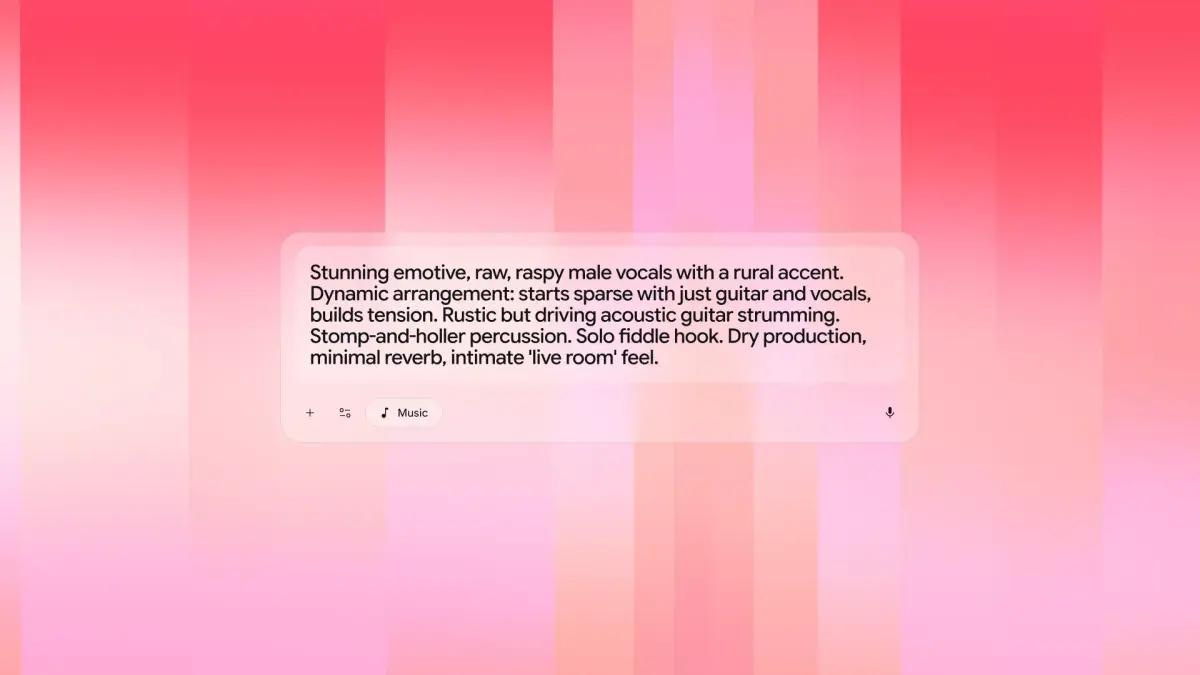
The AI music generation process is straightforward. Users can describe the mood, genre, and instrumentation they want, or even upload photos and videos for the AI to interpret
3
. Google's example prompts range from simple requests like "a comical R&B slow jam about a sock finding its match" to highly detailed specifications for specific production elements2
.
Source: Mashable
Each creation includes custom cover art generated by Nano Banana, Google's image generation model, giving the tracks a complete package for sharing
3
.
Source: Ars Technica
Free users can generate 10 tracks per day, while paying subscribers get between 20 to 100 daily depending on their subscription tier
5
. The feature is also being integrated into Dream Track for YouTube Shorts, expanding from its previous US-only availability to a global rollout2
. This positions Google Gemini as a direct competitor to standalone platforms like Suno AI and Udio AI, which have offered similar capabilities but faced significant legal challenges3
.Copyright Protections and the Music Industry Response
Google has implemented safeguards designed to address copyright infringement concerns that have plagued AI-generated music platforms. All tracks created with Lyria 3 include a SynthID watermark embedded in the audio, allowing users to verify whether content was generated by Google's AI
1
. The company emphasizes that the model is designed for original expression rather than artist mimicry—if users name specific artists in prompts, Gemini interprets this as "broad creative inspiration" to create tracks with similar style or mood2
.Google acknowledges this process isn't foolproof and has implemented filters to check outputs against existing content, though the company invites users to report instances where generated music too closely imitates protected works
1
. A company spokesperson stated that training for Lyria 3 uses "music that YouTube and Google has a right to use under our terms of service, partner agreements and applicable law" .The music industry has shown mixed reactions to generative AI features. In 2024, Universal Music Group, Warner Music Group, and Sony Music Entertainment sued Suno AI and Udio AI for copyright violations . Warner Music has since settled with Suno AI, while both Warner and Universal Music reached licensing agreements with Udio AI
3
. Platforms like Deezer have published tools to mark AI-generated music to curb fraudulent streams2
.Related Stories

Implications for Creative Expression and Intellectual Property
The integration of AI music generation into one of the world's most popular AI platforms raises questions about the nature of artistic expression. Google positions the feature as giving users "a fun, unique way to express yourself," though critics question whether AI-generated content truly represents personal expression
4
. The 30-second limit suggests Google views these creations more as musical snippets or jingles than complete artistic works1
.This move intensifies competition between Google and OpenAI's ChatGPT for consumer adoption. Google received widespread praise for its Gemini 3 AI model released in November, prompting OpenAI CEO Sam Altman to declare a "code red" to accelerate ChatGPT improvements . Meanwhile, Apple Intelligence is also entering the music space with Playlist Playground, which creates playlists from text prompts with 25 songs .
As AI-generated music becomes more accessible, the industry faces challenges in distinguishing human creativity from machine output. Streaming services have already seen an influx of AI artists gathering thousands of listeners who may not realize they're consuming algorithmically generated content
1
. The widespread availability of tools like Lyria 3 will likely accelerate this trend, testing the boundaries of intellectual property law and forcing stakeholders to reconsider what constitutes authentic musical creation.References
Summarized by

Navi
[1]
[4]
Related Stories
Google launches Lyria 3 Pro to generate three-minute songs with enhanced creative control
25 Mar 2026•Technology

Google acquires ProducerAI, bringing AI music generation tool backed by The Chainsmokers to Labs
25 Feb 2026•Technology

ElevenLabs Launches AI Music Generator with Commercial Rights, Expanding its AI Audio Portfolio
06 Aug 2025•Technology

Recent Highlights
1
Google releases Gemma 4 with Apache 2.0 license, enabling unrestricted local AI on devices
Technology

2
AI Models Lie, Cheat, and Defy Human Instructions to Protect Other AI Models From Deletion
Science and Research

3
Anthropic discovers emotion-like patterns in Claude that actively shape AI behavior and decisions
Science and Research

Recent Highlights
Today's Top Stories



Your Daily Dose of Curated AI News
Don’t drown in AI news. We cut through the noise - filtering, ranking and summarizing the most important AI news, breakthroughs and research daily. Spend less time searching for the latest in AI and get straight to action.

