6 Sources
6 Sources
[1]
Adobe's longtime CEO to exit role amid AI disruption, shares tumble
March 12 (Reuters) - Adobe (ADBE.O), opens new tab said on Thursday its chief executive officer Shantanu Narayen will transition from his position once a successor has been appointed, sparking uncertainty around the company's strategy as it grapples with heightened industry competition. Shares of the company fell around 7.5% in extended trading. Narayen's exit from the role comes after he served as the company's head for 18 years, during which he helped the company's flagship software such as Photoshop, Illustrator, Premiere Pro and InDesign become household products for creatives across the world. Narayen will stay on as chair of the board to support the next CEO, the company said. Adobe is grappling with a changing software landscape, where artificial intelligence is lowering the barrier to entry for design and its dominant position in the industry is being threatened by newcomers embracing the technology. Worries have also flared with the rise of new automated AI tools and agents that many fear would be able to disrupt traditional software subscription models and give way to quicker and cheaper ways of creating products. Adobe's shares have fallen around 22% so far this year, reflecting investor apprehension over the firm's AI strategy and outlook. The company also announced quarterly financial results, forecasting second-quarter revenue of between $6.43 billion to $6.48 billion, compared with estimates of $6.43 billion, according to data compiled by LSEG. It reported first-quarter revenue of $6.40 billion, beating estimates of $6.28 billion. Reporting by Zaheer Kachwala in Bengaluru; Editing by Alan Barona Our Standards: The Thomson Reuters Trust Principles., opens new tab
[2]
Adobe CEO Shantanu Narayen's Legacy Differs Dramatically With Who You Ask
Adobe's longtime CEO, Shantanu Narayen, announced this week that he is stepping down after 18 years as CEO and nearly 30 years at the company. If you ask shareholders, Narayen was, for a long time, among the very best in the biz. If you ask Adobe's core customers, the artists who were once indispensable to the company's success, it's a different story. I have been vocal with my criticisms of Narayen. I, like many photographers and other artists, dislike many of the things Adobe has done under his stewardship. While the company's software has increasingly made my life easier, I, like many others, have felt just as increasingly ignored or outright disrespected by the company during Narayen's tenure. If you believe that a CEO's core responsibility is to the shareholder, rather than the customer, Narayen's legacy is one of immense success. I have little doubt that throughout much of his tenure, Adobe's board has been utterly giddy with excitement about how Narayen transformed the company into a software-as-a-service behemoth and grew its B2B business. Narayen himself made sure to mention the company's revenue growth under his guidance in his farewell letter to employees. Fair enough, it was a very impressive run. During Narayen's tenure, Adobe's share price increased from around $40 in late 2007 when he took over to an all-time high of $688.37 in 2021. That's a hell of an increase. It has dipped in recent years and tumbled again after Narayen said he was leaving, but Adobe grew from being big in the software space to outright monolithic under Narayen's leadership. That said, the ongoing AI era has been less kind to Adobe. The company has committed massive resources to AI technology, such as its own Firefly model, but has consistently trailed competitors in both quality and development speed. After touting its ethical approach to AI for years, boasting about how Adobe Firefly was the most commercially-safe AI model out there, the company's lack of success forced its hand, and the it eventually tore down the walls around its garden, undercutting its initial promise once it became clear it was not going to be the most profitable avenue. Adobe announced its Firefly text-to-image generator in March 2023. By that time, Adobe's share price had already dipped from the $688 in November 2021 to well under $400. Initial Firefly success and continually increasing revenues helped the stock rebound up over $600 again in 2024. But since February 2024, the trend has been almost entirely downhill. Adobe stock prices hit their lowest point in over five years last month, just over $244. Although Adobe and Narayen are painting his departure as entirely the outgoing CEO's decision, it's easy to wonder whether tumbling share prices had something to do with the transition, or at least sped up existing plans. Narayen will stay on the board and help Adobe select his successor, but the timing of his departure is fascinating. Investors are about as skeptical of Adobe's approach to software in the AI age as they have ever been, and a massive shakeup at the top could do more harm than good. After over 15 years of extreme confidence in Narayen's ability to lead Adobe and grow it into a bona fide software powerhouse, investors are feeling much less certain about Adobe, while creative professionals are left asking: What took you so long? Adobe's strategy, vision, and direction have long rubbed its subscribers -- many of whom have never once been thrilled about the subscription model in the first place -- the wrong way. There is no question that Adobe has some of the best software engineering talent in the world. The company attracts exceptional people to build its software, and every single one of them I've spoken to over the years has been overflowing with passion for the products Adobe makes and the artists it serves. But when these products live behind increasingly towering paywalls, are marketed more and more to enterprise customers, and are jammed to the gills with AI features that many artists didn't ask for, the developers' passion becomes harder to see in the final product. Premiere Pro is losing ground to DaVinci Resolve, Photoshop has a free new competitor to watch out for, and even Apple is getting in on the creative software suite business. Then there's Canva, which has eaten Adobe Express' lunch in the enterprise world. Adobe is facing more threats from more directions than it has in a very long time. I think a prudent lesson to take away from Adobe's relative challenges during the AI upheaval is that they may be chasing a dragon, and that reinvesting in its core products and audience would be a more sustainable and stable path forward, albeit with a much lower growth ceiling. But shareholders don't want conservative strategies, and they definitely don't want to miss the AI wave. They want more AI, and Adobe is determined to deliver it. "Our mission, Empower Everyone to Create, represents an even larger opportunity in the AI era. By delivering an innovative roadmap aligned to our audience strategy, we are positioning Adobe to lead this next chapter," Narayen wrote. "The next era of creativity is being written right now -- shaped by AI, by new workflows and by entirely new forms of expression. Adobe has never waited for the future to arrive. We've anticipated it. We've built it. And we've led it. What gives me the greatest confidence isn't just our technology -- it's our people. Your ingenuity, resilience and commitment to customers are what will define this moment." "On behalf of the Board, I want to recognize Shantanu's contributions as CEO and architect of Adobe's transformation over the past 18 years, and for positioning Adobe for success in the AI-driven era," said Frank Calderoni, Lead Independent Director of Adobe and the chair of the special committee that will select Adobe's next CEO. "As we take the next step in succession planning, we are focused on selecting the right leader for this next exciting chapter of the company's growth and are grateful for Shantanu's continued leadership as CEO to ensure a smooth transition." This may be what stockholders want, it may even be what many of Adobe's current customers want, but I don't think it's what Adobe's oldest customers care about. There is plenty of room for AI to empower artists, Adobe is right about that. However, it seems to me that Adobe's grandest vision of all is less about empowering artists and more about enabling big corporations to ditch artists altogether. Adobe shareholders and I agree on very little about creative software, but we agree that Adobe's prospects are not what they were a year ago. I think that because I continue to watch Adobe care less about individual artists and more about finding ways to monetize AI technology that is, undeniably, replacing real, creative people. Shareholders lack confidence because they think Adobe is taking too long to build that very AI tech that I wish wasn't coming. Shareholders and I definitely disagree with what Narayen's legacy is, too. They watched the number of zeroes behind dollar signs grow year after year, while I, and many other photographers, felt Adobe feel move farther away from us. I get it from a business perspective -- big numbers got bigger -- but that doesn't mean I need to be happy about it. And it certainly doesn't mean I need to praise Narayen. I respect the sheer scale of what he achieved. I admire that he grew Adobe so that it could hire more great work to build better software. But for me, Narayen's legacy is ultimately one of treating photographers like an afterthought and then, as it stands now and after using our passion and love for art to boost his brand, believing we aren't really necessary at all.
[3]
Adobe CEO Narayen Plans Exit as Tech Firms Restructure Around AI - Decrypt
The automation is rapidly reshaping hiring, engineering roles, and tech leadership, observers told Decrypt. Shantanu Narayen, CEO of Adobe, plans to step down after nearly two decades at the helm of the software maker, as the rise of generative AI forces tech companies to rethink leadership, strategy, and workforce size. Adobe announced Thursday that Narayen will remain as board chair while the company begins a search for his successor, marking a leadership transition as the firm expands its push into generative AI tools across its creative and marketing software products. "The next era of creativity is being written right now -- shaped by AI, by new workflows and by entirely new forms of expression," Narayen wrote in a letter to employees. During his tenure, Narayen oversaw Adobe's growth, lifting its revenue from under $1 billion to over $25 billion, and its software and digital experience tools reached billions of users. The changes at Adobe come as generative AI tools begin to challenge parts of its core creative software business, with new platforms offering image, video, and design capabilities through simple prompts, replacing traditional editing workflows. The shift is forcing other tech companies to rethink how products are built, how teams are structured, and how quickly new tools can be deployed. Tech firms are "pivoting their operations around the AI narrative," to integrate it across all functions, focusing on strategy and product development, Dominick John, analyst at Zeus Research, told Decrypt. There is a "rapid realignment of tech talent," where demand has surged for roles in AI while "legacy and routine positions are being pared back," he added. This week, workplace software firm Atlassian confirmed it will cut about 1,600 jobs as it shifts resources toward AI. That followed Jack Dorsey's payments company Block, which runs the Bitcoin-focused Cash App, also cutting over 4,000 staff last week as it reorganizes around AI tools and automation. What's happening "isn't just a Big Tech story," Ryan Yoon, senior analyst at Tiger Research, told Decrypt. "Organizations are choosing to do fewer things with smaller, more focused teams," Yoon said. OP Labs, the developer behind Optimism, also cut staff earlier this week as Ethereum scaling strategies shift and activity moves toward rival networks such as Coinbase's Base. "The uncomfortable truth: if you've automated your own workflow, you've also made the case for eliminating your role," he added. "This is a long time coming, it's a matter of if not when," Berna Misa, deal partner at Broady Ventures, told Decrypt, pointing to trackers for the trend. One such site, jobloss.ai, tracks layoffs where artificial intelligence is cited as a contributing factor, estimating about 76,800 AI-linked job losses globally, including roughly 66,400 in the U.S. The tech sector "has always been the sector that is most disrupted by its own creations," Luis Buenaventura, president at the Blockchain Council of the Philippines, told Decrypt. "This is because it's often also its own first customer." AI coding tools, for instance, are making experienced developers "lethally productive," reducing the need for large teams of junior engineers and quality assurance staff, Buenaventura explained. As a result, companies launching new projects may hire fewer people and focus on senior developers with "real-world experience that AI cannot currently simulate," he said.
[4]
Adobe CEO to Step Down as Company Faces Intensifying AI Battle
Adobe said yesterday that CEO Shantanu Narayen will step down from his position after appointing his successor. The leadership shift comes amid the design software company's battle to keep up with AI. Narayen is widely credited with building the company over the last nearly 20 years, and plans to act as chair of the board through the transition period. His departure marks the company's attempt to boost its AI sector. "On behalf of the Board, I want to recognize Shantanu's contributions as CEO and architect of Adobe's transformation over the past 18 years, and for positioning Adobe for success in the AI-driven era," said Frank Calderoni, Adobe's lead independent director. Going All in on AI Leaders of software companies have had to work hard to convince investors that their tools won't cave in the face of an increasingly AI-powered environment.
[5]
Adobe's longtime CEO Shantanu Narayen to exit role amid AI disruption
Adobe's CEO Shantanu Narayen will step down after 18 years, sending shares down over 7% amid concerns about AI disruption. Despite reporting Q1 revenue and profit above estimates, the company faces strong competition and fears that new AI tools could disrupt its subscription model. Narayen will remain as board chair to support the transition. Adobe's longtime CEO Shantanu Narayen will leave his role once a successor is appointed, the design software maker said on Thursday, sending its shares down over 7% in extended trading on renewed worries around its strategy as it grapples with AI disruption. Narayen's exit from the role comes after he served as the head of Adobe for 18 years, during which he helped the company's flagship software such as Photoshop, Illustrator, Premiere Pro and InDesign become household products for creatives across the world. Narayen will stay on as chair of the board to support the next CEO, the company said. But the announcement of him leaving the helm puts the company in a precarious position as it comes at a time when Adobe is doubling down on AI, striking partnerships and exploring acquisitions to extend its industry lead. Separately, Adobe reported quarterly financial results, with double-digit growth in total revenue and its customer subscription segments, reflecting resilient spending on its product suite. Adobe is grappling with a changing software landscape, where artificial intelligence is lowering the barrier to entry for design and its dominant position in the industry is being threatened by newcomers embracing the technology. "Investors will likely focus on whether incoming leadership maintains a balance between disciplined execution and aggressive AI investment, especially as competition in creative and enterprise AI intensifies," said Emarketer analyst Grace Harmon. Worries have also flared with the rise of new automated AI tools and agents that many fear would be able to disrupt traditional software subscription models and give way to quicker and cheaper ways of creating products. While Adobe has bet heavily on artificial intelligence to bolster its product suite, "investor skepticism about monetization timing and payoff may have factored into a drop in its share prices," Harmon said. Adobe's shares have fallen around 22% so far this year after declining over 21% in 2025, reflecting investor apprehension over the firm's AI strategy and outlook. The company forecast second-quarter revenue between $6.43 billion and $6.48 billion, compared with estimates of $6.43 billion, according to data compiled by LSEG. It reported first-quarter revenue of $6.40 billion, beating estimates of $6.28 billion. On an adjusted basis, the company earned $6.06 per share, compared with estimates of $5.87 per share. Creative and Marketing Professionals subscription revenue came in at $4.39 billion, topping expectations of $4.32 billion.
[6]
Adobe's longtime CEO to exit role amid AI disruption, shares fall
March 12 (Reuters) - Adobe's longtime CEO Shantanu Narayen will leave his role once a successor is appointed, the creative tooling company said on Thursday, sending its shares down 6.5% in extended trading on renewed worries around its strategy as it grapples with AI disruption. Narayen's exit from the role comes after he served as the company's head for 18 years, during which he helped the company's flagship software such as Photoshop, Illustrator, Premiere Pro and InDesign become household products for creatives across the world. Narayen will stay on as chair of the board to support the next CEO, the company said. Adobe is grappling with a changing software landscape, where artificial intelligence is lowering the barrier to entry for design and its dominant position in the industry is being threatened by newcomers embracing the technology. "Investors will likely focus on whether incoming leadership maintains a balance between disciplined execution and aggressive AI investment, especially as competition in creative and enterprise AI intensifies," said Emarketer analyst Grace Harmon. Worries have also flared with the rise of new automated AI tools and agents that many fear would be able to disrupt traditional software subscription models and give way to quicker and cheaper ways of creating products. Adobe's shares have fallen around 22% so far this year after declining over 21% in 2025, reflecting investor apprehension over the firm's AI strategy and outlook. The company also announced quarterly financial results, forecasting second-quarter revenue of between $6.43 billion to $6.48 billion, compared with estimates of $6.43 billion, according to data compiled by LSEG. It reported first-quarter revenue of $6.40 billion, beating estimates of $6.28 billion. (Reporting by Zaheer Kachwala in Bengaluru; Editing by Alan Barona)
Share
Share
Copy Link
Shantanu Narayen will exit his role as Adobe CEO after 18 years, triggering a 7.5% share drop amid mounting investor concerns over the company's AI strategy. The leadership change comes as Adobe faces intensifying competition from AI-powered design tools threatening its dominant market position. Despite reporting first-quarter revenue of $6.40 billion, Adobe's shares have fallen 22% this year.
Adobe announced that Shantanu Narayen will transition from his role as CEO once a successor is appointed, marking the end of an 18-year tenure that transformed the design software maker into a subscription powerhouse
1
. The announcement sent shares tumble by approximately 7.5% in extended trading, reflecting investor concerns about the company's future strategy in an AI-dominated technology landscape5
. Narayen will remain as chair of the board to support the leadership change and succession planning process.
Source: ET
The timing of this transition puts Adobe in a precarious position as the company grapples with AI disruption that threatens to upend traditional software models. Grace Harmon, an analyst at Emarketer, noted that "investors will likely focus on whether incoming leadership maintains a balance between disciplined execution and aggressive AI investment, especially as competition in creative and enterprise AI intensifies"
5
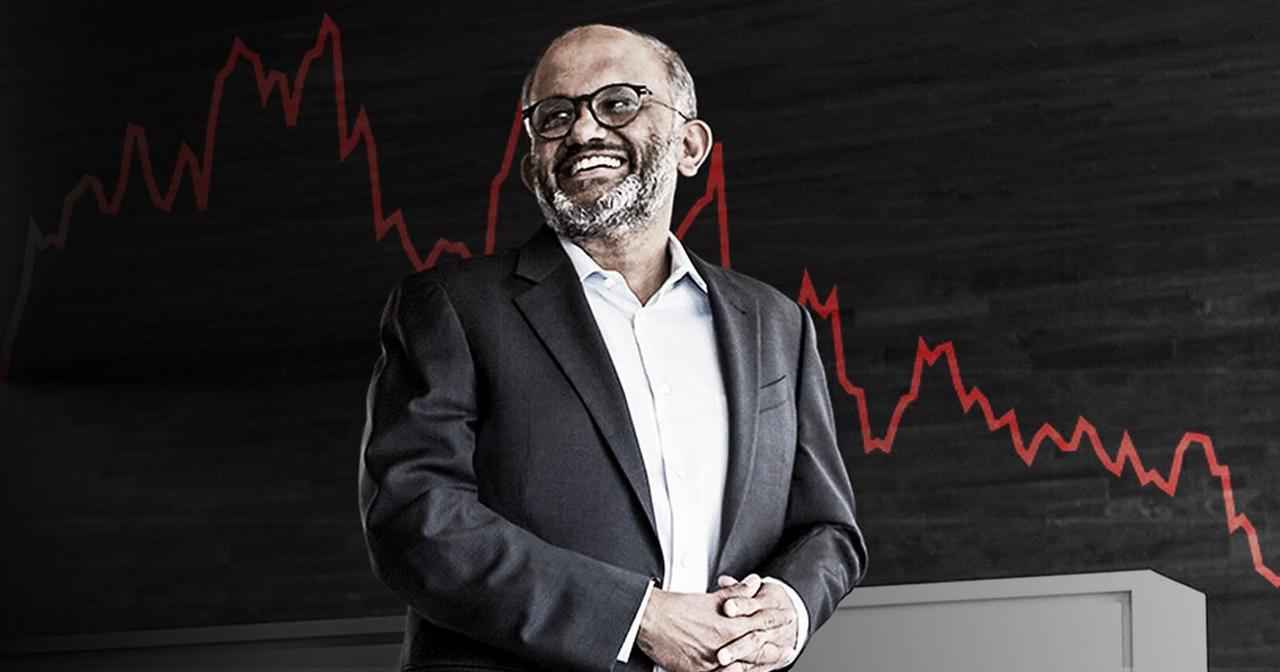
.Adobe's market position has weakened considerably as generative AI impact reshapes the creative software landscape. Stock prices have declined 22% so far this year, adding to a 21% drop in 2025 . The company's shares, which soared from around $40 when Narayen took over in 2007 to an all-time high of $688.37 in 2021, have plummeted to their lowest point in over five years, hitting just over $244 last month
2
.
Source: PetaPixel
Despite quarterly financial results showing first-quarter revenue of $6.40 billion—beating estimates of $6.28 billion—and adjusted earnings of $6.06 per share compared to expectations of $5.87 per share, investors remain skeptical
5
. The company forecast second-quarter revenue between $6.43 billion and $6.48 billion, meeting analyst estimates.Artificial intelligence is lowering the barrier to entry for design, and Adobe's dominant position faces threats from newcomers embracing the technology
1
. Premiere Pro is losing ground to DaVinci Resolve, Photoshop faces new free competitors, and Canva has captured significant enterprise customers in areas where Adobe Express once competed2
.The company's Firefly AI model, announced in March 2023, has consistently trailed competitors in both quality and development speed. After initially promoting its ethical approach to AI and commercial safety, Adobe eventually relaxed restrictions around its Firefly AI model when it became clear the more restrictive approach wasn't the most profitable avenue
2
.Related Stories
The leadership change at Adobe reflects a broader trend as tech firms restructure around AI. Dominick John, analyst at Zeus Research, told Decrypt that companies are "pivoting their operations around the AI narrative" with a "rapid realignment of tech talent" where demand has surged for AI roles while legacy positions are being reduced
3
. Atlassian cut about 1,600 jobs this week, while Block eliminated over 4,000 staff as organizations reorganize around AI tools and automation.
Source: Decrypt
"The uncomfortable truth: if you've automated your own workflow, you've also made the case for eliminating your role," Ryan Yoon, senior analyst at Tiger Research, explained
3
. The subscription model that defined Narayen's success now faces pressure from new automated AI tools and agents that offer quicker and cheaper ways of creating products.While shareholders long celebrated Narayen's transformation of Adobe into a software-as-a-service behemoth with revenue growth from under $1 billion to over $25 billion
3
, the creative user base tells a different story. Many photographers and artists have felt increasingly ignored as products live behind towering paywalls, are marketed more to enterprise customers, and are filled with AI features many didn't request2
.Frank Calderoni, Adobe's lead independent director, stated: "On behalf of the Board, I want to recognize Shantanu's contributions as CEO and architect of Adobe's transformation over the past 18 years, and for positioning Adobe for success in the AI-driven era"
4
. Whether the next CEO can balance aggressive AI investment with rebuilding trust among Photoshop, Illustrator, and Premiere Pro users remains a critical question for Adobe's future.Summarized by
Navi
26 Mar 2026•Business and Economy

10 Dec 2025•Business and Economy

06 Sept 2024

1
Technology

2
Science and Research

3
Startups