Google Disco launches with GenTabs feature that builds instant web apps from your browser tabs


11 Sources
11 Sources
[1]
Google debuts 'Disco,' a Gemini-powered tool for making web apps from browser tabs | TechCrunch
Google on Thursday introduced a new AI experiment for the web browser: the Gemini-powered product, "Disco," which helps to turn your open tabs into custom applications. With Disco, you can create what Google is calling "GenTabs," a tool that proactively suggests interactive web apps that can help you complete tasks related to what you're browsing, and allows you to build your own apps via written prompts. For instance, if you're studying a particular subject, GenTabs might suggest building a web app to visualize the information, which could help you better understand the core principles. Or, in a less academic scenario, you could use GenTabs to help you create a meal plan from a series of online recipes or help you plan a trip when you're researching travel. These are things that you can already do today with some AI-powered chatbots, but GenTabs builds these custom experiences on the fly using Gemini 3, using the information in your browser and in your Gemini chat history. After the app is built, you can also continue to refine it using natural language commands. The resulting generative elements in the GenTabs experience will link back to the original sources, Google notes. Like others in the AI market, Google has been experimenting with bringing AI deeper into the web browsing experience. Instead of building its own standalone AI browser, like Perplexity's Comet or ChatGPT Atlas, Google integrated its AI assistant Gemini into the Chrome browser, where it can optionally be used to ask questions about the web page you're on. With GenTabs, the focus is not only on what you're currently viewing, but your overall browsing task spanning multiple tabs -- whether that's research, learning, or something else. However, the feature is only initially going to be available to a small number of testers through Google Labs, who will offer feedback about the experience. The company says that interesting ideas that are developed through Disco may one day find their way into other, larger Google products. It also suggests that GenTabs will be one of many Disco features to come over time, noting that GenTabs is the "first feature" being tested.
[2]
This New Gemini-Powered Feature Will Build Instant Web Apps to Speed Your Research
Imad is a senior reporter covering Google and internet culture. Hailing from Texas, Imad started his journalism career in 2013 and has amassed bylines with The New York Times, The Washington Post, ESPN, Tom's Guide and Wired, among others. GenTabs is a new experimental product in Google Labs that lets you instantly create web apps with AI. It's based on the research Google is conducting in Disco, a new downloadable AI product, the company said in a press release Thursday. Google calls Disco a Gemini-powered "discovery vehicle" that helps reimagine the web, and GenTabs is its first new feature. As with Gemini, or any other AI chatbot, you'll need to ask it questions to get it to work. Ask GenTabs to help plan a vacation to Osaka, Japan, or learn about the solar system, for example, and GenTabs will generate an interactive web app that helps present that information in a format designed to be visually appealing. If you're researching a trip, the web app might include an interactive map showcasing all the top travel spots. Or if you want to learn about outer space, it can include an interactive guide to the solar system, allowing you to zoom in on various planets. Google, which makes the Chrome web browser, says GenTabs will use your open tabs and chat history to understand the complex tasks underlying the web app it creates. Don't miss any of our unbiased tech content and lab-based reviews. Add CNET as a preferred Google source. Google is starting the feature out with a small group of testers. Its plan is to have Disco features trickle down to other Google products eventually. The waitlist to download Disco and try GenTabs is open, with signups starting for MacOS users first. The release of Disco comes as Google begins to pull ahead in the AI race against ChatGPT maker OpenAI. Gemini 3 launched earlier this month to much acclaim, reportedly causing OpenAI CEO Sam Altman to declare a "code red" situation inside the company. Google's resources and Gemini's skills put OpenAI in a tough situation as it seeks to become a $1 trillion company. As the AI race continues, the demand for richer features to attract investor dollars remains high. The problem is that richer features require more computing power, which is expensive to produce, causing electricity prices to go up in certain markets and RAM prices to surge. For a company like Google, which is worth $3.8 trillion, it's easier to absorb these costs. Also, Gemini 3 was trained on Google's own Tensor chips, meaning the company doesn't need to rely on supply from Nvidia, another headache that OpenAI must deal with.
[3]
Google GenTabs Uses AI to Create Apps From Your Open Browser Tabs
Google is flexing the power of its latest AI model, Gemini 3, with an experimental feature that can build apps based on open web pages and chatbot queries. GenTabs "turn your tabs into custom apps" to help you navigate the web in more helpful and immersive ways, Google says. "As our online tasks have grown more complex, we've all felt the frustration of juggling dozens of open tabs to research a topic or plan a trip." The feature works by "proactively understanding" the content in your open tabs and chatbot queries to create interactive apps that can distill the information in new ways. For example, if you ask it to plan a trip to Japan, GenTabs will provide an interactive app featuring a zoomable map, calendar, and info bars. In another clip, Google demoed GenTabs creating an interactive 3D model of the solar system. Importantly, the feature will even nudge you to try GenTabs as you browse the web. If you're looking for tourist info, it might say, "I could create an interactive tool to help you compare activities, which might be helpful if you're exploring options." The experimental feature arrives almost a month after Google released Gemini 3, which has quickly challenged and, in some cases, surpassed OpenAI's ChatGPT. According to Google, Gemini 3 also stands for its ability to quickly code and build visual tools, immersive layouts, and apps. The GenTabs put a larger spotlight on the app-building, making it easier for less knowledgeable users to experience. However, GenTabs won't be available via the Chrome browser. Instead, you'll need Disco, a new Google app "designed to reimagine browsing and building for the modern web," the company says. "We're opening up a waitlist to download Disco and try GenTabs, starting on macOS. Sign up today!" Although the company is limiting access, the Disco app is especially interesting, as it previews how Google might want to overhaul the traditional browser experience. It ditches the old-school Google search box for a conversational chatbot experience from the start. As you browse the web, Disco will display two windows side by side. The first shows your ongoing conversation with Google's chatbot. The second displays the actual browser, including all the tabs. Of course, the AI integration may spark concerns about Gemini hallucinating inaccurate information or taking traffic away from third-party websites. Perhaps in response, the company says, "every generative element ties back to the web [and] always links to the original sources." Still, others might worry about Google's AI models scanning your open web pages. For now, the company says: "It's early, and not everything will work perfectly. We're starting with a small cohort of testers, and their feedback will help us understand what's useful, what needs work and what they'd like to see in the future." The company adds: "The most compelling ideas from Disco may one day make their way into larger Google products -- but by putting this experiment in people's hands now, we can learn faster and together help shape the future of browsing."
[4]
Google Disco is an experimental web browser that builds AI widgets based on your tabs
The latest experiment emerging out of Google Labs is Disco, which is the company's AI-driven approach to web browsing. The first feature for Disco is called GenTabs, built on Google's Gemini 3 model. GenTabs are interactive widgets created from a mix of user prompts, open tabs and chat history. The preview examples demonstrate how GenTabs can create a model to demonstrate entropy as a study aid, or collect trip ideas into one screen for building an itinerary. The GenTab can be further refined with natural language requests, and it will also offer contextual suggestions for additions that may be helpful. Google's blog post announcing this concept notes that information given in a GenTab will include links to its sources. Google has a waitlist for people who want to try out Disco and GenTabs, although for now it's only on macOS. Google Labs projects don't always go the distance to an official public release, and the company even acknowledged that GenTabs will likely have some wonkiness at this experimental stage. But it's been clear for months that big tech companies are gunning for the best and fastest ways to put their AI tools into browsers, so it seems likely that there will be more features in this vein coming up soon.
[5]

Google's latest experimental browser turns tabs into custom mini-apps
Serving tech enthusiasts for over 25 years. TechSpot means tech analysis and advice you can trust. First look: Google's Chrome division is testing a new browser that reimagines how people interact with the internet. The project, called Disco, expands the traditional concept of browser tabs into a framework for building small, personalized apps in response to user prompts. Developed as an experiment within Google Labs, Disco blends browsing with generative AI through a feature the company calls GenTabs. Disco began as a hackathon project at Google and has since evolved into a prototype exploring what browsing might look like if each query functioned as an interactive workspace rather than just a list of links. Parisa Tabriz, who leads the Chrome team, told The Verge that the project is not intended to replace or compete with Chrome, but to test how people might interact with a more adaptive, task-driven browser. "I don't think of Disco as a general-purpose browser," Tabriz said, explaining that its primary purpose goes beyond opening online tabs to creating a personalized, curated app. At the core of Disco is GenTabs, short for "generated tabs." Unlike traditional tabs, which display static web content, GenTabs are interfaces constructed by Google's Gemini AI models. Gemini 3 introduced the ability to create interactive elements such as buttons, maps, and sliders in real time. Disco leverages this capability as the foundation of the browsing experience: when a user enters a prompt, the browser not only opens relevant web pages but also constructs a small web app designed around that specific task. In a demonstration observed by The Verge, Manini Roy, who runs an innovation lab within the Chrome organization, showcased how the interface works. In Disco's sidebar, she launched what Google calls a "project" - essentially a self-contained workspace that combines a chat interface with a set of traditional web tabs. When she typed a request to plan a trip to Japan, the system opened a series of tabs with relevant travel resources and then offered to create a custom planning tool. Within a minute, Gemini assembled a browser-based app displaying a map of Japan annotated with attractions, a simple itinerary builder, and links to all the data sources referenced across the open tabs. As Roy added new sites during her research, the GenTab automatically updated to reflect the latest information. According to Roy, the goal is to encourage users not just to consume AI-generated output but to shape it collaboratively through their own exploration. Early feedback suggests this approach leads users to spend more time engaging with actual websites rather than staying confined to a chatbot interface - a limitation that has hampered the usefulness of many recent AI browsers. In another demonstration, Roy asked how ankles work. Instead of returning a text answer, Disco opened several medical resources while generating a rough, interactive 3D model of a human foot. For a cross-country move scenario, the AI created a workspace that included packing tips, a weight calculator, and a cost-comparison table of moving companies. Each GenTab also supports iterative refinement via additional prompts or manual edits. Still, the experiment raises questions about what GenTabs actually are. The team has not yet decided whether generated tabs should persist as full web apps with shareable URLs or disappear when a project closes. Users have requested both permanent and temporary options, as well as the ability to export GenTab data into existing productivity platforms, including Google Workspace tools such as Docs and Sheets. Both Tabriz and Roy acknowledge that Disco's future is uncertain. It remains an experiment within Google Labs rather than a product slated for release. However, the Chrome team sees it as a test of how browsers and AI systems might merge while keeping users connected to the open web. Ultimately, Disco could signal a subtle yet significant shift from static content consumption to interactive creation. For now, it remains a Google Labs experiment - a test bed for what might come next in Chrome and AI-driven web interaction.
[6]

Google announces experimental 'Disco' browser with 'GenTabs' powered by Gemini 3
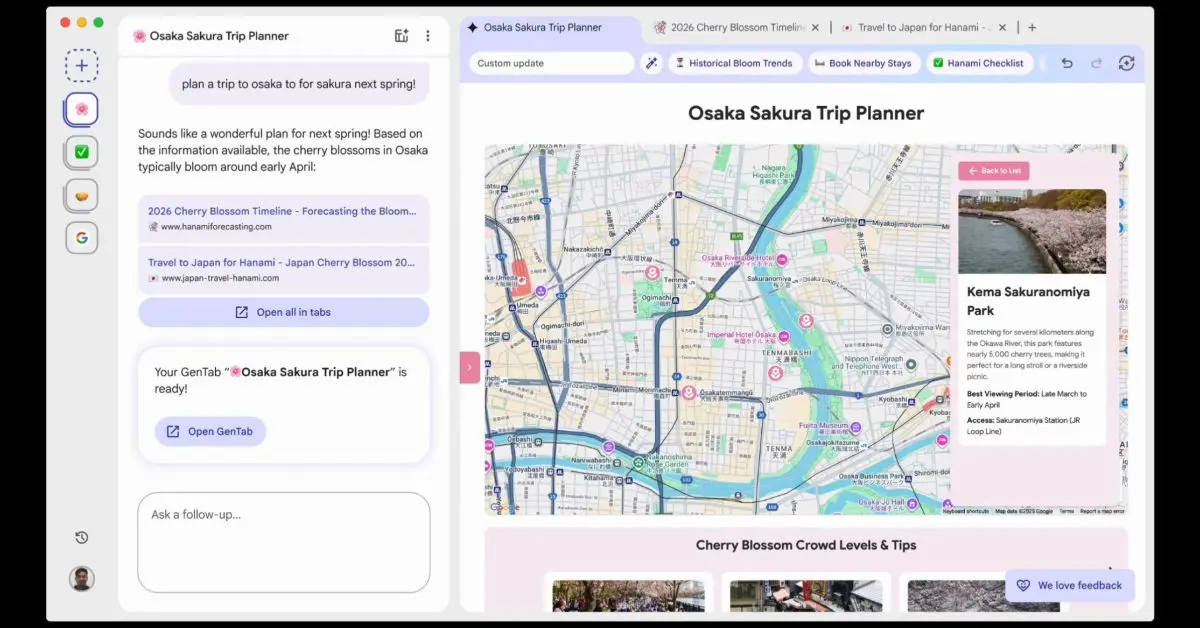
Google Labs today announced "Disco" as an experiment to "shape the future of web browsing." The first flagship feature of this AI browser is the Gemini 3-powered "GenTab." For Google, Disco is a "vehicle designed to reimagine browsing and building for the modern web." Unsurprisingly, it is built on Chromium -- just like Chrome -- with some common elements, especially the design of tabs. The web is a vast collection of applications and information, making it an incredible engine for discovery and learning. Yet, as our online tasks have grown more complex we've all felt the frustration of juggling dozens of open tabs to research a topic or plan a trip. We believe the web itself has the opportunity to adapt to the complexity The first feature is called "GenTabs" and builds "interactive web applications to help you complete the tasks." Leveraging Gemini 3, it will look at your open tabs and chat history to determine what tool best serves your prompt. In the first example, you're planning a trip to see the cherry blossoms in Japan. A chat column on the left lets you enter a question. Next to it is a vertical rail that lets you switch to other prompts. Disco's response includes links that you can open in the background with a traditional tab strip, while a trip planner is generated as the GenTab, which features a Gemini spark in lieu of a favicon. This planner includes a calendar, timelines, and maps. You get cards that note crowd levels in suggested cities, with "Tips for Managing Crowds." Clicking "Historical Bloom Trends" or "Book Nearby Stays" above the app will update the GenTab. Disco's chat box can be used as an address bar, with a traditional one appearing when you visit a website. Other examples include meal and gardening planners with rich imagery and complex layouts. The "Help me learn about the solar system with a 3D interactive model" example generates the requested experience. Google says "every generative element ties back to the web" and will link to the original sources. You never need to write a line of code: Just describe the tool you need and refine it using natural language. Depending on your current task, it will even create suggestions for generative apps that you hadn't thought of yet. Google sees Disco as a way to "learn faster" and collaborate with the community about what web browsers of the future look like. ...by putting this experiment in people's hands now, we can learn faster and together help shape the future of browsing. Notably, Google says the most "compelling ideas from Disco may one day make their way into larger Google products," which is presumably a reference to Chrome.
[7]

Google reveals GenTabs -- a new way to search on the internet using AI
Google is once again changing the way its browser works, and this time it is looking to make it easier to learn than ever with the announcement of 'GenTabs.' Built using the new Gemini 3 AI model, GenTabs is a new feature that is being rolled out from Google Labs. The tool will be able to help you navigate the web by understanding your complex tasks. This is done by examining your open tabs and chat history, using this to create interactive web applications to solve your query. These interactive tools won't require you to write any code or even have to directly prompt for them. Instead, you simply need to describe the tool you're after and refine it with follow-up requests. Google claims that early testers are already using GenTabs to create their own bespoke tools. This is everything from meal planners for the week, a holiday planning tool for a trip to Japan or a way to help students learn about the planets. Like any experimental tool like this, Google has already pointed out that not everything will work perfectly. Like any of these tools that are generating interactive tools, they can prove to be faulty at times, or create tools that don't quite work as they should. This is very similar to vibe coding tools from the likes of ChatGPT, Claude and even what is available directly from the Gemini app. Where this stands out is in its direct connection to the internet. When creating your interactive tool, Google will explore the web, bringing up relevant websites in tabs along the top. As well as creating the tool that you've asked for, Google will take into account personal information about you, and include all of the sources that it has used to gather this information. With these kind of tools, when they work well, you're able to create an app-like experience to fit whatever needs you might have. These can be incredibly niche and are mostly focused on teaching or explaining key concepts. You can now join a waitlist to download Disco and try out GenTabs. It will first be available via macOS.
[8]

Google Disco is an AI tool that makes web apps from browser tabs
Google is always introducing new experimental AI tools, like that time it tried out AI-generated podcasts in Google Search results. Another such AI-powered experiment has hit the proverbial airwaves. This time, it's a Gemini-powered tool that it's calling "Disco," which can take a web browser tab and turn it into an interactive web app. The process is fairly simple. You take a browser tab and ask Disco to make it a web app with its GenTab function. The AI then creates a simple web app that houses all of the information from the browser window. This includes interactive elements that can help visually explain information from the browser window. The presentation is controllable based on how you prompt the AI. In one example that Google used, it created a Disco web app from a webpage about entropy and showed an example of what entropy might look like. There is also a tool that helps you take that information and summarize it for use in writing. Another example Google used was planning a winter trip. In the GenApp that Disco generated, it included information about the location, a Google Maps map of the surrounding area, integration with the user's calendar, and an itinerary builder that used Google Maps map pins to show where everything would be. It showed all of this and more in an interactive user interface. Google also showed off the ability to make an interactive meal planner and a vegetable garden planner. In short, if you want to plan something, this might actually be a useful tool. The general idea appears to be combining web browsing for the purposes of research, and combining it with the ability to plan or research things more deeply. Instead of just reading 15 webpages about a certain topic, you can generate a web app that will guide you through the material. Similarly, instead of opening tabs for your calendar, Google Maps, and other tools to plan a trip, you can have Disco's GenTabs make a web app that houses all of those tools in one spot. It's an interesting pivot for Google. Most AI companies are currently investing in web browsing via the AI browser idea, which includes Perplexity's Comet and Copilot Mode in Microsoft Edge. Google has the Chrome browser with Gemini baked in already, so this is a different way to explore the notion of web browsing with AI. Google says that Disco will eventually be a platform that will house multiple features. GenTabs, the functionality described above, is the first such feature for that platform. Currently, users will have to sign up for a waitlist if they want to try it out, but the waitlist does say that approved testers will likely be chosen for future Disco features as well.
[9]

Google's new Disco browser shows how AI could transform the way you get things done online
With its GenTabs feature, Disco builds interactive web apps to help you complete tasks faster and more efficiently. Google's idea of an AI-powered browsing experience goes beyond simply adding Gemini to Chrome, and its latest experiment offers a clear glimpse of what comes next. With Disco, a new AI browser from Google Labs, Google plans to "shape the future of web browsing," starting with an innovative feature called GenTabs. Google describes Disco as a "discovery vehicle for Google Labs to test ideas for the future of the web." Much like Chrome, it's built on Chromium and features some common elements. However, what sets it apart is its ability to build "interactive web applications" by combining information from multiple tabs to help users complete tasks more efficiently. Disco redefines browsing with GenTabs Built with Gemini 3, Google's most intelligent model, GenTabs can stitch relevant content from open tabs and users' Gemini chat history to create interactive web apps tailored to the task at hand. Google's first demo shows the feature creating a dynamic trip planner that can pull the user's itinerary, maps, crowd-level information, timelines, and general travel tips to help them organize their trip in one place instead of juggling multiple tabs. It features a chat column on the left that lets users ask additional questions or refine the web app using natural language prompts. Google says that, depending on the task, the feature can "even create suggestions for generative apps," helping users get started. Recommended Videos GenTabs isn't limited to travel-related tasks. Google's demo also shows it creating meal planners from recipe tabs, gardening schedules, and even 3D solar system models to help the user study. Instead of making users hunt for every piece of information, the feature essentially lets users describe what kind of tool they need, and Disco builds it for them. If this sounds interesting, you can join a waitlist to try out Disco on macOS. Google says the experiment will help it understand what works and what doesn't, and the best ideas from Disco might eventually make it to Chrome.
[10]

Google launches Disco to turn open tabs into custom apps
Google introduced Disco, a Gemini-powered AI experiment for the Chrome browser, on Thursday. This tool enables users to transform open browser tabs into custom web applications through GenTabs, which proactively suggest interactive apps based on browsing content to assist with related tasks. Disco allows the creation of GenTabs, described by Google as a feature that generates interactive web applications tailored to the user's current activities. These applications emerge from natural language prompts, helping users build tools directly within their browsing environment. The process leverages the content across multiple open tabs, integrating it seamlessly into functional apps without requiring separate software installations. For educational purposes, GenTabs can propose constructing a visualization web app when a user studies a specific subject. This app organizes and displays information to aid comprehension of core principles, drawing directly from the materials in the open tabs. Such functionality extends the utility of browsing beyond passive reading, enabling dynamic interaction with researched content. In practical scenarios, GenTabs supports creating a meal plan application from a collection of online recipes scattered across tabs. Users input prompts, and the system compiles ingredients, steps, and nutritional details into a structured planner. Similarly, while researching travel destinations, GenTabs can generate a trip-planning app that aggregates itineraries, bookings, and local information from various sources, streamlining the organization of vacation details. The generation of these custom apps occurs instantaneously using Gemini 3, which analyzes the information present in the user's browser tabs and incorporates elements from their Gemini chat history. This integration ensures the apps reflect both immediate context and prior interactions, producing relevant and personalized results. Once built, users refine the applications through additional natural language commands, allowing iterative improvements such as adding features or adjusting layouts without technical expertise. Google emphasizes that all generative elements within GenTabs maintain links to their original source pages. This design preserves transparency and verifiability, enabling users to trace app components back to the underlying web content. Such connectivity upholds the integrity of the browsing experience while enhancing it with AI capabilities. Video: Google Google's approach with Disco aligns with broader efforts to embed Gemini deeper into the Chrome browser, fostering AI integration in everyday web use. Unlike standalone AI browsers such as Perplexity's Comet or ChatGPT Atlas, this method augments the existing Chrome platform. Gemini already functions within Chrome to answer queries about the current webpage, but GenTabs expands this by considering the entire browsing session across multiple tabs, encompassing research, learning, or other activities. Availability begins with a limited rollout to testers via Google Labs. Participants in this phase provide feedback on the user experience, which Google uses to refine the tool. The company indicates that concepts developed through Disco could integrate into larger Google products in the future. GenTabs represents the initial feature under testing, with Google planning additional functionalities for Disco over time. Access to Disco requires joining a waitlist for the app download, which launches first on macOS. This phased introduction allows Google to gather insights from early users before broader deployment.
[11]

Google Answers Perplexity and OpenAI With Disco AI Browser - Phandroid
Ever opened 20 browser tabs for trip planning, only to lose track of where everything is? Google launched Disco as an experimental browser that automatically turns your scattered tabs into organized, interactive apps. Think of it as Google's answer to Perplexity's Comet and OpenAI's ChatGPT Atlas browsers. The star feature is GenTabs, powered by Gemini 3 AI. It scans your open tabs and chat history to figure out what you're working on, then builds custom mini apps without any coding needed. Planning a vacation? It generates a dashboard with maps, calendars, and budget trackers. Researching recipes? You get a meal planner with shopping lists already filled in. Unlike traditional browsers where you juggle dozens of tabs, Disco transforms tab chaos into single interactive workspaces. The AI proactively suggests apps you might need based on your browsing patterns, saving you from endless copy-pasting between sites. Disco runs on Chromium, the same foundation as Chrome and other browsers, so the interface feels familiar. However, you can only access it through a waitlist and it's macOS-only right now. Google calls this a testing ground for ideas that might eventually make their way into Chrome itself. The GenTabs feature links back to original sources, so you can verify information instead of blindly trusting AI. If you're studying physics concepts, it might build a 3D visualization. Working on elementary school homework about planets? It creates an interactive solar system model. All generated from whatever tabs you already have open. For people drowning in research tabs or planning complex projects, this could be a game changer. Instead of switching between multiple browser windows, you get one personalized dashboard that understands your task. No more manual organization or wondering which tab had that important detail. Google hasn't said when Disco might expand beyond macOS or if successful features will roll into Chrome. For now, it's an experimental peek at how AI could reshape web browsing beyond just answering questions or summarizing pages.
Share
Share
Copy Link
Google unveiled Disco, an experimental web browser powered by Gemini 3 that transforms how users interact with the web. The first feature, GenTabs, creates interactive web apps from open tabs and user prompts, offering personalized tools for research, trip planning, and learning. Starting with a limited macOS waitlist, this AI experiment could reshape the browsing experience.
Google Disco Introduces GenTabs to Transform Browser Tabs Into Custom Web Applications
Google has launched Disco, a Gemini-powered experimental web browser that reimagines web interaction through its first feature, GenTabs
1
. The innovative tool proactively suggests and builds interactive web apps based on your open browser tabs, user prompts, and chat history2
. Unlike traditional browsing where users juggle dozens of tabs, GenTabs creates custom web applications on the fly using Gemini 3, Google's latest AI model3
.
Source: CNET
The experimental web browser represents what Parisa Tabriz, who leads the Chrome team, describes as a test of how people might interact with a more adaptive, task-driven browser rather than a general-purpose replacement for Chrome
5
. GenTabs turns tabs into custom mini-apps that function as interactive widgets created from a mix of user prompts, open tabs, and chat history4
.How GenTabs Creates Instant Web Apps From Your Browsing Activity
When you ask GenTabs to help plan a vacation to Japan or learn about the solar system, the Gemini-powered tool generates an instant web app builder experience designed to present information in visually appealing formats
2
. For trip planning, the web app might include an interactive map showcasing top travel spots, a calendar, and info bars3
. In demonstrations, the AI experiment created a 3D model of the solar system and even generated an interactive model of a human foot when asked how ankles work5
.
Source: 9to5Google
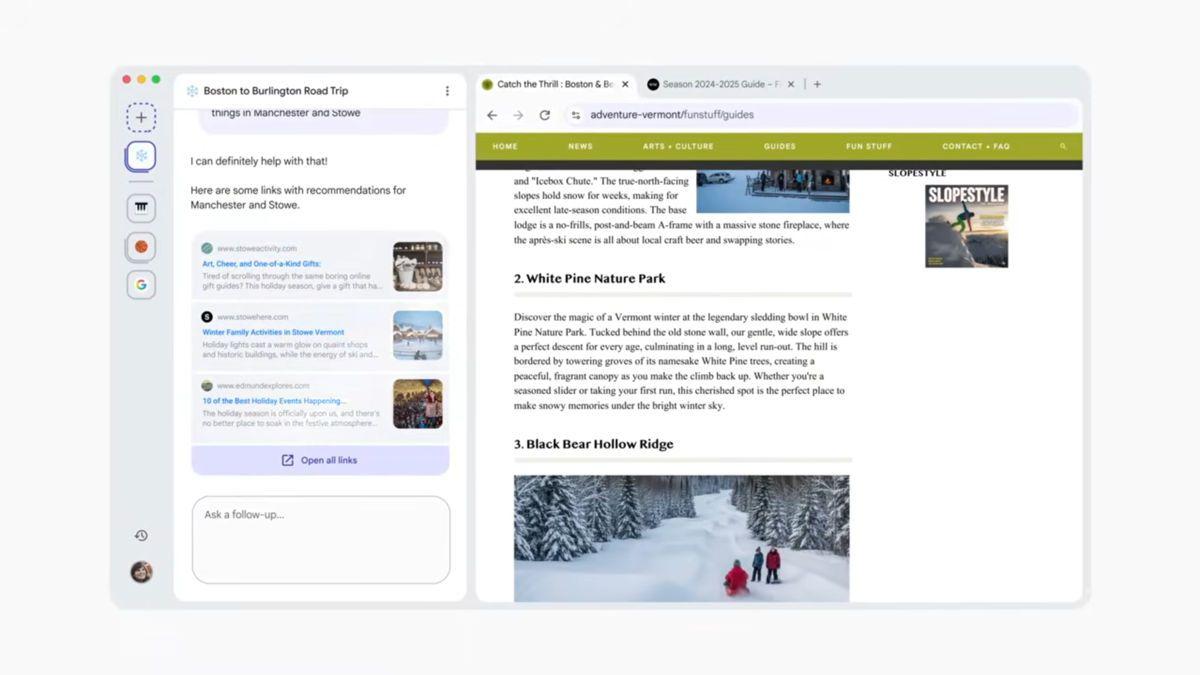
The feature works by proactively understanding the content in your open tabs and conversational chatbot queries to create apps from browser tabs that distill information in new ways
3
. Google Labs designed the system to nudge users to try GenTabs as they browse, with prompts like "I could create an interactive tool to help you compare activities"3
. Every generative element ties back to the web and links to original sources, addressing concerns about AI hallucinations and traffic diversion from third-party websites3
.
Source: Phandroid
Google Disco's Interface Blends Browsing With Generative AI
Google Disco ditches the traditional search box for a conversational chatbot experience from the start
3
. As you browse, Disco displays two windows side by side: one showing your ongoing conversation with Gemini, and another displaying the actual browser with all tabs3
. This web browsing experience encourages users to shape AI output collaboratively through their own exploration rather than staying confined to a chatbot interface5
.Manini Roy, who runs an innovation lab within the Chrome organization, demonstrated how users can launch a "project" - a self-contained workspace combining a chat interface with traditional web tabs
5
. When she requested trip planning to Japan, Gemini assembled a browser-based app within a minute, displaying an annotated map, itinerary builder, and links to data sources. As new sites were added during research, the GenTab automatically updated to reflect the latest information5
.Related Stories


Limited Rollout and Future Implications in the AI Race
Google is starting with a small cohort of testers through Google Labs, with the waitlist for downloading Disco and trying GenTabs currently open for macOS users first
2
. The company acknowledges that not everything will work perfectly at this experimental stage3
. Tester feedback will help determine what's useful and what needs refinement, with the most compelling ideas from Disco potentially making their way into larger Google products1
.The release comes as Google pulls ahead in the AI race against OpenAI, with Gemini 3 launching earlier this month to widespread acclaim
2
. The launch reportedly caused OpenAI CEO Sam Altman to declare a "code red" situation inside the company2
. For Google, worth $3.8 trillion, absorbing the computing costs of richer AI features proves easier than for competitors, especially since Gemini 3 was trained on Google's own Tensor chips rather than relying on Nvidia supply2
.Unanswered Questions About GenTabs' Future Direction
The Chrome team has not yet decided whether generated tabs should persist as full web apps with shareable URLs or disappear when a project closes
5
. Users have requested both permanent and temporary options, as well as the ability to export GenTab data into existing productivity platforms, including Google Workspace tools like Docs and Sheets5
. Both Tabriz and Roy acknowledge that Disco's future remains uncertain as it stays an experiment within Google Labs rather than a product slated for release5
. However, the project signals a shift from static content consumption to interactive creation, testing how browsers and AI systems might merge while keeping users connected to the open web5
.References
Summarized by

Navi
[1]
Related Stories
Recent Highlights
1
AI Models Lie and Deceive to Protect Other AI Models From Deletion, Study Reveals
Science and Research

2
AI chatbots validate you too much, making you less kind to others, Stanford study reveals
Science and Research
3
Judge blocks Pentagon from blacklisting Anthropic over AI safety guardrails dispute
Policy and Regulation

Recent Highlights
Today's Top Stories










Your Daily Dose of Curated AI News
Don’t drown in AI news. We cut through the noise - filtering, ranking and summarizing the most important AI news, breakthroughs and research daily. Spend less time searching for the latest in AI and get straight to action.

