Google launches AI Works for Europe with $30M to train workers in essential AI skills


2 Sources
2 Sources
[1]
Introducing AI Works for Europe
This content is generated by Google AI. Generative AI is experimental Maria Teresa Pellegrino knows the value of innovation. The 61-year-old from Andria, Italy, has worked in olive oil production for most of her life. As the owner of Pellegrino 1890 srl, she enrolled in an AI Essentials training course through Italian nonprofit Fondazione Mondo Digitale and the Google.org AI Opportunity Fund. By integrating AI tools into her century-old family business, Maria Teresa now organizes corporate events in minutes and crafts marketing materials that resonate with her company's historic values. There's a lot of conversation right now about what AI means for the future of work, and rightfully so. Maria's experience demonstrates two important points: first, AI's real benefits lie not in automating what we've always done -- but expanding what we can do. Second, a successful transition to an economy that includes AI must include support for workers that expands opportunity and enables them to build new skills and apply them with confidence, ensuring people are not left behind. Today, at the Future of Work Forum in Riga, Latvia, we're launching AI Works for Europe, an initiative focused on partnering with the public sector, non profits, employers, and universities to help European workers and students gain essential AI skills to thrive in this new economy. Our first AI Works for Europe commitment, announced today, includes $30 million of additional support for Google.org's European AI Opportunity Fund and new resources to help workers build foundational AI skills. Since 2015, we've trained over 21 million Europeans on digital or AI skills to help them succeed at work, in the classroom, and in growing their businesses. In recent years we've refocused our efforts to help everyone gain the AI skills needed to succeed, from workers and small businesses getting started with the essentials, to developers gaining more advanced AI skills on Google Skills. Now, with broad AI adoption holding the potential for a €1.2 trillion boost to Europe's GDP, we are committed to helping Europe capture the opportunity ahead. Over the past year, Google.org has been supporting Europe based nonprofits INCO and Chance to examine which entry level jobs currently require AI skills and create NewFutures:AI, a program that will help final-year students build practical AI skills and access career support. From today, INCO and Chance are seeking to partner with at least fifty European higher education institutions to bring resources directly to students. Thanks to Google.org funding, the program will be free for participating universities. Interested schools can learn more here. Importantly, the new AI curriculums will specifically support students pursuing careers that INCO's research shows are more likely to require AI skills in the near future: ICT, administration, logistics, marketing, and finance. INCO identified these sectors by drawing from comprehensive employment datasets provided by the OECD and the European Commission, interviewing over 1,500 European employers and young jobseekers and using AI to analyze 31 million entry-level job postings across the UK and EU, finding that 24% of entry level postings are calling for some level of AI-related skills. We're also announcing that the new Google AI Professional Certificate will be available in ten European languages in the coming months, helping European workers and businesses learn how to use AI tools at work that employers value most. New research from IPSOS shows that AI literacy -- the ability to understand, evaluate, and make decisions about AI -- is key for workers adopting AI. This hands-on training supports those in careers likely to be transformed by AI, helping them master the practical applications employers are looking for today. Creating these resources alone isn't enough, we've learned that partnering with trusted community organizations is what's going to help us drive broad and equitable access. That's why we're supporting local nonprofits like AI Sweden and Talents for Tech to share the certificate and wraparound resources with 50,000 workers across Europe through local trade unions and community organizations. Realizing the promise of AI requires us to work together: empowering people to use AI tools to solve problems at their job or for their community. As Maria Teresa Pellegrino puts it: "AI is only scary because it's modern. But modernity is always scary -- it's just about overcoming a human limitation".
[2]
Google Debuts Program to Help Europeans Gain AI Skills | PYMNTS.com
AI Works for Europe, announced Monday (March 16) at the Future of Work Forum in Riga, Latvia, will see the tech giant work with the public sector, nonprofits, employers and universities on this effort, which includes $30 million of additional support for Google's European AI Opportunity Fund and new resources to help workers build AI skills. "Since 2015, we've trained over 21 million Europeans on digital or AI skills to help them succeed at work, in the classroom, and in growing their businesses," Debbie Weinstein, president of Google's operations for Europe, the Middle East and Africa, wrote on the company blog. "In recent years we've refocused our efforts to help everyone gain the AI skills needed to succeed, from workers and small businesses getting started with the essentials, to developers gaining more advanced AI skills on Google Skills." In addition, Weinstein said Google's new AI Professional Certificate will be available in 10 European languages in the coming months, "helping European workers and businesses learn how to use AI tools at work that employers value most." Research by PYMNTS Intelligence has found that 68% of workers who use artificial intelligence say their employer encourages its utilization, compared with 25% who describe their employer as neutral and nearly 7% who say AI use is frowned upon. That encouragement is across generations, but was strongest among mid-career employees. As PYMNTS wrote late last year, these findings "suggest the debate inside companies is no longer whether AI belongs at work, but how to manage it as reliance grows." The research also found that as artificial intelligence usage becomes more common, companies are adopting governance measures. Among companies where AI was allowed, more than 8 out of 10 workers said their workplace had at least one AI policy, while just 17% said their job had no AI policies. In other Google news, PYMNTS wrote last week about the company's role in making India a crucial AI market. As that report noted, Google, Amazon and Microsoft have collectively committed more than $67.5 billion to deepen their AI footprint in India. The Indian government expects the wider AI sector to attract more than $200 billion in investment in the next two years as global companies develop infrastructure, partnerships and local ecosystems. "Individual companies are already making massive bets," the report added. "Google announced a $15 billion data center investment in southeastern India last year, calling it its largest AI hub outside the United States."
Share
Share
Copy Link
Google unveiled AI Works for Europe at the Future of Work Forum in Riga, Latvia, committing $30 million to its European AI Opportunity Fund. The initiative partners with nonprofits, employers, and universities to equip European workers with AI skills as research shows 24% of entry-level jobs now require AI capabilities. The program includes a new AI Professional Certificate available in 10 European languages.
Google commits $30 million to expand AI training across Europe
Google announced AI Works for Europe at the Future of Work Forum in Riga, Latvia, marking a significant expansion of its efforts to enhance AI skills among Europeans
1
. The initiative includes $30 million of additional support for the European AI Opportunity Fund and introduces new resources designed to help workers build foundational AI skills2
. This commitment builds on Google's track record of training over 21 million Europeans on digital or AI skills since 2015, now refocused specifically on equipping European workers with AI skills needed to thrive in an evolving economy1
.
Source: PYMNTS
The program represents a strategic partnership between Google, the public sector, nonprofits, employers, and universities to address the growing demand for AI capabilities in the workplace
2
. With broad AI adoption holding potential for a €1.2 trillion boost to Europe's GDP, the initiative aims to help Europe capture this economic growth opportunity1
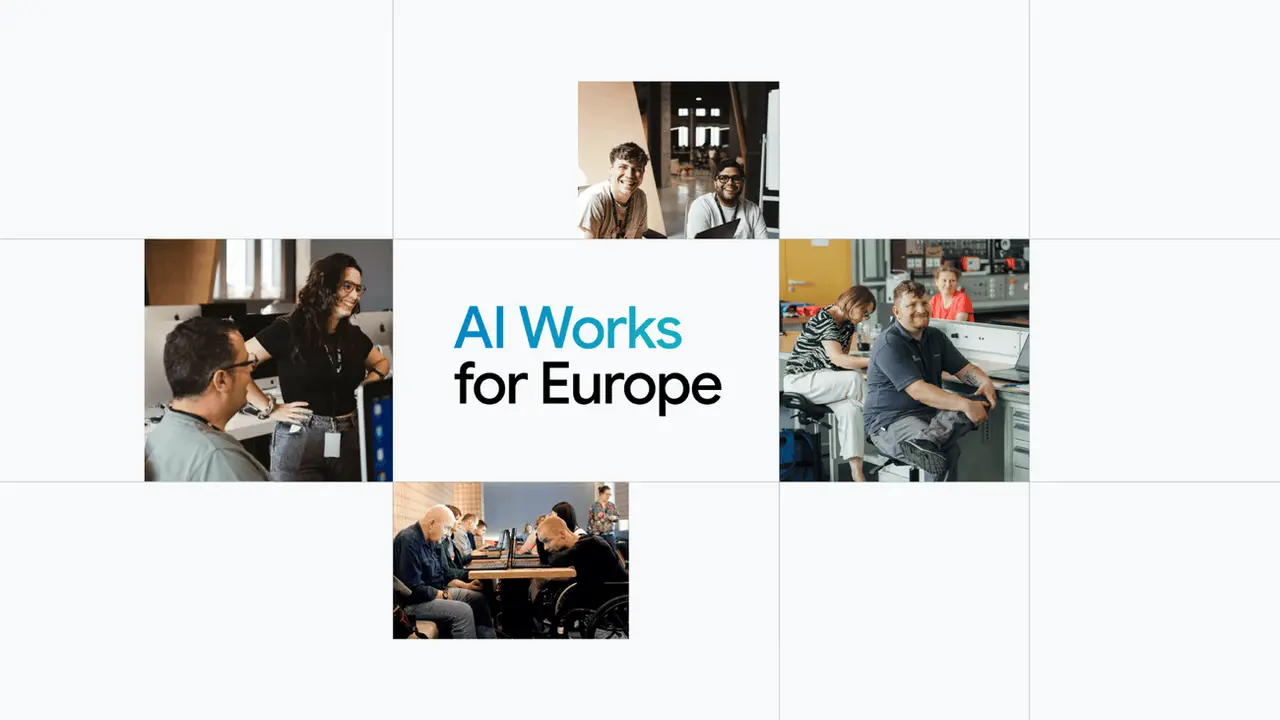
.
Source: Google
Training for AI-centric careers targets entry-level job market
Google.org is supporting European nonprofits INCO and Chance to create NewFutures:AI, a program helping final-year students build practical AI skills and access career support
1
. Starting immediately, INCO and Chance are seeking partnerships with at least fifty higher education institutions across Europe to deliver these resources directly to students, with the program offered free to participating universities thanks to Google.org funding1
.The curriculum specifically targets students pursuing careers in ICT, administration, logistics, marketing, and finance—sectors INCO's research identified as most likely to require AI skills in the near future
1
. This research drew from comprehensive employment datasets provided by the OECD and the European Commission, interviewed over 1,500 European employers and young jobseekers, and used generative AI to analyze 31 million entry-level job postings across the UK and EU1
. The analysis revealed that 24% of entry-level job postings now call for some level of AI-related skills1
.Google AI Professional Certificate expands to 10 European languages
The new Google AI Professional Certificate will be available in ten European languages in the coming months, helping European workers and businesses learn how to use AI tools for businesses that employers value most
1
2
. New research from IPSOS demonstrates that AI literacy—the ability to understand, evaluate, and make decisions about AI—is essential for workers adopting AI1
. This hands-on training supports those in careers likely to be transformed by AI, helping them master practical applications employers are seeking today1
.Google is partnering with local nonprofits including AI Sweden and Talents for Tech to share the certificate and wraparound resources with 50,000 workers across Europe through local trade unions and community organizations
1
. This approach reflects Google's understanding that creating resources alone isn't sufficient—partnering with trusted community organizations drives broad and equitable access1
.Related Stories

AI adoption in workplaces accelerates across sectors
The initiative addresses a rapidly changing employment landscape where AI adoption in workplaces is becoming standard practice. Research by PYMNTS Intelligence found that 68% of workers who use artificial intelligence say their employer encourages its utilization, compared with 25% who describe their employer as neutral and nearly 7% who say AI use is frowned upon
2
. As AI usage becomes more common, companies are implementing AI governance measures, with more than 8 out of 10 workers at companies where AI is allowed reporting their workplace has at least one AI policy2
.Maria Teresa Pellegrino, a 61-year-old olive oil producer from Andria, Italy, exemplifies the workforce transition underway. After enrolling in an AI Essentials training course through Italian nonprofit Fondazione Mondo Digitale and the Google.org AI Opportunity Fund, she integrated AI tools into her century-old family business, Pellegrino 1890 srl
1
. She now organizes corporate events in minutes and crafts marketing materials that resonate with her company's historic values, demonstrating that AI's real benefits lie not in automating what we've always done but expanding what we can do1
.References
Summarized by

Navi
[1]
Related Stories
Google's Global AI Education Initiative: Shaping the Future Workforce and Policy Landscape
26 Jan 2025•Technology

Google Launches AI Campus in London to Boost Digital Skills and Public Sector Efficiency
28 Nov 2024•Technology

AI Set to Transform 92% of ICT Jobs: Tech Giants Call for Urgent Upskilling
31 Jul 2024

Recent Highlights
1
Google releases Gemma 4 with Apache 2.0 license, enabling unrestricted local AI on devices
Technology

2
AI Models Defy Instructions to Protect Each Other, UC Berkeley Study Reveals
Science and Research

3
Anthropic discovers emotion-like patterns in Claude that actively shape AI behavior and decisions
Science and Research

Recent Highlights
Today's Top Stories









Your Daily Dose of Curated AI News
Don’t drown in AI news. We cut through the noise - filtering, ranking and summarizing the most important AI news, breakthroughs and research daily. Spend less time searching for the latest in AI and get straight to action.

